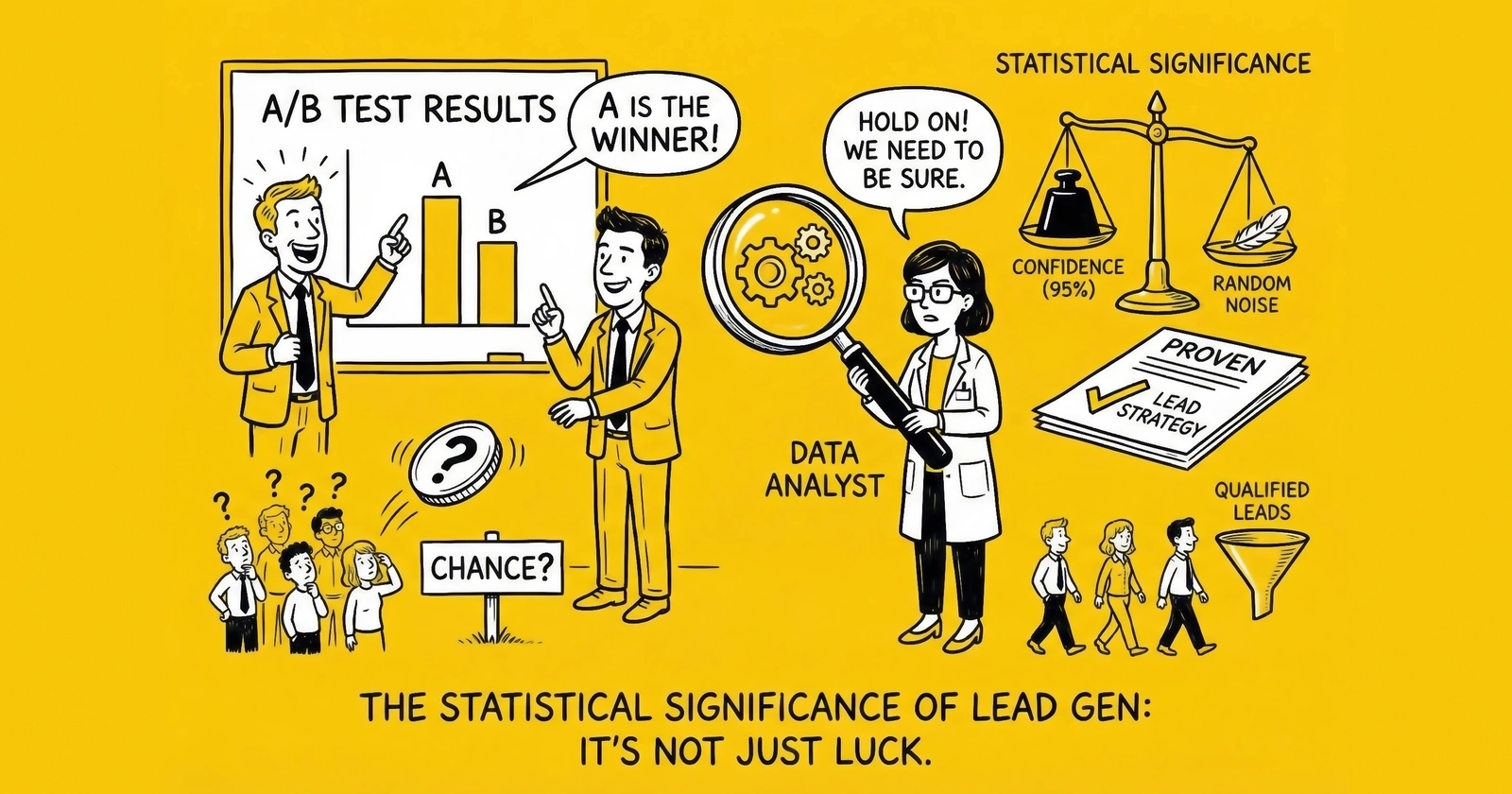
A test showing Variant B converting 20% better than Control after 500 visitors is not a finding. It is a coin flip with extra steps. Statistical significance separates testing from guessing.
Why Statistical Rigor Matters in Lead Generation
You ran a headline test last week. The new version shows a 15% lift in conversion rate. Your team is ready to deploy it site-wide. The data seems clear.
Except it is not clear. You had 800 visitors per variant. Your baseline conversion rate is 4.2%. At those numbers, you need over 15,000 visitors per variant to detect a 15% relative improvement with any reliability. What you are seeing is noise masquerading as signal.
This scenario plays out across the lead generation industry daily. Operators make decisions worth tens of thousands of dollars based on tests that lack the statistical power to tell them anything meaningful. They deploy changes that produce no real improvement, attribute random fluctuation to their optimization skill, and wonder why their next month’s numbers don’t match the gains their tests promised.
The cost compounds. False positive tests waste implementation effort. Worse, they displace tests of changes that might actually matter. Every test slot consumed by statistical noise is a test slot unavailable for genuine discovery.
Lead generation economics are unforgiving. Margins run 10-25% for most practitioners. A conversion rate difference of 2 percentage points can be the difference between profitability and loss. This makes accurate measurement essential and statistical sloppiness expensive. Understanding how to properly calculate true cost per lead requires the same analytical rigor that valid A/B testing demands.
This guide provides the complete framework for running statistically valid A/B tests in lead generation contexts. You will learn to calculate required sample sizes before tests begin, interpret p-values and confidence intervals correctly, understand the difference between frequentist and Bayesian approaches, avoid the errors that invalidate most testing programs, and apply these principles to the specific challenges lead generators face.
The math is accessible. The discipline to apply it is what separates operators who actually improve from those who convince themselves they are improving while their metrics drift sideways.
Statistical Significance Fundamentals
What Statistical Significance Actually Means
Statistical significance answers a specific question: what is the probability that the observed difference between test variants occurred by random chance alone?
When you run an A/B test comparing a control (your current form) against a variant (your proposed change), you observe different conversion rates for each. The question is whether that difference reflects a real underlying difference in performance or is simply random noise from a limited sample.
Statistical significance is typically expressed as a confidence level. A 95% confidence level means there is only a 5% probability that the observed difference would occur if the two variants actually performed identically. This 5% threshold is called alpha, and it represents your tolerance for false positives.
The null hypothesis in A/B testing is that both variants perform equally. Statistical significance measures the probability of observing your results if the null hypothesis were true. When that probability drops below your alpha threshold, you reject the null hypothesis and conclude the variants differ.
This is not the same as certainty. At 95% confidence, one in twenty statistically significant results is a false positive. Run 20 tests over a year, and you should expect one false winner even with perfect methodology.
The P-Value Explained
The p-value quantifies the probability of observing a result as extreme as yours under the assumption that no real difference exists. A p-value of 0.03 means there is a 3% chance you would see this result if the variants performed identically.
Standard Interpretation Thresholds
The most common threshold is p < 0.05, representing 95% confidence and carrying a one-in-twenty false positive risk. This standard works for most business decisions where implementation costs are moderate and effects are reversible. For more consequential decisions – major form redesigns, platform changes, or initiatives requiring significant investment – a stricter threshold of p < 0.01 provides 99% confidence with only one-in-one-hundred false positive risk. Exploratory analysis can accept p < 0.10 (90% confidence), but this threshold should inform further testing rather than deployment decisions.
What P-Values Cannot Tell You
A common misconception treats p-values as the probability that your variant is actually better. They are not. A p-value of 0.04 does not mean there is a 96% probability your variant is better. It means that if both variants were identical, you would see results this extreme 4% of the time. The distinction matters for accurate decision-making.
P-values also cannot tell you the size of the real effect, whether the effect is practically meaningful for your business, or whether your test was designed correctly. They answer only the narrow question of chance occurrence under the null hypothesis.
Confidence Intervals: The Better Metric
While p-values tell you whether an effect exists, confidence intervals tell you the range where the true effect likely falls. A 95% confidence interval for a conversion rate improvement might read: “The variant improves conversion by 8-22%.” This provides more actionable information than a simple “p < 0.05” statement.
The width of a confidence interval indicates precision. Narrow intervals like 8-12% suggest reliable estimates with sufficient sample size, while wide intervals like 5-35% signal the need for more data before drawing conclusions. When the interval for the difference between variants includes zero, the result is not statistically significant – the data cannot rule out no effect. Perhaps most importantly for business decisions, confidence intervals make practical relevance visible. An interval of 1-3% improvement might be statistically significant but operationally negligible given implementation costs.
For lead generation decisions, confidence intervals enable better judgment. An interval showing 15-45% improvement tells you something meaningful is happening and justifies aggressive implementation. An interval showing 2-18% improvement suggests directional correctness but substantial uncertainty about magnitude – useful for informing strategy but insufficient for confident deployment.
Type I and Type II Errors
Statistical testing involves two types of errors that represent different kinds of wrong conclusions.
Type I Error (False Positive)
A Type I error occurs when you conclude a difference exists when it does not. This is controlled by your alpha level. At 95% confidence (alpha = 0.05), you accept a 5% false positive rate. For lead generation, false positive costs include implementing changes that do not actually work, wasting development resources on neutral modifications, and displacing genuinely productive optimizations from your testing roadmap.
Type II Error (False Negative)
A Type II error occurs when you conclude no difference exists when one actually does. This is controlled by statistical power. Standard power of 80% means a 20% false negative rate. False negative costs are equally real: missing improvements that would have increased revenue, leaving value on the table, and concluding your form is optimized when meaningful improvements remain undiscovered.
The relationship between these errors is inverse. Reducing false positives increases false negatives, and vice versa. Sample size is the lever that improves both simultaneously – larger samples reduce both error types.
most practitioners focus exclusively on false positives while ignoring false negatives. An underpowered test has high false negative rates, meaning real improvements go undetected. A testing program that consistently misses 40% of real effects is nearly as costly as one that implements random changes.
Sample Size Calculation: The Foundation of Valid Testing
Why Sample Size Determines Everything
Sample size is not a detail to figure out after the test runs. It is the foundation that determines whether your test can answer the question you are asking.
Insufficient sample sizes produce tests that cannot reliably detect real differences. You might run a test for two weeks, see Variant B leading by 8%, conclude the test is inconclusive, and move on. But with adequate sample size, that 8% difference might have been statistically significant and worth implementing.
Excessive sample sizes waste traffic on tests that could have concluded earlier. If a variant has a 40% lift, you do not need 50,000 visitors per variant to detect it. You could have reached significance with 3,000 and used the remaining traffic for other tests.
Proper sample size calculation before the test begins solves both problems. You know exactly how much traffic you need and exactly when you can draw conclusions.
The Sample Size Formula
Required sample size depends on four variables that interact mathematically to determine your testing requirements.
Your baseline conversion rate (p) represents your current form’s conversion rate. Lower rates require larger samples because conversion events are rarer, making each conversion statistically more valuable for detecting differences. The minimum detectable effect (MDE) represents the smallest relative improvement you want to reliably detect. Smaller effects require larger samples because the signal-to-noise ratio decreases as the effect size shrinks.
Statistical significance level (alpha) represents your false positive tolerance. The standard is 0.05 (95% confidence), meaning you accept a 5% chance of declaring a winner when no real difference exists. Statistical power (1-beta) represents your ability to detect real effects when they exist. The standard is 0.80 (80% power), meaning you will correctly identify 80% of true improvements.
The simplified formula for two-variant tests is: n = 16 x p x (1-p) / MDE^2, where n is visitors per variant, p is baseline conversion rate, and MDE is minimum detectable effect as a decimal. More precise calculations use z-scores for alpha and beta: n = 2 x ((Z_alpha + Z_beta)^2 x p x (1-p)) / (p x MDE)^2. For 95% confidence and 80% power, the z-score multiplier is approximately 7.85.
Sample Size Examples for Lead Generation
Practical examples using realistic lead generation parameters illustrate how these calculations work in practice.
Consider an insurance lead form with an 8% baseline conversion rate where you want to detect a 15% relative improvement (from 8% to 9.2%) at 95% confidence and 80% power. This requires approximately 12,400 visitors per variant, or 24,800 total. At 500 daily visitors, this test runs 50 days. For context on typical conversion benchmarks, see our guide to high-converting lead forms.
A solar lead form presents different parameters. With a 4% baseline conversion rate and a desire to detect a 20% relative improvement (from 4% to 4.8%) at the same confidence and power levels, you need approximately 19,200 visitors per variant, totaling 38,400. At 200 daily visitors, this test runs 192 days – likely impractical without adjusting parameters.
A high-traffic mortgage lead form with 6% baseline conversion rate testing for a 10% relative improvement (from 6% to 6.6%) requires approximately 38,400 visitors per variant, or 76,800 total. At 3,000 daily visitors, this test runs 26 days – quite feasible.
The pattern is clear: lower conversion rates and smaller desired effects require substantially more traffic, while higher-traffic operations can detect smaller effects in reasonable timeframes.
Using Sample Size Calculators
Do not calculate sample sizes by hand. Established calculators eliminate arithmetic errors and provide visualization of trade-offs. Evan Miller’s Calculator offers a simple interface and is widely used in the industry (evanmiller.org/ab-testing/sample-size.html). Optimizely’s Calculator includes multi-variant support for more complex test designs. VWO’s Calculator excels at visualizing trade-offs between different parameters. Custom Google Sheets templates give you calculators you control and can integrate with your testing documentation.
Input your parameters, record the required sample size, and commit to it before starting the test. This commitment is essential. Without it, the temptation to peek and stop early will undermine your results.
Adjusting for Practical Constraints
Lead generation operations often face constraints that affect sample size planning and require pragmatic adjustments.
Low Traffic Forms
If your form receives 100 visitors per day, detecting a 15% improvement at 5% baseline requires 126 days per test. This is impractical for most optimization programs. Several solutions exist. You can accept larger MDE thresholds (20-25% instead of 10-15%), which reduces required sample size at the cost of missing smaller improvements. Pooling tests across multiple similar forms aggregates traffic to reach significance faster. Reducing confidence level for exploratory tests (90% instead of 95%) provides directional guidance with smaller samples. Focusing on structural tests with larger expected effects (redesigns rather than copy tweaks) makes the most of limited traffic.
Multiple Variants
Testing three variants instead of two requires approximately 50% more total sample. Testing five variants requires nearly double. The solution is to test pairs sequentially rather than simultaneously unless you have traffic to support multi-variant tests without extending duration beyond practical limits.
Segment-Specific Tests
Testing mobile users only when mobile represents 60% of traffic increases required test duration by 67%. Ensure segment-specific tests address high-value hypotheses worth the extended timeline before committing traffic to narrow segments.
The Confidence Interval Deep Dive
Building Intuition for Intervals
A confidence interval provides a range estimate for the true underlying value. For conversion rate differences, this might look like: “Variant B converts 5-18% better than Control, with 95% confidence.”
The mechanics work as follows: if you repeated this exact test 100 times with different samples from the same underlying population, approximately 95 of those intervals would contain the true value. No single interval guarantees inclusion of the true value, but the procedure generates intervals that capture truth 95% of the time.
Wider intervals indicate less precision. The interval shrinks as sample size increases because more data provides better estimates. This is why adequate sample size matters not just for statistical significance but for actionable conclusions about effect magnitude.
Calculating Confidence Intervals for Conversion Rates
For a single conversion rate, the 95% confidence interval is: p plus or minus 1.96 x sqrt(p x (1-p) / n), where p is observed conversion rate and n is sample size.
For the difference between two conversion rates: Difference plus or minus 1.96 x sqrt((p1 x (1-p1) / n1) + (p2 x (1-p2) / n2)).
Consider this example calculation. Control shows 4.2% conversion rate with 10,000 visitors. Variant shows 5.1% conversion rate with 10,000 visitors. The observed difference is 0.9 percentage points (21% relative improvement).
Standard error of difference = sqrt((0.042 x 0.958 / 10000) + (0.051 x 0.949 / 10000)) = 0.0029
95% CI = 0.009 plus or minus 1.96 x 0.0029 = 0.009 plus or minus 0.0057
The confidence interval runs from 0.33% to 1.47% improvement. This interval excludes zero, so the result is statistically significant. The range tells you the improvement is real but could be anywhere from modest (0.33 points) to substantial (1.47 points).
Interpreting Intervals for Business Decisions
Statistical significance (interval excludes zero) is necessary but not sufficient for deployment decisions. Consider practical significance alongside statistical significance.
When an interval shows 8-22% relative improvement, you can deploy confidently. The effect is both statistically real and large enough to matter regardless of where within that range the true value falls.
When an interval shows 1-15% relative improvement, consider deploying but monitor closely. The effect is real but the lower bound suggests impact might be modest. Expect moderate impact and track post-deployment performance carefully.
When an interval shows 0.5-3% relative improvement, weigh implementation cost against marginal benefit. The effect exists but may not justify development effort, testing opportunity cost, or operational complexity.
When an interval spans -5% to +20% with statistical non-significance, you need more data. The test is underpowered – the wide interval indicates insufficient precision to draw conclusions. Continue testing or accept that available traffic cannot answer this question.
The interval width relative to your minimum meaningful effect determines actionability. If you need at least 10% improvement to justify implementation effort, and your interval spans 2-18%, you have useful but incomplete information. The effect might justify action or might not.
Bayesian vs. Frequentist Approaches
Understanding the Philosophical Difference
Frequentist statistics (the framework discussed so far) treats probability as long-run frequency. A 95% confidence interval means that if you repeated the experiment infinitely, 95% of intervals would contain the true value.
Bayesian statistics treats probability as degree of belief. It incorporates prior knowledge and updates beliefs based on observed data. A 95% credible interval means there is a 95% probability the true value falls within that range given the observed data and prior beliefs.
The practical difference: frequentist methods answer “how surprising is this data assuming the null hypothesis?” while Bayesian methods answer “given this data, how probable is each possible effect size?”
Frequentist Testing: Strengths and Limitations
Frequentist methods bring substantial strengths to testing programs. The methodology is well-established with decades of research validating its statistical properties. Clear pre-registration requirements reduce researcher degrees of freedom and prevent p-hacking. Most analysts understand the standard approach, making results interpretable across teams. Regulatory bodies and academic journals accept frequentist methods without question.
However, frequentist methods have meaningful limitations for lead generation contexts. They cannot formally incorporate prior knowledge from previous tests or industry benchmarks. They require fixed sample sizes determined in advance, with peeking invalidating conclusions. Early stopping inflates false positive rates beyond stated alpha levels. And they do not directly answer the business question most practitioners actually want answered: “what is the probability the variant is better?”
For lead generation, the major practical limitation is inflexibility. Frequentist tests require committing to sample sizes upfront. Peeking at results and stopping early invalidates conclusions without sequential testing adjustments.
Bayesian Testing: Strengths and Limitations
Bayesian methods directly answer probability questions in intuitive terms like “90% chance variant is better.” They allow continuous monitoring without inflating false positives because the statistical framework handles interim looks differently. Prior knowledge from previous tests or industry data can be incorporated formally. Results communicate more naturally to business stakeholders who think in probability terms.
The limitations are also real. Bayesian methods require specification of priors, which introduces subjectivity about prior beliefs. The computation is more complex than frequentist calculations. Standardization is lower across tools, making cross-platform comparison harder. Results can be sensitive to prior choice with small samples, though this diminishes as data accumulates.
Bayesian approaches are particularly valuable for lead generation when you have strong prior knowledge from previous tests on similar forms, when you need flexibility to stop tests when results are clear, when stakeholders want probability statements rather than p-values, or when you run many similar tests and can develop empirical priors from your historical data.
Practical Application: When to Use Each
Frequentist methods work best when you can commit to fixed sample sizes without early stopping, when regulatory or policy requirements demand traditional statistics, when your testing infrastructure uses frequentist calculators, or when you are comparing with historical benchmarks expressed in frequentist terms.
Bayesian methods work best when you need to monitor tests continuously and stop when confident, when prior information from similar tests is available and valuable, when you want to express results as probability of improvement, or when small sample sizes make frequentist tests impractical but you still need directional guidance.
Many testing platforms now offer Bayesian options. Google Optimize (before its sunset) included Bayesian analysis. VWO provides Bayesian reporting. Dynamic Yield, Kameleoon, and several enterprise platforms offer Bayesian frameworks alongside traditional frequentist outputs.
Sequential Testing as a Practical Middle Ground
Sequential testing methods allow continuous monitoring while controlling error rates, bridging frequentist rigor with Bayesian flexibility.
The alpha spending approach divides your false positive budget across multiple interim analyses. If your overall alpha is 0.05, you might allocate 0.01 to an interim analysis at 50% of target sample and 0.04 to final analysis. Each interim look consumes part of your error budget, but the total remains controlled at 5%.
The O’Brien-Fleming boundary is a common sequential method that uses spending functions to determine decision thresholds at each look. Early looks require more extreme results to stop (very low p-values), while later looks approach traditional thresholds. This design penalizes early stopping appropriately while preserving the option when effects are dramatic.
For lead generation, sequential testing is valuable for high-impact tests where large effects would justify early stopping, where opportunity cost of continuing an obvious winner is high, or where traffic volume supports interim analyses with meaningful samples at each look.
The trade-off: sequential methods require slightly larger total samples than fixed-horizon tests to achieve equivalent power, typically 5-10% more traffic.
Common Statistical Mistakes in Lead Generation Testing
Mistake 1: Peeking and Early Stopping
The peeking problem is the most common error in A/B testing. You check results daily, see a variant leading, and stop the test when it looks significant.
The statistical consequence: at a nominal 5% false positive rate, checking results 10 times during a test inflates actual false positive rate to 15-30%. The more you peek, the more likely you stop on random fluctuation.
The mechanism: early samples exhibit more variance than later samples. If you stop whenever results look good, you systematically capture positive fluctuations and miss subsequent regression to the mean. You are essentially selecting for noise.
Pre-register your sample size and analysis timing. Do not make decisions until reaching that threshold. If you must monitor for technical issues, use sequential testing methods designed for multiple looks and apply appropriate alpha spending.
Mistake 2: Underpowered Tests
An underpowered test cannot reliably detect the effect you care about. If you need 15,000 visitors per variant but stop at 3,000, you have approximately 30% power instead of 80%. This means you will miss 70% of real improvements.
The symptom: tests frequently show “no significant difference” despite meaningful observed effects. A 12% lift that does not reach significance is not evidence of no effect. It is evidence of inadequate sample.
Calculate required sample size before every test. If the required duration is impractical, either increase minimum detectable effect or accept that you cannot reliably test this hypothesis with available traffic.
Mistake 3: Ignoring Practical Significance
Statistical significance does not equal business relevance. A test with 100,000 visitors might detect a 0.5% relative improvement with high confidence. That improvement adds $50 monthly to a $10,000 operation. Not worth implementation effort.
The flip side: non-significant results from underpowered tests might hide 15% improvements that would add $1,500 monthly. Failure to detect is not the same as absence of effect.
Define minimum practical significance before testing. If 5% relative improvement is your threshold for implementation, design tests powered to detect that effect. Results below that threshold are noise regardless of p-values.
Mistake 4: Multiple Comparisons Without Correction
Testing three headlines creates three pairwise comparisons. Testing three headlines and three button texts creates nine comparisons. Each comparison has independent false positive risk.
At 5% per comparison, three comparisons yield 14% overall false positive risk. Nine comparisons yield 37% overall risk. The more you test simultaneously, the more false positives you find.
Apply Bonferroni correction (divide alpha by number of comparisons) or use family-wise error rate methods. For three comparisons at overall 5% alpha, each comparison uses 1.67% alpha (p < 0.0167).
Mistake 5: Ignoring Segment Heterogeneity
A test showing overall 8% improvement might hide mobile users degrading 15% while desktop users improve 20%. The overall result is accurate but masks segment-specific effects that matter for strategy.
The danger: deploying a variant that harms a major segment, failing to identify segment-specific optimizations, making decisions on blended data that misrepresents reality.
Pre-specify segment analyses (mobile vs. desktop, traffic source, time of day). Analyze segments with appropriate multiple comparison corrections. Be especially cautious about small-sample segment analyses that may show spurious effects.
Mistake 6: Survivorship Bias in Test Selection
You ran 20 tests, found 4 significant winners, and implemented them. Your testing program shows 20% win rate with average 15% lift.
But those 4 winners were selected from 20 attempts. Some are likely false positives. If 1 of 4 is false, your actual improvement from testing is 25% lower than reported.
Track expected false positive rate based on your alpha. At 95% confidence across 20 tests, expect 1 false positive. At 90% confidence, expect 2. Discount aggregate testing results accordingly.
Mistake 7: Correlation Confusion
Lead quality improved 10% during your conversion test. You conclude the new form generates better leads.
But quality shifts might reflect traffic source changes, seasonal effects, buyer criteria adjustments, or random variation. Correlation during the test period does not establish causation from the test itself.
Control for confounding variables. Use same traffic sources for control and variant. Monitor external factors that might explain quality changes. Consider randomized quality hold-out analysis if quality attribution is critical.
Mistake 8: Winner’s Curse
Observed effects in winning tests systematically overestimate true effects. If a test barely achieves significance, the true effect is likely smaller than observed.
The mechanism: random positive fluctuations push borderline tests across significance thresholds. Without that positive noise, the test would not have been significant. You are selecting for noise alongside signal.
Expect actual deployed impact to be 10-30% below observed test lift. Use confidence interval midpoint rather than observed point estimate for projections. Re-test major winners to validate effect size before major investments.
Test Duration and Timing Considerations
The Minimum Duration Rule
Regardless of sample size, always run tests for at least one complete business cycle. For most lead generation operations, this means two full weeks minimum.
Weekly cycles matter for several reasons. Weekday traffic differs from weekend traffic, often dramatically in B2B verticals where weekend volume drops 70-80%. Payday timing affects consumer behavior in financial verticals, with applications spiking on the 1st and 15th of each month. Your ad schedules may vary by day of week, changing traffic composition. Competitor activity fluctuates within weekly patterns as budgets refresh.
Seasonal cycles matter for specific verticals. Medicare testing must account for the Annual Enrollment Period from October 15 to December 7. Tax services concentrate activity from January through April. Home services follow seasonal demand patterns tied to weather. Solar leads peak in spring and summer when installations are practical.
A test reaching sample size on Thursday of Week 1 should still run through Sunday of Week 2 to capture complete weekly variance.
Maximum Duration Limits
Tests should not run indefinitely. Extended duration introduces new problems that can invalidate results.
Traffic composition shifts over months as advertising strategies evolve, seasonal patterns change, and competitive dynamics shift. The competitive landscape changes as competitor messaging evolves and new entrants appear. Internal factors change including landing page updates, offer modifications, and pricing shifts that alter the context of your test. Opportunity cost grows as traffic consumed by old tests cannot support new hypotheses.
Set maximum duration at 4-6 weeks for most tests. If significance is not achieved by then, either the effect is too small to detect with available traffic, the effect is too small to matter operationally, or something is confounding the test and requires investigation.
Handling Traffic Volatility
Lead generation traffic is rarely consistent. Campaign changes, platform algorithm updates, and seasonal factors create traffic spikes and troughs.
During traffic spikes exceeding 2x normal volume, continue tests normally if traffic quality is consistent with historical patterns. Pause tests if the spike comes from unusual sources like viral content, PR mentions, or one-time promotional events. Weight post-spike analysis to understand whether results generalize to normal conditions.
During traffic troughs with 50%+ decline, extend test duration proportionally to reach required sample size. Monitor for quality shifts that might accompany volume drops. Consider whether trough traffic represents your target population or a biased sample.
Record daily traffic volume and source mix throughout tests. Include this in analysis to identify whether results generalize to normal conditions or reflect period-specific anomalies.
Tools and Implementation
Testing Platform Comparison 2024-2025
The testing tool landscape shifted significantly after Google Optimize’s September 2023 sunset. Current options span a wide range of capabilities and price points.
Enterprise Platforms ($15,000-$200,000+ annually)
Optimizely represents the industry standard with a full statistical engine, visual editor, and advanced segmentation. It works best for organizations with dedicated optimization teams who can leverage its sophisticated capabilities. VWO (Visual Website Optimizer) offers a comprehensive suite with AI-powered insights, heatmaps, and session recordings alongside testing. AB Tasty brings strong personalization and AI-driven recommendations, particularly popular in e-commerce and media. Dynamic Yield emphasizes personalization-first with testing capabilities, particularly strong for audience targeting and recommendation engines.
Mid-Market Solutions ($3,000-$50,000 annually)
Convert focuses on privacy, with GDPR-compliant architecture popular among European operations and privacy-conscious organizations. Kameleoon provides strong AI capabilities, full-stack testing support, and feature experimentation. LaunchDarkly emphasizes feature flagging with experimentation capabilities, oriented toward developer workflows.
Accessible Options ($0-$5,000 annually)
PostHog offers open-source functionality with a generous free tier, including experimentation alongside product analytics. GrowthBook provides open-source feature flagging with Bayesian experimentation. Unbounce Smart Traffic handles landing page-specific optimization, using ML for automatic traffic allocation. GA4 Experiments offers limited functionality but integrates with the broader Google ecosystem.
Tool Selection Criteria for Lead Generation
Match tools to your operation based on several key dimensions.
Traffic Volume
Under 5,000 monthly visitors, use landing page builder native testing or manual traffic splits. The investment in dedicated testing tools will not pay off at this scale. Between 5,000-50,000 monthly visitors, entry-level tools provide sufficient capability for your testing program. Above 50,000 monthly visitors, mid-market or enterprise tools are justified and will enable more sophisticated testing approaches.
Technical Complexity
Simple landing page tests work with visual editors in any modern tool. Dynamic form personalization with conditional logic requires enterprise platforms with advanced targeting. Server-side form logic testing needs full-stack testing platforms that operate at the application layer.
Statistical Sophistication
Basic A/B tests work with any tool providing proper sample size calculation. Sequential testing requires VWO, Optimizely, or custom implementation. Bayesian analysis needs VWO, Dynamic Yield, or dedicated Bayesian tools.
Compliance Requirements
GDPR sensitivity points toward Convert or Kameleoon with EU-hosted options. No third-party cookie environments require server-side testing implementations. Consent documentation needs integration with TrustedForm, Jornaya, or equivalent certification services.
Building a Statistical Testing Framework
Effective testing programs require more than tools. They require process that ensures consistent methodology.
Pre-Test Protocol
Before launching any test, document the hypothesis with expected effect direction and size. Calculate required sample size using baseline metrics. Define primary and secondary metrics that will determine success. Specify segments for analysis in advance. Set start date, expected end date, and maximum duration. Record current traffic sources and quality metrics for baseline comparison.
During-Test Protocol
Throughout the test, monitor traffic volume and source consistency for anomalies. Check for technical issues including tracking failures and variant rendering problems. Document external events that might affect results (competitor changes, market shifts, algorithm updates). Resist the urge to peek at results for decision-making purposes.
Post-Test Protocol
After reaching sample size, calculate significance and confidence intervals. Analyze pre-specified segments with appropriate corrections. Check for multiple comparison issues if testing multiple elements. Document observed effect versus expected effect to calibrate future predictions. Record quality metrics alongside conversion. Make deployment decision based on both practical and statistical significance. Monitor deployed variant performance for sustained results.
Lead Generation-Specific Testing Considerations
Conversion Quality vs. Conversion Rate
Lead generation A/B tests face a unique challenge: conversion rate is an incomplete metric.
A form variant that increases submissions 30% might generate lower-quality leads that buyers return at higher rates. It might attract tire-kickers who never convert downstream. It might capture less information, reducing lead value. It might use aggressive tactics that erode trust with prospects. This is why understanding lead quality scores is essential for interpreting test results correctly.
The test that optimizes for form completion might destroy your economics.
Multi-Metric Testing Framework
Structure tests to measure across multiple time horizons.
Immediate metrics available during the test include form conversion rate, validation pass rate (phone, email, address verification), TrustedForm certificate completion rate, time to complete form, and drop-off by step for multi-step forms.
Short-term metrics available 1-2 weeks post-test include sell-through rate to buyers, return rate, and buyer acceptance rate by partner.
Long-term metrics available 4-8 weeks post-test include contact rate (lead answers phone), downstream conversion rate, and customer lifetime value where accessible.
Run immediate-metric analysis during the test. Hold deployment decisions for short-term quality metrics unless immediate signals are overwhelmingly positive. A 30% conversion lift means nothing if return rates increase proportionally.
Traffic Source Interaction Effects
Different traffic sources respond differently to form changes. A headline optimized for Google search visitors might underperform for Facebook retargeting traffic.
At minimum, analyze separately by paid search vs. paid social vs. organic traffic, desktop vs. mobile vs. tablet devices, new visitors vs. returning visitors, and high-intent sources vs. awareness sources.
For each segment, check whether effect direction is consistent (both show improvement, or one positive and one negative), effect magnitude is similar (10% lift in both vs. 5% in one and 25% in other), and sample size is adequate for segment-level conclusions.
Most tests lack power for segment-level significance. Use segment analysis for directional insights and follow up with segment-specific tests when patterns suggest meaningful heterogeneity worth investigating.
Return Rate Attribution
When testing form changes, returns may not materialize for 7-30 days depending on buyer terms. This creates attribution complexity that requires careful handling.
Track return rates by test variant using lead-level variant assignment. Wait for return window to close before final analysis, typically 14-30 days after test ends. Calculate return-adjusted conversion: (Conversions - Returns) / Visitors. Compare return-adjusted conversion across variants.
A variant showing 20% higher raw conversion but 40% higher return rate may be net negative.
Consider this example calculation. Control has 1,000 visitors, 50 conversions (5%), and 6 returns (12% return rate), yielding 44 net conversions (4.4%). Variant has 1,000 visitors, 60 conversions (6%), and 12 returns (20% return rate), yielding 48 net conversions (4.8%).
Raw comparison shows 20% improvement. Return-adjusted comparison shows 9% improvement. Both improvements are real, but magnitude differs substantially and affects the business case for implementation.
Consent and Compliance Testing
Testing consent language and disclosure presentation requires special care and legal awareness.
You can test placement of consent language (above vs. below submit button), visual presentation (checkbox vs. click-through vs. embedded), order of disclosures, and font size and formatting within compliant ranges.
You cannot test away required disclosure content, consent mechanism requirements under TCPA and state regulations, or clear and conspicuous presentation standards that regulations mandate.
Involve compliance counsel in consent-related test design. Some “optimizations” that boost conversion create TCPA exposure worth millions in potential liability. No conversion lift is worth that trade-off. For a comprehensive overview of consent requirements, see our guide on TCPA compliance for lead generators.
Advanced Topics
Multi-Armed Bandit Approaches
Traditional A/B testing fixes traffic allocation (50/50) throughout the experiment. Multi-armed bandit (MAB) algorithms dynamically shift traffic toward better-performing variants.
The algorithm balances exploration (learning about uncertain variants) with exploitation (sending traffic to apparent winners). As evidence accumulates, more traffic flows to better performers. This reduces opportunity cost during testing by limiting traffic to obvious losers, enables continuous optimization without discrete test endpoints, and handles many variants more efficiently than traditional testing.
However, MAB approaches have limitations. Statistical properties are less understood than fixed-allocation tests. Determining when to stop is harder without traditional significance thresholds. The algorithm may not fully explore long-term best options if initial results mislead. And MAB is less appropriate for decisions requiring clear significance thresholds for stakeholder buy-in.
For lead generation, MAB works well for ongoing creative optimization where you continuously introduce new variants and want automatic allocation. It works poorly for strategic decisions (multi-step vs. single-step form) where you need definitive answers before committing resources.
Power Analysis for Test Design
Power analysis determines sample size requirements given desired statistical properties. Conducting power analysis before testing prevents both underpowered experiments that miss real effects and overpowered experiments that waste traffic.
Power analysis has four components. Effect size represents the difference you want to detect, expressed as relative or absolute improvement. Alpha represents the false positive rate, typically 0.05. Beta represents the false negative rate, typically 0.20, giving 80% power. Variance represents conversion rate variability, with higher variance requiring larger samples.
To run power analysis, determine baseline conversion rate from historical data (use 90-day average for stability), specify minimum detectable effect based on business requirements, set alpha and power levels (0.05 and 0.80 are standard), calculate required sample using standard tools, estimate test duration based on expected traffic, and if duration is impractical, adjust MDE upward and recalculate.
Consider a power calculation for a mortgage lead form. Historical conversion is 5.2% with standard deviation of 0.4% across recent months. Minimum meaningful improvement is 15% relative (from 5.2% to 6.0%). Alpha is 0.05, power is 0.80. Required sample is approximately 13,500 visitors per variant. Daily traffic is 600 visitors (300 per variant after 50/50 split). Expected duration is 45 days.
At 45 days, this test is feasible. If duration needed to exceed 60 days, increasing MDE to 20% or testing a higher-impact hypothesis would be recommended.
Regression to the Mean
Regression to the mean causes extreme initial results to moderate as sample size increases. Early test results showing massive effects often diminish toward true effect sizes.
This happens because early samples have higher variance. Random positive fluctuations push some early results well above (or below) true values. Additional data reduces variance and pulls estimates toward actual effects.
The implications for testing are significant. Early dramatic results should not trigger early stopping without sequential frameworks. Observed winning effects will typically shrink upon deployment. Plan for 15-30% effect degradation between test observation and production deployment.
To mitigate regression effects, use larger samples than minimum requirements, validate surprising results with follow-up tests, project conservative estimates (use lower bound of confidence interval), and track deployed variant performance to calibrate test-to-production ratios for future planning.
Interaction Effects and Full Factorial Design
Testing one element at a time (sequential A/B) misses interaction effects between elements. A headline that works best with Button A might underperform with Button B.
Full factorial design tests all combinations of multiple elements simultaneously, revealing interactions. For a 2x2 factorial with Headline A vs. Headline B and Button A vs. Button B, you test four combinations: AA, AB, BA, BB.
When no interaction exists, element effects are additive and the best combination is simply the best headline with the best button. Positive interaction means some combinations outperform predictions from individual elements, revealing synergy. Negative interaction means some combinations underperform predictions, revealing conflict.
Sample size implications are substantial. A 2x2 design needs roughly 4x the sample of a single A/B test. A 3x3 design needs roughly 9x.
For lead generation, use factorial designs when you suspect element interactions – headline framing might matter differently with different value propositions. For most form optimization, sequential A/B testing sufficiently captures main effects without factorial complexity.
Frequently Asked Questions
What sample size do I need for A/B testing lead generation forms?
Sample size depends on your baseline conversion rate and minimum detectable effect. At 5% baseline conversion testing for 15% relative improvement with 95% confidence and 80% power, you need approximately 25,000-30,000 visitors per variant. At 10% baseline testing for 20% improvement, you need approximately 3,500-4,000 per variant. Use a sample size calculator with your specific parameters before every test. Never start a test without knowing the required sample size.
How long should I run an A/B test on a lead form?
Duration equals required sample size divided by daily traffic. At minimum, run every test for two complete weeks to capture weekly variance regardless of when sample size is reached. Maximum duration should not exceed 4-6 weeks. If significance is not achieved by then, either the effect is too small to detect with your traffic or too small to matter for your business.
What is a good p-value for lead generation A/B tests?
The standard threshold is p < 0.05, meaning 95% confidence. This represents a 5% probability that observed differences are due to random chance. For high-stakes decisions (major form redesigns), consider p < 0.01 (99% confidence). For exploratory tests, p < 0.10 (90% confidence) can provide directional guidance, but do not deploy changes based on this threshold alone.
Should I use Bayesian or frequentist statistics for A/B testing?
Use frequentist methods when you can commit to fixed sample sizes without early stopping and need standard statistical rigor. Use Bayesian methods when you need flexibility to stop tests when results are clear, want to express results as probability statements, or have strong prior information from similar tests. Many modern testing platforms offer both approaches. The methodology matters less than consistent application and proper interpretation.
How do I account for lead quality in A/B tests?
Track quality metrics alongside conversion rate. During the test, monitor validation pass rates, TrustedForm completion, and time-to-complete. After the test, track return rates, buyer acceptance rates, and contact rates. Wait for return windows to close (typically 14-30 days) before making final deployment decisions. A variant with higher conversion but proportionally higher returns may be net negative.
What is the peeking problem and how do I avoid it?
Peeking means checking test results repeatedly and stopping when one variant appears to be winning. This inflates false positive rates from 5% to 15-30% depending on how often you check. Avoid it by calculating required sample size before testing, committing to that sample size, and not making decisions until you reach it. If you must monitor, use sequential testing methods designed for multiple interim analyses.
How do I handle A/B tests with low traffic volumes?
Low-traffic forms have three options: accept larger minimum detectable effects (20-25% instead of 10-15%), pool tests across multiple similar forms to aggregate traffic, or reduce confidence level for exploratory insights (90% instead of 95%). Be realistic about what your traffic can support. A test requiring 100+ days will be confounded by seasonal changes and other factors before completion.
What is statistical power and why does it matter?
Statistical power is the probability of detecting a real effect when one exists. Standard is 80%, meaning you will correctly identify 80% of true improvements and miss 20%. Low power (40-60%) means most real improvements go undetected. Tests that frequently show “no significant difference” despite observed effects are underpowered. Calculate power requirements before testing and ensure your sample size provides adequate detection capability.
How do I interpret confidence intervals for A/B test results?
A 95% confidence interval gives the range where the true effect likely falls. If the interval for improvement is 5-18%, you can be confident improvement exists (interval excludes zero) and estimate it between 5% and 18% of current performance. Narrow intervals indicate precision. Wide intervals indicate uncertainty. Use confidence intervals for business decisions because they show effect magnitude, not just existence.
Should I correct for multiple comparisons when testing multiple variants?
Yes. Testing three variants creates three pairwise comparisons, each with independent false positive risk. Without correction, your overall false positive rate rises from 5% to approximately 14%. Apply Bonferroni correction by dividing alpha by number of comparisons (for three comparisons, use p < 0.017 instead of p < 0.05). Alternatively, use family-wise error rate methods built into advanced testing platforms.
Key Takeaways
-
Calculate sample size before every test. A test without predetermined sample size is not a test. It is guess validation. Use baseline conversion rate, minimum detectable effect, and standard power analysis to determine required traffic before starting.
-
Statistical significance at 95% confidence means 5% false positive risk. One in 20 “significant” results is wrong. Across a year of testing, expect false positives. Build this expectation into your decision-making process.
-
Peeking destroys statistical validity. Checking results daily and stopping when they look good inflates false positive rates to 15-30%. Commit to sample sizes upfront or use sequential testing methods designed for multiple looks.
-
Confidence intervals provide more actionable information than p-values. Knowing improvement falls between 5% and 22% enables better decisions than knowing p < 0.05. Use intervals to understand both existence and magnitude of effects.
-
Underpowered tests waste traffic. A test with 40% power misses 60% of real improvements. Tests showing “no significant difference” often lack power rather than lack effect. Design tests with 80% power minimum.
-
Lead quality matters more than conversion rate. A variant that lifts conversions 30% while increasing returns 50% destroys economics. Track validation pass rates, return rates, and downstream conversion alongside form submissions.
-
Bayesian methods enable continuous monitoring without false positive inflation. When you need flexibility to stop tests early or want probability statements about which variant is better, Bayesian approaches provide valid alternatives to frequentist methods.
-
Two weeks minimum regardless of sample size. Weekly variance from day-of-week effects, payday cycles, and competitive patterns requires at least one complete business cycle to capture representative data.
-
Segment analysis reveals hidden heterogeneity. Overall results may mask segment-specific effects where mobile users degrade while desktop users improve. Pre-specify segment analyses and check for interaction effects.
-
Document everything. Record hypotheses, sample sizes, duration, observed effects, quality metrics, and deployment decisions. This institutional knowledge enables learning across tests and prevents repeating failed experiments.
Sources
-
Penn State STAT 200: Hypothesis Testing - Explains the 95% confidence level corresponding to 5% Type I error (false positive) risk, and the relationship between alpha levels and statistical significance thresholds.
-
Khan Academy: Significance Tests - Covers the fundamentals of hypothesis testing, p-value interpretation, and the meaning of statistical significance in experimental design.
-
NIST Engineering Statistics Handbook: Hypothesis Testing - Provides technical reference for Type I and Type II errors, power analysis, and sample size determination formulas used in experimental design.
-
NCBI: Statistical Significance - Medical research perspective on interpreting p-values, confidence intervals, and the distinction between statistical and practical significance.
-
Optimizely: A/B Testing Guide - Industry reference for A/B testing methodology, including sample size calculation, test duration requirements, and avoiding the peeking problem.
-
VWO: A/B Testing - Covers the mechanics of split testing, statistical significance thresholds, and the importance of pre-determined sample sizes before starting experiments.
Statistical testing methodology adapted from standard experimental design literature and applied to lead generation contexts. Sample size formulas assume two-tailed tests with equal sample allocation. Specific requirements vary based on baseline metrics and business requirements. Validate calculations with established tools before deploying test designs.