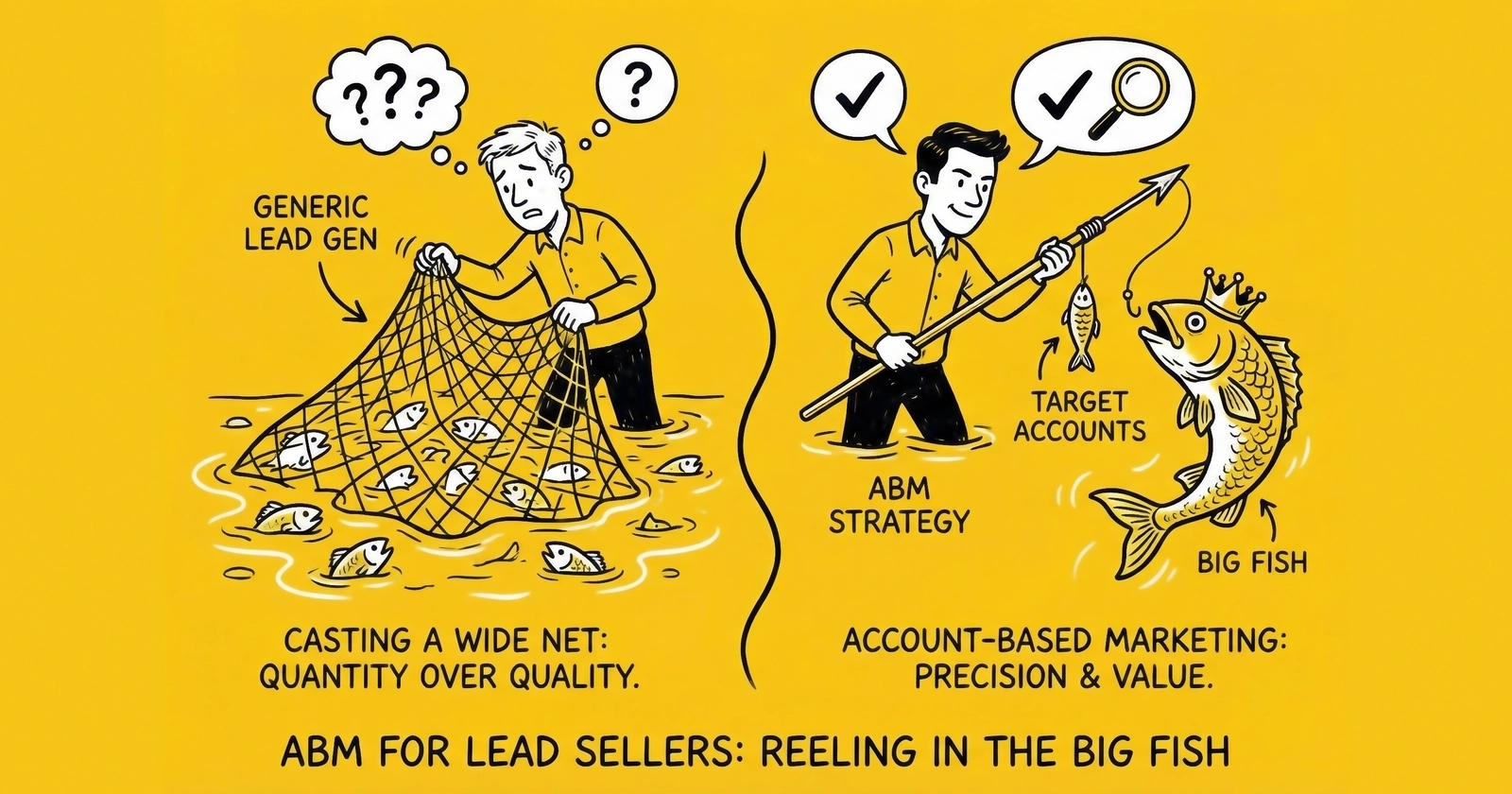
Only 5% of B2B accounts are actively looking to buy at any given time. Yet traditional marketing treats every prospect identically – the enterprise insurance carrier with $500K annual lead budget gets the same email as the solo agent buying 50 leads monthly. Account-Based Marketing changes this equation, delivering 137% ROI by concentrating resources on accounts that actually matter.
Lead selling is fundamentally a B2B business. Your buyers are insurance agencies, mortgage lenders, law firms, home services companies, and call centers. Some spend $10,000 annually on leads. Others spend $10 million. Traditional marketing – blog posts, paid ads, email blasts – treats these vastly different buyers identically.
Account-Based Marketing (ABM) recognizes that a handful of enterprise accounts represent more revenue potential than thousands of small buyers combined. Rather than hoping ideal buyers find you, ABM identifies them first, then builds personalized campaigns to win their business.
The results speak for themselves: 71.2% of organizations now use ABM strategies, with 97% reporting higher ROI than other marketing approaches. Companies implementing ABM see 60% higher win rates and 171% increases in average contract value. For lead sellers competing for enterprise buyers, ABM isn’t a nice-to-have – it’s becoming table stakes.
Why ABM Works for Lead Sellers
The Enterprise Buyer Concentration
In lead generation, revenue concentration is extreme. A typical lead seller might have:
| Buyer Tier | Accounts | Revenue Share | Avg Annual Spend |
|---|---|---|---|
| Enterprise | 5-15 | 40-50% | $200K-$1M+ |
| Mid-Market | 50-100 | 30-35% | $25K-$100K |
| SMB | 500-2000+ | 20-25% | $1K-$15K |
The top 15 accounts often generate more revenue than the next 500 combined. Yet traditional marketing allocates resources proportionally – spending as much to attract a $5K/year buyer as a $500K/year buyer.
ABM inverts this logic. If 15 accounts represent 40% of your revenue, shouldn’t they receive 40% of your marketing attention?
The Enterprise Buying Process
Enterprise lead buyers don’t respond to generic marketing because their buying process is fundamentally different:
SMB Buyer Journey:
- Searches “buy insurance leads”
- Finds your website
- Fills out form
- Talks to sales
- Starts buying (2-4 weeks)
Enterprise Buyer Journey:
- Internal recognition of lead volume needs
- Vendor research and shortlisting (3-6 months)
- RFP or formal evaluation process
- Stakeholder alignment (compliance, IT, operations, finance)
- Pilot program negotiation
- Contract negotiation and legal review
- Implementation and integration
- Full deployment (6-18 months total)
Enterprise buyers have multiple stakeholders, formal evaluation processes, and extended timelines. Generic marketing materials can’t address each stakeholder’s concerns. ABM creates content and campaigns specifically designed for enterprise buying processes.
The Relationship Imperative
Lead generation is a relationship business. Enterprise buyers don’t switch vendors easily – integration costs, training requirements, and operational disruption make switching expensive. They want partners, not vendors.
ABM’s personalized approach builds relationships before sales conversations begin. When your marketing demonstrates understanding of a specific buyer’s challenges, compliance requirements, and operational needs, you position yourself as a partner who “gets it” rather than another vendor sending cold emails.
Identifying Target Accounts for Lead Sellers
Ideal Customer Profile Development
ABM starts with defining your Ideal Customer Profile (ICP) – the characteristics of accounts most likely to become high-value, long-term buyers.
Firmographic Criteria:
- Company size (employees, revenue, locations)
- Industry vertical (insurance, mortgage, legal, home services)
- Geographic coverage (national, regional, state-specific)
- Business model (direct sales, call center, field sales)
Technographic Criteria:
- Current lead distribution platform (Boberdoo, LeadsPedia, custom)
- CRM system (Salesforce, HubSpot, custom)
- Dialer technology (Five9, RingCentral, Convoso)
- Compliance tools (TrustedForm, Jornaya integration capability)
Behavioral Criteria:
- Current lead volume (indicates scale and budget)
- Lead source diversification (single vs. multi-vendor)
- Growth trajectory (expanding, stable, contracting)
- Compliance sophistication (TCPA-aware, proactive vs. reactive)
Intent Criteria:
- Actively researching lead vendors
- Dissatisfied with current providers
- Expanding into new verticals or geographies
- Regulatory pressure requiring vendor changes
Building Target Account Lists
With ICP defined, build your Target Account List (TAL) through systematic research:
Data Sources for Lead Seller TALs:
- Industry publications (Insurance Journal, National Mortgage News)
- Conference attendee lists (LeadsCon, InsureTech Connect)
- LinkedIn Sales Navigator searches
- Intent data platforms (Bombora, G2 Intent)
- Competitive intelligence (who’s buying from competitors?)
- Public filings (insurance carrier reports, HMDA mortgage data)
Example TAL Segmentation:
| Tier | Criteria | Account Count | Investment Level |
|---|---|---|---|
| Tier 1 | $500K+ potential, strong fit, active intent | 10-15 | High (1:1 campaigns) |
| Tier 2 | $100K-$500K potential, good fit | 25-50 | Medium (1:few campaigns) |
| Tier 3 | $25K-$100K potential, acceptable fit | 100-200 | Light (programmatic ABM) |
Tier 1 accounts receive fully personalized attention. Tier 2 gets segment-specific campaigns. Tier 3 receives programmatic ABM with some personalization.
Account Intelligence Gathering
For each Tier 1 target, build comprehensive intelligence:
Organizational Intelligence:
- Organizational structure (who reports to whom)
- Decision-making process (centralized vs. distributed)
- Recent news (expansions, acquisitions, leadership changes)
- Financial health (public filings, funding rounds)
Stakeholder Mapping:
- VP/Director of Marketing (lead acquisition owner)
- Operations leadership (lead handling capacity)
- Compliance officer (TCPA requirements)
- IT/Technology (integration requirements)
- Finance (budget authority, procurement process)
Current State Analysis:
- Existing lead vendors (competitive displacement opportunity?)
- Pain points with current setup (quality, volume, compliance)
- Technology stack and integration capabilities
- Compliance posture and risk tolerance
ABM Strategy for Lead Sellers
The ABM Pyramid
ABM operates at three levels, each requiring different resources and tactics:
1:1 ABM (Tier 1 Accounts)
Individual campaigns for each target account. Every piece of content, every touchpoint, every message is customized for that specific account.
- Personalized landing pages: “How [Account Name] Can Improve Medicare Lead Quality”
- Custom case studies: Similar accounts with relevant outcomes
- Executive-to-executive outreach: CEO to CEO, VP to VP
- Account-specific events: Private dinners, facility tours
- Custom proposals: Pre-built proposals addressing known needs
1:Few ABM (Tier 2 Accounts)
Campaigns targeting segments of similar accounts – all large mortgage lenders, all regional P&C agencies, all multi-state call centers.
- Segment-specific landing pages: “Lead Solutions for Regional Insurance Agencies”
- Vertical case studies: Outcomes relevant to the segment
- Targeted advertising: Account list-based ads on LinkedIn
- Segment webinars: Topics relevant to specific buyer types
- Personalized email sequences: Segment-specific content with account personalization
Programmatic ABM (Tier 3 Accounts)
Technology-driven personalization at scale using automation and dynamic content.
- Dynamic website content: Industry-specific messaging based on visitor identification
- Automated email sequences: Triggered by behavior with segment personalization
- Retargeting campaigns: Account-targeted display advertising
- Content recommendations: AI-driven content matching to account characteristics
Content Strategy for Lead Seller ABM
ABM requires content addressing each stakeholder’s specific concerns:
For Marketing/Acquisition Leaders:
- Lead quality benchmarks and improvement case studies
- ROI calculators showing cost-per-acquisition improvements
- Volume scaling strategies and capacity planning
- Competitive comparisons (how you differ from their current vendor)
For Operations Leaders:
- Integration documentation and implementation timelines
- Lead delivery SLAs and performance guarantees
- Capacity planning and volume ramp strategies
- Training and support resources
For Compliance Officers:
- TCPA compliance documentation and certifications
- TrustedForm/Jornaya integration capabilities
- Consent documentation and audit trail features
- State-specific compliance support (Florida FTSA, Oklahoma OTSA)
For IT/Technology:
- API documentation and integration guides
- Security certifications (SOC 2, data handling)
- CRM integration capabilities (Salesforce, HubSpot)
- Platform uptime and reliability metrics
For Finance:
- Pricing models and volume commitments
- Payment terms and credit options
- Contract flexibility and termination provisions
- Total cost of ownership analysis
Multi-Channel Orchestration
ABM requires coordinated outreach across channels, with each touchpoint building on previous interactions:
Week 1-2: Awareness
- LinkedIn connection requests from relevant team members
- Display advertising to account stakeholders
- Content engagement tracking begins
Week 3-4: Education
- Personalized email with relevant case study
- LinkedIn content engagement
- Retargeting with educational content
Week 5-6: Engagement
- Direct outreach referencing specific challenges
- Invitation to relevant webinar or event
- Introduction to technical resources
Week 7-8: Conversion
- Meeting request with specific agenda
- Custom proposal or pilot program offer
- Executive-level engagement if needed
Ongoing: Nurture
- Regular value-add content delivery
- Industry news and insights sharing
- Relationship maintenance across stakeholders
Implementing ABM for Lead Generation
Technology Stack for Lead Seller ABM
Account Identification & Intelligence:
- ZoomInfo, Apollo.io: Contact data and company intelligence
- LinkedIn Sales Navigator: Stakeholder identification and engagement
- Clearbit: Real-time enrichment and visitor identification
Intent Data:
- Bombora: Third-party intent signals across B2B web
- G2 Intent: Software category research signals
- First-party intent: Website behavior, content engagement
Marketing Automation:
- HubSpot: Mid-market friendly, good ABM features
- Marketo: Enterprise ABM capabilities
- Pardot: Salesforce-native option
For a deeper dive into platform selection and campaign setup, see our marketing automation guide for lead nurturing.
Advertising:
- LinkedIn Campaign Manager: Account-targeted advertising
- Metadata.io: B2B advertising optimization
- RollWorks: ABM-specific advertising platform
CRM:
- Salesforce: Enterprise standard
- HubSpot CRM: Integrated with marketing
- Account-based views and reporting
Sales and Marketing Alignment
ABM only works when sales and marketing operate as unified teams. For lead sellers, this means:
Shared Account Ownership:
- Marketing and sales jointly own target account list
- Weekly account review meetings
- Shared visibility into all touchpoints and engagement
Coordinated Outreach:
- Marketing warms accounts before sales outreach
- Sales provides feedback on messaging effectiveness
- Neither team contacts accounts without coordination
Unified Metrics:
- Shared pipeline metrics (not just MQLs)
- Account engagement scores visible to both teams
- Revenue attribution spans marketing and sales activities
Service Level Agreements:
- Marketing commits to account engagement levels
- Sales commits to follow-up timing and quality
- Both accountable for pipeline and revenue
Measurement Framework
ABM metrics differ from traditional marketing metrics. Understanding multi-touch attribution becomes essential for tracking how different touchpoints contribute to account conversion.
Engagement Metrics:
- Account engagement score (composite of all interactions)
- Stakeholder coverage (% of buying committee engaged)
- Content consumption by account
- Website visits from target accounts
Pipeline Metrics:
- Target accounts entering pipeline
- Pipeline velocity (time to close)
- Deal size by account tier
- Win rate by account tier
Revenue Metrics:
- Revenue from ABM accounts
- Customer lifetime value
- Expansion revenue (upsell/cross-sell)
- Contract renewal rates
Efficiency Metrics:
- Cost per engaged account
- Marketing spend per closed deal
- Time to first meeting
- Stakeholder engagement breadth
ABM Playbooks for Lead Seller Scenarios
Playbook 1: Displacing Incumbent Vendors
Many enterprise accounts have existing lead vendor relationships. ABM can position you as the superior alternative. Having documented lead generation SOPs and operational playbooks gives you credibility when enterprise accounts evaluate your operational maturity.
Intelligence Phase:
- Identify current vendor through industry research
- Document known pain points with current vendor
- Map decision-makers and influencers
- Understand contract renewal timeline
Differentiation Campaign:
- Create content specifically contrasting your capabilities
- Develop ROI calculator showing improvement potential
- Build case study of similar account switching to you
- Prepare objection handling for switching costs
Timing Strategy:
- 6+ months before contract renewal: Begin awareness
- 3-6 months: Intensive engagement and evaluation support
- 1-3 months: Proposal and negotiation
- Renewal date: Close or nurture for next cycle
Playbook 2: Expansion Opportunities
Accounts expanding into new verticals or geographies present greenfield opportunities.
Signal Detection:
- Monitor news for expansion announcements
- Track job postings indicating growth
- Watch for M&A activity
- Follow leadership changes
Expansion Support Campaign:
- Position as expansion partner vs. just vendor
- Provide market intelligence for new territories
- Offer pilot programs for new verticals
- Connect them with relevant case studies
Land and Expand:
- Win initial vertical or geography
- Demonstrate success through metrics
- Propose expansion based on proven results
- Build relationships across new stakeholder groups
Playbook 3: New Market Entry
When accounts enter the lead buying market for the first time (e.g., carrier going direct-to-consumer).
Education Campaign:
- Foundational content about lead buying
- Industry benchmarking and best practices
- Compliance guidance and risk mitigation
- Technology selection guidance
Advisory Positioning:
- Position as trusted advisor, not just vendor
- Offer consultative support beyond your products
- Provide introductions to complementary vendors
- Build relationship before competitive pressure emerges
Low-Risk Entry:
- Pilot programs with minimal commitment
- Prove value before scaling
- Build internal champions through success
- Expand as they grow
Key Takeaways
-
ABM delivers 137% average ROI – significantly outperforming traditional marketing approaches for B2B lead sellers targeting enterprise buyers.
-
71.2% of organizations now use ABM – it’s becoming standard practice, with 49.7% planning to increase ABM budgets in 2026.
-
Revenue concentration justifies ABM investment – when 15 accounts represent 40% of revenue, they deserve proportional marketing attention.
-
Enterprise buyers require different approaches – extended timelines, multiple stakeholders, and formal processes demand personalized campaigns.
-
Target account selection is critical – building ICP-based target account lists ensures ABM resources focus on accounts with genuine potential.
-
Three-tier ABM structure optimizes resources – 1:1 for top accounts, 1:few for segments, programmatic for broader coverage.
-
Content must address all stakeholders – marketing, operations, compliance, IT, and finance each have different concerns requiring specific content.
-
Sales and marketing alignment is non-negotiable – companies using aligned ABM are 67% better at closing deals.
-
AI integration accelerates ABM – 89.5% of marketers have integrated AI into ABM processes, with 86.2% expecting improved ROI.
-
Measurement requires account-level metrics – engagement scores, pipeline velocity, deal size, and win rates matter more than lead volume.
Frequently Asked Questions
How much should lead sellers invest in ABM?
Investment should scale with target account potential. A reasonable starting point: allocate 20-30% of marketing budget to ABM for Tier 1 and 2 accounts that represent 50%+ of revenue potential. As ABM proves ROI, many companies shift to 40-50% ABM allocation.
For a lead seller with $100K marketing budget, this means $20-30K dedicated to ABM activities: account intelligence tools, personalized content creation, targeted advertising, and event participation. The investment should be proportional to the revenue opportunity – spending $5K to win a $500K/year account is rational; spending $5K for a $10K/year account is not.
How do we identify which accounts to target?
Start with your existing customer base. Analyze your best customers – highest revenue, longest retention, best fit – and identify their common characteristics. These characteristics form your Ideal Customer Profile (ICP).
Then research the market to find accounts matching your ICP. Use data providers (ZoomInfo, LinkedIn Sales Navigator) to build lists of companies matching firmographic criteria. Layer intent data to identify accounts actively researching lead vendors. Prioritize based on fit, potential value, and likelihood of conversion.
For lead sellers, good starting criteria include: industry vertical alignment, current lead volume (indicates budget), technology stack compatibility, and compliance sophistication.
What if we’re a smaller lead generation company?
ABM scales down effectively. A smaller lead seller might target 10-25 accounts rather than hundreds. The principles remain identical – identify high-value targets, research their needs, create personalized campaigns – just at smaller scale. Our guide to scaling lead generation operations covers how to build toward enterprise-ready infrastructure as you grow.
Advantages for smaller companies: you can often provide more personalized attention than large competitors, your leadership can be directly involved in key accounts, and you’re more agile in customizing solutions. Use your size as a positioning advantage: “You’ll work directly with our founders, not account managers.”
Start with a handful of Tier 1 accounts and prove the model before expanding.
How long until we see ABM results?
ABM is a medium to long-term strategy. Typical timelines:
- 30-60 days: Initial engagement metrics (website visits, content downloads, email opens from target accounts)
- 60-90 days: Meeting and conversation activity
- 3-6 months: Pipeline impact (opportunities created from target accounts)
- 6-12 months: Revenue impact and ROI calculation
ABM shortens sales cycles by 40% compared to non-ABM approaches, but enterprise sales cycles are still measured in months, not weeks. Set realistic expectations and track leading indicators (engagement, meetings) while waiting for lagging indicators (revenue).
How do we handle accounts with existing vendor relationships?
Most enterprise accounts have existing lead vendor relationships. Competitive displacement requires patience and strategic positioning:
- Understand the incumbent: What do they provide? Where do they fall short?
- Position on differentiation: Don’t compete on price – compete on unique value
- Time your approach: Contract renewal periods offer natural switching opportunities
- Reduce switching friction: Offer integration support, parallel testing, gradual transitions
- Build relationships: Become known to the account even if they’re not switching now
The goal is to be the obvious alternative when the incumbent relationship weakens. Stay engaged, provide value, and be ready when opportunity emerges.
What content works best for lead seller ABM?
Content that demonstrates understanding of specific buyer challenges:
High performers:
- Case studies of similar accounts (same vertical, similar size)
- ROI calculators with account-specific inputs
- Compliance documentation (critical for lead buyers)
- Integration guides for their specific technology stack
- Market intelligence for their verticals and geographies
Lower performers:
- Generic company overviews
- Broad “benefits of buying leads” content
- One-size-fits-all presentations
- Content that could apply to any lead vendor
The more specific to the account’s situation, the more effective. A case study about a similar-sized regional P&C agency resonates more than a generic “we help insurance companies” message.
How do we coordinate ABM with existing marketing?
ABM should complement, not replace, existing marketing. Structure your marketing with both ABM and demand generation working together:
Demand Generation: Broad awareness, inbound lead capture, content marketing, SEO – these activities continue generating pipeline from accounts not in your ABM target list.
ABM: Focused attention on target accounts, personalized outreach, account-specific content, coordinated sales-marketing engagement.
Budget allocation typically shifts over time: start with 70-80% demand gen / 20-30% ABM, then move toward 50/50 or even ABM-dominant as you prove results. The key is ensuring both functions share data and don’t create conflicting messages to the same accounts.
What role does AI play in ABM for lead sellers?
AI transforms ABM efficiency and effectiveness:
Intent Detection: AI analyzes signals across the web to identify accounts actively researching lead vendors – website visits, content downloads, review site activity, job postings.
Predictive Scoring: Machine learning models score accounts based on fit and likelihood to convert, helping prioritize ABM investment.
Content Personalization: AI generates account-specific content variations, personalizing at scale without manual effort for each account.
Orchestration: AI determines optimal timing, channel, and message for each touchpoint based on engagement patterns.
Analytics: AI identifies patterns in successful deals, informing targeting and messaging strategies.
89.5% of marketers have integrated AI into ABM processes, and 86.2% expect AI to improve ROI. For lead sellers, AI-powered ABM enables enterprise-quality personalization without enterprise-size teams.
How do we measure ABM success?
Move beyond traditional lead metrics to account-level measurement:
Engagement: Are target accounts engaging with your content, visiting your website, responding to outreach? Track engagement scores that aggregate all touchpoints.
Coverage: Are you reaching the full buying committee? Track stakeholder engagement breadth – reaching only marketing won’t close enterprise deals that require operations, compliance, and IT buy-in.
Pipeline: Are target accounts entering and progressing through your pipeline? Track pipeline velocity, stage progression, and conversion rates for ABM accounts specifically.
Revenue: Are ABM accounts generating revenue at expected rates? Compare deal size, win rate, and customer lifetime value for ABM vs. non-ABM accounts.
Efficiency: What does it cost to engage, convert, and retain ABM accounts? Calculate cost-per-engaged-account, cost-per-opportunity, and marketing cost per closed deal.
Only 52% of companies effectively measure ABM ROI – those that do report significantly higher returns because measurement enables optimization.
Sources
-
SBA: Marketing and Sales Guide - U.S. Small Business Administration resource on B2B marketing strategy fundamentals including account targeting and sales alignment principles.
-
HBR: The Short Life of Online Sales Leads - Harvard Business Review research on lead response timing, demonstrating that leads contacted within the first hour are 7x more likely to qualify, supporting the case for prioritized account engagement.
-
Forrester Research - Industry research firm providing ABM adoption statistics, ROI benchmarks, and B2B marketing strategy analysis referenced for ABM market sizing and performance metrics.
-
IBM: Machine Learning - Technical reference for AI and machine learning concepts underlying predictive account scoring and intent signal detection in modern ABM platforms.
-
Schema.org: Organization - Structured data vocabulary for defining business entities, relevant for B2B account identification and data standardization across ABM platforms.