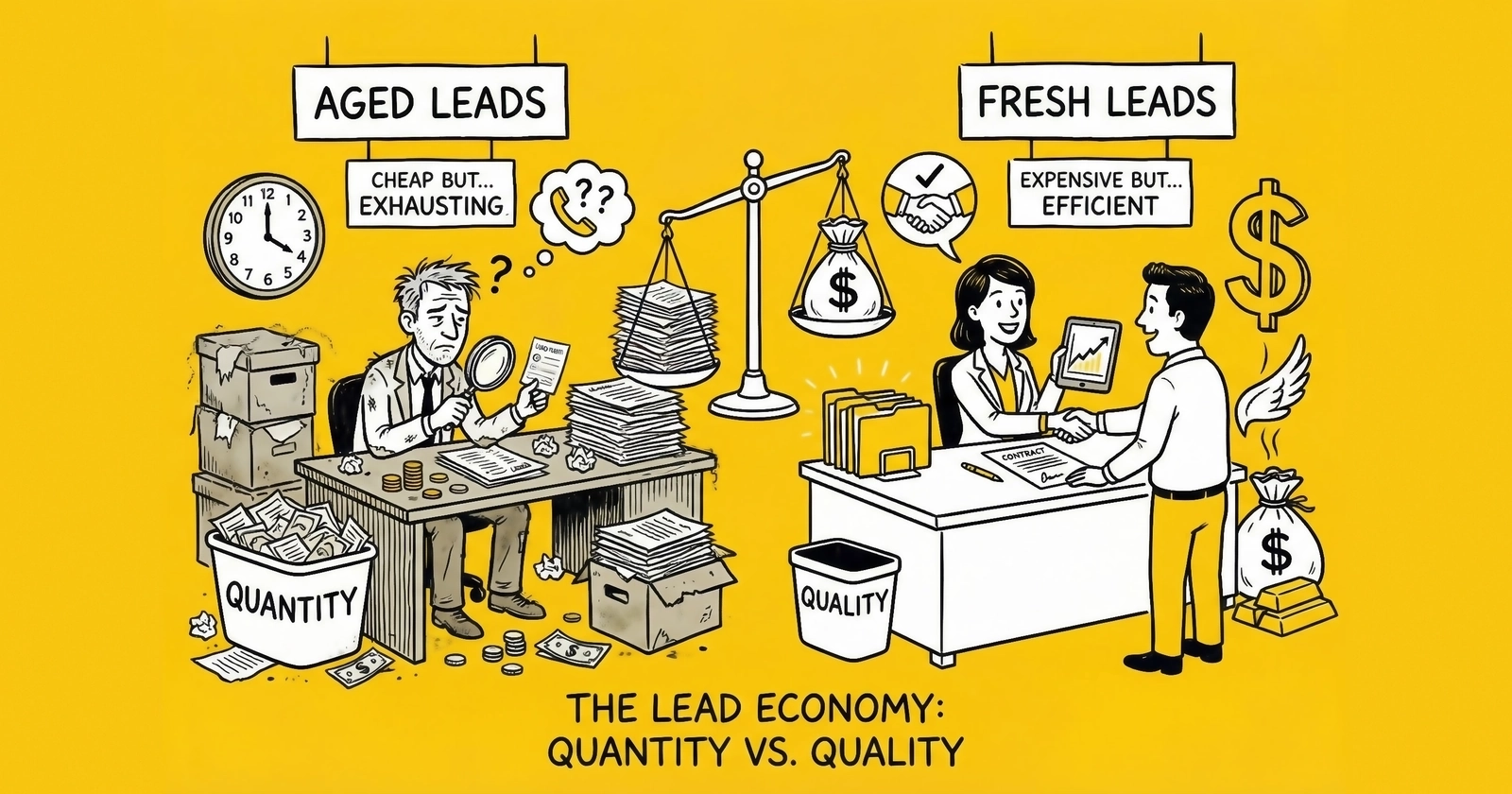
Understanding the value decay curve transforms how you buy leads. Fresh leads deliver speed and conversion; aged leads deliver margin and volume. Those who master both build sustainable businesses.
Introduction: The Economics of Lead Freshness
A consumer fills out a solar quote form at 2 PM on Tuesday. By 2:01 PM, that lead has been auctioned, sold for $85, and delivered to an installer’s CRM. The sales team calls within 90 seconds. The consumer is still at their computer, still thinking about their electric bill, still ready to engage.
Contrast that with the same lead at 30 days old. The consumer vaguely remembers filling out a form. They may have already purchased, moved, or lost interest. That $85 lead now sells for $7. Same consumer. Same data fields. Entirely different asset. Understanding this value decay is fundamental to calculating true cost per lead.
This is the economics of lead freshness: the brutal math of value decay that separates operators who profit from those who wonder where their margin went. Lead freshness operates on a decay curve, not a cliff. Value erodes predictably, creating pricing tiers and strategic opportunities at each stage.
The numbers are unforgiving. Research shows leads contacted within one minute convert at 391% higher rates. Leads contacted within five minutes are 21 times more likely to qualify than those reached after 30 minutes. And 78% of consumers purchase from the first responder.
These statistics explain why fresh leads command premium pricing – and why aged leads, priced at 5-20% of fresh lead costs, can still deliver profitable economics for operators who understand how to work them.
Defining Lead Age Categories
The industry has settled on four general age categories, each with distinct characteristics, pricing expectations, and operational requirements.
Fresh Leads: 0-24 Hours (90-100% of Peak Value)
Fresh leads represent the gold standard. The consumer submitted their information within the past day – often within the past hour or minute. Intent is at its peak. The consumer remembers requesting information, remains interested in the product, and is available to engage.
Characteristics:
- Consumer is actively shopping
- Contact information is current and verified
- High answer rates (45-55% in most verticals)
- Strong conversion rates (8-15% depending on vertical)
- Premium pricing ($25-150+ depending on vertical and exclusivity)
Best applications: High-volume sales operations with speed-to-contact infrastructure, buyers who can monetize the conversion advantage, operations where cost-per-sale matters more than absolute lead cost.
Warm Leads: 1-7 Days (50-70% of Peak Value)
Warm leads occupy the middle ground. The consumer expressed intent recently enough to remember, but urgency has begun to fade. Some warm leads represent consumers who are taking their time with a considered purchase. Others represent leads that failed to sell in the initial auction or leads that were contacted but not converted.
Characteristics:
- Consumer likely remembers the inquiry
- Intent remains, but urgency has diminished
- Contact rates drop to 35-45%
- Conversion rates decline to 5-10%
- Pricing at 40-60% of fresh lead costs
Best applications: Operations with systematic follow-up processes, buyers who can nurture leads over multiple touches, verticals with longer natural sales cycles (life insurance, mortgage refinance).
Aged Leads: 7-30 Days (20-40% of Peak Value)
Aged leads represent unsold or unconverted inventory. These leads failed to sell in real-time distribution, or they were worked by initial buyers who failed to convert them. The consumer may have solved their need, changed circumstances, or simply cooled off.
Characteristics:
- Consumer may not immediately recall the inquiry
- Significant portion have already purchased elsewhere
- Contact rates decline to 25-35%
- Conversion rates drop to 3-6%
- Pricing at 10-25% of fresh lead costs
Best applications: Cost-conscious buyers building sales capacity, operations with high-volume outbound calling infrastructure, markets where margins are thin and every dollar of lead cost matters.
Recycled Leads: 30+ Days (5-15% of Peak Value)
Recycled leads are the bottom tier – leads that have aged beyond 30 days, often to 60, 90, or even 180 days. Contact information degrades at 3-5% monthly, meaning a 90-day lead may have 10-15% invalid phone numbers or emails. Consumer circumstances change significantly over this timeframe.
Characteristics:
- High percentage of consumers have already purchased
- Contact information degradation is significant
- Answer rates drop below 25%
- Conversion rates fall to 1-3%
- Pricing at 2-10% of fresh lead costs ($0.50-5 per lead)
Best applications: Call center training programs, new agent practice, high-volume operations that can profitably work leads at scale, markets where even 1% conversion creates acceptable economics.
The Decay Curve by Vertical
Lead value does not decay uniformly across all markets. Different verticals have different purchase cycles, different urgency levels, and different consumer behaviors. Understanding your vertical’s specific decay curve shapes buying strategy.
Insurance Leads
Insurance leads follow a relatively standard decay curve with steep initial decline.
| Age | Value Retention | Typical Pricing |
|---|---|---|
| 0-24 hours | 100% | $30-100 |
| 1-7 days | 50-60% | $15-50 |
| 7-30 days | 15-25% | $5-15 |
| 30-90 days | 5-15% | $1.50-5 |
| 90+ days | 2-5% | $0.50-3 |
Auto insurance leads decay fastest – consumers often need coverage immediately for a new vehicle or policy renewal. Life insurance leads maintain value longer because the sales cycle is inherently longer and the decision less urgent. See our complete auto insurance lead generation guide for vertical-specific strategies.
Medicare leads follow enrollment period dynamics. Aged leads generated during the Annual Enrollment Period (October 15 - December 7) become nearly worthless after December 7 because the enrollment window closed. Aged leads from Special Enrollment Periods may retain value if the qualifying life event still applies.
Key insight: Insurance aged leads convert at roughly 10% for leads 30-90 days old, compared to 15-20% for fresh leads. The conversion drop is significant but not catastrophic given the pricing differential.
Mortgage Leads
Mortgage leads experience more gradual decay than insurance because the purchase cycle is inherently longer. Refinance leads, in particular, maintain value over 2-7 days as consumers gather quotes and compare options.
| Age | Value Retention | Typical Pricing |
|---|---|---|
| 0-24 hours | 100% | $40-150 |
| 1-7 days | 60-75% | $25-100 |
| 7-30 days | 25-40% | $10-40 |
| 30-90 days | 10-20% | $4-20 |
| 90+ days | 5-10% | $2-8 |
Rate sensitivity creates unique dynamics. Aged mortgage leads generated when rates were higher may convert better if rates have dropped since – the consumer’s financial situation improved. Conversely, aged leads from low-rate periods may convert poorly if rates have risen since generation.
Key insight: Mortgage leads benefit from nurturing more than most verticals. A systematic drip campaign over 30-60 days can reactivate leads that were not ready to convert initially.
Solar Leads
Solar leads maintain value longer than insurance due to the considered nature of the purchase, but geographic and policy factors create complexity.
| Age | Value Retention | Typical Pricing |
|---|---|---|
| 0-24 hours | 100% | $50-150 |
| 1-7 days | 65-80% | $35-100 |
| 7-30 days | 30-45% | $15-45 |
| 30+ days | 10-20% | $5-30 |
The Investment Tax Credit elimination (December 31, 2025) creates a unique dynamic for solar leads. Post-2025, aged leads from the pre-elimination period may have limited value as consumers reassess economics without the 30% tax credit.
Key insight: Solar leads require geographic segmentation in aged inventory. A 30-day aged lead from California (high electricity rates, strong solar economics) may convert better than a fresh lead from a low-rate state.
Legal Leads
Legal leads present the widest variation in decay dynamics based on case type.
| Case Type | Shelf Life | Aged Lead Viability |
|---|---|---|
| Personal injury | 7-14 days | Moderate (statute of limitations provides runway) |
| Mass tort | 30-90 days | High (long qualification processes) |
| Criminal defense | 24-48 hours | Very low (urgent by nature) |
| Family law | 7-14 days | Moderate |
| Bankruptcy | 14-30 days | Moderate to high |
Time-sensitive cases (criminal defense, DUI) decay rapidly because consumers need representation immediately. Mass tort and bankruptcy leads maintain value longer because the underlying need persists over time.
Key insight: Legal aged leads require careful case-type segmentation. Mixing urgent and non-urgent case types in aged inventory creates unpredictable conversion economics.
Aged Lead Pricing: The 5-20% Rule
Aged leads typically price at 5-20% of fresh lead costs. This pricing reflects the conversion differential while still creating profitable economics for buyers with appropriate operational capabilities.
Pricing by Age Tier
| Lead Age | Price as % of Fresh | Typical Absolute Range |
|---|---|---|
| 7-14 days | 25-35% | $8-35 |
| 15-30 days | 15-25% | $5-20 |
| 31-60 days | 8-15% | $3-10 |
| 61-90 days | 5-10% | $1.50-5 |
| 90+ days | 2-5% | $0.50-3 |
Factors That Affect Aged Lead Pricing
Original source quality: Aged leads from premium sources (high-intent comparison sites, verified form fills) maintain value better than leads from lower-quality traffic sources.
Vertical: High-value verticals with longer sales cycles (solar, mortgage, life insurance) maintain aged lead pricing better than transactional verticals (auto insurance, home services).
Data completeness: Aged leads with complete data fields (address, secondary phone, email) price higher than leads with minimal information.
Compliance documentation: Aged leads with verifiable consent documentation (TrustedForm certificates, TCPA compliance records) command premiums over undocumented inventory.
Exclusivity history: Leads sold exclusively retain more value than leads that were sold shared to multiple buyers. Buyers can query for contact history.
The ROI Calculation
The math often favors aged leads despite lower conversion rates.
Fresh lead economics:
- Lead cost: $50
- Contact rate: 50%
- Conversion rate: 12%
- Effective conversion: 6%
- Cost per sale: $833
Aged lead economics (30-day):
- Lead cost: $5
- Contact rate: 30%
- Conversion rate: 5%
- Effective conversion: 1.5%
- Cost per sale: $333
The aged lead delivers a cost-per-sale that is 60% lower – despite converting at one-quarter the rate. The pricing discount more than compensates for the conversion decline.
The catch: working aged leads requires more operational capacity. Reaching 30% of leads requires more dial attempts than reaching 50%. Converting 5% requires working more leads to achieve the same sale volume. Aged lead economics only work with adequate infrastructure.
When Aged Leads Make Economic Sense
Aged leads are not universally inferior to fresh leads. In specific situations, aged leads represent the superior buying decision.
Situation 1: Building Sales Capacity
New sales teams need leads to practice on. Fresh leads at $50-100 each represent expensive training material. Aged leads at $3-5 each allow new agents to develop scripts, practice objection handling, and build confidence without burning premium inventory.
Best practice: Run new agents on aged leads for 2-4 weeks before transitioning to fresh inventory. Track their conversion rates on aged leads to identify readiness for higher-value leads.
Situation 2: High Call Center Capacity with Low Marginal Cost
Operations with existing call center infrastructure – fixed headcount, already-amortized technology, excess capacity during off-peak hours – can profitably work aged leads because the marginal cost per dial is near zero.
If your cost per dial is $0.05 and aged leads require 15 dials to reach versus 5 dials for fresh leads, the additional $0.50 in calling cost is trivial compared to the $45 savings in lead cost.
Best practice: Calculate your true marginal cost per dial including labor, telephony, and technology. If that cost is under $0.10, aged leads often deliver superior economics.
Situation 3: Markets with Compressed Fresh Lead Margins
Some verticals or geographies have fresh lead pricing that leaves minimal margin after conversion. When fresh leads cost $100 and your cost-per-sale target is $400, you have no room for error. Aged leads at $8 provide margin buffer and risk reduction.
Best practice: Monitor your fresh lead cost-per-sale trends. When margins compress below 20%, shift mix toward aged leads to protect profitability.
Situation 4: Supplemental Volume
Operations with fixed revenue targets and variable lead volume can use aged leads to fill gaps when fresh lead supply is constrained. Rather than missing targets or overpaying for fresh leads in tight markets, aged leads provide reliable supplemental volume.
Best practice: Maintain relationships with aged lead suppliers even when you are primarily buying fresh. Having aged lead supply available prevents desperation buying during fresh lead shortages.
Situation 5: Nurture-First Business Models
Some business models prioritize relationship-building over immediate conversion. Financial advisors, insurance agents building referral networks, and consultative sales operations may find aged leads valuable for their database-building strategy.
A lead that does not convert today may refer three friends next year – if you maintain the relationship.
Best practice: Calculate customer lifetime value including referral revenue. Aged leads that seem unprofitable on a single-transaction basis may justify themselves through relationship economics.
Aged Lead Buying Strategies
Purchasing aged leads requires different evaluation criteria than fresh lead buying.
Source Verification
Not all aged leads are equal. Ask suppliers: What was the original traffic source? When was the lead generated? How many times has this lead been sold? What consent documentation exists? Suppliers who cannot answer these questions are selling inventory you should avoid.
Tiered Purchasing
Buy aged leads in tiers based on age, working fresher aged leads first. Week 1: work 7-14 day leads. Week 2: work 14-30 day leads. Week 3: work 30-60 day leads. This approach extracts maximum value from each tier before moving to less responsive inventory.
Data and Return Requirements
Specify minimum data requirements: valid phone number (verified within 30 days), email address, full street address, and lead generation timestamp. Negotiate return rights for invalid contact information – even a 24-hour return window for disconnected numbers protects against degraded inventory.
Working Aged Leads Effectively
Aged leads require different sales approaches. The consumer is in a different mindset; your scripts and processes must adapt.
Script Adjustments
Fresh lead opening: “Hi, this is [Name] calling about the insurance quote you just requested.”
Aged lead opening: “Hi, this is [Name]. You requested information about insurance coverage a few weeks ago. Were you able to find what you needed, or can I still help?”
The aged lead opening acknowledges the time gap, offers a graceful exit if they purchased, and positions you as helpful rather than pushy.
Multi-Channel Contact Sequences
Aged leads respond better to multi-channel outreach. A 7-day sequence combining phone, email, and SMS typically achieves 25-30% higher contact rates than phone-only approaches.
Effective sequence: Day 1: Phone + Email. Day 2: SMS + Phone. Day 3: Phone + Email. Day 5: Phone. Day 7: Final phone + Email.
Dial Attempts and Disposition Tracking
Fresh leads require 3-5 dial attempts. Aged leads require 8-12. Budget 3x the dial capacity for aged leads.
Track dispositions carefully: already purchased, no longer interested, not reached (invalid), not reached (no answer), reached but not qualified, reached but not converted, converted. These reveal which sources and age tiers deliver value.
Aged Lead Specialization: Businesses Built on Recycled Inventory
Some operators build entire businesses around aged lead economics. These specialists develop infrastructure, processes, and buyer relationships optimized for volume-based, low-cost lead acquisition.
The Aged Lead Specialist Model
Aged lead specialists operate differently than fresh lead buyers:
Volume-based economics: Where fresh lead buyers might purchase 1,000 leads monthly, aged lead specialists buy 50,000-100,000+. The conversion rate is lower, but the volume economics work.
Dedicated call center infrastructure: Aged lead operations require high-dial-capacity call centers with predictive dialers, automated voicemail drops, and efficiency-focused metrics.
Lower-cost labor models: With lower revenue per lead, aged lead operations often use offshore or lower-cost domestic labor. First-call qualification, not sophisticated consultative selling, drives results.
Relationship-based supplier arrangements: Aged lead specialists build exclusive relationships with fresh lead generators, buying their entire unsold or unconverted inventory at predictable pricing.
Economics of the Specialist Model
| Metric | Fresh Lead Buyer | Aged Lead Specialist |
|---|---|---|
| Monthly lead volume | 1,000 | 75,000 |
| Average lead cost | $50 | $3 |
| Monthly lead spend | $50,000 | $225,000 |
| Contact rate | 50% | 28% |
| Conversion rate | 12% | 4% |
| Monthly conversions | 60 | 840 |
| Cost per conversion | $833 | $268 |
The aged lead specialist produces 14x more conversions at one-third the cost per conversion. The total spend is higher, but the unit economics are superior for operations that can handle the volume.
Who Succeeds as Aged Lead Specialists
Aged lead specialization works for:
- Insurance agencies with established carrier relationships who need volume
- Mortgage brokers with processing capacity during refinance booms
- Solar installers building pipeline for future installation capacity
- Legal intake operations with high-volume case processing
Aged lead specialization does not work for:
- Small operations without call center infrastructure
- Businesses where every lead requires high-touch, consultative selling
- Markets where aged lead conversion rates fall below break-even thresholds
Quality Verification for Aged Leads
Aged leads carry higher fraud and quality risk than fresh leads. Verification becomes more important, not less, as leads age.
Verification Checkpoints
Verify phone numbers are still active before dialing – validation services cost $0.01-0.03 per lookup but eliminate waste on disconnected numbers. Verify email deliverability before including email in contact sequences. Request and verify TrustedForm certificates or equivalent consent documentation; aged leads without verifiable consent carry TCPA risk that exceeds their economic value. Our guide on lead validation for phone, email, and address covers verification best practices.
Red Flags and Quality Tiers
Avoid leads from unknown sources, batches with suspiciously consistent data patterns, pricing significantly below market, and suppliers who refuse any return rights.
Segment purchases by source quality: Tier 1 (premium aged from verified comparison sites, 15-25% of fresh pricing), Tier 2 (standard aged from affiliate networks, 8-15% of fresh), Tier 3 (discount aged of unknown origin, 5-8% of fresh). Keep tiers operationally separate to preserve performance analysis.
Mixing Fresh and Aged in Your Portfolio
sophisticated practitioners blend fresh and aged leads to optimize economics and capacity utilization. Your optimal ratio depends on sales capacity, margin requirements, and growth objectives.
Portfolio Mix by Business Stage
| Business Stage | Fresh Lead % | Aged Lead % | Rationale |
|---|---|---|---|
| Startup (building team) | 30% | 70% | Train agents on lower-cost inventory |
| Growth (scaling volume) | 70% | 30% | Maximize conversions with higher-quality leads |
| Mature (optimizing margin) | 50% | 50% | Balance conversion and cost efficiency |
| Distressed (cash-constrained) | 20% | 80% | Preserve cash while maintaining volume |
Operational Separation
Maintain separate queues, metrics, and potentially compensation structures for fresh versus aged leads. Fresh leads require immediate response; aged leads can wait. Blending metrics obscures profitability by inventory type. Adjust your mix dynamically: shift toward aged leads when fresh lead CPS rises, toward fresh leads when aged lead conversion falls, and add aged volume when call center capacity is underutilized.
Frequently Asked Questions
Q: What is the biggest mistake operators make with aged leads?
A: Treating aged leads like fresh leads. Aged leads convert at 25-40% of fresh lead rates. The economics work because pricing discounts exceed conversion declines – but only if you calibrate expectations correctly and build operational processes designed for aged lead characteristics.
Q: How do I know if an aged lead supplier is legitimate?
A: Legitimate suppliers can answer five questions: What was the original traffic source? When was the lead generated? Was it sold fresh first? How many times resold? What consent documentation exists? Suppliers who evade these questions are selling inventory you should avoid.
Q: Should I start with fresh leads or aged leads as a new operation?
A: Start with aged leads for training, then transition to fresh leads for production. Burning $50 fresh leads on untrained agents destroys margin. Aged leads at $3-5 each provide affordable training material. Graduate agents to fresh lead queues once they demonstrate proficiency.
Q: What is the optimal dial attempt count for aged leads?
A: Plan for 10-15 dial attempts over 7-10 days for leads aged 30-60 days. After 15 attempts without contact, the marginal return falls below break-even for most operations.
Q: How does aged lead performance vary by vertical?
A: Verticals with longer sales cycles (mortgage, solar, life insurance) maintain aged lead value better than transactional verticals (auto insurance, home services). A 30-day aged solar lead may retain 30-40% of fresh value; a 30-day aged auto lead may retain only 15-20%.
Q: Can I mix aged leads from different sources in the same campaign?
A: You should not. Mixing sources obscures performance analysis. Segment aged leads by source and work each segment separately to identify which sources justify continued purchasing.
Q: What consent documentation should I require for aged leads?
A: At minimum: lead generation timestamp, disclosure language, and consent acknowledgment. TrustedForm certificates provide stronger protection. Never purchase aged leads without verifiable consent – the TCPA exposure exceeds any economic benefit.
Q: How do I explain aged lead purchases to my sales team?
A: Frame aged leads as opportunity. An agent converting 3% of aged leads at $5 each produces a $167 cost per sale – often better than 10% conversion on $50 fresh leads ($500 cost per sale). Agents who understand the math are more motivated.
Q: Should I return aged leads that do not convert?
A: Negotiate return rights for invalid contact information before purchasing. Do not expect returns for leads that simply do not convert – conversion is your responsibility.
Q: What technology do I need to work aged leads profitably?
A: At minimum: a predictive dialer, a CRM tracking attempt counts and dispositions, email and SMS capability, and phone number validation tools. Without these, operational inefficiency erodes the economic advantage. For technology decisions, see our guide on build vs buy for lead management software.
Key Takeaways
-
Lead value follows a predictable decay curve: 100% at 0-24 hours, 50-70% at 1-7 days, 20-40% at 7-30 days, and 5-15% at 30+ days. Pricing discounts often exceed conversion declines, creating opportunity.
-
Aged leads price at 5-20% of fresh lead costs, enabling cost-per-sale economics that can outperform fresh leads when worked with appropriate infrastructure.
-
Vertical decay varies: insurance leads decay fastest, mortgage and solar leads maintain value longer due to longer purchase cycles.
-
Aged lead success requires operational adaptation: multi-channel sequences, higher dial attempts (10-15 versus 3-5), scripts acknowledging the time gap, and separate performance tracking.
-
Quality verification matters more for aged leads: validate phone numbers before dialing, require consent documentation, and segment by source quality tier.
-
The optimal portfolio blends fresh and aged leads strategically – not an either/or choice but a mix based on capacity, margin requirements, and growth objectives.
-
Specialized aged lead operations achieve 60%+ lower cost per sale than fresh-only operations, but require high-volume call center infrastructure.
-
Aged leads work best for training agents, filling excess capacity, supplementing volume during shortages, and protecting margins in compressed markets.
Sources
-
HBR: The Short Life of Online Sales Leads - Harvard Business Review research documenting that leads contacted within 5 minutes are 21x more likely to qualify, establishing the foundational speed-to-lead data that defines fresh lead value.
-
SBA: Marketing and Sales Guide - U.S. Small Business Administration guidance on lead management best practices and sales process optimization for small business operations.
-
Penn State STAT 200: Probability and Statistics - Statistical methodology reference for understanding conversion rate analysis, confidence intervals, and the data analysis underlying lead decay curve calculations.
-
NIST Engineering Statistics Handbook - Technical reference for statistical analysis methods used in calculating lead value decay rates and comparing conversion performance across lead age segments.
This guide is part of The Lead Economy series on lead generation best practices. For more on lead economics, compliance, and operational excellence, explore our complete resource library.