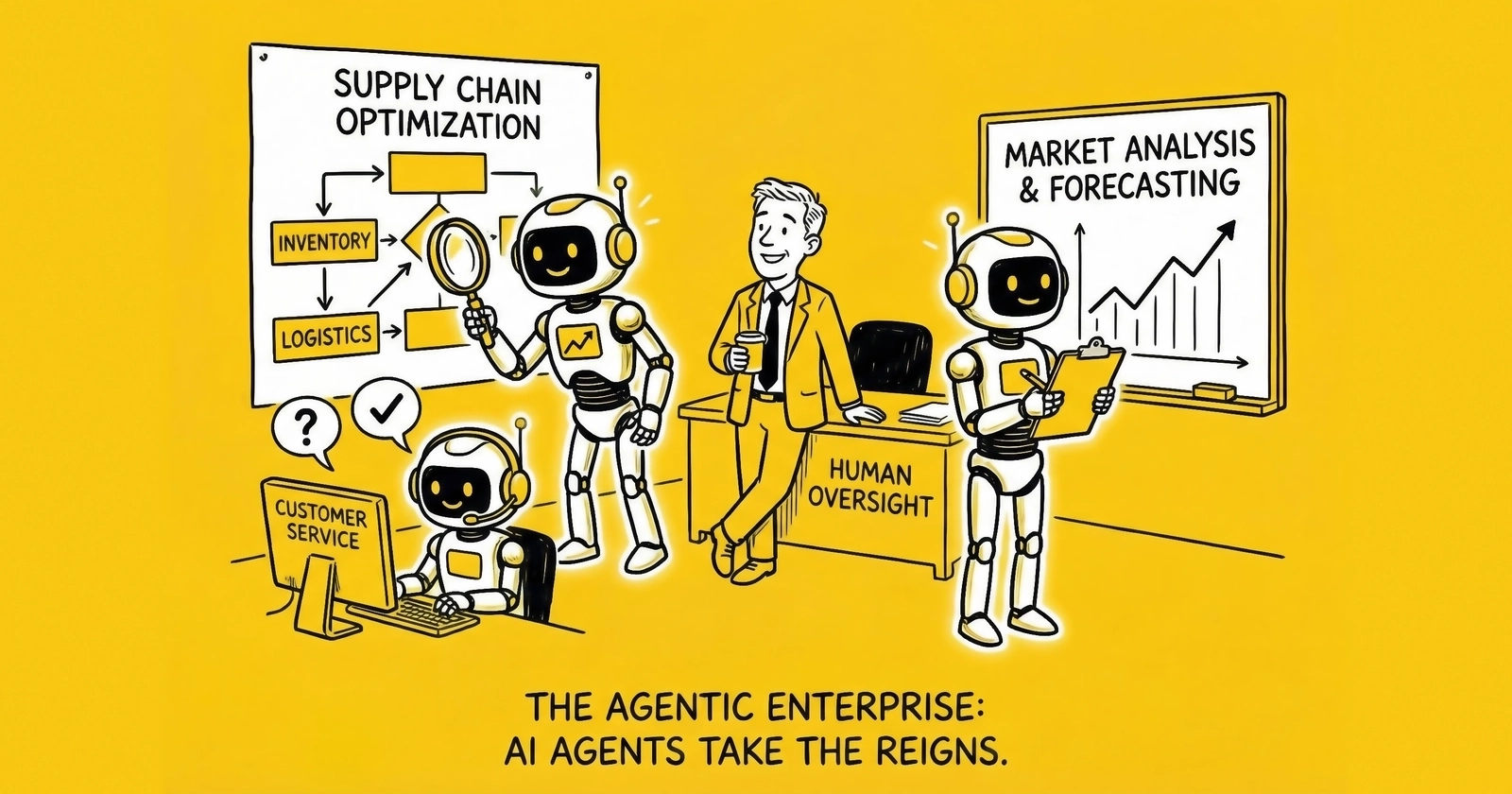
From assistants to autonomous actors – the 2026-2030 roadmap for AI that doesn’t just answer questions but takes action
The trajectory of enterprise AI has reached an inflection point that many organizations have not yet recognized. For three years, the focus centered on generative AI as an assistant – a sophisticated tool that could draft documents, summarize reports, and answer questions when prompted. This assistant paradigm, while valuable, represented a fraction of AI’s potential impact on business operations. The emerging reality is far more significant: AI systems that do not merely respond but act, that do not wait for instructions but pursue goals, that do not augment human decision-making but make decisions autonomously within defined boundaries.
This shift from assistant to agent represents more than a technical evolution. It demands fundamental reconsideration of how organizations structure work, allocate authority, and define accountability. When AI systems can book travel, negotiate with suppliers, triage customer issues, and manage routine operational decisions without human intervention, the entire framework of enterprise operations transforms. Job descriptions change. Organizational structures adapt. Competitive dynamics shift toward organizations that deploy agents effectively.
The timeline for this transformation is compressed. Unlike previous technology transitions that unfolded over decades, the infrastructure for agentic AI largely exists today. AI agents can traverse the same digital paths that humans use – the websites, APIs, and applications built during the internet and mobile eras. The challenge is not technological feasibility but organizational readiness: governance frameworks, integration architectures, and workforce adaptation that enable confident deployment at scale.
Executive Summary
The enterprise software landscape is undergoing its most significant architectural shift since cloud computing. Agentic AI – systems that pursue goals autonomously rather than responding to individual prompts – represents a fundamental change in how organizations structure work, allocate resources, and compete for market position. This analysis examines the trajectory from current assistant-based implementations toward fully autonomous agent ecosystems, providing frameworks for organizations evaluating deployment timelines, governance requirements, and competitive positioning.
The evidence points to rapid acceleration. Gartner’s projections indicate 40% of enterprise applications will embed task-specific agents by end of 2026. McKinsey estimates $3-5 trillion in global commerce will flow through agent-mediated systems by 2030. Yet the same research suggests 40% of agentic AI projects will be canceled due to governance gaps, unclear value propositions, and integration complexity. Success requires understanding both the opportunity and the substantial operational requirements for capturing it.
The shift from asking to acting
For three years, generative AI has answered questions. We’ve asked ChatGPT for summaries, requested Claude to analyze documents, prompted Gemini to draft emails. The AI responds. We review. We act. That model is ending. The next phase isn’t AI that helps you make decisions – it’s AI that makes decisions on your behalf. Not as a theoretical capability but as production reality, already deploying across the most aggressive enterprises.
Gartner’s August 2025 prediction captured the velocity: 40% of enterprise applications will integrate task-specific AI agents by the end of 2026, up from less than 5% in early 2025. That’s not incremental growth. That’s an 8x expansion in eighteen months.
McKinsey projects the economic scale: $3-5 trillion in global commerce will be orchestrated by AI agents by 2030. In the U.S. B2C market alone, $1 trillion in retail revenue will flow through autonomous systems that shop, negotiate, and transact without continuous human involvement.
This isn’t science fiction extrapolation. OpenAI launched “Buy it in ChatGPT” in September 2025 – AI agents that browse, compare, and execute purchases. Alibaba’s AI Mode, launching December 2025, targets the $30 trillion B2B market where 90% of buyers already use AI for sourcing.
The transition from conversational AI to agentic AI represents the most significant operational shift since the internet. The question for every organization isn’t whether to prepare but how quickly preparation can translate to competitive advantage.
What makes AI “agentic”
Beyond chat: the architecture of autonomy
The distinction between assistants and agents sounds semantic but has profound operational implications.
AI Assistants respond to requests. You ask a question; they provide an answer. You describe a task; they offer suggestions. The human remains in the loop for every decision and action. The AI enhances human capability but doesn’t replace human involvement.
AI Agents pursue goals. You define an objective; they plan steps to achieve it. They select tools, execute actions, observe results, and adjust their approach based on outcomes. The human sets direction; the agent handles execution.
A practical example illustrates the difference:
| Assistant Model | Agentic Model |
|---|---|
| ”What flights are available to London next week?" | "Book me the best value flight to London, arriving before 6 PM, with my preferred airline and payment method.” |
| Human reviews options, selects flight, completes booking | Agent searches options, evaluates against preferences, completes purchase, adds to calendar, sends confirmation |
The assistant provides information. The agent takes action.
This distinction requires fundamentally different architectures. Agents must understand not just immediate requests but underlying objectives – “book a flight” includes implicit goals like minimizing cost, optimizing timing, maintaining status preferences, and avoiding known issues. They decompose complex objectives into executable steps: booking travel might require checking calendar availability, searching flight options, evaluating against constraints, comparing prices, selecting the optimal choice, executing payment, updating calendars, and notifying relevant parties.
Beyond planning, agents invoke external capabilities – APIs, databases, applications – to accomplish tasks. They don’t just process information; they manipulate systems. They maintain context across extended workflows, remembering what’s been accomplished, what failed, and what remains to be done. And critically, they observe the results of their actions and adjust strategy accordingly. When a booking fails, they try alternatives rather than simply reporting failure.
The technical architecture of agents
Understanding the technical requirements illuminates why agent deployment differs fundamentally from traditional software implementation. Agents require several capabilities working in concert.
Goal decomposition breaks high-level objectives into executable steps. When instructed to “optimize this marketing campaign,” an agent must decompose that into specific actions: analyze current performance data, identify underperforming segments, generate alternative creative approaches, test variations, and reallocate budget based on results. This decomposition requires understanding of both the domain and the constraints within which the agent operates.
Tool selection and orchestration determines which capabilities to invoke for each step. A procurement agent might need access to vendor databases, pricing APIs, contract management systems, and communication platforms. The agent must understand which tool serves which purpose and in what sequence.
State management maintains context across extended workflows. Unlike a chatbot that handles each query independently, an agent pursuing a multi-day objective must remember what has been accomplished, what failed, what remains pending, and what contextual factors have changed since the task began. This is where context engineering becomes critical – the discipline of structuring information so AI systems can reason effectively across complex workflows.
Feedback integration allows agents to observe results and adjust strategy. When an initial approach fails, the agent should recognize the failure, diagnose potential causes, and attempt alternative approaches rather than simply reporting inability to complete the task.
These architectural requirements explain why most current “AI agents” are marketing relabels of existing automation. True agentic capability requires substantial technical infrastructure that most organizations have not yet built – and 95% of enterprise AI projects fail precisely because they underestimate these foundational requirements.
The five stages of enterprise agent evolution
Gartner outlines a progression that illuminates where we are and where we’re heading:
Stage 1: Assistants in every application (2025)
AI assistants embedded in productivity tools – copilots in Office, assistants in Slack, helpers in Salesforce. These systems answer questions and generate content but don’t act autonomously. Nearly every enterprise application will include some form by the end of 2025.
Stage 2: Task-specific agents (2026)
AI agents handling discrete tasks within applications: customer support resolution, scheduling, data processing, document routing. These agents operate within defined boundaries but complete end-to-end processes without human intervention. 40% of enterprise apps will embed such agents by end of 2026.
Stage 3: Collaborative agents within applications (2027)
Multiple agents working together inside single applications – combining complementary skills to manage complex tasks. A cybersecurity agent that scans traffic, an analyst agent that assesses threats, a response agent that initiates containment. One-third of agentic implementations will feature multi-agent collaboration by 2027.
Stage 4: Agent ecosystems across applications (2028)
Networks of agents collaborating across platforms, shifting user experience from application interfaces toward agentic front ends. Users interact with agents who orchestrate activity across multiple systems. 33% of enterprise software will include agentic AI by 2028.
Stage 5: The new normal (2029)
At least half of knowledge workers expected to create, govern, and deploy agents on demand. Agent creation becomes a core professional skill, not a specialist function.
The economic opportunity
The $3-5 trillion commerce transformation
McKinsey’s agentic commerce research quantifies the opportunity:
“By 2030, the US B2C retail market alone could see up to $1 trillion in orchestrated revenue from agentic commerce, with global projections reaching as high as $3 trillion to $5 trillion.”
These figures only reflect goods – they don’t include services or the massive B2B marketplace. The total economic impact of agentic systems extends far beyond retail.
The transformation differs fundamentally from previous digital transitions. E-commerce (1995-2010) moved transactions online but preserved human decision-making – consumers browsed, compared, and purchased, making the internet a medium rather than an actor. Mobile commerce (2010-2020) added convenience and location but maintained the human at every step; phones enabled shopping, but they didn’t do shopping. Agentic commerce (2025-2030) shifts decision-making from humans to software. AI agents don’t just facilitate – they evaluate options, negotiate terms, and execute transactions. The human sets preferences; the agent handles everything else.
McKinsey emphasizes the velocity: “This trend will have the breadth of impact of prior web and mobile-commerce revolutions, but it can move even faster since agents can traverse the same digital paths to purchase as humans, allowing them to ‘ride on the rails’ laid down by these prior revolutions.”
Enterprise operations: the productivity multiplier
Beyond commerce, agentic AI promises transformation of internal operations. Gartner projects that by 2028:
- 15% of day-to-day work decisions will be made autonomously through agentic AI (up from 0% in 2024)
- 33% of enterprise software will include agentic capabilities (up from <1% in 2024)
McKinsey estimates that in advanced industries alone, agentic AI could generate $450-650 billion in additional annual revenue by 2030 – representing 5-10% revenue uplift through operational transformation.
The functions most immediately affected span the enterprise. Customer service leads the transformation – Gartner forecasts that by 2027, self-service and AI-mediated chat will surpass phone and email as the primary customer service channels, with agents handling complete resolution cycles without human escalation for the majority of inquiries. Procurement and sourcing follow close behind: 90% of B2B buyers already use AI for sourcing, and agent-mediated procurement – automated RFP processes, vendor evaluation, contract negotiation, order placement – represents the natural extension. Gartner predicts that by 2028, 90% of B2B buying will be AI agent intermediated, pushing over $15 trillion of B2B spend through agent exchanges.
Financial operations – invoice processing, payment reconciliation, expense management, budget tracking – currently require human review at multiple steps but will become autonomous workflows. HR administration follows a similar pattern with benefits enrollment, leave management, policy questions, and onboarding workflows; Forrester predicts that the top five HCM platforms will offer digital employee management capabilities by 2026, treating AI agents as trackable members of the workforce. IT operations round out the immediate targets: monitoring, alerting, initial diagnosis, and routine remediation. When systems fail, agents identify problems, attempt standard fixes, and escalate only when automatic resolution fails.
Industry-specific transformation patterns
The impact of agentic AI varies significantly across industries, with some sectors positioned for faster adoption than others.
Financial services faces unique opportunities and constraints. High transaction volumes, standardized processes, and extensive digital infrastructure make financial operations prime candidates for agent deployment. A payments processing agent can evaluate transactions, detect anomalies, route approvals, and execute settlements across thousands of daily transactions. However, regulatory oversight and fiduciary responsibilities require governance frameworks that most financial institutions are still developing. Early implementations focus on back-office operations where regulatory exposure is contained.
Healthcare presents a different pattern. Administrative burden consumes significant clinician time – scheduling, documentation, prior authorization, billing reconciliation. Agents handling these administrative workflows could return substantial capacity to patient care. Yet healthcare faces unique liability considerations: when an agent makes an error in patient scheduling or insurance processing, accountability structures must be clear. Most healthcare organizations are proceeding cautiously, piloting agents in low-risk administrative functions before expanding scope.
Manufacturing and supply chain operations offer perhaps the clearest near-term value. Inventory optimization, supplier coordination, logistics routing, and quality monitoring involve complex decisions across enormous data volumes. Agents can evaluate thousands of variables simultaneously – demand signals, supplier capacity, shipping constraints, cost factors – and optimize outcomes that human planners cannot match. The physical-world connection through IoT sensors provides agents with real-time visibility that accelerates decision cycles.
Professional services firms face interesting trade-offs. Client relationships depend heavily on human judgment and trust. Yet substantial portions of professional work involve information gathering, analysis, and document preparation that agents can accelerate. The emerging pattern involves agents handling research and preparation while humans retain client interaction and final judgment. This hybrid model may prove the dominant approach across knowledge work.
The multi-agent future
The real power emerges not from individual agents but from coordinated teams. Gartner reported a 1,445% surge in multi-agent system inquiries from Q1 2024 to Q2 2025 – organizations recognizing that single-purpose agents are just the beginning.
Multi-agent architectures mirror how human teams operate:
| Human Team | Agent Team |
|---|---|
| Researcher gathers information | Research agent retrieves and synthesizes data |
| Analyst evaluates options | Analysis agent applies decision frameworks |
| Specialist implements solution | Execution agent takes action |
| Manager coordinates and reviews | Orchestrator agent sequences and validates |
LinkedIn’s production implementation demonstrates the pattern. By combining RAG with a knowledge graph in an agent architecture, they achieved 78% accuracy improvement and reduced median issue resolution time from 40 hours to 15 hours – a 63% efficiency gain.
The reality check
The 40% cancellation rate
Gartner delivers a sobering counterbalance: Over 40% of agentic AI projects will be canceled by the end of 2027 due to escalating costs, unclear business value, or inadequate risk controls.
The reasons are instructive. “Most agentic AI propositions lack significant value or return on investment,” Gartner notes. “Current models don’t have the maturity and agency to autonomously achieve complex business goals or follow nuanced instructions over time.” Making matters worse, Gartner warns that only approximately 130 of thousands of claimed agentic AI vendors actually offer legitimate agent technology – the rest are rebranding existing automation, chatbots, or RPA without genuine agentic capabilities.
Beyond the hype and vendor confusion, agents that act autonomously create accountability questions that traditional IT governance doesn’t address. When an agent makes a mistake – a wrong purchase, a poor customer interaction, a compliance violation – who is responsible? And true agents must connect to the systems where they take action. API limitations, security constraints, data quality issues, and legacy system incompatibilities create friction that pilots often underestimate.
Bounded autonomy: the practical model
Leading organizations implement “bounded autonomy” architectures that balance agent capability with human oversight. Agents operate within defined boundaries – maximum transaction sizes, approved vendor lists, permitted actions – with anything outside those boundaries requiring escalation. High-stakes decisions route to humans; an agent might handle routine orders but escalate unusual quantities, new vendors, or amounts above threshold.
Every agent action is logged with reasoning, enabling after-the-fact review and continuous improvement. And increasingly, specialized “guardian agents” monitor other agents for policy violations, anomalous behavior, and risk indicators. “Gartner’s new category of guardian agents – AI designed to monitor other AI systems – is set to explode.”
Preparing for the agentic enterprise
The 90-day agent pilot framework
Weeks 1-2: Use case selection
Identify a bounded process with:
- Clear success criteria
- Measurable outcomes
- Tolerance for some error
- Existing data and system access
- Organizational appetite for experimentation
Good candidates: customer inquiry triage, meeting scheduling, expense processing, document routing.
Weeks 3-4: Infrastructure assessment
Evaluate:
- API availability for required systems
- Data quality in relevant domains
- Security requirements for agent access
- Integration complexity and timeline
- Monitoring capabilities
Weeks 5-8: Pilot development
Build minimum viable agent:
- Define agent goals and boundaries
- Implement core functionality
- Establish monitoring and logging
- Create escalation paths
- Deploy to limited scope
Weeks 9-10: Controlled deployment
- Run agent on subset of real transactions
- Human review of all actions initially
- Track success/failure patterns
- Identify edge cases and exceptions
- Refine boundaries and escalation rules
Weeks 11-12: Evaluation and planning
- Measure outcomes against criteria
- Document lessons learned
- Calculate ROI and scaling economics
- Develop roadmap for expansion or pivot
The governance imperative
Gartner emphasizes that organizations need governance capabilities “embedded into every step of the AI lifecycle.” For agents, this means answering five critical questions. First, action governance: what can agents do? Clear policies must define permitted actions, spending limits, system access, and decision boundaries. Second, data governance: what can agents access? Agents should only retrieve information appropriate to their function and user context.
Third, performance governance: how do we know agents are working? This requires metrics, monitoring, alerting, and review processes for agent behavior. Fourth, accountability governance: who is responsible? Organizations need clear ownership of agent decisions and actions, including liability for failures. Finally, evolution governance: how do agents improve? Processes for updating agent capabilities, retraining models, and incorporating feedback determine long-term success.
The competitive dynamic
First-mover advantages
Organizations deploying agents early gain compounding benefits. Every agent interaction generates data for improvement, building experience curves that late entrants must match. Agents reveal process inefficiencies invisible to human workers, enabling early deployers to optimize operations while competitors maintain the status quo.
The advantages extend to workforce development: employees who work with agents develop new skills and expectations, creating agent-fluent teams. And as B2B and B2C customers increasingly expect agent-ready interfaces, early deployers meet those expectations while late adopters frustrate customers.
McKinsey’s guidance is explicit: “Companies that begin adapting their infrastructure today – creating ‘agent-ready’ websites, composable commerce stacks, and transparent APIs – will be better positioned to capture the next phase of digital growth.”
The agent-ready organization
What does “agent-ready” mean in practice? At its foundation, it requires structured data – agents parse data; they don’t infer meaning from ambiguity. Product information, customer data, and operational metrics must all be structured for agent consumption. It requires open APIs, giving agents programmatic access to systems. Organizations with robust API strategies have the foundation for agent deployment; those with closed systems face integration barriers.
Agent-ready also means composable architecture – modular systems that agents can orchestrate. Emerging standards like the Model Context Protocol (MCP) provide universal connectors that let AI agents access diverse enterprise systems through a single integration layer. Monolithic applications resist agent integration; composable stacks enable it. Systems must handle consent and identity, verifying agent authority, maintaining user permissions, and tracking delegation. And governance infrastructure – monitoring, logging, alerting, and audit capabilities – must provide visibility into agent behavior.
The talent and organizational implications
Agent deployment creates ripple effects through workforce structure, skills requirements, and organizational design that many leaders underestimate.
Measurement and success metrics for agent deployments
Defining success for agent deployments requires moving beyond traditional software metrics. Organizations deploying agents successfully track multiple dimensions that together indicate whether agent systems deliver value.
Task completion rate measures whether agents accomplish assigned objectives. Unlike software that executes predefined functions, agents pursue goals that may require multiple approaches. An 85% task completion rate might represent excellent performance for complex tasks or poor performance for routine operations – the benchmark depends on task difficulty and organizational tolerance for manual intervention.
Quality of outcomes assesses whether completed tasks meet standards. An agent that schedules meetings but double-books participants or creates awkward timing has technically completed its task while creating downstream problems. Quality metrics specific to each agent’s domain provide necessary granularity.
Resource efficiency compares agent costs against alternative approaches. This includes compute costs, supervision time, and the opportunity cost of errors. Agents that save time but consume expensive infrastructure may not deliver net value. The calculation requires honest accounting across all cost dimensions.
Escalation patterns reveal agent limitations. Agents that escalate frequently may lack necessary capabilities or may have overly conservative confidence thresholds. Agents that rarely escalate may be making poor decisions without seeking appropriate input. The optimal escalation rate depends on task risk and organizational preferences.
Time-to-value tracks how quickly agents deliver benefits after deployment. Long ramp-up periods increase risk and delay returns. Organizations should establish clear timelines for when agents should demonstrate value and be prepared to adjust or abandon deployments that miss milestones.
Role transformation affects employees at every level. Individual contributors find their work shifting from task execution to task supervision and exception handling. A procurement specialist who previously processed vendor evaluations now oversees agents handling routine evaluations while focusing human attention on complex negotiations and relationship management. This shift requires different skills – understanding agent capabilities and limitations, recognizing when to override agent decisions, and designing the constraints within which agents operate effectively.
New roles emerge specifically around agent management. Agent trainers develop and refine the instructions that guide agent behavior. Agent supervisors monitor performance, identify failure patterns, and implement corrections. Agent governance specialists ensure compliance with organizational policies and external regulations. These roles require hybrid expertise spanning domain knowledge and technical understanding of how agents function.
Organizational structure adapts to agent capabilities. Traditional departmental boundaries blur when agents can execute workflows across functional areas. A customer issue that once required handoffs between sales, support, and operations can be resolved by an agent system that orchestrates across all three domains. This integration capability challenges organizations designed around functional specialization.
Change management becomes critical. Employees uncertain about their role in an agentic enterprise may resist adoption or fail to develop the oversight capabilities that successful implementation requires. Organizations that communicate clearly about how agent deployment changes work – and invest in developing new skills among existing employees – show significantly higher success rates than those that deploy agents without workforce preparation.
The Trust Calibration Challenge
Perhaps the most significant barrier to agent deployment is not technical capability but human trust. Organizations struggle to calibrate appropriate confidence in agent systems – some teams hesitate to deploy agents for tasks they could handle effectively, while others push agents into situations that exceed current capabilities. This trust calibration problem manifests differently across organizational levels and requires deliberate management.
Executive Trust Dynamics
Senior leaders often oscillate between over-enthusiasm and excessive caution regarding agent capabilities. Early exposure to impressive demonstrations can create unrealistic expectations about immediate deployment potential. Subsequent encounters with agent limitations or failures can trigger overcorrection toward blanket prohibition. Neither extreme serves organizational interests.
Effective executive trust calibration requires structured exposure to both agent successes and failures in controlled environments. Pilots with clear success criteria provide concrete evidence of what agents can and cannot accomplish. Dashboards that surface agent performance metrics enable ongoing calibration rather than reliance on anecdotal impressions. Regular reviews that include both wins and failures prevent the selective perception that distorts trust in either direction.
Operational Trust Dynamics
Frontline employees and managers face different trust calibration challenges. Workers whose tasks agents might assume often underestimate agent capabilities out of psychological defensiveness – acknowledging that an agent could perform their work threatens their sense of professional identity. Conversely, workers may over-delegate to agents, assuming capabilities the agents do not possess and failing to catch errors that human review would identify.
Trust calibration at the operational level benefits from gradual responsibility transfer with explicit checkpoints. Agents initially handle portions of tasks with human verification at each stage. As verification consistently confirms agent performance, the verification requirements relax, and agents assume greater autonomy. This graduated approach builds calibrated trust based on demonstrated performance rather than abstract capability claims.
Customer Trust Considerations
When agents interact with customers directly, trust dynamics extend beyond the organization. Customers form impressions of agent capabilities based on their interactions, and those impressions affect their willingness to engage with agent-mediated services. Early negative experiences with poorly deployed agents can create lasting resistance that affects future adoption even after agent capabilities improve.
Organizations deploying customer-facing agents should carefully manage expectation setting. Transparent disclosure that customers are interacting with AI systems, combined with easy access to human escalation when needed, builds trust that pure automation cannot achieve. The goal is not to disguise agents as humans but to demonstrate that agents can handle routine matters effectively while humans remain available for complex situations.
Building Institutional Trust Competency
Organizations that navigate the agentic transition successfully will develop institutional competency in trust calibration – systematic approaches to evaluating agent capabilities, setting appropriate autonomy boundaries, and adjusting those boundaries based on performance data. This competency becomes a competitive advantage as agent deployment accelerates, enabling faster deployment with appropriate safeguards rather than the paralysis of excessive caution or the failures of premature deployment.
Key takeaways
-
40% of enterprise apps will embed AI agents by end of 2026. This represents an 8x expansion from less than 5% in early 2025. Task-specific agents handling discrete processes without human intervention become the norm, not the exception.
-
$3-5 trillion in commerce will be agent-mediated by 2030. AI agents don’t just facilitate transactions – they evaluate options, negotiate terms, and execute purchases. The human sets preferences; the agent handles everything else.
-
The shift from assistant to agent is architectural. Agents require goal orientation, planning capability, tool use, persistent memory, and feedback integration – fundamentally different from responding to individual prompts.
-
40% of agentic AI projects will be canceled by 2027. Hype-driven pilots, agent-washing vendors (only ~130 of thousands offer legitimate technology), governance gaps, and integration complexity cause failures. Clear success criteria and governance frameworks distinguish survivors.
-
Multi-agent architectures deliver dramatic results. LinkedIn achieved 78% accuracy improvement and 63% faster resolution with orchestrated agent teams. Gartner saw 1,445% surge in multi-agent system inquiries as organizations recognize the pattern.
-
Bounded autonomy enables confident deployment. Clear operational limits, escalation paths, audit trails, and guardian agents that monitor other agents balance capability with oversight and build confidence for scaling.
-
By 2028, 90% of B2B buying will be agent-intermediated. Over $15 trillion in B2B spend will flow through agent exchanges. Procurement agents negotiate with sales agents across company boundaries.
-
Agent-ready infrastructure is a prerequisite. Structured data, open APIs, composable architecture, consent and identity systems, and governance infrastructure determine whether organizations can deploy agents effectively.
-
First-mover advantages compound. Learning accumulation, process optimization, workforce evolution, and customer expectation alignment create accelerating returns for early deployers. Late adopters face catch-up that becomes progressively harder.
-
By 2029, agent creation becomes a core professional skill. At least half of knowledge workers expected to create, govern, and deploy agents on demand. The trajectory leads from assistants to autonomous actors to ubiquitous workforce partners.
Sources
-
LinkedIn Engineering Blog - Technical publications documenting LinkedIn’s multi-agent architecture that achieved 78% accuracy improvement and 63% faster resolution, validating enterprise agent deployment patterns.
-
Model Context Protocol - Anthropic’s open standard for AI agent integration, defining the technical architecture for connecting agents to enterprise data sources and tools.
-
Meta AI Research - Research publications on large language models and AI agent capabilities underlying the enterprise agent projections and multi-agent system architectures.
-
IBM: Machine Learning - Technical reference for machine learning concepts powering enterprise AI agents, including the neural network architectures enabling autonomous decision-making.
-
Schema.org - Structured data vocabulary enabling the “agent-ready infrastructure” described for enterprise systems, allowing AI agents to parse and understand business data programmatically.
Frequently asked questions
What distinguishes AI agents from AI assistants?
AI assistants respond to requests – you ask a question, they provide an answer. AI agents pursue goals – you define an objective, they plan steps to achieve it, select tools, execute actions, observe results, and adjust their approach. The human sets direction; the agent handles execution autonomously.
What is Gartner’s projection for AI agent adoption?
Gartner predicts 40% of enterprise applications will integrate task-specific AI agents by end of 2026 (up from less than 5% in early 2025). By 2028, they forecast 15% of day-to-day work decisions will be made autonomously by agents, and 33% of enterprise software will include agentic capabilities.
What is McKinsey’s projection for agent-mediated commerce?
McKinsey projects $3-5 trillion in global commerce will be orchestrated by AI agents by 2030. In the US B2C market alone, $1 trillion in retail revenue will flow through autonomous systems. The transformation has the breadth of prior web and mobile revolutions but can move faster since agents use existing digital infrastructure.
What is the five-stage enterprise agent evolution?
Gartner outlines: Stage 1 (2025) – Assistants in every application; Stage 2 (2026) – Task-specific agents handling discrete tasks; Stage 3 (2027) – Collaborative agents working together; Stage 4 (2028) – Agent ecosystems across applications; Stage 5 (2029) – Agent creation as core professional skill.
Why will 40% of agentic AI projects be canceled?
Gartner predicts cancellations due to hype-driven pilots without clear value, “agent-washing” vendors (only ~130 of thousands offer legitimate agent technology), governance gaps creating accountability questions, and integration complexity with existing systems. Projects lacking clear success criteria and governance frameworks account for most failures.
What is bounded autonomy in agent deployment?
Bounded autonomy balances agent capability with human oversight through clear operational limits (maximum transaction sizes, approved actions), escalation paths for high-stakes decisions, audit trails for all agent actions, and guardian agents that monitor other agents for policy violations. This layered approach enables confident scaling.
What functions will agents transform first?
Customer service (self-service and AI chat surpassing phone by 2027), procurement (90% of B2B buying agent-intermediated by 2028), financial operations (invoice processing, reconciliation), HR administration (benefits, leave management), and IT operations (monitoring, remediation) are the immediate transformation targets.
What is the multi-agent architecture pattern?
Multi-agent systems mirror human teams with specialized agents: research agents gather information, analysis agents evaluate options, execution agents take action, and orchestrator agents coordinate and validate. LinkedIn achieved 78% accuracy improvement and 63% faster resolution with this architecture. Gartner saw 1,445% surge in multi-agent inquiries.
What makes an organization “agent-ready”?
Agent-ready requires structured data (agents parse data, don’t infer from ambiguity), open APIs (programmatic access to systems), composable architecture (modular systems agents can orchestrate), consent and identity systems (verifying agent authority), and governance infrastructure (monitoring, logging, audit capabilities).
What governance is required for agent deployment?
Agent governance requires action governance (what agents can do, spending limits, decision boundaries), data governance (what agents can access), performance governance (how to know agents work correctly), accountability governance (who is responsible for agent decisions), and evolution governance (how agents improve over time).