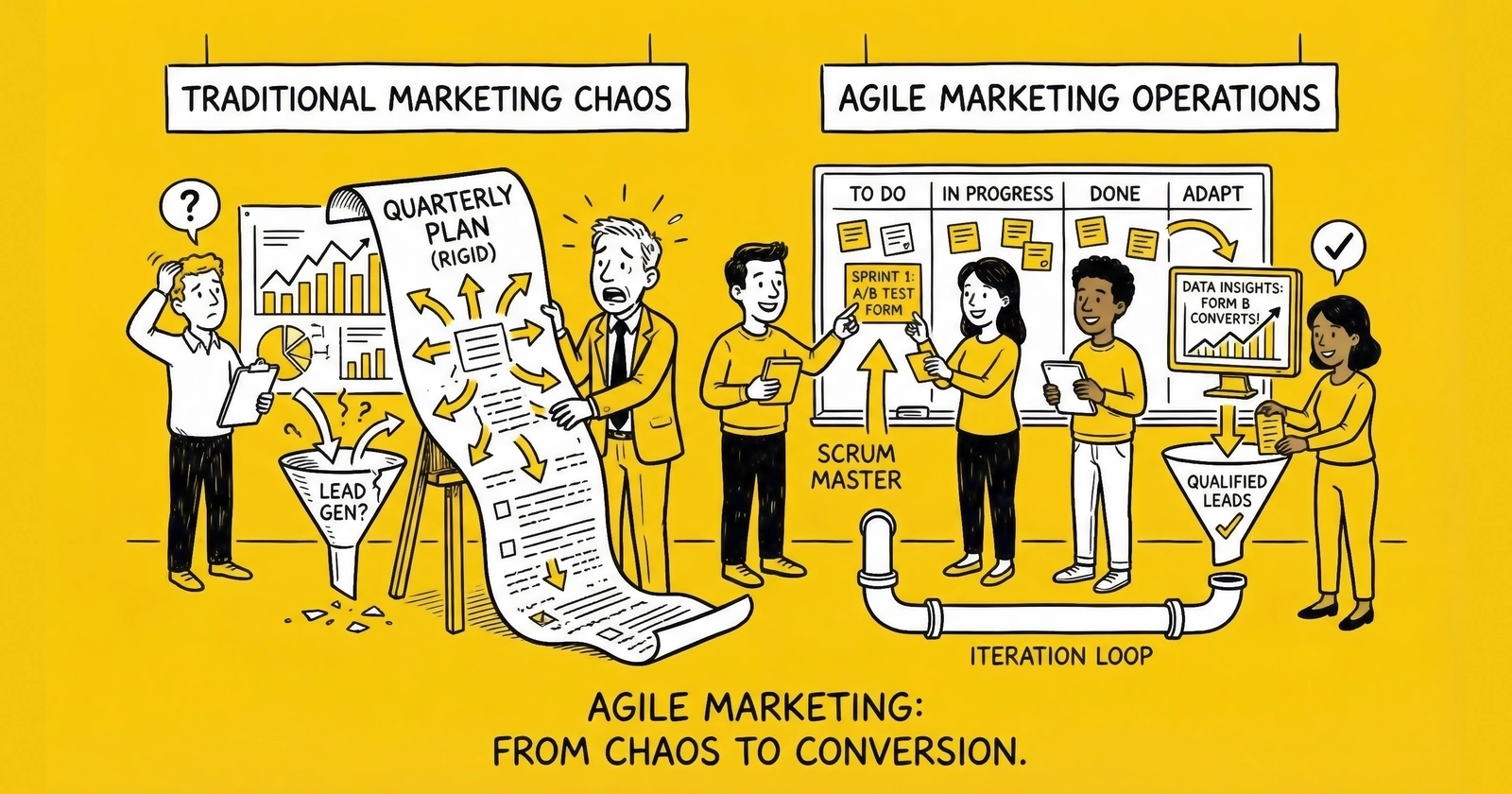
How lead generation operators apply agile methodologies to marketing operations – sprint planning, rapid testing cycles, cross-functional collaboration, and continuous improvement frameworks.
Lead generation operates in an environment where yesterday’s winning campaign becomes today’s fatigue victim, where regulatory changes invalidate tested approaches overnight, and where platform algorithm shifts can double costs without warning. Traditional marketing planning – annual budgets, quarterly campaigns, monthly reporting – cannot respond at the speed this environment demands.
Agile methodologies, developed originally for software development, provide frameworks for operating effectively in high-uncertainty, fast-changing environments. Applied to lead generation marketing, agile principles enable faster response to market changes, systematic learning from experiments, and continuous optimization that compounds over time.
This analysis examines how lead generation operators adapt agile methodologies to marketing operations, covering sprint-based planning, testing frameworks, team structures, and continuous improvement processes.
Why Agile Matters for Lead Generation
Lead generation’s operational reality makes agile approaches particularly valuable.
The Speed Problem
Lead generation changes faster than traditional planning cycles can accommodate:
Platform Changes: Meta, Google, and TikTok make algorithm, policy, and feature changes that can dramatically affect campaign performance. Annual or quarterly plans cannot anticipate these shifts.
Competitive Response: Competitors test, learn, and adapt continuously. Operators using slow planning cycles fall behind competitors who iterate faster.
Creative Fatigue: Ad creative fatigue occurs in days or weeks, not months. The creative that worked last month may deliver half the performance this month.
Regulatory Evolution: Compliance requirements shift with regulatory guidance, enforcement actions, and legal developments. Slow response creates compliance risk.
The Uncertainty Problem
Lead generation involves inherent uncertainty that planning cannot eliminate:
Testing Outcomes: Which creative, landing page, audience, or offer will perform best cannot be known in advance. Testing reveals reality that planning cannot predict.
Market Timing: Consumer behavior, competitive intensity, and economic conditions create performance variance that plans cannot anticipate.
Channel Dynamics: New channels emerge; existing channels mature or decline. Rigid channel allocation misses opportunity or wastes budget on declining returns.
The Learning Problem
Lead generation success depends on learning faster than competitors:
Compounding Advantage: Operators who learn and adapt quickly compound improvements over time. A 5% weekly improvement compounds to 12x annual improvement.
Knowledge Assets: Understanding what works in specific verticals, audiences, and contexts creates competitive advantage. Slow learning cycles waste this opportunity.
Institutional Memory: Systematic capture and application of learning builds organizational capability that individual heroics cannot match.
Agile methodologies address these problems through iterative cycles, systematic experimentation, and continuous learning processes.
Core Agile Principles for Marketing
Agile principles translate from software development to marketing operations.
Iterative Over Waterfall
Traditional “waterfall” marketing proceeds linearly: strategy → planning → creative development → launch → measurement → report. Each phase completes before the next begins, with feedback occurring only at the end.
Iterative agile marketing proceeds in cycles: plan → execute → measure → learn → repeat. Each cycle is short (typically 1-2 weeks), with learning from each cycle informing the next.
Waterfall Problems: By the time waterfall campaigns complete and measure, market conditions have changed. Feedback arrives too late to inform current decisions.
Iterative Advantages: Short cycles enable rapid response to performance data. Learning compounds through many small iterations rather than few large campaigns.
Working Results Over Comprehensive Documentation
Traditional marketing emphasizes detailed plans, comprehensive briefs, and thorough documentation before execution begins.
Agile marketing emphasizes getting campaigns live, measuring results, and iterating based on data. Documentation serves execution rather than substituting for it.
Documentation Trap: Extensive planning often delays execution without improving outcomes. Plans become outdated before they’re implemented.
Results Focus: Getting campaigns live quickly generates data that informs better decisions than extended planning without market feedback.
Responding to Change Over Following a Plan
Traditional marketing treats plans as commitments to be executed. Deviating from plan is failure; budget reallocation requires approval processes.
Agile marketing treats plans as hypotheses to be tested. Changing direction based on data is success; budget follows performance rather than predetermined allocation.
Plan Rigidity Problem: Market conditions change; customer behavior shifts; competitive dynamics evolve. Plans that don’t adapt become increasingly disconnected from reality.
Adaptive Advantage: Operators who reallocate resources based on performance data outperform those who execute predetermined plans regardless of results.
Collaboration Over Silos
Traditional marketing separates functions – creative, media, analytics, operations – with handoffs between teams and communication through documentation.
Agile marketing brings cross-functional teams together with shared objectives, continuous communication, and collective ownership of outcomes.
Silo Problems: Handoffs create delays; communication gaps cause rework; functional optimization undermines overall performance.
Collaboration Benefits: Cross-functional teams can make integrated decisions quickly, adapting creative, targeting, and landing pages together rather than sequentially.
Sprint-Based Marketing Planning
Sprints – fixed time periods of focused work – provide structure for agile marketing execution.
Sprint Structure
A typical marketing sprint follows this structure:
- Sprint Duration: 1-2 weeks is typical for lead generation marketing. Shorter sprints (1 week) enable faster iteration but increase planning overhead. Longer sprints (2 weeks) reduce overhead but slow response to performance data.
- Sprint Planning: At sprint start, the team identifies priorities, defines specific deliverables, and allocates capacity. Planning should be timeboxed – typically 2-4 hours – to prevent planning from consuming execution time.
- Daily Standups: Brief daily meetings (15 minutes or less) where team members share progress, blockers, and plans. Standups maintain coordination without consuming significant time.
- Sprint Execution: The team executes against sprint priorities, with flexibility to adjust tactics while maintaining strategic focus.
- Sprint Review: At sprint end, the team reviews what was accomplished, measures results, and identifies learnings. Review should include stakeholders who benefit from visibility.
- Sprint Retrospective: The team reflects on how they worked together, identifying process improvements for future sprints. Retrospectives focus on how, not what.
Sprint Planning for Lead Generation
Lead generation sprint planning addresses specific operational elements:
- Testing Backlog: Maintain a prioritized list of tests to run – creative variations, audience segments, landing page changes, offer modifications. Sprint planning selects which tests to execute based on priority and capacity.
- Optimization Work: Identify campaigns requiring attention – underperforming campaigns to fix, successful campaigns to scale, fatigued creative to refresh.
- Infrastructure Work: Technical improvements, tracking updates, automation implementation, and other operational investments that enable future execution.
- Compliance Tasks: Consent flow updates, disclosure modifications, documentation requirements, and other compliance-driven work.
- Capacity Allocation: Allocate team capacity across work types. A common split: 40% testing, 30% optimization, 20% infrastructure, 10% compliance. Adjust based on current priorities.
Sprint Metrics
Each sprint should have defined success metrics:
- Output Metrics: What did we produce? Campaigns launched, tests completed, creative variations deployed.
- Outcome Metrics: What results did we achieve? Leads generated, cost per lead, conversion rates.
- Learning Metrics: What did we learn? Tests conclusive, hypotheses validated or invalidated, insights captured.
Track sprint metrics over time to identify improvement trends and process problems.
Testing Frameworks
Systematic testing distinguishes agile marketing from ad hoc experimentation.
Test Prioritization
Not all tests are equally valuable. Prioritize based on:
- Impact Potential: How much could this test improve results if the hypothesis is correct? Tests with high improvement potential deserve priority.
- Confidence Level: How sure are we this will work? Lower confidence tests may warrant testing before higher confidence assumptions.
- Effort Required: How much work is needed to run the test? Low-effort tests can be run more frequently; high-effort tests require higher impact potential to justify.
- Learning Value: What will we learn regardless of outcome? Tests that inform future decisions have value beyond their immediate results.
A common prioritization framework: ICE (Impact × Confidence × Ease). Score each factor 1-10, multiply for composite score, prioritize higher scores.
Test Design
Well-designed tests produce reliable learning:
- Clear Hypothesis: Define what you’re testing and what you expect to happen. “This headline will increase conversion rate by 15% because it addresses the primary objection.”
- Single Variable: Change one thing at a time when possible. Multi-variable tests can work with sufficient volume but complicate interpretation.
- Statistical Validity: Ensure sufficient sample size for reliable conclusions. Use statistical significance calculators to determine required volume before testing.
- Control Condition: Maintain a control (current state) for comparison. Without control, you can’t isolate test impact from other changes.
- Defined Timeline: Specify when the test will conclude. Open-ended tests rarely conclude; timeboxed tests produce decisions.
Test Categories for Lead Generation
Common test categories in lead generation:
- Creative Testing: Headlines, images, video, ad copy variations. Creative testing is highest-velocity because creative can be produced and deployed quickly.
- Audience Testing: Targeting variations – demographics, interests, behaviors, custom audiences, lookalikes. Audience tests require sufficient budget to reach statistical significance across segments.
- Landing Page Testing: Page layout, form design, value proposition, social proof, urgency elements. Landing page tests affect all traffic, providing high impact per test.
- Offer Testing: What you’re offering – consultation type, content download, assessment, incentive. Offer tests can dramatically change performance but require more setup than creative tests.
- Funnel Testing: Multi-step qualification, progressive profiling, conditional paths. Funnel tests are more complex but can significantly affect lead quality and conversion.
Test Documentation
Document tests to capture and apply learning:
- Test Brief: Before launch – hypothesis, success criteria, timeline, metrics to track.
- Test Results: After conclusion – performance data, statistical significance, outcome determination.
- Learning Capture: What did we learn? What should we do differently? How does this inform future tests?
Maintain a searchable test repository. Past tests inform future decisions and prevent re-testing what you’ve already learned. For guidance on building documentation systems that scale, see our lead generation SOPs and operational playbooks guide.
Team Structure and Roles
Agile marketing requires team structures that enable rapid iteration.
Cross-Functional Teams
Effective agile marketing teams include:
- Media/Acquisition: Campaign management, platform expertise, budget allocation, bid management.
- Creative: Ad creative production, landing page design, copywriting, video production.
- Analytics: Performance tracking, test analysis, reporting, insight development.
- Operations: Technical infrastructure, integrations, automation, compliance implementation.
- Strategy: Prioritization, planning, stakeholder communication, competitive analysis.
Small operations may have individuals covering multiple functions; larger operations may have multiple people in each function. The principle: teams should have all capabilities needed to execute without external dependencies that create delays.
Agile Roles
Specific agile roles support effective execution:
- Product Owner/Marketing Owner: Sets priorities, defines success criteria, represents business objectives. Makes decisions about what to work on.
- Scrum Master/Facilitator: Facilitates agile processes – sprint planning, standups, reviews, retrospectives. Removes blockers that slow team progress.
- Team Members: Execute work within their functional expertise while collaborating across functions.
For small teams, one person may fill multiple roles. The functions matter more than formal role assignments.
Decision Rights
Clear decision rights prevent bottlenecks:
- Team Decisions: Day-to-day execution decisions should be made by team members doing the work. Don’t require approval for routine changes.
- Owner Decisions: Strategic decisions – priorities, major budget shifts, new direction – go to the marketing owner or leadership.
- Escalation Criteria: Define when decisions should escalate. Typical criteria: budget threshold, brand risk, compliance uncertainty.
Err toward team empowerment. Approval processes that slow execution undermine agile benefits.
Continuous Optimization Process
Agile marketing enables continuous optimization through systematic processes.
Performance Review Cadence
Regular performance review maintains optimization momentum:
- Daily: Review key metrics, identify issues requiring immediate response, surface blockers.
- Weekly: Analyze performance trends, review test results, plan optimization actions.
- Monthly: Assess strategic direction, evaluate channel mix, review against business objectives.
- Quarterly: Comprehensive review, strategy adjustment, capacity planning, process improvement.
Each cadence serves different purposes; skipping levels creates gaps in either tactical response or strategic direction.
Optimization Workflow
Systematic optimization follows a workflow:
- Identify: What’s underperforming or has improvement opportunity?
- Diagnose: Why is performance at current level? What’s causing the gap?
- Hypothesize: What change would improve performance?
- Test: Implement change in controlled manner.
- Measure: Did the change improve performance?
- Scale or Iterate: Scale successful changes; iterate on unsuccessful ones.
This workflow applies to campaigns, creative, landing pages, and any performance-affecting element.
Feedback Loops
Multiple feedback loops inform optimization:
- Platform Data: Real-time campaign performance from advertising platforms.
- Conversion Data: Lead quality, contact rates, conversion to sale from downstream systems.
- Buyer Feedback: Lead buyer satisfaction, quality disputes, pricing feedback.
- Consumer Feedback: Complaints, support inquiries, form abandonment signals.
Shorter feedback loops enable faster optimization. Integrate downstream data as quickly as possible; waiting weeks for lead-to-sale data slows optimization cycles. Implementing multi-touch attribution creates visibility into which touchpoints drive conversions across your testing program.
Learning Systems
Capture and apply learning systematically:
- Test Repository: All test results, searchable and accessible.
- Playbooks: Documented approaches that work, updated as learning evolves.
- Training Materials: Onboarding content so new team members absorb institutional knowledge.
- Post-Mortems: Analysis of significant failures, capturing learning to prevent repetition.
Learning that stays in individuals’ heads leaves when they do. Systematic capture builds organizational capability.
Common Implementation Challenges
Agile marketing implementation faces predictable challenges.
Resistance to Change
Teams accustomed to traditional marketing may resist agile approaches:
Planning Comfort: Detailed plans feel safer than iterative approaches. The discomfort of not knowing what you’ll do in month three is real.
Role Disruption: Cross-functional teams may threaten functional identities and reporting structures.
Measurement Anxiety: Frequent measurement can feel like surveillance rather than learning.
Response: Start with pilot teams or projects rather than organization-wide transformation. Demonstrate results that build buy-in. Address concerns directly rather than dismissing them.
Meeting Overhead
Agile ceremonies (standups, planning, reviews, retrospectives) can consume significant time:
Time Cost: A team doing all ceremonies might spend 5-10 hours weekly in meetings.
Fatigue: Meeting fatigue undermines engagement and value extraction.
Response: Timebox strictly – standups at 15 minutes, planning at 2 hours. Eliminate ceremonies that don’t add value for your context. Combine or reduce frequency if ceremonies become rote.
Speed vs. Quality Tension
Rapid iteration can pressure quality:
Shortcuts: Speed pressure may encourage cutting corners on creative quality, testing rigor, or compliance review.
Technical Debt: Quick fixes accumulate into systems that become difficult to maintain or modify.
Response: Include quality in sprint planning – time for review, testing, documentation. Track quality metrics alongside speed metrics. Address technical debt explicitly rather than letting it accumulate invisibly.
Stakeholder Expectations
Stakeholders may expect traditional outputs:
Plan Requests: Leadership may want comprehensive plans that agile approaches don’t produce.
Reporting Formats: Traditional reports may not capture agile learning and iteration.
Approval Processes: Existing approval workflows may conflict with agile decision speed.
Response: Educate stakeholders on agile approach and benefits. Provide visibility through sprint reviews rather than traditional reports. Negotiate approval thresholds that enable speed while maintaining appropriate oversight.
Scaling Agile Marketing
As operations grow, agile approaches must scale. For a comprehensive view of growth infrastructure, our guide to scaling lead generation operations covers the technical and organizational foundations that support agile at scale.
Multiple Teams
Larger operations require multiple agile teams:
- Team Scope: Each team owns a defined scope – vertical, channel, product, customer segment.
- Coordination: Cross-team coordination through regular sync meetings, shared backlog visibility, and communication channels.
- Consistency: Shared standards for testing, measurement, and documentation enable cross-team learning.
Portfolio Management
Multiple teams require portfolio-level coordination:
- Resource Allocation: Distribute budget and capacity across teams based on opportunity and performance.
- Strategic Alignment: Ensure team priorities align with business objectives.
- Dependency Management: Identify and manage dependencies between teams.
- Agile Approaches: SAFe (Scaled Agile Framework), LeSS (Large-Scale Scrum), and other frameworks provide structure for scaling, though marketing adaptations are typically lighter than software implementations.
Tool Requirements
Scaling requires tool support:
- Work Management: Jira, Asana, Monday, or similar tools for backlog management, sprint tracking, and visibility.
- Documentation: Confluence, Notion, or similar for playbooks, test repositories, and knowledge management.
- Analytics: Dashboards and reporting tools that provide real-time performance visibility.
- Communication: Slack, Teams, or similar for cross-team coordination.
Tool selection matters less than consistent usage. Pick tools that fit team preferences and enforce consistent practices.
Measuring Agile Marketing Effectiveness
Measure whether agile approaches are actually improving operations.
Process Metrics
Cycle Time: How long from idea to live campaign? Shorter is better.
Test Velocity: How many tests per sprint? More tests means more learning.
Sprint Completion: What percentage of sprint commitments are completed? Consistent completion indicates realistic planning.
Blocker Resolution: How quickly are blockers resolved? Fast resolution indicates effective process.
Outcome Metrics
Performance Improvement Rate: Are metrics improving sprint over sprint? Track CPL, conversion rate, lead quality trends.
Learning Capture: Are test results documented and accessible? Learning not captured is learning lost.
Stakeholder Satisfaction: Are business objectives being met? Are stakeholders getting what they need?
Team Health Metrics
Team Satisfaction: Do team members find the process effective? Survey periodically.
Sustainable Pace: Is the team maintaining velocity without burnout? Watch for velocity drops or turnover increases.
Skill Development: Is the team learning and growing? Track capability improvements.
Case Patterns: Agile Marketing in Practice
Understanding how operators have implemented agile marketing provides practical guidance.
The Testing Transformation
A lead generation operator struggled with creative fatigue. Ads that worked well initially would decline rapidly, but the team couldn’t produce new creative fast enough to keep pace. Monthly creative refreshes couldn’t address weekly performance decline.
Implementation: Adopted sprint-based creative production with dedicated testing backlog. Each two-week sprint included: 5+ new creative concepts tested, 10+ copy variations per winning concept, landing page tests aligned with creative themes. Daily performance monitoring identified fatigue within days rather than weeks.
Results: Creative refresh cycle shortened from monthly to weekly. CPL stabilized by replacing fatigued creative before significant performance decline. Testing velocity increased 5x. Win rate on tests improved as learning accumulated.
Key Insight: The sprint structure created predictable rhythm for creative production that matched the platform’s creative consumption rate.
The Campaign Recovery Sprint
A major regulatory change invalidated an operator’s primary consent flow. Traffic had to stop immediately while compliant alternatives were developed. Traditional planning would have required weeks of review and approval; the business couldn’t afford weeks without traffic.
Implementation: Emergency sprint focused entirely on compliance recovery. Cross-functional team (compliance, creative, media, technology) worked together with single objective: launch compliant campaigns within one week. Daily standups became twice-daily syncs. Decision authority was delegated to the team for anything under compliance threshold.
Results: New compliant campaigns launched in five days rather than the 3-4 weeks the previous process would have required. Revenue loss limited to one week instead of one month. The emergency sprint demonstrated agile capability that leadership then extended to normal operations.
Key Insight: Agile structures enable crisis response that traditional planning cannot match. The capability built for emergencies improves normal operations.
The Learning Accumulation Pattern
An operator ran many tests but struggled to apply learning systematically. Tests provided immediate optimization but didn’t build institutional knowledge. New team members repeated tests that previous team members had already run.
Implementation: Added learning documentation to sprint ceremonies. Each sprint review included explicit learning capture: what hypotheses were validated or invalidated, what the results mean for future tests, and how learnings apply beyond the specific test. Created searchable test repository with standardized documentation.
Results: Within six months, the repository contained 200+ documented tests. New team members could search for relevant prior tests before designing new experiments. Test win rate improved as the team avoided repeating failed approaches. Learning compounded as each sprint built on previous sprints’ knowledge.
Key Insight: Agile without learning capture produces temporary optimization. Systematic learning documentation creates permanent capability improvement.
Integrating AI with Agile Marketing
AI tools amplify agile marketing capability when properly integrated.
AI-Assisted Creative Production
AI accelerates the creative production that agile marketing requires:
- Variation Generation: AI can produce dozens of ad copy variations, image concepts, and video scripts in time that humans would need for a single version. Sprint creative capacity multiplies.
- Rapid Iteration: When tests identify winning elements, AI can generate iterations quickly. A winning headline can spawn 20 variations within hours rather than days.
- Format Adaptation: AI can adapt winning creative across formats and platforms. Content that works on Meta can be adapted for TikTok, LinkedIn, and YouTube formats efficiently.
- Quality Review: Human review remains essential. AI produces volume; humans ensure quality, brand alignment, and compliance. Build human review into sprint workflows as non-negotiable checkpoint.
AI-Assisted Analysis
AI accelerates the analysis that informs agile decisions:
- Pattern Recognition: AI can identify performance patterns across large numbers of campaigns, creative, and audiences that human analysis would miss or take weeks to surface.
- Anomaly Detection: AI can monitor for performance anomalies – sudden changes that warrant attention – enabling faster response than scheduled human review.
- Prediction: AI can forecast performance trends, helping teams prioritize which campaigns need attention and which will stabilize.
- Reporting Automation: AI can generate sprint reports, performance summaries, and learning documentation that would consume significant human time.
AI Integration Challenges
AI integration creates specific challenges:
- Over-Automation Risk: AI without human oversight can make decisions that damage quality, compliance, or brand. Build human checkpoints into AI-assisted workflows.
- Garbage In, Garbage Out: AI analysis is only as good as input data. Ensure tracking, attribution, and data quality support AI-driven insights.
- Team Skill Requirements: Teams need skills to direct AI effectively, evaluate AI output, and integrate AI into workflows. Training investment is required.
- Tool Proliferation: Many AI tools exist; selecting the right ones and integrating them coherently requires strategic approach rather than ad hoc adoption.
Agile Marketing Maturity Model
Organizations develop agile marketing capability through stages.
Stage 1: Initial Experimentation
Characteristics: Team experiments with agile practices – maybe running sprints for one campaign type or testing the retrospective process. Adoption is inconsistent and informal.
Indicators: Some agile vocabulary in use. Sporadic sprint-like cycles. Limited documentation. High variance in practice across team members.
Development Focus: Build understanding of agile principles. Identify champions who believe in the approach. Run formal pilot to demonstrate value.
Stage 2: Structured Practice
Characteristics: Team follows defined agile processes with consistent sprints, ceremonies, and documentation. Leadership supports the approach and provides resources.
Indicators: Regular sprint cadence. Consistent ceremony execution. Documented tests and learnings. Metrics tracked over time.
Development Focus: Optimize sprint structure for marketing context. Improve test prioritization and design. Build learning systems that capture institutional knowledge.
Stage 3: Integrated Operations
Characteristics: Agile practices integrated with broader organization. Cross-functional collaboration is standard. Learning flows across teams. Strategic and tactical work coexist in agile structure.
Indicators: Multiple coordinated teams. Portfolio-level sprint coordination. Strategic planning integrated with sprint execution. Organization-wide visibility into marketing performance.
Development Focus: Scale agile across organization. Integrate AI tools effectively. Build advanced measurement capability. Develop internal agile coaching.
Stage 4: Adaptive Excellence
Characteristics: Organization continuously improves agile practice itself. Processes evolve based on retrospective learning. The system optimizes its own performance.
Indicators: Regular process innovation. Metrics improvement trends sustained over years. Strong talent attraction and development. Industry recognition for marketing capability.
Development Focus: Share learning externally. Develop competitive moats from operational excellence. Invest in emerging capabilities before competitors.
Key Takeaways
-
Lead generation’s pace of change – platform algorithm shifts, creative fatigue, regulatory evolution – exceeds traditional planning cycles’ ability to respond, making agile methodologies valuable for operations that must adapt faster than quarterly or annual planning allows.
-
Agile’s core principles translate to marketing: iterative cycles over waterfall phases, working results over comprehensive documentation, responding to change over following plans, and cross-functional collaboration over siloed handoffs.
-
Sprint-based planning provides structure for agile execution with 1-2 week cycles including planning, daily standups, execution, review, and retrospective – each element serving specific coordination and learning purposes.
-
Test prioritization using frameworks like ICE (Impact × Confidence × Ease) ensures testing capacity focuses on highest-value experiments rather than ad hoc experimentation without strategic direction.
-
Well-designed tests require clear hypotheses, single variable changes when possible, statistical validity through sufficient sample size, control conditions for comparison, and defined timelines that force conclusions.
-
Cross-functional teams combining media, creative, analytics, operations, and strategy capabilities can execute without external dependencies that create delays – small teams may have individuals covering multiple functions.
-
Clear decision rights prevent bottlenecks: team members make execution decisions; marketing owners make strategic decisions; escalation criteria define when decisions move upward.
-
Continuous optimization follows systematic workflow: identify underperformance, diagnose root cause, hypothesize improvement, test the change, measure results, scale success or iterate on failure.
-
Multiple feedback loops – platform data, conversion data, buyer feedback, consumer feedback – inform optimization, with shorter loops enabling faster improvement cycles.
-
Implementation challenges include change resistance, meeting overhead, speed vs. quality tension, and stakeholder expectations – each requiring specific responses: pilot projects for buy-in, strict timeboxing for efficiency, quality metrics alongside speed metrics, and stakeholder education.
Frequently Asked Questions
How do we start implementing agile marketing without disrupting current operations?
Start with a pilot – one team, one vertical, or one campaign type. Define a 6-8 week pilot period with specific objectives: run X sprints, complete Y tests, achieve Z improvement in metric. Document what works and what doesn’t. Use pilot results to build organizational buy-in before broader implementation. The pilot team becomes advocates and advisors for subsequent rollout. Avoid mandating organization-wide transformation without demonstrated proof of concept; resistance to untested methodology is legitimate.
What sprint duration works best for lead generation marketing?
One-week sprints work well for high-velocity environments where creative testing is primary focus and quick iteration matters most. Two-week sprints work better when work includes more complex elements – landing page development, integration work, compliance reviews – that don’t fit one-week cycles. Many teams start with two-week sprints and move to one-week as they mature. The right answer depends on your work mix and team preferences; try different durations and measure which produces better results.
How do we balance testing velocity with statistical rigor?
This tension is real but manageable. For high-traffic campaigns, statistical significance accumulates quickly; prioritize these for rigorous testing. For lower-traffic campaigns, accept directional signals with larger uncertainty bands – a 70% confidence result still informs better than no data. Use Bayesian approaches that provide continuous probability updates rather than binary significant/not-significant conclusions. Reserve strict frequentist rigor for high-stakes tests where being wrong carries substantial cost. The goal is better decisions, not academic precision.
What tools do agile marketing teams actually need?
Essential: work management (Jira, Asana, Monday, or even Trello), communication (Slack/Teams), and basic analytics dashboards. Helpful but not essential: dedicated test documentation tools, automated reporting, integration platforms. Many teams over-tool early; sophisticated platforms go underutilized while simple spreadsheets would have sufficed. Start minimal, add tools when specific pain points justify them. Tool consistency matters more than tool selection – pick something and use it consistently rather than debating optimal solutions.
How do we handle stakeholders who expect traditional marketing plans and reports?
Education and translation. Help stakeholders understand what agile provides that traditional approaches don’t – faster adaptation, systematic learning, continuous improvement. Provide visibility through sprint reviews rather than static reports; invite stakeholders to see real results and real learning. Translate agile output into formats they understand – quarterly summaries of sprint outcomes, annual learning synthesis, performance trend analysis. Don’t fight the requirement for visibility; demonstrate that agile provides better visibility into what’s actually happening.
How does agile marketing handle longer-term strategic work?
Agile doesn’t mean only tactical. Strategic work fits into agile through: periodic strategic sprints focused on planning and analysis rather than execution; dedicated capacity allocation for strategic thinking within regular sprints; longer planning horizons (quarterly “big picture” planning) that set direction while sprints handle execution. The sprint structure handles execution; strategic direction comes from appropriate planning cadence – typically quarterly strategy reviews that inform sprint priorities for the following period.
What metrics indicate agile marketing is actually working?
Look for: improving cycle time (faster from idea to live campaign), increasing test velocity (more learning per period), better sprint predictability (completing commitments consistently), improving business outcomes (CPL, conversion rates, lead quality), and sustained team engagement (velocity maintained without burnout). Early indicators: the team feels more responsive to changes, learning is documented and accessible, stakeholders report better visibility. Warning signs: meeting fatigue, declining velocity, increasing incomplete sprints, team frustration with process overhead.
How do we maintain agile discipline during high-pressure periods?
High-pressure periods – regulatory emergencies, budget crunches, leadership demands – often cause teams to abandon agile practices in favor of reactive firefighting. This is precisely when agile discipline provides most value. Maintain core practices: daily standups become more important during crisis, not less; sprint structure provides focus amid chaos; retrospectives after high-pressure periods capture learning. Adapt intensity: sprint duration might shorten, ceremonies might compress, but structure should persist. The teams who maintain agile discipline through pressure emerge stronger; those who abandon it during stress never rebuild the practice.
What’s the relationship between agile marketing and marketing operations more broadly?
Agile marketing is a methodology within the broader marketing operations function. Marketing operations encompasses technology infrastructure, process design, measurement systems, and operational efficiency – the “how” of marketing execution. Agile provides methodology for how work flows through marketing operations. The two are complementary: strong marketing operations infrastructure (tracking, automation, integration) enables agile execution; agile methodology maximizes value from marketing operations investment. Organizations with weak marketing operations foundations may struggle with agile because they lack the infrastructure to execute rapidly. Marketing automation platforms provide the technical backbone that makes rapid iteration possible.
How does agile marketing adapt to remote and distributed teams?
Remote and distributed teams can execute agile marketing effectively with appropriate adaptation. Daily standups work well over video conference when timeboxed strictly. Async communication tools (Slack, Teams) replace hallway conversations. Sprint planning and retrospectives may need longer scheduled time to account for remote communication overhead. Documentation becomes more important when impromptu clarification is harder. Shared dashboards and real-time reporting tools replace physical boards. Time zone coordination requires explicit design – either overlapping work hours or clear async handoff protocols. Remote agile often produces better documentation and process clarity because implicit coordination mechanisms don’t work remotely. The principles remain the same; the tools and cadence adapt to distributed context.
What’s the minimum viable agile marketing implementation?
Minimum viable agile marketing includes three core elements: sprint cadence (regular cycles with defined start/end), sprint planning (prioritized work selection at cycle start), and sprint review (measuring what was accomplished and learned). Skip retrospectives initially if resource-constrained. Skip daily standups if the team is small and co-located. Use simple tools – a shared spreadsheet or Trello board. The minimum implementation should demonstrate value before expanding to full agile practice. Many teams fail by implementing too much ceremony too quickly; start minimal and add practices as their value becomes apparent.
Sources
- Agile Alliance. “Agile Manifesto and Principles.” https://agilealliance.org/agile101/
- Brinker, Scott. “Hacking Marketing: Agile Practices for Marketing Teams.” Wiley, 2016.
- McKinsey & Company. “Agile Marketing: A Step-by-Step Guide.” https://www.mckinsey.com/capabilities/growth-marketing-and-sales/our-insights/agile-marketing-a-step-by-step-guide
- Gartner. “Marketing Operations and Agile Methodology.” https://www.gartner.com/en/marketing/topics/marketing-operations
- Scrum.org. “Scrum Guide.” https://scrumguides.org/
- AgileSherpas. “State of Agile Marketing Report.” https://www.agilesherpas.com/state-of-agile-marketing-report