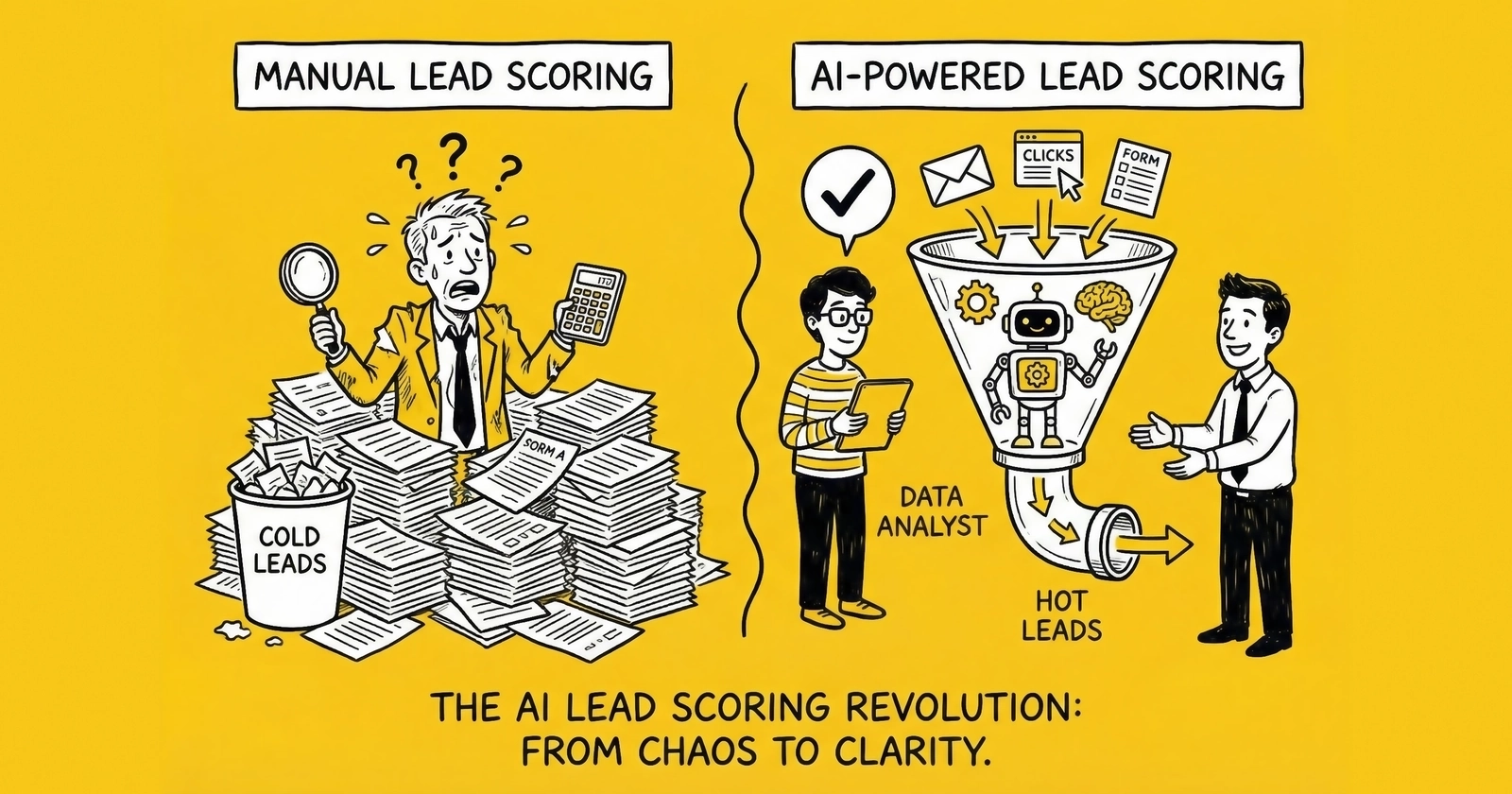
The difference between operators who talk about AI lead scoring and those who actually deploy it comes down to implementation discipline. Machine learning models that score leads in real-time, route high-value prospects instantly, and continuously improve from outcome data represent the operational standard for 2025. Here is the complete technical framework for building, deploying, and maintaining predictive scoring systems that deliver measurable results.
Lead scoring has existed for decades. Assign points for job title. Add points for company size. Subtract points for consumer email domains. The approach works well enough when lead volume is low and sales capacity is high.
Those conditions no longer exist.
Modern lead generation operations process thousands of leads daily across multiple channels, each lead generating dozens of data points that traditional scoring cannot synthesize. A lead who spent 8 minutes on your pricing page, arrived via branded search, submitted at 2 PM on a Tuesday from a corporate IP address, and matches the firmographic profile of your best customers looks identical to another lead who spent 45 seconds, arrived via display ad, submitted at 3 AM from a mobile device, and works at a company that has never purchased your category. Traditional scoring treats them similarly because it cannot process the combinatorial complexity of real behavioral data.
Machine learning changes this equation. Predictive models analyze thousands of historical leads with known outcomes to discover patterns that human intuition cannot detect. The model might learn that leads who view case studies before pricing pages convert at 2.3x the rate of those who view pricing first. Or that leads from specific referral sources convert poorly despite appearing qualified on demographic dimensions. These patterns exist in every lead database, invisible to rule-based scoring but accessible to properly constructed ML models.
The gap between AI-powered scoring leaders and traditional scoring laggards continues widening. Research indicates that companies using predictive lead scoring see 25-40% higher conversion rates and 28% shorter sales cycles compared to those using rule-based approaches. By 2025, 84% of B2B companies report using some form of AI for lead generation, though implementation depth varies dramatically.
This article provides the complete technical framework for AI-powered lead scoring: the machine learning model architectures that work in production, the feature engineering techniques that separate useful models from useless ones, training and validation methodologies that prevent common failures, deployment architectures for real-time scoring, and the continuous improvement practices that compound advantage over time.
The Anatomy of Predictive Lead Scoring
Before diving into implementation, understanding what makes predictive scoring fundamentally different from traditional approaches provides necessary context for architectural decisions.
Why Rules Fail at Scale
Traditional lead scoring operates on explicit rules created by humans based on assumptions about what matters. A marketing operations team decides that VP titles are worth 20 points, that pricing page visits add 15 points, and that downloading a whitepaper adds 10 points. These weights reflect intuition, not data.
The problems compound quickly:
Static weights ignore context. A VP title at a 50-person startup means something different than a VP title at a Fortune 500 company. The same pricing page visit from a prospect researching competitors carries different intent than one from a prospect returning after a demo. Static weights cannot capture these distinctions.
Linear combinations miss interactions. In reality, the combination of signals matters more than individual signals. A lead who downloads a whitepaper AND visits pricing AND requests a demo within 48 hours behaves fundamentally differently than one who does each action months apart. Linear point systems cannot express these interaction effects.
Weights become stale. The relationship between lead characteristics and conversion changes over time. Economic conditions shift buyer behavior. Competitive dynamics alter qualification patterns. Product changes affect who converts. Static scoring reflects historical conditions that may no longer apply.
Manual maintenance does not scale. As operations add channels, products, and buyer segments, the rules multiply. Maintaining thousands of rules across dozens of segments exceeds human capacity. Gaps and inconsistencies emerge.
How Machine Learning Differs
Machine learning approaches the problem differently. Rather than humans specifying which patterns matter, algorithms discover patterns by analyzing historical outcomes.
The training process works as follows: the model receives thousands of historical leads with their characteristics (the features) and their outcomes (converted or did not convert). Through iterative optimization, the model adjusts internal weights to minimize prediction error. The resulting model can score new leads based on patterns learned from historical data.
The key differences from rule-based scoring:
Automatic pattern discovery. The model identifies which features predict conversion without human specification. It might discover that leads from specific referral sources convert poorly despite appearing qualified on other dimensions, a pattern that would never occur to human rule-writers.
Interaction capture. Modern ML models naturally capture interaction effects. A gradient boosting model might learn that the combination of “enterprise company size” AND “multiple stakeholder visits” AND “competitive comparison page views” predicts conversion at 4x the rate that any individual signal predicts.
Continuous calibration. Probability scores from well-calibrated models have interpretable meaning. A 30% conversion probability means roughly 30% of similar leads actually convert. This calibration enables principled decision-making about resource allocation.
Scalable maintenance. When patterns change, retraining updates the model automatically rather than requiring manual rule revision. The same training pipeline that built the initial model can refresh it with new data.
Model Architecture Overview
Predictive lead scoring systems typically comprise several interconnected components:
Data pipeline. Collects and transforms raw data from source systems (CRM, marketing automation, web analytics, lead distribution platforms) into model-ready features.
Feature store. Maintains computed features in a format accessible for both model training and real-time scoring.
Training pipeline. Periodically trains or retrains models on historical data with known outcomes.
Model registry. Version-controls trained models with metadata about training data, performance metrics, and deployment status.
Scoring service. Applies the current production model to new leads in real-time or batch mode.
Monitoring system. Tracks prediction accuracy, feature drift, and model degradation to trigger retraining when necessary.
Each component has specific technical requirements that determine overall system effectiveness. The following sections address each in detail.
Feature Engineering: The Foundation of Predictive Power
Feature engineering transforms raw data into predictive signals. This step determines model performance more than algorithm selection. A simple model with excellent features outperforms a sophisticated model with poor features.
Principles of Effective Feature Engineering
Several principles guide feature construction for lead scoring:
Capture information available at scoring time. Features must represent information available when the lead is scored, not information that becomes available later. Including future information in training creates “leakage” that produces excellent training metrics but fails in production.
Transform raw signals into patterns. Raw data rarely predicts directly. “Visited pricing page” matters less than “visited pricing page three times within 48 hours after viewing case studies.” Feature engineering extracts these patterns.
Encode domain knowledge. While ML discovers patterns automatically, encoding known relationships accelerates learning. If leads from specific industries historically convert better, creating explicit industry category features helps the model leverage that knowledge.
Balance complexity with interpretability. Highly complex features improve prediction but obscure understanding. Balance predictive power against the ability to explain why leads receive specific scores.
Feature Categories for Lead Scoring
Effective lead scoring draws features from multiple data categories:
Demographic and firmographic features describe who the lead is. For B2B, this includes company size, industry, revenue, growth rate, technology stack, and organizational structure. For individual contacts, this includes job title, seniority level, and department. These features establish baseline qualification but rarely differentiate between similar leads.
Behavioral features capture what the lead has done. Page views, content downloads, email engagement, webinar attendance, and product usage create behavioral fingerprints. Temporal patterns within behavior often matter more than event counts: a lead who engaged intensively over three days signals differently than one who engaged sporadically over three months.
Channel and source features encode where the lead originated. Traffic source, campaign, keyword, referral site, and ad creative all carry predictive signal. Source quality varies dramatically, and these features help models learn which channels produce genuine intent versus form-fillers. For more on channel evaluation, see our blended vs channel ROI analysis guide.
Timing features capture when interactions occurred. Time of day, day of week, recency of engagement, and cadence between interactions all predict conversion. Leads who engage during business hours from corporate networks behave differently than those engaging late at night from mobile devices.
Validation and enrichment features add external signals. Phone validation (line type, carrier, connection status), email verification (deliverability, domain reputation), address verification (accuracy, commercial versus residential), and third-party enrichment data (intent signals, technographic data, recent funding) enhance prediction accuracy. See our guide on lead validation for phone, email, and address for implementation details.
Constructing Behavioral Features
Behavioral features typically provide the highest predictive lift. Constructing them effectively requires thoughtful aggregation:
Recency features capture how recently each behavior occurred. “Last pricing page visit within 24 hours” predicts differently than “last pricing page visit 30 days ago.” Recency often matters more than frequency.
Frequency features count behavior occurrences within time windows. “Visited pricing page 5 times in last 7 days” creates a more predictive feature than simple “visited pricing page” indicators.
Velocity features capture rate of change. “Page views per day increased 3x this week versus last week” signals escalating interest that point-in-time features miss.
Sequence features encode behavior order. “Viewed case study before pricing page” differs from “viewed pricing page before case study.” Sequence reflects buyer journey stage and intent level.
Engagement depth features measure intensity of individual interactions. Time on page, scroll depth, video watch percentage, and form completion time indicate engagement quality beyond binary “did or did not” signals.
Content affinity features categorize what content the lead consumed. Leads who engage with product-focused content signal differently than those consuming thought leadership. Topic clustering reveals intent patterns.
Feature Selection and Importance
Not all engineered features improve prediction. Feature selection removes noise while retaining signal:
Correlation analysis identifies redundant features measuring the same underlying signal. When features correlate highly (correlation above 0.85), retaining one typically suffices.
Importance ranking from tree-based models quantifies feature contribution. Features with minimal importance can be removed without accuracy loss.
Recursive elimination systematically removes features while monitoring accuracy. Features whose removal does not degrade performance can be dropped, simplifying the model.
Domain validation ensures retained features make business sense. If an important feature defies logical explanation, it may reflect data leakage or spurious correlation rather than genuine signal.
Feature selection typically reduces feature sets by 30-60% while maintaining or improving accuracy. Simpler models train faster, deploy more easily, and explain more clearly.
Model Selection and Training
With features engineered, model selection and training translate data into predictive capability. The choices made here determine whether the scoring system delivers value or becomes an expensive failure.
Algorithm Selection for Lead Scoring
Several algorithm families apply to lead scoring, each with distinct characteristics:
Logistic regression remains the default starting point despite being among the simplest approaches. The model predicts probability of binary outcomes (will convert / will not convert) based on weighted feature contributions. Logistic regression offers complete interpretability: you can see exactly which features drive predictions and by how much. For many lead scoring applications, logistic regression with well-engineered features performs within 5-10% of more complex approaches while offering far greater transparency.
Gradient boosting machines (XGBoost, LightGBM, CatBoost) build ensembles of decision trees where each tree corrects errors from previous trees. These models typically achieve the highest accuracy in tabular data applications like lead scoring. They handle non-linear relationships, interaction effects, and missing values naturally. The trade-off is reduced interpretability, though feature importance rankings and SHAP values provide some transparency.
Random forests aggregate predictions from many decision trees trained on different data subsets. Performance typically falls between logistic regression and gradient boosting. They work well when training data is limited or robustness matters more than maximum accuracy.
Neural networks can capture arbitrarily complex patterns but require substantially more training data and computational resources. For most lead scoring applications, neural networks offer minimal improvement over gradient boosting while adding significant complexity.
The practical recommendation: start with logistic regression to establish interpretable baselines. If accuracy gains justify complexity, move to gradient boosting (LightGBM offers the best balance of speed and accuracy). Only consider more sophisticated approaches when simpler methods demonstrably hit ceilings.
Training Data Preparation
Training data quality determines model quality. Several preparation steps ensure training data supports effective learning:
Outcome definition. Define precisely what “conversion” means for your scoring objective. Form submission? Sales accepted lead? Closed-won opportunity? Customer after 30 days? Different definitions produce different models optimized for different purposes. Be explicit about what you are predicting.
Observation window. Determine how far back training data extends. Too short a window provides insufficient examples. Too long a window includes stale patterns that no longer apply. Twelve to eighteen months typically balances volume with relevance for B2B lead scoring.
Outcome window. Define how long after lead creation you wait before labeling outcomes. A lead created today might convert next month. Including recent leads without waiting for outcomes biases training toward non-conversion. Typical outcome windows range from 30-90 days depending on sales cycle length.
Class balance. Lead scoring typically involves imbalanced classes: conversions represent 2-10% of leads. Several techniques address imbalance:
- Oversampling duplicates minority class examples to balance training
- Undersampling removes majority class examples to balance training
- SMOTE generates synthetic minority examples through interpolation
- Class weighting adjusts loss function to penalize minority class errors more heavily
Experiment with multiple approaches. The best technique varies by dataset characteristics.
Train-validation-test split. Partition data into three sets: training (60-70%), validation (15-20%), and test (15-20%). The training set builds the model. The validation set tunes hyperparameters. The test set provides unbiased final evaluation. Never allow information from validation or test sets to influence training decisions.
Temporal ordering. For lead scoring specifically, temporal splits often matter more than random splits. Train on leads from months 1-12, validate on months 13-15, test on months 16-18. This approach tests whether patterns discovered in historical data predict future behavior rather than just interpolating within the training period.
Hyperparameter Tuning
Hyperparameters control model behavior and require tuning for optimal performance. For gradient boosting, key hyperparameters include learning rate, number of trees, maximum tree depth, and minimum samples per leaf. Tuning approaches range from grid search (exhaustive but slow) to random search (faster for large spaces) to Bayesian optimization (most sample-efficient). Automated ML platforms (H2O, DataRobot) automate tuning alongside feature engineering. Hyperparameter tuning typically improves accuracy by 5-15% over default settings.
Validation and Performance Metrics
Model performance requires evaluation against appropriate metrics. Several metrics apply to lead scoring:
AUC-ROC measures the model’s ability to rank leads correctly, independent of any specific threshold. A model with 0.85 AUC correctly ranks a random converting lead above a random non-converting lead 85% of the time. AUC provides a threshold-independent measure of discrimination ability.
Precision at K measures what fraction of the top K-scored leads actually convert. If you can only work 100 leads per day, precision at 100 tells you what fraction of those 100 will convert. This metric directly maps to operational decisions about resource allocation.
Recall at K measures what fraction of all converters appear in the top K-scored leads. If 500 leads will convert this month and 400 of them score in your top 1,000, recall at 1,000 is 80%. This metric indicates whether high-value leads are being prioritized.
Lift measures how much better model-guided selection performs versus random selection. If the top 10% of scored leads convert at 3x the baseline rate, that is 3x lift in the top decile. Lift translates directly to business impact.
Calibration measures whether probability scores match actual conversion rates. A well-calibrated model’s 30% probability predictions should see roughly 30% actual conversion. Calibration matters when using scores to set thresholds or make probabilistic decisions.
Precision-recall curves and F1 scores help select operating thresholds when precision and recall trade off against each other.
Evaluate models on the held-out test set after all training and tuning decisions are finalized. The test set must remain untouched until final evaluation to provide unbiased performance estimates.
Addressing Common Training Failures
Several failure modes undermine model development:
Overfitting occurs when models memorize training data rather than learning generalizable patterns. Signs include large gaps between training and validation performance. Address overfitting through regularization, feature reduction, or more training data.
Data leakage occurs when training features contain information that would not be available at scoring time. A common example: including the outcome variable or close derivatives as features. Leaky models appear excellent during training but fail completely in production.
Label noise occurs when outcome labels are incorrect or inconsistent. Leads labeled as non-conversions that actually converted corrupt training signal. Audit outcome data quality before model development.
Distribution shift occurs when the training data distribution differs from the deployment distribution. A model trained on leads from six months ago may not predict accurately on current leads if market conditions have changed.
Insufficient data prevents reliable pattern learning. With fewer than 1,000 conversion examples, patterns may reflect noise rather than signal. Collect more data before attempting sophisticated modeling.
Deployment Architecture for Production Scoring
A trained model creates no value until deployed to score actual leads. Deployment architecture determines whether predictions reach operational systems reliably and quickly.
Real-Time vs. Batch Scoring
Lead scoring deployments fall into two categories based on latency requirements:
Real-time scoring generates predictions at lead intake, typically within milliseconds. When a lead submits a form, the scoring service receives the lead data, computes features, applies the model, and returns a score before the lead routes to a destination. Real-time scoring enables immediate prioritization and routing decisions.
Real-time requirements:
- Scoring latency under 100 milliseconds
- High availability (99.9%+ uptime)
- Horizontal scalability for volume spikes
- Feature computation fast enough for synchronous execution
Batch scoring processes accumulated leads periodically (hourly, daily). Leads enter the system without scores, and periodic jobs compute scores for all unscored leads. Batch scoring suffices when immediate prioritization is unnecessary.
Batch requirements:
- Processing capacity for full lead volume within batch window
- Reliable job scheduling and monitoring
- Score distribution to downstream systems after batch completion
Most mature implementations use hybrid approaches: real-time scoring for initial prioritization with batch re-scoring as additional behavioral data accumulates. A lead scored at submission might be re-scored 24 hours later incorporating subsequent engagement.
Scoring Service Architecture
Real-time scoring services typically follow microservice patterns. Model serving infrastructure hosts the trained model and exposes it through an API. Options include custom API servers (Flask/FastAPI), managed ML serving (AWS SageMaker, Google Vertex AI), or open-source serving tools (MLflow, BentoML). The choice depends on scale, team capabilities, and existing infrastructure.
Feature computation must happen within latency constraints. Pre-computed features stored in low-latency databases (Redis, DynamoDB) reduce scoring latency but introduce staleness. Real-time computation ensures freshness but adds latency. Most production systems combine pre-computed historical features with real-time event features.
Error handling must address failures gracefully: timeout handling, fallback scores when unavailable, input validation, and circuit breakers to prevent cascade failures. A scoring service that fails 1% of requests creates operational pain. Design for reliability from the start.
Integration with Downstream Systems
Scores only create value when they reach systems where decisions are made:
CRM integration pushes scores to lead records where sales teams see them. Salesforce, HubSpot, Dynamics, and other CRMs accept scores through APIs or webhooks. Scores should appear on lead views and inform workflow automation.
Marketing automation integration enables score-based segmentation and workflow routing. High-scored leads might trigger immediate sales alerts while lower-scored leads enter nurture sequences.
Lead distribution integration incorporates scores into routing logic. Ping-post systems can include scores in ping responses, allowing buyers to bid based on predicted quality. Internal routing can direct high-scored leads to senior resources.
BI and analytics integration makes scores available for reporting and analysis. Dashboards tracking score distributions, score-to-outcome correlations, and model performance require score data in analytical systems.
Integration architecture should treat scores as first-class data flowing through existing pipelines rather than requiring separate data paths.
Model Versioning and Rollback
Production systems require controlled model updates:
Version control tracks every trained model with its training data, hyperparameters, and performance metrics. Tools like MLflow, Weights & Biases, or Neptune provide model registries.
Staged deployment tests new models before full production rollout:
- Shadow mode: new model scores leads in parallel with production model, but only production scores route decisions
- Canary deployment: new model scores a small percentage of traffic, with outcomes monitored
- Full rollout: new model replaces production model for all traffic
Rollback capability enables quick reversion when new models underperform. Keeping previous model versions deployable within minutes prevents extended periods of degraded performance.
A/B testing compares model versions with statistical rigor. Randomly assigning leads to model variants and measuring conversion rate differences determines whether new models actually improve outcomes.
Continuous Improvement and Model Maintenance
Initial deployment begins rather than ends the work. Models degrade over time as conditions change. Continuous improvement practices maintain and extend value.
Monitoring Model Performance
Production models require ongoing monitoring across several dimensions:
Prediction accuracy compares scores to subsequent outcomes. Track conversion rates by score band: do leads scored 0.7-0.8 actually convert at rates between 70-80%? Declining correlation between scores and outcomes signals model degradation.
Score distribution drift monitors whether score distributions change over time. If median scores increase without corresponding conversion rate increases, the model may be inflating scores without predictive basis.
Feature drift detects when input feature distributions change from training distributions. If average company size of incoming leads increases 40% from training data, the model may not predict accurately for these different leads.
Latency and availability track operational performance. P99 latency exceeding thresholds or availability dropping below targets requires immediate attention regardless of prediction accuracy.
Data quality monitors input data for completeness and validity. Missing features, invalid values, and format changes can corrupt predictions silently.
Dashboard these metrics with alerting thresholds that trigger investigation when violations occur. Catching degradation early prevents extended periods of poor predictions.
Retraining Cadence and Triggers
Models require periodic retraining to incorporate new data and adapt to changing conditions:
Scheduled retraining updates models at fixed intervals (monthly, quarterly) regardless of detected degradation. This approach ensures models stay current even when monitoring does not detect drift.
Triggered retraining initiates updates when monitoring detects performance degradation beyond thresholds. This approach retrains only when necessary, reducing operational overhead.
Continuous learning updates models incrementally as new labeled data becomes available. This approach maintains freshness without full retraining but requires more sophisticated infrastructure.
Most production systems combine scheduled and triggered approaches: monthly scheduled retraining as baseline with triggered retraining when monitoring detects significant degradation.
Retraining pipelines should be automated and reproducible. Manual retraining processes introduce errors and delay updates.
Feedback Loop Implementation
Models improve when outcomes flow back to training:
Outcome collection captures which leads converted and when. CRM integrations that mark leads as won or lost complete the feedback loop. Without outcome data, models cannot learn from experience.
Attribution alignment connects leads to downstream outcomes despite identity fragmentation. A lead who submits on mobile, engages via email on desktop, and converts through a phone call must be recognized as single journey for proper attribution.
Negative outcome handling includes leads that did not convert in training data. Training only on successes creates biased models that cannot distinguish converters from non-converters.
Label latency accounts for time between lead creation and outcome determination. Leads created yesterday cannot yet be labeled because their outcomes remain unknown. Training data must exclude recent leads without waiting sufficient time for outcomes.
Label quality ensures outcomes accurately reflect reality. If sales teams close leads as “lost” without qualification, or if conversions are not recorded consistently, label noise corrupts training signal.
Building robust feedback loops often requires more effort than building initial models. The investment compounds because better feedback produces better models which produce better predictions indefinitely.
Experimentation and Improvement
Beyond maintenance, continuous improvement extends model capability:
New feature experimentation tests whether additional data sources improve predictions. Intent data, technographic enrichment, or new behavioral signals might increase accuracy.
Algorithm experimentation evaluates whether different modeling approaches outperform current production. Annual algorithm reviews ensure you are not leaving performance on the table.
Objective refinement questions whether you are predicting the right outcome. Shifting from predicting lead qualification to predicting revenue value might better align with business objectives.
Explanation enhancement improves ability to explain why leads receive specific scores. Better explanations increase sales team trust and adoption.
Run experiments with proper controls (A/B tests or holdout groups) to measure actual impact rather than assuming improvements.
Deployment Strategy Selection: The D.E.P.L.O.Y. Framework
Choosing the right deployment strategy determines whether your scoring model delivers value or becomes expensive shelfware. The D.E.P.L.O.Y. Framework guides strategy selection based on organizational context.
D - Data Infrastructure Maturity
Assess your existing data infrastructure before committing to deployment approaches:
Nascent (Level 1): Spreadsheets and basic CRM. Manual processes dominate. Limited API integration capability.
- Recommended: Start with embedded platform scoring (HubSpot, Salesforce Einstein, Marketo) before building custom models.
Developing (Level 2): CRM and marketing automation integrated. Basic reporting infrastructure. Some API connectivity.
- Recommended: Use managed ML platforms (BigML, DataRobot) to reduce infrastructure burden.
Maturing (Level 3): Data warehouse established. ETL pipelines functional. Analytics team exists.
- Recommended: Custom model development with cloud ML services (SageMaker, Vertex AI) balancing control with managed infrastructure.
Advanced (Level 4): Real-time data pipelines. Feature stores. MLOps practices established.
- Recommended: Full custom deployment with Kubernetes-based serving, A/B testing infrastructure, and automated retraining pipelines.
E - Expertise Available
Technical expertise shapes feasible deployment approaches:
No ML Expertise: Use embedded platform scoring. Train marketing/sales teams to interpret and act on scores rather than building models.
Data Analyst Expertise: Apply AutoML tools (H2O, DataRobot, Google AutoML) that abstract model development. Focus analyst time on feature engineering and business interpretation.
Data Science Capability: Build custom models with appropriate tooling. Balance sophistication against maintenance burden.
ML Engineering Team: Full custom deployment with production-grade infrastructure. Invest in MLOps practices that compound advantage over time.
P - Processing Latency Requirements
Latency requirements constrain deployment architecture:
Batch Processing (Hours/Daily): Simplest deployment. Score leads in overnight batches. Scores available next business day. Suitable for long sales cycles where immediate scoring provides marginal value.
Near-Real-Time (Minutes): Webhook-triggered scoring when leads arrive. Processing delay acceptable. Simpler infrastructure than true real-time. Works for most B2B lead routing scenarios.
Real-Time (Milliseconds): Score during form submission. Enables real-time personalization and routing. Requires production-grade serving infrastructure with high availability.
Streaming (Continuous): Update scores continuously as behavioral data arrives. Maximum freshness but maximum complexity. Required only for sophisticated personalization engines.
L - Lead Volume and Velocity
Volume determines infrastructure scale requirements:
| Monthly Leads | Processing Approach | Infrastructure Needs |
|---|---|---|
| Under 1,000 | Manual batch viable | Spreadsheet/basic tools |
| 1,000-10,000 | Scheduled batch | Cloud function or small server |
| 10,000-100,000 | Near-real-time | Managed ML service |
| 100,000+ | Real-time streaming | Production infrastructure |
O - Outcome Feedback Latency
How quickly outcomes become known affects deployment design:
Fast Feedback (Days): Lead accepts/rejects within days. Model can iterate quickly. Aggressive retraining viable.
Medium Feedback (Weeks): Sales cycle extends 2-8 weeks. Training data accrues slowly. Monthly retraining typical.
Slow Feedback (Months): Long consideration cycles delay outcome visibility. Annual model updates may suffice. Focus on feature engineering rather than frequent retraining.
Y - Yield Requirements
Define acceptable performance levels before deployment:
Minimum Viable Accuracy: What AUC or lift is required for the model to add value? A model with 0.62 AUC may not justify deployment complexity.
Acceptable Downtime: How much scoring unavailability can the business tolerate? 99% uptime means 7+ hours of outage monthly.
Latency SLAs: What scoring latency does the business require? Specify P50, P95, and P99 requirements.
Deployment Architecture Patterns
Based on D.E.P.L.O.Y. assessment, select from these proven architecture patterns:
Pattern 1: Embedded Platform Scoring
Description: Use ML scoring built into existing platforms (Salesforce Einstein, HubSpot, Marketo).
How It Works: Platform ingests behavioral and demographic data. Proprietary models score leads automatically. Scores appear in platform UI and workflows.
Advantages:
- Zero infrastructure investment
- Pre-integrated with existing workflows
- Vendor handles model maintenance
- Rapid deployment (days, not months)
Limitations:
- Black-box models limit customization
- Features constrained to platform data
- Cannot incorporate external signals
- Limited to platform’s modeling approach
Best For: Organizations with under 10,000 monthly leads, limited technical resources, or primary CRM/marketing automation platforms that offer scoring.
Pattern 2: Managed ML Platform
Description: Use cloud AutoML services (Google AutoML, AWS SageMaker Autopilot, Azure AutoML) or dedicated platforms (DataRobot, H2O).
How It Works: Upload training data to platform. Platform handles feature engineering, model selection, and hyperparameter tuning. Deploy models through platform APIs.
Advantages:
- Sophisticated models without ML expertise
- Automated feature engineering and selection
- Built-in deployment and monitoring
- Scales with volume automatically
Limitations:
- Per-prediction costs add up at scale
- Less control over model architecture
- Vendor lock-in risks
- May not support all feature types
Best For: Organizations with data science-capable analysts but without ML engineering. Monthly volumes of 1,000-100,000 leads.
Pattern 3: Custom Model, Managed Serving
Description: Build custom models with preferred tools, deploy via managed serving infrastructure (SageMaker Endpoints, Vertex AI Prediction, Azure ML).
How It Works: Data scientists develop models locally or in notebooks. Export models to standard formats. Deploy to managed serving infrastructure that handles scaling, monitoring, and availability.
Advantages:
- Full control over model architecture
- Custom features and domain logic
- Production-grade reliability without ops overhead
- Pay-per-prediction pricing at reasonable rates
Limitations:
- Requires ML development capability
- Model maintenance remains your responsibility
- Integration work needed for downstream systems
- Monitoring and alerting must be configured
Best For: Organizations with data science capability seeking production reliability without building infrastructure. Medium to high volume operations.
Pattern 4: Full Custom Deployment
Description: Build end-to-end ML infrastructure including feature stores, training pipelines, model serving, and monitoring.
How It Works: Custom infrastructure handles data ingestion, feature computation, model training, serving, and monitoring. Typically Kubernetes-based with tools like MLflow, Kubeflow, or Feast.
Advantages:
- Maximum control and customization
- Lowest per-prediction cost at scale
- No vendor dependencies
- Can implement sophisticated MLOps
Limitations:
- Highest initial investment
- Requires ML engineering expertise
- Ongoing infrastructure maintenance
- Takes months to build properly
Best For: High-volume operations (100,000+ monthly leads) with ML engineering capability and long-term commitment to scoring as competitive advantage.
Deployment Differentiation: Competitive Moats in Lead Scoring
The operators who build durable advantage in lead scoring do not just deploy models; they create systems that compound improvement over time. These differentiation strategies separate scoring leaders from followers.
The Proprietary Feature Advantage
Standard models use standard features. Competitive advantage comes from proprietary signals unavailable to competitors:
First-Party Behavioral Data: Your website analytics, form interaction patterns, and content consumption create features competitors cannot replicate. Every form abandonment pattern, pricing page sequence, and support chat interaction builds unique signal.
Proprietary Validation Signals: Custom validation checks beyond standard APIs create unique features. Phone validation combined with SIM tenure, email verification combined with domain reputation, address standardization combined with move date indicators.
Buyer Feedback Integration: Outcomes from your specific buyers create learning loops competitors lack. Which leads do YOUR buyers convert? What return patterns appear in YOUR data? These signals train models optimized for your specific buyer ecosystem.
Cross-Vertical Insights: Operations spanning multiple verticals discover patterns invisible to single-vertical competitors. A consumer who qualifies for auto insurance exhibits patterns predictive of home insurance qualification. Cross-vertical features compound advantage.
The Speed Advantage
Faster model iteration creates compounding advantage:
Rapid Experimentation: Infrastructure that supports quick model testing allows more hypotheses per quarter. Ten experiments per quarter beats two experiments per quarter over a year.
Automated Retraining: Pipelines that automatically retrain on fresh data maintain model freshness without manual intervention. Models updated monthly outperform models updated annually as markets shift.
Real-Time Feature Computation: Features computed in real-time incorporate recent behavior that batch features miss. A lead showing intensive engagement in the last hour signals differently than one whose most recent activity was yesterday.
The Integration Advantage
Deep integration across the lead lifecycle creates feedback loops:
Outcome Velocity: Reducing time from lead to labeled outcome accelerates learning. Operations that know within 48 hours whether a lead converted train better models than those waiting 30 days.
Downstream Signal Capture: Integrating call center outcomes, buyer feedback, and post-sale data creates richer training signals. Most operations stop at form submission; leaders incorporate months of downstream behavior.
Multi-System Orchestration: Scoring that informs routing, pricing, nurture, and buyer matching creates multiplicative value. A score that only prioritizes sales follow-up captures fraction of potential value.
Organizational and Operational Considerations
Technical implementation is necessary but insufficient. Organizational factors often determine whether scoring systems deliver value.
Driving Adoption
The best model delivers zero value if users ignore it.
Demonstrate value early. Before full deployment, show stakeholders how high-scored leads differ from low-scored leads in historical data. If high-scored leads converted at 3x the rate, that evidence builds trust.
Integrate into existing workflows. Scores should appear where users already work. Adding scores to CRM views, email notifications, and existing dashboards reduces adoption friction.
Explain predictions. Users trust systems they understand. Showing which features contributed most to a score helps users assess whether the score makes sense.
Track adoption metrics. Measure whether users actually use scores in decisions. If high-scored leads do not receive faster follow-up, the scoring system is not changing behavior.
Address concerns directly. Sales teams may worry that algorithms will replace their judgment or that scores will be used against them. Address these concerns explicitly. Position scoring as augmenting judgment rather than replacing it.
Defining Success Metrics
Clear success metrics focus effort and enable accountability:
Model metrics (AUC, precision, lift) measure technical performance but do not directly measure business impact.
Conversion metrics (conversion rate, revenue per lead) measure outcomes but may be influenced by factors beyond scoring.
Efficiency metrics (speed to contact for high-scored leads, time spent on low-probability leads) measure behavioral change from scoring.
Adoption metrics (percentage of users accessing scores, correlation between scores and prioritization) measure whether the system is actually used.
Track multiple metrics to get complete picture. A model with excellent AUC that users ignore delivers no value. High adoption with a poorly performing model also fails.
Define targets before deployment. What improvement justifies the investment? Agreeing on success criteria upfront prevents goalpost movement later.
Managing Expectations
AI lead scoring is not magic. Expect 3-6 months from project start to meaningful results. Expect 15-40% improvement in prioritization effectiveness, not 10x transformation. Budget for ongoing maintenance, not just initial development. Scores inform decisions; they do not make decisions. No model achieves perfect accuracy. Evaluate performance in aggregate, not on individual cases.
Frequently Asked Questions
What is AI-powered lead scoring and how does it differ from traditional point-based scoring?
AI-powered lead scoring uses machine learning algorithms to analyze historical conversion patterns and predict which leads are most likely to convert. Traditional scoring assigns fixed point values based on human assumptions: job titles get 20 points, pricing page visits add 15 points. These weights are arbitrary and static.
Machine learning discovers patterns from data rather than assumptions. The algorithm might learn that leads who view case studies before pricing pages convert at 2.3x the rate of those who view pricing first, or that specific referral sources produce high-intent leads despite appearing unremarkable on demographic dimensions. These patterns emerge from thousands of outcome examples, not human intuition. Research indicates that predictive scoring delivers 25-40% higher conversion rates compared to rule-based approaches.
What data do I need to build an effective lead scoring model?
Effective lead scoring requires three categories of data. First, outcome data connecting leads to eventual results: which leads converted, which did not, and ideally the revenue value and time to conversion. Without outcome data, models cannot learn what success looks like. Second, lead attribute data including demographics (job title, company size, industry), firmographics (revenue, technology stack), and contact quality signals. Third, behavioral data capturing engagement patterns: page views, content consumption, email interactions, and timing signals.
Minimum viable implementation requires at least 5,000-10,000 leads with documented outcomes. Below this threshold, models cannot reliably distinguish signal from noise. Data must be connected across systems; if marketing captures behavior but outcomes live in a disconnected CRM, the feedback loop is broken.
How long does it take to implement AI lead scoring from start to production?
Implementation timelines range from 3-6 months for comprehensive deployments. Month one focuses on data audit and preparation: inventorying data sources, establishing tracking for missing data, and cleaning historical records. Months two and three cover feature engineering and model development: transforming raw data into predictive features, training and validating models, and tuning for performance. Months four and five address deployment and integration: building scoring services, connecting to CRM and automation systems, and training users. Month six focuses on monitoring and optimization: tracking production performance, addressing adoption barriers, and beginning continuous improvement.
Organizations with mature data infrastructure may accelerate timelines. Those discovering significant data gaps may need additional time for foundation work before modeling can begin.
What conversion rate improvement can I realistically expect from predictive scoring?
Documented results show 25-40% improvement in conversion rates when focusing effort on high-scored leads. This improvement comes from prioritization, not lead quality changes. The same leads processed with predictive scoring convert at higher rates because sales resources focus on highest-probability opportunities.
Improvement magnitude depends on baseline sophistication. Operations currently using no scoring or crude demographic rules see larger gains. Operations already using sophisticated rule-based scoring see more modest improvements. Starting point matters: 40% improvement from a 5% baseline produces 7% conversion, a meaningful but not transformative absolute change.
Which machine learning algorithms work best for lead scoring?
Gradient boosting machines (XGBoost, LightGBM, CatBoost) typically achieve the highest accuracy for lead scoring on tabular data. These algorithms handle non-linear relationships, feature interactions, and missing values naturally. LightGBM offers the best balance of speed and accuracy for most applications.
However, logistic regression remains valuable as a starting point. It offers complete interpretability: you can see exactly which features drive predictions. For many applications, logistic regression with well-engineered features performs within 5-10% of gradient boosting while providing transparency that aids debugging and builds user trust. Start with logistic regression, move to gradient boosting if accuracy gains justify reduced transparency.
How do I handle the class imbalance problem in lead scoring?
Lead scoring involves imbalanced classes: conversions typically represent 2-10% of leads. A model predicting “will not convert” for every lead achieves high accuracy while being useless. Several techniques address imbalance.
Oversampling duplicates minority class (converting) examples to balance training data. SMOTE generates synthetic minority examples through interpolation. Undersampling removes majority class examples. Class weighting adjusts the loss function to penalize minority class errors more heavily. Each approach has trade-offs. Oversampling may cause overfitting to minority examples. Undersampling discards potentially useful majority examples. Experiment with multiple approaches and select based on validation performance.
How often should I retrain my lead scoring model?
Most production systems retrain monthly or quarterly as baseline, with triggered retraining when monitoring detects significant performance degradation. Monthly retraining ensures models incorporate recent patterns without excessive operational overhead. Monitoring should track score-to-outcome correlation, score distribution drift, and feature distribution changes to trigger earlier retraining when conditions shift.
Markets that change rapidly may require more frequent retraining. Stable markets may permit less frequent updates. The key is monitoring: if prediction accuracy degrades between scheduled retrains, the schedule is too infrequent.
What infrastructure do I need for real-time lead scoring?
Real-time scoring requires a scoring service that applies models within latency constraints, typically under 100 milliseconds. Infrastructure options include custom API servers built with Python frameworks (Flask, FastAPI), managed ML serving platforms (AWS SageMaker, Google Vertex AI), or open-source serving tools (MLflow, BentoML).
Beyond model serving, real-time scoring requires feature computation infrastructure. Pre-computed features stored in low-latency databases (Redis, DynamoDB) reduce scoring latency. Real-time feature computation requires fast data access and efficient calculation. Most production systems combine pre-computed historical features with real-time event features.
High availability matters: a scoring service that fails 1% of requests creates operational pain. Design for 99.9%+ uptime with appropriate redundancy and failover.
How do I get my sales team to actually use lead scores?
Adoption requires demonstrating value, integrating into existing workflows, and addressing concerns. Before deployment, show historical analysis: high-scored leads in past data converted at 3x the rate of low-scored leads. This evidence builds trust before asking for behavior change.
Integrate scores where users already work. Scores appearing on CRM lead views, in email notifications, and on existing dashboards reduce adoption friction. Avoid requiring users to access separate systems. Provide score explanations showing which factors contributed most; users trust systems they understand.
Track adoption metrics: are high-scored leads actually receiving faster follow-up? If behavior does not change, investigate barriers. Some teams fear algorithmic replacement of judgment or worry scores will be used against them. Address these concerns directly by positioning scoring as augmenting judgment rather than replacing it.
What are the most common reasons AI lead scoring implementations fail?
Data quality issues cause the most failures. Missing outcome data prevents learning. Inconsistent definitions produce unreliable predictions. Small sample sizes mean patterns reflect noise rather than signal. Data quality problems must be solved before sophisticated modeling.
Organizational adoption failures rank second. Models that users ignore create no value regardless of technical excellence. Without change management, training, and demonstrated value, scoring systems become expensive shelfware.
Inadequate maintenance causes delayed failures. Models degrade as conditions change. Organizations that deploy models without monitoring and retraining processes find initial benefits evaporate within 6-12 months. Building the model is 20% of the work; maintaining it is 80%.
Key Takeaways
Feature engineering determines model success more than algorithm selection. A simple logistic regression with excellent features outperforms sophisticated neural networks with poor features. Invest heavily in transforming raw data into predictive signals, particularly behavioral features that capture engagement patterns invisible to demographic data.
Start with interpretable models before adding complexity. Logistic regression provides complete transparency into what drives predictions. Begin there to establish baselines and build organizational trust. Move to gradient boosting (LightGBM) only when interpretability trade-offs are justified by meaningful accuracy gains.
Training data quality and quantity set the ceiling. Models cannot learn patterns that do not exist in training data. Minimum viable implementation requires 5,000-10,000 leads with documented outcomes. Invest in outcome tracking and data quality before sophisticated modeling.
Real-time scoring requires production-grade infrastructure. Latency under 100 milliseconds, 99.9%+ availability, and horizontal scalability are table stakes for production deployments. Build or buy infrastructure appropriate to your scale and capabilities.
Deployment is the beginning, not the end. Models degrade as conditions change. Continuous monitoring, periodic retraining, and feedback loop maintenance determine whether initial value persists. Budget for ongoing investment, not just initial development.
Adoption determines actual impact. The best model creates zero value if users ignore it. Demonstrate value early, integrate into existing workflows, explain predictions, and address concerns directly. Track adoption metrics alongside accuracy metrics.
Expect 15-40% improvement in prioritization effectiveness, not transformation. AI lead scoring optimizes existing capacity rather than creating new capacity. Set realistic expectations to prevent disappointment while recognizing that compound improvements over time generate substantial value.
Build for iteration and learning. Initial models will not be optimal. Feature stores, model registries, and automated retraining pipelines enable rapid improvement. Organizations that treat scoring as a one-time project rather than ongoing capability fail to capture compounding benefits.
Sources
- Forrester Research - Research foundation for B2B marketing and sales technology adoption statistics, including AI implementation rates
- Salesforce Research Reports - Industry data on sales cycle optimization and AI-driven lead prioritization outcomes
- HubSpot State of Marketing - Annual survey data on marketing technology adoption and conversion rate benchmarks
- Google Core Web Vitals - Technical specifications for real-time performance metrics including latency thresholds
- MLflow Documentation - Open-source platform documentation for model versioning, registry, and deployment patterns referenced in the article
The operators building predictive scoring capabilities now, with proper feature engineering, rigorous training practices, production-grade deployment, and continuous improvement processes, will compound advantage over competitors still relying on static rules. The technology has matured from experimental to essential. The implementation patterns are documented and repeatable. The question is no longer whether to implement AI-powered lead scoring but how quickly you can build the capability before it becomes table stakes.