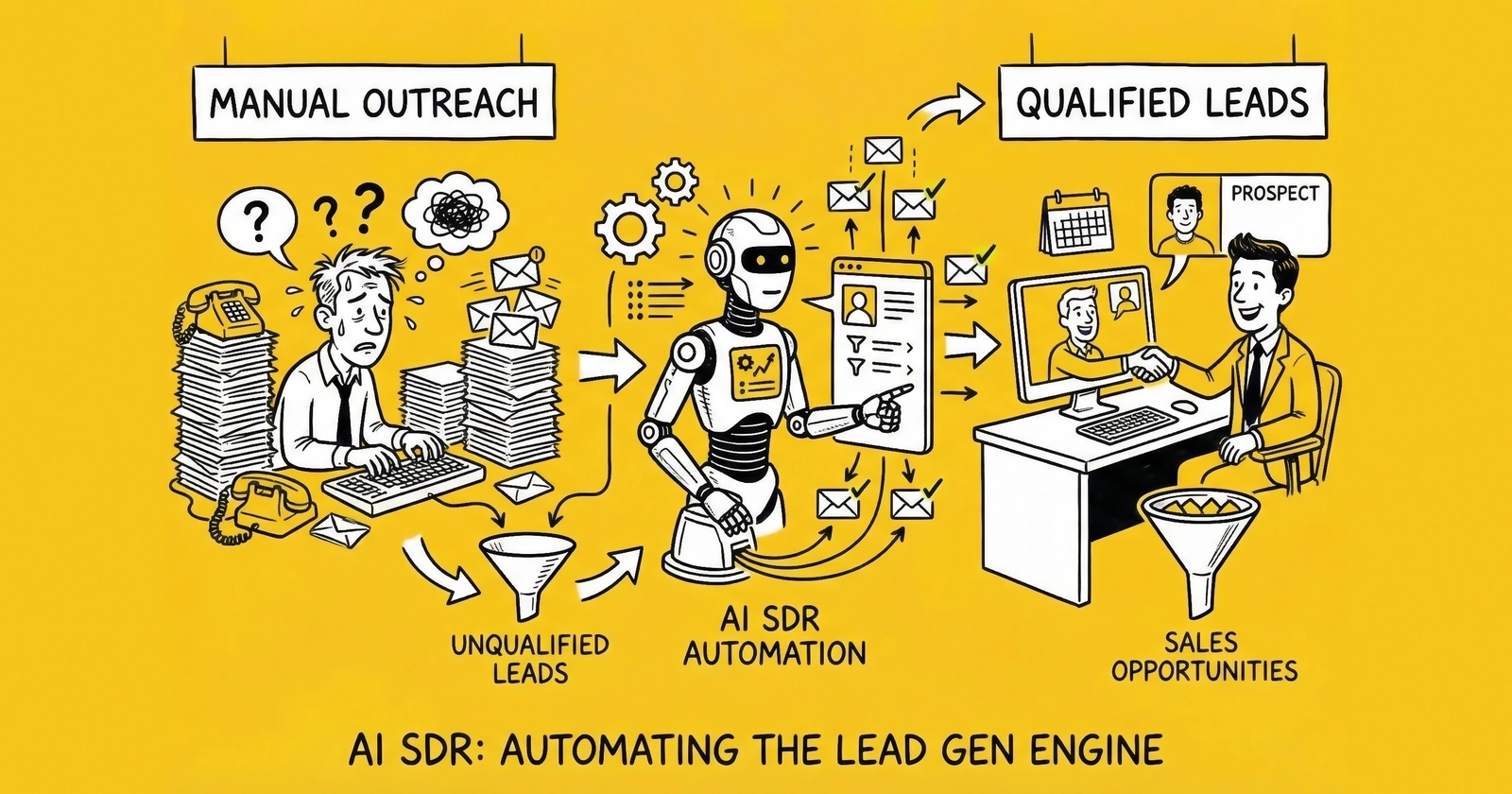
How artificial intelligence is reshaping sales development, which platforms actually deliver results, and the strategic considerations for integrating AI SDRs into your lead generation operations.
Introduction: The AI SDR Revolution
The sales development representative function is undergoing its most significant transformation since the rise of predictive dialers. AI-powered SDR tools now handle prospecting, email personalization, multi-channel outreach sequencing, and initial qualification – tasks that traditionally required teams of human representatives working full-time.
The market has responded aggressively. Platforms like 11x.ai have raised over $50 million in funding to build “AI workers” that operate autonomously. Artisan AI promises onboarding in 10 minutes with 80% task automation. Enterprise players like Salesforce have integrated AI agents directly into their CRM ecosystem through Agentforce.
For lead generation operators, this shift creates both opportunity and competitive pressure. Organizations deploying AI SDRs effectively report 50-70% reductions in cost per qualified meeting. Those that ignore the technology face margin compression as competitors achieve lower customer acquisition costs.
But the technology is not magic. AI SDRs excel at specific use cases while struggling with others. Deployment requires significant operational adjustment. The platforms vary dramatically in capabilities, pricing, and actual performance versus marketing claims.
This guide provides the practitioner’s perspective on AI SDR technology: what works, what does not, how to evaluate platforms, and how to integrate AI sales development into lead generation operations.
Understanding AI SDR Technology
What AI SDRs Actually Do
AI SDR platforms automate the core functions of human sales development representatives:
Prospecting and List Building
AI systems identify potential prospects by analyzing firmographic data, technographic signals, intent data, and behavioral patterns. They build targeted lists based on ideal customer profiles, often integrating with data providers like ZoomInfo, Apollo, or LinkedIn Sales Navigator. The technology excels at scale. An AI system can evaluate thousands of potential targets against dozens of criteria simultaneously, identifying prospects that match complex qualification frameworks. Understanding what constitutes lead generation provides essential context for how AI SDRs fit into the broader ecosystem.
Email Personalization at Scale
Traditional personalization required SDRs to research each prospect individually and craft custom messages. AI systems generate personalized content by analyzing company news and press releases, individual LinkedIn activity and posts, technographic stack information, industry-specific pain points, and previous engagement history. The output ranges from variable insertion (basic personalization) to fully generated messages that reference specific prospect situations.
Multi-Channel Sequencing
Modern AI SDR platforms orchestrate outreach across email, LinkedIn, phone, and sometimes SMS. They manage timing, frequency, and channel selection based on engagement patterns and prospect preferences.
Response Handling and Qualification
AI systems process inbound responses, categorizing them as positive interest, objections, questions, or out-of-office. They can handle routine qualification conversations, asking screening questions and capturing structured data.
Meeting Scheduling
When prospects express interest, AI systems can navigate calendar availability, propose times, handle rescheduling, and send confirmations without human intervention.
What AI SDRs Cannot Do (Yet)
Understanding limitations prevents disappointment and misallocation of resources.
Complex Objection Handling
AI systems struggle with nuanced objections that require creative problem-solving or deep product knowledge. They handle common objections well but fail on edge cases.
Relationship Building
High-touch enterprise sales requiring relationship development over months or years remain human territory. AI systems excel at initial contact and qualification, not long-term relationship nurturing.
Strategic Account Planning
Developing comprehensive account strategies involving multiple stakeholders, competitive positioning, and custom value propositions exceeds current AI capabilities.
Live Phone Conversations
While some platforms advertise AI voice agents, performance in live phone conversations remains inconsistent. Most AI SDR platforms focus on written communication with phone-adjacent features like voicemail drops or call scheduling.
Major AI SDR Platforms Compared
11x.ai
The highest-profile player in the AI SDR space, 11x.ai has raised over $50 million and positions its products as “AI workers” rather than tools. The platform offers three core products: Alice handles autonomous outbound SDR functions including prospecting, email outreach, and qualification; Jordan serves as an AI phone agent for inbound and outbound calls; and Julian manages inbound lead engagement and qualification.
The platform delivers full-stack outbound automation from list building to meeting booking, integration with major CRM and data platforms, multi-language support for international campaigns, and voice AI for phone-based engagement. Pricing follows a consultative sales process without public rates, though industry reports suggest costs range from $5,000-$15,000+ monthly depending on volume and features.
This platform serves enterprise organizations with significant outbound volume seeking to replace or augment SDR teams at scale. The platform’s sophistication requires meaningful implementation investment. High cost of entry and implementation complexity make 11x.ai less suitable for SMB or operations testing AI SDR capabilities.
Artisan AI (Ava)
Artisan positions Ava as an “AI employee” focused on B2B outbound sales development with emphasis on rapid deployment. The platform claims 10-minute onboarding for basic setup with 80% automation of traditional SDR tasks. Core capabilities include email and LinkedIn outreach automation, built-in B2B contact database access, and CRM integration with Salesforce, HubSpot, and Pipedrive.
Artisan uses tiered pricing starting at approximately $1,000/month for smaller implementations, scaling based on contact volume and feature access. The platform serves mid-market companies wanting faster time-to-value without extensive implementation, prioritizing accessibility over maximum customization. Simpler implementation may come with less sophisticated personalization and fewer advanced features compared to enterprise platforms.
AiSDR
AiSDR differentiates through pre-built playbooks, offering 50+ SDR sequences tested across industries and use cases. The platform provides an extensive playbook library for rapid deployment, LinkedIn and email channel support, intent signal integration, CRM and sales tech stack integration, and conversation intelligence with optimization capabilities.
Pricing follows a volume-based model with entry points around $500-$1,500 monthly for smaller implementations. The platform serves organizations preferring proven playbook approaches over building sequences from scratch, particularly valuable for teams without extensive SDR process expertise. Playbook-driven approaches may limit customization for organizations with unique sales processes or positioning.
Salesforce Agentforce (Einstein SDR Agent)
Salesforce’s native AI SDR solution integrates directly with the Salesforce ecosystem. The platform offers native CRM integration without middleware, applying existing Salesforce data and workflows. Einstein AI powers personalization and scoring, with multi-channel orchestration within Sales Cloud and enterprise security and compliance built in.
Pricing integrates with Salesforce licensing, typically as an add-on to Sales Cloud, with costs of $50-$200+ per user monthly depending on feature tier. The platform serves organizations already using Salesforce who want native integration without third-party platform complexity. Feature depth may lag specialized AI SDR platforms, and dependency on the broader Salesforce ecosystem may limit flexibility.
Reply.io
Reply.io evolved from a sales engagement platform to include AI-powered SDR capabilities. The platform offers AI email generation and personalization, multi-channel sequences across email, LinkedIn, and calls, a Jason AI assistant for conversation handling, built-in contact data access, and team collaboration features.
Tiered pricing starts at $49/month for basic features, scaling to $99-$299/month for AI features. The platform serves organizations wanting AI SDR capabilities within a broader sales engagement platform at accessible price points. AI features are additive to the core platform rather than purpose-built, which may require more manual configuration than dedicated AI SDR platforms.
Outreach and SalesLoft AI Capabilities
The established sales engagement platforms have added AI features to compete with purpose-built AI SDR solutions.
Outreach integrates AI across its platform through Outreach Kaia for conversation intelligence and AI-powered sequence recommendations. The platform offers predictive analytics for identifying high-probability prospects, automated email drafting with personalization suggestions, and smart send-time optimization. Pricing typically runs $100-150 per user monthly for enterprise deployments with AI features. Outreach serves enterprise organizations already using the platform who want AI augmentation without switching vendors.
SalesLoft added Rhythm AI to provide guided selling recommendations, automated meeting scheduling, and AI-generated email content. The platform emphasizes workflow optimization – suggesting next best actions based on engagement patterns and deal stage. Cadence AI automates sequence creation and optimization based on historical performance data. Pricing follows enterprise licensing models, typically $125-175 per user monthly for full AI capabilities.
Both platforms position AI as enhancement to existing sales engagement workflows rather than autonomous replacement. Organizations already invested in these ecosystems may find native AI features more practical than integrating standalone AI SDR platforms, though purpose-built solutions like 11x.ai and Artisan typically offer deeper automation.
Emerging Players and Specialists
Beyond the major platforms, specialized solutions target specific niches within AI SDR functionality.
Clay focuses on data enrichment and prospecting intelligence rather than outreach automation. The platform aggregates data from dozens of sources to build comprehensive prospect profiles that feed into AI SDR systems. Clay serves as infrastructure for AI SDR operations rather than a direct competitor, often used alongside platforms like Artisan or AiSDR.
Warmly identifies anonymous website visitors and provides real-time intelligence to sales teams. While not a full AI SDR platform, Warmly integrates with AI SDR systems to trigger outreach when target accounts visit key pages – adding intent signals that improve timing and relevance.
Lavender specializes in AI email coaching, analyzing messages and providing real-time recommendations for improving open and reply rates. The platform integrates with AI SDR systems to improve message quality rather than handling automation directly.
Platform Comparison Matrix
| Platform | Starting Price | Best For | Key Differentiator |
|---|---|---|---|
| 11x.ai | ~$5,000+/mo | Enterprise full-stack | AI workers concept, voice AI |
| Artisan (Ava) | ~$1,000/mo | Mid-market fast deployment | 10-minute onboarding, 80% automation |
| AiSDR | ~$500/mo | Playbook-driven orgs | 50+ pre-built sequences |
| Salesforce Agentforce | ~$50-200/user/mo | Salesforce shops | Native CRM integration |
| Reply.io | $49-299/mo | Budget-conscious teams | Accessible entry point |
Implementation Strategy for Lead Generation
Assessing AI SDR Readiness
Not every organization should deploy AI SDRs immediately. Evaluate readiness across three critical dimensions.
Data Quality Requirements
AI systems are only as good as the data they access. Successful deployment requires clean CRM data with accurate contact information, defined ideal customer profiles with measurable criteria, historical engagement data for training and optimization, and integration capability with your existing tech stack. Organizations with poor data hygiene will amplify problems through AI automation rather than solve them. Proper lead validation across phone, email, and address establishes the data quality foundation AI SDRs require.
Process Maturity
AI SDRs work best when replicating proven processes. Required foundations include documented outreach sequences with known performance, clear qualification criteria and handoff definitions, established response handling protocols, and measurement frameworks for SDR performance. Automating undefined processes produces automated chaos.
Volume Justification
AI SDR platforms require meaningful volume to justify investment. Consider your current monthly outbound volume and capacity constraints, target account universe size, cost per SDR versus AI platform licensing, and growth trajectory requiring scalable infrastructure. Organizations sending 500 emails monthly do not need enterprise AI SDR platforms.
Phased Implementation Approach
Phase 1: Parallel Testing (Weeks 1-4)
Run AI SDR campaigns alongside human SDR efforts targeting similar profiles. Measure response rates, meeting conversion rates, lead quality scores, and cost per meeting booked. This baseline establishes realistic expectations for AI performance in your specific context.
Phase 2: Process Optimization (Weeks 5-8)
Based on Phase 1 learnings, optimize AI configurations. Refine messaging templates based on response analysis, adjust targeting criteria based on conversion patterns, configure exception handling for common scenarios, and establish escalation protocols for complex situations.
Phase 3: Scale and Integration (Weeks 9-12)
Expand AI SDR coverage to additional segments. Roll out to new ICPs or territories, integrate with downstream sales processes, implement advanced features like intent triggers and multi-touch sequences, and build monitoring and alerting infrastructure.
Phase 4: Continuous Optimization (Ongoing)
AI SDR performance improves through iteration. A/B test messaging variations, analyze conversion funnel for drop-off points, incorporate new data sources and signals, and refine qualification criteria based on close rates.
Human + AI Hybrid Models
The most effective implementations combine AI scale with human judgment. AI handles initial outreach at scale, response categorization and routing, meeting scheduling logistics, data capture and CRM updating, and follow-up sequence management. Humans handle complex objection resolution, high-value account engagement, strategic relationship development, deal negotiation, and custom proposal development.
The hybrid model often outperforms both pure-human and pure-AI approaches by leveraging respective strengths.
Building the AI SDR Technology Stack
Successful AI SDR deployment requires integration with a broader technology infrastructure. The components must work together to maximize AI effectiveness.
CRM integration forms the foundation. AI SDRs must read from and write to your CRM in real-time to access prospect data, record activities, and update lead statuses. Bidirectional sync ensures human team members see AI activities and AI systems see human interactions. Platforms with native CRM connectors for Salesforce and HubSpot reduce implementation complexity significantly.
Data enrichment services enhance AI personalization capabilities. Services like ZoomInfo, Apollo, or Clearbit provide technographic, firmographic, and intent data that AI systems use to personalize outreach. The quality of enrichment directly impacts personalization quality – poor data produces generic messages regardless of AI sophistication.
Email deliverability infrastructure protects sender reputation while enabling volume. This includes domain warming services, email verification tools, and monitoring dashboards that track deliverability metrics. Without proper infrastructure, AI-generated volume can damage your entire email program.
Analytics and reporting close the feedback loop. You need visibility into AI activities, response patterns, and downstream outcomes. Platforms with built-in analytics simplify reporting; those without require integration with external BI tools.
| Stack Component | Purpose | Example Tools |
|---|---|---|
| CRM | Lead data, activity logging | Salesforce, HubSpot, Pipedrive |
| Data Enrichment | Contact and company data | ZoomInfo, Apollo, Clearbit |
| Email Infrastructure | Deliverability protection | Mailgun, SendGrid, Warmbox |
| Analytics | Performance tracking | Platform native, Looker, Tableau |
Performance Benchmarks and ROI
Realistic Performance Expectations
Marketing claims from AI SDR vendors often exceed real-world performance. Baseline expectations based on industry data provide realistic planning benchmarks.
Email Metrics
Expect open rates of 25-45% where AI personalization helps, reply rates of 3-8% similar to human-optimized campaigns, positive reply rates of 1-3%, and meeting conversion from outreach of 0.5-2%.
Volume Capabilities
AI SDRs typically send 8-15 emails per account monthly depending on platform limits, manage 500-2,000 accounts per AI SDR instance, and book 5-20 meetings per 1,000 contacts.
Quality Metrics
No-show rates run 15-25% compared to 20% average for human SDRs. SQL conversion from AI-booked meetings ranges 40-60%. Pipeline generated per meeting varies by average contract value.
ROI Calculation Framework
Calculate AI SDR ROI against human SDR alternatives using the following cost structures.
Human SDR Costs (Monthly)
| Cost Element | Amount |
|---|---|
| Base salary | $4,500-$6,500 |
| Benefits (25%) | $1,125-$1,625 |
| Tools/tech stack | $200-$500 |
| Management overhead | $500-$1,000 |
| Training/ramp time | $300-$500 |
| Total per SDR | $6,625-$10,125 |
AI SDR Costs (Monthly)
| Cost Element | Amount |
|---|---|
| Platform licensing | $1,000-$5,000 |
| Data/enrichment | $200-$500 |
| Human oversight (0.25 FTE) | $1,500-$2,500 |
| Implementation (amortized) | $200-$500 |
| Total per AI SDR | $2,900-$8,500 |
Comparative Output
| Metric | Human SDR | AI SDR |
|---|---|---|
| Outreach capacity | 500-800/month | 2,000-5,000/month |
| Meetings booked | 15-30 | 20-50 |
| Cost per meeting | $220-$675 | $60-$425 |
The math favors AI SDRs when volume requirements are high and targets are well-defined. Human SDRs win when relationship depth matters more than volume.
Warning Signs of Poor Implementation
Monitor several indicators that signal AI SDR problems. Increasing spam complaints suggest AI over-automation is triggering recipient flags. Declining domain reputation indicates aggressive sending is damaging deliverability. Dropping meeting quality means AI is booking unqualified prospects. Declining response rates point to message fatigue from poor personalization. Overwhelming escalation volume reveals AI unable to handle common scenarios.
Compliance and Risk Management
Email Deliverability Protection
AI SDR platforms can damage sender reputation through volume and poor targeting. Protect deliverability through infrastructure, volume management, and list hygiene practices.
Domain Infrastructure
Use separate sending domains from your primary corporate domain. Implement proper SPF, DKIM, and DMARC records. Warm new domains gradually by increasing volume over weeks rather than days. Monitor blacklist status regularly to catch problems early.
Volume Management
Start with 50-100 emails daily per domain and scale gradually. Spread sending across business hours rather than bursting. Avoid email spikes that trigger spam filters. Implement automatic throttling when engagement drops below thresholds.
List Hygiene
Verify email addresses before sending to minimize bounces. Remove bounces immediately from active lists. Honor unsubscribe requests within 24 hours. Suppress previous opt-outs across all campaigns. Maintaining TCPA compliance is essential when AI-driven outreach includes calls or texts.
CAN-SPAM and GDPR Compliance
AI automation does not exempt organizations from email marketing regulations.
CAN-SPAM Requirements
All emails must include a physical address and clear identification of the sender. Subject lines must be honest and not misleading. Every message requires a functional unsubscribe mechanism. Organizations must honor opt-outs within 10 business days.
GDPR Considerations
B2B outreach requires either legitimate interest or consent basis. Maintain data processing documentation for all contacts. Ensure right to erasure compliance when requested. Implement cross-border transfer safeguards when data moves between jurisdictions.
LinkedIn Automation Risks
LinkedIn actively enforces automation restrictions with significant account risk for violators.
Platform Limits (2026)
LinkedIn enforces 150 total daily actions combining connections, messages, and profile views. Connection requests are limited to 50-100 per week maximum. Messages to non-connections are heavily restricted and monitored.
Risk Mitigation
Use platforms with LinkedIn partnership or demonstrated compliance. Stay well below stated limits to avoid triggering detection algorithms. Avoid obvious automation patterns like identical connection requests. Accept that some AI platforms violate Terms of Service, placing your account at risk.
Industry-Specific Applications
B2B SaaS Lead Generation
AI SDRs excel in B2B SaaS contexts where target accounts are well-defined by firmographics, value propositions are standardized, sales cycles are predictable, and volume requirements are high. Deploy AI SDRs for mid-market and SMB segments while reserving human SDRs for enterprise targets requiring relationship development.
Professional Services
Service firms face unique challenges including relationship-heavy sales processes, custom engagement requirements, and longer evaluation cycles. Use AI SDRs for initial prospect identification and meeting scheduling, transitioning immediately to human engagement for qualification conversations.
Insurance Lead Generation
The insurance vertical presents regulatory complexity around communications, state-specific compliance requirements, and the need for licensed personnel in the sales process. AI SDRs can support agent prospecting and appointment setting but require careful compliance configuration. Human agents must conduct actual sales conversations. For more on insurance-specific strategies, see our auto insurance lead generation guide.
Financial Services
Financial services face strict regulations including FINRA supervision requirements for communications, documentation and archival obligations, and suitability considerations in outreach. AI SDRs require compliance review integration and supervision workflows. Many firms limit AI to appointment setting with human-reviewed messaging.
Emerging Trends in AI SDR Technology
The AI SDR market continues to evolve rapidly, with several trends shaping the next generation of platforms.
Conversational AI Integration
The line between email-based AI SDRs and conversational AI is blurring. Platforms increasingly incorporate real-time chat capabilities that can engage website visitors, handle initial qualification conversations, and route qualified prospects to human representatives. This convergence means AI SDRs operate across more touchpoints – email, LinkedIn, web chat, and SMS – creating more cohesive prospect experiences.
Intent Signal Sophistication
First-generation AI SDRs relied primarily on static firmographic targeting. Emerging platforms integrate third-party intent data from providers like Bombora, G2, and TrustRadius to identify prospects actively researching solutions. Intent-triggered outreach reaches prospects when they are most receptive, improving response rates by 30-50% according to early adopter reports. The challenge lies in signal quality – not all intent data accurately predicts buying behavior.
Voice AI Advancement
Voice AI capabilities are maturing, though they remain behind written communication. Platforms like 11x.ai’s Jordan agent and emerging competitors offer AI-powered phone outreach for voicemail drops, basic qualification calls, and appointment confirmation. The technology handles scripted interactions well but struggles with unscripted conversations. Most organizations deploy voice AI for narrow use cases rather than replacing human callers entirely.
Personalization Depth
AI personalization is moving beyond variable insertion toward genuine contextual relevance. Systems now analyze recent company news, individual LinkedIn activity, job changes, and funding announcements to generate messages that reference specific prospect situations. The most sophisticated implementations approach human-quality personalization at machine scale – though achieving this requires high-quality data inputs and careful prompt engineering.
Account-Based Marketing Integration
AI SDRs increasingly integrate with account-based marketing strategies, coordinating outreach with marketing activities targeting the same accounts. When marketing runs advertising to a target account, the AI SDR times outreach to capitalize on brand exposure. When prospects engage with content, AI SDRs follow up with contextually relevant messages. This coordination requires integration between marketing automation and AI SDR platforms – a capability that varies significantly by vendor.
Competitive Intelligence Features
Advanced platforms now incorporate competitive intelligence into messaging. When a prospect’s company uses a competitor product (detected through technographic data), AI systems adjust messaging to address switching scenarios. Some platforms track competitor pricing changes, feature announcements, and reviews to inform timely outreach when competitive vulnerabilities emerge.
Common Implementation Mistakes and How to Avoid Them
Organizations implementing AI SDRs frequently encounter predictable challenges. Understanding these patterns helps avoid costly errors.
Mistake 1: Deploying Before Data Readiness
Many organizations activate AI SDR platforms with incomplete or inaccurate CRM data, hoping AI will somehow compensate for data quality issues. The reality is opposite – AI amplifies data problems. Sending automated outreach to wrong contacts, outdated emails, or misattributed companies damages reputation faster than manual outreach ever could.
Avoidance strategy: Conduct a data audit before platform selection. Verify email deliverability rates, contact accuracy, and CRM hygiene. Establish data quality thresholds and do not deploy until those thresholds are met.
Mistake 2: Over-Automating Too Quickly
Enthusiastic adoption often leads to aggressive automation before understanding what works. Organizations set AI systems to maximum volume without testing messaging, timing, or targeting – then wonder why deliverability plummets and response rates disappoint.
Avoidance strategy: Start with constrained deployments. Limit initial volume to 20-30% of eventual target. Test messaging variations before scaling. Build volume gradually over 4-8 weeks while monitoring deliverability metrics.
Mistake 3: Neglecting Human Oversight
AI SDR platforms market autonomy, leading some organizations to assume minimal human involvement is required. In practice, successful deployments require significant human oversight – reviewing AI-generated messages, monitoring response quality, handling escalations, and continuously optimizing performance.
Avoidance strategy: Budget 0.25-0.5 FTE for AI SDR management per platform instance. Establish daily review cadences during ramp-up, transitioning to weekly reviews once performance stabilizes. Never assume AI systems will manage themselves.
Mistake 4: Unrealistic Timeline Expectations
Vendor marketing emphasizes rapid deployment – “live in 10 minutes” or “see results in week one.” While basic functionality may activate quickly, meaningful results require months of optimization. Organizations expecting immediate performance often abandon platforms prematurely.
Avoidance strategy: Plan for 90-day evaluation cycles minimum. Set intermediate milestones rather than expecting final-state performance immediately. Compare against realistic benchmarks rather than vendor marketing claims.
Mistake 5: Ignoring Compliance Requirements
The automation capabilities of AI SDRs can enable compliance violations at scale. Organizations focused on volume sometimes overlook CAN-SPAM requirements, GDPR obligations, or platform-specific rules, creating legal exposure that far exceeds any efficiency gains.
Avoidance strategy: Conduct compliance review before deployment. Establish clear policies for opt-out handling, consent documentation, and geographic restrictions. Configure platform settings to enforce compliance automatically rather than relying on human vigilance.
Frequently Asked Questions
What are AI SDR tools?
AI SDR (Sales Development Representative) tools are software platforms that use artificial intelligence to automate sales prospecting, outreach, and qualification tasks traditionally performed by human SDRs. These platforms handle email personalization, multi-channel sequencing, response processing, and meeting scheduling. Leading platforms include 11x.ai, Artisan AI, AiSDR, and Salesforce Agentforce. AI SDRs can manage 500-2,000 accounts simultaneously compared to 50-100 for human SDRs, creating significant scale advantages for organizations with high-volume outbound requirements.
How much do AI SDR platforms cost?
AI SDR platform pricing varies significantly by vendor and capability level. Entry-level platforms like Reply.io start at $49-299 monthly. Mid-market solutions like AiSDR and Artisan range from $500-$2,000 monthly. Enterprise platforms like 11x.ai typically require $5,000-15,000+ monthly investment. When calculating total cost, include data enrichment ($200-500 monthly), human oversight time (typically 0.25 FTE), and implementation costs (often $5,000-20,000 for enterprise deployments). Cost per meeting booked typically ranges $60-425 with AI SDRs compared to $220-675 with human SDRs.
Can AI SDRs replace human sales development representatives?
AI SDRs augment rather than fully replace human SDRs in most implementations. AI excels at high-volume prospecting, initial outreach, response categorization, and meeting scheduling. Humans remain superior for complex objection handling, relationship building, strategic account development, and situations requiring judgment or creativity. The most effective deployments use hybrid models where AI handles initial engagement at scale while humans focus on high-value interactions. Organizations report 50-70% cost reductions in SDR functions while maintaining or improving meeting quality through hybrid approaches.
What results can I expect from AI SDR implementation?
Realistic performance benchmarks include: email open rates of 25-45%, reply rates of 3-8%, positive reply rates of 1-3%, and meeting conversion rates of 0.5-2% from initial outreach. AI SDRs typically book 20-50 meetings monthly compared to 15-30 for human SDRs, at lower cost per meeting. However, results vary significantly based on data quality, targeting accuracy, messaging relevance, and implementation sophistication. Organizations should expect 4-8 weeks of optimization before achieving steady-state performance. Poor implementations can damage sender reputation and produce lower results than manual outreach.
How do I choose between AI SDR platforms?
Platform selection depends on several factors: existing tech stack (Salesforce users may prefer Agentforce), budget constraints (Reply.io for cost-conscious, 11x.ai for enterprise), volume requirements (higher volume justifies more sophisticated platforms), and implementation resources (Artisan for fast deployment, 11x.ai for customized implementations). Evaluate platforms through parallel testing against human SDR performance in your specific context. Key selection criteria include: integration depth with your CRM, messaging quality and personalization capability, compliance features for your industry, and vendor stability and support quality.
Are AI SDRs compliant with email regulations?
AI SDRs must comply with the same regulations as human outreach: CAN-SPAM in the US (requiring physical address, sender identification, and unsubscribe mechanism) and GDPR in Europe (requiring legitimate interest basis or consent). Platforms themselves are tools – compliance depends on how they are configured and used. Organizations must implement proper list hygiene, honor opt-outs, maintain sending infrastructure, and ensure messaging meets regulatory requirements. LinkedIn automation carries additional platform-specific risks, with limits of 150 daily actions and active enforcement against automation. Always consult legal counsel for industry-specific compliance requirements.
How long does AI SDR implementation take?
Full AI SDR implementation typically requires 8-12 weeks for enterprise deployments: 2-3 weeks for platform setup and integration, 4 weeks for parallel testing against human SDRs, 2-3 weeks for optimization based on results, and 2-3 weeks for scale-up and process integration. Simpler implementations (mid-market platforms with basic requirements) can achieve initial deployment in 2-4 weeks, though optimization continues. Critical success factors include data preparation, clear ICP definition, documented existing processes, and dedicated implementation resources. Rushing implementation typically produces poor results and potential reputation damage.
What data do I need for AI SDR success?
AI SDRs require quality data across several categories: clean CRM records with accurate contact information, defined ideal customer profiles with measurable firmographic and technographic criteria, historical engagement data showing what messaging resonates, and integration access to enrichment sources for prospect research. Organizations with poor data hygiene should address data quality before AI SDR deployment, as AI systems amplify data problems through automation. Minimum requirements include verified email addresses, current job titles, and basic company information. Advanced implementations benefit from intent data, technographic signals, and engagement history.
Key Takeaways
-
AI SDRs automate core sales development functions including prospecting, email personalization, multi-channel sequencing, response handling, and meeting scheduling – enabling single AI systems to manage 500-2,000 accounts versus 50-100 for human SDRs.
-
Platform options range from $49 to $15,000+ monthly with Reply.io and AiSDR serving cost-conscious teams, Artisan offering mid-market accessibility with fast deployment, and 11x.ai providing enterprise-grade AI workers with voice capabilities.
-
Hybrid human + AI models outperform pure approaches by applying AI for high-volume initial engagement while reserving human SDRs for complex objection handling, relationship development, and strategic accounts.
-
Implementation requires 8-12 weeks for enterprise deployments including parallel testing, optimization, and process integration – rushing deployment risks reputation damage and poor results.
-
Realistic benchmarks include 0.5-2% meeting conversion from initial outreach, with cost per meeting ranging $60-425 compared to $220-675 for human SDRs, representing 50-70% cost reduction potential.
-
Compliance obligations remain unchanged despite automation – CAN-SPAM, GDPR, and platform-specific rules (LinkedIn’s 150 daily action limit) apply equally to AI-generated outreach.
-
Data quality determines AI SDR success more than platform selection – organizations should address CRM hygiene, ICP definition, and integration infrastructure before deployment.
-
AI SDRs augment rather than replace humans in most scenarios, with technology excelling at scale and efficiency while humans remain essential for judgment, creativity, and relationship depth.
Sources
- 11x.ai - Official platform documentation for Alice, Jordan, and Julian AI worker capabilities and enterprise deployment specifications
- Artisan AI - Platform information for Ava AI SDR implementation timelines and mid-market pricing structures
- Salesforce Agentforce - Enterprise AI agent documentation for CRM-integrated sales development automation
- LinkedIn Sales Navigator - Platform policies on automation limits (150 daily actions) and prospecting compliance requirements
- CAN-SPAM Act Compliance Guide - FTC requirements for commercial email including opt-out handling and sender identification
For comprehensive coverage of AI in lead generation, automation strategies, and technology stack design, explore The Lead Economy, the complete guide to building and operating profitable lead generation businesses.