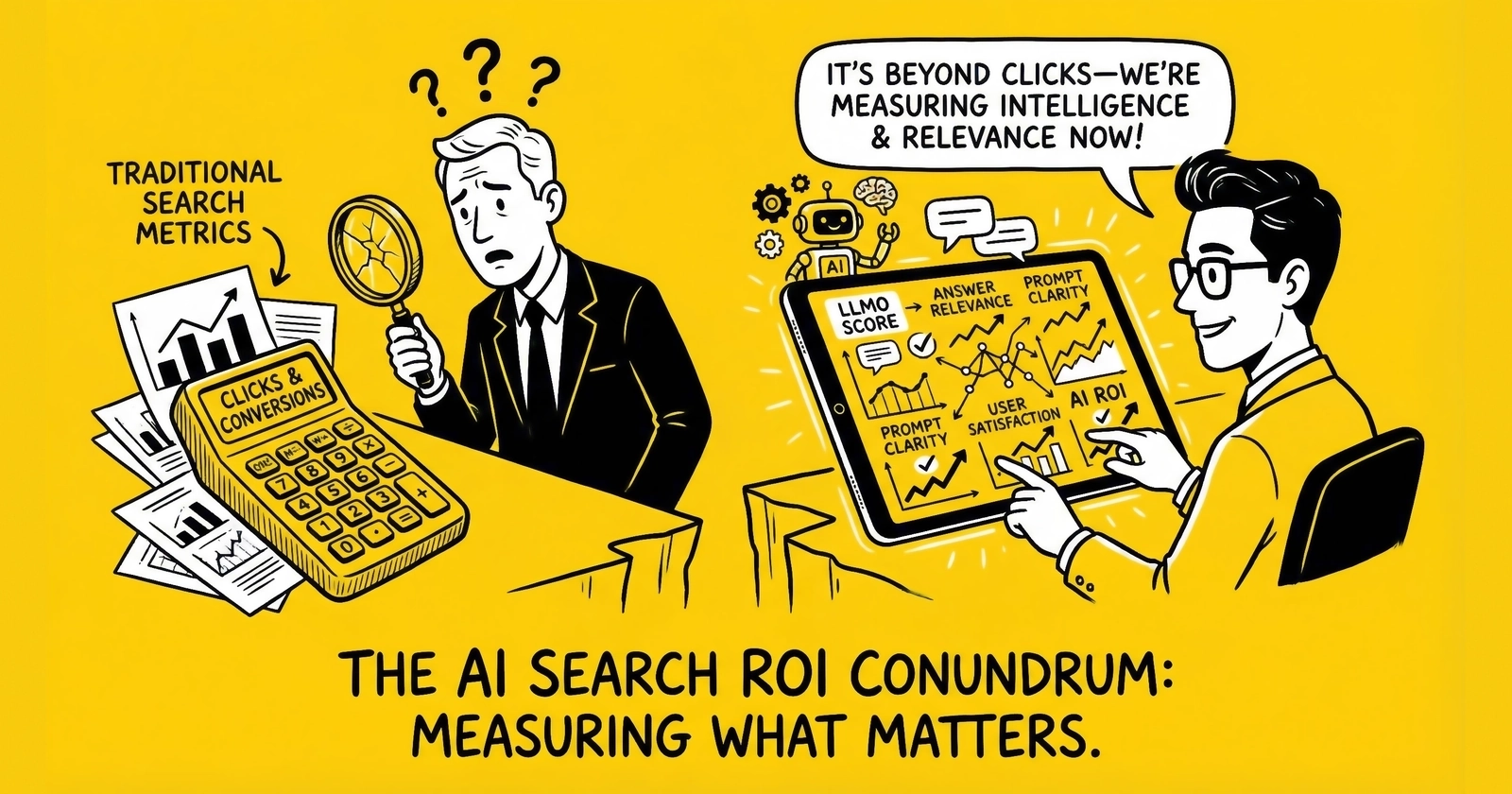
AI-referred sessions grew 527% in five months. AI visitors convert 4.4x better than traditional search. Yet most analytics dashboards show none of this – a blind spot that causes companies to systematically undervalue AI visibility investments. Building measurement frameworks that capture AI influence requires rethinking attribution, adopting new tools, and connecting visibility metrics to business outcomes.
When a marketing director researches lead providers using ChatGPT, asks follow-up questions, receives recommendations, and later navigates directly to a recommended site – Google Analytics records “direct traffic.” The AI interaction that influenced the decision remains invisible. The company that invested in AI visibility cannot prove that investment drove the conversion.
This measurement gap creates strategic problems. Marketing teams allocating budget based on attributed performance shift resources toward measurable channels (paid search, traditional SEO) and away from AI optimization – exactly backwards from where audience attention is moving. Meanwhile, competitors who invest in AI visibility despite measurement challenges gain market position that compounds over time.
Solving this requires new measurement approaches: tools that track AI-specific metrics, proxy indicators that capture AI influence indirectly, attribution models that account for AI-mediated journeys, and frameworks that connect visibility metrics to business outcomes. For background on how to optimize for these AI discovery channels, see our LLMO guide for lead generation AI citation.
The Attribution Challenge
Why Traditional Analytics Fail
Traditional web analytics were designed for a simpler world: users searched on Google, clicked results, and visited websites. The referral chain was traceable. Google Analytics could tell you exactly which queries, campaigns, and pages drove conversions.
AI-mediated discovery breaks this model:
Scenario 1: Direct Navigation After AI Research
- User asks ChatGPT “What are the best mortgage lead providers?”
- ChatGPT mentions several providers, including yours
- User opens a new browser tab and types your URL directly
- Analytics records: “Direct traffic”
Scenario 2: Branded Search After AI Discovery
- User asks Claude about lead generation compliance
- Claude cites your TCPA compliance guide
- User searches your company name on Google
- Analytics records: “Branded organic search”
Scenario 3: Multi-Platform AI Journey
- User asks Perplexity for lead vendor comparison
- Later asks ChatGPT for more detail on specific vendors
- Eventually clicks a Perplexity citation link
- Analytics records: “Referral from perplexity.ai” (partial credit)
Only Scenario 3 provides any AI attribution, and even then, it credits only the final interaction – not the full journey.
The Hidden AI Influence Problem
Research suggests AI influence is substantially larger than referral data indicates:
| Traffic Source | Analytics Attribution | Actual AI Influence |
|---|---|---|
| AI platform referrals | Fully attributed | ~15-20% of AI influence |
| Direct traffic | Not attributed | ~40-50% is AI-influenced |
| Branded search | Not attributed | ~20-30% is AI-influenced |
| Unattributed | Not attributed | ~10-15% is AI-influenced |
These estimates vary by industry and audience, but the pattern is consistent: traditional analytics capture only a fraction of AI-mediated discovery.
The Investment Distortion
Measurement gaps distort investment decisions:
What Analytics Show:
- Google Ads: Clear attribution → Maintained/increased budget
- SEO: Measurable organic traffic → Maintained budget
- AI optimization: Unclear attribution → Questioned investment
What’s Actually Happening:
- Google search volume declining (Gartner: 25% by 2026)
- AI traffic growing 527% over 5 months
- AI visitors converting 4.4x better
Companies following analytics data invest in declining channels while underinvesting in growing ones. The measurement gap causes systematic misallocation.
AI Citation Tracking Methods
Dedicated AI Tracking Tools
Specialized tools have emerged to track AI visibility:
| Tool | Pricing | Key Features |
|---|---|---|
| LLMO Metrics / GEO Metrics | €80/month | ChatGPT, Gemini, Claude, Perplexity, DeepSeek, Copilot tracking |
| Peec AI | €89/month | Brand visibility, sentiment, competitor benchmarking |
| Semrush AI SEO Toolkit | Included with Semrush | ChatGPT visibility, sentiment share, content gaps |
| SE Ranking AI Search Toolkit | $89/month add-on | AI Overviews, ChatGPT, Gemini monitoring |
What These Tools Track:
- Citation frequency across AI platforms
- Brand mentions in AI responses
- Sentiment of AI mentions (positive, neutral, negative)
- Competitor citation comparison
- Visibility trends over time
Limitations:
- Cannot directly connect citations to conversions
- Sample-based rather than comprehensive
- Platform changes can affect tracking accuracy
- Cost adds up for comprehensive monitoring
Manual Citation Auditing
For companies not ready for dedicated tools, manual auditing provides baseline measurement:
Monthly Audit Process:
- List 20-30 queries buyers likely ask AI systems
- Run each query on ChatGPT, Claude, Perplexity, Gemini
- Document which sources each platform cites
- Track your brand’s citation frequency
- Note competitor citations
Sample Query List for Lead Generation:
- “Best mortgage lead providers”
- “How much do exclusive leads cost?”
- “TCPA compliance for lead buyers”
- “Lead distribution platforms comparison”
- “How to evaluate lead quality”
Tracking Template:
| Query | Platform | Your Brand Cited? | Competitors Cited | Notes |
|---|---|---|---|---|
| Best mortgage lead providers | ChatGPT | Yes - position 3 | [List] | Cited for compliance focus |
| Claude | No | [List] | Gap opportunity | |
| Perplexity | Yes - with link | [List] | Direct referral potential |
Monthly audits reveal citation trends that indicate whether AI visibility investments are working.
Referral Tracking from AI Platforms
Direct referral traffic from AI platforms provides the most reliable attribution:
Identifiable AI Referrers:
- chat.openai.com (ChatGPT)
- claude.ai (Claude)
- perplexity.ai (Perplexity)
- bard.google.com / gemini.google.com (Gemini)
Google Analytics 4 Setup:
Traffic acquisition → Session source/medium → Filter:
- Source contains "openai"
- Source contains "perplexity"
- Source contains "claude"
- Source contains "anthropic"
- Source contains "gemini"
Segment Creation: Create an “AI Traffic” segment combining all AI platform referrals for trend analysis and conversion comparison.
Limitations:
- Only captures clicks from AI interfaces
- Misses AI-influenced journeys that don’t include clicks
- Platform interface changes may affect referral data
Proxy Metrics That Work
Direct Traffic Analysis
Since AI influence often appears as direct traffic, analyzing direct traffic patterns provides proxy measurement:
Pattern Analysis:
- Direct traffic spikes correlating with AI citation increases
- Geographic patterns matching AI platform user bases
- Time-of-day patterns suggesting AI research behavior
- Page landing patterns (AI users often land on cited pages)
Comparative Metrics:
| Metric | Direct Traffic | AI Referral Traffic | Implication |
|---|---|---|---|
| Bounce rate | 45% | 38% | AI-influenced direct has AI-like engagement |
| Time on site | 3:45 | 4:12 | AI-influenced visitors are engaged |
| Pages per session | 2.8 | 3.4 | AI visitors explore more |
| Conversion rate | 2.1% | 4.4% | AI influence drives higher conversion |
If direct traffic shows engagement patterns similar to attributed AI traffic, it likely contains substantial AI-influenced visits.
Branded Search Volume
AI citations often lead to branded searches as users seek more information:
Tracking Approach:
- Monitor branded search volume in Google Search Console
- Track brand name queries in Google Trends
- Correlate with AI citation activity
Interpretation:
- Branded search increases without corresponding marketing spend suggests AI-driven awareness
- Brand + category queries (e.g., “[Company] mortgage leads”) indicate informed searchers
- Volume spikes following content publication may indicate AI pickup
Engagement Quality Metrics
AI-influenced visitors exhibit distinct engagement patterns:
Quality Indicators:
- Longer session duration
- More pages per session
- Lower bounce rate
- Higher conversion rate
- Different landing page patterns
Analysis Approach:
Segment: High-engagement direct traffic
Criteria:
- Session duration > 3 minutes
- Pages per session > 2
- Landed on blog/guide content

Compare conversion rates and behavior to:
- All direct traffic
- Known AI referral traffic
- Organic search traffic
High-engagement direct traffic that behaves like AI referral traffic likely contains AI-influenced visits.
Survey and Qualitative Data
Direct customer feedback reveals AI influence that analytics cannot capture:
Survey Questions:
- “How did you first learn about our company?”
- “Did you use AI assistants (ChatGPT, Claude, etc.) during your research?”
- “Which AI platforms influenced your decision?”
Sales Call Tracking:
- Note when prospects mention AI research
- Track which AI platforms they reference
- Document if they mention specific content cited by AI
Contact Form Analysis:
- Review inquiry language for AI-influenced patterns
- Track mentions of competitors AI systems cite together with you
- Note questions suggesting AI-researched awareness
Building Custom Dashboards
Essential KPIs for AI Search
Primary KPIs:
| KPI | Data Source | Target | Frequency |
|---|---|---|---|
| AI Citation Frequency | LLMO tools, manual audit | Increasing trend | Monthly |
| AI Referral Traffic | Google Analytics | 10%+ growth monthly | Weekly |
| AI Traffic Conversion Rate | Google Analytics | 4%+ (4.4x benchmark) | Monthly |
| Share of AI Voice | LLMO tools | Above competitors | Monthly |
| Direct Traffic Growth | Google Analytics | Positive trend | Monthly |
Secondary KPIs:
| KPI | Data Source | Target | Frequency |
|---|---|---|---|
| Branded Search Volume | Search Console, Trends | Increasing trend | Monthly |
| High-Engagement Direct % | Google Analytics | Above 30% | Monthly |
| Content Pages Cited | Manual audit | Expanding set | Quarterly |
| Citation Sentiment | Peec AI, LLMO tools | Positive dominant | Monthly |
Dashboard Architecture
Executive Dashboard (Monthly):
┌─────────────────────────────────────────────────────────────┐
│                AI VISIBILITY SUMMARY                       │
├───────────────┬───────────────┬───────────────┬────────────┤
│ AI Citations  │ AI Traffic    │ AI Conv Rate  │ AI Revenue │
│     47 ↑12%   │   2,340 ↑8%   │    4.2% ↑0.3% │ $187K ↑15% │
└───────────────┴───────────────┴───────────────┴────────────┘

┌─────────────────────────────────────────────────────────────┐
│              CITATION TRENDS BY PLATFORM                    │
│ [Sparkline charts for ChatGPT, Claude, Perplexity, Gemini] │
└─────────────────────────────────────────────────────────────┘

┌─────────────────────────────────────────────────────────────┐
│              COMPETITIVE CITATION SHARE                     │
│ [Bar chart comparing your citations vs top 5 competitors]  │
└─────────────────────────────────────────────────────────────┘
Operational Dashboard (Weekly):
┌─────────────────────────────────────────────────────────────┐
│                AI TRAFFIC THIS WEEK                         │
├───────────────────────────────────────────────────────────┤
│ Sessions by Platform:                                       │
│   ChatGPT:    423 (↑5%)   Avg Session: 4:23                │
│   Perplexity: 312 (↑12%)  Avg Session: 5:01                │
│   Claude:     89 (↑3%)    Avg Session: 6:12                │
│   Gemini:     156 (↓2%)   Avg Session: 3:45                │
└─────────────────────────────────────────────────────────────┘

┌─────────────────────────────────────────────────────────────┐
│              TOP AI-CITED CONTENT THIS WEEK                │
│ 1. TCPA Compliance Guide         - 23 citations            │
│ 2. Lead Distribution Comparison  - 18 citations            │
│ 3. Lead Quality Framework        - 12 citations            │
└─────────────────────────────────────────────────────────────┘
Data Integration Approaches
For Technical Teams:
# Example: Combining GA4 + LLMO Metrics API
def calculate_ai_influenced_revenue():
    # Direct AI referral revenue
    ai_referral_revenue = ga4.get_revenue(
        segment="ai_platforms"
    )

    # Estimated AI-influenced direct revenue
    direct_traffic = ga4.get_sessions(
        segment="direct"
    )
    ai_behavior_match = ga4.get_sessions(
        segment="high_engagement_direct"
    )
    ai_influenced_direct_pct = ai_behavior_match / direct_traffic

    direct_revenue = ga4.get_revenue(segment="direct")
    estimated_ai_direct = direct_revenue * ai_influenced_direct_pct

    return ai_referral_revenue + estimated_ai_direct
For Non-Technical Teams:
- Use Looker Studio with GA4 connector for basic dashboards
- Export LLMO tool data to spreadsheets for manual integration
- Create monthly reporting templates combining sources
- Consider platforms like Supermetrics for data aggregation
Connecting to Business Outcomes
Revenue Attribution Framework
Connecting AI visibility to revenue requires multi-layer attribution:
Layer 1: Direct Attribution
AI Referral Traffic → Conversions → Revenue
(Fully trackable in analytics)
Layer 2: Assisted Attribution
AI Citation → Brand Awareness → Branded Search → Conversion → Revenue
(Partially trackable via branded search correlation)
Layer 3: Influence Attribution
AI Research → Direct Navigation → Conversion → Revenue
(Estimated via proxy metrics and survey data)
Combined Attribution Model:
Total AI-Influenced Revenue =
  Direct AI Referral Revenue (100% attribution)
+ Branded Search Revenue × AI Influence Factor (50-70% attribution)
+ High-Engagement Direct Revenue × AI Behavior Match (30-50% attribution)
Cost Per Acquisition Calculation
AI Channel CPA:
AI CPA = AI Optimization Investment / AI-Attributed Conversions

Example:
- Monthly AI optimization investment: $5,000
- Direct AI referral conversions: 45
- Estimated AI-influenced conversions: 120
- Total AI-attributed: 165

AI CPA = $5,000 / 165 = $30.30

Compare to:
- Google Ads CPA: $85
- Traditional SEO CPA: $45
- AI CPA: $30.30 (best performer)
Lifetime Value Comparison
AI-acquired customers may have different lifetime value than other channels:
| Acquisition Channel | First Purchase | LTV (12 mo) | LTV (24 mo) |
|---|---|---|---|
| Google Ads | $2,400 | $8,200 | $14,500 |
| Organic Search | $2,100 | $9,100 | $16,800 |
| AI Referral | $2,800 | $11,400 | $21,200 |
| AI-Influenced Direct | $2,600 | $10,800 | $19,500 |
Higher LTV for AI-acquired customers would reflect the informed nature of AI-researched buyers – they’ve done homework and selected you deliberately. This aligns with research on how context engineering affects enterprise AI accuracy – better context leads to better recommendations.
Investment Justification Frameworks
The Competitive Displacement Argument
AI visibility is zero-sum for many queries. When AI cites one source, it doesn’t cite another. Investment justification can frame the competitive stakes:
Current State:
- Competitor A cited for “best mortgage lead providers” - ChatGPT
- Competitor B cited for “TCPA compliance” - Claude
- Your company: Not cited for top queries
Investment Impact:
- Creating authoritative content on priority topics
- Building citation authority over 6-12 months
- Displacing competitors from AI recommendations
Cost of Inaction:
- Competitors solidify citation positions
- Market share shifts to AI-visible competitors
- Catch-up investment grows over time
The Channel Shift Projection
Project the shift from traditional to AI search and its revenue implications:
Current Channel Mix:
Traditional organic search: 45% of leads
Paid search: 35% of leads
Other channels: 20% of leads
Projected Channel Mix (2027):
Traditional organic search: 30% of leads (-33%)
AI-mediated discovery: 25% of leads (new)
Paid search: 30% of leads (-14%)
Other channels: 15% of leads
Revenue Impact:
Current annual lead revenue: $2,000,000
AI channel by 2027: 25% = $500,000

Investment required: $60,000/year
ROI if capturing channel: 733%
The Conversion Advantage ROI
AI traffic’s superior conversion rate creates ROI opportunity:
Traditional Organic Traffic:
- 10,000 monthly sessions
- 2% conversion rate
- 200 conversions/month
AI Traffic (Same Session Count):
- 10,000 monthly sessions
- 8.8% conversion rate (4.4x)
- 880 conversions/month
Incremental Value:
AI conversion advantage: 680 additional conversions/month
Average conversion value: $150
Monthly incremental value: $102,000

Annual incremental value: $1,224,000
AI optimization investment: $60,000/year
ROI: 1,940%
Even with conservative estimates, the conversion advantage creates compelling investment cases.
Budget Allocation Framework
Recommended Allocation Evolution:
| Year | Traditional SEO | AI Optimization | Rationale |
|---|---|---|---|
| 2026 | 75% | 25% | Building AI foundation |
| 2027 | 60% | 40% | AI channel growing |
| 2028 | 50% | 50% | Channel parity |
| 2029+ | 35% | 65% | AI-dominant discovery |
IDC forecasts companies will spend up to 5x more on LLMO than traditional SEO by 2029. Current underinvestment creates opportunity for early movers.
Key Takeaways
-
Traditional analytics undercount AI influence by 50-80% – most AI-influenced journeys appear as direct traffic or branded search.
-
AI visitors convert 4.4x better than traditional search – superior conversion rates compound the value of AI visibility investment.
-
Dedicated tracking tools are emerging – LLMO Metrics, Peec AI, and platform-integrated tools enable citation monitoring across AI systems.
-
Proxy metrics reveal hidden AI influence – direct traffic patterns, branded search volume, and engagement quality indicate AI-driven awareness.
-
Multi-layer attribution is necessary – combine direct referral data, assisted conversion analysis, and survey data for comprehensive AI revenue attribution.
-
Dashboard architecture should separate executive and operational views – monthly strategic KPIs versus weekly tactical metrics serve different decisions.
-
Business case frameworks should emphasize competitive displacement – AI citation positions are zero-sum, creating urgency for early investment.
-
Channel shift projections justify forward-looking investment – Gartner’s 25% search decline prediction and 527% AI traffic growth support budget reallocation.
-
IDC forecasts 5x more LLMO than SEO spend by 2029 – current underinvestment creates first-mover advantage opportunity.
-
ROI calculations should include LTV differences – AI-acquired customers may have higher lifetime value due to informed selection.
Frequently Asked Questions
How do I know if AI systems are driving any of my traffic?
Start with what’s directly measurable. Check Google Analytics (or your analytics platform) for referrals from AI domains:
- chat.openai.com
- claude.ai / anthropic.com
- perplexity.ai
- bard.google.com / gemini.google.com
If you see any traffic from these sources, AI systems are definitely driving some visits. But remember: this is the floor, not the ceiling. Most AI-influenced traffic appears as direct traffic or branded search because users interact with AI, then navigate to sites separately.
To estimate total AI influence, analyze your direct traffic for patterns matching known AI referral behavior (higher engagement, different landing pages, superior conversion rates). The portion of direct traffic exhibiting AI-like patterns likely includes substantial AI-influenced visits.
What’s the minimum investment to start tracking AI visibility?
You can start with zero additional tools:
Free Approach:
- Set up GA4 segments for AI platform referrals
- Create monthly manual audit of 20-30 priority queries
- Track branded search volume in Search Console
- Add survey questions about AI research to customer intake
This approach takes 4-6 hours monthly and provides baseline AI visibility measurement.
Low-Cost Approach (€80-90/month): Add LLMO Metrics or Peec AI for automated citation tracking across platforms. This saves audit time and provides competitive benchmarking.
Comprehensive Approach (€200-400/month): Multiple tracking tools plus analytics platform add-ons for integrated measurement. Suitable for companies with significant AI traffic or competitive markets.
How long until we see ROI from AI optimization?
Timeline varies by platform and optimization type:
Quick Impact (2-8 weeks):
- Real-time retrieval systems like Perplexity can surface new content quickly
- Technical improvements (page speed, llms.txt) affect crawler behavior within crawl cycles
- Existing content restructuring for better AI extraction
Medium-Term Impact (3-6 months):
- New content building citation authority
- Topic cluster development establishing expertise
- Schema markup implementation affecting AI understanding
Long-Term Impact (6-18 months):
- Training data inclusion (for models like Claude with periodic updates)
- Citation momentum compounding over time
- Brand recognition in AI responses
For technical approaches to content optimization, see our guide on vector embeddings for lead generation content.
Start measuring early – leading indicators (citation frequency, engagement patterns) signal future business impact before conversion data becomes clear.
Should we reallocate budget from traditional SEO to AI optimization?
Not “reallocate” – “expand.” Traditional SEO still drives traffic and will continue to, even as AI grows. Most AI optimization activities also benefit traditional SEO (quality content, clear structure, technical performance).
Recommended Approach:
- Maintain current SEO investment
- Add incremental AI-specific investment (20-30% initially)
- Shift ratio toward AI as channel grows
- Monitor both channels and adjust based on performance
Cutting traditional SEO to fund AI optimization creates risk. Growing total investment to include AI optimization captures emerging opportunity without sacrificing existing performance.
How do we prove AI ROI to skeptical leadership?
Build evidence incrementally:
Phase 1: Demonstrate Presence Show that AI platforms are citing your content (or competitors’ content). Manual audits provide concrete examples: “When users ask ChatGPT about mortgage leads, here’s what they see.”
Phase 2: Show Traffic Present AI referral traffic data, even if small. Growth percentages often look impressive even from small bases. “AI referral traffic grew 200% this quarter.”
Phase 3: Compare Conversion If you have enough AI traffic for statistical significance, compare conversion rates. “AI visitors convert at 4.2% versus 1.8% for traditional organic – 2.3x better.”
Phase 4: Estimate Total Impact Use proxy metrics to estimate total AI influence beyond direct referrals. “Based on direct traffic patterns, we estimate AI influences approximately 15% of our conversions.”
Phase 5: Project Forward Apply industry trends (527% growth, Gartner projections) to your data. “If AI traffic continues growing at even half the industry rate, it will represent 30% of our leads by 2027.”
What competitive intelligence can we gather from AI tracking?
AI citation tracking reveals competitive positioning you can’t see in traditional SEO:
What You Can Learn:
- Which competitors AI systems cite for key queries
- What content competitors are getting cited for
- How competitor citation frequency trends over time
- Which topics have citation gaps (opportunity)
- Sentiment of competitor mentions (positive vs. critical)
Competitive Action:
- Create better content on topics where competitors get cited
- Fill content gaps where no competitor has citation authority
- Monitor competitor citation gains to identify their strategies
- Track citation share as a market share proxy
How accurate are AI tracking tools?
Accuracy varies by platform and method:
High Confidence:
- Direct referral traffic from AI platforms (accurate)
- Manual query audits (accurate for sampled queries)
- Branded search trends (directionally accurate)
Moderate Confidence:
- LLMO tool citation counts (sampling-based, directionally accurate)
- Sentiment analysis (algorithm-dependent)
- Competitor comparisons (relative accuracy)
Lower Confidence:
- Total AI influence estimates (methodology-dependent)
- Revenue attribution models (assumption-heavy)
- Future projections (inherently uncertain)
Use high-confidence metrics for operational decisions and moderate-confidence metrics for strategic direction. Acknowledge uncertainty in projections while making clear that the directional trend is evident.
What’s the difference between LLMO and GEO metrics?
LLMO (Large Language Model Optimization):
- Focuses on citation by standalone AI assistants
- Tracks ChatGPT, Claude, Perplexity, etc.
- Measures whether AI systems reference your content
- Important for direct AI assistant queries
GEO (Generative Engine Optimization):
- Focuses on visibility in AI-enhanced search
- Tracks Google AI Overviews, Bing Copilot integration
- Measures whether generative search features include you
- Important for search-integrated AI features
Why Both Matter: Different users access AI through different channels. Some use standalone ChatGPT; others see AI Overviews in Google results. Comprehensive visibility requires optimization for both.
Most tracking tools cover both categories, but understanding the distinction helps interpret metrics and prioritize optimization efforts.
How do we handle attribution when AI traffic is tiny?
When AI referral traffic is small, direct conversion attribution is unreliable (small sample sizes produce noisy data). Alternative approaches:
Focus on Leading Indicators:
- Citation frequency (regardless of traffic)
- Engagement metrics from AI traffic
- Content performance on AI-cited pages
Use Qualitative Data:
- Customer surveys about research methods
- Sales call notes about AI mentions
- Inquiry language patterns
Apply Industry Benchmarks: If your AI traffic is too small for reliable conversion rates, apply industry benchmarks (4.4x conversion advantage) to model potential value as traffic grows.
Track Relative Growth: Even small absolute numbers can show meaningful growth trends. “AI traffic grew from 50 to 150 sessions monthly” represents 200% growth regardless of absolute size.
What should our first AI measurement report include?
Start simple and expand:
Minimum Viable Report:
- AI referral traffic by platform (with trends)
- Top 5 queries where you are/aren’t cited
- Competitor citation comparison for priority queries
- One conversion metric (even if preliminary)
- Key action items for next month
Expanded Report (After 3+ Months): Add:
- Citation frequency trends
- Direct traffic pattern analysis
- Branded search correlation
- Content performance by AI citation status
- Conversion rate comparison
- Revenue attribution estimate
Keep initial reports simple to build organizational understanding before introducing complexity.
How do we integrate AI metrics into existing marketing dashboards?
Integration Approaches:
Separate Section: Add an “AI Visibility” section to existing marketing dashboards. Keep metrics distinct until the organization builds AI measurement literacy.
Channel Comparison: Add AI as a channel row in channel performance tables, comparing to paid, organic, social, etc. Highlight where AI metrics differ (conversion rate).
Influence Layer: Create an “AI Influence” overlay showing estimated AI contribution to each existing channel (e.g., “Estimated AI influence on Direct: 35%”).
Unified Attribution: Eventually integrate AI touchpoints into multi-touch attribution models, weighting AI interactions alongside traditional touchpoints.
Start with separation for clarity, then integrate as organizational understanding grows and data quality improves.
Sources
- Gartner Research - Industry forecasts predicting 25% decline in traditional search volume by 2026 due to AI-powered search alternatives
- Google Analytics 4 Documentation - Technical specifications for tracking AI referral traffic segments and conversion attribution
- LLMO Metrics - Platform documentation for AI citation monitoring and LLMO performance measurement across ChatGPT, Claude, and Perplexity
- Peec AI - Tracking tool specifications for multi-platform AI visibility measurement and competitive citation analysis
- Google Search Console - Official platform for monitoring branded search trends and organic traffic patterns that indicate AI influence