The infrastructure that powers the modern lead economy operates in milliseconds. Master API lead posting and you control the flow of billions in annual transaction value. Get it wrong and leads die in transit while your competitors capture the revenue.
A consumer clicks submit on an insurance quote form. Within 200 milliseconds, that lead must travel through your system, pass validation checks, broadcast to qualified buyers, collect bids, route to the winner, and deliver to their CRM. The consumer sees a confirmation page. Behind the scenes, a real-time auction just executed that determines whose phone will ring.
This is API lead posting: the technical backbone of modern lead distribution. Whether you are building your first lead generation operation or scaling an enterprise processing millions of leads monthly, understanding the mechanics of real-time API integration separates professional operations from amateur ones. Those who master this infrastructure extract more value from every lead, maintain buyer loyalty through reliable delivery, and scale their businesses efficiently.
This guide covers everything you need to implement production-grade API lead posting: the technical architecture, authentication patterns, payload design, error handling, performance optimization, and the operational disciplines that prevent catastrophic failures at 3 AM on a Saturday.
What Is API Lead Posting?
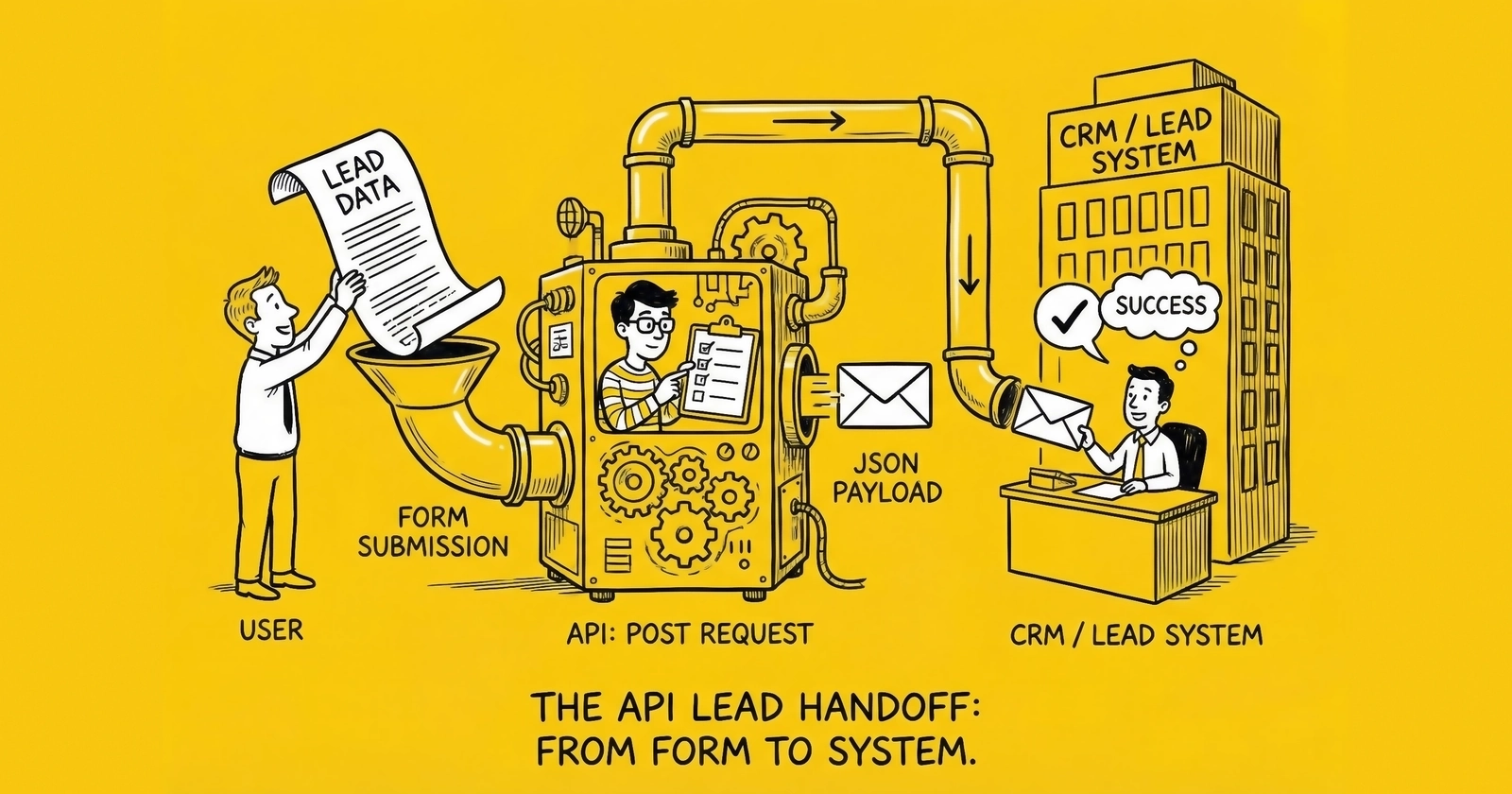
API lead posting is the programmatic transmission of lead data between systems using HTTP-based application programming interfaces. When a lead captures on your landing page, your system makes an HTTP request to a destination endpoint, transmitting the lead data in a structured format. The receiving system processes the request, validates the data, and returns a response indicating success or failure.
The concept sounds simple. The implementation is anything but.
Real-time lead posting operates under constraints that most web applications never face. You have milliseconds, not seconds, to complete transactions. A 500-millisecond delay that would be imperceptible in a typical web application can cost you auction wins. A 2-second timeout that would be reasonable for a normal API can cause leads to expire before delivery completes. Every additional round trip, every unnecessary validation step, every inefficient database query compounds into latency that destroys value.
The Two Primary Patterns
Lead posting follows two primary patterns, each with distinct use cases and technical requirements.
Direct Post transmits complete lead data immediately to a predetermined buyer without a bidding phase. Your landing page captures the lead, validates the data, and posts directly to your buyer’s endpoint. The transaction is point-to-point, and the price is fixed in advance through contract. Direct post works for exclusive buyer relationships, captive lead programs, and situations where price discovery is unnecessary because you have a single committed buyer.
Ping/Post is a bifurcated transaction protocol that separates bid solicitation from lead delivery. In the ping phase, partial lead data broadcasts to multiple potential buyers who return bids. In the post phase, complete lead data delivers to the winning bidder only. Ping/post enables competitive pricing, price discovery on every transaction, and protects consumer data from non-winning bidders who never see the full lead. For a complete overview of this distribution model, see our ping-post systems guide.
Both patterns require robust API infrastructure. The difference lies in transaction complexity and the number of endpoints involved in each lead journey.
Technical Architecture for Lead Posting
Production lead posting systems follow recognizable architectural patterns regardless of scale. Understanding these patterns helps you design infrastructure that handles complexity without brittleness.
The Request-Response Cycle
Every API lead post follows the same fundamental cycle:
-
Payload Assembly: Your system gathers lead data, formats it according to the destination’s specification, and constructs the HTTP request including headers, authentication, and body content.
-
Transport: The request travels over HTTPS to the destination endpoint. TLS encryption protects data in transit.
-
Reception: The destination system receives the request, parses the payload, and validates the structure.
-
Processing: The destination validates the lead data against business rules, checks for duplicates, and evaluates acceptance criteria.
-
Response: The destination returns an HTTP response including a status code and body containing acceptance status, internal lead ID, or error details.
-
Handling: Your system parses the response, determines success or failure, and takes appropriate action: logging the transaction, updating your database, triggering downstream processes, or initiating retry logic.
This cycle must complete within strict time constraints. Industry standards for ping/post operations require ping responses within 100 milliseconds and total transaction times under 2 seconds. Direct post operations typically have more latitude, with acceptance windows ranging from 5 to 30 seconds depending on the receiving system’s validation complexity.
Request Components
An HTTP POST request for lead delivery consists of several components that must be configured correctly for successful transmission.
Endpoint URL: The destination address where your request will be sent. This is provided by the buyer or platform receiving your leads. URLs should always use HTTPS for encrypted transmission.
HTTP Method: Lead posting uses POST requests because you are creating a new resource (the lead) on the destination system. GET requests are inappropriate for lead transmission because they expose sensitive data in URLs and have length limitations.
Request Headers: Headers carry metadata about the request. Critical headers include:
Content-Type: Specifies the format of your payload (application/json,application/xml, orapplication/x-www-form-urlencoded)Authorization: Carries authentication credentialsAccept: Indicates what response format you expect- Custom headers for tracking, versioning, or buyer-specific requirements
Request Body: The payload containing the lead data. Format depends on the destination’s specification, but JSON has become the industry standard for modern integrations.
Payload Formats
Three payload formats dominate lead posting integrations.
JSON (JavaScript Object Notation) is the modern standard. JSON is human-readable, compact, and well-supported by every programming language and framework. A typical JSON lead payload looks like this:
{
  "source_id": "abc123",
  "timestamp": "2024-12-15T14:30:00Z",
  "lead": {
    "first_name": "John",
    "last_name": "Smith",
    "email": "john.smith@email.com",
    "phone": "5551234567",
    "address": {
      "street": "123 Main St",
      "city": "Austin",
      "state": "TX",
      "zip": "78701"
    }
  },
  "attributes": {
    "credit_tier": "excellent",
    "home_value": 350000,
    "current_carrier": "State Farm"
  },
  "consent": {
    "trustedform_url": "https://cert.trustedform.com/xxxxx",
    "tcpa_consent": true,
    "consent_timestamp": "2024-12-15T14:29:58Z"
  }
}
XML (Extensible Markup Language) remains common with legacy enterprise systems. XML is more verbose than JSON but supports complex data validation through XSD schemas. Some long-established buyers in insurance and mortgage still require XML formatting.
Form-Encoded Data (application/x-www-form-urlencoded) is the simplest format, sending data as key-value pairs. This format has size limitations and does not naturally support nested data structures. It persists in some legacy integrations but is declining in new implementations.
When given a choice, default to JSON. When a buyer specifies XML or form-encoded, request their exact specification document to ensure your output matches their expected structure.
Authentication and Security
Lead data contains personally identifiable information (PII) protected by various regulations. Your API infrastructure must implement security at multiple levels to protect this data and authenticate your transactions. Maintaining TCPA compliance requires proper consent documentation in every lead payload.
Authentication Methods
API Keys are the simplest authentication method. The buyer provides a unique key that you include with every request, typically in an HTTP header or as a query parameter. API keys are easy to implement but offer limited security if the key is compromised. Rotate keys periodically and never expose them in client-side code.
Authorization: Bearer your-api-key-hereBasic Authentication uses a username and password encoded in Base64 and included in the Authorization header. While simple, basic auth is considered legacy and should only be used over HTTPS.
Authorization: Basic base64(username:password)OAuth 2.0 provides more sophisticated authentication with token-based access, scope limitations, and automatic token refresh. Enterprise buyers, particularly those using Salesforce or similar platforms, often require OAuth. OAuth adds integration complexity but provides better security and easier credential rotation.
OAuth 2.0 flow for lead posting typically uses the Client Credentials grant:
- Your system requests an access token from the authorization server using client ID and secret
- The authorization server returns an access token with a defined expiration
- You include the access token in subsequent API requests
- When the token expires, you request a new one
Implement token caching to avoid requesting new tokens for every lead. Implement proactive token refresh before expiration to prevent failed deliveries due to expired credentials.
IP Whitelisting adds a layer of security beyond authentication. The buyer configures their system to accept requests only from your registered IP addresses. This prevents stolen credentials from being used outside your infrastructure. Maintain current documentation of your outbound IP addresses and notify buyers before changes.
Transport Security
All lead posting must occur over HTTPS using TLS 1.2 or higher. TLS encrypts data in transit, preventing interception and tampering. Never transmit lead data over unencrypted HTTP.
Verify that your systems validate TLS certificates properly. Disabling certificate validation to “make things work” opens you to man-in-the-middle attacks that can intercept lead data.
Data Handling Security
Beyond transport security, implement proper data handling practices:
- Minimize data exposure: Only transmit data fields the buyer requires. Extra fields create unnecessary risk.
- Mask sensitive data in logs: Never log full credit card numbers, full social security numbers, or complete passwords. Mask these in any logging output.
- Encrypt data at rest: Lead data stored in your databases should be encrypted using AES-256 or equivalent.
- Implement access controls: Limit who can access lead data and API credentials. Use role-based access control with audit trails.
Field Mapping: Where Integration Complexity Lives
Field mapping translates your internal data structure to the format each buyer expects. This seemingly simple task is where most integration problems originate and where they are most difficult to diagnose.
The Mapping Challenge
Your internal data model almost never matches your buyer’s expected format perfectly. Consider these common mismatches:
- You store
first_nameandlast_nameseparately; the buyer expects a singlefull_namefield - Your state codes use two-letter abbreviations; theirs expects full state names
- Your date formats use ISO 8601 (
2024-12-15); their legacy system expects12/15/2024 - Your phone numbers include formatting; they require exactly 10 digits with no separators
- You track
homeowner_statusasown/rent; they expectY/N
Transformation Types
A robust field mapping system supports multiple transformation types:
Static Mapping directly connects your field to theirs with no transformation. Your email maps to their email.
Concatenation combines multiple source fields into one destination field. First name plus space plus last name creates full name.
Splitting parses composite fields into components. A full address field splits into street, city, state, and ZIP fields.
Value Translation converts your internal codes to their expected values. Your own becomes their homeowner; your rent becomes their renter.
Format Transformation handles data type and format conversions:
- Phone:
(555) 123-4567becomes5551234567 - Date:
2024-12-15T14:30:00Zbecomes12/15/2024 - Currency:
350000becomes$350,000 - Boolean:
truebecomesY
Conditional Mapping applies different transformations based on data values. If state equals California, use one value set; otherwise use another.
Common Field Mapping Mistakes
Assuming consistency: Buyers change their APIs without notice. A field that was optional becomes required. An accepted value gets deprecated. The mapping that worked for two years suddenly starts failing.
Ignoring encoding: Character encoding mismatches cause data corruption. UTF-8 is standard, but some legacy systems expect Latin-1 or Windows-1252. Special characters, accented letters, and emoji can cause failures if encoding is not handled correctly.
Forgetting null handling: What happens when a field in your system is empty but required by the buyer? Your mapping must define default values, omit empty fields, or reject leads with missing required data.
Neglecting field length limits: The buyer’s system may have maximum character limits you are not aware of. A 200-character address that passes your validation fails their database constraint.
Mapping Best Practices
Document every field mapping for every buyer integration. Include the source field name, destination field name, transformation logic, example input and output, and date of last verification.
Version control your mapping configurations. When problems occur, you need to identify exactly what changed and when.
Implement automated validation that compares your payload structure against the buyer’s published specification. Alert on schema drift before it causes production failures.
Error Handling and Retry Logic
Errors in API lead posting are inevitable. Network issues, buyer system outages, data validation failures, authentication expiration, and countless other problems will cause deliveries to fail. How your system handles these failures determines operational stability and revenue recovery.
Error Classification
The first discipline of error handling is classification. Different error types require different responses.
Transport Errors occur when you cannot establish a connection: DNS resolution failures, connection timeouts, TLS handshake problems. These typically indicate infrastructure issues on either side and often resolve on retry.
HTTP-Level Errors use standard status codes:
400 Bad Request: Your payload structure or content is invalid. Missing required fields, malformed data, values outside acceptable ranges. This error will not resolve on retry with the same payload.401 Unauthorized: Authentication failure. Expired tokens, incorrect API keys, revoked credentials. Requires credential refresh before retry.403 Forbidden: Authentication is valid but access is denied. May indicate IP whitelist issues or permission problems.404 Not Found: The endpoint URL is incorrect or the resource does not exist.429 Too Many Requests: Rate limiting triggered. Wait before retrying.500 Internal Server Error: Something broke on the buyer’s side. May resolve on retry.502 Bad Gateway/503 Service Unavailable: Infrastructure problems. Retry with backoff.504 Gateway Timeout: The server did not respond in time. Retry may succeed.
Application-Level Errors return a successful HTTP status (usually 200) but include rejection information in the response body. The buyer’s system accepted your request, processed it, and decided to reject the lead: duplicate submission, outside their geographic territory, failed their internal validation.
Retry Logic
The critical discipline is distinguishing retryable errors from permanent failures. Retrying a 400 validation error wastes resources and annoys the buyer. Retrying a 503 may recover the lead successfully.
Exponential Backoff is the industry standard retry approach:
- First retry: Wait 2 seconds
- Second retry: Wait 4 seconds
- Third retry: Wait 8 seconds
- Fourth retry: Wait 16 seconds
- Fifth retry: Wait 32 seconds (or cap at 60 seconds)
This pattern gives transient issues time to resolve while limiting retry volume.
Jitter adds small random variations to retry timing. If a buyer’s system goes down for five minutes and comes back up, you do not want every lead that failed during that window to retry simultaneously. Jitter spreads the retry load and prevents thundering herd problems.
Maximum Retry Limits prevent indefinite retry loops. Most implementations cap retries at five or six attempts, then route the lead to exception handling.
Circuit Breaker Pattern
When an endpoint fails repeatedly, continuing to attempt delivery wastes resources and may harm the failing system. The circuit breaker pattern provides protection.
Implementation:
- Track delivery attempts and failures per endpoint
- When failures exceed a threshold (e.g., 10 consecutive failures or 50% failure rate over 5 minutes), “open” the circuit
- While the circuit is open, immediately reject new delivery attempts to that endpoint without making requests
- After a cooling period (e.g., 60 seconds), allow a single “probe” request
- If the probe succeeds, “close” the circuit and resume normal operation
- If the probe fails, reset the cooling period
Circuit breakers prevent cascade failures and allow failing systems time to recover without being hammered with requests.
Waterfall Recovery
For leads that exhaust all retries to the primary buyer, implement waterfall logic to attempt delivery to secondary buyers. The lead that could not reach the primary winner might still have value to the second-highest bidder.
Industry data suggests that well-implemented waterfall-on-failure systems recover 20-40% of revenue that would otherwise be lost to post rejections, buyer timeouts, and system failures. This recovery rate directly impacts profitability. For strategies on building custom lead buyer integrations, see our dedicated guide.
Track waterfall recovery as a key operational metric. It represents revenue recaptured from technical failures.
Performance Optimization
Speed matters critically in lead posting. Buyers expect near-instant delivery. Delays cost sales. The lead contacted within one minute converts at 391% higher rates than the lead contacted after 30 minutes, as documented in our speed-to-lead response time guide.
Latency Targets
Establish and monitor latency targets for every stage of the posting process:
| Stage | Target | Warning Threshold |
|---|---|---|
| Payload assembly | < 10 ms | > 50 ms |
| DNS resolution | < 10 ms | > 50 ms |
| Connection establishment | < 50 ms | > 100 ms |
| Request transmission | < 50 ms | > 100 ms |
| Server processing | < 500 ms | > 1000 ms |
| Response parsing | < 10 ms | > 50 ms |
| Total transaction | < 650 ms | > 1500 ms |
For ping/post systems, ping responses should return within 100 milliseconds. Total ping phase (broadcast to bid collection) should complete within 200 milliseconds. Post delivery should complete within 1 second.
Connection Optimization
Connection Pooling maintains persistent connections to frequently-used endpoints rather than establishing new connections for each request. Connection establishment requires a TCP handshake and TLS negotiation that add 100-200 milliseconds of latency. Connection pooling eliminates this overhead for subsequent requests.
HTTP/2 enables multiplexing multiple requests over a single connection. If buyers support HTTP/2, enable it to reduce connection overhead.
DNS Caching prevents repeated DNS lookups for the same endpoints. Cache DNS results for their TTL duration and implement background refresh before expiration.
Parallel Processing
When posting to multiple buyers (as in ping/post systems), execute requests in parallel rather than sequentially. Pinging 10 buyers sequentially with 100ms per response takes 1 second. Pinging them in parallel takes only as long as the slowest response, typically under 150ms.
Implement concurrent request handling using async/await patterns, thread pools, or event loops depending on your technology stack. Configure appropriate concurrency limits to avoid overwhelming your own infrastructure or violating buyer rate limits.
Database Optimization
Lead databases grow continuously and can become performance bottlenecks.
Index key fields used in queries: lead ID, timestamp, source ID, buyer ID, status. Unindexed queries on large tables create latency spikes during peak volume.
Archive historical data that is no longer needed for real-time operations. Leads older than 90 days rarely need sub-second query performance. Move them to archival storage.
Separate read and write paths for high-volume operations. Use read replicas for reporting queries that do not need to compete with real-time posting transactions.
Caching Strategies
Cache data that is frequently accessed and changes infrequently:
- Buyer filter configurations
- Field mapping rules
- Authentication tokens
- Pricing tables
- Geographic lookup data
Implement cache invalidation when underlying data changes. Stale cache data can cause leads to route incorrectly or fail validation.
Monitoring and Alerting
You cannot fix what you cannot see. Comprehensive monitoring enables you to catch problems before they compound into revenue loss.
Key Metrics to Track
Volume Metrics:
- Leads received per minute/hour/day
- Leads posted per buyer
- Distribution across delivery methods
Success Metrics:
- Delivery success rate by buyer (target: > 95%)
- Overall acceptance rate
- Return rate by source and buyer
Performance Metrics:
- Average response time by endpoint
- 95th percentile response time
- Timeout rate
- Retry rate and success rate on retry
Error Metrics:
- Error rate by type (transport, HTTP, application)
- Error distribution by buyer
- Circuit breaker open events
Dashboard Design
Build real-time dashboards showing:
- Current leads in queue
- Delivery success rate (rolling 1-hour)
- Active alerts and circuit breaker status
- Response time trends
- Top errors in past hour
Review dashboards at the start of each business day and during campaign launches.
Alert Configuration
Configure alerts for conditions that require immediate attention:
Critical Alerts (immediate response required):
- Overall success rate drops below 85%
- Any buyer endpoint has 5+ consecutive failures
- Circuit breaker opens for a major buyer
- Response time exceeds 5 seconds
- Queue depth exceeds capacity threshold
Warning Alerts (investigate within 4 hours):
- Success rate for any buyer drops below 90%
- Average response time increases by 50% from baseline
- Error rate for any error type doubles from baseline
- Authentication failure detected
Informational Alerts (daily review):
- New error types appearing
- Unusual volume patterns
- Performance degradation trends
Configure alerts to minimize noise. Alert fatigue from excessive notifications leads to ignored alerts. Set thresholds based on meaningful deviation from baseline, not arbitrary fixed values.
Testing and Quality Assurance
Never deploy a new integration or significant change to production without comprehensive testing. Lead posting failures cost revenue and damage buyer relationships.
Test Environments
Maintain separate environments for:
- Development: Unrestricted experimentation with synthetic data
- Staging: Production-like environment for integration testing
- Production: Live transactions with real data
Request sandbox or test endpoints from buyers whenever possible. Major platforms like Salesforce, HubSpot, and enterprise lead distribution systems provide test environments that accept requests without creating real records.
Test Coverage
Unit Tests validate individual components: payload assembly, field transformation, response parsing, error classification.
Integration Tests verify end-to-end flow with actual HTTP requests to test endpoints. Confirm correct payload format, proper authentication, appropriate error handling.
Load Tests determine capacity limits before they are discovered in production. How many concurrent requests can your system handle? At what point does latency degrade unacceptably? Where is the bottleneck?
Failure Mode Tests intentionally trigger error conditions: authentication expiration, timeout scenarios, malformed responses, circuit breaker activation. Verify your system handles each failure appropriately.
Pre-Deployment Checklist
Before going live with any new buyer integration:
- Confirm endpoint URL is correct (test and production are different)
- Verify authentication credentials work
- Test with sample data in staging environment
- Confirm field mapping produces expected output
- Test error handling with simulated failures
- Validate timeout behavior under slow response conditions
- Confirm retry logic activates appropriately
- Test at expected volume levels
- Document test results
- Get buyer confirmation that test leads were received correctly
Ongoing Validation
Integration testing should not stop after initial deployment. Establish ongoing validation:
- Daily: Automated health checks confirm endpoints are responsive
- Weekly: Review error logs for emerging patterns
- Monthly: Verify field mappings against buyer specifications
- Quarterly: Load testing confirms capacity meets projected growth
Compliance and Documentation
Lead posting involves regulated data. Proper documentation and compliance practices protect your business and enable audit response.
Consent Documentation
Every lead you post should include consent verification data:
TrustedForm Certificates: Include the certificate URL with each lead. The certificate provides independent third-party documentation of consent. Buyers may verify certificates before accepting leads.
Jornaya LeadiD: Include the LeadiD token for leads captured with Jornaya tracking. This enables buyer verification of consent journey.
Consent Timestamps: Record exactly when consent was obtained, in ISO 8601 format with timezone.
TCPA Flags: Explicitly indicate whether the consumer provided TCPA consent for calls, texts, or both.
Logging Requirements
Log every API transaction with sufficient detail to diagnose issues and respond to audits:
- Timestamp (with millisecond precision)
- Lead identifier
- Buyer/endpoint identifier
- Full request payload (with sensitive fields masked)
- Full response body
- HTTP status code
- Response time
- Retry attempts if any
- Final disposition (accepted, rejected, failed)
Retain logs for a minimum of five years to support TCPA compliance defense. Some regulations require longer retention.
Data Protection
Document your data protection practices:
- Encryption methods (TLS version for transit, AES for rest)
- Access controls and audit logging
- Data retention and deletion policies
- Incident response procedures
- Vendor security assessments for third-party services
Frequently Asked Questions
What is API lead posting and how does it differ from other lead delivery methods?
API lead posting transmits lead data programmatically between systems using HTTP requests. When a lead captures on your landing page, your system makes an HTTP POST request to a buyer’s endpoint, transmitting data in a structured format like JSON or XML. The buyer’s system processes the request and returns a response indicating acceptance or rejection.
API posting differs from other delivery methods in speed and automation. Email delivery requires manual processing. Portal access requires buyers to log in and retrieve leads. Batch file transfers operate on scheduled intervals. API posting delivers leads in sub-second timeframes with programmatic acceptance handling, enabling real-time routing and immediate buyer notification. For high-intent verticals where speed-to-contact directly impacts conversion, API posting is the only professional choice.
What response time is acceptable for API lead posting?
Industry standards require total transaction times under 2 seconds for well-optimized systems. For ping/post distribution, ping responses should return within 100 milliseconds, and post acceptance should complete within 500-1000 milliseconds.
Buyers whose systems cannot respond within timeout windows get excluded from auctions. Sellers with slow platforms lose buyer participation. A buyer endpoint that consistently responds in 3 seconds instead of 300 milliseconds will miss most competitive auctions and see significantly reduced lead volume.
Measure actual latency across all stages of the posting process and optimize toward sub-second total transaction times.
How should I handle authentication token expiration?
For OAuth 2.0 integrations, tokens have defined expiration periods, typically 1-24 hours. Implement proactive token management that refreshes tokens before expiration rather than waiting for a 401 error.
Best practices include caching tokens with their expiration timestamps, refreshing tokens when less than 10% of their lifetime remains, implementing fallback logic if the token refresh fails, logging token refresh events for troubleshooting, and never hardcoding tokens since they change.
If a token refresh fails, queue leads for retry rather than losing them. Alert your operations team immediately since token refresh failures often indicate credential problems that require manual intervention.
What causes lead posting to fail and how can I prevent failures?
Common failure causes include authentication expiration (OAuth tokens timeout, API keys get rotated), field mapping misalignment (buyer changes their API specification), network issues (DNS failures, connection timeouts, TLS problems), buyer system downtime, payload validation failures (missing required fields, incorrect data types), and rate limiting.
Prevention requires monitoring delivery success rates in real-time, implementing proper retry logic with exponential backoff, maintaining current documentation for each integration, testing integrations regularly even when no changes have been made, using circuit breakers to detect and handle persistent failures, and proactively refreshing authentication tokens before expiration.
Should I use JSON or XML for API lead posting?
JSON is the modern industry standard. It is more readable, more compact, and better supported by programming languages and frameworks. Default to JSON for new integrations.
However, some legacy enterprise systems still require XML, particularly in insurance and mortgage verticals with long-established technology stacks. If a buyer specifies XML, request their exact XSD schema definition to ensure your output matches their expected structure.
Your system should support both formats and transform between them based on buyer requirements. Most lead distribution platforms handle this automatically through configurable delivery templates.
How do I implement ping/post lead distribution via API?
Ping/post is a two-phase transaction protocol. In the ping phase, you broadcast partial lead data (geography, attributes, but no PII) to multiple buyers simultaneously. Each buyer evaluates the data and returns a bid or rejection within 100 milliseconds. In the post phase, you transmit complete lead data to the winning bidder only.
Implementation requires high-performance infrastructure capable of parallel request execution, bid aggregation logic that selects winners based on price, reliability, and other factors, timeout handling for slow bidders, post-rejection waterfall logic to route to secondary winners, and sub-second total transaction times.
Most operations use established platforms (boberdoo, LeadsPedia, LeadExec) rather than building ping/post infrastructure from scratch. The platform handles the auction mechanics while you configure buyer endpoints and pricing rules.
What validation should occur before posting a lead?
Pre-post validation prevents wasting money on leads that will be rejected or returned:
Phone validation confirms the number is valid, identifies line type (mobile/landline/VoIP), and checks against DNC registries. Email validation confirms deliverability and identifies disposable addresses. Address validation standardizes formatting and confirms the location exists. Fraud detection checks IP geolocation, device fingerprinting, and behavioral signals. Consent verification confirms TrustedForm certificates or Jornaya LeadiD tokens are valid.
Validation should complete within your acceptance window. Run validation steps in parallel rather than sequentially to minimize latency. Reject leads that fail critical validation before attempting to post.
How do I troubleshoot a buyer integration that suddenly stops working?
Systematic diagnosis identifies root causes quickly. Check recent changes on your side (new deployments, configuration changes) and check with the buyer for changes on their side (API version updates, credential rotation, maintenance windows).
Verify authentication by requesting a fresh token or testing credentials directly. Check the endpoint URL since test and production URLs differ. Review error responses carefully because HTTP status codes and response bodies contain diagnostic information. Compare recent successful requests against failing ones to identify differences.
Use request logging to capture the exact payload being sent. Test the same payload in a tool like Postman or cURL to isolate whether the problem is in your code or the transport. Contact the buyer’s technical support with specific error details, timestamps, and example request/response pairs.
What delivery success rate should I target?
Professional operations target overall delivery success rates above 95%, with elite operations achieving 99% or higher. For individual buyer integrations, anything below 90% success rate warrants investigation.
Break this down by error type: transport errors (connection failures) should be under 0.5% for well-maintained infrastructure, HTTP errors should be under 2% with proper field mapping and authentication, and application-level rejections depend on lead quality and buyer filters but should be tracked separately from infrastructure failures.
Monitor trends over time rather than absolute numbers alone. A sudden drop from 97% to 93% signals a problem requiring investigation even though 93% might seem acceptable in isolation.
How do I scale API lead posting for high volume?
Scaling requires investment across multiple dimensions. For infrastructure, implement connection pooling and keep-alive connections, use HTTP/2 where supported, deploy geographic distribution for multi-region operations, and configure auto-scaling to handle volume spikes.
For performance, execute validation and posting in parallel where possible, implement efficient caching for configuration data, optimize database queries and use read replicas, and profile and eliminate bottlenecks before they become critical.
For reliability, use circuit breakers to prevent cascade failures, implement comprehensive retry logic with jitter, maintain redundant infrastructure across availability zones, and monitor capacity utilization and scale proactively.
Plan for 3x current volume as a baseline, with infrastructure capable of handling 10x spikes during successful campaigns. Conduct load testing regularly to identify capacity limits before production traffic discovers them.
Key Takeaways
-
API lead posting is the technical backbone of modern lead distribution. Real-time HTTP POST requests transmit lead data between systems in sub-second timeframes, enabling competitive auctions and immediate buyer notification. Master this infrastructure and you control lead flow worth billions annually.
-
Speed is a structural requirement, not a preference. Industry standards require total transaction times under 2 seconds and ping responses within 100 milliseconds. Systems that cannot meet these thresholds lose auction participation and revenue. Every millisecond of latency optimization matters.
-
Security must be implemented at multiple layers. Use HTTPS with TLS 1.2+ for all transmissions. Implement proper authentication (API keys, OAuth 2.0, or IP whitelisting). Encrypt data at rest. Mask sensitive information in logs. Role-based access control limits exposure.
-
Field mapping is where integration complexity lives. Your data model never perfectly matches buyer specifications. Document every mapping, version control configurations, and validate continuously. A single field mismatch can break an integration that worked for years.
-
Error handling separates professional operations from amateur ones. Classify errors correctly, distinguishing retryable transport issues from permanent validation failures. Implement exponential backoff with jitter. Use circuit breakers to prevent cascade failures. Waterfall logic recovers 20-40% of failed deliveries.
-
Monitoring and alerting catch problems before they compound. Track success rates, response times, and error distributions in real-time. Configure alerts for meaningful deviation from baseline. Review dashboards daily and investigate warning signals before they become critical failures.
-
Testing is not optional. Validate every new integration in staging before production. Test error handling with simulated failures. Load test to discover capacity limits. Verify integrations regularly even when no changes have been made since buyer systems evolve without notice.
-
Documentation and compliance protect your business. Log every transaction with sufficient detail for diagnosis and audit response. Include consent documentation with every lead. Retain records for at least five years to support TCPA compliance defense.
Sources
- JSON.org Specification - Official JSON data interchange format documentation for lead payload structure
- IETF RFC 9110 HTTP Semantics - HTTP protocol specifications including status codes, methods, and header requirements
- OpenAPI Specification - Industry standard for API documentation and contract definitions
- OWASP API Security Project - Security guidelines for API implementation including authentication and data protection
- OWASP REST Security Cheat Sheet - Best practices for secure REST API implementation
This guide provides technical implementation information for API lead posting. Platform capabilities, vendor specifications, and industry standards evolve; verify current requirements with your technology vendors and buyer partners. Statistics and benchmarks current as of late 2024 through early 2025.