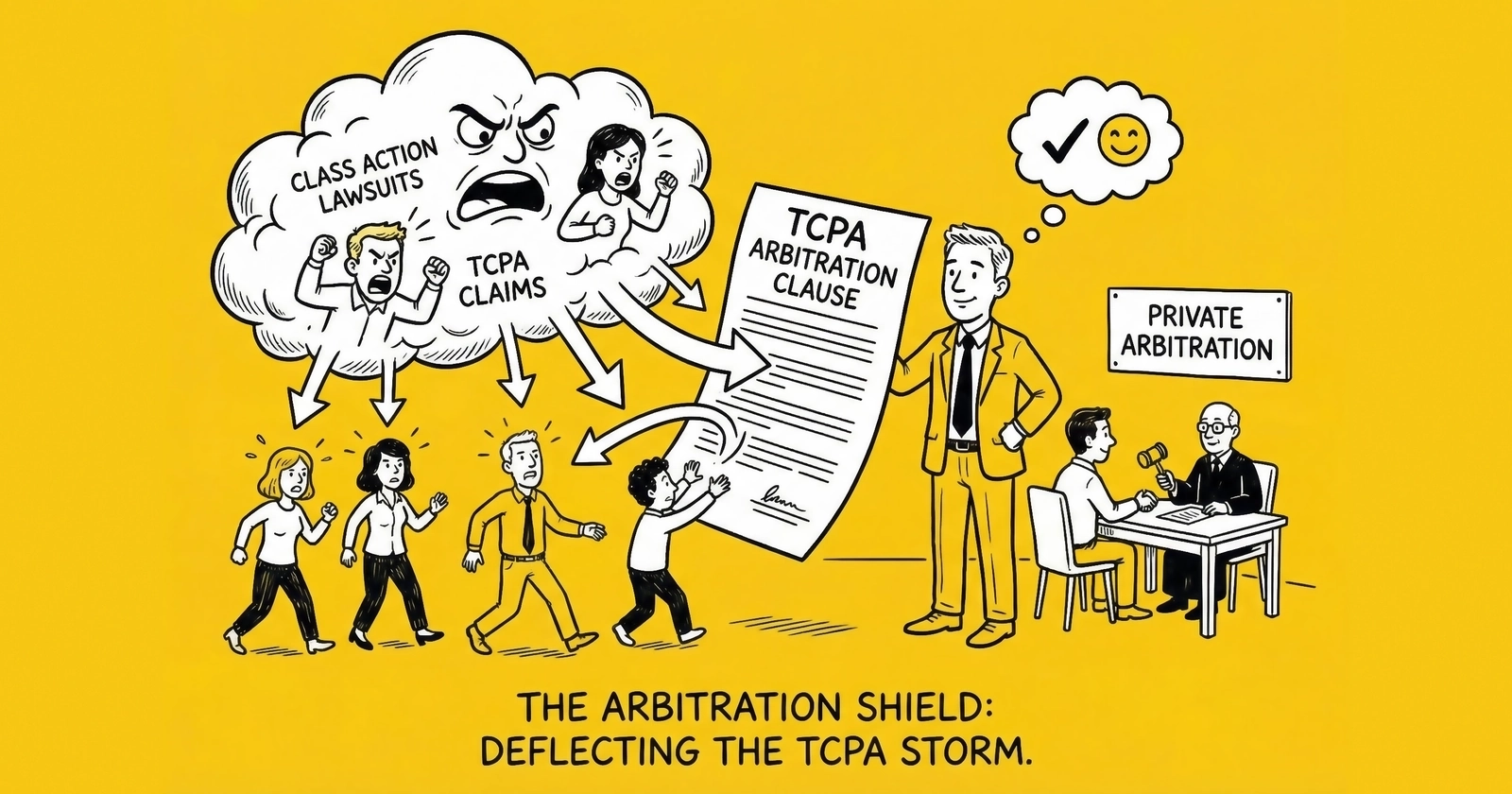
How properly drafted arbitration agreements with class action waivers can transform existential TCPA class action exposure into manageable individual disputes, with implementation strategies, sample language, and the legal framework that determines enforceability.
Introduction: The Class Action Killer
In March 2025, a mid-sized insurance lead generator in Florida received a class action complaint alleging 47,000 TCPA violations. Potential exposure: $70.5 million. Annual revenue: $12 million. The case should have been an extinction-level event.
It was dismissed within six weeks.
The difference was three paragraphs of text embedded in the company’s lead capture form: an arbitration agreement with a class action waiver. The consumer who filed the lawsuit had agreed, by checking a box on a form seeking insurance quotes, to resolve any disputes through individual arbitration rather than class litigation. The court enforced that agreement, compelling arbitration and dismissing the class claims.
This is not an anomaly. Arbitration clauses have become one of the most effective defensive tools in TCPA litigation. When properly drafted and implemented, they eliminate class action exposure entirely, transforming potential nine-figure liability into disputes where a plaintiff’s maximum recovery is $500 to $1,500 for their individual violations.
The math changes everything. A class action seeking $70 million in damages is worth pursuing for a plaintiff’s attorney who will receive 25-33% of any settlement. An individual arbitration for $1,500 is not worth the filing fee. This economic reality is why arbitration clauses work: they do not prevent violations from being actionable, but they make pursuing those actions economically irrational for plaintiffs and their counsel.
In the first quarter of 2025 alone, 507 TCPA class actions were filed – a 112% increase over Q1 2024. Nearly 80% of all TCPA lawsuits are filed as class actions, compared to just 2-5% for other consumer protection statutes. Average settlements exceed $6.6 million. The arbitration clause is the single most effective countermeasure against this tsunami of aggregate litigation. For comprehensive compliance requirements, see our TCPA compliance guide for lead generators.
This guide covers how arbitration clauses work, why courts enforce them, how to draft clauses that survive legal challenge, implementation strategies for lead generation operations, and the ongoing maintenance required to keep your protection current.
Why Arbitration Clauses Work Against TCPA Class Actions
Arbitration clauses work because they address the fundamental economics that drive TCPA litigation. Understanding this economics explains both why the plaintiff’s bar targets the industry and how arbitration disrupts their business model.
The Class Action Economics That Created the TCPA Litigation Industry
TCPA provides statutory damages of $500 per violation, trebled to $1,500 for willful violations. There is no cap on aggregate damages. A defendant who made 100,000 non-compliant calls faces potential exposure of $50 million to $150 million.
No individual consumer has suffered $50 million in harm from receiving unwanted phone calls. The harm is distributed across thousands or millions of people, each experiencing minor annoyance. But TCPA’s private right of action allows those individuals to aggregate their claims through class certification.
This aggregation mechanism is what makes TCPA litigation profitable:
-
Individual claim: $500-$1,500 in damages minus filing fees, attorney costs, and time. Net value to plaintiff: often negative.
-
Class claim representing 50,000 consumers: $25 million to $75 million in potential damages. Plaintiff’s attorney takes 25-33%. Net attorney fee potential: $6 million to $25 million.
The plaintiff’s bar recognized this arbitrage opportunity. Leading TCPA defense attorney Eric Troutman calls the statute “the biggest cash cow in history” for plaintiffs’ counsel. The economics create a self-reinforcing cycle: high-value class actions fund plaintiff firms, which file more actions, which increase industry pressure, which creates more non-compliance, which generates more litigation opportunity.
How Arbitration Breaks the Class Action Model
Arbitration clauses with class action waivers break this cycle by eliminating aggregation:
- With class waiver in effect: Individual claim remains $500-$1,500 minus arbitration fees, attorney costs, and time. Net value to plaintiff: still often negative.
The plaintiff’s attorney can no longer aggregate 50,000 claims into a single action. Each consumer must pursue their own individual arbitration. The economics that made TCPA litigation attractive evaporate.
Consider the practical implications:
A plaintiff’s firm files a TCPA class action. The defendant moves to compel arbitration based on the arbitration clause the plaintiff agreed to when completing a lead form. If the court grants the motion, the plaintiff must pursue their individual $500-$1,500 claim through arbitration rather than as class representative for thousands of consumers.
The plaintiff’s attorney faces a choice: invest significant resources pursuing a case worth at most $1,500, or drop the case. Most drop the case. Even if they proceed, maximum exposure is three orders of magnitude smaller than a class action.
The Litigation Data That Proves Arbitration Works
Companies with enforceable arbitration clauses see dramatically different litigation outcomes:
-
Dismissal rates: Motions to compel arbitration in TCPA cases succeed approximately 70-80% of the time when the arbitration clause is properly drafted and documented.
-
Settlement economics: When arbitration is compelled, nuisance settlement values drop from $2,500-$15,000 (pre-litigation class action threats) to minimal or zero, as the economics no longer favor plaintiff pursuit.
-
Volume deterrence: Plaintiff’s firms track defendant arbitration practices. Companies known to enforce arbitration clauses receive fewer demand letters and class action filings because plaintiff counsel recognize the cases cannot be prosecuted profitably.
The pattern is clear in litigation data. Serial TCPA plaintiffs and sophisticated plaintiff’s firms preferentially target companies without arbitration clauses, where class certification and large settlements remain possible.
The Legal Foundation: Why Courts Enforce Arbitration Clauses
Arbitration clauses work only because courts enforce them. Understanding the legal framework that compels enforcement helps draft clauses that will survive challenge.
The Federal Arbitration Act
The Federal Arbitration Act (FAA), enacted in 1925, establishes a strong federal policy favoring arbitration. Section 2 of the FAA provides that written arbitration agreements “shall be valid, irrevocable, and enforceable, save upon such grounds as exist at law or in equity for the revocation of any contract.”
This language means arbitration agreements receive the same treatment as other contracts. Courts cannot refuse to enforce an arbitration agreement simply because they disfavor arbitration or prefer that certain claims proceed in court. If the agreement was validly formed and is not unconscionable, it must be enforced.
The Supreme Court has repeatedly reinforced this principle:
-
AT&T Mobility v. Concepcion (2011): The Court held that the FAA preempts state laws that discriminate against arbitration, including rules that make class waivers unenforceable. States cannot create special obstacles to arbitration agreements that do not apply to contracts generally.
-
American Express v. Italian Colors (2013): The Court enforced an arbitration clause with class waiver even though individual arbitration was uneconomical for the plaintiffs, holding that the FAA does not guarantee access to class procedures.
-
Epic Systems v. Lewis (2018): The Court confirmed that class action waivers in employment arbitration agreements are enforceable, further cementing the FAA’s primacy over arguments that class procedures are necessary for effective vindication of rights.
These decisions establish that arbitration clauses with class action waivers are enforceable even when they effectively prevent collective litigation – which is precisely the mechanism that makes them effective against TCPA class actions.
TCPA-Specific Enforcement
Courts have consistently enforced arbitration clauses in TCPA cases specifically:
-
Jackson v. Home Depot USA (N.D. Ga. 2023): Court compelled arbitration of TCPA claims based on arbitration clause in terms of service, holding the clause was properly incorporated and not unconscionable.
-
Lanza v. T-Mobile USA (N.D. Cal. 2022): Court enforced arbitration clause against TCPA claims, rejecting arguments that TCPA rights cannot be waived.
-
Smith v. Sirius XM Radio (S.D.N.Y. 2021): Court compelled arbitration of TCPA text message claims based on arbitration agreement in subscription terms.
The pattern across circuits and districts is consistent: properly drafted arbitration clauses with class action waivers are enforceable in TCPA litigation.
Challenges That Can Defeat Arbitration Clauses
Not every arbitration clause survives challenge. Courts have declined to enforce clauses based on several grounds:
-
Procedural Unconscionability: The clause was presented in a way that prevented meaningful consent. Hidden arbitration provisions, small print, lack of opportunity to review, or take-it-or-leave-it presentation with no alternative can create procedural unconscionability.
-
Substantive Unconscionability: The clause is so one-sided that it shocks the conscience. Provisions that impose unreasonable costs on consumers, allow the company to seek court relief while requiring consumers to arbitrate, or limit damages below statutory minimums may be substantively unconscionable.
-
Failure of Formation: The consumer never agreed to the arbitration clause. Missing signature, lack of mutual assent, or failure to present the terms before agreement can prevent contract formation.
-
Scope Limitations: The clause does not cover the claims at issue. A narrowly drafted arbitration clause might not extend to TCPA claims if they are not clearly within its scope.
In the 2024 Dahdah v. Rocket Mortgage case, the court denied a motion to compel arbitration in part because the disclosure was located too far from the “agree and subscribe” button. The arbitration clause existed but was not sufficiently connected to the consumer’s consent action. Location matters. This aligns with best practices for high-converting lead forms that position consent language prominently.
Understanding these challenges informs how to draft clauses that avoid them.
Drafting Arbitration Clauses That Survive Challenge
An arbitration clause is only as good as its enforceability. The following elements maximize the likelihood that courts will compel arbitration when challenged.
Essential Elements of an Enforceable Arbitration Clause
1. Clear Mutual Agreement to Arbitrate
The clause must clearly state that both parties agree to resolve disputes through arbitration rather than court litigation:
ARBITRATION AGREEMENT: You and [Company Name] agree that any dispute, claim,
or controversy arising out of or relating to these terms, the services we
provide, or any communications between us shall be resolved exclusively
through binding individual arbitration rather than in court.
The language must be mutual – both parties bound – though the company will rarely seek to enforce it against consumers.
2. Explicit Class Action Waiver
The class action waiver must be explicit and unmistakable:
CLASS ACTION WAIVER: You agree that any arbitration will be conducted in your
individual capacity only, and not as a class action or other representative
proceeding. You expressly waive any right to file a class action or to
participate in a class action. The arbitrator may not consolidate claims of
more than one person or otherwise preside over any form of representative or
class proceeding.
Courts focus on whether the consumer knowingly waived class rights. Explicit language survives scrutiny better than vague or implicit waivers.
3. Scope Covering All Potential Claims
Draft the scope broadly to cover all disputes, including TCPA claims:
This arbitration agreement covers all claims arising from or relating to:
(a) any communications between you and [Company Name] or its marketing partners;
(b) any calls, text messages, or other contacts you receive;
(c) the manner in which your information is collected, used, or shared;
(d) any federal or state consumer protection laws, including but not limited
    to the Telephone Consumer Protection Act (TCPA);
(e) any disputes regarding consent, revocation, or marketing communications.
Explicitly referencing TCPA and phone/text communications removes ambiguity about whether TCPA claims fall within scope.
4. Selection of Arbitration Forum
Specify the arbitration organization and rules:
Arbitration will be administered by the American Arbitration Association (AAA)
under its Consumer Arbitration Rules, or by JAMS under its Streamlined
Arbitration Rules, at the consumer's election. If both AAA and JAMS are
unavailable, the parties will select another nationally recognized arbitration
provider.
AAA and JAMS are the most commonly specified forums. Their consumer arbitration rules include consumer protections that reduce unconscionability challenges.
5. Cost Allocation Provisions
Address arbitration costs in a way that does not create economic barriers:
COSTS: [Company Name] will pay all arbitration filing fees and arbitrator
costs that exceed the amount you would have paid to file a lawsuit in court.
If the arbitrator finds you cannot afford to pay your share of filing fees,
[Company Name] will pay them on your behalf.
Provisions requiring consumers to bear substantial arbitration costs can create unconscionability challenges. Having the company absorb excess costs eliminates this attack vector.
6. Opt-Out Provision
Including an opt-out right significantly strengthens enforceability:
OPT-OUT: You may opt out of this arbitration agreement by sending written
notice to [Company Name] at [address] within 30 days of agreeing to these
terms. Your opt-out notice must include your name, address, phone number,
and a statement that you wish to opt out of arbitration.
An opt-out provision demonstrates that the arbitration agreement was not truly take-it-or-leave-it, defeating procedural unconscionability arguments. Very few consumers actually opt out.
7. Severability Clause
Protect the agreement if specific provisions are found unenforceable:
SEVERABILITY: If any portion of this arbitration agreement is found
unenforceable, the remainder shall continue in full force and effect. However,
if the class action waiver is found unenforceable as to a particular claim,
then this entire arbitration agreement shall be void as to that claim only,
and that claim may proceed in court on an individual basis.
This ensures that a court finding one provision problematic does not void the entire arbitration agreement.
Sample Complete Arbitration Clause for Lead Generation
The following sample integrates all essential elements:
DISPUTE RESOLUTION: BINDING INDIVIDUAL ARBITRATION AND CLASS ACTION WAIVER

PLEASE READ THIS SECTION CAREFULLY. IT AFFECTS YOUR LEGAL RIGHTS, INCLUDING
YOUR RIGHT TO FILE A LAWSUIT IN COURT.

Agreement to Arbitrate: By submitting this form, you and [Company Name] agree
to resolve any dispute, claim, or controversy arising from or relating to
these terms, any communications you receive from [Company Name] or its
marketing partners, or any calls, text messages, emails, or other contacts
made to you through binding individual arbitration. This includes, without
limitation, claims under the Telephone Consumer Protection Act (TCPA), state
telemarketing laws, and any other federal or state consumer protection laws.

No Class Actions: All claims must be brought in your individual capacity, not
as a plaintiff or class member in any purported class, collective, or
representative proceeding. You expressly waive any right to participate in a
class action or class arbitration. The arbitrator may not consolidate claims
of more than one person or preside over any class or representative proceeding.

Arbitration Forum and Rules: Arbitration will be administered by the American
Arbitration Association (AAA) under its Consumer Arbitration Rules, or by JAMS
under its Streamlined Arbitration Rules, at your election. You may obtain
these rules by visiting www.adr.org or www.jamsadr.com. The arbitration will
be conducted by a single neutral arbitrator in [County, State] or, at your
request, in your county of residence.

Costs: [Company Name] will pay all AAA or JAMS filing fees, administration
fees, and arbitrator fees that exceed what you would pay to file a lawsuit in
your local state or federal court. If you prevail on your claims, the
arbitrator may award you your reasonable attorney fees and costs.

Small Claims Court: Either party may bring a claim in small claims court
rather than arbitration, provided the claim is within the court's
jurisdictional limits.

Opt-Out: You may opt out of this arbitration agreement by sending written
notice to [Company Name], Attn: Legal Department, [Address], within 30 days
of your first submission of personal information. Your notice must include
your name, address, phone number, and a clear statement that you wish to opt
out of arbitration. If you opt out, all other provisions of these terms will
continue to apply.

Severability: If any provision of this arbitration agreement is found
unenforceable, the remaining provisions will continue in effect. However, if
the class action waiver is found unenforceable in any particular case, this
entire arbitration agreement shall be void as to that case only.

Survival: This arbitration agreement will survive termination of your
relationship with [Company Name].
This clause addresses all major challenge vectors while maintaining clarity and readability.
Implementation for Lead Generation Operations
Having a well-drafted arbitration clause means nothing if it is not properly implemented. Implementation determines whether the clause will be enforceable when challenged. Understanding how the ATDS definition changed after Duguid helps contextualize current litigation exposure.
Placement and Presentation
Location on Form: The arbitration clause must be presented before the consumer submits their information. Best practice is to place the arbitration agreement on the same page as the lead capture form, visible without scrolling (or with minimal scrolling).
In Dahdah v. Rocket Mortgage, the court found the arbitration disclosure inadequate because it was located too far from the submission button. Keep arbitration terms visually connected to the consent action.
Visibility Requirements: The arbitration clause should be:
- In the same font size as or larger than surrounding text
- Not in gray or low-contrast text
- Not requiring multiple clicks or scrolling to access essential terms
- Separated from other content with clear visual boundaries
Acknowledgment Mechanism: Require affirmative acknowledgment of the arbitration agreement:
Option 1: Separate checkbox specifically for arbitration agreement
[ ] I have read and agree to the Arbitration AgreementOption 2: Combined acknowledgment with explicit reference
[ ] I agree to the Terms of Service, Privacy Policy, and Arbitration Agreement
    (including class action waiver)
Option 3: Clickwrap with required reading Present the arbitration agreement in a scrollable text box that must be scrolled to the bottom before the submit button becomes active.
No Pre-Checked Boxes: Never pre-check arbitration acknowledgment boxes. Pre-checked consent does not satisfy affirmative agreement requirements and creates enforceability challenges.
Integration with Consent Documentation
Arbitration agreement acceptance should be documented with the same rigor as TCPA consent:
Capture with TrustedForm/Jornaya: Deploy consent verification scripts that capture the arbitration agreement presentation and consumer acknowledgment. The session replay should show:
- The arbitration clause was displayed
- The consumer had opportunity to read it
- The consumer took affirmative action to agree
Timestamp and IP Documentation: Record the timestamp and IP address of arbitration agreement acceptance, linked to the specific lead record.
Preserve Version History: Maintain records of which arbitration language was displayed at what times. If the clause is updated, preserve historical versions so you can prove what the consumer agreed to.
Retention Period: Retain arbitration agreement documentation for at least five years – matching consent documentation retention – to support enforcement against delayed claims.
Consistency Across Touchpoints
Consumers may interact with your operation through multiple channels. Ensure consistent arbitration agreement presentation:
All Landing Pages: Every lead capture form should include the arbitration agreement, regardless of traffic source or campaign.
Different Form Versions: If you test multiple form versions, ensure the arbitration clause is present and consistent in all versions.
Partner/Publisher Forms: If publishers capture leads on your behalf, require them to include your arbitration agreement in their forms. Audit compliance regularly.
Mobile-Specific Considerations: Mobile form layouts may require adjustment to ensure arbitration terms are visible. Test on actual mobile devices, not just responsive previews.
Buyer Communication and Documentation
When selling leads, communicate arbitration status to buyers:
Lead Data Fields: Include a field indicating whether the consumer agreed to arbitration:
"arbitration_agreed": "true",
"arbitration_agreement_version": "2.1",
"arbitration_timestamp": "2025-03-15T14:32:17Z"
Certificate Integration: TrustedForm certificates should capture the arbitration agreement presentation. When providing certificates to buyers, note that arbitration is documented.
Buyer Reliance: Sophisticated buyers recognize arbitration agreement presence as valuable. It transfers protection to them for TCPA claims arising from their contact with the lead.
Special Considerations for Multi-Party Lead Flows
Lead generation involves multiple parties: publishers who capture leads, aggregators who route them, and buyers who contact consumers. Arbitration clause benefits must flow through this chain.
Publisher Requirements
If publishers capture leads on your behalf, ensure your arbitration clause is included in their forms:
Contractual Requirements: Include in publisher agreements:
Publisher shall include Company's current Arbitration Agreement in all lead
capture forms, presented in the manner specified by Company. Publisher shall
not modify the Arbitration Agreement language without prior written approval.
Template Provision: Provide publishers with exact arbitration clause language to use. Do not allow variation.
Audit Rights: Include audit rights allowing you to verify arbitration clause presentation on publisher forms. Conduct regular audits.
Documentation Flow: Require publishers to pass through arbitration acknowledgment documentation with each lead.
Aggregator and Broker Considerations
If you operate as an aggregator or broker purchasing leads from multiple sources:
Source Verification: Verify that upstream sources include enforceable arbitration clauses. A lead without arbitration protection has different risk characteristics than one with protection.
Supplemental Agreement: Consider requiring consumers to re-acknowledge arbitration when they interact with your platform, even if they previously agreed on a publisher site. Belt-and-suspenders approaches strengthen enforceability.
Documentation Chain: Maintain documentation linking each lead to its arbitration agreement, including upstream source information.
Buyer Benefits and Limitations
Buyers who contact leads benefit from arbitration clauses in the consent transaction:
Third-Party Beneficiary Status: Arbitration clauses can explicitly extend to marketing partners and their affiliates:
This arbitration agreement applies to all disputes between you and [Company
Name], as well as any of [Company Name]'s marketing partners, affiliates, or
service providers who contact you or receive your information.
Buyer Verification: Sophisticated buyers should verify arbitration agreement presence before purchasing leads. Request documentation confirming arbitration was agreed to.
Limitations: Arbitration clauses may not protect buyers who were not identified in the original disclosure or whose conduct falls outside the arbitration scope. Buyers should not assume protection without verification.
Maintaining and Updating Arbitration Agreements
Arbitration clauses require ongoing maintenance. Legal developments, business changes, and operational evolution all require updates.
When to Update Arbitration Language
Legal Developments: Court decisions interpreting arbitration clauses, new state laws affecting enforceability, or Supreme Court rulings on FAA scope may require language updates.
Business Changes: New verticals, new marketing channels, new partners, or new dispute categories may require scope expansion.
Operational Changes: Changes to form design, consent flow, or documentation systems may affect how arbitration agreements are presented and recorded.
Regulatory Requirements: FCC or state regulatory changes affecting consent requirements may have implications for arbitration clause presentation.
Update Process
Legal Review: Have TCPA-experienced counsel review proposed changes before implementation. Arbitration clause drafting is technical, and errors can defeat enforceability.
Version Control: Assign version numbers to each arbitration clause iteration. Document effective dates for each version.
Implementation Testing: Before deploying updated language, test across all form variants, devices, and platforms to confirm proper presentation.
Documentation Transition: When updating arbitration language, preserve the ability to document which version applied to which leads. Consumers are bound by the version they agreed to.
Retroactivity Considerations: Arbitration clause updates generally apply only to new transactions. Existing leads remain bound by the version they agreed to.
Annual Review Checklist
Conduct at least annual review of arbitration clause effectiveness:
- Review court decisions affecting arbitration enforceability
- Verify arbitration clause presence on all active lead capture forms
- Audit publisher compliance with arbitration requirements
- Confirm documentation systems capture arbitration acknowledgment
- Review version control and historical preservation
- Test enforcement by reviewing any motions to compel from the past year
- Assess whether scope covers all current business activities
- Confirm arbitration forum (AAA/JAMS) rules have not changed materially
When Arbitration Clauses May Not Protect You
Arbitration clauses are powerful but not omnipotent. Understanding limitations prevents overreliance.
Formation Failures
If the consumer never actually agreed to the arbitration clause, it cannot be enforced:
-
Missing Documentation: If you cannot prove the consumer agreed to arbitration at the time of lead capture, the clause is unenforceable as to that consumer.
-
Form Errors: Technical errors that allowed form submission without arbitration acknowledgment create unprotected leads.
-
Fraud or Fabrication: If consent records are fabricated or tampered with, courts will not enforce the purported agreement.
Scope Limitations
Arbitration clauses cover only what they say they cover:
-
Narrow Drafting: A clause that covers “disputes arising from services provided” might not cover TCPA claims if contact was made before any service was provided.
-
Third-Party Exclusions: Buyers not identified in the arbitration clause may not be protected.
-
Excluded Claims: Some arbitration clauses carve out specific claim types. Ensure TCPA claims are not inadvertently excluded.
State Law Variations
While the FAA preempts most state law obstacles to arbitration, variations exist:
-
California: California courts historically scrutinized arbitration clauses closely, though FAA preemption limits state law interference.
-
Consumer Protection Carve-Outs: Some state laws attempt to prevent waiver of certain consumer rights. While FAA generally preempts these laws, litigation may be required to confirm enforceability.
-
Public Injunction Exception: California’s McGill rule prevents enforcement of arbitration clauses as to claims for public injunctive relief. This exception has limited TCPA application but may affect certain claim types.
Regulatory Actions
Arbitration clauses protect against private litigation, not government enforcement:
-
FCC Enforcement: The FCC can pursue enforcement actions regardless of arbitration clauses in consumer contracts.
-
State AG Actions: State attorneys general are not bound by consumer arbitration agreements.
-
FTC Actions: FTC enforcement proceeds independently of private arbitration agreements.
Arbitration clauses protect against the class action exposure that represents the majority of TCPA liability risk, but do not eliminate regulatory oversight.
Responding to Arbitration Challenges
When plaintiffs challenge arbitration clauses, the response strategy determines outcomes.
Motion to Compel Arbitration
Upon receiving a TCPA lawsuit, defendants with arbitration clauses should promptly file a motion to compel arbitration:
Timing: File early, before engaging extensively in discovery or other litigation activity. Delay can create waiver arguments.
Evidence Package: Support the motion with:
- Copy of the arbitration clause the plaintiff agreed to
- Documentation showing when and how the plaintiff agreed
- TrustedForm certificate or equivalent showing clause presentation
- Declaration authenticating the documentation
Argument Structure: The motion should establish:
- A valid arbitration agreement exists
- The agreement covers the claims at issue
- The plaintiff agreed to the arbitration clause
- The FAA requires enforcement
Common Plaintiff Arguments and Responses
“I never agreed to arbitration.” Response: Present documentation showing the plaintiff’s interaction with the form, including session replay, timestamp, IP address, and consent acknowledgment. TrustedForm certificates are particularly effective.
“The clause is unconscionable.” Response: Demonstrate procedural fairness (clear presentation, opt-out available, no take-it-or-leave-it circumstances) and substantive fairness (mutual obligations, company pays excess fees, forum is accessible).
“The clause doesn’t cover TCPA claims.” Response: Point to broad scope language explicitly including TCPA and telemarketing communications. If TCPA is not explicitly mentioned, argue that “all disputes arising from communications” inherently includes TCPA claims.
“The class waiver is unenforceable.” Response: Cite AT&T Mobility v. Concepcion and subsequent Supreme Court precedent establishing FAA preemption of state law rules disfavoring class waivers.
Success Rates and Outcomes
When arbitration clauses are properly drafted and documented:
Motion Grant Rate: Approximately 70-80% of motions to compel arbitration in TCPA cases are granted when the defendant presents adequate documentation.
Post-Compel Outcomes: After arbitration is compelled, the vast majority of cases are dismissed or abandoned. Plaintiff economics do not support individual arbitration pursuit.
Settlement Dynamics: Even when motions are pending, the existence of an arbitration clause shifts settlement dynamics. Plaintiffs facing likely arbitration compulsion settle for reduced amounts or abandon claims.
Cost-Benefit Analysis: Is an Arbitration Clause Worth It?
For lead generation operations evaluating whether to implement arbitration clauses, the economics are unambiguous.
Implementation Costs
-
Legal Drafting: Properly drafted arbitration clauses require TCPA-experienced counsel. Initial drafting: $5,000-$15,000. Annual review and updates: $2,000-$5,000.
-
Form Integration: Technical implementation on lead capture forms. Minimal incremental cost if forms are already being updated.
-
Documentation Systems: Enhanced documentation to prove arbitration agreement. Incremental cost over existing consent documentation: minimal if TrustedForm/Jornaya already deployed.
-
Potential Conversion Impact: Longer form disclosures may marginally reduce conversion rates. Testing typically shows minimal impact when arbitration terms are clearly presented.
Total annual cost for mid-sized operation: $10,000-$25,000.
Exposure Reduction
Without Arbitration Clause:
- Class action exposure from 100,000 contacts: $50 million to $150 million
- Average settlement if class certified: $6.6 million
- Defense costs through class certification: $100,000-$300,000
- Probability of class action filing (high-volume operation): meaningful annual risk
With Enforceable Arbitration Clause:
- Class action exposure: eliminated
- Maximum individual claim exposure: $1,500 per consumer
- Defense costs per individual claim: $5,000-$15,000 (rarely pursued)
- Probability of class action proceeding past motion to compel: dramatically reduced
ROI Calculation
Prevention of a single class action represents ROI exceeding 100:1 on arbitration clause investment. Even preventing a single pre-litigation settlement demand (typically $10,000-$50,000) generates positive ROI.
For operations making any meaningful volume of outbound contacts, arbitration clause implementation is among the highest-ROI compliance investments available.
Frequently Asked Questions
What is an arbitration clause and how does it protect against TCPA lawsuits?
An arbitration clause is a contractual provision requiring disputes to be resolved through private arbitration rather than court litigation. In the TCPA context, arbitration clauses protect by eliminating class action exposure. When a consumer agrees to individual arbitration with a class action waiver, they give up the right to participate in class litigation. This transforms potential nine-figure class action exposure into individual claims worth at most $1,500 each. The economics of pursuing individual claims in arbitration are unfavorable for plaintiffs and their attorneys, resulting in most claims being abandoned rather than pursued.
Are arbitration clauses with class action waivers enforceable under federal law?
Yes. The Federal Arbitration Act establishes a strong federal policy favoring arbitration. The Supreme Court has repeatedly confirmed that arbitration clauses with class action waivers are enforceable. In AT&T Mobility v. Concepcion (2011), the Court held that the FAA preempts state laws that discriminate against arbitration or make class waivers unenforceable. In American Express v. Italian Colors (2013), the Court enforced class waivers even when individual arbitration was economically impractical. Courts routinely enforce arbitration clauses in TCPA cases when they are properly drafted and documented.
Where should the arbitration clause be placed on a lead capture form?
The arbitration clause should be placed on the same page as the lead capture form, visible without extensive scrolling, and visually connected to the consent/submission action. Courts have declined to enforce arbitration clauses that were located too far from the submission button or required multiple clicks to access. Best practice is to present the arbitration agreement immediately above or adjacent to the form submission button, in the same font size as surrounding text, with clear visual separation from other content. Require affirmative acknowledgment through an unchecked checkbox or clickwrap agreement.
Can an arbitration clause protect lead buyers who purchase leads from third parties?
Yes, if the arbitration clause is properly drafted. The clause should explicitly extend protection to “marketing partners, affiliates, and their service providers” who may contact the consumer. When a buyer is identified in the consent disclosure and falls within the arbitration clause scope, they receive the same protection as the original lead generator. However, buyers should verify arbitration agreement presence before purchasing leads and should not assume protection without documentation confirming the consumer agreed to arbitration covering the buyer’s contact.
What documentation is needed to enforce an arbitration clause in litigation?
To enforce an arbitration clause, you need documentation proving the consumer agreed to it. Essential documentation includes: the exact arbitration clause language displayed to the consumer, timestamp of when the consumer agreed, IP address associated with the agreement, evidence of the affirmative action taken (checkbox selection, signature, etc.), and session replay or recording showing the clause presentation. TrustedForm certificates or Jornaya LeadiDs that capture the arbitration agreement presentation provide strong third-party evidence. Retain this documentation for at least five years to support enforcement against delayed claims.
Do arbitration clauses prevent regulatory enforcement by the FCC or state attorneys general?
No. Arbitration clauses bind private parties to the agreement. Government agencies like the FCC, FTC, and state attorneys general are not parties to consumer contracts and are not bound by arbitration provisions. These agencies can pursue enforcement actions regardless of arbitration clauses. However, private class actions represent the vast majority of TCPA exposure for most companies. Regulatory enforcement, while possible, is far less common than private litigation. Arbitration clauses address the primary threat.
What makes an arbitration clause unconscionable and unenforceable?
Courts may refuse to enforce arbitration clauses that are procedurally or substantively unconscionable. Procedural unconscionability arises when the clause is hidden, in fine print, presented without opportunity for review, or truly take-it-or-leave-it with no alternative. Substantive unconscionability arises when terms are so one-sided they shock the conscience, such as requiring consumers to bear all arbitration costs, allowing the company to pursue court relief while requiring consumers to arbitrate, or limiting recoverable damages below statutory minimums. Including an opt-out provision, having the company pay excess arbitration fees, and using established forums like AAA or JAMS reduces unconscionability risk.
How often should arbitration clause language be reviewed and updated?
Conduct at least annual review of arbitration clause language and implementation. More frequent review is warranted following significant court decisions affecting arbitration enforceability, changes to AAA or JAMS rules, expansion of business activities that may require scope updates, or FCC/state regulatory changes affecting consent requirements. When updating language, maintain version control, document effective dates, and preserve the ability to prove which version applied to which consumers.
What is the success rate for motions to compel arbitration in TCPA cases?
When arbitration clauses are properly drafted and documented, motions to compel arbitration succeed approximately 70-80% of the time. Success depends primarily on documentation quality. Defendants who can present clear evidence that the plaintiff agreed to arbitration – ideally including session replay, timestamp, and explicit acknowledgment – prevail at high rates. Failures typically stem from inadequate documentation, overly narrow clause scope, or presentation deficiencies that create unconscionability concerns.
Should the arbitration clause be separate from the TCPA consent disclosure?
They can be combined or separate, but each must be independently clear and conspicuous. Many operations combine arbitration agreement with terms of service acceptance, separate from TCPA consent. Others integrate all disclosures with references to each: “I agree to the Terms of Service, Privacy Policy, Arbitration Agreement, and consent to receive marketing calls and texts…” Either approach can work if each element is clearly presented and affirmatively acknowledged. The key requirement is that neither arbitration agreement nor TCPA consent can be buried or made contingent on the other in a way that makes either a condition of a required transaction.
Key Takeaways
-
Arbitration clauses with class action waivers eliminate TCPA class action exposure. By requiring individual arbitration rather than class litigation, they transform potential nine-figure liability into claims worth at most $1,500 each. The economics that drive TCPA class action litigation evaporate.
-
The Federal Arbitration Act provides strong legal foundation for enforcement. Supreme Court precedent, including AT&T Mobility v. Concepcion and American Express v. Italian Colors, establishes that arbitration clauses with class waivers are enforceable even when they effectively prevent collective litigation.
-
Proper drafting is essential for enforceability. Arbitration clauses must include clear mutual agreement, explicit class action waiver, broad scope covering TCPA claims, selection of arbitration forum, consumer-friendly cost allocation, opt-out provision, and severability clause.
-
Implementation determines whether the clause can be enforced. The arbitration clause must be clearly presented, affirmatively acknowledged, and thoroughly documented. TrustedForm certificates or equivalent verification capturing the arbitration agreement presentation provide critical litigation evidence.
-
Documentation must be retained for at least five years. The TCPA statute of limitations is four years. Retain arbitration agreement documentation with margin beyond this period to support enforcement against delayed claims.
-
Arbitration clauses protect against private litigation, not regulatory enforcement. FCC, FTC, and state AG actions proceed independently of consumer arbitration agreements. However, private class actions represent the dominant threat for most operations.
-
Motions to compel arbitration succeed at high rates when properly supported. Approximately 70-80% of motions are granted when the defendant presents clear documentation of agreement. Post-compel, the vast majority of claims are abandoned.
-
The ROI on arbitration clause implementation is among the highest of any compliance investment. Annual costs of $10,000-$25,000 protect against potential exposure of millions or tens of millions in class action liability. Prevention of a single class action represents 100:1+ return.
-
Ongoing maintenance is required. Annual review of language, implementation, and documentation systems ensures continued enforceability as legal standards and business practices evolve.
Sources
- Federal Arbitration Act (9 U.S.C.) - Complete statutory text establishing federal policy favoring enforcement of arbitration agreements
- AT&T Mobility v. Concepcion - Oyez - Supreme Court case summary (2011) establishing FAA preemption of state laws restricting class action waivers
- American Express v. Italian Colors - Oyez - Supreme Court case summary (2013) enforcing class waivers even when individual arbitration is economically impractical
- JAMS Arbitration Services - Major arbitration forum frequently specified in consumer arbitration clauses
- American Arbitration Association - Leading provider of alternative dispute resolution services for consumer and commercial disputes
- 47 U.S.C. 227 - TCPA Statute - Complete statutory text defining TCPA requirements and private right of action
Building the Full Defense Stack
Arbitration clauses are one component of comprehensive TCPA risk management. Those who survive combine arbitration protection with:
Valid PEWC capture: Proper prior express written consent with all six required elements, documented through TrustedForm or Jornaya.
DNC suppression: Screening against federal and state Do Not Call registries before any telemarketing contact.
Litigator scrubbing: Identifying and avoiding known serial TCPA plaintiffs who actively seek litigation opportunities.
Revocation processing: Honoring opt-out requests within the ten-business-day FCC requirement across all communication channels.
Documentation retention: Maintaining complete records of consent, arbitration agreement, and contact history for five or more years.
Arbitration clauses do not make other compliance unnecessary. They provide a fallback when compliance fails or when plaintiffs pursue claims despite valid consent. The strongest defense combines prevention (compliance that avoids violations) with protection (arbitration clauses that limit exposure when violations are alleged).
The lead generation industry operates in the most aggressive TCPA litigation environment in the statute’s 34-year history. Those who build defense in depth – compliance, documentation, and arbitration protection – are the ones who will still be operating five years from now.
The math is unforgiving. Build your defenses accordingly.
This article provides general information about arbitration clauses and TCPA litigation. It is not legal advice. Arbitration clause drafting requires TCPA-experienced counsel familiar with current case law and enforcement trends. Consult qualified legal counsel before implementing or modifying arbitration agreements.
Legal information current as of late 2025. Case law and regulatory requirements evolve continuously.
Related Resources: