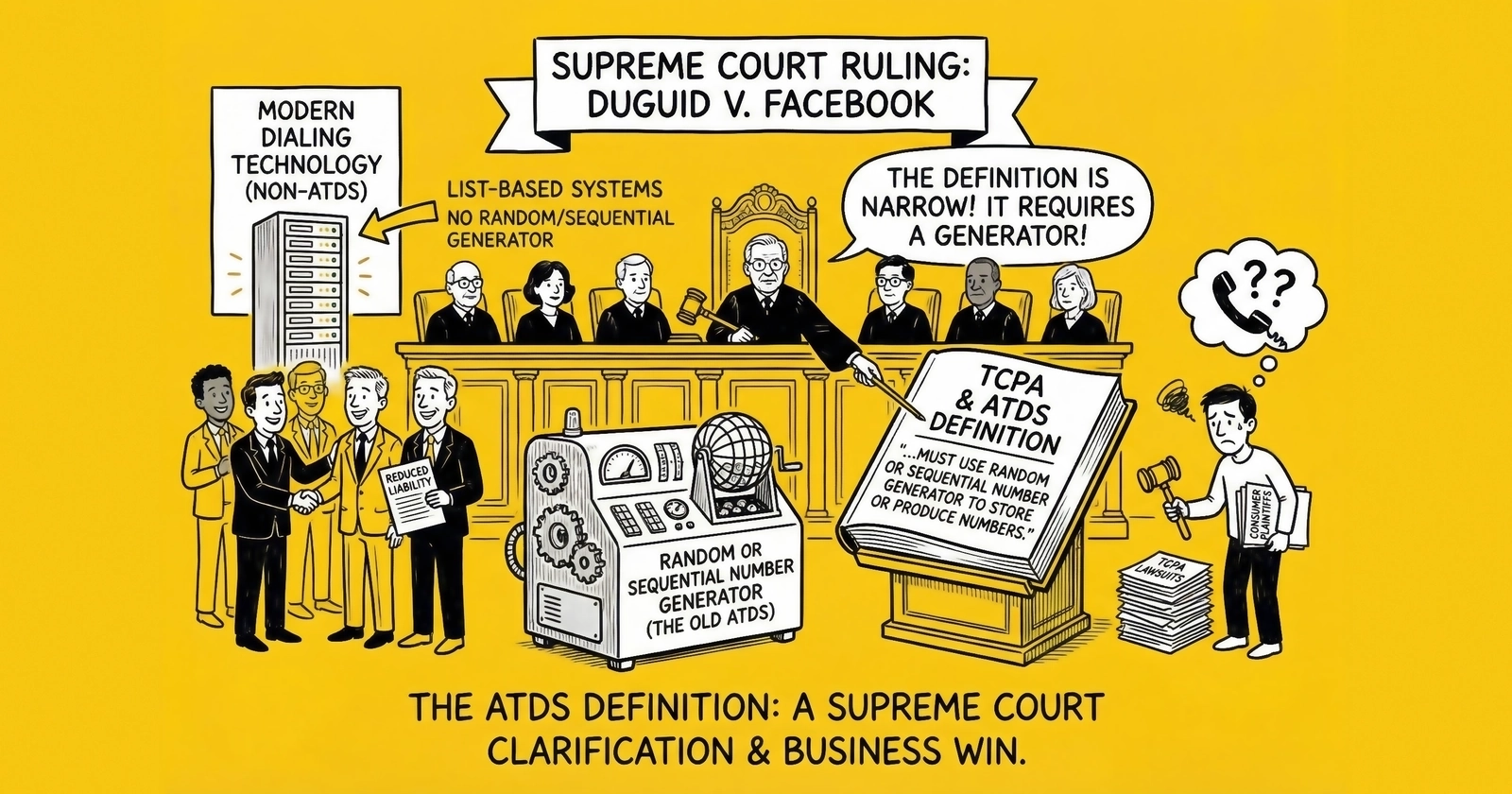
A comprehensive guide to the Supreme Court’s landmark 2021 decision narrowing the automatic telephone dialing system definition, its ongoing impact on TCPA litigation, and practical compliance strategies for lead generation professionals in 2025.
Introduction: The Case That Changed TCPA Litigation
On April 1, 2021, the Supreme Court issued its decision in Facebook, Inc. v. Duguid, fundamentally reshaping the landscape of Telephone Consumer Protection Act litigation. The unanimous 9-0 ruling narrowed the definition of “automatic telephone dialing system” (ATDS) in ways that continue to reverberate through courtrooms and compliance departments four years later.
For lead generation professionals, the Duguid decision represents both relief and complexity. Relief because the ruling eliminated liability for many common dialing technologies. Complexity because the decision created new questions, spawned state-level responses, and left significant exposure for operations using prerecorded messages.
The statistics tell the story of what happened next. TCPA class action filings dropped immediately following Duguid, as plaintiff attorneys recalibrated their strategies. Then filings surged again – 2,788 cases in 2024, a 67% increase over 2023. By Q3 2025, filings were running 97% ahead of 2024’s pace. The litigation machine adapted. For comprehensive compliance guidance, see our TCPA compliance guide for lead generators.
This article explains what the Supreme Court actually decided, why it matters for your operations, how courts have applied Duguid over the past four years, and what compliance strategies protect you in 2025 and beyond. Whether you operate a call center, run lead generation campaigns, or buy leads for outbound contact, understanding the post-Duguid ATDS definition is essential to managing litigation risk.
What the Supreme Court Actually Decided
The Duguid decision resolved a circuit split that had created uncertainty for years. Understanding the Court’s reasoning helps predict how lower courts will apply the ruling.
The Facts of the Case
Noah Duguid received unsolicited security notification texts from Facebook about an account he did not create. Someone had registered a Facebook account using Duguid’s phone number, and Facebook’s automated system sent him login alerts and other notifications without his consent.
Duguid sued Facebook under the TCPA, which prohibits calls or texts made using an “automatic telephone dialing system” without prior express consent. The central question: Did Facebook’s system qualify as an ATDS?
Facebook’s notification system stored phone numbers and dialed them automatically. It did not generate phone numbers randomly or sequentially – it called from a list of numbers previously associated with user accounts. This distinction proved decisive.
The Statutory Language
The TCPA defines an automatic telephone dialing system as equipment that has “the capacity to store or produce telephone numbers to be called, using a random or sequential number generator, and to dial such numbers.”
The circuit courts had split on how to read this definition. Some courts held that any equipment with the capacity to store numbers and dial them automatically qualified as an ATDS – the broad interpretation. Others held that the equipment must actually use a random or sequential number generator to qualify – the narrow interpretation.
The Ninth Circuit, where Duguid filed, had adopted the broad interpretation. Under that reading, Facebook’s system was an ATDS because it could store numbers and dial them, regardless of whether it generated numbers randomly.
The Supreme Court’s Holding
The Supreme Court unanimously rejected the broad interpretation. Writing for the Court, Justice Sotomayor held that the phrase “using a random or sequential number generator” modifies both “store” and “produce.” Equipment qualifies as an ATDS only if it stores numbers generated by a random or sequential number generator or produces numbers using such a generator.
The Court applied the “series-qualifier canon” of statutory interpretation: when a modifier appears at the end of a list, it ordinarily applies to the entire series, not just the last item. Under this reading, an ATDS must use a random or sequential number generator – not merely store and dial numbers.
Justice Sotomayor wrote: “Expanding the definition of an autodialer to encompass any equipment that merely stores and dials telephone numbers would take a chainsaw to these nuanced problems when Congress meant to use a scalpel.”
What the Decision Means in Plain English
Before Duguid, plaintiffs argued that any system capable of storing phone numbers and dialing them automatically was an ATDS. This interpretation would have covered virtually every modern dialing system – from smartphone address books to sophisticated call center platforms.
After Duguid, only equipment that uses random or sequential number generation qualifies as an ATDS. Systems that dial from pre-loaded lists of telephone numbers – the standard approach in lead generation – do not meet the ATDS definition, regardless of how automated the dialing process may be.
The practical implication: if your system calls numbers from a list (of leads, customers, or contacts) without generating those numbers randomly, calls made with that system are not subject to the ATDS provisions of the TCPA.
This does not mean those calls are unregulated. Other TCPA provisions, particularly those governing prerecorded messages, continue to apply and create substantial liability exposure.
Why This Matters for Lead Generation
The Duguid decision has specific implications for lead generation operations at every point in the ecosystem.
For Lead Generators and Publishers
If you generate leads and conduct outbound calling to qualify or verify those leads, Duguid clarifies that systems calling from your lead lists are not ATDS. The leads you capture through web forms, landing pages, or inbound calls populate contact lists – not random number generators. Calling from these lists does not trigger ATDS liability.
However, this does not eliminate consent requirements if you use prerecorded messages. The TCPA’s prerecorded message provisions operate independently of the ATDS definition. A system that plays a recorded message when a call connects requires prior express consent for non-telemarketing calls to cell phones and prior express written consent (PEWC) for telemarketing calls, regardless of whether the dialing mechanism is an ATDS.
Additionally, live-agent calling from lists remains subject to Do Not Call requirements for telemarketing. The Duguid decision addresses only the ATDS provisions, not the broader TCPA regulatory framework. Understanding what constitutes lead generation helps frame these compliance requirements.
For Lead Buyers and Call Centers
If you purchase leads and contact them through outbound calling campaigns, Duguid provides significant relief – but only for systems that genuinely avoid random or sequential number generation and prerecorded messaging.
Many call centers use predictive dialers that dial multiple numbers simultaneously, connecting answered calls to available agents. Post-Duguid, courts have generally held that predictive dialers calling from lead lists do not qualify as ATDS because they do not generate numbers randomly. The dialing may be automated, but the numbers come from predetermined lists.
This analysis changes if the system uses prerecorded messages for any portion of the call – including pre-call verification, Interactive Voice Response (IVR) prompts, or after-hours messages. Prerecorded message liability exists regardless of ATDS status.
For Lead Aggregators and Distributors
If you aggregate leads from multiple sources and distribute them to buyers, Duguid affects your downstream liability and your buyers’ willingness to accept leads without robust consent documentation.
Before Duguid, buyers purchasing leads for outbound calling faced ATDS exposure even for calls from pre-loaded lists. This created pressure for strong consent documentation. After Duguid, buyers using list-based dialing face reduced ATDS exposure, but prerecorded message exposure remains. Sophisticated buyers continue requiring TrustedForm certificates, Jornaya LeadiDs, or equivalent documentation because prerecorded message claims now dominate TCPA litigation.
The Prerecorded Message Problem
The most important thing to understand about Duguid is what it does not do: it does not eliminate consent requirements for prerecorded messages.
Independent Statutory Provisions
The TCPA contains separate prohibitions for ATDS calls and prerecorded message calls. Section 227(b)(1)(A) addresses calls “using any automatic telephone dialing system or an artificial or prerecorded voice.” This is a disjunctive requirement – either an ATDS or a prerecorded voice triggers the prohibition.
Duguid addressed only the ATDS prong. The prerecorded voice prong remains unchanged. If your system uses any artificial or prerecorded voice when calling cell phones, prior express consent is required for non-telemarketing calls and PEWC is required for telemarketing calls.
What Counts as Prerecorded
Courts interpret “prerecorded or artificial voice” broadly:
Obvious prerecording: Any message recorded before the call and played during the call qualifies. This includes marketing messages, hold music with voiceover, and recorded introductions before agent connection.
IVR systems: Interactive Voice Response systems that greet callers and route based on keypad input typically use prerecorded prompts. These trigger prerecorded message provisions.
Soundboard technology: Some call centers use “soundboards” where live agents click to play pre-recorded phrases. Courts have split on whether this constitutes prerecorded messaging. The safest assumption is that it does.
AI-generated voices: Artificial intelligence that generates speech in real time presents emerging questions. The statutory language references “artificial voice,” and AI-generated speech fits that description. Prudent practitioners treat AI voices as triggering the same requirements as prerecorded messages.
Ringless voicemail: Dropping prerecorded messages directly to voicemail without ringing the phone still involves a prerecorded message. Courts have generally held that ringless voicemail is subject to TCPA requirements.
The Practical Reality
For most lead generation operations, the Duguid distinction matters less than it might appear. Lead buyers typically use some form of prerecorded messaging – whether for qualification prompts, hold messages, or after-hours handling. These uses maintain consent requirements regardless of ATDS status.
Those who benefit most from Duguid are those conducting purely live-agent calling with no prerecorded elements at any point in the call. For these operations, calls from lead lists without consent are not ATDS violations. They may still violate DNC requirements for telemarketing, but the $500-$1,500 per-call statutory damages for ATDS violations do not apply.
How Courts Have Applied Duguid (2021-2025)
The four years since Duguid have produced substantial case law clarifying how lower courts apply the ruling.
Predictive Dialers
The most common post-Duguid question involves predictive dialers. These systems dial multiple numbers simultaneously, predicting when agents will become available, and connecting answered calls to those agents. The dialing is automated, but numbers come from pre-loaded lists.
Courts have consistently held that predictive dialers operating from lists do not qualify as ATDS post-Duguid. In Brickman v. Facebook (D. Del. 2022), Mantha v. QuoteWizard (N.D. Ill. 2022), and numerous other cases, courts dismissed ATDS claims against predictive dialing systems because the systems did not generate numbers randomly or sequentially.
The key inquiry is whether the dialing system uses random or sequential number generation for any purpose. If the system randomly selects which numbers to dial from a list (randomizing the order of calling), courts have generally held this does not constitute random number generation within the statutory meaning. The numbers themselves were not generated randomly – only the order of dialing was randomized.
The “Capacity” Question
Pre-Duguid, some courts focused on whether equipment had the “capacity” to generate numbers randomly, even if that capacity was not used for the calls at issue. This interpretation created liability for any equipment theoretically capable of random number generation.
Post-Duguid, this interpretation has largely disappeared. Courts focus on whether the equipment actually uses random or sequential number generation for the calls at issue. Theoretical capacity is insufficient.
However, some plaintiffs continue arguing that modern dialing platforms technically have the capacity to generate random numbers through software updates or configuration changes. These arguments have generally failed when defendants demonstrate that the relevant dialing functionality operates exclusively from pre-loaded lists.
Text Message Cases
Duguid applies to text messages as well as voice calls. The TCPA’s ATDS prohibition covers calls “to any telephone number assigned to a … cellular telephone service,” and courts have consistently held that text messages qualify as “calls” under the statute.
Text messaging platforms that send messages to lists of phone numbers – the standard approach for SMS marketing – do not qualify as ATDS post-Duguid because they do not generate recipient numbers randomly. However, text messaging platforms that use prerecorded or artificial voice (including certain automated voice-to-text messages) may trigger separate provisions.
The more common exposure for text messaging involves consent deficiencies rather than ATDS claims. Plaintiffs challenge whether adequate consent was obtained, whether opt-out requests were honored, and whether messages violated time-of-day restrictions.
Exceptions and Edge Cases
Not all post-Duguid cases favor defendants. Courts have found ATDS liability in specific circumstances:
Random subset selection: Systems that randomly generate subsets of numbers from larger databases may trigger ATDS liability if the random generation function is integral to identifying which numbers to call.
Sequential dialing through area codes: Systems that dial sequentially through area code blocks (555-1000, 555-1001, 555-1002, etc.) qualify as ATDS because they produce numbers using sequential generation.
Number generation for specific digits: Systems that randomly generate portions of phone numbers (such as the last four digits within an area code and prefix) constitute ATDS.
The common thread: ATDS liability attaches when random or sequential number generation creates the numbers to be called. It does not attach when predetermined lists are dialed in any order.
State Law Responses to Duguid
The Duguid decision interpreted federal law only. States retain authority to enact their own telemarketing regulations, and several have done so in response to Duguid.
Florida Telephone Solicitation Act (FTSA)
Florida enacted the FTSA in 2021, partially in response to Duguid. The original FTSA defined “automated system for the selection or dialing of telephone numbers” broadly to include any system with the capacity to store or produce numbers and dial them – essentially the pre-Duguid interpretation that the Supreme Court rejected.
In May 2023, Florida amended the FTSA to narrow its autodialer definition. The amended definition requires systems that “select and dial telephone numbers” through “an automated or predictive process without human intervention.” This is narrower than the original FTSA language but remains broader than the federal post-Duguid standard.
The FTSA creates a private right of action with statutory damages of $500 per violation ($1,500 for willful violations), and plaintiffs can recover their attorney’s fees. In 2024, Florida accounted for 330 TCPA filings – the highest of any state – reflecting the continued attractiveness of Florida venues for telemarketing litigation.
Oklahoma Telephone Solicitation Act (OTSA)
Oklahoma enacted the OTSA in 2022 with broad autodialer language. The statute prohibits telephone solicitations using an “automatic dialing device” without defining that term precisely. Courts will likely interpret this definition independently of the federal Duguid standard.
The OTSA creates a private right of action with damages of $500 per violation and allows treble damages for willful violations.
Maryland Stop the Spam Calls Act
Maryland’s 2024 law retains a broader autodialer definition than the federal post-Duguid standard. The law focuses on predictive dialers and automated systems that can send texts or make calls without human initiation.
The law also imposes 8 AM to 8 PM calling hours (stricter than the federal 8 AM to 9 PM window) and enhanced penalties for certain violations.
Implications for National Operations
Companies with nationwide operations cannot rely solely on Duguid for protection. A calling technology that is not an ATDS under federal law may still qualify as an autodialer under state law.
Compliance strategies must consider the most restrictive applicable jurisdiction. For operations calling into Florida, Oklahoma, Maryland, and other states with broader autodialer definitions, state-level exposure may exceed federal exposure even after Duguid.
Current Litigation Landscape (2025)
The Duguid decision eliminated one category of claims but did not reduce overall TCPA litigation. Plaintiffs adapted.
Shift to Prerecorded Message Claims
Post-Duguid, plaintiff attorneys shifted focus from ATDS claims to prerecorded message claims. This explains why TCPA litigation surged after an initial post-Duguid dip. The same calls that were alleged as ATDS violations are now alleged as prerecorded message violations – often with success.
Prerecorded message claims are harder for defendants to dismiss because they do not require the technical equipment analysis of ATDS claims. If a plaintiff received an automated message with any prerecorded content, the elements are met. The only defense is valid consent.
Enhanced Focus on Consent Deficiencies
With ATDS claims less available, plaintiffs now scrutinize consent documentation more aggressively. Common challenge theories include:
Disclosure deficiencies: Claims that consent disclosures were not clear and conspicuous, did not adequately identify the caller, or did not specify automated technology and prerecorded messages.
E-SIGN non-compliance: Following Bradley v. Dentalplans.com (D. Md. 2024), plaintiffs argue that electronic consent is invalid without E-SIGN Act compliance.
Scope challenges: Claims that calls exceeded the scope of consent – either by coming from unauthorized parties or relating to topics outside the consent’s coverage.
Revocation failures: Claims that opt-out requests were not honored within required timeframes, particularly under the April 2025 FCC rules requiring 10-day revocation processing.
Do Not Call Claims
Do Not Call claims were never affected by Duguid. The National Do Not Call Registry contains over 240 million numbers, and calling registered numbers for telemarketing purposes creates liability regardless of dialing technology.
DNC claims have increased as a percentage of TCPA litigation post-Duguid. These claims are straightforward: if the number was on the registry and the call was for telemarketing, liability attaches unless an established business relationship or other exception applies.
Class Action Dynamics
Nearly 80% of all TCPA lawsuits are filed as class actions. This rate far exceeds other consumer protection statutes (2-5% for FDCPA, for example). The statutory damages structure – $500-$1,500 per violation with no cap – makes class certification extraordinarily valuable.
Post-Duguid class actions often combine multiple theories: prerecorded messages, DNC violations, consent deficiencies, and state mini-TCPA claims. This multi-theory approach maximizes settlement leverage even if some claims are vulnerable to dismissal.
The average TCPA class action settlement exceeds $6.6 million. The largest settlements reach eight figures. Defense costs for cases proceeding through discovery run $100,000 to $300,000, and full defense through trial can exceed $500,000. These economics drive settlement behavior.
Compliance Strategies for the Post-Duguid Environment
Understanding Duguid helps calibrate compliance investment. Here are practical strategies for managing litigation risk.
Technology Assessment
Audit your dialing systems. Determine whether any component of your calling technology generates phone numbers randomly or sequentially. If your systems exclusively call from pre-loaded lists, ATDS claims are defensible. Document this with technical specifications from your platform providers.
Identify all prerecorded content. Map every point in your call flow where prerecorded audio is used. This includes greeting messages, hold music with voiceover, IVR prompts, after-hours messages, and any soundboard clips. Each of these creates prerecorded message exposure requiring consent.
Evaluate text messaging platforms. Confirm your SMS systems send to lists rather than generating recipient numbers. Document the technical process for regulators and litigation.
Consent Documentation
Regardless of Duguid, consent remains your primary defense for prerecorded message claims. Robust documentation is non-negotiable.
Third-party verification. Implement TrustedForm, Jornaya TCPA Guardian, or equivalent services for all leads. The cost ($0.15-$0.50 per lead) is trivial compared to potential liability ($500-$1,500 per violation). Claim and retain certificates for at least five years. See our guide on TrustedForm and Jornaya for consent verification for implementation details.
Disclosure language. Ensure disclosures explicitly address prerecorded messages. Language authorizing “calls using automated technology” may not cover prerecorded messages specifically. Best practice: “I consent to receive calls and texts using automated technology, including prerecorded and artificial voice messages…”
Seller identification. Following the Eleventh Circuit’s January 2025 vacatur of the one-to-one consent rule, multi-seller consent remains permissible. However, disclosures must clearly identify authorized callers by name. Ambiguous references to “marketing partners” invite challenges.
E-SIGN compliance. For electronic consent, implement E-SIGN disclosures and obtain consent to receive disclosures electronically. This addresses the Bradley v. Dentalplans.com attack vector.
Operational Controls
DNC suppression. Implement comprehensive DNC screening against federal registry, state registries, and internal suppression lists. Screen before every call – not just at lead acquisition. Numbers may be added to registries after you acquire the lead.
Revocation processing. Build systems capable of honoring opt-out requests within 10 business days across all channels. The April 2025 FCC rules require this timeline for any reasonable revocation method.
Time-zone management. Automate calling hour compliance based on recipient time zone. Federal rules permit 8 AM to 9 PM calls; some states (Florida, Maryland) require 8 AM to 8 PM. Configure systems for the most restrictive applicable window.
Litigator suppression. Integrate serial litigator databases from providers like Contact Center Compliance or PossibleNOW. Serial litigators represent 31-41% of TCPA plaintiffs. Suppression reduces exposure. For comprehensive protection strategies, see our guide on arbitration clauses for TCPA protection.
Vendor Management
If you purchase leads or use third-party call centers, your compliance depends on their practices.
Contractual protections. Require vendors to warrant TCPA compliance, provide access to consent documentation, and indemnify you for their failures. Audit rights are essential.
Consent verification. Do not rely on vendor representations. Retrieve and review consent certificates for random samples of leads. Verify disclosure language meets your standards.
Technology confirmation. Understand what dialing technology your call centers use. Request documentation confirming systems do not generate numbers randomly. Verify prerecorded message content is authorized by consent.
Insurance Considerations
Most general liability policies exclude TCPA claims. Dedicated TCPA insurance products exist but are expensive and may contain sublimits inadequate for class action exposure.
If you obtain TCPA coverage, understand:
- Premium ranges: $15,000 to $50,000+ annually for $1-5 million coverage
- Coverage scope: Does it cover defense costs? Settlement costs? Judgments?
- Exclusions: Are intentional violations excluded? How is “intentional” defined?
- Claim notification: What triggers reporting obligations?
Even with insurance, coverage disputes are common. Defense is often the best insurance – invest in compliance to avoid claims rather than relying on policies to cover them.
What the Future Holds
The post-Duguid landscape continues to evolve. Several developments merit attention.
Supreme Court Developments
The Supreme Court’s consideration of McLaughlin Chiropractic Associates v. McKesson Corp. could affect how lower courts interpret FCC guidance. The case addresses whether federal district courts are bound by FCC interpretations of the TCPA under the Hobbs Act.
If the Court limits judicial deference to FCC guidance, TCPA interpretation could become more inconsistent across jurisdictions. Different courts might reach different conclusions about what constitutes an ATDS, valid consent, or other regulatory requirements. Operators would face a more unpredictable compliance environment.
State Legislative Activity
State legislatures continue proposing telemarketing regulations. Several bills pending in various states would create or expand autodialer definitions, consent requirements, and private rights of action.
The trend is toward stricter state-level regulation, particularly in states with active consumer protection constituencies. National operators should monitor legislative developments in their key calling markets.
FCC Rulemaking
The FCC retains authority to issue rules implementing the TCPA. While the Eleventh Circuit’s January 2025 decision in Insurance Marketing Coalition v. FCC limited FCC authority in some areas, the Commission continues to regulate robocalls and telemarketing.
The April 2025 revocation rules demonstrate ongoing FCC activity. Future rulemaking could address consent standards, caller identification requirements, or call-blocking protocols.
AI and Emerging Technology
Artificial intelligence is transforming call center operations. AI-powered conversational agents can conduct calls that sound increasingly human. Voice cloning technology can replicate specific voices.
These technologies raise novel TCPA questions:
- Does an AI-generated voice constitute an “artificial voice” under the TCPA?
- Do calls conducted by AI agents require the same consent as human-agent calls?
- How do disclosure requirements apply when the caller is not human?
prudent practitioners treat AI voices as triggering the same requirements as prerecorded messages. As technology evolves, expect regulatory and judicial attention to these questions.
Frequently Asked Questions
1. What exactly is an ATDS after the Duguid decision?
An automatic telephone dialing system (ATDS) is equipment that stores or produces telephone numbers using a random or sequential number generator and dials those numbers. After the Supreme Court’s 2021 decision in Facebook v. Duguid, equipment that simply stores phone numbers from a list and dials them automatically does not qualify as an ATDS. The system must actually use random or sequential number generation to store or produce the numbers to be called.
2. Does Duguid mean I can call anyone without consent?
No. Duguid only addressed the ATDS definition. It does not eliminate consent requirements for calls using prerecorded or artificial voice messages. It does not eliminate Do Not Call Registry requirements for telemarketing. It does not override state telemarketing laws, which may have broader autodialer definitions. If your calls use any prerecorded content or are for telemarketing purposes, consent requirements and DNC restrictions continue to apply.
3. My dialer calls from a list of leads. Is it an ATDS?
Under federal law after Duguid, a dialing system that calls exclusively from pre-loaded lists of phone numbers – such as leads, customers, or contacts – does not qualify as an ATDS because the numbers are not generated randomly or sequentially. However, state laws in Florida, Oklahoma, Maryland, and elsewhere may have broader definitions. Additionally, if your dialer uses prerecorded messages at any point, consent requirements apply regardless of ATDS status.
4. What about predictive dialers? Are they considered ATDS?
Predictive dialers that dial from pre-loaded lists do not qualify as ATDS under the post-Duguid federal standard. Courts have consistently held that the predictive aspect – estimating agent availability and dialing multiple numbers simultaneously – does not constitute random number generation. The numbers themselves come from predetermined lists, not random generation. Again, state laws may differ, and prerecorded message rules apply separately.
5. If prerecorded message rules still require consent, what did Duguid actually change?
Duguid eliminated ATDS claims for systems calling from lists, which represented a significant portion of pre-2021 TCPA litigation. However, the practical impact is limited for operations using any prerecorded content, which includes most call centers. The main beneficiaries are operations conducting purely live-agent calling with no prerecorded elements. For those operations, calls from lists without consent are not federal ATDS violations (though DNC rules still apply for telemarketing). For operations using prerecorded messages, consent remains required regardless of ATDS status.
6. How do I know if my system uses prerecorded messages?
Audit every component of your call flow. Prerecorded content includes greeting messages before agent connection, IVR prompts for routing calls, hold music with voiceover, after-hours messages, soundboard clips played by agents, and ringless voicemail drops. Any of these creates prerecorded message exposure requiring consent. When in doubt, assume the content is prerecorded and obtain appropriate consent.
7. What are the damages for ATDS violations versus prerecorded message violations?
Both categories carry the same statutory damages: $500 per violation, which can be trebled to $1,500 for willful or knowing violations. There is no cap on aggregate damages. A class action involving 100,000 calls creates exposure of $50 million to $150 million. The source of liability (ATDS or prerecorded message) does not affect the damages calculation.
8. Do state mini-TCPA laws follow the Duguid definition?
Not necessarily. State laws operate independently of federal TCPA. Florida, Oklahoma, and Maryland have autodialer definitions that are broader than the federal post-Duguid standard. Other states may enact similar laws. National operations must comply with the most restrictive applicable jurisdiction, which may require consent for calls that would not trigger federal ATDS liability.
9. What should I ask my dialing platform vendor about ATDS compliance?
Request written documentation confirming the platform does not use random or sequential number generation to produce phone numbers. Ask for technical specifications describing how calling lists are processed. Confirm whether any component of the system generates numbers randomly for any purpose. Obtain vendor representations and warranties regarding ATDS status that can be included in your contracts and used in litigation defense if needed.
10. How has TCPA litigation changed since Duguid?
Total TCPA filings dropped briefly after Duguid as plaintiff attorneys recalibrated. Filings then surged – 2,788 cases in 2024 (67% increase over 2023), with 2025 running 97% ahead of 2024’s pace. The composition changed: prerecorded message claims, consent deficiency claims, and DNC claims replaced many ATDS claims. Class actions remain dominant (80% of all filings). Average settlements still exceed $6.6 million. The litigation environment is as aggressive as ever, just focused on different theories.
Key Takeaways
-
Facebook v. Duguid (2021) narrowed the ATDS definition. Equipment qualifies as an ATDS only if it uses random or sequential number generation to store or produce phone numbers. Systems calling from pre-loaded lists do not qualify under this definition.
-
Duguid does not eliminate prerecorded message consent requirements. The TCPA separately prohibits calls using artificial or prerecorded voice without consent. This provision operates independently of ATDS status. If your calls use any prerecorded content, consent requirements apply.
-
Most lead generation operations still require consent. Because most outbound calling operations use some form of prerecorded messaging – IVR prompts, greeting messages, hold music with voiceover – consent requirements remain effectively unchanged for practical purposes.
-
State laws may have broader autodialer definitions. Florida, Oklahoma, Maryland, and other states have enacted or proposed telemarketing laws with autodialer definitions exceeding the federal post-Duguid standard. National operations must consider state-level exposure.
-
TCPA litigation has adapted, not declined. After an initial post-Duguid dip, class action filings surged to record levels. Plaintiff attorneys shifted to prerecorded message claims, consent deficiency challenges, and DNC violations. Average settlements still exceed $6.6 million.
-
Consent documentation remains the primary defense. TrustedForm, Jornaya, or equivalent third-party verification creates the documentation needed to defend against consent challenges. The cost ($0.15-$0.50 per lead) is trivial compared to per-violation damages ($500-$1,500).
-
Audit your technology and call flows. Confirm your dialing systems do not use random or sequential number generation. Map all prerecorded content in your call flows. Document everything for potential litigation defense.
-
State and federal regulatory environments continue to evolve. Monitor FCC rulemaking, state legislative activity, and emerging case law. The Supreme Court’s pending McLaughlin decision could affect TCPA interpretation. Compliance strategies must adapt to ongoing changes.
The Bottom Line
The Duguid decision provided meaningful relief for specific calling operations – those conducting purely live-agent calls from pre-loaded lists with no prerecorded elements. For these operations, federal ATDS liability is largely eliminated.
For the majority of lead generation operations that use some form of automated or prerecorded messaging, Duguid changes less than it might appear. Consent requirements remain. Documentation remains essential. Litigation risk remains high.
Those who succeed in this environment are those who understand what Duguid actually decided, what it did not decide, and how to build compliance programs that address the full spectrum of TCPA exposure. The ATDS definition is one piece of a complex regulatory puzzle.
Four years after Duguid, the lesson is clear: there are no shortcuts to TCPA compliance. The technology analysis matters. The consent documentation matters more. The margin for error remains zero.
Build your compliance program accordingly.
Sources
- Facebook, Inc. v. Duguid - Supreme Court Decision (PDF) - Full text of the April 2021 Supreme Court ruling narrowing the ATDS definition
- Facebook v. Duguid - Oyez Case Summary - Case overview including oral arguments, questions presented, and decision summary
- 47 U.S.C. 227 - TCPA Statute - Complete statutory text including ATDS definition at subsection (a)(1)
- U.S. Courts Caseload Statistics - Federal court filing data for tracking TCPA litigation trends
- ActiveProspect TrustedForm - Consent verification platform for documenting TCPA compliance
- 47 CFR 64.1200 - FCC TCPA Rules - Federal implementing regulations for TCPA consent requirements
- Jornaya TCPA Guardian - Independent consent verification and compliance documentation service
Legal and regulatory information current as of December 2025. TCPA requirements evolve continuously through FCC rulemaking, court decisions, and state legislative action. Consult qualified TCPA counsel for current compliance requirements specific to your operations.