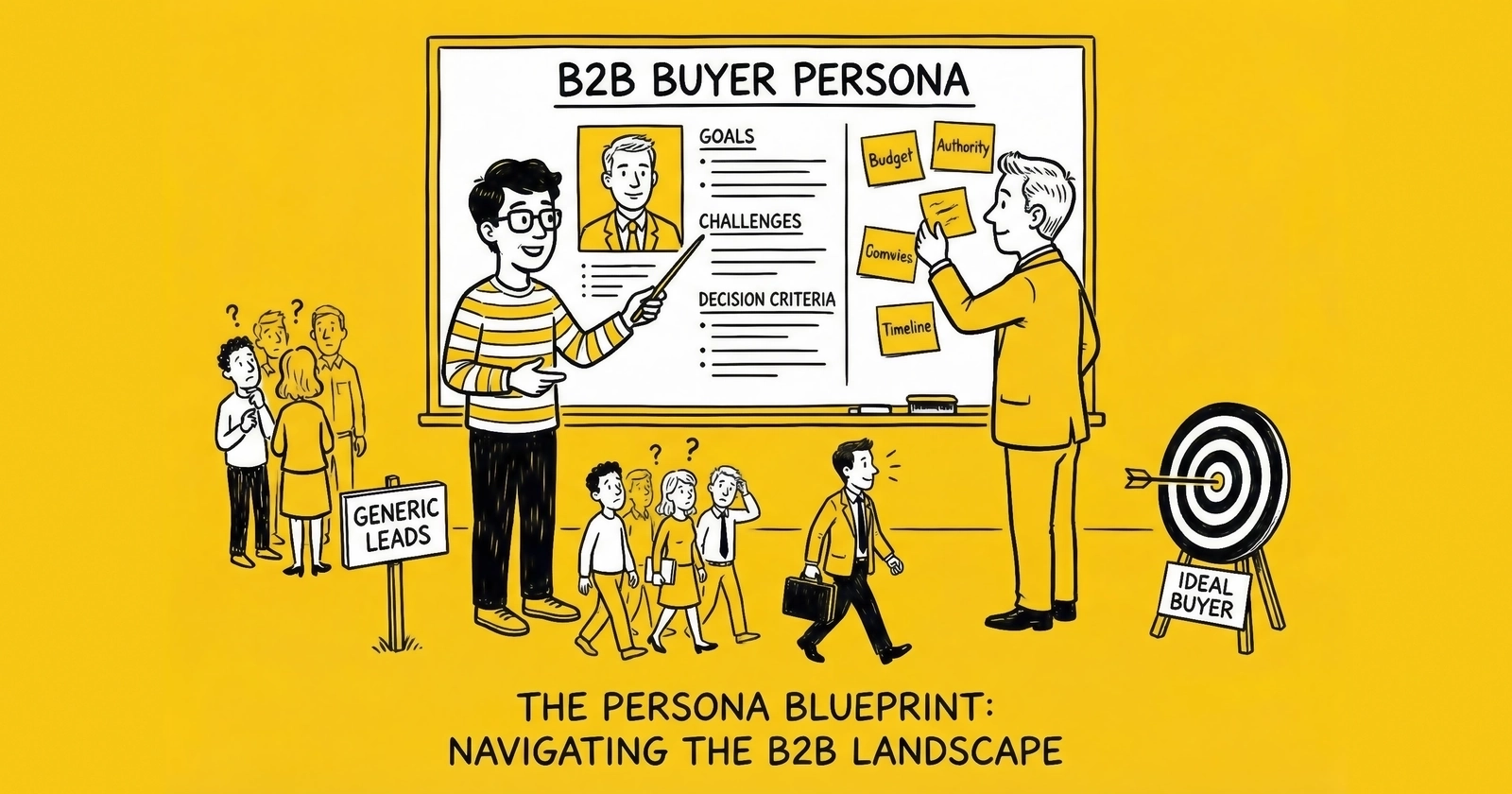
How to build data-driven buyer personas for lead generation businesses, improving targeting, conversion rates, and buyer-seller alignment through systematic persona development.
Lead generation operates at the intersection of two persona challenges: understanding the lead buyers who purchase from you, and helping those buyers understand the end consumers who become their customers. This dual-persona complexity makes systematic persona development more critical – and more valuable – than in single-audience businesses. Organizations that develop clear, data-driven personas for both relationships achieve fundamentally different results than those operating on assumptions.
The evidence supports persona investment. Research consistently shows that companies using well-developed buyer personas achieve 2-5x higher marketing ROI, significantly improved conversion rates, and stronger buyer retention. Yet most lead generation operations rely on implicit, undocumented assumptions about their buyers rather than systematic persona development.
This analysis examines how to build effective buyer personas for lead generation businesses at both levels: understanding your lead buyers (B2B persona development) and understanding the end consumers your buyers seek (consumer persona development that informs lead product design). The framework applies whether you generate leads, buy leads, or operate lead marketplaces.
The Dual-Persona Challenge in Lead Generation
Lead generation is fundamentally a two-sided market. Lead generators must understand lead buyers – the insurance agents, mortgage brokers, contractors, and marketers who purchase leads. Simultaneously, they must understand the end consumers those buyers serve – the homeowners seeking solar installation, the families shopping for insurance, the businesses evaluating software.
This creates distinct persona requirements:
-
Buyer Personas (B2B): Who purchases your leads? What drives their buying decisions? What problems do they face? What outcomes do they seek? These personas inform your sales process, pricing strategy, product development, and relationship management.
-
Consumer Personas (End User): Who are the leads themselves? What motivates their inquiries? What qualifies them for your buyers’ products? What signals conversion likelihood? These personas inform lead generation strategy, qualification criteria, and the lead product you deliver.
Confusion between these persona levels creates operational problems. A lead generator who understands consumers but not buyers may generate high-quality leads that don’t match buyer needs. A generator who understands buyers but not consumers may promise performance they can’t deliver.
Why Most Lead Gen Persona Development Fails
Common approaches to persona development in lead generation suffer from several weaknesses:
-
Assumption-based personas: Many operations rely on intuitive assumptions – “our buyers are insurance agents who want cheap leads” – without systematic validation. These assumptions often prove wrong or incomplete when tested against actual buyer behavior.
-
Static personas: Markets evolve, but personas remain frozen. Buyer needs shift with technology, regulation, and competition. Consumer behavior changes with economic conditions and generational preferences. Personas that don’t update become increasingly irrelevant.
-
Surface-level demographics: Personas that stop at job titles and company sizes miss the psychological and behavioral factors that actually drive decisions. Knowing that a buyer is a “small insurance agency owner” doesn’t explain why they choose one vendor over another.
-
Single-dimensional views: Effective personas capture multiple dimensions – demographic, firmographic, psychographic, behavioral – that together explain buyer patterns. Single-dimension personas provide incomplete guidance.
Building Buyer Personas for Lead Generation
Effective B2B buyer personas for lead generation require systematic data collection across multiple dimensions, followed by pattern identification and validation.
Data Collection Framework
Begin with structured research across four data categories:
Firmographic Data: Business characteristics that correlate with buying behavior.
- Company size (solo operator, small team, enterprise)
- Vertical/industry focus
- Geographic coverage
- Years in business
- Business model (agency, direct sales, hybrid)
- Technology sophistication
- Compliance maturity
Demographic Data: Individual characteristics of decision-makers.
- Role/title
- Decision authority (sole decision-maker, committee member, influencer)
- Experience level
- Age/generation (affects technology comfort, communication preferences)
- Education and professional background
Psychographic Data: Attitudes, values, and motivations that drive decisions.
- Risk tolerance (aggressive growth vs. conservative protection)
- Quality vs. quantity orientation
- Relationship vs. transaction preference
- Innovation adoption profile (early adopter vs. late majority)
- Price sensitivity vs. value focus
- Trust/skepticism levels toward vendors
Behavioral Data: Actual purchasing and usage patterns.
- Lead volume purchased (monthly, annually)
- Price points accepted
- Verticals/lead types purchased
- Vendor switching frequency
- Payment patterns (prepay, terms, disputes)
- Communication preferences
- Support utilization
- Conversion performance with leads
Tracking behavioral patterns requires robust multi-touch attribution to understand how different buyer segments interact with your marketing and sales touchpoints.
Research Methods
Collect persona data through multiple methods:
-
CRM and Transaction Analysis: Your existing customer data contains rich behavioral information. Analyze purchasing patterns, lifetime value distribution, churn predictors, and segment performance. Identify what distinguishes high-value customers from average or problematic ones.
-
Customer Interviews: Conduct structured interviews with 15-25 customers across segments. Focus on understanding decision-making processes, pain points, evaluation criteria, and outcomes sought. Ask about their business challenges, not just their lead needs.
-
Sales Team Input: Sales representatives accumulate insight about buyer motivations, objections, and decision processes through daily interactions. Structure this knowledge capture through regular debrief sessions and documented feedback.
-
Survey Research: Quantitative surveys validate patterns identified through qualitative research. Survey both customers and non-customers to understand both why buyers choose you and why prospects choose competitors.
-
Win/Loss Analysis: Systematically analyze why deals close or don’t close. Lost deals reveal persona gaps – buyer types you’re not serving effectively. Won deals reveal successful persona alignment.
Pattern Identification and Persona Construction
Analyze collected data to identify meaningful buyer segments. Look for clusters of characteristics that correlate with behavior:
-
High-Value Buyer Profile: What characteristics predict customers who buy more, pay promptly, stay longer, and dispute less? This becomes your ideal buyer persona.
-
Problematic Buyer Profile: What characteristics predict customers who churn quickly, dispute frequently, or fail to convert leads effectively? Understanding this anti-persona helps avoid misaligned customers.
-
Growth Opportunity Profile: What characteristics indicate buyers who could become high-value with better service, products, or relationship management?
Construct personas that synthesize patterns into practical profiles:
Persona Elements:
- Name and representative description
- Firmographic profile (company characteristics)
- Decision-maker profile (individual characteristics)
- Primary goals and motivations
- Key pain points and challenges
- Evaluation criteria and priorities
- Decision process and timeline
- Preferred communication channels
- Objections and concerns
- Success metrics (how they measure vendor performance)
Example: Insurance Lead Buyer Personas
“Growth Gary” - The Ambitious Agency Builder
Firmographic Profile: Independent agency, 3-10 licensed agents, $500K-$2M annual premium, suburban markets, 5-15 years in business.
Decision-Maker Profile: Agency owner, 35-50 years old, hands-on manager, moderate technology comfort, growth-oriented mindset.
Primary Goals: Scale agency revenue, reduce dependence on carrier appointments, build predictable lead flow, achieve consistent month-over-month growth.
Key Pain Points: Inconsistent lead quality from current vendors, difficulty scaling beyond current capacity, limited time for marketing management, compliance concerns as agency grows.
Evaluation Criteria: Lead quality consistency (primary), volume scalability, pricing predictability, compliance documentation, responsive support.
Decision Process: 30-60 day evaluation, typically tests 2-3 vendors simultaneously, measures performance over 90-day period before committing volume.
Preferred Communication: Email for routine communication, phone for issues, monthly performance review calls appreciated.
Objections: “How do I know your leads are better than what I’m getting?” “What happens if quality drops?” “Can you scale with me as I grow?”
Success Metrics: Contact rate above 60%, quote rate above 25%, close rate above 8%, cost per acquisition below $150.
“Cautious Carol” - The Risk-Averse Veteran
Firmographic Profile: Established agency, 1-3 agents, $200K-$500K annual premium, local market focus, 15+ years in business.
Decision-Maker Profile: Owner-operator, 55+ years old, traditional marketing background, limited technology comfort, relationship-oriented.
Primary Goals: Maintain steady business, supplement referral flow, avoid compliance problems, minimize hassle.
Key Pain Points: Previous bad experiences with lead vendors, overwhelmed by technology, concerned about regulatory exposure, limited time for vendor management.
Evaluation Criteria: Vendor reputation and trust (primary), compliance certainty, simplicity of process, responsive personal support.
Decision Process: Extended evaluation (90+ days), heavy referral influence, prefers vendors recommended by trusted peers, cautious with initial volume.
Preferred Communication: Phone calls preferred, personal relationship with account manager valued, dislikes automated systems.
Objections: “I’ve been burned by lead vendors before.” “I don’t want to deal with compliance headaches.” “I don’t have time to learn new systems.”
Success Metrics: No compliance issues, consistent quality (not necessarily optimal), reliable vendor relationship.
These contrasting personas require different sales approaches, different product configurations, different support models, and different messaging. Treating them identically wastes opportunity and creates friction.
Building Consumer Personas for Lead Product Design
Beyond understanding lead buyers, lead generators must understand the end consumers whose information they capture. Consumer personas inform lead generation strategy, qualification criteria, and the lead product that buyers receive.
Consumer Persona Applications
Consumer personas serve multiple functions in lead generation operations:
-
Traffic Source Selection: Different consumer personas respond to different channels. Understanding persona media consumption, search behavior, and online habits guides traffic source selection.
-
Landing Page Design: Effective lead capture requires messaging that resonates with target consumers. Persona understanding informs copy, design, and offer development.
-
Qualification Criteria: Not all consumer leads serve all buyers. Persona-based qualification ensures leads match buyer capabilities and preferences.
-
Lead Product Definition: Consumer personas define what a “good lead” looks like – the characteristics that predict conversion for specific buyer segments.
-
Pricing Strategy: Different consumer segments convert at different rates and have different buyer value. Persona-based pricing captures this variation.
Consumer Persona Research for Lead Generation
Consumer persona research differs from buyer persona research in methods and focus:
-
Lead Disposition Analysis: Analyze historical lead performance to identify consumer characteristics that predict conversion. What demographics, behaviors, or responses correlate with higher buyer success?
-
Buyer Feedback Integration: Buyers possess direct knowledge of which leads convert and why. Structure feedback collection to capture consumer-level insights about conversion drivers.
-
Consumer Journey Mapping: Understand how consumers move from initial interest to lead submission to eventual purchase. Map the journey to identify where lead quality signals emerge.
-
Market Research: Industry research on consumer behavior, preferences, and trends informs persona development beyond your direct data. Vertical-specific studies provide context for interpretation.
Example: Solar Consumer Personas
“Research Randy” - The Analytical Decision-Maker
Demographics: Homeowner, 35-55, $100K+ household income, professional occupation, suburban single-family home.
Motivation: Reducing electricity costs, environmental responsibility, home value enhancement, technology interest.
Behavior Pattern: Extensive research before inquiry (6+ weeks), compares multiple options, reads reviews, calculates ROI, visits multiple landing pages before converting.
Lead Indicators: Detailed form responses, specific questions, realistic timeline expectations, verified homeownership.
Conversion Profile: Higher conversion rate (15-25%), longer sales cycle (45-90 days), values detailed proposals, responds to ROI-focused messaging.
Buyer Fit: Best for consultative sellers who can handle technical questions and detailed proposals. Not ideal for high-volume, rapid-close operations.
“Impulse Irene” - The Deal-Driven Responder
Demographics: Homeowner, 25-45, $60K-100K household income, responds to promotional messaging, smartphone-dominant.
Motivation: Cost savings, “free” or “no-cost” messaging appeals, social proof influence, urgency response.
Behavior Pattern: Quick decision to inquire, limited pre-research, responds to urgency and scarcity, mobile-first form completion.
Lead Indicators: Brief form responses, fast submission, responds to promotional landing pages, may have incomplete information.
Conversion Profile: Lower conversion rate (5-10%), shorter consideration window, requires rapid follow-up, price-sensitive, may not fully qualify.
Buyer Fit: Best for high-volume operations with rapid contact capability. Requires strong qualification process. Not ideal for consultative sellers.
Understanding these distinct consumer personas enables lead generators to segment their products, price appropriately, and route leads to buyers whose operations align with consumer characteristics.
Persona-Based Segmentation and Targeting
Developed personas enable strategic segmentation across the lead generation value chain.
Buyer Segmentation Applications
-
Sales Process Customization: Different buyer personas require different sales approaches. Growth-oriented buyers respond to opportunity messaging; risk-averse buyers respond to protection messaging. Tailor sales conversations to persona profiles.
-
Product Configuration: Develop product configurations that match persona needs. Volume-focused buyers need different packages than quality-focused buyers. Compliance-sensitive buyers need different documentation than efficiency-focused buyers.
-
Pricing Strategy: Persona-based pricing captures willingness to pay variation. Enterprise buyers may accept premium pricing for enterprise features; small buyers may need entry-level options.
-
Customer Success Design: Support and success programs should reflect persona preferences. Some personas want hands-on guidance; others prefer self-service. Match support models to expectations.
-
Marketing Message Development: Persona-specific messaging resonates better than generic claims. Develop distinct value propositions for distinct personas.
Lead Product Segmentation Applications
-
Quality Tier Definition: Consumer personas define quality tiers. “Research Randy” leads command premium pricing; “Impulse Irene” leads suit different buyer profiles at different price points.
-
Buyer-Lead Matching: Route leads to buyers whose operations match consumer characteristics. Consultative buyers get analytical consumers; volume buyers get impulse responders. Matching improves buyer satisfaction and retention.
-
Channel Strategy: Target traffic sources that reach desired consumer personas. Channels that attract “Research Randy” differ from those attracting “Impulse Irene.”
-
Qualification Optimization: Design qualification flows that identify persona indicators. Use progressive profiling to capture persona-relevant data.
Persona Maintenance and Evolution
Effective personas require ongoing maintenance as markets evolve.
Monitoring Signals
-
Conversion Pattern Changes: Shifting conversion rates within segments may indicate persona evolution. Monitor performance trends for early warning of needed updates.
-
Buyer Feedback Evolution: Changing buyer priorities, objections, and requests signal market shifts. Track feedback themes over time.
-
Market Research: Industry trends affect persona validity. Monitor market research for changes in buyer or consumer behavior.
-
Competitive Dynamics: New competitors or competitor strategy changes affect persona preferences. Track competitive landscape for persona implications.
Update Cadence
-
Quarterly Review: Assess persona performance against current data. Are existing personas still predictive? Are new segments emerging?
-
Annual Refresh: Conduct comprehensive persona research annually. Validate or update all persona elements against fresh data.
-
Triggered Updates: Market disruptions (regulatory changes, technology shifts, economic conditions) warrant immediate persona review regardless of scheduled cadence.
Measuring Persona Effectiveness
Evaluate persona value through operational metrics:
-
Targeting Efficiency: Does persona-based targeting improve lead buyer acquisition cost and quality? Measure customer acquisition cost and lifetime value by persona alignment.
-
Conversion Improvement: Does persona-based messaging and positioning improve conversion rates? A/B test persona-specific approaches against generic approaches.
-
Customer Satisfaction: Do persona-matched customers report higher satisfaction? Survey customers to assess expectation alignment.
-
Retention Impact: Do persona-aligned customers retain longer? Track churn rates by persona alignment to quantify relationship quality.
-
Revenue Concentration: Does persona-based prioritization improve revenue quality? Analyze revenue distribution across persona segments.
Applying Personas to Marketing and Sales
Developed personas become operational tools when applied systematically across marketing and sales functions.
Persona-Driven Marketing
-
Content Strategy: Create content that addresses persona-specific pain points and priorities. “Growth Gary” responds to content about scaling operations and ROI optimization. “Cautious Carol” responds to content about compliance assurance and vendor reputation. Generic content that tries to speak to everyone speaks effectively to no one. Our guide to scaling lead generation operations provides content that resonates strongly with growth-oriented personas.
-
Channel Selection: Different personas consume content through different channels. Growth-oriented personas may engage with LinkedIn thought leadership and industry webinars. Risk-averse personas may prefer peer referrals and industry association resources. Match channel investment to persona media consumption patterns.
-
Messaging Hierarchy: Lead with persona-relevant value propositions. For growth-focused personas, lead with opportunity and results. For risk-averse personas, lead with security and reliability. The same product can be positioned differently for different personas without misrepresentation.
-
Campaign Segmentation: Segment campaigns by persona rather than just by vertical or geography. Persona-based segmentation enables testing of persona-specific messaging, offers, and creative approaches.
Persona-Driven Sales
-
Discovery Process: Structure sales discovery to identify persona indicators early. Ask questions that reveal growth orientation vs. risk aversion, quality focus vs. volume focus, relationship preference vs. transaction preference. Persona identification enables appropriate positioning.
-
Pitch Customization: Adjust sales presentations to persona priorities. Growth personas want to hear about scale potential and competitive advantage. Risk-averse personas want to hear about compliance, stability, and protection. Same product, different emphasis.
-
Objection Handling: Anticipate persona-specific objections and prepare responses. Growth personas object to limitations on scale. Risk-averse personas object to perceived risks. Understanding persona concerns enables proactive objection addressing.
-
Proposal Design: Configure proposals to match persona needs. Growth personas may want flexible scaling terms. Risk-averse personas may want strong service level commitments. Persona-aligned proposals close at higher rates.
-
Relationship Approach: Match relationship style to persona preference. Some personas want frequent strategic consultation. Others want efficient transaction processing with minimal overhead. Mismatched relationship styles create friction.
Sales-Marketing Alignment
-
Persona Handoff: Ensure marketing-qualified leads include persona indicators that sales can use. Lead forms should capture persona-relevant information. Marketing scoring should weight persona alignment.
-
Feedback Loop: Sales observations about persona accuracy should flow back to marketing. If personas don’t match real buyer behavior, update personas based on sales intelligence.
-
Shared Language: Marketing and sales should use consistent persona terminology. When marketing refers to “Growth Gary” and sales understands exactly what that means, alignment improves.
Common Persona Development Mistakes
Avoid pitfalls that undermine persona value.
The Demographic Trap
Mistake: Creating personas that are primarily demographic descriptions – “small agency owners aged 45-55” – without capturing psychological and behavioral factors that actually drive decisions.
Consequence: Personas that look complete but provide little guidance for messaging, positioning, or sales approach. Demographics alone don’t explain why buyers choose one vendor over another.
Correction: Ensure every persona includes psychographic elements (attitudes, motivations, concerns) and behavioral indicators (how they evaluate, what they prioritize, how they decide).
The Composite Problem
Mistake: Creating “average” personas that represent statistical composites rather than real buyer types. The composite buyer – moderately growth-oriented, moderately risk-averse, moderately price-sensitive – often doesn’t exist.
Consequence: Personas that don’t match any actual buyers. Messaging designed for composites resonates with no one.
Correction: Build personas around distinct buyer types, even if they represent segments rather than averages. Real buyers are usually more clearly differentiated than composites suggest.
The Static Persona
Mistake: Treating personas as permanent once developed, without updating as markets evolve.
Consequence: Personas that reflected market reality during development but become increasingly irrelevant over time. Marketing and sales operate on outdated understanding.
Correction: Establish persona review cadence. Quarterly validation checks, annual comprehensive refreshes, and triggered updates for significant market changes keep personas current.
The Aspirational Persona
Mistake: Building personas around desired customers rather than actual customers. “We want to serve enterprise buyers” leads to enterprise persona development even when current customers are predominantly small businesses.
Consequence: Marketing and sales targeting personas that don’t match the market you actually serve. Wasted resources pursuing buyers who won’t convert.
Correction: Ground personas in actual customer data. Develop aspirational target personas separately from current customer personas, with explicit recognition of the gap.
The Siloed Persona
Mistake: Developing personas that only marketing uses, without integration into sales, product development, and customer success operations.
Consequence: Personas that inform acquisition but not the full customer lifecycle. Messaging that attracts personas but product and service that doesn’t serve them.
Correction: Build personas as organizational tools, not marketing tools. Ensure sales, product, and customer success contribute to development and apply personas operationally.
Case Patterns: Persona Development in Practice
Understanding how operators have implemented persona development provides practical guidance.
The Discovery Transformation
A lead generation operator realized their sales team operated on assumptions about buyer needs that varied by salesperson. Different reps described ideal customers differently, pursued different value propositions, and achieved widely varying results.
Approach: Conducted systematic persona research including 25 customer interviews, CRM analysis of 500+ customers, and win/loss analysis of 100 recent opportunities. Identified three distinct buyer personas with clear differentiating characteristics.
Implementation: Developed persona documentation including identifying questions, value propositions, common objections, and success metrics. Trained sales team on persona identification and customization. Built persona indicators into lead scoring.
Results: Sales cycle shortened 20% as reps aligned approach to buyer type faster. Win rates improved 15% as positioning matched buyer priorities. Reduced time wasted pursuing poor-fit buyers. New reps achieved quota faster through persona-guided training.
Key Insight: The value wasn’t in creating personas – it was in creating shared understanding that aligned team behavior.
The Product Segmentation Pattern
A lead generator treating all leads as equivalent discovered through buyer feedback that different lead types performed dramatically differently for different buyers.
Approach: Developed consumer personas based on lead disposition data, buyer feedback, and conversion analysis. Identified three distinct consumer types with different behavior patterns, conversion profiles, and buyer fit characteristics.
Implementation: Segmented leads by consumer persona indicators. Created differentiated products (quality tiers) based on persona classification. Matched lead products to buyer personas based on fit analysis. Priced products according to conversion probability.
Results: Buyer satisfaction improved as leads better matched their operations. Dispute rates dropped 30% as expectations aligned with delivery. Revenue per lead increased through appropriate pricing. Buyer retention improved through better buyer-product matching.
Key Insight: Consumer personas enabled product differentiation that improved outcomes for both buyers and the operator.
The Anti-Persona Application
An operator struggled with high churn among certain customer segments despite seemingly successful acquisition.
Approach: Analyzed churned customers to identify characteristics predicting short tenure and frequent disputes. Developed “anti-persona” profiles representing poor-fit customers.
Implementation: Built anti-persona indicators into lead qualification. Trained sales to recognize anti-persona signals and either disqualify or set appropriate expectations. Adjusted marketing to avoid attracting anti-persona profiles.
Results: Churn reduced 25% as poor-fit customers were filtered before acquisition. Customer lifetime value improved as remaining customers were better matches. Sales efficiency improved as reps spent less time on prospects likely to churn. Customer success resources redirected from damage control to value expansion.
Key Insight: Knowing who not to pursue is as valuable as knowing who to pursue. Anti-personas prevent costly misalignment.
Integrating Personas Across the Customer Lifecycle
Personas provide maximum value when applied across the full customer relationship, not just acquisition.
Acquisition Phase
-
Targeting: Use personas to identify prospects most likely to become valuable customers. Target marketing and sales efforts toward persona-aligned prospects.
-
Messaging: Develop persona-specific messaging that addresses relevant pain points and priorities. Generic messaging converts poorly compared to persona-aligned communication.
-
Qualification: Build persona identification into qualification process. Early persona recognition enables appropriate positioning from first contact.
Onboarding Phase
-
Expectation Setting: Set expectations appropriate to persona needs. Growth personas need understanding of scale path. Risk-averse personas need clarity on support and protection.
-
Training Customization: Customize onboarding based on persona characteristics. Technology-comfortable personas may prefer self-service. Technology-challenged personas may need hands-on training.
-
Success Definition: Align success metrics to persona priorities. What “success” looks like varies by persona type.
Retention Phase
-
Communication Cadence: Match communication frequency and style to persona preference. Some personas want proactive check-ins. Others prefer minimal contact unless issues arise. Marketing automation systems can segment communications by persona type automatically.
-
Value Demonstration: Demonstrate value in terms that matter to specific personas. Show growth personas their expansion metrics. Show risk-averse personas their compliance record.
-
Expansion Opportunity: Identify expansion paths aligned with persona objectives. Growth personas may expand volume. Risk-averse personas may expand services that provide additional protection.
Recovery Phase
-
Issue Understanding: When problems occur, understand them through persona lens. The same issue may be a minor annoyance to one persona and a relationship-ending crisis to another.
-
Resolution Approach: Match resolution approach to persona expectations. Some personas want empathetic acknowledgment. Others want rapid efficient resolution.
-
Relationship Repair: Repair relationships in ways that address persona-specific concerns. What rebuilds trust varies by persona type.
Key Takeaways
-
Lead generation operates as a dual-persona challenge, requiring systematic understanding of both lead buyers (B2B personas) and end consumers (lead product personas) for effective operations.
-
Assumption-based personas consistently underperform data-driven personas. Research indicates that companies using well-developed buyer personas achieve 2-5x higher marketing ROI compared to those operating on implicit assumptions.
-
Effective buyer personas synthesize four data dimensions: firmographic (company characteristics), demographic (decision-maker characteristics), psychographic (attitudes and motivations), and behavioral (actual purchasing patterns).
-
Persona research requires multiple methods for validity: CRM and transaction analysis for behavioral patterns, customer interviews for qualitative insight, surveys for quantitative validation, and win/loss analysis for competitive understanding.
-
High-value buyer personas identify the characteristics that predict customers who buy more, pay promptly, stay longer, and dispute less – enabling targeted acquisition and resource allocation.
-
Consumer personas inform lead product design by identifying characteristics that predict conversion success for specific buyer segments – enabling quality tier definition, buyer-lead matching, and appropriate pricing.
-
Different buyer personas require fundamentally different approaches: Growth-oriented buyers respond to opportunity messaging while risk-averse buyers respond to protection messaging – treating them identically wastes opportunity.
-
Persona-based buyer-lead matching improves satisfaction and retention by routing leads to buyers whose operations align with consumer characteristics rather than distributing generically.
-
Personas require ongoing maintenance as markets evolve. Quarterly performance reviews, annual comprehensive refreshes, and triggered updates for market disruptions maintain persona relevance.
-
Measure persona effectiveness through operational metrics: targeting efficiency (acquisition cost by persona), conversion improvement (persona-specific vs. generic), customer satisfaction, retention rates, and revenue concentration across segments.
Frequently Asked Questions
How many buyer personas should a lead generation company develop?
Most lead generation operations benefit from three to five distinct buyer personas. Fewer than three typically oversimplifies meaningful variation; more than five becomes operationally complex to maintain and apply. The right number depends on market diversity and operational capacity to customize approaches. Start with clearly differentiated segments – perhaps one high-value, one growth-opportunity, and one problematic anti-persona – then expand as understanding deepens. Each persona should represent a meaningfully different buyer type that requires different treatment.
How do I validate that my personas are accurate?
Persona validation requires testing predictions against outcomes. If your “Growth Gary” persona predicts certain evaluation criteria, test whether leads who match that profile actually exhibit those criteria in sales conversations. If your “Cautious Carol” persona predicts extended evaluation timelines, verify this against actual sales cycle data. Quantitative validation compares persona predictions to observed behavior across sufficient sample sizes. Qualitative validation involves showing personas to sales teams and customers and asking whether they recognize the profiles as accurate. Both validation types are necessary.
What’s the relationship between buyer personas and ideal customer profiles (ICPs)?
Ideal Customer Profile (ICP) typically refers to firmographic characteristics of target accounts – company size, industry, geography, technology profile. Buyer personas go deeper, adding decision-maker characteristics, psychological factors, and behavioral patterns. In practice, ICP defines which companies to target, while personas describe the people within those companies and how to engage them. For lead generation, ICP might specify “insurance agencies with 5-20 agents in growing markets” while personas describe the different decision-maker types within those agencies and their distinct buying patterns.
How do I gather persona research when I have limited customer data?
Early-stage operations or those entering new markets can develop initial personas through several approaches. First, conduct interviews with the customers you do have – even 10-15 in-depth conversations reveal patterns. Second, interview industry participants including buyers who chose competitors – understanding why they didn’t choose you provides persona insight. Third, use industry research and reports that characterize market segments. Fourth, leverage sales team observations from prospect interactions. Fifth, develop hypothesis personas based on available information and explicitly plan to validate and refine as data accumulates. Initial personas based on limited data are better than no personas, provided you treat them as hypotheses rather than facts.
Should consumer personas be shared with lead buyers?
Sharing consumer persona information with lead buyers can strengthen relationships by demonstrating expertise and helping buyers succeed with leads. However, the depth of sharing depends on competitive dynamics. High-level persona insights (these leads tend to research extensively before contacting) add value without revealing proprietary methodology. Detailed persona data might be competitive intelligence that differentiates your offering. Consider what sharing accomplishes: if it helps buyers convert leads better, that’s good for both parties. If it enables buyers to replicate your segmentation, it may dilute competitive advantage.
How often should personas be updated?
Personas should receive quarterly performance review (are they still predictive?), annual comprehensive refresh (validate all elements against fresh data), and triggered updates for significant market changes. Technology shifts, regulatory changes, economic disruptions, and competitive dynamics all affect persona validity. The COVID-19 pandemic, for example, dramatically shifted buyer and consumer behavior in ways that invalidated pre-pandemic personas. The current AI transformation is similarly reshaping buyer priorities and evaluation criteria. Personas that don’t evolve become historical artifacts rather than operational tools.
How do I use personas when buyers have multiple decision-makers?
Complex B2B purchases often involve multiple stakeholders with different roles and priorities. Develop personas for each significant decision-maker type: the economic buyer (controls budget), the technical buyer (evaluates capabilities), the user buyer (will use the product), and the coach (guides the vendor through the organization). Map how these personas interact in purchasing decisions. For lead generation, this might mean the agency owner (economic buyer) cares about ROI while the compliance manager (technical buyer) cares about documentation. Sales approaches should address each relevant persona’s priorities, typically engaging different personas at different stages of the sales process.
How do I get organizational buy-in for persona development investment?
Organizational buy-in requires connecting persona development to business outcomes stakeholders care about. For sales leadership, emphasize win rate improvement and sales cycle reduction. For marketing leadership, emphasize campaign effectiveness and acquisition cost reduction. For executive leadership, emphasize customer lifetime value and retention improvement. Start with a pilot – develop personas for one segment or vertical, measure impact, then use results to justify broader investment. Involve stakeholders in persona development process rather than delivering finished personas – participation creates ownership and adoption. Address skepticism directly: if stakeholders question persona value, agree on metrics that would demonstrate value and commit to measurement. Evidence converts skeptics more effectively than arguments.
What tools support persona development and management?
Persona development tools range from simple (documented templates in shared documents) to sophisticated (dedicated persona management platforms). For most lead generation operations, structured documentation in accessible formats works well – persona cards that sales teams can reference, persona-specific messaging guides for marketing. CRM systems can tag accounts by persona to enable segment-specific analysis and outreach. More sophisticated operations use platforms like HubSpot’s persona tools or dedicated persona management solutions. The tool matters less than the process: systematic research, documented personas, regular validation, and operational application. Our guide to lead generation SOPs and operational playbooks covers how to document and maintain personas as part of your operational infrastructure.
Sources
- Philip Kotler. “Marketing Management.” DAMP criteria for segmentation evaluation.
- Salesforce. “Segmentation Targeting Positioning Model Complete Guide.” https://salesforce.com/in/blog/segmentation-targeting-positioning-model/
- Marketing Map. “Differentiation and Positioning Process.” https://marketingmap.pressbooks.tru.ca/chapter/differentiation-and-positioning/
- Gartner Digital Markets. “Lead Generation vs Demand Generation Strategic Analysis.” https://gartner.com/en/digital-markets/insights/lead-generation-vs-demand-generation
- Content Marketing Institute. “B2B Content Marketing Benchmarks.” https://contentmarketinginstitute.com/b2b-research/
- Edelman-LinkedIn. “B2B Thought Leadership Impact Report.” https://edelman.com/expertise/Business-Marketing/2025-b2b-thought-leadership-report