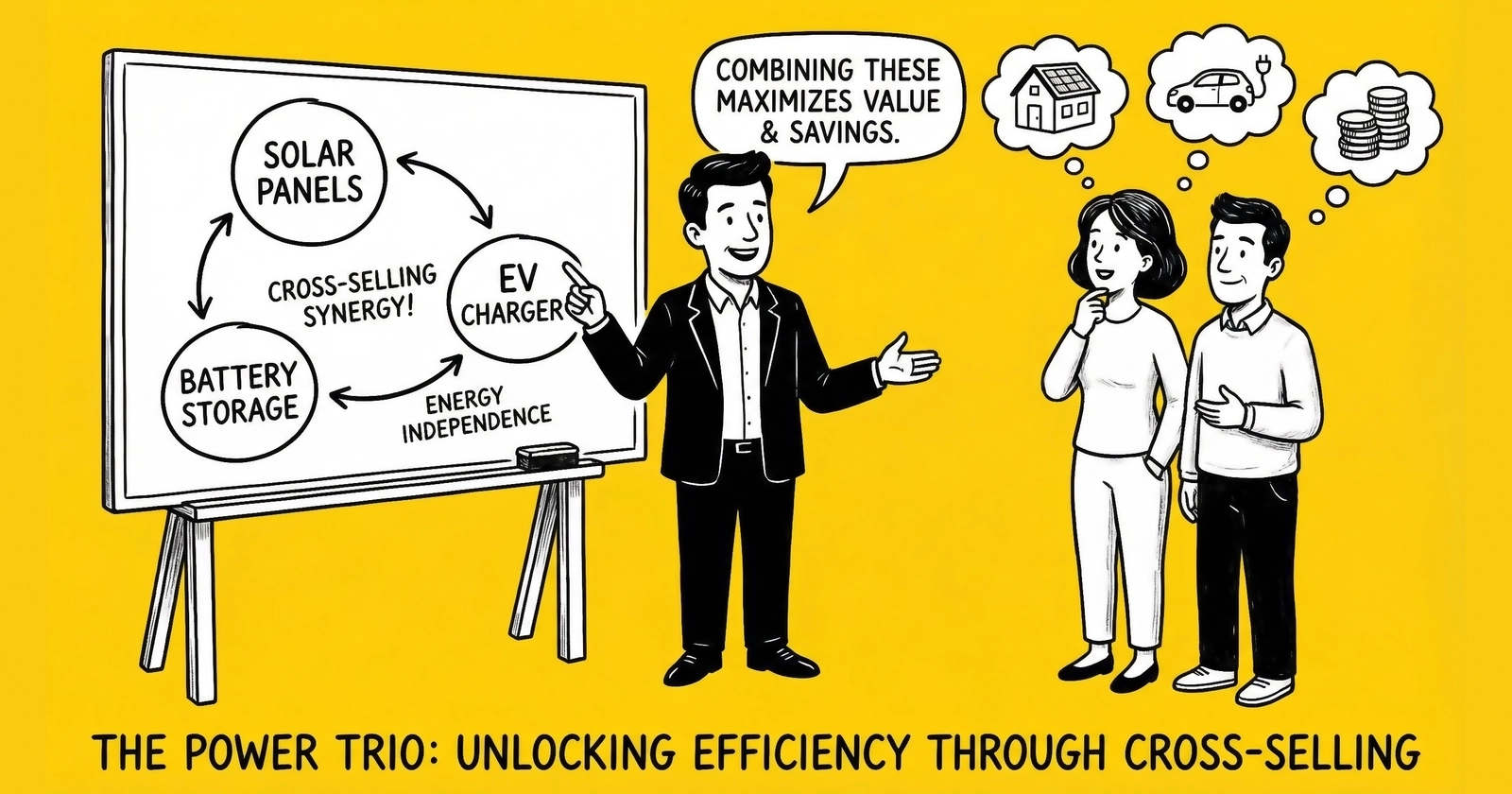
Forty percent of residential solar installations now include battery storage. The EV charging market is growing at 25% annually. Smart lead generators are transforming single-product solar leads into multi-system energy package opportunities worth 2-3x the original lead value.
The solar lead that converts into a $25,000 installation is good. The same lead that converts into solar plus battery storage plus EV charger installation worth $45,000-$60,000 is exceptional. This is not theoretical. Forty percent of new residential solar installations were paired with storage in 2025, up from just 11% in 2020. Battery attachment rates in California reached 79% after NEM 3.0 changed the economic calculus. The EV charger market is expanding at 25% compound annual growth as electric vehicle adoption accelerates past 18% of new vehicle sales.
Cross-selling transforms the unit economics of solar lead generation. A solar-only lead sells for $100-$200 exclusive. A qualified solar-plus-storage lead commands $175-$300. Add verified EV charger interest with an electric vehicle in the household, and premium buyers pay $250-$400 for the complete package. The math is straightforward: more services per customer, higher customer lifetime value, higher lead prices.
This guide provides the complete framework for battery storage and EV charger cross-selling with solar leads. You will learn market dynamics, qualification strategies, bundling economics, installer partnership requirements, technical considerations, and the operational infrastructure needed to capture this opportunity. Every recommendation comes from current market conditions and operational experience.
The Residential Energy Ecosystem: Understanding the Convergence
Three markets are converging into a single residential energy ecosystem: solar photovoltaics, battery storage, and electric vehicle charging. Understanding this convergence is essential for lead generators who want to capture the full opportunity rather than leaving money on the table with single-product leads.
Solar Market Position in 2025
Solar remains the anchor product in residential energy. The U.S. installed 11.7 gigawatts of solar capacity in Q3 2025, a 20% increase year-over-year. Solar and battery storage combined accounted for 85% of new generating capacity through the first three quarters of 2025. Despite policy headwinds in the residential sector, solar provides the foundation for the complete home energy system.
The residential solar market faces challenges that actually accelerate the convergence. The federal Investment Tax Credit expiration after December 31, 2025 changes economics. California’s NEM 3.0 reduced export compensation by 75%. These policy shifts make standalone solar less attractive while making solar-plus-storage essential for economic viability.
For lead generators, this means solar-only leads are declining in value while integrated energy leads are increasing. The market is forcing the transition from single-product to multi-product lead generation. For complete solar strategies, see our solar lead generation guide.
Battery Storage Market Expansion
The residential battery storage market has transformed from niche to mainstream. Forty percent of new residential solar installations included storage in 2025, according to SEIA data. This represents a fundamental shift in how consumers purchase solar: battery storage is no longer an optional add-on but an expected component.
Several factors drive this adoption surge. Grid reliability concerns have moved battery storage from luxury to necessity. Extended power outages from extreme weather events, wildfire-related public safety power shutoffs in California, and aging grid infrastructure create genuine backup power demand. A 2024 survey found that 67% of homeowners considering solar cited backup power as a primary motivation.
Net metering reductions in California and other states eliminate the economic case for exporting solar production to the grid. When utilities pay $0.05-$0.08 per kWh for exported solar instead of retail rates of $0.25-$0.40, self-consumption becomes the only path to acceptable payback periods. Battery storage enables this self-consumption by storing daytime production for evening use.
Time-of-use rate proliferation creates arbitrage opportunity. Many utilities now charge $0.35-$0.50 per kWh during peak evening hours (4-9 PM) while charging $0.15-$0.25 during off-peak periods. Battery storage allows homeowners to avoid peak rates entirely, creating savings of $50-$150 monthly beyond solar production value.
Federal tax credit inclusion extends the 30% ITC to battery storage when paired with solar. This reduces the effective cost of a $15,000 battery system to $10,500, fundamentally changing the ROI calculation. After the residential ITC expires, battery storage economics will require state-level incentives or continued cost declines to maintain current adoption rates.
EV Charging Market Growth
Electric vehicle adoption is accelerating faster than most projections anticipated. Combined sales of hybrid, plug-in hybrid, and battery electric vehicles rose to 18.7% of all vehicle sales in Q2 2024. Battery electric vehicles alone captured 7.1% market share. Projections suggest EVs will represent 25-30% of new vehicle sales by 2027.
Every EV purchase creates home charging demand. Approximately 80% of EV charging occurs at home. Level 2 home chargers (240V, 32-48 amp) cost $500-$1,500 for the unit plus $500-$2,000 for installation, depending on electrical panel capacity and distance from the panel to the charging location.
The intersection with solar is direct and compelling. Electricity demand increases significantly when a household adds an electric vehicle. A typical EV driven 12,000 miles annually requires approximately 4,000 kWh of electricity. For a household using 10,000 kWh annually, adding an EV increases demand by 40%. This increased demand improves solar economics by providing more consumption to offset with production.
Time-of-use rate exposure also increases for EV owners. Those who charge during peak hours face substantial electricity costs. Solar production during daytime hours combined with battery storage enables overnight EV charging from stored solar energy rather than grid electricity at peak rates.
Federal tax credits create additional alignment. The 30% Alternative Fuel Vehicle Refueling Property Credit (Section 30C) applies to EV charger installations in low-income communities or non-urban census tracts, providing potential $1,000 credit on charger costs. While more limited than the solar ITC, this credit creates additional incentive for bundled installations.
The Integrated Energy Home
The convergence creates a new product category: the integrated energy home. Solar panels generate electricity. Battery storage enables self-consumption and backup power. EV chargers provide the primary fueling infrastructure for electric vehicles. Smart energy management systems optimize the interaction between these components.
Homeowners increasingly recognize these systems as interconnected rather than independent purchases. A homeowner buying solar in 2020 might not have considered battery storage. A homeowner buying solar in 2025 expects to discuss storage and often initiates the EV charger conversation themselves.
For lead generators, this convergence means the qualification process must expand. Capturing only solar interest leaves potential value uncaptured. Leads that include verified interest in storage and EV charging command premium prices because they represent larger project values and higher customer lifetime value for installers. Understanding lead quality scores helps quantify this value differential.
Cross-Selling Economics: Understanding the Numbers
The economics of cross-selling determine whether bundled lead products justify the additional qualification effort. Understanding these numbers enables informed decisions about product strategy and pricing.
Installation Economics by Product
Solar-only installations typically cost between $20,000 and $30,000 with average gross margins of 25-35%. This translates to gross profit of $5,000-$10,500 per installation. After accounting for typical customer acquisition costs of $1,500-$3,000, installers net $2,000-$7,500 per solar-only project.
The economics shift dramatically when battery storage enters the equation. Solar plus battery storage systems average $35,000-$50,000 in total cost with slightly better margins of 28-38%. Gross profit climbs to $9,800-$19,000 per installation. Customer acquisition costs rise to $2,000-$4,000, but net profit per installation reaches $5,800-$15,000.
The complete package tells an even more compelling story. Solar plus battery plus EV charger installations average $40,000-$60,000 with the best margins in the category at 30-40%. Gross profit reaches $12,000-$24,000 per project. Even with customer acquisition costs of $2,500-$5,000, net profit per installation lands between $7,000 and $19,000.
The math is clear: bundled installations generate 2-3x the net profit of solar-only installations. This increased profit creates room for higher lead prices, faster sales follow-up, and preferential treatment from installer buyers.
Lead Value by Configuration
Lead pricing reflects the installation economics:
| Lead Configuration | Exclusive Price Range | Typical Close Rate |
|---|---|---|
| Solar-only | $100-$200 | 8-15% |
| Solar + Storage Interest | $150-$275 | 10-18% |
| Solar + Storage + EV | $200-$400 | 12-22% |
| Solar + Storage + EV + Verified EV Ownership | $250-$400+ | 15-25% |
Premium pricing for bundled leads reflects two factors: higher project value and higher conversion rates. Homeowners who have considered their complete energy needs and express interest in multiple components demonstrate more serious purchase intent than those responding to basic solar advertising.
The Attach Rate Opportunity
“Attach rate” measures the percentage of primary product sales that include secondary products. Current market attach rates reveal substantial opportunity.
Battery storage attach rates vary dramatically by geography. The national average sits at 40% as of 2025, but regional variations tell a more nuanced story. California leads at 79%, driven by NEM 3.0 economics. Hawaii follows at 65%, where high electricity rates make storage economics compelling. The Northeast states of New York, Massachusetts, and Connecticut range from 35-45%. Texas has grown to 25-30% following grid reliability concerns after the 2021 freeze. Florida lags at 20-25% despite hurricane exposure that would seem to favor backup power.
EV charger attach rates with solar correlate directly with vehicle ownership. Households with existing EVs attach chargers at 60-70% rates. Those planning EV purchases within 24 months attach at 35-45%. General solar buyers without specific EV plans attach at only 15-20%.
These attach rates represent both current opportunity and untapped potential. In markets with 25% battery attach rates, the remaining 75% of solar buyers represent qualification and education opportunity. Lead generators who can identify and qualify storage interest in these markets command premium prices from installers seeking to increase their attach rates.
Installer Willingness to Pay
Installers pay premiums for bundled leads because the math works in their favor. Consider solar-only economics at $150 CPL: with a 10% close rate, the effective CPA is $1,500, leaving net profit per close around $4,000 on $6,500 average solar gross profit.
Now compare solar-plus-storage economics at $250 CPL. The higher close rate of 15% actually reduces effective CPA to $1,667 despite the higher per-lead cost. More importantly, net profit per close exceeds $10,000 on $12,000 average bundled gross profit.
The bundled lead costs more per lead but delivers higher net profit per close. Sophisticated installers understand this math and actively seek bundled lead products. Less sophisticated installers focus on per-lead cost rather than per-close profit, creating opportunity for lead generators who can demonstrate the value through performance data.
Qualification Strategy: Identifying Multi-Product Opportunities
Effective cross-selling begins with qualification. The goal is identifying homeowners with genuine interest and qualification for solar, battery storage, and EV charging without creating form friction that destroys conversion rates.
Tiered Qualification Approach
The most effective approach uses tiered qualification: capture core solar qualification first, then progressively reveal cross-sell opportunity through additional questions.
The first tier covers core solar qualification and applies to all leads regardless of cross-sell potential. You need homeownership verification, property address, monthly electric bill amount, electric utility provider, roof age and condition, shading assessment, installation timeline, and contact information. These fundamentals establish baseline lead quality.
The second tier addresses storage qualification through progressive disclosure. Rather than asking directly about battery storage products, focus on the benefits that storage provides. Ask about interest in backup power during outages, experience with power outages in the past 24 months, awareness of net metering changes in affected markets, interest in energy independence, and time-of-use rate enrollment. These questions identify storage interest without requiring explicit storage knowledge. Many homeowners want the benefits of battery storage without knowing that battery storage is the solution. Qualifying on benefits rather than product features captures this latent demand.
The third tier handles EV charger qualification, also through progressive disclosure. Capture current vehicle type (gas, hybrid, EV), EV ownership status across a spectrum from current ownership through planned purchases within 12 or 24 months to not considering, current charging infrastructure, and interest in home charging if an EV purchase is planned. EV ownership provides the strongest qualification signal. Homeowners with EVs have immediate, active demand for Level 2 charging. Those planning purchases within 12-24 months represent near-term opportunity. Those not considering EVs are unlikely cross-sell candidates for charging infrastructure.
Form Design for Cross-Selling
Form design balances comprehensiveness against conversion rate degradation. Each additional question creates friction. The key is ensuring each question earns its place through qualification value.
Multi-step form structure works best for cross-sell qualification. The first step captures property basics like ZIP code, ownership status, and bill amount. The second step handles roof qualification including age, condition, and shading. The third step explores energy interests encompassing backup power, rate management, and EV status. The fourth step collects contact information. This structure moves from least personal to most personal while progressively revealing cross-sell opportunity. Prospects who complete all four steps demonstrate serious intent.
Question sequencing matters for optimization. Place storage qualification questions before EV questions. Storage has higher attach rates and broader applicability. A homeowner uninterested in EVs may still be a strong storage candidate. A homeowner interested in EVs but not storage represents a smaller opportunity.
Skip logic improves relevance and reduces abandonment. If a prospect indicates no power outage experience and no concern about grid reliability, skip detailed backup power questions. If they indicate no EV ownership or plans, skip charging infrastructure questions. Tailored forms convert better than one-size-fits-all approaches.
Behavioral Signals Beyond Form Data
Form responses provide declared data. Behavioral signals provide additional qualification insight.
Time on page indicates consideration depth. A prospect who spends 45 seconds on a storage benefit page demonstrates more interest than one who immediately clicks through. Track page engagement and incorporate into lead scoring.
Content consumption reveals priorities. A prospect who reads three articles about battery backup before submitting a form has different intent than one who found you through a generic solar search. Track content path and include in lead metadata.
Return visits indicate serious consideration. A prospect who visits Monday, returns Thursday, and converts Saturday represents higher intent than an immediate converter. Multi-session tracking where privacy-compliant improves qualification accuracy.
Device and time patterns suggest demographics. Desktop submissions during business hours may indicate professional homeowners researching during work. Mobile submissions on weekends suggest different demographics. These patterns can inform buyer routing decisions.
Data Enrichment for Cross-Sell Qualification
Third-party data enrichment enables cross-sell qualification without requiring direct form questions.
Vehicle registration data identifies EV owners at the household level. Services like Experian AutoCheck or IHS Markit provide vehicle ownership data that can be matched against lead records. A lead from a household with a Tesla Model 3 is automatically EV charger qualified regardless of form responses.
Property data indicates home characteristics relevant to storage and EV charging. Square footage correlates with electricity consumption. Presence of swimming pools or hot tubs indicates high consumption suitable for larger solar systems. Older homes may have electrical panel limitations affecting EV charger installation.
Electricity consumption estimates from utility data services can substitute for self-reported bill amounts, improving accuracy while reducing form friction.
Income and credit indicators from credit bureau data suggest qualification for financing. Solar-plus-storage installations averaging $40,000+ require either substantial cash reserves or strong credit profiles.
Data enrichment adds $1-$5 per lead but can improve qualification accuracy by 30-40%. The ROI calculation depends on lead pricing: $3 enrichment cost on a $250 lead represents 1.2% of revenue while potentially improving close rates by 25%. For more on calculating these economics, see our guide on calculating true cost per lead.
Market Segmentation: Where Cross-Selling Works Best
Cross-selling opportunity varies dramatically by geography, demographics, and market conditions. Understanding these segments enables targeted traffic acquisition and buyer development.
Geographic Segmentation
High-storage markets develop where policy changes or grid reliability concerns drive battery demand. California stands out with NEM 3.0 making storage essential and attach rates reaching 79%. Premium pricing for storage-qualified leads is standard. Hawaii offers the highest electricity rates nationwide combined with grid reliability concerns on islands, creating strong storage economics. Arizona faces grid reliability concerns from summer demand peaks and shows growing storage adoption. Texas developed lasting backup power demand after the 2021 ERCOT grid instability crisis. Florida’s hurricane exposure drives backup power interest with steadily growing attach rates.
High-EV markets develop where vehicle adoption creates charger demand. California leads with over 25% EV market share and charger infrastructure expected as standard. Washington state shows strong EV adoption driven by tech-sector demographics. Colorado’s environmental consciousness drives EV adoption. The Northeast corridor spanning New York, New Jersey, Connecticut, and Massachusetts sees high EV adoption among affluent suburbs.
Convergence markets where both storage and EV opportunity overlap represent the highest-value territories. California coastal communities combine high electricity rates with strong EV adoption and grid concerns. Austin, Texas merges tech-sector demographics with grid reliability concerns and EV-friendly culture. Denver metro pairs environmental consciousness with new construction featuring solar-ready infrastructure. Phoenix offers high electricity costs alongside grid concerns and growing EV adoption.
Demographic Segmentation
Certain demographics demonstrate high cross-sell potential. Households with income above $150,000 can afford bundled installations and are more likely to own EVs. Homeowners between 35 and 55 years old occupy peak earning years with family-stage consumption and represent the EV-adoption sweet spot. Tech-sector employment correlates with early EV adoption and sophisticated energy consumption patterns. New construction homeowners benefit from electrical infrastructure already configured for storage and EV charging. Multiple-vehicle households show higher probability of EV ownership or purchase plans.
Other demographics show lower cross-sell potential and may not justify the qualification investment. Fixed-income retirees tend toward price sensitivity and may resist bundled upsells. Single-vehicle households show lower EV consideration unless they already own an electric vehicle. Rural properties may have residents already accustomed to outages, making grid reliability less relevant as a selling point. Older homes built before 1980 often require electrical panel upgrades adding $2,000-$5,000 to project costs, affecting economics.
Psychographic Segmentation
Beyond demographics, psychographic profiles predict cross-sell receptivity. Resilience-motivated buyers prioritize backup power and energy independence. These prospects respond to messaging about grid reliability, storm protection, and self-sufficiency. For them, battery storage is essential and solar is the means to charge the battery. EV charging fits the independence narrative. Lead qualification should emphasize power outage history and independence values.
Economics-motivated buyers focus on bill reduction and ROI. These prospects respond to detailed payback calculations, monthly savings projections, and rate arbitrage explanations. Storage must be justified economically, not just emotionally. EV charging is attractive because it eliminates gasoline costs. Lead qualification should capture current electricity rates, utility rate plans, and transportation costs.
Environment-motivated buyers prioritize carbon reduction and sustainability. These prospects respond to emissions reduction messaging and clean energy positioning. Storage and EVs fit the narrative of complete electrification and fossil fuel elimination. Lead qualification should capture environmental values and interest in complete home electrification.
Technology-motivated buyers want the latest home technology. These prospects respond to smart home integration, app-based monitoring, and advanced features. Storage appeals as home automation infrastructure. EV charging fits the connected home vision. Lead qualification should capture existing smart home technology and technology comfort level.
Different buyer types require different messaging and may route to different installers. An installer specializing in premium technology-forward installations is not the right match for an economics-motivated buyer seeking minimum viable cost.
Installer Partnership Strategy: Building Cross-Sell Capable Buyer Networks
Cross-sell lead products require buyers capable of delivering bundled installations. Not all solar installers offer battery storage. Fewer offer integrated EV charger installation. Building a buyer network with cross-sell capability requires deliberate partnership development.
Installer Capability Assessment
Evaluate potential buyers across multiple dimensions to ensure they can actually deliver on cross-sell leads.
Storage capability encompasses several factors: battery brand certifications from manufacturers like Tesla Powerwall, Enphase, LG, and Generac; installation volume history measured in monthly storage installs; permitting experience in your target markets; and financing options for storage additions. An installer without established storage operations cannot effectively convert storage-qualified leads.
EV charger capability requires specific credentials: electrician licensing and EVSE certification, brand partnerships with companies like ChargePoint, JuiceBox, or Tesla Wall Connector, experience with electrical panel upgrades, and established permitting and inspection relationships. The electrical work overlaps significantly with storage installation, making this a natural expansion for storage-capable installers.
Sales capability determines whether qualified leads actually convert. Assess whether the installer takes a consultative sales approach capable of selling complete energy solutions. Examine their sales compensation structure to determine whether it incentivizes bundled sales or just solar volume. Verify training on storage and EV charger value propositions. Review their CRM and proposal tools for multi-product quoting capability.
Operational capability ensures projects actually get completed. Can they coordinate multiple trades including solar installers and electricians? Do they offer integrated warranties covering all system components? What is their typical project timeline for bundled installs? How do they handle phased installations where customers want solar now and storage later?
Partnership Development Approach
Start with storage capability since battery storage represents higher value and higher attach rates than EV charging. Installers with storage capability are your primary targets for cross-sell lead products. Identify installers doing 10+ monthly storage installs in your target markets.
Assess EV charger interest among your storage-capable partners. Many storage-capable installers do not currently offer EV charging but could add capability easily. The infrastructure requirements for electrical work and permitting overlap substantially. EV charging represents a logical expansion for storage installers. Position your cross-sell leads as a catalyst for their service expansion.
Create tiered products that accommodate varying buyer capabilities. Not all buyers need all products. Offer solar-only leads at base pricing for general buyers, solar-plus-storage leads at premium pricing for storage-capable buyers, and full bundle leads at top-tier pricing for complete-capability buyers. Allow buyers to select the products they can serve and route leads to the highest-capability buyers who accept all product types. For technical implementation, see our API lead posting guide.
Provide performance data to build partnership depth. Share attach rate data with buyers. Show them concrete numbers: “Your close rate on storage-qualified leads is 18% versus 10% on solar-only leads. Your average project value is $42,000 versus $24,000. Your net profit per lead is 2.3x higher on qualified leads despite the 1.6x price increase.” Data-driven conversations build trust and justify premium pricing.
Exclusive Arrangements for Cross-Sell Products
Cross-sell leads justify exclusivity arrangements more than solar-only leads due to their inherent value and complexity.
Higher value justifies exclusivity because a $250 lead with 18% close rate and $45,000 average project value is worth exclusivity to serious buyers. The math works: $250 divided by 0.18 equals $1,389 CPA on a $45,000 project with $14,000 gross margin, yielding strong ROI for the installer.
Operational complexity requires coordination. Bundled installs require more touchpoints than solar-only projects. Multiple follow-up calls, site assessments, and design iterations benefit from single-installer focus rather than competitive scramble among multiple buyers.
Premium pricing enables premium service. Exclusive cross-sell leads at $250+ allow lead generators to invest in enhanced verification, faster delivery, and quality guarantees that would be uneconomic at $100 shared pricing.
Structure exclusive arrangements with clear terms: geographic territory definitions specifying exactly where the exclusivity applies, volume commitments ensuring minimum monthly leads that justify the installer’s investment in capabilities, performance requirements establishing maximum return rates and minimum close rate expectations, price escalation provisions tied to conversion performance, and termination provisions for underperformance on either side.
Operational Infrastructure: Systems for Cross-Sell Lead Generation
Executing cross-sell lead generation requires operational infrastructure beyond basic solar lead systems. Lead routing, scoring, and delivery must accommodate multiple products and variable buyer capabilities.
Lead Scoring for Cross-Sell
Develop scoring models that reflect cross-sell qualification across multiple dimensions.
The base solar score ranges from 0 to 100 points. Award 20 points for verified homeownership. Add 15 points for electric bills above $150, or 25 points for bills exceeding $250. Positive roof qualification earns 15 points. Installation timeline under 6 months adds 15 points. Positive credit indication contributes 10 points.
The storage modifier adds 0 to 50 points. Power outage experience in the past 24 months earns 15 points. Indicated backup power interest adds 20 points. Location in a high TOU rate market contributes 10 points. California or Hawaii location adds 15 points.
The EV modifier adds 0 to 40 points. Current EV ownership earns 25 points. EV planned within 12 months adds 20 points. EV planned within 24 months contributes 10 points. Absence of current Level 2 charger adds 5 points.
A lead scoring 100+ on the base solar score with 30+ storage modifier and 25+ EV modifier represents premium cross-sell opportunity worthy of routing to top-tier bundled installation partners.
Lead Routing Logic
Configure routing to match leads with capable buyers using conditional logic:
IF solar_score >= 80 AND storage_modifier >= 30 AND ev_modifier >= 25:
    route_to: premium_bundle_buyers
    lead_type: "solar_storage_ev"
    pricing_tier: "premium"

ELIF solar_score >= 80 AND storage_modifier >= 30:
    route_to: storage_capable_buyers
    lead_type: "solar_storage"
    pricing_tier: "enhanced"

ELIF solar_score >= 80 AND ev_modifier >= 25:
    route_to: ev_charger_capable_buyers
    lead_type: "solar_ev"
    pricing_tier: "enhanced"

ELSE:
    route_to: standard_solar_buyers
    lead_type: "solar_only"
    pricing_tier: "standard"
This routing ensures leads reach buyers capable of serving the indicated interests while capturing appropriate pricing for qualification depth.
Delivery Format for Bundled Leads
Standard solar lead delivery formats require enhancement for cross-sell products.
Required additional fields include storage interest level rated as high, medium, or low; backup power motivation as yes or no; power outage history including frequency and duration; EV ownership status categorized as current, planned, or none; current charging infrastructure; and electrical panel age estimate when captured.
Buyer-visible qualification flags should indicate Storage_Qualified as Yes or No, EV_Charger_Qualified as Yes or No, and Panel_Upgrade_Likely as Yes, No, or Unknown.
The lead notes section should capture prospect-stated priorities, key motivations identified during form completion, and any concerns or objections the prospect mentioned.
Comprehensive lead delivery enables informed follow-up calls and higher conversion rates.
Performance Tracking by Product Configuration
Track performance metrics separately by lead configuration:
| Metric | Solar-Only | Solar+Storage | Full Bundle |
|---|---|---|---|
| Delivery volume | Track | Track | Track |
| Contact rate | Track | Track | Track |
| Appointment rate | Track | Track | Track |
| Close rate | Track | Track | Track |
| Average project value | Track | Track | Track |
| Return rate | Track | Track | Track |
| Buyer satisfaction | Track | Track | Track |
Performance variance by configuration reveals optimization opportunities. If solar-plus-storage leads show 20% higher close rates but only 15% higher pricing, there is room to increase pricing. If full bundle leads show high return rates, qualification may need tightening.
Traffic Acquisition: Sourcing Cross-Sell Qualified Prospects
Traffic acquisition strategy must align with cross-sell qualification goals. Standard solar traffic sources may not efficiently generate cross-sell qualified prospects.
Keyword Strategy for Cross-Sell Intent
High cross-sell intent keywords target prospects already thinking about integrated solutions. Terms like “solar battery system,” “solar battery storage,” “home battery backup,” “backup power for home,” “solar and EV charger,” “electric car charger installation,” “whole home battery,” “Powerwall installation,” “home energy storage,” “residential battery storage,” and “solar panel and battery package” all indicate multi-product consideration.
Storage-specific keywords capture prospects focused on backup power: “battery backup for power outage,” “solar battery cost,” “how much is a Tesla Powerwall,” “best home battery system,” and “solar plus storage.”
EV-specific keywords capture charger installation demand: “Level 2 charger installation,” “home EV charger cost,” “solar panel EV charger,” “charge EV with solar panels,” and “Tesla Wall Connector installation.”
These keywords cost more per click than generic solar terms but generate higher-quality cross-sell prospects. A click on “solar battery backup system” at $15 that converts to a $350 bundled lead is more profitable than a click on “solar panels” at $8 that converts to a $150 solar-only lead.
Content Marketing for Cross-Sell Qualification
Educational content captures cross-sell interested prospects earlier in their research journey.
Storage-focused content should address the questions prospects actively research: “How Much Does a Home Battery System Cost in 2025?”, “Solar Battery Backup: Complete Guide to Keeping Your Lights On,” “NEM 3.0 Explained: Why You Need Battery Storage with Solar,” “Time-of-Use Rates: How Battery Storage Saves You Money,” and “Tesla Powerwall vs. Enphase vs. LG: Home Battery Comparison.”
EV charger content should similarly address active research topics: “Installing a Home EV Charger: Complete Cost and Process Guide,” “Should You Get Solar If You Have an Electric Car?”, “Level 2 EV Charger Installation: What Homeowners Need to Know,” and “Charge Your EV with Solar: How It Works and What It Costs.”
Bundled solution content captures prospects considering complete systems: “The Complete Home Energy System: Solar, Storage, and EV Charging,” “How Much Does Full Home Electrification Cost?”, and “Solar, Battery, and EV Charger: Making the Numbers Work.”
Content marketing generates organic traffic with demonstrated cross-sell interest. Prospects who read a 2,500-word article on home battery storage before submitting a form have genuine interest beyond casual curiosity.
Paid Social for Cross-Sell Audiences
Social media platforms enable audience targeting aligned with cross-sell qualification.
Facebook and Instagram targeting should focus on interests in electric vehicles, Tesla, Rivian, and sustainable living. Behavioral targeting should capture EV owners, environmental activists, and home improvement enthusiasts. Lookalike audiences built from your existing cross-sell converted customers can expand reach efficiently.
Creative should align with cross-sell messaging. Show integrated systems featuring solar, battery, and EV charger together. Emphasize complete energy independence in your messaging. Feature testimonials from multi-product customers who can speak to the integrated experience.
Lead form design should capture qualification data directly. Use Facebook Lead Ads with custom questions including storage interest and EV status. Capture vehicle type to enable data-driven routing.
Social traffic quality for cross-sell tends to be lower than search but can be profitable at appropriate CPL targets. Test creative variations and audience segments to identify efficient cross-sell traffic sources.
Partner and Referral Channels
EV dealership partnerships create high-quality cross-sell opportunity. New EV buyers have immediate home charging needs and elevated interest in solar for charging with sunshine. Partner with EV dealerships to capture buyer information at vehicle purchase for solar-plus-charger follow-up.
Home builder partnerships in new construction markets capture homeowners at the point of maximum energy system flexibility. New construction allows optimal system design without retrofit constraints. Builders increasingly offer solar, storage, and EV charger as upgrade packages.
Utility program partnerships in markets with utility-sponsored storage or EV charger programs provide qualified prospect access. Utilities often struggle with customer acquisition for these programs and welcome lead generation partnerships.
Insurance company referrals target homeowners with backup power needs following disaster claims. Homeowners who experienced extended outages have acute backup power motivation.
Bundling Strategies: Pricing and Packaging for Maximum Value
How you structure and price bundled lead products affects both buyer acceptance and your revenue optimization.
Product Packaging Options
Three primary packaging approaches exist, each with distinct advantages.
The all-inclusive bundle offers a single lead product with all qualification at $250-$400 exclusive. Buyers must offer solar, storage, and EV charging to participate. This approach simplifies your product line but limits your buyer pool to only the most capable installers.
Tiered products with add-ons start with a base solar lead at $100-$200, then layer storage qualification at +$50-$100 and EV qualification at +$40-$75. This provides flexible buyer matching but creates complex pricing and potential for buyers to cherry-pick only certain lead types.
Qualification-based tiers establish clear value progression: Tier 1 for solar-only leads at base price, Tier 2 for solar plus one additional product at 1.5x base, and Tier 3 for solar plus both additional products at 2x base. This approach provides clear value progression but may undervalue leads in high-storage markets where storage qualification alone commands significant premium.
most practitioners find the qualification-based tiers approach provides the best balance of simplicity and value capture.
Pricing Optimization
Price testing reveals optimal price points for your specific markets and buyer relationships.
Structure tests systematically with a control group at current pricing, Test A at +15% premium for storage qualification, Test B at +25% premium, and Test C at +35% premium.
Measure buyer acceptance rate at each tier, close rate performance at each tier, and total revenue optimization calculated as volume times price times close rate.
In most markets, bundled lead pricing 50-75% above solar-only pricing optimizes total value capture. Higher premiums reduce buyer acceptance without proportional close rate improvement. Lower premiums leave value on the table.
Volume Commitments and Guarantees
Bundled lead products justify volume commitments from buyers given the investment both sides make in the relationship.
Minimum volume commitments matter because cross-sell qualified leads require buyer investment in capabilities. Minimum thresholds of 20-50 leads monthly ensure buyers maintain sales team readiness. Volume commits justify exclusive territory arrangements.
Performance guarantees should include contact rate guarantees with refund or replacement if contact rates fall under 70%, close rate expectations with relationship review if rates fall under 10%, and quality SLAs around return rate thresholds.
Price protection provisions should include price locks for committed volume lasting 90-180 days, price escalation provisions tied to market changes, and mutual termination rights for material changes to the agreement.
Technical Considerations: What Lead Generators Need to Know
While lead generators do not install systems, understanding technical considerations improves qualification accuracy and buyer credibility.
Battery Storage Basics
System sizing correlates with backup needs and usage patterns. Small systems of 5-10 kWh provide partial home backup covering only essential circuits. Medium systems of 10-20 kWh enable whole home backup for hours or partial backup for days. Large systems of 20-40 kWh support extended whole home backup and enable full self-consumption of solar production.
Lead qualification should capture backup power expectations to enable appropriate system sizing conversations between the installer and prospect.
Major battery brands occupy different market positions. Tesla Powerwall enjoys high brand recognition with integrated software but faces ongoing supply constraints. Enphase IQ Battery features modular design with native microinverter integration. LG Energy Solution offers value positioning with reliable performance. Generac PWRcell has strong backup power positioning leveraging the company’s generator brand heritage. Franklin Home Power has emerged as an aggressive competitor with competitive pricing.
Understanding brand positions helps lead generators speak credibly with buyers and qualify prospect preferences.
EV Charger Technical Factors
Charging levels determine installation requirements. Level 1 charging uses a standard 120V outlet and delivers only 3-5 miles of range per hour, inadequate for most EV owners. Level 2 charging uses a 240V dedicated circuit and delivers 25-30 miles of range per hour, representing the standard for home charging. Level 3 and DC Fast Charging are commercial-only technologies not relevant for residential lead generation.
Lead qualification should confirm Level 2 charger interest rather than assuming all EV owners need installation. Some have adequate Level 1 service or existing Level 2 infrastructure.
Electrical panel considerations affect installation complexity and cost. Panel capacity determines whether a home can support additional EV charging load. Older homes built before 1990 often have 100-150 amp service. An EV charger drawing 40-50 amps plus existing loads may require panel upgrade. Panel upgrades add $1,500-$4,000 to project cost.
Qualification questions about home age and existing electrical issues can flag likely panel upgrade situations, enabling appropriate buyer routing and customer expectation setting.
Integration Considerations
Smart energy management coordinates solar, storage, and EV charging through time-based charging optimization, load balancing during peak demand, backup power prioritization, and app-based monitoring and control. Prospects interested in technology and automation represent strong cross-sell candidates. Those focused solely on cost reduction may be less interested in integration features.
Future-proofing matters for multi-product installations. Electrical infrastructure should accommodate future additions. Solar system sizing should account for storage and EV charging loads. Battery systems should allow capacity expansion. Lead generators can add value by flagging future expansion interest in lead delivery notes.
The Post-ITC Cross-Sell Landscape
The residential ITC expiration after December 2025 changes cross-sell economics. Understanding these changes enables strategic positioning.
Storage Economics Without ITC
When the 30% tax credit disappears, a $15,000 battery system costs $15,000 rather than the current effective price of $10,500. Payback periods extend by approximately 30%. Pure economic justification becomes more difficult to achieve. Backup power and resilience value become the primary justification rather than economic return.
The strategic implication is clear: post-ITC storage sales require emphasis on backup power value rather than economic payback. Lead qualification should weight resilience motivation more heavily than economic motivation.
EV Charger Economics Post-ITC
The Section 30C credit for EV chargers has its own provisions. The 30% credit up to $1,000 applies to qualified installations, but only for installations in low-income communities or non-urban census tracts. This makes the credit more limited in applicability than the solar ITC.
The strategic implication is that EV charger cross-sell justification depends on EV ownership and convenience rather than tax credits. Focus qualification on current EV owners and those with imminent purchase plans.
Geographic Shifts
Post-ITC economics favor markets with strong fundamentals beyond tax credits. High electricity rate markets like California, Hawaii, and the Northeast maintain strong economics. Grid reliability concern markets like Texas, Florida, and California retain backup power demand. High EV adoption markets like California, Washington, and Colorado sustain charger installation demand.
Markets with strong fundamentals across multiple dimensions become even more valuable. Markets dependent primarily on tax credit economics decline in value.
Product Mix Evolution
Expect product mix evolution as the market adjusts. Storage attach rates may decline from 40% to 25-30% without ITC support. EV charger attach rates may hold or increase as EV adoption accelerates regardless of tax policy. Complete bundle sales become more premium and less mainstream.
Lead generators should anticipate lower volume of cross-sell qualified leads at higher unit values. Fewer prospects will justify bundled installations, but those who do will have stronger purchase intent and higher close rates.
Frequently Asked Questions
What percentage of solar leads should be cross-sell qualified?
In mature markets like California, Hawaii, and the Northeast, aim for 40-60% of leads to include storage qualification and 15-25% to include EV charger qualification. In developing markets, these percentages will be lower (20-30% storage, 10-15% EV). The right percentage depends on your traffic sources and targeting. Pure search traffic on storage-specific keywords should approach 80-90% storage qualification. Broad solar display traffic may only yield 15-20% storage qualification.
How much more should I charge for cross-sell qualified leads?
Market pricing suggests 50-75% premium for solar-plus-storage leads over solar-only leads, and 80-100% premium for full bundle (solar, storage, EV charger) leads. If your solar-only exclusive leads sell for $150, solar-plus-storage should be $225-$260 and full bundle $270-$300. Test pricing in your specific markets and buyer relationships to find optimal price points that maximize total revenue (volume times price).
Which cross-sell product is more valuable: storage or EV charger?
Battery storage is more valuable due to higher attach rates, larger revenue addition, and broader applicability. Storage adds $10,000-$20,000 to project value and applies to any homeowner concerned about backup power or rate optimization. EV charger adds $1,500-$3,500 but only applies to current or imminent EV owners. Prioritize storage qualification in your forms and traffic strategy. Add EV qualification as a secondary enhancement.
How do I find installers who can do all three services?
Start with installers who already offer battery storage with solar. Storage-capable installers have the electrical capabilities and permitting relationships to add EV charger installation relatively easily. Look for installers doing 10+ monthly storage installs in your target markets. Approach them with your cross-sell lead products as a catalyst for their service expansion. Many will add EV charger capability to access your premium leads.
Should I separate cross-sell leads into different products or bundle them?
Bundled products with tiered pricing work best for most operations. Separating into distinct products creates operational complexity and enables buyer cherry-picking. A tiered approach (solar-only, solar-plus-storage, full bundle) provides buyer flexibility while capturing appropriate value at each level. Reserve truly separate products for specific buyer requirements, such as an EV charger-focused installer who wants EV-qualified leads regardless of storage interest.
What are the best traffic sources for cross-sell qualified leads?
Search traffic on storage-specific and EV-specific keywords generates the highest cross-sell qualification rates but at higher CPCs. Content marketing around battery storage and EV charging topics captures research-stage prospects with demonstrated interest. Facebook and Instagram targeting of EV owners and sustainable living interests generates cross-sell qualified traffic at moderate costs. Partner channels (EV dealerships, home builders, utility programs) provide high-quality cross-sell prospects at variable costs depending on partnership structure.
How does the ITC expiration affect cross-sell lead value?
The ITC expiration after December 2025 reduces the economic justification for battery storage, which may reduce storage attach rates from 40% to 25-30% nationally. However, resilience-motivated buyers (backup power, grid independence) will continue purchasing storage regardless of tax credits. Post-ITC cross-sell leads will be fewer but represent stronger purchase intent. Expect higher close rates on qualified cross-sell leads but lower total volume. Pricing should hold or increase for truly qualified cross-sell prospects.
What qualification questions identify genuine storage interest?
The most predictive storage qualification questions focus on benefits rather than product knowledge. Ask about power outage experience in the past 24 months, concern about grid reliability, interest in backup power during emergencies, and awareness of changing utility rate structures. These questions identify storage-motivated prospects even if they do not know battery storage is the solution. Direct questions about storage brand preference indicate advanced consideration but may miss earlier-stage prospects.
How do I handle leads interested in EV chargers but not storage?
Route EV-charger-qualified leads without storage interest to installers who offer EV charger installation without requiring bundled storage. Some electricians and EV specialists focus on charger installation without solar capability. Alternatively, route to solar installers who can use EV charger interest as an entry point to discuss storage benefits during the sales conversation. EV owners concerned about charging costs are often receptive to storage messaging around rate optimization.
What return rates should I expect on cross-sell leads?
Cross-sell qualified leads should have lower return rates than solar-only leads because cross-sell qualification indicates deeper consideration and stronger purchase intent. Target 8-12% return rate on solar-plus-storage leads versus 12-18% on solar-only leads. Full bundle leads should target under 10% return rate. If cross-sell leads show higher return rates than solar-only, your qualification process is not effectively identifying genuine interest. Review form questions and verification processes.
Key Takeaways
-
Cross-selling transforms unit economics. Solar-only installations generate $5,000-$10,000 gross profit. Solar plus storage plus EV charger generates $12,000-$24,000. This profit expansion justifies 50-100% lead pricing premiums while delivering better ROI for buyers.
-
Battery storage is the priority cross-sell. Forty percent national attach rate with 79% in California. Storage adds $10,000-$20,000 to project value. Every solar lead should be qualified for storage interest through benefit-focused questions about backup power and rate management.
-
EV ownership is the strongest EV charger qualifier. Current EV owners have immediate charging demand. Planned purchases within 12 months represent near-term opportunity. Generic EV interest without ownership or purchase plans rarely converts to charger installation.
-
Tiered lead products capture appropriate value. Solar-only at base price, solar-plus-storage at 1.5x, full bundle at 2x. This structure matches leads to buyer capabilities while capturing value for qualification depth.
-
Traffic sources must align with cross-sell goals. Storage-specific and EV-specific keywords, content marketing on battery backup and EV charging topics, and social targeting of EV owners generate cross-sell qualified traffic that generic solar campaigns cannot match.
-
Installer capability determines routing strategy. Build buyer networks with verified storage and EV charger installation capabilities. Route cross-sell leads to capable buyers. Do not send bundled leads to solar-only installers.
-
Post-ITC economics favor resilience messaging. Without the 30% tax credit, storage economic justification weakens. Backup power, grid independence, and energy resilience become primary value propositions. Qualification should weight resilience motivation accordingly.
-
Geographic concentration intensifies. High electricity rate markets, grid reliability concern markets, and high EV adoption markets represent the convergence zones where cross-sell economics work best. California, Hawaii, Texas, and the Northeast corridor offer the strongest cross-sell opportunity.
Sources
- SEIA U.S. Solar Market Insight - Industry data on solar installation volumes, storage attach rates, and market trends including the 40% national storage attachment rate
- SEIA Solar Investment Tax Credit - Details on the 30% federal ITC for solar and battery storage systems
- IRS Residential Clean Energy Credit - Official IRS guidance on the 30% residential solar and storage tax credit
- IRS Clean Vehicle Credits - Section 30C Alternative Fuel Vehicle Refueling Property Credit details for EV charger installations
- California PUC Net Energy Metering - Official NEM 3.0 policy documentation explaining reduced export compensation rates
- EIA Today in Energy - U.S. Energy Information Administration reporting on solar capacity growth and generating capacity statistics
- IEA Global EV Outlook 2024 - International Energy Agency data on EV market share growth and adoption trends
- AFDC Home Charging - Department of Energy Alternative Fuels Data Center guidance on home EV charging infrastructure and Level 2 charger specifications
Market data current as of December 2025. Tax credit information reflects the post-One Big Beautiful Bill environment. All regulatory claims regarding tax credits should be verified before acting, as policy continues to evolve.