# Bayer Roundup $7.25B Preliminary Approval – Why the King v. Monsanto Settlement Resets the Mass-Tort Intake CPL Curve
> **Canonical:** https://www.leadgen-economy.com/blog/bayer-roundup-7-25-billion-preliminary-approval-mass-tort-cpl-reset/
> **Published:** 2026-06-25
> **Author:** Alex Paddington
> **Source:** LeadGen Economy – https://www.leadgen-economy.com
---
*The state-court Roundup class settlement is structurally different from the federal MDL – and the difference is where the mass-tort intake CPL window between March 4 and July 9 actually sits.*
---
## March 4, 2026 – When Missouri Took the Class
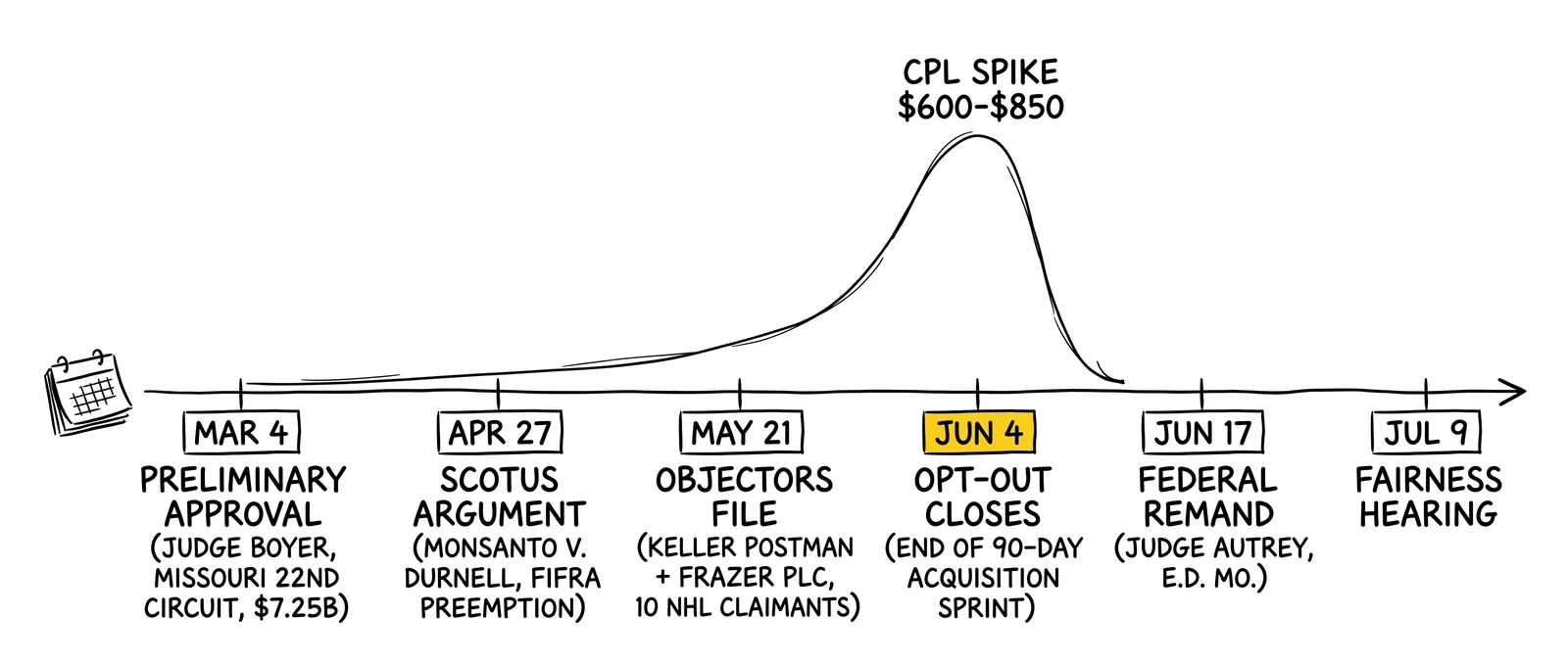
On March 4, 2026, Judge Timothy J. Boyer of the 22nd Judicial Circuit Court for the City of St. Louis granted preliminary approval to a $7.25 billion class settlement in *Randall King, et al. v. Monsanto Company*, Cause No. 2622-CC00325. The written order followed on March 9. The settlement covers approximately 65,000 current pending Roundup claims and structures the resolution over 17 to 21 years on a declining annual-funding-cap schedule. Bayer deposited $500 million within 10 days of approval.
The structure pulls the Roundup resolution into Missouri state court and out of the federal multidistrict litigation track that has dominated the trade-press coverage. MDL 2741 – *In re Roundup Products Liability Litigation*, 3:16-md-02741-VC, presided over by Judge Vince Chhabria in the Northern District of California – held approximately 3,902 actions as of the JPML's January 5, 2026 pending-docket count. Judge Chhabria characterized the proposed deal as "filthy" in May 2026 commentary, but does not preside over the state-court class. The two tracks operate in parallel under separate judicial supervision. The state-court structure is where the $7.25 billion preliminary approval lives; the federal MDL is where the cases not absorbed into the class continue.
For mass-tort intake operators, the structural detail matters. The preliminary approval established a 90-day window between March 4 and the June 4 opt-out deadline during which plaintiff firms refilled their Roundup pipelines. The fairness hearing follows on July 9. The SCOTUS oral argument in *Monsanto v. Durnell* on April 27 on FIFRA preemption sits inside the same window and operates as a binary CPL trigger that operators have largely not priced into media commitments.
The article walks through the court order mechanics, the prior Bayer Roundup reserve context, the objector challenges from Keller Postman and Frazer PLC, the SCOTUS preemption case, the operator-side intake economics during the sprint window, and what the structure means for mass-tort acquisition planning through the fairness hearing and the eventual SCOTUS decision.
The 90-day sprint between preliminary approval and opt-out closure is where qualified Roundup CPL spiked to $600-$850 – and where pre-committed media budgets cleared at premium.
---
## What the Class Settlement Actually Structures
The settlement architecture rewards close reading because the headline number conceals the time-and-cap structure that determines per-claimant outcomes. The $7.25 billion runs across 17 to 21 years on a declining annual-funding-cap schedule rather than as a lump-sum settlement fund. The cap declines reflect Bayer's expected continuing exposure curve through that window.
The payout-per-claimant range is $6,000 to $165,000 per the court-authorized notice, with the typical residential-user tier closer to the lower end and severe-injury non-Hodgkin lymphoma tiers reaching the upper end. Bloomberg's coverage cites a tier-average range of $10,000 to $165,000, which differs from the court notice on the floor figure. The variation reflects the difference between authorized-notice estimates and Bloomberg's parsing of the underlying matrix. The court notice is the authoritative source for individual class-member rights.
Bayer's Q1 2026 quarterly statement disclosed cumulative glyphosate-related legal reserves at approximately €11.8 billion ($13.9 billion). The reserves include €9.6 billion specifically allocated to glyphosate litigation. Approximately $10 to $11 billion of prior settlement obligations has already been paid out from earlier tranches: the $10.9 billion announced June 2020, the $4.5 billion additional funding announced July 2021, and the $1.37 billion announced August 2025. The $7.25 billion King settlement is the largest single class structure within the broader Bayer Roundup line, but it does not exhaust the reserve.
Class counsel fees are reported at $675 million, with Christopher Seeger leading the class counsel team. The $675 million is allocated within the $7.25 billion total rather than added on top. The fee structure is front-loaded in the early settlement years alongside the $500 million Bayer deposit, with remaining funding flowing to claimant payouts on the per-tier schedule.
The opt-out deadline closed June 4, 2026. Claimants who did not opt out are bound by the class structure. The fairness hearing on July 9 will address objector challenges, including the Keller Postman and Frazer PLC challenge filed May 21 on behalf of 10 non-Hodgkin lymphoma claimants. The fairness hearing outcome determines whether the structure receives final court approval and becomes binding on the class.
---
## The Objector Challenge and the Re-Intake Arbitrage
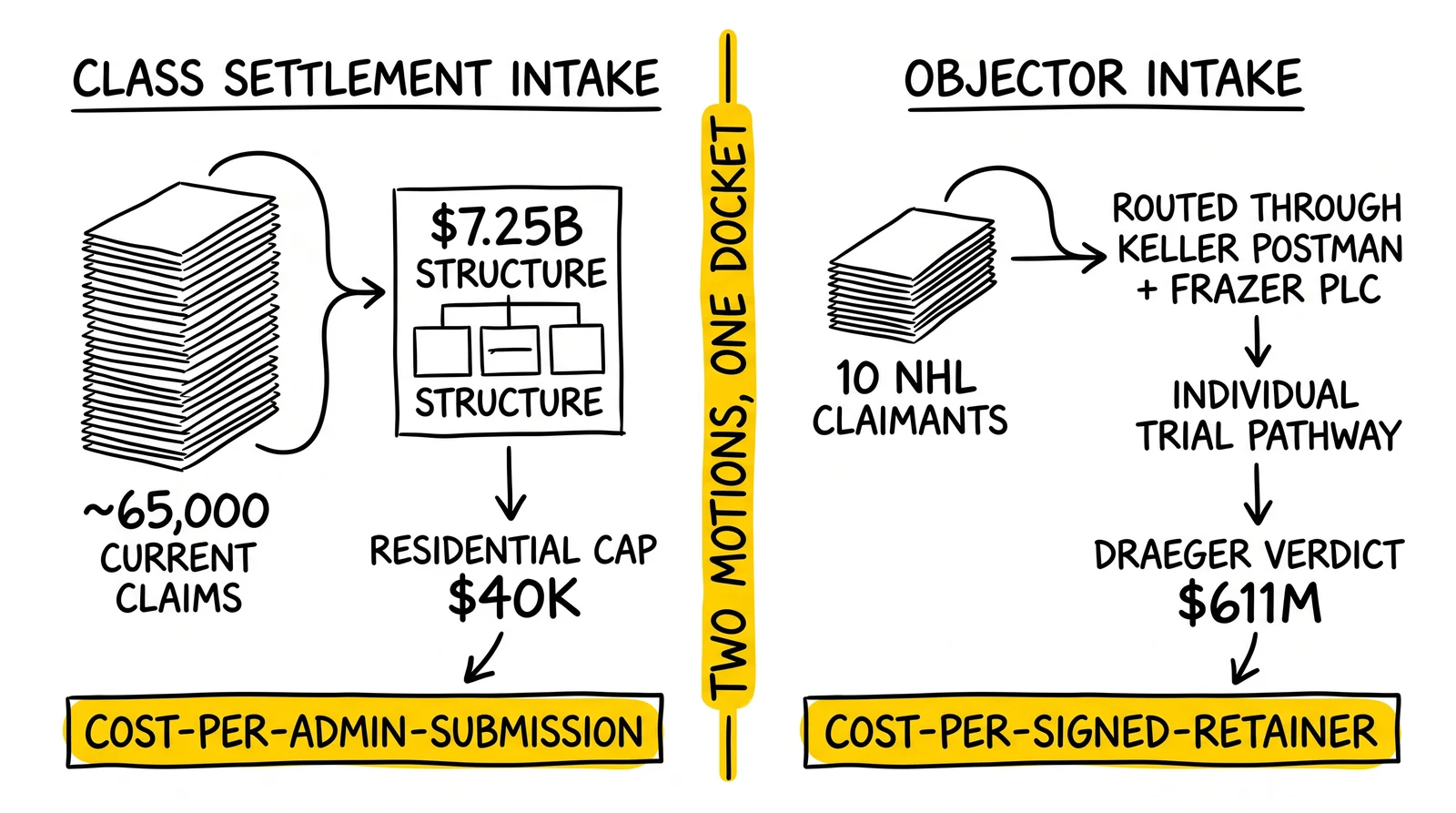
Keller Postman and Frazer PLC filed objector challenges on May 21, 2026 representing 10 non-Hodgkin lymphoma claimants. Their challenge focuses on the structural mechanics of the class settlement – the 17-21 year declining funding schedule, the cap structure that allocates approximately $40,000 to residential users, and the comparison to individual trial verdicts that plaintiffs have secured.
The comparison number that anchors the objector case is the Draeger/Gunther/Anderson verdict from Cole County, Missouri in November 2023. The original jury verdict reached $1.56 billion before appellate reduction to $611 million, affirmed by the Missouri Supreme Court on May 28, 2025 with subsequent denial of review in September 2025. The structural argument: individual residential users who pursue individual trial pathways have produced verdicts that orders-of-magnitude exceed the class structure's $40,000 cap for the same claimant profile.
The arbitrage that emerges from the objector challenge is the parallel acquisition market for opt-out clients. A mass-tort intake operator working on the class-settlement side captures clients into a $40,000-cap structure. An operator working on the objector side captures opt-out clients into individual-trial pathways with substantially larger per-claim verdict upside but longer resolution timelines and higher per-claim litigation cost. The two intake motions run in parallel during and after the sprint window.
Trade-press coverage occasionally names additional plaintiff firms – Wisner Baum, Beasley Allen, Wallace Miller, Andrus Wagstaff, Miller Firm – in connection with the settlement. As of the article publication date, only Keller Postman and Frazer PLC are confirmed objectors in court filings. Operators tracking the objector positions for media-buying purposes should track court-filed objections directly rather than relying on plaintiff-firm advertising for confirmation.
---
## The SCOTUS Binary Trigger – Monsanto v. Durnell
*Monsanto v. Durnell*, No. 24-1068 at the Supreme Court, was argued April 27, 2026 on the question of FIFRA preemption for state-law failure-to-warn claims against pesticide manufacturers. The decision is expected during the current 2026-2027 SCOTUS term.
The case structure makes the eventual ruling a binary CPL trigger for Roundup intake. A decision favoring Monsanto on preemption would establish that state-law failure-to-warn claims against pesticide manufacturers are precluded by FIFRA labeling requirements. The downstream consequence for Roundup litigation: future plaintiffs lose the dominant state-law pathway, the federal MDL inventory loses its principal claim theory, and per-claim leverage compresses. CPL for new Roundup intake collapses because the realistic case-value distribution shifts toward a settlement-tier outcome rather than an individual-trial-verdict outcome.
A decision against Monsanto on preemption would preserve the state-law pathway and validate the objector-side economic logic. The class settlement's $40,000 residential-user cap becomes more clearly suboptimal relative to the trial-verdict pathway, accelerating opt-out flow and pushing CPL for objector-side intake higher. The class settlement's enforceability through the fairness hearing on July 9 is the immediate question; the SCOTUS decision determines whether the post-fairness-hearing intake economics move toward consolidation or fragmentation.
The decision timing relative to the July 9 fairness hearing is operationally important. SCOTUS decisions in cases argued late in the April calendar typically issue between mid-May and late June. A pre-July 9 decision would inform the fairness hearing record. A post-July 9 decision would land into a settlement structure that has already received final approval, complicating any subsequent reopening of the class.
For mass-tort intake operators with pre-committed Roundup media, the article's analytical claim is that contingent budget commitments around the SCOTUS decision date are the missing variable in most media plans. Operators that priced sprint-window CPL between March 4 and June 4 without contingent commitment around the SCOTUS decision will face budget reallocation friction in the post-decision period. Operators that built contingent budget commitments captured the optionality.
---
## What the Sprint-Window CPL Actually Looked Like
The 90-day window between March 4 preliminary approval and June 4 opt-out closure produced a forced-march intake cycle that plaintiff firms operated against. Industry marketing-agency estimates indicate qualified Roundup CPL spiked into the $600 to $850 range during the sprint window. The numbers are vendor-attested by mass-tort marketing agencies and lead aggregators rather than authoritatively benchmarked by the FTC or ABA, and operators should cite the range as industry estimates rather than as verified benchmarks.
The spike pattern reflects the underlying intake economics. Plaintiff firms anticipating final settlement approval and the closure of the class to new claimants attempted to maximize intake pre-deadline. Pre-committed media budgets cleared at premium CPL because alternative pathways for capturing eligible claimants were closing. Operators without pre-committed budgets faced inventory turnover to faster-moving firms.
The post-deadline collapse follows the canonical mass-tort sprint pattern. Once the opt-out deadline closes, qualified-case CPL for the class-settlement pathway compresses sharply. The objector-side intake pathway continues at separate CPL economics, but the volume is structurally smaller – 10 confirmed objector NHL claimants versus the 65,000 class-settlement pool. The intake market bifurcates between high-volume low-per-case-revenue class-settlement work and low-volume higher-per-case-upside objector work.
For mass-tort operators planning future sprint windows in other dockets – Hair Relaxer MDL 3060, AFFF firefighting foam, Camp Lejeune Justice Act administrative claims, talc, hernia mesh – the Roundup sprint provides the canonical CPL-spike model. The 90-day acquisition window with spike-and-collapse curve is the recurring pattern. Operators that under-commit pre-deadline pay opportunity cost; operators that over-commit post-deadline pay direct cost. The discipline is sizing the sprint correctly against the docket's specific opt-out closure timing.
---
## The Class Counsel Economics and the 17-21 Year Tail
The $675 million class-counsel fee allocation within the $7.25 billion settlement reshapes plaintiff-firm cash flow on the 17-21 year tail. Christopher Seeger's leadership of class counsel positions his firm as the front-loaded beneficiary of the fee structure. The remaining firms participating in class-counsel allocation share the balance under the court-approved allocation methodology, with sub-allocations not yet finalized in the published settlement materials.
The cash-flow restructuring affects how plaintiff-firm intake operations price acquisition cost going forward. Front-loaded $675 million class-counsel revenue paired with declining per-year funding through the 17-21 year tail changes the discount-rate calculations that previously favored long-tail individual-trial work. The class structure's predictability reduces revenue variance at the firm level even as it caps per-case upside. Firms that participated in class-counsel allocation have substantially different revenue profiles in the 2026-2030 window than firms that elected not to participate.
The structural insight for mass-tort marketing operations is that cost-per-signed-retainer remains the volume-acquisition metric but loses some of its relevance against the new revenue distribution. Cost-per-claim-administrator-submission becomes the more directly economic metric for class-settlement-affiliated firms. The marginal cost of acquiring an additional claim-administrator submission is lower than the marginal cost of acquiring a signed retainer for individual-trial work, and the per-case revenue from administrator submission is correspondingly lower but more predictable.
Mass-tort marketing operations supporting both class-settlement firms and objector-side individual-trial firms now operate against fundamentally different economic models within the same docket. The article's [mass-tort lead-generation framework](https://www.leadgen-economy.com/blog/mass-tort-lead-generation-guide/) covers the broader vertical economics; the King v. Monsanto structure is a case study in how a single docket can produce two parallel acquisition markets that operators must distinguish in budget allocation.
One docket, two acquisition motions: $40K class-cap volume work versus objector-side individual-trial economics. Operations that don't segregate the motions internally face margin compression.
---
## What Operators Should Do Before the Fairness Hearing
The action surface against the July 9 fairness hearing and the eventual SCOTUS *Durnell* decision is concrete. Five operator considerations track.
First, evaluate whether the operation supports class-settlement-affiliated firms, objector-side individual-trial firms, or both. The two acquisition motions run against different CPL economics, different qualification criteria, and different downstream conversion rates. Operations that have not segregated the two motions internally will see margin compression as the post-fairness-hearing inventory turns over.
Second, model the SCOTUS *Durnell* decision as a binary CPL trigger. Pre-decision media plans should incorporate contingent budget commitments – either pull-forward acquisition before an expected favorable-to-Monsanto ruling, or hold acquisition for post-decision pricing if the ruling is expected to preserve the trial-verdict pathway. The exact decision-timing risk depends on the operator's view of the SCOTUS calendar.
Third, audit TCPA consent-capture infrastructure for mass-tort sprint windows specifically. The post-Eleventh-Circuit *Insurance Marketing Coalition v. FCC* environment allows multi-seller consent sharing across affiliated plaintiff firms, but the Sixth Circuit's [Dahdah v. Rocket Mortgage form-architecture standard](https://www.leadgen-economy.com/blog/dahdah-rocket-mortgage-click-consent-form-audit/) applies to the click-wrap design. Sprint-window intake spikes produce defensibility surface that should be audited before the next docket's sprint, not during it.
Fourth, develop intake infrastructure that scales for sprint windows. Mass-tort docket sprints produce 30-to-60-day intake spikes that overwhelm static call-center capacity. Cross-link to the [refi-wave operational analysis](https://www.leadgen-economy.com/blog/mba-april-refi-wave-lead-buyer-operations/) for the canonical sprint-staffing challenge under a different vertical. The mass-tort version follows the same pattern: pre-committed call-center capacity, qualified-handler scaling, and post-sprint capacity drawdown without permanent overhead build.
Fifth, track future sprint-window dockets. Hair Relaxer MDL 3060 closed fact discovery March 18, 2026 with Daubert motions due April 1. The Daubert-window outcome will determine whether the next major sprint window is the Hair Relaxer docket or a different MDL. Camp Lejeune Justice Act administrative claims continue accumulating, with DOJ disclosure of $907 million in offers and $723 million paid as of June 15, 2026 against approximately 407,000 Navy claims and only 13,000 documented to the three-document threshold. Operators positioned for the next sprint will outperform operators reacting to it.
---
## Key Takeaways
- Missouri 22nd Judicial Circuit (St. Louis) preliminarily approved $7.25 billion Roundup class settlement in King v. Monsanto, No. 2622-CC00325 on March 4, 2026 (written order March 9). Judge Timothy J. Boyer presiding.
- 65,000 current pending claims covered; payouts $6,000 to $165,000 per claimant by tier; 17-21 year declining funding caps; $500 million Bayer deposit within 10 days.
- $675 million class counsel fee; Christopher Seeger leading. The fee is allocated within the $7.25 billion total.
- Opt-out deadline closed June 4, 2026. Fairness hearing July 9, 2026. Federal remand by Judge Henry E. Autrey (E.D. Mo.) June 17, 2026 after objector removal attempt.
- Keller Postman and Frazer PLC filed objector challenges May 21, 2026 representing 10 NHL claimants. Other plaintiff firms named in trade press are not confirmed as court-filed objectors.
- SCOTUS Monsanto v. Durnell, No. 24-1068, argued April 27, 2026 on FIFRA preemption. Decision is binary CPL trigger for future Roundup intake economics.
- Industry marketing-agency estimates: qualified Roundup CPL spiked to $600-$850 range during March 4 to June 4 sprint window. Cite as industry estimates, not authoritative benchmarks.
- Bayer cumulative glyphosate reserve €11.8 billion ($13.9 billion) through Q1 2026, including €9.6 billion glyphosate-specific. Prior tranches: $10.9B (June 2020), $4.5B (July 2021), $1.37B (August 2025).
- Objector re-intake arbitrage creates parallel acquisition market: class settlement $40K cap vs. individual trial-verdict pathway. Draeger/Gunther/Anderson comparison verdict: $1.56B reduced to $611M.
- Operator action surface: distinguish class vs. objector acquisition motions, model SCOTUS decision as binary CPL trigger, audit TCPA consent infrastructure, develop sprint-window intake capacity, track future docket sprint windows.
---
## Sources
- [Bayer Q1 2026 Quarterly Statement – Legal Risks](https://reports.bayer.com/quarterly-statement-q1-2026/en/condensed-consolidated-interim-financial-information/legal-risks.html)
- [Bayer Press Release – Missouri Court Grants Preliminary Approval](https://www.bayer.com/media/en-us/missouri-court-grants-preliminary-approval-of-roundup-class-settlement-to-resolve-current-and-future-claims/)
- [Bayer Press Release – Federal Judge Remands Case to State Court (June 17, 2026)](https://www.bayer.com/media/en-us/federal-judge-remands-monsanto-class-settlement-case--back-to-missouri-state-court/)
- [King v. Monsanto Settlement Agreement PDF](https://www.classaction.org/media/king-et-al-v-monsanto-company-settlement-agreement.pdf)
- [JPML Pending MDL Dockets (January 5, 2026)](https://www.jpml.uscourts.gov/sites/jpml/files/Pending_MDL_Dockets_By_Actions_Pending-January-5-2026.pdf)
- [CourtListener – In re Roundup Products Liability Litigation MDL 2741](https://www.courtlistener.com/docket/4579168/in-re-roundup-products-liability-litigation/)
- [Monsanto v. Durnell – SCOTUS Docket No. 24-1068](https://www.supremecourt.gov/search.aspx?filename=/docket/docketfiles/html/public/24-1068.html)
- [Claims Journal – Bayer Wins Preliminary Approval (March 5, 2026)](https://www.claimsjournal.com/news/national/2026/03/05/336073.htm)
- [Claims Journal – Chhabria "Grave Concerns" (May 5, 2026)](https://www.claimsjournal.com/news/national/2026/05/05/337361.htm)