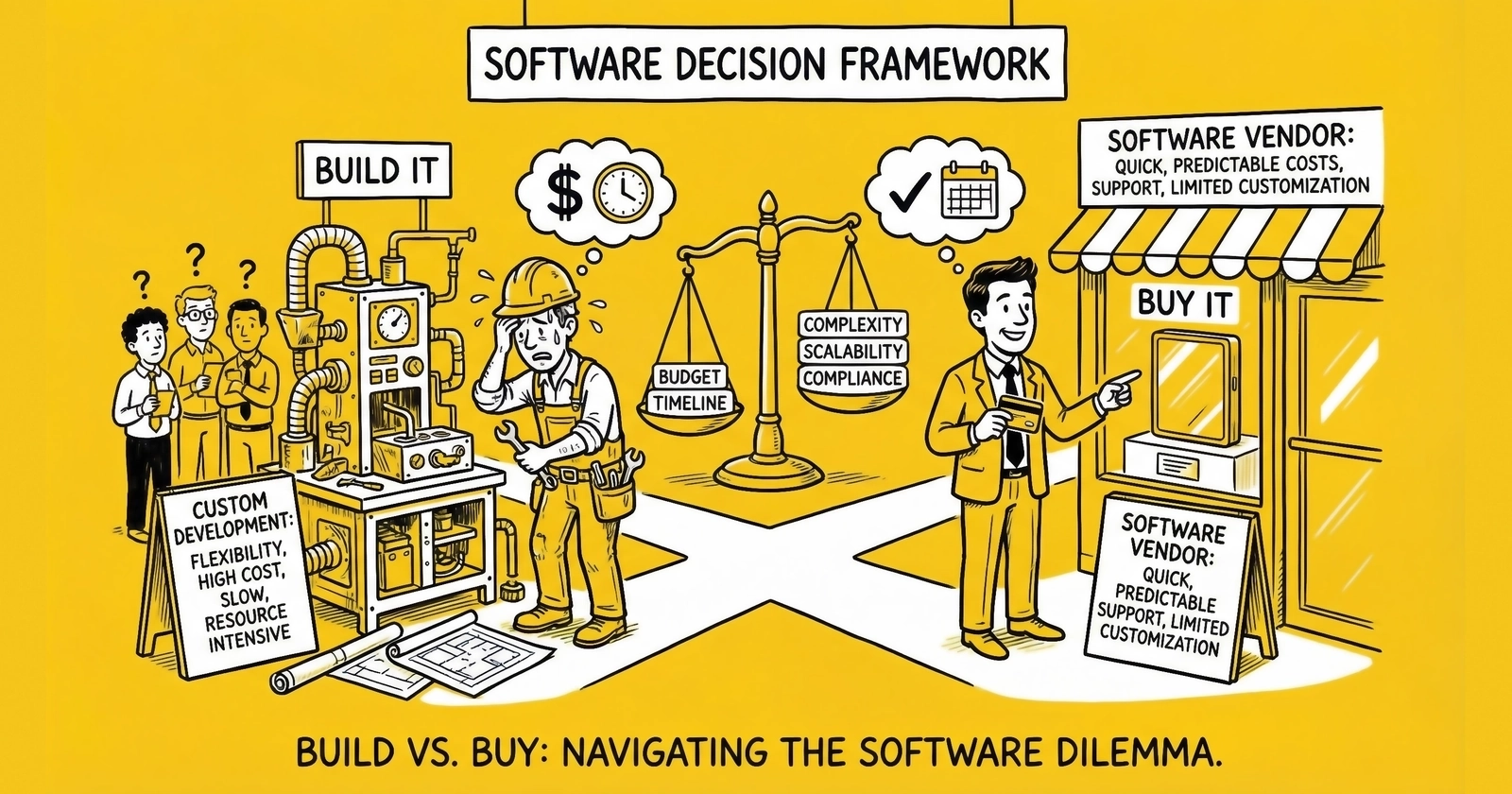
The platform decision that shapes every dollar flowing through your operation. Make the wrong choice and spend years fighting limitations that should have been features. Make the right choice and your infrastructure becomes invisible – scaling seamlessly while you focus on growing the business.
The question every growing lead generation operation eventually faces: should you build custom lead management software or buy an existing platform?
This is not a theoretical exercise. The decision you make will determine your operational ceiling for years. It will dictate how quickly you can onboard new buyers, how accurately you can route leads, how defensibly you can document consent, and whether your business can scale beyond your current capacity to manage it manually.
I have watched operators spend eighteen months building custom platforms, only to discover they’ve recreated – poorly – what a $1,500/month SaaS would have provided. I have also watched operators outgrow commercial platforms, hitting walls that no amount of configuration could solve, losing competitive advantage because their infrastructure couldn’t support capabilities their business model demanded.
Neither outcome is inevitable. Both result from failing to apply rigorous analysis to the build versus buy decision.
This guide provides the framework for making that decision correctly. We will examine the true costs of custom development versus commercial platforms, identify the specific circumstances where each approach makes strategic sense, and provide practical tools for evaluating your own situation. By the end, you will have the clarity to make a decision that serves your operation for years rather than months.
Understanding the Decision Landscape
Before diving into analysis, establish a clear understanding of what lead management software actually does. This isn’t about CRM – it’s about the specialized infrastructure that powers lead distribution operations.
What Lead Management Software Does
Lead management software in the distribution context handles several interconnected functions:
Lead Routing and Distribution. When a lead enters your system, the platform determines which buyer receives it based on configurable criteria: geography, lead type, price, buyer capacity, time of day, and dozens of other factors. Sophisticated platforms support multiple routing algorithms including price-based auctions, priority cascades, round-robin distribution, and weighted allocation.
Ping/Post Processing. The industry-standard protocol for real-time lead trading. A “ping” sends lead attributes to potential buyers asking “do you want this lead?” Buyers respond with bids. A “post” delivers the complete lead data to the winning buyer. Platforms differ dramatically in how efficiently they handle ping/post workflows, particularly at high volumes. Enterprise platforms process billions of pings annually. For a complete overview of this distribution model, see our ping-post systems guide.
Financial Management. Lead distribution generates complex financial flows: buying from sources, selling to buyers, managing returns, tracking margins, processing payments, reconciling accounts. Your platform should automate billing, manage buyer orders, track profitability by source and buyer, and handle the accounting complexity that scales with volume.
Compliance Documentation. TCPA litigation has reached unprecedented levels. Your platform must integrate with consent documentation services like TrustedForm and Jornaya, store certificates for years, and provide retrieval capabilities when compliance inquiries arise. Average TCPA settlements exceed $6.6 million – compliance infrastructure is not optional. See our TCPA compliance guide for complete requirements.
Reporting and Analytics. Understanding which sources, campaigns, and distribution paths generate profit versus loss requires sophisticated analytics. Real-time dashboards, drill-down diagnostic capabilities, historical trend analysis, and margin reporting all depend on your platform’s data architecture.
The Stakes of Getting This Wrong
The build versus buy decision carries consequences that compound over time.
Choose to build when you should have bought, and you face eighteen to thirty-six months of development before reaching feature parity with commercial alternatives. During that period, your developers are building lead routing logic instead of competitive differentiators. Your capital goes into infrastructure rather than growth. Your operation runs on immature software while competitors leverage platforms refined over two decades of production use.
Choose to buy when you should have built, and you face a different set of constraints. Your platform’s limitations become your operation’s limitations. Proprietary routing algorithms that create competitive advantage cannot be implemented. Scale economics that would transform your margins remain inaccessible. You pay perpetual licensing fees while competitors who invested in custom infrastructure capture that value permanently.
Neither mistake is fatal. But both cost years of operational effectiveness that cannot be recovered.
The True Cost of Building Custom Software
The appeal of building custom lead management software is straightforward: total control, no recurring licensing fees, exact fit to your requirements. The reality is considerably more complex.
Development Costs
Custom lead management software requires substantial engineering investment. A production-ready platform with core distribution, routing, delivery, and reporting capabilities typically requires:
Engineering Talent. A minimal development team includes two to three backend developers, one frontend developer, one DevOps engineer, and a technical architect for system design. Fully loaded costs for this team in North America range from $600,000 to $1.2 million annually, depending on location and seniority.
Offshore development reduces hourly rates but introduces coordination overhead, communication friction, and often quality variance. Blended models – senior architects domestically with development teams offshore – can reduce costs by 40-60% while maintaining quality, but require experienced management to execute effectively.
Development Timeline. A minimum viable product for lead distribution – basic routing, ping/post, delivery, and reporting – requires twelve to eighteen months of focused development. Feature parity with mature commercial platforms requires twenty-four to thirty-six months. Enterprise-grade reliability, compliance integration, and advanced analytics extend timelines further.
During this development period, you’re paying salaries without receiving production value. A $800,000 annual team cost over eighteen months represents $1.2 million invested before your first lead routes through custom infrastructure.
Technology Stack Costs. Beyond salaries, custom development requires:
- Cloud infrastructure during development: $3,000-15,000/month
- Development tools and environments: $1,000-5,000/month
- Third-party integrations and APIs: variable
- Security audits and penetration testing: $10,000-50,000 annually
Total Initial Investment. For a production-ready custom lead management platform, expect $1.5 million to $3 million in development costs before processing your first lead at scale.
Ongoing Maintenance Costs
Development costs are only the beginning. Custom software requires perpetual maintenance:
Bug Fixes and Updates. Software doesn’t stand still. Bug fixes, security patches, and performance optimizations require ongoing engineering attention. Budget 20-30% of initial development costs annually for maintenance.
Feature Development. The industry evolves. New compliance requirements emerge. Buyers demand new delivery formats. Competitors introduce capabilities you must match. Feature development for a custom platform never ends.
Infrastructure Operations. Someone must keep the servers running, manage databases, handle security updates, and respond to incidents. DevOps costs continue indefinitely.
Staff Turnover. Engineers leave. When the developer who built your routing logic joins a competitor, you lose institutional knowledge that cannot be fully documented. Rebuilding that knowledge base takes months. Turnover compounds custom development risk in ways commercial platforms avoid.
Annual Ongoing Costs. For a custom platform, budget $400,000 to $800,000 annually in maintenance, operations, and ongoing development after initial build is complete.
Hidden Costs Often Overlooked
Several cost categories escape initial planning but materialize inevitably:
Opportunity Cost. Every engineer working on infrastructure is not working on competitive differentiators. If your technology team could be building proprietary lead scoring algorithms, conversion optimization tools, or buyer-facing capabilities that drive revenue, infrastructure development represents a strategic diversion.
Time to Market. Eighteen months building custom infrastructure is eighteen months your competitors with commercial platforms spend scaling their operations. The revenue you could have generated during that period – but didn’t because your platform wasn’t ready – represents real cost.
Technical Debt. Custom software built under time pressure accumulates shortcuts that become future liabilities. The quick fix that got you launched becomes the architectural constraint that limits your scale. Technical debt compounds until it demands repayment through expensive refactoring.
Compliance Risk. Commercial platforms serving thousands of customers invest heavily in compliance infrastructure. They have dedicated compliance teams monitoring regulatory changes, updating consent capture mechanisms, and maintaining integration with services like TrustedForm and Jornaya. Custom platforms must replicate this investment or operate with elevated risk.
Integration Burden. Lead distribution requires integration with countless external systems: buyer CRMs, traffic sources, validation services, compliance tools, payment processors. Commercial platforms maintain these integrations across their customer base. Custom platforms maintain them alone. When a buyer’s CRM updates their API, you – not a vendor with a support team – must update your integration.
The True Cost of Buying Commercial Software
Commercial lead management platforms offer production-ready capabilities at subscription pricing. Understanding total cost of ownership requires looking beyond the headline subscription fee.
Subscription and Transaction Fees
Commercial platform pricing follows several models:
Fixed Monthly Subscription. Base platform fees ranging from $250/month for entry-level platforms to $3,000+/month for enterprise configurations. These fees typically include core platform access, some level of support, and basic features.
Volume-Based Pricing. Many platforms charge per-lead or per-ping fees that scale with your volume. At $0.001-$0.002 per ping and processing millions of pings monthly, transaction fees can exceed subscription costs.
Tiered Feature Access. Advanced capabilities – scenario optimization, parallel pinging, custom reporting, API access – may require higher subscription tiers or add-on fees.
Representative Annual Costs by Platform:
- Entry-level platforms (Lead Prosper, basic tiers): $3,000-15,000/year
- Mid-market platforms (LeadsPedia Premium, LeadExec): $18,000-36,000/year
- Enterprise platforms (boberdoo, Phonexa Enterprise): $36,000-100,000+/year including add-ons and transaction fees
Implementation and Onboarding Costs
Commercial doesn’t mean instant. Implementation requires investment:
Setup Fees. One-time onboarding fees range from $250 to $2,000+ depending on platform and configuration complexity.
Implementation Timeline. Basic implementations complete in two to four weeks. Complex multi-vertical operations with dozens of buyers require eight to sixteen weeks. Enterprise implementations may extend to six months.
Configuration Labor. Someone on your team must configure routing logic, set up buyer filters, establish delivery integrations, and build reports. This requires staff time even with a commercial platform.
Training Costs. Your team needs training on the new platform. Formal training sessions, documentation review, and the learning curve productivity loss all represent real costs.
Representative Implementation Costs: $10,000-75,000 depending on operation complexity, including staff time, consulting assistance, and setup fees.
Ongoing Platform Costs
Beyond subscription fees, commercial platforms carry ongoing costs:
Support Escalations. Standard support handles routine issues. Complex problems requiring priority attention may require premium support tiers or professional services engagement.
Custom Development. When platform capabilities don’t match requirements, you may need custom development from the vendor. Professional services rates range from $150-300/hour.
Integration Maintenance. While platforms maintain core integrations, custom buyer integrations still require your attention when buyer systems change.
Annual Ongoing Costs: Subscription plus 10-25% for support escalations, custom work, and integration maintenance.
Hidden Costs of Commercial Platforms
Commercial platforms carry hidden costs that offset some of their advantages:
Vendor Lock-In. Your lead data, buyer configurations, routing logic, and operational history live in the vendor’s system. Migrating to a different platform requires significant effort. This lock-in reduces your negotiating leverage over time.
Feature Limitations. Commercial platforms serve many customers. Features must work for broad use cases. Your specific routing logic, pricing model, or workflow may not fit neatly into available configurations.
Performance at Scale. Some platforms that perform well at moderate volumes struggle at enterprise scale. Discovering this limitation after you’ve built your operation on the platform creates painful migration decisions.
Dependency on Vendor Roadmap. When you need a feature the platform doesn’t provide, you’re dependent on vendor prioritization. If your need doesn’t align with their roadmap, you wait – or build workarounds.
The Decision Framework: When to Build
Custom development makes strategic sense under specific circumstances. The following criteria indicate when building may be the right choice.
You Have Genuine Competitive Advantage in Technology
If your routing algorithms, pricing logic, or lead optimization capabilities are genuinely proprietary and create competitive differentiation, implementing them on a commercial platform might require exposing intellectual property to vendors.
The key word is “genuine.” most practitioners overestimate the uniqueness of their technical requirements. Before concluding that commercial platforms cannot meet your needs, verify your requirements are actually unique rather than simply requiring deeper platform configuration expertise.
Questions to evaluate genuine technical differentiation:
- Would a competitor with the same commercial platform and your configuration logic have equivalent capabilities?
- Does your technical approach create measurable advantages in lead quality, margin, or scale that competitors cannot replicate?
- Would implementing your approach on a commercial platform expose trade secrets that create your competitive moat?
If you answer yes to these questions after rigorous analysis, custom development may preserve competitive advantage that commercial platforms cannot protect.
Your Scale Economics Justify Infrastructure Investment
At very high volumes, the economics shift. When you’re processing tens of millions of leads monthly, the infrastructure cost of commercial platforms can exceed the fully-loaded cost of custom infrastructure operated at scale.
Consider the math. A high-volume operation processing 50 million pings monthly at $0.001 per ping pays $50,000/month in transaction fees alone – $600,000 annually. A custom platform with similar capacity might cost $400,000 annually in engineering and infrastructure once built and stabilized. At that scale, build-versus-buy economics favor building.
But this threshold is higher than most practitioners realize. Commercial platforms achieve economies of scale that individual operators cannot match until volumes are substantial. The crossover point varies by platform, but typically requires enterprise-scale operations before custom infrastructure becomes economically competitive.
You Have Strong Engineering Leadership with Domain Expertise
Successful custom lead distribution platforms require engineering teams who understand both software development and lead distribution operations. Pure software expertise is insufficient – the engineers must understand ping/post mechanics, buyer economics, compliance requirements, and the operational realities of lead distribution.
This combination is rare. Most engineering teams lack domain expertise. Most domain experts lack engineering skills. Building custom infrastructure without this combination leads to platforms that work technically but fail operationally.
Evaluate your team honestly:
- Do you have engineering leadership with direct experience building lead distribution systems?
- Does your technical team understand TCPA compliance, consent documentation, and regulatory requirements?
- Can your engineers translate business requirements into scalable technical architecture?
If you cannot answer yes to all three questions, custom development carries elevated risk that vendor partnership might mitigate.
You Can Tolerate Extended Development Timeline
Custom platform development requires eighteen to thirty-six months to reach feature parity with commercial alternatives. During this period, you’re operating on incomplete infrastructure.
Some operations can tolerate this timeline:
- Established operations with existing infrastructure that can continue operating during development
- Well-capitalized operations that can fund development without immediate ROI pressure
- Operations where the competitive advantage of custom capabilities justifies delayed market entry
Operations that cannot tolerate extended timelines – startups needing rapid market entry, cash-constrained operations needing immediate revenue, businesses facing competitive pressure that demands quick response – should default to commercial platforms that provide immediate capability.
The Decision Framework: When to Buy
For most practitioners, commercial platforms represent the better choice. The following circumstances indicate when buying makes strategic sense.
Speed to Market Matters
Commercial platforms provide production-ready capabilities immediately. Implementation in weeks rather than years enables:
- Faster market entry to capture emerging opportunities
- Immediate revenue generation rather than delayed while building infrastructure
- Quick response to competitive pressure or market changes
When timing matters, commercial platforms’ speed advantage outweighs custom development’s flexibility advantage.
You Need Proven Reliability
Lead distribution platforms handle time-sensitive, high-value transactions. System downtime costs real money. Commercial platforms offer:
Production Track Record. Mature platforms have processed billions of leads, encountering and solving edge cases that custom implementations must discover through painful experience.
Uptime Guarantees. Enterprise platforms offer 99.99% uptime guarantees backed by operational infrastructure and incident response teams.
Disaster Recovery. Commercial platforms invest in redundancy, backup systems, and disaster recovery that individual operators cannot economically replicate.
When your revenue depends on platform reliability, commercial platforms’ operational maturity provides insurance custom builds cannot match.
You Lack Engineering Resources
Custom platform development requires sustained engineering investment. If you cannot hire, retain, and manage a qualified engineering team, custom development is not viable.
Commercial platforms serve operators without technical staff:
- Configuration-based setup requires operational knowledge, not programming skills
- Vendor support handles technical issues
- Platform upgrades happen automatically
Operations without dedicated engineering resources should default to commercial platforms that translate their limitations into operational capability.
The Total Cost Favors Commercial
When honestly accounting for all costs – development, maintenance, opportunity cost, risk – commercial platforms often cost less than custom development, especially at moderate volumes.
A representative comparison:
Custom Build:
- Initial development: $1.5-3M
- Annual maintenance: $400-800K
- Opportunity cost of engineering: variable but substantial
- Five-year total: $3.5-7M+
Commercial Platform (Enterprise Tier):
- Annual subscription and fees: $50-100K
- Implementation: $25-75K
- Ongoing customization: $25-50K/year
- Five-year total: $400-700K
The commercial option costs 10-20% of the custom build in this comparison. Your specific numbers will vary, but the directional difference often surprises operators who haven’t conducted rigorous analysis.
Hybrid Approaches: The Best of Both Worlds
The build versus buy choice is not always binary. Hybrid approaches can capture benefits of both strategies while mitigating their respective weaknesses.
Commercial Platform Plus Custom Components
The most common hybrid approach: license a commercial platform for core distribution infrastructure, then build custom tools for specific capabilities where you have unique requirements.
This approach accepts the platform’s limitations in areas where customization isn’t essential while maintaining flexibility where it matters. Examples:
Custom Analytics Layer. Use commercial distribution for routing and delivery while building proprietary analytics that provide insights beyond platform-native reporting.
Custom Buyer Interface. Accept platform routing logic while building differentiated buyer-facing portals that improve the buyer experience beyond what the platform provides.
Custom Optimization Algorithms. Route leads through commercial infrastructure while running proprietary algorithms that influence routing decisions via the platform’s API.
The key to successful hybrid approaches is clear boundaries. Define precisely what the commercial platform handles versus what custom components handle. Avoid building custom functionality that duplicates platform capabilities – that creates maintenance burden without value.
API-First Platform Selection
Platforms with robust APIs enable more ambitious hybrid strategies. When evaluating commercial platforms for hybrid deployment, assess:
API Completeness. Can you access all platform data and functionality through the API? Partial APIs limit hybrid flexibility.
Webhook Depth. What events trigger webhooks? Deep webhook coverage enables custom components to respond to platform events in real-time.
Performance at Scale. Can the API handle your transaction volume without rate limiting or degraded performance?
Platforms like boberdoo (50+ webhooks, extensive API coverage) enable hybrid architectures that simpler platforms cannot support.
Middleware Layer Strategy
For operations outgrowing commercial platforms but not ready for fully custom infrastructure, middleware provides a transitional approach.
Middleware layers – like ActiveProspect’s LeadConduit – sit between lead sources and distribution platforms, handling validation, enhancement, compliance checks, and routing logic before forwarding to distribution. This architecture enables:
- Custom logic in the middleware layer
- Platform-agnostic capabilities that survive platform migration
- Gradual transition of functionality from platform to custom components
Middleware increases system complexity and cost but provides flexibility that pure platform approaches cannot match.
Evaluating Your Specific Situation
With the framework established, apply it to your specific circumstances through structured analysis.
Volume and Growth Assessment
Current volume and growth trajectory influence optimal architecture:
Under 10,000 leads monthly: Commercial platforms, likely entry-level tiers. Custom development economics don’t work at this scale.
10,000-100,000 leads monthly: Commercial platforms, mid-market to enterprise tiers. Hybrid approaches become viable for specific capabilities.
100,000-1,000,000 leads monthly: Enterprise commercial platforms or hybrid approaches. Custom development becomes economically viable for operations with strong engineering resources.
Over 1,000,000 leads monthly: Economics may favor custom infrastructure for operations with engineering capability. Hybrid approaches at minimum; full custom development for operations with demonstrated technical leadership.
Engineering Capability Assessment
Honest assessment of your technical resources shapes viable options:
No dedicated engineering: Commercial platforms only. Build capability does not exist.
Small engineering team (1-5 developers): Commercial platforms with possible custom integrations. Team cannot sustain full platform development while maintaining existing responsibilities.
Moderate engineering team (5-15 developers): Hybrid approaches viable. Team can build custom components while commercial platform handles core distribution.
Strong engineering organization (15+ developers with domain expertise): Full custom development viable if strategic analysis supports it. Hybrid or commercial still potentially optimal depending on priorities.
Capital and Timeline Constraints
Available capital and timeline requirements constrain options:
Limited capital, urgent timeline: Commercial platforms. No other option is viable.
Moderate capital, flexible timeline: Commercial or hybrid approaches. Custom development possible for patient, well-capitalized operations.
Strong capital, long-term view: All options viable. Decision should be based on strategic analysis rather than constraints.
Strategic Priority Assessment
What does your business actually need technology to accomplish?
Competitive advantage through technology: If technology creates differentiation, custom development may protect that advantage.
Operational excellence through proven systems: If reliability and efficiency matter more than technical differentiation, commercial platforms’ maturity is valuable.
Flexibility for unknown future requirements: If future requirements are uncertain, commercial platforms’ vendor-maintained evolution may handle changes you cannot predict.
Making the Final Decision
After completing analysis, synthesize findings into a clear decision.
Decision Matrix Approach
Score each option against weighted criteria:
| Criterion | Weight | Build Score | Buy Score |
|---|---|---|---|
| Time to market | [1-5] | [1-5] | [1-5] |
| Total 5-year cost | [1-5] | [1-5] | [1-5] |
| Customization flexibility | [1-5] | [1-5] | [1-5] |
| Reliability/risk | [1-5] | [1-5] | [1-5] |
| Engineering resource fit | [1-5] | [1-5] | [1-5] |
| Competitive advantage protection | [1-5] | [1-5] | [1-5] |
| Integration burden | [1-5] | [1-5] | [1-5] |
Weight criteria according to your strategic priorities. Calculate weighted scores for each option. The option with the higher weighted score – assuming honest scoring – likely represents your better choice.
Common Decision Patterns
Certain patterns emerge from rigorous analysis:
Pattern: Early-Stage Operation
- Limited capital, urgent revenue need, small team
- Decision: Commercial platform
- Get operational quickly, focus resources on growth rather than infrastructure
Pattern: Growing Mid-Market Operation
- Established revenue, some engineering capability, specific customization needs
- Decision: Commercial platform with custom components (hybrid)
- Core distribution via platform, custom capabilities where differentiated
Pattern: Enterprise Operation with Technical Leadership
- Strong engineering organization, proprietary technical advantages, scale economics favor custom
- Decision: Custom development or deep hybrid
- Protect competitive advantage while accepting longer development timeline
Pattern: Rapid Scaling Operation
- Fast growth, need to onboard buyers quickly, can’t wait for custom development
- Decision: Commercial platform (enterprise tier)
- Accept platform limitations in exchange for immediate capability
Reversibility Consideration
Not all decisions are permanent. Consider reversibility:
Commercial to Custom: Relatively straightforward migration path. Operations data export from commercial platform, build custom, migrate. Time-intensive but technically feasible.
Custom to Commercial: More challenging. Custom integrations, proprietary logic, and operational patterns must adapt to platform constraints. Often requires significant reconfiguration.
The asymmetric reversibility suggests defaulting to commercial platforms when uncertain – you can always build later if analysis changes.
Implementation Planning
Once you’ve made the decision, implementation requires careful planning.
If You Chose to Build
Custom development success requires:
Hire or Partner Strategically. If you lack internal domain expertise, partner with consultants or agencies who have built lead distribution platforms. Don’t expect general software developers to understand ping/post mechanics and compliance requirements without guidance.
Start with Core Capabilities. Build the minimum viable platform first: basic routing, essential delivery methods, fundamental reporting. Validate that your architecture works before building advanced features.
Plan for Parallel Operation. Run your custom platform alongside existing infrastructure (whether manual processes or commercial platforms) until you’ve verified production performance. Don’t cut over to untested systems under production load.
Budget for Iteration. Your first version will require significant revision. Budget 40-60% more time and resources than initial estimates suggest. Custom development always takes longer than planned.
If You Chose to Buy
Commercial platform success requires:
Rigorous Vendor Evaluation. Request demonstrations tailored to your specific use cases. Talk to reference customers with similar business models and scale. Evaluate total cost of ownership, not just headline pricing.
Proof-of-Concept Before Commitment. Conduct POC implementation testing critical integrations and workflows before signing long-term contracts. What works in demos may not work in your specific operational context.
Plan for Training and Adoption. Platform capabilities are worthless if your team cannot use them. Budget time and resources for comprehensive training before going live.
Document Configuration Decisions. As you configure the platform, document why you made each decision. When requirements change or team members turn over, this documentation prevents rediscovering solutions you’ve already found.
If You Chose Hybrid
Hybrid approaches require the most careful planning:
Define Clear Boundaries. Explicitly document which capabilities the platform handles versus which custom components handle. Overlap creates maintenance burden and potential conflicts.
Design Integration Architecture. Custom components must integrate with the commercial platform. Design these integrations for reliability and maintainability before building.
Plan for Evolution. Hybrid architectures evolve. Define criteria for when functionality should migrate from platform to custom components (or vice versa). Build with evolution in mind.
Frequently Asked Questions
What is the average cost to build custom lead management software?
The average cost to build production-ready custom lead management software ranges from $1.5 million to $3 million for initial development, with ongoing maintenance costs of $400,000 to $800,000 annually. These figures assume a competent engineering team with domain expertise, development timelines of eighteen to thirty-six months, and enterprise-grade reliability requirements. Costs can be reduced through offshore development or by building minimal functionality, but these approaches often result in platforms that lack production-grade capability or require significant rework. Most operations underestimate total development costs by 40-60% in initial planning.
How long does it take to build a lead distribution platform?
Building a production-ready lead distribution platform typically requires twelve to eighteen months for a minimum viable product with basic routing, ping/post, delivery, and reporting capabilities. Feature parity with mature commercial platforms requires twenty-four to thirty-six months. Enterprise-grade reliability, comprehensive compliance integration, and advanced analytics extend timelines further. These estimates assume adequate engineering resources and clear requirements. Scope creep, team turnover, and technical challenges frequently extend actual timelines beyond initial projections.
Which commercial lead management platforms are best for lead distribution?
The leading commercial lead management platforms for lead distribution include boberdoo (best for high-volume financial engineering with scenario optimization and approximately 85 standard reports), LeadsPedia (best for hybrid affiliate and lead distribution operations with unified tracking), Phonexa (best for multi-channel operations with strong call routing), and LeadExec (best for mid-market operations with comprehensive delivery options). Platform selection should match your specific business model, volume, and technical requirements rather than following generic recommendations. An aggregator processing millions of pings monthly has different requirements than a boutique generator in a single vertical.
When does custom development make financial sense?
Custom development makes financial sense when three conditions align: you have proprietary technical capabilities that create genuine competitive advantage, your volume scale creates economics where custom infrastructure costs less than perpetual licensing fees, and you have engineering leadership with domain expertise to execute effectively. For most operations, the crossover point where custom development becomes economically competitive requires processing tens of millions of leads monthly. Operations below this scale typically find commercial platforms more economical when accounting for all costs including development, maintenance, opportunity cost, and risk.
Can I migrate from a commercial platform to custom software later?
Yes, migration from commercial platforms to custom software is technically feasible, though time-intensive. The migration process involves exporting operational data and configurations from your commercial platform, building custom infrastructure that replicates required capabilities, establishing parallel operation to validate custom platform performance, and gradually transitioning production traffic. Plan for three to six months of parallel operation minimum. The asymmetric reversibility of this decision – commercial to custom being easier than custom to commercial – suggests defaulting to commercial platforms when uncertain, since building custom infrastructure later remains an option.
How do commercial platform costs compare over five years?
Five-year total cost of ownership for commercial platforms typically ranges from $200,000 to $700,000 for enterprise-tier platforms including subscription fees, implementation, customization, and ongoing support. This compares to $3.5 million to $7 million for custom development over the same period when accounting for initial build, ongoing maintenance, and opportunity costs. These figures vary significantly based on volume, platform selection, and operational complexity. Operations at very high volumes – processing tens of millions of leads monthly – may find commercial platform fees exceeding custom infrastructure costs, shifting the economics toward building.
What are the risks of building custom lead management software?
Key risks of custom development include: development timeline extension (projects typically take 40-60% longer than initially estimated), engineering talent dependency (losing key developers can cripple ongoing development), technical debt accumulation (shortcuts taken under deadline pressure become future constraints), compliance gaps (custom platforms must independently maintain regulatory compliance without vendor support), and opportunity cost (engineers building infrastructure are not building competitive differentiators). These risks compound over time. Operations that cannot absorb extended development timelines, talent turnover, or compliance challenges should default to commercial platforms where vendor organizations absorb these risks.
Should I consider hybrid approaches combining commercial and custom?
Hybrid approaches – using commercial platforms for core distribution while building custom components for specific capabilities – offer flexibility that pure approaches cannot match. Consider hybrid when you have specific customization needs that commercial platforms cannot address, engineering resources sufficient for targeted development but not full platform builds, and clear boundaries between platform and custom capabilities. Successful hybrid implementations require careful architecture to avoid redundancy and ensure reliable integration between commercial and custom components. The added complexity of hybrid approaches is justified when customization needs are genuine and specific.
How do I evaluate if a commercial platform can meet my needs?
Effective platform evaluation requires documenting specific operational requirements before reviewing platforms, requesting demonstrations tailored to your use cases rather than generic capability overviews, conducting proof-of-concept testing with real integrations and production-like volume, speaking with reference customers operating at similar scale and business model, calculating total cost of ownership including implementation and ongoing customization, and assessing vendor stability and product roadmap trajectory. Many practitioners discover that requirements they believed unique are actually addressed by deeper platform configuration rather than custom development.
What compliance capabilities should I prioritize in platform selection?
Essential compliance capabilities include native integration with consent documentation services like TrustedForm and Jornaya, support for certificate storage and retrieval throughout required retention periods, real-time consent verification capabilities (such as TrustedForm Verify), DNC and litigator scrubbing service integration, and audit trail functionality for compliance defense. TCPA litigation has reached unprecedented levels with settlements averaging over $6.6 million. Platforms without robust compliance infrastructure expose your operation to regulatory risk that no feature advantage can offset.
Key Takeaways
-
Custom development costs $1.5-3 million for initial build plus $400-800K annually in maintenance. Commercial platforms cost $3,000-100,000 annually depending on tier and volume. The five-year cost differential often favors commercial by 10-20x.
-
Build custom only when three conditions align: proprietary technical capabilities that create genuine competitive advantage, volume scale where custom infrastructure is economically competitive, and engineering leadership with domain expertise to execute effectively.
-
Speed to market matters. Commercial platforms provide production-ready capability in weeks. Custom development requires eighteen to thirty-six months. When timing matters, this difference is determinative.
-
Hybrid approaches offer flexibility. Commercial platform for core distribution plus custom components for differentiated capabilities captures benefits of both approaches while mitigating their weaknesses.
-
Default to commercial when uncertain. The asymmetric reversibility of this decision – commercial to custom being easier than custom to commercial – suggests commercial platforms as the lower-risk default.
-
Total cost of ownership, not headline pricing. Evaluate all costs including implementation, maintenance, opportunity cost, and risk. Custom development often costs 10x commercial when honestly accounting for all factors.
-
Compliance infrastructure is non-negotiable. Whether building or buying, robust compliance capabilities for consent documentation, DNC scrubbing, and audit trails are essential given the current regulatory environment.
-
Platform selection is an operational decision, not a software decision. Match platform capabilities to your business model, volume, technical capacity, and strategic priorities rather than comparing feature lists.
Sources
- boberdoo - Enterprise lead distribution platform with scenario optimization, 50+ webhooks, and comprehensive API coverage for hybrid architectures
- LeadsPedia - Hybrid affiliate and lead distribution platform with unified tracking capabilities
- Phonexa - Multi-channel marketing automation platform with strong call tracking and routing features
- LeadExec - Scalable, automated lead capture, validation, routing, and distribution platform
- ActiveProspect LeadConduit - Middleware platform for lead validation, enhancement, and routing between sources and distribution systems
- ActiveProspect TrustedForm - Independent consent documentation and verification service for TCPA compliance
- Investopedia: Total Cost of Ownership - Framework for calculating comprehensive costs beyond initial purchase price
This guide reflects the lead management software landscape as of late 2025. Platform pricing, features, and market positions evolve continuously. Conduct current research before making final decisions.