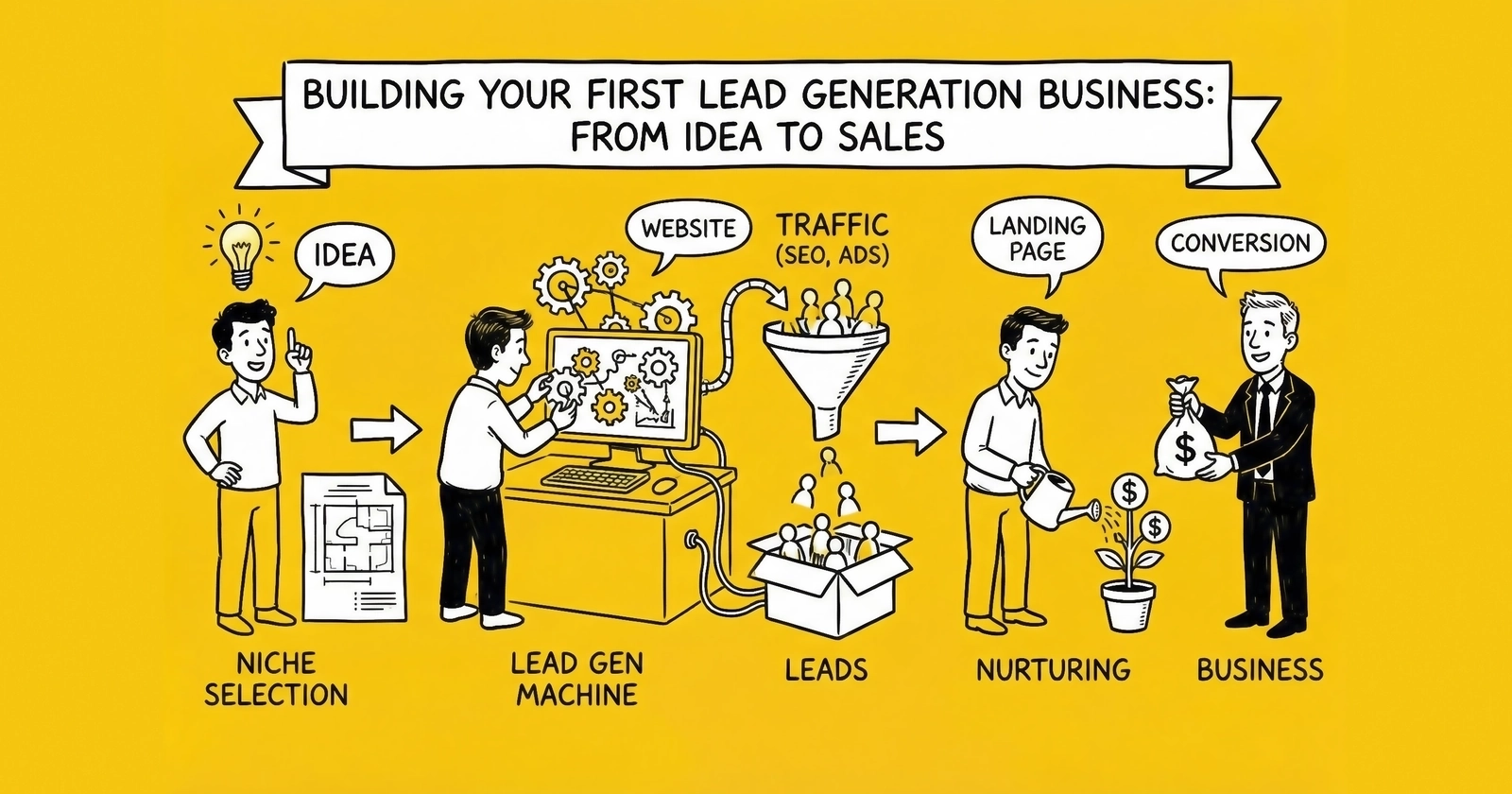
The exact sequence from zero to profitable. Capital requirements, timeline expectations, and the mistakes that kill 80% of newcomers before month six.
Most lead generation businesses fail. Not because the operators lack intelligence or work ethic. They fail because they built traffic before they had buyers. They launched landing pages before establishing compliance infrastructure. They spent money before understanding unit economics.
The lead economy offers legitimate opportunity. More than 21,000 lead generation businesses operate in the United States, competing in a $5-10 billion market projected to reach $15-32 billion by 2035. Success requires realistic expectations about capital, timeline, and the specific sequence of decisions that separates profitable operations from expensive lessons. For industry context, see our guide on what is lead generation.
This guide provides the complete roadmap from concept to revenue, including the capital requirements most guides conveniently omit, the vertical selection framework that prevents costly pivots, and the 90-day timeline that shows what your bank account will actually experience.
Choosing Your Entry Model: The First Critical Decision
Your entry model determines everything else: capital requirements, timeline to profit, risk profile, and operational complexity. Three models dominate the industry, each with distinct economics.
Q: What Are the Three Lead Generation Business Models?
The Affiliate Model represents the lowest-barrier entry point. Affiliates generate leads and sell them to networks or aggregators who handle buyer relationships. You focus purely on traffic acquisition and conversion optimization. Someone else worries about distribution, payment collection, and buyer management.
Capital requirement: $5,000-10,000 minimum, $25,000 recommended. The gap between minimum and recommended reflects the difference between barely surviving the learning curve and having enough runway to optimize your way to profitability.
Timeline to profit: 3-6 months. Most affiliates lose money for the first 60-90 days while testing traffic sources and landing pages. Profitability emerges as you identify winning campaigns and cut losers.
The Direct Publisher Model means generating leads and selling directly to end buyers. You build relationships with insurance agents, loan officers, or service providers who consume your leads. Higher margins than affiliate, but requires sales skills and buyer management capabilities.
Capital requirement: $25,000-50,000 minimum, $100,000 recommended. The additional capital covers buyer development time, working capital for payment timing gaps, and runway for testing multiple buyer relationships.
Timeline to profit: 6-12 months. Building direct buyer relationships takes longer than plugging into an existing network. Each buyer requires negotiation, integration, and ongoing relationship management.
The Broker Model involves buying leads from publishers and reselling to buyers. You’re a matchmaker and risk manager, operating a marketplace that connects supply and demand. The highest margins but also the highest capital and operational requirements.
Capital requirement: $100,000-250,000 minimum, $500,000 recommended. The primary capital driver is float: you pay publishers within 7-15 days, but buyers pay you Net-30 to Net-45. That 30-day gap multiplied by monthly volume equals substantial working capital requirements.
Timeline to profit: 12-18 months. Building both supply and demand sides of a marketplace takes time. Each side waits for the other to develop before committing volume.
Capital Requirements Table: Entry Model Comparison
| Model | Minimum Capital | Recommended Capital | Time to Profit | Primary Risk |
|---|---|---|---|---|
| Affiliate | $5,000-10,000 | $25,000 | 3-6 months | Traffic costs |
| Publisher | $25,000-50,000 | $100,000 | 6-12 months | Buyer concentration |
| Broker | $100,000-250,000 | $500,000 | 12-18 months | Cash flow timing |
Q: Which Entry Model Should I Choose?
Choose affiliate if you have limited capital, strong paid traffic skills, and no existing buyer relationships. The network handles distribution complexity while you focus on what you can control: generating quality leads efficiently.
Choose publisher if you have moderate capital, sales skills to build buyer relationships, and patience for a longer development timeline. Direct buyer relationships eventually command better economics than network intermediaries.
Choose broker if you have substantial capital, operational management experience, and relationships on both supply and demand sides. This model builds enterprise value but requires the longest runway.
Selecting Your Vertical: Start With One, Not Five
The second critical decision is vertical selection. Newcomers commonly attempt multiple verticals simultaneously to “diversify risk.” This strategy produces the opposite result: spreading thin resources across multiple learning curves guarantees mediocrity in all of them.
Q: What Are the Major Lead Generation Verticals?
Insurance represents the largest vertical. Auto, home, Medicare, and life insurance lead generation generates billions annually. MediaAlpha alone processed over $1.5 billion in insurance lead transaction value in 2024. The market is mature with established pricing benchmarks, proven traffic sources, and sophisticated buyers.
CPL range: $25-150 for auto, $40-80 for Medicare, varying significantly by state and demographics.
Mortgage and Financial Services fluctuates with interest rates. When rates drop, refinance demand surges and CPLs rise with competition. When rates rise, purchase demand dominates with different economics. Highly regulated with licensing requirements that vary by state.
CPL range: $50-200+ depending on loan type, credit quality, and rate environment.
Solar offers geographic arbitrage opportunities. A lead in California, Texas, or Florida commands premiums based on installer density and state incentive programs. A lead in a state with unfavorable solar economics has minimal value.
CPL range: $75-300 depending on location and homeownership verification.
Legal commands the highest CPLs reflecting high case values. Personal injury leads routinely sell for $200-500+, with mass tort leads exceeding $1,000. Compliance requirements are strict, and buyer relationships are concentrated.
CPL range: $100-3,000+ depending on practice area and case type.
Home Services covers HVAC, roofing, plumbing, and similar local services. Lower CPLs but higher volume potential. Seasonality affects demand: HVAC leads surge during temperature extremes.
CPL range: $40-150 depending on service type and geography.
Q: How Do I Choose the Right Vertical for My First Business?
Evaluate four factors:
Market size and demand stability. Insurance provides consistent demand with minimal seasonality. Mortgage fluctuates dramatically with rate movements. Solar depends on policy incentives that change with administrations. Choose a vertical where demand exists regardless of external conditions.
Compliance complexity. Medicare leads require navigating CMS regulations in addition to TCPA. Legal leads require understanding bar association rules. Home services leads have simpler compliance profiles. If you’re starting with limited compliance infrastructure, begin with a lower-complexity vertical.
Traffic acquisition difficulty. Legal keywords cost $50+ per click. Auto insurance keywords cost $15-30. Home services keywords cost $5-15. Your capital allocation must match traffic costs in your chosen vertical.
Your existing knowledge. If you’ve worked in mortgage lending, you understand buyer needs and qualification criteria in that vertical. Relevant experience shortens the learning curve and improves buyer credibility.
For most newcomers, auto insurance or home services provides the best combination of market size, accessible traffic costs, moderate compliance complexity, and buyer availability.
Building Your First Landing Page
Your landing page is the conversion engine where traffic becomes leads. Every element affects conversion rate, which directly determines unit economics.
Q: What Makes a High-Converting Lead Generation Landing Page?
Single clear offer. The page does one thing: capture consumer information for a specific product or service. No navigation menus. No competing calls to action. One path: complete the form.
Headline that states the benefit. Not features, not company credentials. What does the consumer get? “Compare Auto Insurance Quotes in Minutes” outperforms “Leading Insurance Comparison Platform” because it describes consumer benefit, not company identity.
Trust elements above the fold. Partner logos, security badges, review ratings, and “As Seen On” media mentions reduce form abandonment. Consumers need reasons to trust an unfamiliar website with personal information.
Form design that balances quantity and quality. More fields improve lead quality but reduce conversion rate. Start with essential fields: name, email, phone, and 2-3 qualifying questions. A 10-field form might produce higher-quality leads, but a 4-field form will generate more volume. Test to find the optimal balance for your vertical and buyer requirements.
Mobile-first design. More than half of consumer traffic originates from mobile devices. Forms that work on desktop but fail on mobile sacrifice half your potential conversions.
Q: What Compliance Elements Must Every Landing Page Include?
TCPA disclosure language. Consumers must see and acknowledge consent before submitting their information. The disclosure explains who may contact them, by what methods, and that they’re authorizing automated marketing communications. Have an attorney review this language before launch.
Privacy policy link. Accessible from the form page, explaining how consumer data is collected, used, and shared.
Consent checkbox or clear submission action. The FCC requires affirmative consent, not pre-checked boxes. Consumers must take an action demonstrating they agree to be contacted.
TrustedForm or Jornaya integration. These services capture independent documentation of the consent experience: what the consumer saw, when they submitted, and exactly what disclosure language was visible. This documentation becomes essential if consent is ever challenged.
Q: How Long Should My Landing Page Form Be?
Start with 4-6 fields:
- First name
- Last name
- Phone number
- Email address
- 1-2 qualifying questions specific to your vertical
This captures essential information while maintaining conversion rates typically between 5-12% depending on traffic source and vertical.
Add fields only after establishing baseline metrics. Each additional field reduces conversion rate by 5-15%. The math must work: if adding a field drops conversion from 8% to 7% but improves lead value by 20%, the trade-off is profitable.
Setting Up Tracking and Analytics
Without tracking, you’re operating blind. Every decision requires data: which traffic sources produce quality, which landing pages convert, which buyers accept your leads.
Q: What Tracking Infrastructure Do I Need From Day One?
Conversion pixel on thank-you page. Every completed form submission triggers a pixel that records the conversion back to its traffic source. Google Ads, Meta Ads, and other platforms require this pixel to optimize delivery.
UTM parameters on all traffic. Structure URLs to capture source, medium, campaign, ad group, and creative.
Lead-level attribution. Assign unique identifiers to each lead that travel through your system. When a buyer returns a lead as poor quality, trace it back to the specific traffic source and creative.
Server-side tracking. Browser-based tracking faces increasing limitations from privacy restrictions and ad blockers. Server-side implementations recover 15-35% of conversion data lost to browser restrictions.
Q: What Metrics Should I Track Daily?
Traffic metrics: Cost per click (CPC), click-through rate (CTR), traffic volume by source.
Conversion metrics: Landing page conversion rate, form start vs. completion rate, cost per lead (CPL).
Quality metrics: Delivery acceptance rate, return rate by buyer, invalid contact rate.
Revenue metrics: Revenue per lead (RPL), margin per lead, earnings per click (EPC).
Track these metrics daily during testing, weekly once operations stabilize. Create dashboards that surface problems immediately.
Finding Your First Buyer (or Network)
The fundamental failure pattern in lead generation: build traffic first, find buyers later. Successful operators invert this sequence.
Q: Should I Sell to Networks or Direct Buyers?
Networks provide immediate access to buyers without relationship development. You generate leads, deliver them to the network’s system, and receive payment based on their posted rates. Lower margins but faster path to revenue. Advantages include consistent demand and quick payment terms. Disadvantages include lower per-lead pricing and dependence on network policies.
Direct buyers require relationship development but offer higher margins. Advantages include higher per-lead revenue and potential for exclusive arrangements. Disadvantages include longer sales cycles and payment risk.
For newcomers, start with networks to validate your capabilities, then layer in direct buyer relationships as you scale.
Q: How Do I Find Lead Buyers or Networks?
For networks: Search for lead generation networks in your vertical. Apply through their publisher portals, describe your traffic sources, and negotiate terms.
For direct buyers: Create a target list of 50+ potential accounts. Research each before outreach. Use honest messaging: “I’m launching a lead generation operation focused on [vertical]. I’m gathering input before generating leads – not selling anything yet.”
Expect 10-20% response rate. From 50 outreaches, secure 5-10 conversations. Document acceptable CPLs, required fields, and quality expectations.
Q: What Should I Negotiate With Lead Buyers?
Price per lead. Understand the range for your vertical. Expect $20-40 for shared auto insurance leads, $50-100 for exclusive.
Return policy. Standard is 5-15% return allowance for invalid contact information, duplicates, or consumers outside criteria. Get terms in writing.
Payment terms. Networks typically pay weekly or Net-15. Direct buyers may request Net-30 or Net-45.
Delivery specifications. Required fields, API endpoints, timing expectations.
Secure commitments from at least three buyers before spending on traffic.
Launching Your First Campaign: Start Small, Test Everything
The launch phase separates hopeful operators from disciplined ones. Discipline means starting small, testing systematically, and scaling only what proves profitable.
Q: How Much Should I Spend on My First Traffic Tests?
$50-100 per day on a single traffic source. At $5 CPC and 5% conversion, that generates 5-10 leads daily. Enough to test your system, gather buyer feedback, and calculate preliminary unit economics.
Resist the temptation to launch across multiple sources simultaneously. Isolated tests generate cleaner data. If you test Google and Facebook simultaneously and lose money, you won’t know which source is the problem.
Q: What Should I Test First?
Week 1-2: System validation. Does your landing page convert? Do leads deliver correctly? Submit test leads and verify end-to-end.
Week 3-4: Traffic source validation. One source, one geographic market. Calculate CPC, conversion rate, and CPL.
Week 5-8: Optimization tests. A/B test headlines, form length, and page layout.
Q: What Does Profitable Unit Economics Look Like?
Calculate your true cost per lead:
Direct costs: Traffic CPC divided by conversion rate = raw CPL. If CPC is $5 and conversion rate is 5%, raw CPL = $100.
Operational costs: Consent certification, validation, platform fees. Add $1-3 per lead.
Return adjustment: 10% buyer returns increase effective CPL by 11%.
Revenue per lead: If you sell at $120 and effective cost is $111, margin is $9 per lead (7.5%).
Sustainable unit economics means margin exceeds 15-20% to buffer variability.
The First 90 Days: What to Expect
Most guides present an optimistic timeline. Reality differs. Here’s what your first 90 days actually look like.
Month 1: Learning and Losing Money
Weeks 1-2: Finalize landing page, implement tracking, activate consent capture, confirm buyer integrations. Zero traffic spending.
Weeks 3-4: Launch first traffic tests at $50-100 daily. Generate first leads. Discover that conversion rate is lower than expected. Watch cost per lead exceed buyer pricing.
Financial reality: You spend $1,500-3,000 on traffic. You generate 30-60 leads. Buyers accept 70-80%. Revenue: $1,000-2,500. Net loss: $500-1,500.
What you learn: Which headlines attract clicks. Why consumers abandon forms. What quality issues buyers identify. This education costs money but provides essential data for Month 2.
Month 2: Finding What Works
Weeks 5-6: Implement learnings from Month 1. Revise landing page based on buyer feedback. Cut traffic sources with unacceptable quality.
Weeks 7-8: A/B test improvements. Conversion rate should improve from 3-4% to 5-7%. Cost per lead drops. Some campaigns approach breakeven.
Financial reality: You spend $2,000-4,000 on traffic. You generate 50-100 leads. Revenue: $2,500-5,000. Net result: breakeven to slight loss.
What you learn: Which creative messages convert. Which traffic sources produce quality. What price points buyers actually accept. Unit economics become positive on best-performing campaigns.
Month 3: Scaling Winners
Weeks 9-10: Increase budget on profitable campaigns by 25-50%. Cut remaining underperformers. Add second traffic source if first is validated.
Weeks 11-12: Optimize for scale efficiency. Conversion rates may decline slightly as volume increases. Manage quality carefully as volume grows.
Financial reality: You spend $4,000-8,000 on traffic. You generate 150-300 leads. Revenue: $7,500-18,000. Net profit: $1,000-5,000.
The pivot point: By Month 3, you know whether this business works. Unit economics are either positive and improving, or the fundamental approach needs revision.
When to Scale and When to Pivot
Scaling prematurely is expensive. Pivoting too late wastes months. Here’s how to distinguish between the two.
Q: What Signals Indicate Ready to Scale?
Positive unit economics sustained over 30+ days. Consistent profitability, not one good week.
Multiple validated traffic sources. Dependence on one source creates unacceptable risk.
Buyer capacity exceeds current volume. Buyers requesting more leads signals demand for growth.
Operational processes running without heroics. If 100 leads requires constant manual intervention, 500 leads will break the system.
Q: What Signals Indicate Time to Pivot?
Negative unit economics after 60 days of optimization. The fundamental approach may be flawed.
Buyer returns consistently above 20%. A quality problem optimization alone won’t solve.
Cash runway below 60 days at current burn rate. Preserve capital for a restart.
Q: How Do I Scale Without Breaking What Works?
Increase budgets in 25-50% increments. Sudden increases degrade performance as algorithms bid on less qualified traffic.
Add traffic sources one at a time. Test at small scale before combining.
Maintain source-level tracking. Cheap but low-quality sources destroy profitability while appearing to reduce costs.
Build buyer relationships ahead of volume. Have capacity in place before scaling traffic.
Common First-Year Mistakes to Avoid
Ten mistakes kill 80% of new lead generation businesses. Each is avoidable with discipline.
Mistake 1: Generating Traffic Before Securing Buyers
Building supply without confirmed demand creates leads you can’t sell. Secure buyer commitments before spending on traffic.
Mistake 2: Skipping Compliance Infrastructure
TCPA violations carry $500-$1,500 per call. Class action settlements average $6.6 million. Implementing consent capture costs $0.25-0.50 per lead. The math is obvious.
Mistake 3: Undercapitalizing the Business
The minimum capital figures in guides represent survival, not success. Recommended capital figures provide runway for the learning curve every new operator experiences.
Mistake 4: Single-Buyer Concentration
When one buyer represents 50%+ of your revenue, they control your business. They can dictate price cuts, change terms, or leave entirely. Maintain the 30% rule: no single buyer exceeds 30% of volume.
Mistake 5: Ignoring Cash Flow Timing
You pay traffic sources immediately. Buyers pay you Net-30 or later. The 30-day gap multiplied by monthly volume equals working capital requirement. Many profitable businesses fail because they can’t finance growth.
Mistake 6: Scaling Before Optimizing
A campaign losing $2 per lead at 100 leads daily loses $6,000 monthly. Scaling to 500 leads daily doesn’t fix the problem – it accelerates losses to $30,000 monthly. Optimize to profitability before scaling.
Mistake 7: Trusting Blended Metrics
A business averaging $8 CPL with 10% margin looks healthy. But if Traffic Source A delivers $6 CPL with 20% margin and Source B delivers $12 CPL with -10% margin, the blended average masks a source destroying value. Track metrics at source level.
Mistake 8: Neglecting Buyer Feedback
Buyers know whether your leads answer the phone, qualify for products, and convert to customers. Ignoring this feedback means missing quality signals that predict returns and relationship problems.
Mistake 9: Chasing New Verticals Before Mastering One
Each vertical requires distinct knowledge: buyer relationships, traffic patterns, compliance requirements, and quality benchmarks. Practitioners who attempt three verticals simultaneously typically fail at all three.
Mistake 10: Treating This as Passive Income
Lead generation requires constant optimization. Platform algorithms change. Competitors enter. Buyers change requirements. Compliance requirements evolve. Those who thrive work on their businesses every week.
Frequently Asked Questions
How much money do I need to start a lead generation business?
The minimum depends on your entry model. Affiliates can start with $5,000-10,000, though $25,000 is recommended to survive the learning curve. Direct publishers need $25,000-50,000 minimum, with $100,000 recommended. Brokers require $100,000-250,000 minimum for working capital, with $500,000 recommended for sustainable operations.
How long until a lead generation business becomes profitable?
Affiliates typically reach profitability in 3-6 months. Direct publishers take 6-12 months due to buyer relationship development time. Brokers require 12-18 months to build both supply and demand sides of their marketplace. These timelines assume adequate capital and disciplined execution.
What is the best vertical for beginners?
Auto insurance and home services offer the best combination of market size, accessible traffic costs, moderate compliance complexity, and buyer availability. Both have established pricing benchmarks and sufficient buyer demand to absorb new supply.
Do I need technical skills to run a lead generation business?
Basic technical competence is required: understanding tracking pixels, configuring API integrations, and managing landing page tools. You don’t need programming skills – modern platforms handle most technical complexity. If you lack basic digital marketing technical skills, consider partnering with someone who has them.
How do I find lead buyers for my business?
Start with networks that aggregate buyer demand – they provide immediate access without relationship development. For direct buyers, create target lists of 50+ potential accounts in your vertical, research each before outreach, and contact them with honest messages about gathering input before launch. Expect 10-20% response rates.
What compliance requirements do lead generation businesses face?
TCPA (Telephone Consumer Protection Act) requires documented prior express written consent before marketing calls or texts. State regulations add additional requirements. Consent capture services like TrustedForm and Jornaya provide documentation. DNC (Do Not Call) scrubbing is required before outbound contact. Retain consent records for at least 5 years.
What technology platforms do lead generation businesses use?
Essential platforms include landing page builders (Unbounce, Leadpages), lead distribution systems (boberdoo, LeadsPedia, Phonexa), consent capture services (TrustedForm, Jornaya), phone/email validation services, and analytics tools. Budget $500-2,500 monthly for platform costs plus $0.20-0.50 per lead for validation and consent services.
Can I run a lead generation business part-time?
Yes, particularly the affiliate model where networks handle buyer relationships. However, expect the learning curve to extend proportionally. A 20-hour weekly commitment that takes full-time operators 3 months to reach profitability will take part-time operators 6-9 months. Lead generation rewards daily attention during the optimization phase.
What profit margins should I expect in lead generation?
Gross margins typically range from 15-40% depending on vertical and model. Net margins after operational costs, returns, and overhead often compress to 15-25% for healthy operations. Margins below 15% leave insufficient buffer for variability and make the business fragile.
How do I know if my lead quality is good enough?
Buyer feedback is the ultimate quality indicator. Track return rates by source – anything above 15% signals problems. Ask buyers directly about contact rates and qualification rates. Good quality leads show: 40-60% contact rate, return rates below 10%, and buyers requesting more volume at current prices.
Key Takeaways
-
Choose your entry model based on capital and skills. Affiliates need $5,000-25,000 and traffic skills. Publishers need $25,000-100,000 and sales abilities. Brokers need $100,000-500,000 and operational management experience.
-
Select one vertical and master it. Spreading resources across multiple verticals guarantees mediocrity. Auto insurance and home services offer the best beginner combination of market size, accessible costs, and buyer availability.
-
Secure buyers before spending on traffic. The typical failure pattern is “build it and they will come.” Successful operators confirm buyer demand before generating supply.
-
Build compliance infrastructure from day one. TCPA consent capture, disclosure language, and documentation protect against million-dollar litigation. Implementation cost: pennies per lead. Lawsuit cost: millions.
-
Start small, test systematically, scale deliberately. Launch with $50-100 daily budget. Validate unit economics. Scale only what proves profitable. Premature scaling accelerates losses.
-
Expect the 90-day learning curve. Month 1 loses money while you learn. Month 2 approaches breakeven as you optimize. Month 3 generates profit on validated campaigns.
-
Track metrics at source level, not blended. Averages hide problems. A source with cheap but low-quality leads destroys profitability while appearing to reduce costs.
-
Maintain cash reserves for the 60-day float. You pay traffic immediately; buyers pay you Net-30. The timing gap requires working capital. Many profitable businesses fail because they can’t finance their own growth.
Sources
- Statista: Lead Generation - Market data on lead generation industry size, trends, and business statistics
- Grand View Research: Lead Generation Solution Market - Market analysis projecting lead generation industry growth to $15-32 billion by 2035
- Cornell Law: 47 U.S.C. 227 - TCPA - Full text of the Telephone Consumer Protection Act governing consent requirements
- SBA: Fund Your Business - Small Business Administration guidance on business capitalization and funding sources
- boberdoo - Enterprise lead distribution platform with pricing and feature benchmarks
- LeadExec - Scalable, automated lead capture, validation, routing, and distribution platform
- LeadsPedia - Lead distribution platform illustrating industry standard capabilities
- Unbounce - Landing page builder platform with conversion rate optimization features
- Leadpages - Landing page and lead capture platform with industry benchmarks
This guide provides educational information about starting a lead generation business. Statistics current as of late 2024/early 2025. Capital requirements, timelines, and market conditions vary – validate current data and consult with compliance professionals before making business decisions.