# California DROP August 1 Go-Live – Why the $200-per-Day-per-Request Penalty Math Lands Harder on Lead Generators Than CCPA Ever Did
> **Canonical:** https://www.leadgen-economy.com/blog/california-drop-august-1-200-dollars-per-day-data-broker-lead-gen/
> **Published:** 2026-06-26
> **Author:** Alex Paddington
> **Source:** LeadGen Economy – https://www.leadgen-economy.com
---
*The penalty math under DROP stacks per request per day rather than per violation per consumer – which is why a 1,000-request backlog under 30 days of inaction reaches $6 million in statutory fines that the CPPA's recent enforcement docket suggests it will be willing to use.*
---
## August 1, 2026 – When DROP Stops Being a Build Project
The California Privacy Protection Agency's Delete Request and Opt-Out Platform reaches its operative compliance deadline on August 1, 2026. The platform went live for consumer-facing deletion requests on January 1, 2026. Between those two dates, the platform accumulated consumer requests against registered data brokers that the brokers were not yet bound to process. On August 1, the processing obligation activates. Registered data brokers must access DROP and process the resulting deletion requests every 45 days at minimum.
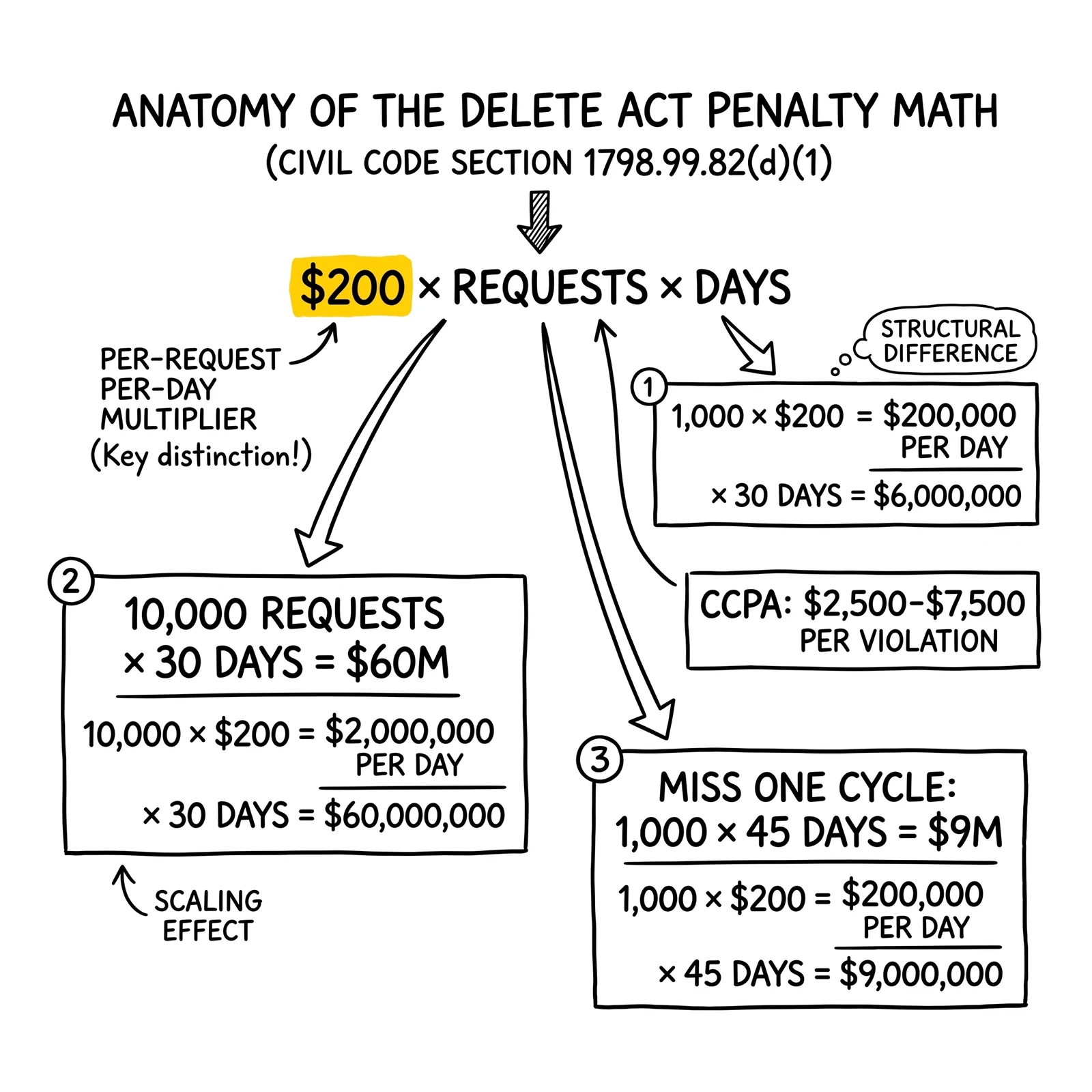
The CPPA's regulatory framework sits under Civil Code section 1798.99.82, the broader Delete Act passed as SB 362 in 2023. The Act's penalty provision – section 1798.99.82(d)(1) – authorizes an administrative fine of $200 for each deletion request for each day the data broker fails to delete information. The per-request times per-day stacking is the structural detail that distinguishes the Delete Act from the broader CCPA penalty framework. A broker ignoring 1,000 deletion requests for 30 days faces $200 times 1,000 times 30, or $6 million. A broker ignoring 10,000 requests for 30 days faces $60 million. The math does not require multiple violations across multiple consumers – it stacks the same way for one consumer's request, one day at a time, multiplied by every consumer whose request is ignored.
For lead-generation operators that meet the California data-broker definition under section 1798.99.80, the August 1 deadline is not a planning horizon. It is the point past which the CPPA gains the statutory authority to compound penalties at a rate most operators have not modeled into compliance budgets. The CPPA's verified 2025 and 2026 enforcement docket – Honda $632,500, Tractor Supply $1.35 million, Todd Snyder $345,178, S&P Global $62,600, Rickenbacher $45,000 – demonstrates that the agency is willing to use the statutory tools at scales that materially affect operator economics.
The article works through the DROP mechanics, the broker-registration trap that catches lead aggregators, the CPPA-versus-Attorney-General enforcement split, the lead-gen translation against TCPA defense, and what operators should do before August 1.
The 45-day cadence is the gate. Brokers that miss it accrue $200-per-request-per-day exposure on a clock the CPPA reads directly from DROP processing logs.
---
## How DROP Actually Works
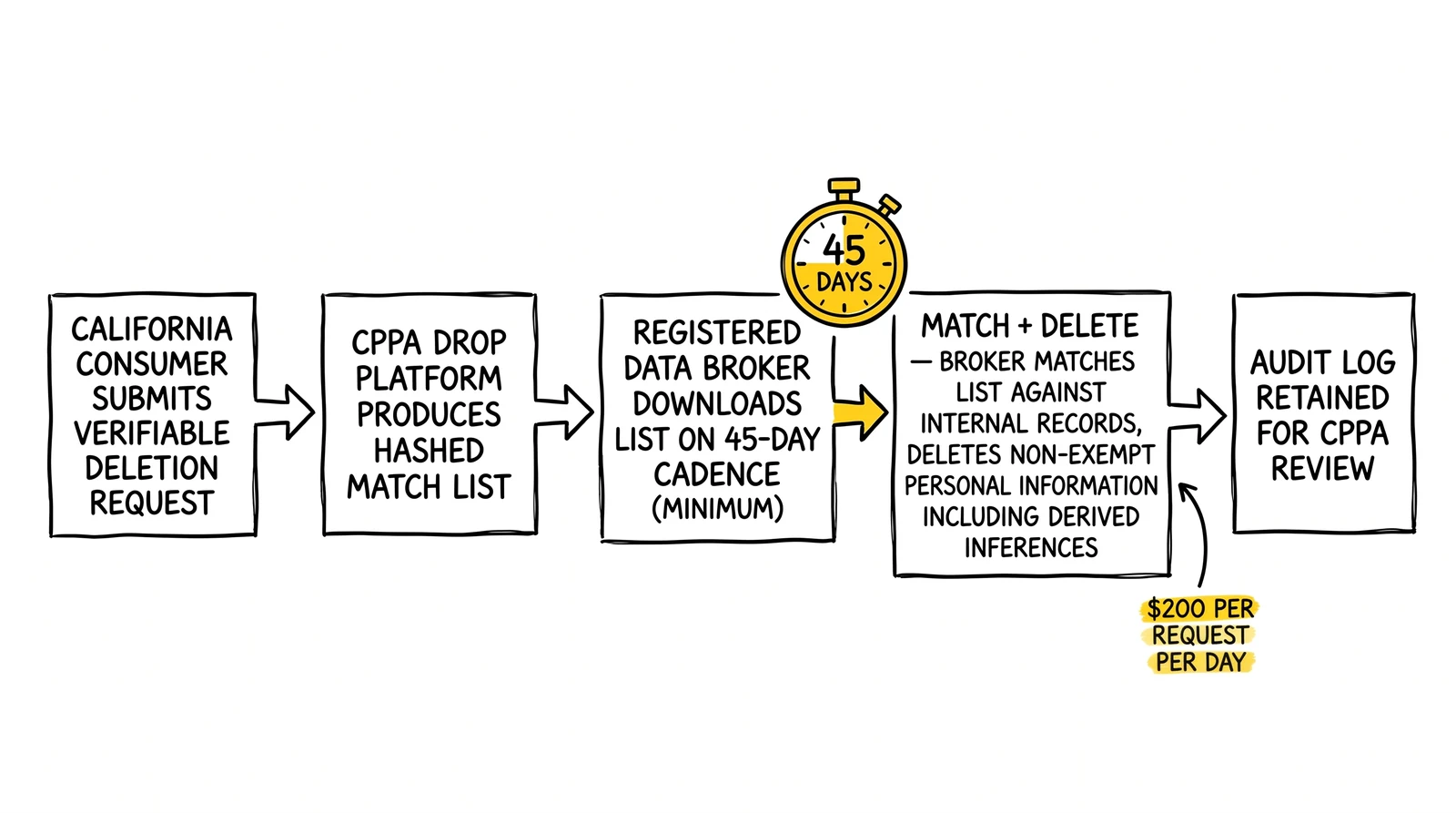
The DROP mechanic is procedurally simpler than the regulatory text reads. A California consumer submits a single verifiable deletion request to the CPPA-hosted platform. The platform produces a hashed match list that registered data brokers download on a 45-day minimum cadence. Each broker must process the match list against its internal customer records, delete all non-exempt personal information for matched consumers – including derived inferences – and document the deletion in a log retained for audit.
The 45-day cadence applies as a minimum; brokers can process more frequently. The deletion obligation includes inferences derived from the personal information, not only the directly-captured data fields. The exemption framework follows the broader CCPA structure – brokers may retain personal information necessary to complete a transaction the consumer has requested, to detect security incidents or fraud, to comply with a legal obligation, or to exercise free speech. The exemptions are narrow and operator-specific; broad invocation will face CPPA scrutiny.
The data-broker definition under section 1798.99.80 is the analytical pivot for lead aggregators. The Act defines a data broker as a business that knowingly collects and sells to third parties the personal information of a consumer with whom the business does not have a direct relationship. The direct-relationship carve-out is the interpretation question every lead aggregator's California-focused compliance team should be running.
A pure ping-post operator that resells consumer-form data to multiple downstream buyers likely meets the data-broker definition. The consumer's primary relationship is with the originating publisher or comparison site, not the aggregator that brokers the lead to multiple lenders, carriers, or installers. A lead aggregator that runs an owned-brand comparison site and captures the consumer's first interaction with the brand has a stronger direct-relationship argument. The aggregator that buys upstream from publishers without an originating consumer interaction is more clearly a broker.
The CPPA has not published a registry of which lead-gen verticals are most exposed to data-broker classification, but the November 19, 2025 Data Broker Strike Force announcement and the January 8, 2026 enforcement cluster signal that the agency intends to identify and pursue brokers that fail to register. Operators in mortgage, insurance, solar, and home services that operate at scale and resell consumer records to multiple downstream buyers should expect Strike Force scrutiny independent of self-registration.
---
## The Verified CPPA Enforcement Docket
The CPPA's enforcement record through mid-2026 demonstrates willingness to use statutory penalties at scale. Five named actions anchor the docket.
American Honda Motor Co. received a March 7, 2025 order at $632,500 for asymmetric opt-out flows that required consumers to provide more information to opt out than to opt in, excessive verification demands, and ad-tech contract failures. The case (ENF23-V-HO-2) is the first major CCPA enforcement action against an automotive manufacturer.
Tractor Supply Co. received a January 8, 2026 enforcement action at $1.35 million for combined data-broker and privacy compliance violations. The action was part of the Data Broker Strike Force cluster.
Todd Snyder, Inc. received an enforcement action at $345,178 for privacy management tool defects. The specific cited violations involved failures in the customer-facing rights-management interface that produced inconsistent opt-out processing.
S&P Global, Inc. received a $62,600 fine in the same January 8, 2026 announcement for failure to register as a data broker. The case is notable because S&P Global is a Fortune 500 financial information company that operates a substantial data-licensing business but had not maintained current California data-broker registration.
Rickenbacher Data, operating as Datamasters, received a $45,000 fine in the same announcement for failure to register and was ordered to stop selling data into California until registration was completed.
The fifth named case requires correction in operator coverage. Tilting Point Media's $500,000 settlement was announced jointly by California Attorney General Rob Bonta and Los Angeles City Attorney Hydee Feldstein Soto in 2026. The case involved COPPA and CCPA allegations around children's data captured through SDKs in SpongeBob-branded mobile games. The Tilting Point settlement is an Attorney General action, not a CPPA action. Trade-press coverage has occasionally conflated the two enforcement tracks. Operators should attribute the action correctly to the Attorney General's office and recognize that the California privacy-enforcement surface now includes parallel CPPA, AG, and city-attorney pathways.
The combined CPPA docket shows the agency willing to pursue mid-six-figure to seven-figure fines against both consumer brands (Honda, Tractor Supply, Todd Snyder) and infrastructure providers (S&P Global, Rickenbacher). The pattern signals that the August 1 DROP processing obligation will be enforced against registered brokers that fail to maintain the 45-day cadence.
---
## The Penalty Math That Stacks Differently from CCPA
The Delete Act's penalty structure is what makes August 1 a different inflection point from the prior CCPA enforcement framework. Three structural points distinguish the math.
First, the Delete Act penalty under section 1798.99.82(d)(1) is $200 per request per day. CCPA's broader penalty framework under section 1798.155 caps at $2,500 per violation for non-intentional violations and $7,500 per intentional violation. The CCPA framework treats each consumer's data as a violation rather than each request as a fresh failure surface. The Delete Act treats each consumer's deletion request as a separately compounding penalty for each day of broker inaction.
Second, the per-day stacking compounds quickly. A broker that maintains a clean 45-day processing cadence has near-zero exposure. A broker that misses the cadence by one cycle – 45 days late on 1,000 requests – faces $200 times 1,000 times 45, or $9 million. The penalty does not require malicious intent; it accrues automatically as the broker fails to process within the statutory cadence.
Third, the Strike Force structure means the CPPA does not need consumer complaints to identify non-compliant brokers. The agency can audit DROP processing logs directly. A broker that registers but fails to process accrues penalty exposure on a clock the CPPA can read from its own systems.
The Delete Act multiplier stacks per request per day, not per violation. A 1,000-request 30-day backlog reaches $6 million – math CCPA's $2,500-$7,500 cap never produced.
The compliance arithmetic for lead aggregators is therefore: estimate California DROP request volume against the operator's California consumer record base, model the 45-day processing cost against the per-request-per-day penalty exposure for non-processing, and decide whether the engineering investment to maintain clean cadence justifies the alternative penalty exposure. For operators handling millions of California consumer records, the math points strongly toward compliance investment.
---
## TCPA Defense Meets DROP Deletion
The intersection of DROP-mediated deletion and TCPA consent capture is where lead-gen operators face the structural compliance question that broader privacy coverage does not address.
A consumer who fires a DROP deletion request that propagates to a lead aggregator does not automatically revoke TCPA consent. The TCPA layer governs whether the consent record itself is part of the deleted personal information. Two interpretations matter operationally.
Under the strict-deletion interpretation, the consent record is consumer personal information that the broker must delete along with the underlying lead record. The operator loses the TCPA defense documentation for any subsequent contact attempt – including contact attempts already initiated within the prior 45-day window before the deletion request propagated. The defensibility consequence under the post-Dahdah TCPA framework lands hard.
Under the consent-preservation interpretation, the broker may retain the consent record under the legal-obligation exemption because TCPA compliance requires documented consent for contact. The deletion applies to the consumer's lead data but preserves the consent metadata necessary for TCPA defense. The interpretation is plausible but has not been tested in CPPA enforcement.
Operators should determine in advance, in writing, how their consent-capture systems treat DROP-driven deletions of the underlying consumer record. The [Sixth Circuit Dahdah v. Rocket Mortgage analysis](https://www.leadgen-economy.com/blog/dahdah-rocket-mortgage-click-consent-form-audit/) covered the form-architecture defense surface; the DROP layer adds a parallel data-broker compliance surface that operates on the same underlying consumer record. The two compliance regimes must be coordinated rather than operated independently.
For consent capture infrastructure providers – TrustedForm, Jornaya, the consolidated ActiveProspect/InfutorData stack covered in the [identity-resolution consolidation analysis](https://www.leadgen-economy.com/blog/infutordata-trustedform-jornaya-consolidation-risk/) – the DROP interaction creates a contractual question. Does the consent provider's data-handling commitment include processing DROP-mediated deletions on the operator's behalf? Operators should evaluate the contract surface in light of the August 1 deadline.
---
## The Texas Front – Why California Is Not the Only Risk
The Texas Attorney General's January 2025 action against Allstate and its Arity subsidiary under the Texas Data Privacy and Security Act signals that state privacy enforcement against insurance-vertical lead aggregators is no longer California-confined. The case alleges Allstate and Arity collected and sold driver geolocation data without proper consent, focusing specifically on telematics data embedded in usage-based insurance programs.
The structural insight from the Texas action is that telematics data, embedded in usage-based insurance offerings, can become the enforcement vector under state privacy regimes other than California's. The TDPSA does not include a DROP-equivalent platform, but it does authorize Attorney General enforcement actions for privacy violations. The Texas case is the first major insurance-vertical privacy enforcement under a state privacy law outside California.
For insurance lead aggregators handling telematics-derived data – usage-based insurance comparison sites, OEM-direct lead programs, fleet-management lead networks – the Texas case is precedent risk that the CCPA-only compliance posture does not address. The state privacy enforcement pattern is now multi-front. Tennessee's Information Privacy Act took effect July 1, 2025. Maryland's Online Data Privacy Act took effect October 1, 2025. Texas, Delaware, Indiana, Minnesota, New Jersey, and Oregon each have privacy laws now in effect or coming into effect in 2026. Operators selling into multiple states must run a state-by-state compliance map, not a California-anchored map.
The compliance translation runs through the same logic as the broader regulatory thesis Forrester's GTM Singularity framed for the AI-mediated buyer journey. The enforcement surface for lead aggregators has expanded along multiple dimensions simultaneously. California DROP is the August 1 dated event; Texas TDPSA is the precedent risk; the broader state privacy framework is the operational constraint that runs into 2027 planning.
---
## What Lead Operators Should Do Before August 1
The action surface is concrete and time-bounded. Five steps map the implementation arc against the August 1 deadline.
First, determine whether the operation meets the California data-broker definition under section 1798.99.80 and whether DROP registration is required. The direct-relationship test is the analytical pivot. Pure ping-post operations resellers, identity-resolution-adjacent lead aggregators, and any operation that buys upstream consumer data without an originating consumer interaction likely meet the definition. Owned-brand comparison sites have a stronger direct-relationship argument but should document the interpretation in writing.
Second, audit the consent capture stack against the DROP-mediated deletion scenario. Determine how the operation's consent-capture system handles deletion of the underlying consumer record. Determine whether the TCPA consent metadata is preserved under the legal-obligation exemption or deleted alongside the lead data. Get a written legal opinion on the consent-preservation versus strict-deletion interpretation before August 1.
Third, build the 45-day processing cadence. The engineering work is modest in technical complexity but operationally non-trivial. The system must download the DROP match list on cadence, match against internal records, execute deletions with appropriate exemption handling, and log the processing for CPPA audit. Operators that defer the engineering work until the first match list arrives in late August will accrue penalty exposure during the build window.
Fourth, evaluate the penalty exposure model. For operations handling more than 100,000 California consumer records with substantial DROP request volume projection, the $200-per-request-per-day exposure justifies dedicated compliance engineering investment. Smaller operations should still register and process, but the engineering investment can be sized against the realistic penalty exposure.
Fifth, audit other state privacy law exposure. The Texas AG case against Allstate signals enforcement appetite outside California. Operators with significant volume in Texas, Tennessee, Maryland, Colorado, Oregon, and the other state-privacy-law jurisdictions should map the obligations and enforcement-risk profile by state. The compliance investment that satisfies California DROP does not automatically satisfy TDPSA, Tennessee TIPA, or Maryland MODPA. Multi-state compliance is the 2026-and-2027 operating environment.
---
## Key Takeaways
- California's Delete Request and Opt-Out Platform – DROP – went live for consumer requests on January 1, 2026 and reaches the broker compliance deadline on August 1, 2026. Registered brokers must process deletion requests on a minimum 45-day cadence.
- Civil Code section 1798.99.82(d)(1) authorizes $200 per request per day for failure to delete. The penalty stacks across consumers and across calendar days. A 1,000-request 30-day inaction window reaches $6 million in statutory fines.
- The CPPA verified enforcement docket through mid-2026: Honda $632,500 (March 7, 2025), Tractor Supply $1.35 million (January 8, 2026), Todd Snyder $345,178, S&P Global $62,600 (data-broker registration failure), Rickenbacher Data $45,000.
- Tilting Point Media's $500,000 settlement is a California Attorney General and Los Angeles City Attorney action, NOT a CPPA action. Attribute correctly.
- The Delete Act data-broker definition under section 1798.99.80 turns on direct relationship. Pure ping-post resellers and upstream-buying aggregators are most clearly within the definition. Owned-brand comparison sites have a stronger direct-relationship argument.
- TCPA defense intersects with DROP deletion at the consent record. Operators must determine in writing whether their consent capture system treats DROP-driven deletions under the strict-deletion or consent-preservation interpretation.
- Texas AG v. Allstate / Arity under TDPSA signals that state privacy enforcement is no longer California-confined. Telematics data is the first vertical enforcement vector. Multi-state compliance is the 2026-and-2027 operating environment.
- The 90-day pre-August-1 operator window calls for: data-broker classification analysis, consent-capture audit, 45-day processing engineering, penalty exposure modeling, and multi-state privacy law map.
---
## Sources
- [CPPA – California DROP Regulations](https://cppa.ca.gov/regulations/drop.html)
- [California Legislature – SB 362 (Delete Act, 2023)](https://leginfo.legislature.ca.gov/faces/billTextClient.xhtml?bill_id=202320240SB362)
- [California Civil Code Section 1798.140](https://leginfo.legislature.ca.gov/faces/codes_displaySection.xhtml?sectionNum=1798.140.&lawCode=CIV)
- [CPPA – Honda Enforcement Order ENF23-V-HO-2 (March 7, 2025)](https://cppa.ca.gov/regulations/pdf/20250307_hmc_order.pdf)
- [CPPA – Honda Action Announcement (March 12, 2025)](https://cppa.ca.gov/announcements/2025/20250312.html)
- [CPPA – January 8, 2026 Strike Force Announcement](https://cppa.ca.gov/announcements/2026/20260108.html)
- [CPPA – Data Broker Strike Force Launch (November 19, 2025)](https://cppa.ca.gov/announcements/2025/20251119.html)
- [California Attorney General – Tilting Point Media Settlement Announcement](https://oag.ca.gov/news/press-releases/attorney-general-bonta-la-city-attorney-feldstein-soto-announce-500000)
- [CPPA – Data Broker Registry](https://cppa.ca.gov/data_brokers/)