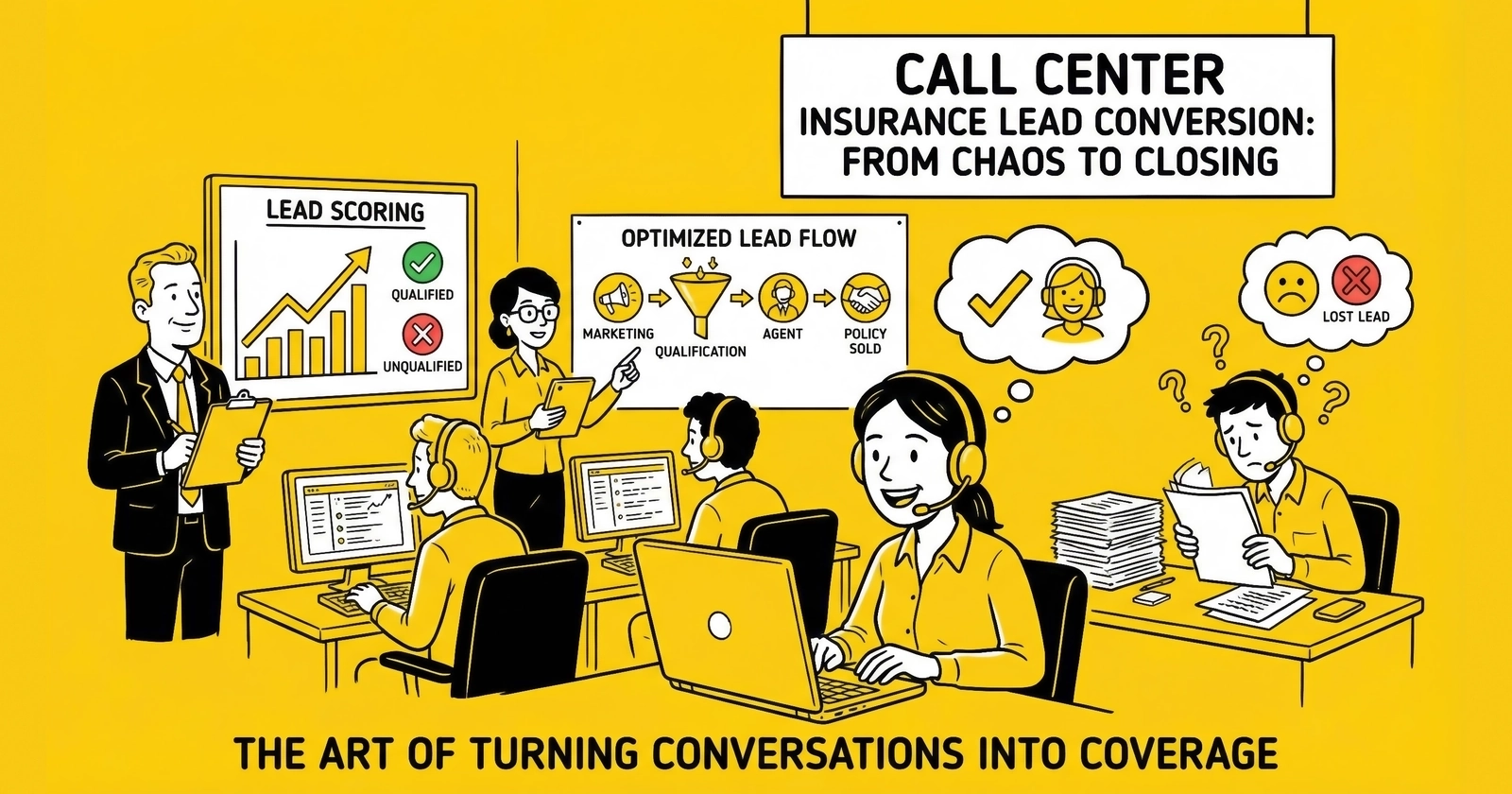
Master the operational systems, agent training protocols, and technology infrastructure that separate high-performing insurance call centers from operations that hemorrhage money on unconverted leads. Includes 2025 benchmarks, script frameworks, and the metrics that matter.
Two call centers buy the same leads from the same source at the same price. One converts at 18% and generates profit. The other converts at 6% and loses money every month. The leads are identical. The outcomes are not.
The difference is not luck. It is operational discipline – the systems, training, technology, and metrics that transform raw leads into closed policies. Insurance lead conversion is not primarily a marketing problem or a product problem. It is an operations problem. And operations can be systematized, measured, and improved.
This guide provides the complete framework for building and optimizing call center operations specifically for insurance lead conversion. Whether you are launching a new operation, scaling an existing agency, or buying a book of business that comes with a sales team, these are the systems that determine whether you make money or burn through capital wondering why your leads never convert.
The insurance industry spent over $11 billion on customer acquisition in 2024. A significant portion of that investment gets wasted by operations that cannot convert the leads they purchase. The opportunity for disciplined operators is substantial – but only if you understand how conversion actually works at the operational level. For context on lead costs and benchmarks, see our auto insurance lead generation guide.
The Speed-to-Contact Imperative
Before discussing any other aspect of call center operations, you need to understand the single most important variable in insurance lead conversion: speed.
The Data Is Unambiguous
Research consistently demonstrates that faster response correlates directly with higher conversion. Velocify found that leads contacted within one minute convert at 391% higher rates. The Lead Response Management Study showed that teams calling within five minutes are 100 times more likely to connect compared to waiting an hour. And according to Lead Connect Survey data, 78% of customers purchase from the first responder who reaches them.
These are not marginal improvements. They are order-of-magnitude differences. A call center that responds in 45 seconds and one that responds in 5 minutes are operating in fundamentally different businesses, even if they buy the same leads.
Why Speed Matters Psychologically
The speed-to-contact effect operates through multiple psychological mechanisms.
Recency and attention. A consumer who just completed an insurance form has insurance actively in working memory. They are thinking about coverage, considering options, mentally prepared for a conversation. An hour later, they have moved on to email, meetings, family activities. Breaking through that mental barrier requires more effort and reduces conversion probability.
Commitment and consistency. Taking the action of submitting a form creates a small commitment. Following through on that commitment by engaging with the responding agent feels psychologically consistent. Ignoring a call hours later requires no such consistency – the moment has passed.
Trust through responsiveness. A rapid, professional response signals competence and customer orientation. If this agent responds quickly to a quote request, they will probably respond quickly to claims or service needs. Delayed response raises questions – if it takes them two days to return a sales call, what happens when I need help?
Shopping momentum. A consumer actively comparing insurance options has momentum. They are in shopping mode. A call that arrives while they are still comparing options catches them in that mode. A call that arrives later interrupts whatever they have moved on to – a much harder context for sales success.
Industry Reality: Most Operations Fail at Speed
Despite overwhelming evidence, most insurance sales operations fail to achieve optimal speed-to-contact. Research from Drift found that only 7% of companies responded to inbound leads within five minutes. More than half failed to respond within five business days.
This gap between best practice and typical practice creates opportunity for disciplined operators. If you can consistently respond in under a minute while competitors average five minutes or more, you gain systematic competitive advantage across your entire lead portfolio. Our complete guide on speed-to-lead and response time covers this in depth.
Speed Benchmarks for Insurance Call Centers
| Response Time | Contact Rate | Conversion Rate | Competitive Position |
|---|---|---|---|
| Under 1 minute | 55-65% | 15-20% | Market leader |
| 1-3 minutes | 50-55% | 12-16% | Competitive |
| 3-5 minutes | 45-50% | 10-14% | Below average |
| 5-15 minutes | 35-45% | 8-12% | Disadvantaged |
| 15+ minutes | 25-35% | 5-8% | Losing money |
These benchmarks apply to shared leads where multiple buyers receive the same lead simultaneously. For exclusive leads, the urgency moderates slightly because you are not racing against competitors calling the same prospect. But even with exclusive leads, speed matters – consumer attention fades, situations change, alternative solutions emerge.
Building Speed Into Operations
Speed is not achieved by telling agents to work faster. It requires systematic infrastructure.
Real-time lead delivery ensures your CRM or dialer receives leads the moment they generate. Delays of even 30 seconds in transmission compound with any delay in agent response. Work with lead sources that support real-time API delivery, not batch file transfers.
Predictive dialing systems begin outreach instantly as leads arrive, prioritizing new leads above aged inventory and adjusting dial rates dynamically to ensure fresh leads get immediate attention.
Click-to-call functionality eliminates seconds lost to number dialing and system switching. When an agent can initiate a call with a single click directly from their lead queue, response times drop measurably.
Automated first-touch through SMS or email acknowledgment establishes contact while agents prepare to call. This reduces the chance of the prospect submitting additional forms elsewhere and buys time for human follow-up.
Staffing models aligned to lead flow ensure you have maximum agent availability when lead volume peaks. If your leads concentrate at 2 PM, that is when you need agents ready – not at 10 AM when it happens to be convenient for scheduling.
Dedicated new-lead response teams prevent fresh leads from getting buried behind aged lead work or inbound service calls. Priority requires separation.
Call Center Infrastructure and Setup
The physical and technological infrastructure of your call center directly impacts conversion performance. This section covers the essential systems and considerations for insurance-focused operations.
Facility Considerations
While remote work has become common in call center operations, the infrastructure principles remain consistent whether agents work in a centralized facility, from home, or in a hybrid arrangement.
Network reliability determines call quality. For centralized operations, this means enterprise-grade connectivity with failover capabilities. For remote agents, you need minimum bandwidth standards (typically 25+ Mbps download, 10+ Mbps upload), hardwired connections rather than WiFi where possible, and company-provided equipment to ensure consistency.
Acoustic environment can make or break calls. Background noise destroys conversations and signals unprofessionalism. Centralized call centers require proper acoustic treatment with sound-absorbing panels, adequate spacing between workstations (typically 8-10 square feet minimum per agent), and noise-canceling headsets. Remote agents need dedicated workspace requirements and periodic audio quality audits to maintain standards.
Hardware standards should be uniform across the operation. Standardized equipment reduces troubleshooting time and ensures consistent call quality. Agents need dual monitors (one for CRM, one for resources), high-quality USB headsets with noise cancellation, adequate processing power for CRM and dialer software, and backup power for critical systems. The investment in proper equipment pays for itself in reduced technical issues and improved agent productivity.
Security infrastructure is non-negotiable for insurance operations handling sensitive personal and financial data. Physical security includes badge access, camera systems, and clean desk policies. Cybersecurity requires encrypted communications, VPN requirements for remote access, and regular security training for all staff.
Technology Stack Components
A complete insurance call center technology stack includes multiple integrated systems working together.
Customer Relationship Management
The CRM is the operational heart of the call center. For insurance operations, the system must handle lead intake and routing automation, maintain complete contact history and notes, track pipeline and opportunities through the sales cycle, integrate with carrier quoting systems for seamless quote generation, provide robust reporting and analytics, and offer mobile access for field agents who need flexibility. Popular CRM platforms in insurance include Salesforce for enterprise operations, HubSpot for mid-market agencies, and specialized platforms like AgencyZoom, Radiusbob, and InsuredMine that include insurance-specific functionality out of the box.
Dialer System
The dialer determines how efficiently agents connect with leads. Different dialer types serve different purposes.
| Dialer Type | Description | Best For |
|---|---|---|
| Preview | Agent sees lead info before initiating call | Complex products, high-value leads |
| Progressive | System dials automatically after agent becomes available | Balanced efficiency and preparation |
| Predictive | System dials multiple numbers simultaneously | High-volume operations, experienced agents |
| Power | Rapid sequential dialing from a list | Aged lead campaigns, callback lists |
Most insurance call centers operate with progressive or preview dialers for fresh leads (where conversion matters more than volume) and predictive dialers for aged lead campaigns (where volume throughput takes priority).
Telephony Infrastructure
Modern call centers typically use VoIP (Voice over IP) systems that integrate with CRM and dialer platforms. Key capabilities include local presence dialing that displays local caller ID to improve answer rates, call recording and quality monitoring for compliance and training, IVR capabilities for routing inbound calls, seamless call transfer and conferencing for escalations, and compliance call disposition logging to maintain proper records.
Lead Distribution System
Operations purchasing leads from multiple sources need a lead distribution system to manage intake, validation, routing, and vendor performance. Essential capabilities include real-time API integration with lead providers, duplicate detection and suppression to avoid wasted contacts, lead scoring and prioritization to focus agent attention, round-robin or skills-based routing to match leads with appropriate agents, and source-level performance tracking to optimize vendor allocation. Platforms like boberdoo, LeadsPedia, and Phonexa provide comprehensive lead distribution capabilities specifically designed for high-volume lead operations.
Carrier Integration
Insurance-specific call centers need connectivity to carrier systems including comparative raters that pull quotes from multiple carriers simultaneously, carrier appointment and licensing management to ensure agents can sell specific products, policy issuance and binding capabilities for same-call closes, and commission tracking systems to manage agent compensation accurately.
Quality Monitoring and Compliance Technology
Systematic quality assurance requires call recording storage with search capabilities, scorecard-based evaluation tools, coaching and feedback workflow management, and performance trending over time. Compliance technology must include TCPA consent verification through services like TrustedForm or Jornaya, Do-Not-Call list management with regular updates, call disposition documentation, state-specific script compliance checking, and licensing verification for multi-state operations.
Sizing Your Operation
Call center staffing depends on lead volume, response time requirements, and conversion targets.
Leads per agent per day varies based on efficiency and product complexity. A well-equipped agent can effectively work 50-80 fresh leads per day with proper dialer support and CRM efficiency. This assumes 6-8 productive hours, average call duration of 8-12 minutes including wrap time, and standard contact rates.
Staffing ratios for shared leads require buffer capacity to ensure immediate response when speed-to-contact is critical:
| Daily Lead Volume | Minimum Agents | Optimal Agents |
|---|---|---|
| 100 leads | 2-3 | 4-5 |
| 250 leads | 4-5 | 6-8 |
| 500 leads | 8-10 | 12-15 |
| 1,000 leads | 15-20 | 25-30 |
Coverage hours typically concentrate during business hours (9 AM - 6 PM) but extend into evenings (up to 9 PM local time for TCPA compliance). Weekend coverage increases contact rates but requires staffing cost-benefit analysis based on your specific lead flow and conversion data.
Scheduling for peaks requires analyzing your lead flow patterns and staffing accordingly. Most operations see peaks mid-morning (10-11 AM) and mid-afternoon (2-4 PM), with lower volume early morning, lunch hours, and late afternoon.
Agent Recruitment and Training
The agents making calls determine conversion performance more than any other single factor. Recruitment, onboarding, and ongoing training separate high-performing operations from those that churn through agents and leads alike.
Recruitment Profile
Successful insurance sales agents share common characteristics that should guide your hiring decisions.
The required attributes form the foundation for success. Candidates must demonstrate clear, professional phone presence during interviews. They need strong active listening skills – you can assess this by noting whether they actually respond to what you say or simply wait to deliver prepared answers. Resilience and persistence matter enormously because rejection is constant in sales; candidates who have never faced professional rejection often struggle. Detail orientation ensures accurate data capture during calls. Basic computer proficiency should be table stakes, and candidates must be licensed or licensable in your operating states.
Preferred experience shortens the ramp to productivity. Prior insurance sales or customer service experience provides product familiarity. Call center or telesales background means they understand the rhythm of phone sales. Familiarity with CRM and dialer systems reduces training time. Understanding of insurance products allows faster progression to complex sales scenarios.
Watch for red flags that predict failure. Poor listening skills during the interview itself suggest the same behavior on calls. Inability to handle rejection scenarios in role-play indicates fragility under real-world pressure. Resistance to coaching and feedback means the candidate will not improve. Inconsistent work history without explanation suggests reliability issues. Over-reliance on scripts without adaptability produces robotic interactions that prospects reject.
Licensing Requirements
Insurance sales require state licenses, and multi-state operations face considerable complexity in managing these requirements.
Producer licensing requires that agents selling insurance hold appropriate licenses – Property & Casualty, Life & Health, or both – in each state where they sell. Initial licensing involves pre-licensing education (typically 40-60 hours per license type), passing the state licensing examination, completing background check and fingerprinting requirements, and securing carrier appointments that authorize them to sell specific company products.
License maintenance creates ongoing obligations including continuing education (typically 24 hours every two years), license renewal fees, and carrier appointment renewals that must be tracked systematically.
Resident vs. non-resident licenses add another layer of complexity. Agents must hold a resident license in their home state and non-resident licenses in other states where they sell. Reciprocity agreements simplify some of this, but multi-state operations require systematic license tracking to avoid compliance gaps.
License management tools become essential at scale. For operations with multiple agents across multiple states, platforms like Sircon, Vertafore, or Nipr help track requirements, expirations, and compliance status across the organization.
Onboarding Program Structure
A structured onboarding program reduces time-to-productivity and improves retention. Rushing agents to the phones before they are ready costs more in blown leads than the extra training week would have cost.
Week 1 establishes foundations. New agents need company orientation and culture immersion to understand expectations. Product knowledge basics covering coverage types, terminology, and pricing factors provide vocabulary for conversations. System training on CRM, dialer, and quoting tools builds technical proficiency. Compliance and regulatory overview establishes guardrails from day one. Call observation through shadowing experienced agents shows what good looks like in practice.
Week 2 focuses on skills development. Script training and extensive role-play builds muscle memory for common scenarios. Objection handling practice prepares agents for resistance without crumbling. Quality standards and expectations set the bar clearly. First supervised calls with immediate coaching provide real-world experience with a safety net. Continued call observation and modeling reinforces good habits.
Weeks 3-4 provide supervised production. Agents begin independent calling with real-time monitoring available. Daily coaching sessions address specific issues from observed calls. Performance metrics introduction helps agents understand what success looks like. Escalation procedures and support resources ensure they know where to get help. Graduation criteria establish clear expectations for transition to full independence.
Ongoing development continues after onboarding ends. Weekly team training sessions address common challenges and share best practices. Monthly product and carrier updates keep knowledge current. Quarterly compliance refreshers reinforce critical requirements. Individual coaching based on performance data targets specific development needs. Career path and advancement opportunities provide motivation for long-term engagement.
Training Curriculum Components
Comprehensive training covers multiple domains that together produce effective insurance sales agents.
Product knowledge forms the foundation. Agents must understand insurance fundamentals including how policies work and coverage types available. They need carrier-specific product knowledge and appetites to match prospects with appropriate options. Underwriting basics and risk factors help them set realistic expectations. Pricing determinants and quote interpretation skills enable confident presentation. Policy comparison and gap analysis capabilities allow them to demonstrate value against competitors.
Sales skills translate product knowledge into closed business. Opening and rapport building techniques create connection quickly. Needs discovery and qualification processes identify what prospects actually need. Presenting coverage recommendations requires translating features into benefits. Handling objections around price, timing, and trust separates closers from order-takers. Closing techniques that ask for the business directly complete the sale. Follow-up and persistence strategies maximize conversion from prospects who do not close immediately.
Compliance training protects the operation and the agents. TCPA requirements and restrictions must be understood thoroughly. State-specific regulations vary enough to require explicit training. Disclosure requirements cannot be skipped or summarized. Do-Not-Call procedures need consistent execution. Call recording and consent rules require proper handling. Documentation standards ensure defensible records.
System proficiency removes friction from the sales process. Agents need fluent CRM navigation and accurate data entry. Dialer operation and optimization affects productivity directly. Carrier rating and quoting systems require practice to use efficiently. Policy issuance workflows must be followed precisely. Internal communication and escalation channels should be clear and accessible.
Quality standards define what excellent looks like. Call structure and pacing set the rhythm for effective conversations. Active listening verification through confirmation and reflection builds trust. Accuracy and completeness in information gathering reduces errors and callbacks. Professionalism and tone create the impression that leads to referrals. Recovery from difficult situations – angry prospects, technical problems, awkward moments – distinguishes experienced agents.
Sales Scripts and Call Frameworks
Scripts provide structure and consistency. They are not straitjackets that prevent authentic conversation – they are frameworks that ensure key elements happen on every call while allowing agents to adapt to individual prospects.
The Opening: First 30 Seconds
The opening determines whether the prospect engages or disengages. For inbound leads (consumers who requested information), the opening must accomplish three things: identify yourself clearly by stating your name, company, and reason for calling; reference their action by acknowledging that they requested information; and ask for permission to continue by confirming they have time to speak.
Sample opening script:
“Hello, this is [Agent Name] with [Company]. I’m calling because you requested auto insurance quotes through [Lead Source] a few moments ago. Do you have a few minutes to go over some options that might save you money on your coverage?”
Variations based on timing adjust tone appropriately. If calling within 5 minutes: “I saw your request just come through and wanted to reach out right away while you’re still comparing options.” If calling later: “I’m following up on the insurance quote request you submitted earlier. I want to make sure you got the information you needed.”
Qualification and Discovery
After securing engagement, the qualification phase accomplishes two goals: gathering information needed for accurate quoting and building rapport that supports conversion.
Essential qualification questions include a motivation probe (“What prompted you to look at quotes today? Are you shopping for a new policy, or looking to improve what you have?”), current coverage assessment (“Who are you insured with currently, and how long have you been with them?”), satisfaction assessment (“What do you like or dislike about your current coverage or carrier?”), timeline clarification (“When is your policy up for renewal? Are you looking to make a change before then?”), budget orientation (“Do you have a monthly budget in mind for your coverage?”), and coverage verification (“Let me make sure I understand what coverage you need – you have [vehicles] with [drivers], is that right?”).
The qualification approach matters. Questions should feel conversational, not interrogative. Explain why you are asking when it is not obvious. Build value by demonstrating expertise as you gather information.
Presenting the Quote
Quote presentation is where many agents fail. They recite numbers without context, fail to differentiate options, or present in a way that invites price objections.
Effective quote presentation framework follows a logical sequence. First, set context: “Based on what you told me about your situation, let me show you a couple of options.” Then start with your recommendation: “My recommendation for someone in your situation is [Option X] because [relevant reasons].” Present price in context: “This comes out to [price] per month. Compared to what you’re paying now, that’s [savings or premium].” Highlight differentiators: “What you get with this that you might not have with [competitor] is [specific benefit].” Finally, offer alternatives: “I can also show you [lower/higher coverage option] if that’s a better fit for your budget.”
Price presentation tips improve reception. Always present monthly, not annual – smaller numbers feel more manageable. Compare to their current premium if known to anchor expectations. Frame as investment rather than cost when discussing comprehensive coverage. Acknowledge price while redirecting to value when premium is higher than expected.
Objection Handling
Objections are not rejections – they are requests for more information or reassurance. Common insurance objections require prepared responses.
“I need to think about it.” Acknowledge with “Of course, this is an important decision.” Clarify by asking “Help me understand what specifically you want to think through – is it the coverage, the price, or something else?” Address the real concern based on what they share. Create appropriate urgency: “I can hold this rate for [timeframe], but rates do change. Would it help if I emailed you the details to review?”
“I need to talk to my spouse.” Acknowledge with “I completely understand. Insurance decisions should be made together.” Offer options: “Would it help to schedule a time when you’re both available? Or I can call back at a specific time?” Leave materials: “Let me email you the details so you can review them together. What’s the best email?” Set clear follow-up: “When would be a good time for me to follow up after you’ve had a chance to discuss?”
“Your price is too high.” Acknowledge with “I hear you – price matters.” Explore by asking “Help me understand – when you say the price is too high, are you comparing to your current coverage, or to another quote you received?” Differentiate based on their response by explaining coverage differences, carrier quality, or service level. Offer alternatives: “I can adjust the coverage to hit a specific target if that helps. What monthly payment works for your budget?”
“I’m not ready to switch yet.” Acknowledge with “That’s fine – timing matters.” Understand by asking “Is there something specific keeping you with your current carrier, or is it more about timing?” Plant seeds: “Let me lock in this quote for you so when you are ready, you have a benchmark. There’s no obligation.” Maintain relationship: “Would you mind if I followed up closer to your renewal date?”
“I want to compare with other companies first.” Acknowledge with “Smart approach – shopping around makes sense.” Position yourself: “I work with [multiple carriers / the leading carrier in your area], so I can probably show you comparable options here.” Add value: “What other companies are you looking at? I might be able to save you some time if I can show you how we compare.” Stay in the game: “If you do find something better, give me a call before you commit – I might be able to match or beat it.”
The Close
Closing is not about pressure – it is about asking for the business directly after addressing concerns.
Assumptive close: “I’m going to go ahead and get your policy started. What date would you like the coverage to begin?”
Alternative close: “Would you like to start this coverage on the first of the month, or would you prefer it effective today?”
Summary close: “So we’ve got you covered for [recap key points] at [monthly price]. Does everything look good to move forward?”
Urgency close (when legitimate): “I can lock in this rate today, but I can’t guarantee it will be available next week. Should we get this started now?”
Quality Assurance and Monitoring
Systematic quality assurance identifies performance gaps, ensures compliance, and drives continuous improvement. Without measurement, you cannot manage.
Call Monitoring Framework
Effective quality programs include multiple monitoring approaches that together provide comprehensive visibility.
Live monitoring allows supervisors to listen to calls in real-time, able to coach agents through difficult situations or intervene if compliance issues arise. This is essential for new agents and critical for identifying issues before they compound into patterns.
Random sampling provides objective assessment of typical performance. Quality analysts review randomly selected recordings from each agent, typically 3-5 calls per agent per week. Random selection prevents agents from gaming the system by performing only when they know they are being monitored.
Targeted review addresses specific concerns. When performance metrics flag problems – low conversion, high complaints, unusually short handle times – targeted review of that agent’s calls identifies specific issues requiring intervention.
Peer review builds team culture around quality improvement. Experienced agents review colleagues’ calls, identifying best practices to share and common issues to address collaboratively.
Quality Scorecard Components
A comprehensive scorecard evaluates calls across multiple dimensions, with weighting that reflects relative importance.
Opening (15-20% of total score) assesses whether the agent provided clear identification and purpose, secured permission to continue, maintained professional tone and pace, and correctly referenced the lead source.
Qualification (20-25%) evaluates complete information gathering, conversational approach versus interrogation, logical question flow, and demonstrated active listening.
Presentation (25-30%) measures accurate quote and coverage explanation, value-based positioning rather than price-leading, carrier and product knowledge, and tailored recommendations that address stated needs.
Objection handling (15-20%) examines acknowledgment of concerns, appropriate and effective responses, persistence without aggression, and proper follow-up establishment.
Compliance (15-20%) verifies that required disclosures were delivered, accurate information was provided, no prohibited claims or language was used, and proper call disposition was recorded.
Pass/fail items exist separately from the weighted score. Any failure on these critical elements results in automatic low score regardless of other performance: TCPA violations, material misrepresentation, failing to capture required consent, and disclosure omissions.
Coaching and Feedback
Quality monitoring without coaching wastes the investment. The purpose of monitoring is improvement, not just measurement.
Timely feedback matters enormously. Review calls within 24-48 hours of occurrence while context is fresh for both coach and agent.
Specific examples make feedback actionable. Reference exact moments in the call, not general observations. “At 2:15, when the customer mentioned their budget concern, you moved directly to presenting price rather than exploring what specifically concerned them” is far more useful than “you need to handle objections better.”
Balanced approach maintains engagement. Identify what went well alongside what needs improvement. Agents who only receive criticism disengage and eventually leave.
Development focus frames feedback constructively. “Here’s an approach that might work better” lands differently than “You did this wrong.”
Follow-up verification completes the loop. After coaching, monitor subsequent calls to verify improvement and provide reinforcement when you see the changes taking hold.
Performance Metrics for Insurance Call Centers
Track these metrics at individual agent, team, and call center levels to understand performance comprehensively.
Efficiency Metrics
| Metric | Definition | Target Range |
|---|---|---|
| Speed to contact | Time from lead receipt to first call | Under 60 seconds |
| Average handle time | Duration of connected calls | 8-12 minutes |
| Calls per hour | Connected calls per productive hour | 6-10 calls |
| Wrap time | Time between calls for disposition | Under 90 seconds |
| Available time | Percentage of time logged in and available | 85%+ |
Effectiveness Metrics
| Metric | Definition | Target Range |
|---|---|---|
| Contact rate | Leads contacted / leads attempted | 45-55% |
| Conversion rate | Policies sold / contacts made | 12-18% |
| Quote rate | Quotes delivered / contacts made | 60-80% |
| Quote-to-close | Policies sold / quotes delivered | 20-30% |
| Premium per policy | Average written premium | Varies by vertical |
| Revenue per lead | Total revenue / leads worked | $20-$60 |
Quality Metrics
| Metric | Definition | Target Range |
|---|---|---|
| QA score | Average scorecard result | 85%+ |
| First call resolution | Issues resolved without callback | 80%+ |
| Customer satisfaction | Post-call survey rating | 4.2/5.0+ |
| Compliance score | Audit pass rate | 98%+ |
Retention and Culture Metrics
| Metric | Definition | Target Range |
|---|---|---|
| Agent tenure | Average months in role | 12+ months |
| Training completion | New agents completing onboarding | 80%+ |
| Voluntary turnover | Agents choosing to leave | Under 30% annually |
| Internal promotion | Agents advancing to senior roles | 15-20% annually |
Lead Source Optimization
Not all leads perform equally. Systematic source-level tracking and optimization ensures your lead spend focuses on sources that actually convert.
Source-Level Tracking
Track performance metrics by lead source to identify which providers deliver value. Required tracking dimensions include cost per lead by source, contact rate by source, conversion rate by source, premium per policy by source, cost per acquisition by source, return rate by source, and complaint rate by source.
Time-based analysis reveals patterns that aggregate metrics miss. Performance can vary significantly by day of week (Monday leads versus Friday leads), by time of day (morning versus evening submissions), and by season (Q1 versus AEP for Medicare products).
Attribution challenges require explicit decisions. Some leads touch multiple sources before converting. Decide on attribution methodology – first touch, last touch, or weighted – and apply it consistently across your analysis.
Lead Quality Indicators
Beyond conversion metrics, quality indicators help identify problems before they cost money.
Pre-contact indicators reveal issues before you spend agent time. These include phone verification (valid number, mobile versus landline, carrier), email deliverability, address standardization, duplicate rate against your existing database, and consent documentation completeness.
Contact indicators emerge during outreach attempts. Track answer rate on first attempt, wrong number rate, “not interested” rate on first contact, and voicemail versus live answer ratios.
Post-contact indicators show true value after the initial sale. Monitor policy stick rate (do customers keep the policy after 30, 60, and 90 days?), payment completion rate, complaint and return rates, and lifetime value of acquired customers.
Vendor Management
Active vendor management optimizes your lead portfolio over time.
Regular performance reviews with each lead provider – monthly or quarterly depending on volume – allow you to review performance data together, address emerging issues, and negotiate improvements.
Return rate monitoring provides an important signal. Track which sources generate leads you return for quality issues. High return rates indicate quality problems even if conversion rates look acceptable on paper.
Pricing optimization uses your performance data as leverage. Sources with strong conversion justify premium pricing because they deliver value. Underperforming sources should reduce pricing to reflect actual value or be eliminated from your mix.
Volume allocation should shift toward high-performing sources and away from poor performers. Do not maintain volume with underperforming vendors out of relationship loyalty – your business depends on lead quality.
Testing new sources keeps your portfolio fresh. Continuously test new lead sources with controlled initial volume. Sources that prove out earn expanded allocation; those that fail get cut quickly before they consume significant budget.
The Lead Economics Calculation
Understanding true lead economics prevents expensive mistakes that look good on superficial analysis.
Example: Comparing two lead sources
Source A costs $35 per lead. It delivers a 50% contact rate and 10% conversion rate of contacts, yielding 5% effective conversion of leads purchased. That produces $700 cost per sale. With an 8% return rate, the net cost per retained sale is $761.
Source B costs $55 per lead – 57% more expensive on the surface. But it delivers a 60% contact rate and 15% conversion rate of contacts, yielding 9% effective conversion. That produces $611 cost per sale. With a 4% return rate, the net cost per retained sale is $636.
Source B costs more per lead but delivers 16% lower cost per retained sale. The premium pricing is justified by the quality differential.
The full calculation must include lead cost, contact and conversion rates, return and cancellation rates, agent time and compensation, system and overhead costs, and policy lifetime value. Incomplete analysis leads to poor decisions.
Aged Lead Strategies
Fresh leads demand immediate response. Aged leads demand different approaches – systematic, persistent, and value-focused.
Economics of Aged Leads
Aged leads price at 5-20% of fresh lead costs, which can make the economics compelling:
| Lead Age | Typical Price | Expected Contact Rate | Expected Conversion |
|---|---|---|---|
| Fresh | $40-100 | 50-60% | 15-20% |
| 30-day | $8-15 | 35-45% | 8-12% |
| 60-day | $4-8 | 30-40% | 5-8% |
| 90+ day | $2-5 | 25-35% | 3-5% |
The math can work: $5 leads converting at 4% yield $125 cost per sale. But only if you work them properly.
Aged Lead Calling Strategies
Multi-attempt sequences plan 8-12 contact attempts across 2-3 weeks, varying times and days. Day 1 includes two attempts (morning and evening). Day 2 adds one attempt at a different time. Day 3 continues with one attempt in a different day part. Day 5 includes two attempts. Day 7 adds one attempt with voicemail. Day 10 and Day 14 round out the sequence with final attempts, the last including a closing voicemail.
Script adjustments acknowledge reality rather than pretending the lead is fresh. Fresh lead script: “I’m calling about the quote you just requested…” Aged lead script: “I’m following up on an insurance inquiry you made a while back. I wanted to check if you were able to find the coverage you needed – or if I can still help.”
Time-of-day optimization improves contact rates with aged leads who are harder to reach. Early morning (7-8 AM) catches people before work. Lunch hour (12-1 PM) catches people during breaks. Evening (6-8 PM) catches people after work. Weekends work for B2C insurance products where personal time enables longer conversations.
Voicemail strategy provides value and creates curiosity: “Hi [Name], this is [Agent] with [Company]. I’m calling about your insurance – I noticed you might be paying more than you need to. Give me a call back at [number] and I’ll see if I can help. Again, that’s [number].”
Multi-Channel Nurture
Phone alone does not maximize aged lead value. Integrate other channels to maintain presence and drive callbacks.
Email sequences send educational content between call attempts. Day 1: “Thanks for your interest in insurance quotes.” Day 3: “5 things most people don’t know about auto insurance.” Day 7: “Common insurance mistakes that cost you money.” Day 14: “Your personalized quote is still available.”
SMS touchpoints use brief, permission-based text messages: “Hi [Name], wanted to follow up on your insurance quote. Good time to call? Reply YES and I’ll reach out.”
Ringless voicemail delivers a voicemail without ringing the phone, though you should check state compliance requirements before deployment.
Retargeting keeps your brand visible. Upload aged lead emails to advertising platforms for display retargeting as they continue shopping.
Compliance and Risk Management
Insurance call center compliance is not optional. TCPA violations average $6.6 million in settlements. CMS Medicare marketing rules can result in carrier termination. State insurance regulations can cost you your license.
TCPA Compliance for Call Centers
The Telephone Consumer Protection Act governs how you can contact leads.
Consent requirements form the foundation. Prior Express Written Consent (PEWC) is required for calls using autodialed or prerecorded technology to cell phones for marketing purposes. This consent must be in writing (electronic signatures are acceptable), must clearly authorize the specific seller, must identify the phone number being authorized, must not be a condition of purchase, and must include clear disclosure of what the consumer is authorizing.
Time-of-day restrictions prohibit calls before 8 AM or after 9 PM in the consumer’s local time zone. Some states including Florida and Maryland restrict calling to 8 AM - 8 PM.
Do-Not-Call compliance requires checking numbers against the National DNC registry (updated every 31 days), your internal DNC list of consumers who requested no further contact, and state DNC registries where applicable.
Consent revocation must be honored when consumers withdraw permission. They can revoke consent at any time through “any reasonable method.” New FCC rules effective April 2025 require honoring revocation within 10 business days.
Documentation must be thorough and retained for at least five years. Third-party verification tools like TrustedForm and Jornaya provide independent evidence of consent that can be crucial in litigation.
Medicare-Specific Compliance
Medicare lead conversion faces additional CMS requirements that go beyond standard TCPA rules.
One-to-one consent has applied since October 2024. Separate consent is required for each Third-Party Marketing Organization (TPMO) that will receive beneficiary information.
Enrollment period restrictions limit marketing to specific windows: Annual Enrollment Period (October 15 - December 7), Open Enrollment Period (January 1 - March 31), and valid Special Enrollment Periods.
Prohibited practices include making unsolicited contact regarding Medicare Advantage or Part D, providing meals or gifts above nominal value ($15), using high-pressure sales tactics, and marketing non-health products during enrollment calls.
Recording requirements mandate that all enrollment calls be recorded and retained per CMS guidelines.
Creative approval requires that marketing materials be submitted to and approved by CMS before use.
State Insurance Regulations
Each state has insurance sales regulations that may include additional requirements.
Licensing requires that agents be licensed in the state where the consumer resides, not just where the agent is located.
Unfair trade practices prohibit misrepresentation, twisting (inappropriate replacement of existing coverage), and churning.
Specific disclosures may be mandated by state law for certain products or circumstances.
Suitability requirements apply particularly to life insurance and annuities. Agents must document suitability of recommendations.
Replacement procedures trigger specific comparison and disclosure requirements when replacing existing coverage.
Building a Compliance Program
Systematic compliance requires infrastructure, not just good intentions.
Policies and procedures must document required behaviors, prohibited behaviors, and consequences for violations in writing that all agents acknowledge.
Training should include initial compliance certification and ongoing refreshers for all agents, with testing to verify understanding.
Monitoring through regular audits of calls, dispositions, and documentation identifies issues before they become patterns.
Reporting mechanisms allow agents to report concerns without retaliation, ensuring problems surface before they compound.
Remediation processes address discovered violations including corrective action and regulatory reporting if required.
Technology enforcement builds compliance into systems rather than relying on human judgment. This includes DNC checking before dial, time-of-day blocking, consent verification before contact, required disclosure prompts in scripts, and call recording with proper retention.
Frequently Asked Questions
What is the ideal response time for insurance leads?
The optimal response time for shared insurance leads is under 60 seconds. Research demonstrates that leads contacted within one minute convert at 391% higher rates. For exclusive leads, where you are not racing against competitors, under five minutes remains the target. Every minute of delay reduces contact probability and conversion rates.
Operations achieving sub-minute response times require real-time lead delivery integration, predictive or progressive dialer systems, adequate staffing during lead flow periods, and workflows that prioritize fresh leads above all other activities.
What conversion rate should an insurance call center expect?
Insurance call center conversion rates typically range from 8-18% of contacted leads, depending on lead quality, product complexity, and agent skill. Fresh exclusive leads from quality sources converting at 15-18% represent strong performance. Shared leads typically convert at 8-12% due to competition for the same prospects.
Conversion rates vary significantly by insurance line: auto insurance leads often convert higher (10-15%) due to simpler products and shorter sales cycles, while life insurance leads may convert lower (5-10%) due to longer consideration periods and more complex underwriting.
How many leads can one agent effectively work per day?
A well-equipped agent with proper dialer support can effectively work 50-80 fresh leads per day during a standard 8-hour shift. This assumes average connected call duration of 8-12 minutes, wrap time between calls of 60-90 seconds, and target productive time (time available for calls) of 6-7 hours.
For aged lead campaigns requiring more attempts per lead, effective capacity drops to 40-60 leads per day. For complex products like life insurance requiring longer conversations, capacity may be 30-50 leads per day.
What technology is essential for an insurance call center?
The essential technology stack includes: CRM system (for lead management, pipeline tracking, and customer records), dialer system (progressive or predictive for efficiency), telephony infrastructure (VoIP with local presence dialing and call recording), lead distribution platform (for multi-source operations), carrier rating/quoting tools (for real-time quote generation), and compliance technology (DNC checking, consent verification, required disclosure prompts).
Optional but valuable additions include quality monitoring platforms, workforce management tools, and advanced analytics/reporting capabilities.
How do you handle the “I need to think about it” objection?
When a prospect says they need to think about it, acknowledge their position, then probe for the specific concern behind the statement. Ask: “I completely understand. Help me understand what specifically you want to think through – is it the coverage, the price, or something else?”
Often, “I need to think about it” masks a specific objection (price, timing, spouse consultation, trust) that can be addressed directly. Once you identify the real concern, address it. If they genuinely need time, offer to send a quote summary via email, set a specific follow-up time, and create appropriate urgency (rates may change, policy effective date, etc.).
What scripts work best for calling aged insurance leads?
Aged lead scripts must acknowledge the time gap rather than pretending the lead is fresh. Open with: “Hi [Name], this is [Agent] with [Company]. I’m following up on an insurance inquiry you made a while back. I wanted to check if you were able to find the coverage you needed – or if I can still help.”
This approach acknowledges reality, checks if they still need help (qualifying interest), and positions you as helpful rather than pushy. If they did not purchase, explore why and offer to help now. If they did purchase, ask if they are satisfied or would welcome a comparison when renewal approaches.
Aged leads require more persistence (8-12 attempts vs. 4-6 for fresh leads) and multi-channel touchpoints (email, SMS in addition to calls).
How do you stay TCPA compliant in an insurance call center?
TCPA compliance requires systematic practices: Verify Prior Express Written Consent (PEWC) exists and is documented before calling cell phones using autodialing or prerecorded technology. Check all numbers against National DNC registry and internal DNC lists before dialing. Restrict calling hours to 8 AM - 9 PM in the consumer’s local time zone (stricter in some states). Honor revocation requests within 10 business days through any reasonable method.
Use third-party consent verification tools (TrustedForm, Jornaya) to document consent evidence. Record all calls and maintain records for at least five years. Conduct regular compliance audits. Train agents on TCPA requirements and consequences. Do not rely on lead sellers to ensure compliance – verify independently.
What metrics should a call center manager track daily?
Daily monitoring should include: Speed-to-contact (are we responding fast enough?), contact rate (are we reaching prospects?), conversion rate (are we closing?), calls per agent (are we productive?), quality scores (are we compliant and professional?), and lead source performance (are our sources delivering?).
Weekly and monthly analysis should add: Cost per acquisition by source, return and cancellation rates, agent-level performance variance, pipeline and opportunity aging, and customer satisfaction metrics.
How do you train new insurance agents for call center success?
Effective training combines product knowledge, sales skills, system proficiency, and compliance understanding. A typical onboarding program spans 3-4 weeks: Week 1 covers foundations (products, systems, compliance), Week 2 focuses on skills development (scripts, role-play, observation), and Weeks 3-4 provide supervised production with coaching.
Training should include call listening (modeling successful agents), role-play with feedback, graduated responsibility (simple calls before complex ones), and ongoing coaching after onboarding ends. New agents should not be fully independent until demonstrating competency on quality scorecards and compliance requirements.
What is a realistic cost per acquisition for insurance call centers?
Cost per acquisition for insurance varies significantly by line and lead quality. Auto insurance CPA typically ranges from $300-800 per policy, with efficient operations achieving the lower end. Home insurance CPA runs $400-1,000. Medicare CPA during AEP ranges from $200-500 for Medicare Advantage enrollments.
These figures include lead cost, agent compensation (salary or commission), system costs, overhead, and management. The calculation must also factor returns and cancellations – a $400 initial CPA becomes $500+ if 20% of policies cancel within 90 days.
Key Takeaways
Speed determines winners. Leads contacted within one minute convert at 391% higher rates. Build infrastructure for sub-minute response: real-time lead delivery, predictive dialers, dedicated new-lead teams, and staffing aligned to lead flow.
Conversion is operational, not accidental. The difference between 6% and 18% conversion rates is not luck – it is systematic training, quality monitoring, coaching, and continuous improvement. Every aspect of the call center operation contributes to or detracts from conversion performance.
Script frameworks beat improvisation. Consistent call structure ensures key elements happen on every call while allowing adaptation to individual prospects. Train to the framework, coach to the framework, measure against the framework.
Source-level tracking is non-negotiable. Not all leads perform equally. Track cost per lead, contact rate, conversion rate, and cost per acquisition by source. Shift volume toward performers, cut underperformers, continuously test new sources.
Aged leads require different approaches. Systematic multi-attempt sequences, adjusted scripts that acknowledge time elapsed, and multi-channel nurture extract value from leads that did not convert initially. The economics can be compelling at 5-20% of fresh lead pricing.
Compliance is table stakes. TCPA violations average $6.6 million in settlements. CMS Medicare rules can terminate carrier relationships. State insurance regulations can cost licenses. Build compliance into every system and train it into every agent.
Quality assurance drives improvement. Call monitoring, scorecard evaluation, and systematic coaching identify gaps and develop skills. What you do not measure, you cannot manage. What you do not coach, you cannot improve.
Technology enables performance. The right stack – CRM, dialer, telephony, lead distribution, quoting, compliance tools – removes friction from the sales process. Underinvestment in technology creates operational drag that costs more than the systems would.
Sources
- TCPA Statute - 47 U.S.C. 227 - Federal telemarketing regulations governing call center operations
- FCC TCPA Rules - 47 CFR 64.1200 - FCC implementing regulations for TCPA compliance
- Insurance Information Institute - Insurance industry statistics on customer acquisition spending ($11+ billion annually)
- National Do Not Call Registry - FTC registry requirements for telemarketing operations
- TrustedForm - Consent verification platform referenced for compliance documentation
The insurance lead conversion operation that wins is not the one with the best leads or the lowest prices – it is the one that executes most consistently on the fundamentals. Speed, training, quality, compliance, and continuous improvement compound over time into systematic competitive advantage that competitors cannot easily replicate.