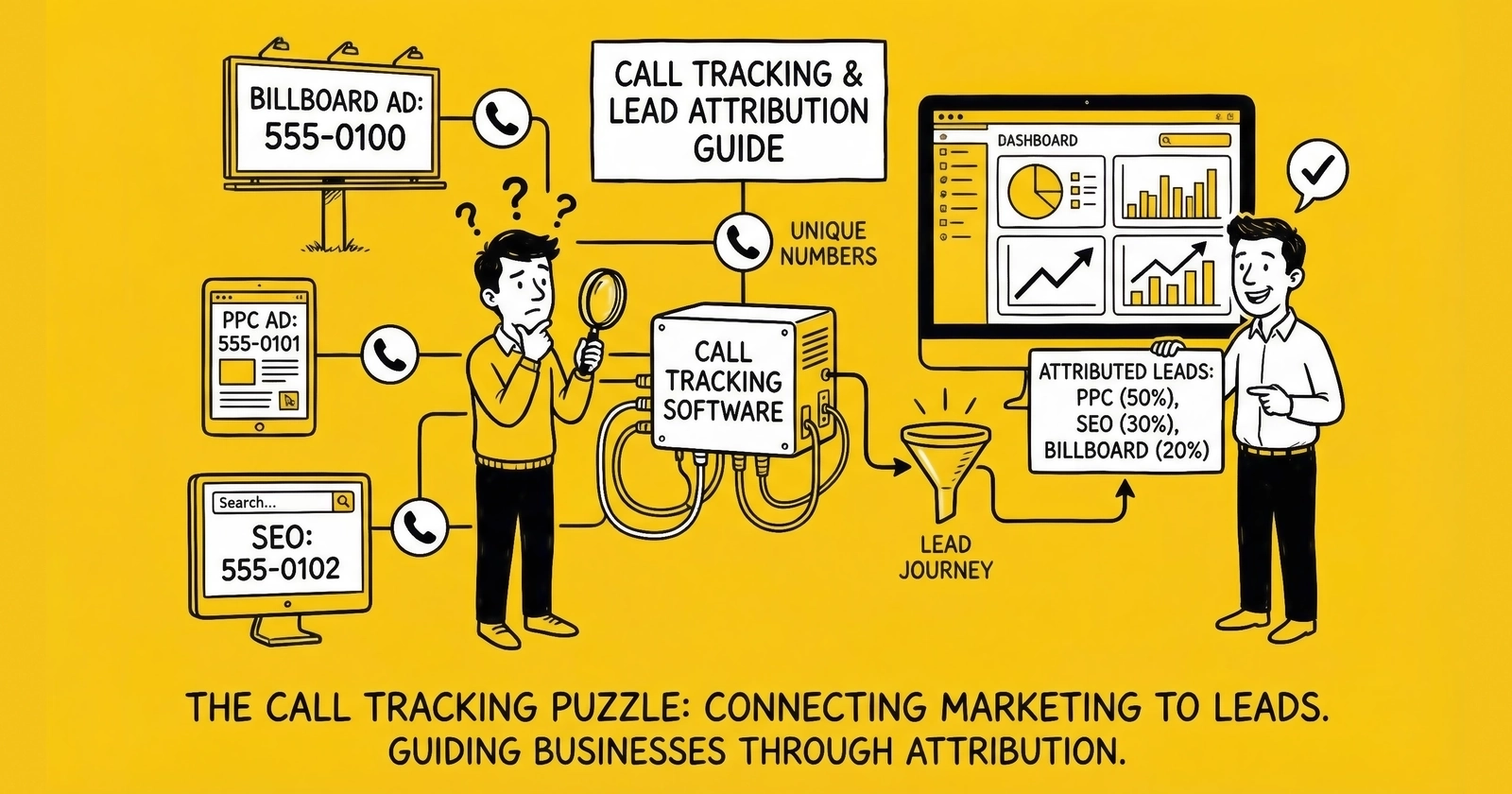
How call tracking transforms phone conversations into measurable marketing assets, enabling attribution precision that justifies premium pricing and drives sustainable growth.
Phone calls remain the highest-intent action a consumer can take. When someone picks up their phone and dials your number, they have moved beyond clicking and browsing. They want to talk to someone. Right now.
The challenge has always been measuring this high-value behavior with the same precision we apply to digital clicks and form submissions. Call tracking software solves that challenge by transforming anonymous phone conversations into data-rich marketing assets with complete source attribution, behavioral analysis, and revenue connection.
This guide examines call tracking software through the lens of lead attribution: how these platforms connect phone calls to their marketing origins, why that connection matters for ROI measurement, and which solutions fit different operational requirements. The goal is practical decision-making, not vendor comparison for its own sake. This measurement capability is fundamental to understanding lead attribution models and calculating true cost per lead.
Those who master call attribution don’t just know which campaigns generate calls. They know which calls generate revenue, which revenue came from which traffic sources, and how to systematically shift budget toward what actually works.
What Call Tracking Software Actually Does
Call tracking software assigns unique phone numbers to specific traffic sources, campaigns, or marketing channels. When a consumer calls one of these tracking numbers, the platform logs the call metadata, routes it according to configured rules, records the conversation if enabled, and attributes the call to its marketing origin.
The core value proposition is simple: know where your phone calls come from.
The implementation, however, involves considerable technical sophistication. Modern call tracking platforms handle six core functions that together enable complete call intelligence.
Number Pool Management
Dynamic Number Insertion (DNI) displays different phone numbers to different website visitors based on their traffic source. A visitor from Google Ads sees one number, a visitor from Facebook sees another, and a visitor from organic search sees a third. This enables granular attribution without requiring separate landing pages for each traffic source. The platform manages pools of numbers, automatically rotating them to ensure session-level tracking accuracy.
Call Routing
When calls arrive, the platform routes them based on configurable criteria: time of day, caller geography, IVR responses, buyer availability, or real-time auction results. Sophisticated platforms support priority-based routing, round-robin distribution, and percentage-based allocation to match calls with the buyers most likely to convert them.
IVR Qualification
Interactive Voice Response systems pre-qualify callers before routing to buyers. A basic IVR might confirm intent: “Press 1 if you’re looking for auto insurance quotes.” Advanced IVRs collect zip code, current coverage status, purchase timeline, and other qualification data that informs routing decisions and gets passed to buyers in real-time.
Recording and Transcription
Call recordings provide compliance documentation, quality monitoring, and performance optimization data. AI-powered transcription converts audio to searchable text, enabling keyword analysis across thousands of calls. Sentiment analysis identifies caller emotional state, flagging frustrated callers for supervisor review.
Attribution Reporting
The platform connects calls to their marketing origins, reporting metrics by source, campaign, keyword, ad group, and creative. Integration with ad platforms enables automated feedback, allowing algorithms to optimize for call conversions rather than just clicks.
Conversion Tracking
Beyond counting calls, platforms track call outcomes: qualified transfers, sales, appointments set. This closed-loop measurement connects marketing spend to actual revenue, not just call volume.
Why Call Attribution Matters for Lead Generation
The pay-per-call market reached $12 billion in 2024, growing at approximately 16% annually since 2021. This growth reflects a fundamental reality: phone calls deliver contact rates and conversion rates that form-based leads cannot match.
Research from the Lead Connect Survey shows that 78% of customers buy from the first responder. When consumers call rather than submit a form, they are the ones initiating contact. The business answering that call is the first responder by definition.
Consider the economics that explain why buyers willingly pay premium prices for calls. A form-based lead might cost $15 to generate and sell for $18. The buyer must then attempt contact, facing 30-40% contact rates on average. Of those contacted, perhaps 10-15% convert to customers. A qualified phone call might cost $40 to generate and sell for $50-60. But the buyer faces near-100% contact rate because the caller is already on the line. Conversion rates on qualified calls run 2-3x higher than form-based leads in most verticals. The math clarifies the premium: a consumer on the phone is 10-12x more likely to convert than a consumer who filled out a web form and is now waiting for a callback.
But this premium pricing only works if you can prove attribution. Without call tracking, you cannot attribute calls to specific campaigns, keywords, or creatives. You cannot measure which traffic sources generate qualified calls versus misdials. You cannot calculate true cost per qualified call by source, optimize ad spend toward call-generating campaigns, or prove to buyers that calls originated from your traffic.
Call tracking transforms phone calls from untracked events into measurable marketing assets. That measurement enables the optimization that separates profitable operations from those burning money on campaigns that look good in click reports but generate no real revenue.
How Call Tracking Attribution Works
Understanding the technical mechanisms behind call attribution helps you evaluate platforms and troubleshoot implementation issues.
Static vs. Dynamic Number Assignment
Static number assignment gives each traffic source a dedicated phone number. Your Google Ads display one number across all campaigns. Your Facebook ads display a different number. Your billboard displays a third. When calls arrive, you know the channel but not the specific campaign, ad group, or keyword. Static assignment works well for offline advertising like billboards, radio, TV, and print. It also serves high-level channel attribution, simple operations with few traffic sources, and budget-constrained implementations where the cost of large number pools would be prohibitive.
Dynamic Number Insertion takes a fundamentally different approach, assigning numbers based on visitor sessions rather than channels. When a user arrives at your website, the system assigns them a tracking number from a pool. That assignment persists throughout their session. If they call, the system connects the call to their complete session data: traffic source, landing page, pages viewed, time on site, and any form interactions.
DNI enables granular attribution at levels impossible with static assignment. You gain keyword-level tracking for paid search, ad-level tracking for display campaigns, device-type attribution, geographic correlation, and complete user journey reconstruction. The technical implementation involves JavaScript snippets that swap displayed phone numbers based on visitor attributes. The number pool size determines attribution precision: too few numbers means concurrent visitors might share numbers, creating attribution ambiguity, while too many numbers increases telephony costs without proportional benefit.
Session-Level Attribution
The most valuable call attribution connects calls to specific website sessions. When a visitor arrives from Google Ads, clicks through three pages, spends four minutes on your pricing page, and then calls the number displayed, session-level attribution captures that entire journey.
This capability enables insights impossible with simpler tracking. You can correlate multi-page engagement with call propensity, analyze which exit pages prompt calls, measure time-to-call from session start, identify device and browser patterns, and reconstruct cross-session journeys when proper identity resolution exists.
Session-level attribution requires cookie-based or fingerprint-based visitor identification. Privacy regulations and browser restrictions increasingly limit this tracking, making first-party data strategies essential for maintaining attribution accuracy.
Offline Attribution Challenges
Not all calls originate from digital sessions. Someone sees your TV ad, notes the phone number, and calls later from their landline. Someone receives your direct mail piece and calls the number printed on it. Someone hears your radio spot and uses voice search to find your number.
Offline attribution relies on dedicated static numbers for offline channels, statistical matching of call timing with advertising schedules, vanity numbers that identify specific campaigns, and caller surveys asking “how did you hear about us.” Accuracy decreases as the gap between ad exposure and call increases. A caller three days after seeing a billboard might have experienced multiple touchpoints in between, making clean attribution increasingly difficult.
Multi-Touch Call Attribution
Complex customer journeys involve multiple marketing touchpoints before the final call. A consumer might see a Facebook ad, click a Google search result, receive a retargeting impression, and finally call after receiving an email. Multi-touch attribution for calls applies the same frameworks used for digital conversions.
First-touch attribution credits the initial marketing interaction because without that first Facebook impression, the journey never started. Last-touch attribution credits the final interaction before the call, recognizing that email was the trigger that prompted action. Linear attribution distributes credit equally across all touchpoints, acknowledging that each interaction contributed to the outcome. Time-decay attribution weights recent touchpoints more heavily, reflecting that the email arriving one hour before the call matters more than the Facebook ad from two weeks ago. Position-based attribution emphasizes first and last touches while acknowledging the middle interactions that maintained engagement.
In 2024, over half of brands and agencies reported using multi-touch attribution despite its complexity. For call attribution specifically, the challenge intensifies because calls often occur offline, after unknown intervals, from devices different than those that saw ads.
Key Features to Evaluate
When selecting call tracking software, certain capabilities prove essential for effective lead attribution.
Dynamic Number Insertion
DNI quality varies dramatically between platforms. You need to evaluate pool size recommendations for your traffic volume, session timeout handling when numbers recycle, number format options including local, toll-free, and vanity numbers, geographic number availability if you need specific area codes, mobile versus desktop handling differences, and JavaScript implementation complexity. Platforms like CallRail, CallTrackingMetrics, and Invoca all offer DNI, but implementation details affect both attribution accuracy and user experience.
Call Recording and Transcription
For compliance documentation and quality analysis, evaluate recording storage duration and associated costs, transcription accuracy especially for industry-specific terminology, searchability across transcriptions, compliance disclosures including automatic “this call may be recorded” messages, PCI/HIPAA compliance for sensitive industries, and export capabilities for long-term storage. AI-powered transcription has improved dramatically, with major platforms achieving 95%+ accuracy on clear audio. Noisy environments, accents, and technical jargon reduce accuracy.
IVR Builder
Interactive Voice Response qualification affects both call quality and buyer acceptance. Consider menu depth supported and how many levels of qualification you can implement, data collection options including touch-tone, speech recognition, and open-ended questions, routing logic complexity and whether you can route based on IVR responses, real-time data passing to buyer systems, and abandonment rate reporting showing where callers drop off.
Industry benchmarks suggest keeping IVR interactions under 45 seconds with no more than three prompts before connecting to a live person. Each additional step reduces completion rates.
Integration Capabilities
Call attribution requires bidirectional data flow across your technology stack.
Ad platform integrations enable automated conversion import to Google Ads, Facebook, and Microsoft, algorithmic optimization for call conversions, and call extension management. CRM integrations connect calls to customer records through Salesforce, HubSpot, Pipedrive, and vertical-specific CRMs, enabling automatic call logging with recordings and lead creation from inbound calls. Lead distribution integrations pass calls into your routing infrastructure through boberdoo, LeadsPedia, and Phonexa compatibility, with real-time caller data transfer and disposition feedback loops. Webhook/API capabilities enable custom integrations through real-time call event notifications, custom data transformations, and third-party system updates.
Real-Time Reporting
Effective call operations require immediate visibility. You need live call monitoring to see calls in progress, real-time dashboards comparing current performance against targets, alert configuration to notify when metrics exceed thresholds, drill-down capability from aggregate views to individual calls, and historical comparison showing performance versus prior periods.
Platforms that batch reporting, providing data hours after events occur, leave operators blind during precisely the periods when intervention matters most.
AI-Powered Analytics
The AI in sales market exceeded $31 billion in 2024, growing at nearly 29% annually. AI capabilities increasingly differentiate call tracking platforms. Automated quality scoring evaluates calls against predefined criteria without manual review. Conversion prediction identifies call characteristics that correlate with outcomes. Talk pattern analysis measures metrics like talk-to-listen ratio, question frequency, and interruption rate. Agent coaching recommendations generated by AI identify specific improvement areas for each agent. Sentiment analysis detects caller emotional state, flagging frustrated or confused callers for attention.
These capabilities matter more at scale. An operation handling hundreds of daily calls cannot manually review each one. AI extends quality monitoring across 100% of call volume.
Major Call Tracking Platforms Compared
The call tracking market includes platforms serving different operational needs and scales.
CallRail
Best for: SMB call tracking with strong marketing agency support
CallRail has built its market position on accessibility and ease of use. The platform provides essential call tracking functionality without requiring extensive technical expertise to implement.
The platform delivers Dynamic Number Insertion with intuitive setup, call recording and transcription, Google Ads, Facebook, and HubSpot integrations, Conversation Intelligence for AI-powered analysis, and multi-channel attribution including form and chat tracking.
Pricing follows a subscription model starting at $45/month for the Call Tracking tier, ranging up to $145/month for Complete tier including conversation analytics. Usage-based minutes are included at each tier. The platform serves marketing agencies and local businesses who need reliable attribution without pay-per-call marketplace complexity.
CallTrackingMetrics
Best for: Agencies and contact centers needing unified tracking and call handling
CallTrackingMetrics bridges marketing attribution and contact center functionality. Unlike pure tracking platforms, it includes softphone capabilities allowing agents to answer calls directly in the browser.
The platform provides Dynamic Number Insertion with session-level tracking, a built-in softphone for browser-based call handling, Google Ads and Facebook attribution, ACD (Automatic Call Distribution) for contact center routing, and FormReactor for form tracking alongside calls.
Pricing follows a tiered subscription starting at approximately $39/month for basic plans, with enterprise plans offering custom pricing for high-volume operations. The hybrid positioning suits businesses managing inbound sales teams who want tracking and call handling in a single platform.
Invoca
Best for: Enterprise marketing teams requiring AI-powered conversation analytics
Invoca has positioned itself as the enterprise leader in conversation intelligence. The platform emphasizes AI-driven insights that turn conversations into actionable data.
The platform offers AI-powered Signal Scoring for automated quality assessment, real-time conversation analytics, integration with enterprise marketing stacks, HIPAA-compliant recording options, and custom AI model training for industry-specific terminology.
Pricing requires custom enterprise quotes, with implementation including professional services for AI configuration. Invoca serves enterprise marketing organizations where conversation intelligence justifies premium investment.
Ringba
Best for: Pay-per-call specialists and call marketplaces
Ringba has established itself as the industry standard for pay-per-call operations. The platform provides carrier-grade infrastructure optimized for call monetization.
The platform delivers real-time bidding through “Ring Tree” marketplace, an IVR builder with advanced routing logic, duration-based billing and payout management, a native marketplace connecting call buyers and sellers, and an API-first architecture for custom integrations.
Pricing follows a usage-based model with per-minute rates starting around $0.03-0.05 and no platform fee for basic tiers. For businesses where voice calls are the primary revenue driver, Ringba’s depth in call-specific routing, billing, and analytics justifies specialization over general-purpose platforms.
Phonexa
Best for: Enterprise multi-channel operations needing unified lead and call management
Phonexa spans lead distribution, call tracking, email, and SMS in an eight-product suite. The “Ping Post Calls 2.0” capability handles all five lead flows: Ping-Post Web Leads, Calls, Click Listings, Direct Post, and Ping Post Calls.
The platform provides the Call Logic module with predictive routing, deep integration with LMS (lead management) and email marketing, Cloud PBX with call scoring, closed-loop visibility across web, voice, and email, and enterprise-scale architecture. For detailed comparison of distribution platforms, see lead distribution platforms comparison.
Pricing follows a usage-based model with platform fees, requiring custom quotes based on product mix and volume. For enterprises wanting call tracking fully integrated with lead distribution and email systems, Phonexa eliminates the need to stitch together multiple point solutions.
Retreaver
Best for: Complex campaigns requiring tag-based dynamic routing
Retreaver differentiates through its “tagging” system for call routing. Instead of rigid hierarchical trees, calls route based on attributes attached to caller profiles.
The platform offers tag-based dynamic routing, webhook integrations for compliance verification, LeadiD and TrustedForm certificate transfer, and complex routing logic for nuanced buyer matching.
Pricing combines usage-based charges with subscription components. The platform serves operations where simple linear routing cannot capture the nuanced criteria determining optimal buyer matching.
Platform Selection Framework
Choosing call tracking software requires matching platform capabilities to your operational requirements.
By Business Scale
Operations handling under 1,000 calls monthly should consider CallRail or CallTrackingMetrics, which provide accessible entry points with essential functionality. Implementation takes hours, not weeks, and cost remains manageable at subscription pricing.
Operations in the 1,000-10,000 monthly call range find the full platform landscape becomes relevant. Your operational model – marketing attribution versus pay-per-call monetization – should guide selection. CallRail remains viable for pure marketing tracking, while Ringba or Phonexa better serve pay-per-call operations.
Operations exceeding 10,000 monthly calls face enterprise requirements that dominate selection. Evaluate Invoca for marketing intelligence emphasis, Ringba for marketplace operations, and Phonexa for multi-channel integration.
By Operational Model
Marketing attribution focus characterizes operations that generate calls for their own business and want to understand which marketing efforts drive them. CallRail, CallTrackingMetrics, or Invoca match this model, emphasizing integration with advertising platforms and CRMs.
Pay-per-call monetization describes operations that generate calls to sell to third-party buyers. Ringba, Phonexa, or Retreaver match this model, emphasizing routing, bidding, billing, and marketplace connectivity.
Hybrid lead/call operations handle both web leads and phone calls, possibly selling to the same buyers. Phonexa’s multi-channel suite or LeadsPedia’s integrated approach with call tracking reduce platform fragmentation.
By Technical Capacity
Operations without dedicated developers should prioritize platforms with intuitive interfaces and strong support. CallRail and CallTrackingMetrics excel here. Avoid platforms requiring custom integration development.
Operations with technical teams available find the full platform range accessible. Evaluate based on API capabilities, customization depth, and integration flexibility. Ringba and Phonexa offer more configuration options but demand more implementation effort.
By Vertical Requirements
Insurance and Financial Services compliance documentation requirements favor platforms with native TrustedForm and Jornaya integration. Phonexa’s eight-product suite addresses common insurance workflows, while Ringba’s marketplace connects to insurance-focused buyers.
Home Services operations find geographic routing matters significantly. Platforms must route calls to contractors serving specific service areas. CallRail, CallTrackingMetrics, and Ringba all handle geographic logic effectively.
Legal verticals command the highest CPLs in the industry, demanding precise attribution. Every misattributed call represents significant lost revenue. Ringba’s pay-per-call infrastructure handles the complex qualification required for legal calls.
Healthcare HIPAA compliance requirements narrow platform selection considerably. Evaluate BAA (Business Associate Agreement) availability and compliance certifications carefully.
Implementation Best Practices
Successful call tracking implementation extends beyond platform selection.
Number Pool Sizing
The number of tracking numbers in your pool determines attribution precision. Too few numbers means concurrent visitors share numbers, creating attribution ambiguity. Industry guidelines suggest a minimum pool size of 4 numbers per 100 concurrent website sessions, a recommended pool size of 6-8 numbers per 100 concurrent sessions, and 10+ numbers per 100 concurrent sessions for high-precision requirements. Monitor pool utilization weekly. If numbers frequently recycle before sessions close, expand the pool.
JavaScript Implementation
DNI requires JavaScript executing on every page where phone numbers appear. Place tracking JavaScript in the document head for fastest execution and use async loading to prevent render blocking. Test number swapping across all page templates, verify mobile rendering which represents a common failure point, and monitor JavaScript errors that might prevent number insertion. Failed JavaScript means displayed numbers don’t match expected tracking numbers, breaking attribution entirely.
Phone Number Formatting
Consistent formatting prevents user experience issues. Display local numbers in local format and toll-free numbers with standard 1-800 formatting. Ensure click-to-call functionality works on mobile, verify ADA compliance for screen readers, and test across browsers and devices.
Call Flow Testing
Before launching campaigns, verify the complete call path. Dial each tracking number from multiple devices and verify IVR prompts play correctly. Confirm routing reaches intended destinations, test after-hours handling, verify recording disclosures play, and check that caller data passes correctly to receiving systems. Document each test result. Call path issues discovered after launch create attribution gaps that cannot be recovered.
Conversion Tracking Configuration
For bidirectional platform integration, configure Google Ads call conversion import with appropriate windows and set up Facebook Conversions API for call events. Define conversion criteria including minimum duration, IVR completion, and agent connection. Verify conversion data flows within 24-48 hours and compare platform-reported conversions with call tracking system reports.
Attribution discrepancies between systems require investigation. Common causes include timezone differences, conversion window mismatches, and filter criteria inconsistencies.
Measuring Call Attribution Effectiveness
Effective call tracking generates specific metrics that inform optimization decisions.
Source-Level Metrics
Track six core metrics by traffic source: calls per source measuring raw call volume from each channel, qualified calls per source counting calls meeting duration or quality thresholds, qualification rate calculated as qualified calls divided by total calls, cost per call calculated as media spend divided by total calls, cost per qualified call calculated as media spend divided by qualified calls, and revenue per call requiring downstream data integration.
Sources with high volume but low qualification rates may indicate targeting or messaging issues. Sources with low volume but high qualification rates may deserve increased budget.
Campaign-Level Metrics
Within sources, granular campaign data enables optimization that source-level data cannot provide. Track keyword-level call attribution for paid search, ad-level call rates for display campaigns, landing page call rates across page variants, device-type call propensity where mobile typically indexes higher, and geographic call concentration. A campaign with low overall call volume might contain high-performing keywords worth expanding.
Quality Metrics
Beyond quantity, quality metrics prevent optimization toward high-volume but low-quality call sources. Average call duration indicates engaged conversations, with longer calls typically signaling quality. IVR completion rate shows the percentage of callers completing qualification prompts. Transfer success rate matters for live transfer operations. Agent talk time versus listen time reveals conversation balance, where balanced conversation typically indicates quality. Sentiment scores provide AI-derived caller satisfaction indicators.
Revenue Attribution
The ultimate measure connects calls to revenue. Track close rate by source to identify which sources generate calls that convert. Revenue per call by source captures actual revenue, not just call count. Customer lifetime value by call source reveals long-term value beyond initial sales. Return/refund rate by source serves as a quality indicator for call buyers.
Revenue attribution requires downstream data integration. When a call you generated ultimately converts to a sale through your buyer’s process, that conversion data should flow back to inform your acquisition strategies.
Common Attribution Challenges and Solutions
Challenge: Cross-Device Attribution
A consumer sees your mobile ad, researches on their desktop, and calls from their personal phone. Three devices, one journey, and traditional tracking sees three separate people.
Solutions include first-party identity graphs connecting authenticated sessions, probabilistic matching based on behavioral signals, CRM-based reconciliation after lead creation, and accepting attribution limitations while using incrementality testing for channel-level measurement.
Challenge: Offline-to-Online Tracking
Someone sees your billboard, searches your brand name, and calls the number on your website. The search gets credit; the billboard drove the action.
Solutions include vanity numbers unique to offline campaigns, landing page URLs unique to offline campaigns, post-call surveys asking about advertising exposure, geographic lift studies comparing markets with and without offline advertising, and statistical models correlating offline spend with call volume.
Challenge: View-Through Attribution
Did that display impression the caller saw but never clicked actually contribute to the call?
Solutions include platform-provided view-through reporting with its inherent bias acknowledged, incrementality testing by turning off display and measuring call volume change, reasonable view-through windows where 7 days often proves more defensible than 30, and separate reporting for click-through versus view-through attributed calls.
Challenge: Long Consideration Cycles
In B2B or high-value B2C, weeks or months may pass between first touch and call.
Solutions include extended attribution windows of 60-90 days for long cycles, multi-touch attribution weighting toward first touch, lead creation touchpoint emphasis identifying when prospects first identified themselves, and account-level attribution for B2B connecting all contacts to the account.
Challenge: Privacy Restrictions
Safari’s Intelligent Tracking Prevention, Chrome’s evolving cookie policies, and consumer opt-outs create data gaps.
Solutions include first-party data collection prioritization, server-side tracking implementation recovering 20-40% of lost signals, authenticated session extension, conversion modeling for untracked portions, and aggregated measurement approaches like GA4 data-driven attribution.
The Future of Call Attribution
Several trends are reshaping how call attribution will function in the coming years.
Server-Side Tracking
As browser-based tracking degrades, server-side tracking recovers signals. Platforms increasingly support server-side integration with ad platforms, reducing reliance on client-side JavaScript and third-party cookies.
AI-Powered Conversation Intelligence
AI analysis of call content moves beyond transcription to understanding intent, predicting conversion, and automated quality scoring. Platforms that invest in conversation AI will provide attribution insights impossible with traditional metadata analysis.
Privacy-First Attribution
New frameworks like Google’s Privacy Sandbox will affect how call attribution works across the web. Platforms must adapt to aggregate measurement, cohort-based attribution, and differential privacy approaches.
Unified Cross-Channel Attribution
The distinction between call tracking and web analytics continues to blur. Platforms that unify web, call, chat, and in-store attribution will provide more complete customer journey visibility.
Frequently Asked Questions
What is call tracking software and why do lead generation businesses need it?
Call tracking software assigns unique phone numbers to marketing sources, enabling attribution of phone calls to specific campaigns, keywords, and channels. Lead generation businesses need call tracking because phone calls represent high-intent consumer actions that often command 2-3x the value of form-based leads. Without call tracking, you cannot measure which marketing efforts generate calls, calculate true cost per call by source, or prove to buyers that calls originated from your traffic. The pay-per-call market reached $12 billion in 2024, and effective participation requires precise attribution.
How does Dynamic Number Insertion work for call attribution?
Dynamic Number Insertion displays different phone numbers to different website visitors based on their traffic source and session. When a user arrives at your website, JavaScript assigns them a tracking number from a pool. That assignment persists throughout their session. If they call, the system connects the call to their complete session data: traffic source, landing page, pages viewed, and time on site. This enables keyword-level attribution for paid search and ad-level tracking for display campaigns. Pool sizing matters: recommend 6-8 numbers per 100 concurrent sessions for reliable attribution.
What is the difference between call tracking and call analytics platforms?
Call tracking platforms focus on attribution: assigning calls to marketing sources and routing calls to destinations. Call analytics platforms extend beyond attribution to analyze call content, using AI to evaluate conversation quality, predict conversion probability, detect sentiment, and provide agent coaching recommendations. Some platforms like CallRail and CallTrackingMetrics combine both functions. Enterprise platforms like Invoca emphasize AI-powered analytics. Pay-per-call platforms like Ringba emphasize marketplace functionality. Choose based on whether attribution alone meets your needs or whether conversation intelligence adds sufficient value.
Which call tracking platform is best for pay-per-call lead generation?
Ringba has established itself as the industry standard for pay-per-call operations, providing carrier-grade infrastructure with real-time bidding, IVR builder, duration-based billing, and a native marketplace connecting call buyers and sellers. Phonexa offers an alternative for operations wanting call tracking integrated with lead distribution and email systems through its eight-product suite. For simpler pay-per-call operations, CallRail provides accessible functionality at lower cost. The choice depends on volume, marketplace needs, and integration requirements with existing lead distribution infrastructure.
How much does call tracking software cost?
Call tracking pricing models vary significantly. CallRail offers subscription pricing from $45-145/month with included minutes. CallTrackingMetrics starts around $39/month for basic plans. Ringba uses usage-based pricing at $0.03-0.05 per minute with no platform fee for basic tiers. Phonexa and Invoca require custom enterprise quotes. Beyond platform fees, consider number rental costs typically running $1-4 per number monthly, per-minute usage charges, and any integration or professional services. For a 10,000-call monthly operation, expect total platform costs of $500-3,000 depending on feature requirements.
Can call tracking integrate with Google Ads and Facebook for optimization?
Yes, major call tracking platforms support bidirectional integration with advertising platforms. Calls meeting configured conversion criteria automatically import as conversions into Google Ads and Facebook, enabling algorithms to optimize for call conversions rather than just clicks. This integration requires proper conversion tracking configuration, appropriate attribution windows, and verification that conversion data flows correctly. The integration enables bid strategies like Target CPA to optimize toward calls, typically delivering more qualified traffic than click-optimized campaigns.
How does call recording work for compliance and quality monitoring?
Call tracking platforms record calls when configured, storing audio files for compliance documentation and quality analysis. Recording requires proper disclosure, typically through an automated message at call start or agent verbal disclosure, depending on state law requirements. Some states require all-party consent. Recordings support TCPA compliance defense by documenting consumer consent and interaction. AI-powered transcription converts audio to searchable text, enabling keyword analysis and automated quality scoring across thousands of calls. Consider storage duration and costs: some platforms charge per recording, others include storage in subscription.
What metrics should I track to measure call tracking ROI?
Essential call tracking metrics include calls per source measuring raw volume by channel, qualified calls per source for calls meeting duration or quality thresholds, qualification rate as qualified divided by total, cost per qualified call as media spend divided by qualified calls, and revenue per call requiring downstream data. Quality metrics include average call duration, IVR completion rate, transfer success rate, and sentiment scores. Revenue attribution metrics connect calls to outcomes: close rate by source, revenue per call by source, and return rate by source for call buyers. These metrics enable systematic budget allocation toward sources generating actual revenue.
How do I handle call attribution for offline advertising like billboards or radio?
Offline call attribution uses dedicated static numbers assigned to each offline channel. Your billboard displays one number; your radio ad mentions a different number. When calls arrive on these numbers, you know the offline source. Limitations include: you cannot track which specific billboard or time slot drove each call, and callers may later find your number online rather than using the dedicated number. Supplementary methods include vanity numbers, post-call surveys, geographic lift studies comparing markets with and without offline advertising, and statistical models correlating offline spend with call volume trends.
What should I look for in call tracking for insurance lead generation?
Insurance call tracking requires compliance documentation integration through TrustedForm and Jornaya for TCPA defense, sophisticated IVR for caller qualification covering coverage type, zip code, and current carrier, geographic routing to match callers with licensed agents, and often real-time bidding for call monetization. Platforms like Phonexa offer eight-product suites addressing common insurance workflows. Ringba’s marketplace connects to insurance-focused buyers. Ensure any platform provides indefinite certificate storage given TCPA statute of limitations considerations. Medicare and ACA verticals require additional compliance features for CMS requirements.
Key Takeaways
-
Call tracking software transforms phone conversations into measurable marketing assets by assigning unique numbers to traffic sources, enabling the attribution precision that justifies premium call pricing in the $12 billion pay-per-call market.
-
Dynamic Number Insertion provides session-level attribution, connecting calls to complete visitor journeys including traffic source, pages viewed, and time on site. Pool sizing of 6-8 numbers per 100 concurrent sessions ensures attribution accuracy without excessive telephony costs.
-
Platform selection depends on operational model: CallRail and CallTrackingMetrics serve marketing attribution needs; Ringba and Phonexa serve pay-per-call monetization; Invoca serves enterprise conversation intelligence requirements.
-
Effective call attribution requires bidirectional integration with advertising platforms, enabling algorithms to optimize for call conversions rather than clicks, and downstream CRM integration for closed-loop revenue measurement.
-
AI-powered conversation analytics have moved from competitive advantage to baseline requirement, enabling automated quality scoring, conversion prediction, and agent coaching across 100% of call volume at scales impossible for human-only review.
-
Privacy restrictions increasingly limit client-side tracking, making server-side implementation and first-party data strategies essential for maintaining attribution accuracy in 2026 and beyond.
-
True ROI measurement requires attributing all costs to call-generating campaigns: media spend, platform fees, per-call technology charges, labor allocation, compliance costs, and return reserves.
Sources
- CallRail - Call tracking and marketing analytics platform referenced for DNI and attribution capabilities
- CallTrackingMetrics - Call tracking platform referenced for multi-channel attribution features
- Invoca - Enterprise conversation intelligence platform referenced for AI-powered call analytics
- Ringba - Pay-per-call platform referenced for carrier-grade call tracking infrastructure
- IAB Internet Advertising Revenue Report - Industry data on digital advertising and pay-per-call market growth
What Comes Next
Call attribution represents one layer of the complete lead attribution challenge. Form-based leads, multi-channel journeys, and cross-device behavior all require measurement strategies that complement call tracking.
For operations handling both calls and web leads, unified attribution becomes essential. Platforms that integrate call tracking with form tracking and lead distribution provide the complete visibility that enables systematic optimization.
Those who build sustainable businesses don’t just track calls. They connect calls to revenue, understand which marketing efforts generate that revenue, and continuously shift budget toward what actually works. Call tracking software provides the measurement foundation. What you build on that foundation determines results.
Statistics and platform information current as of late 2025. Pricing and features change regularly. Verify details with vendors before selection decisions.