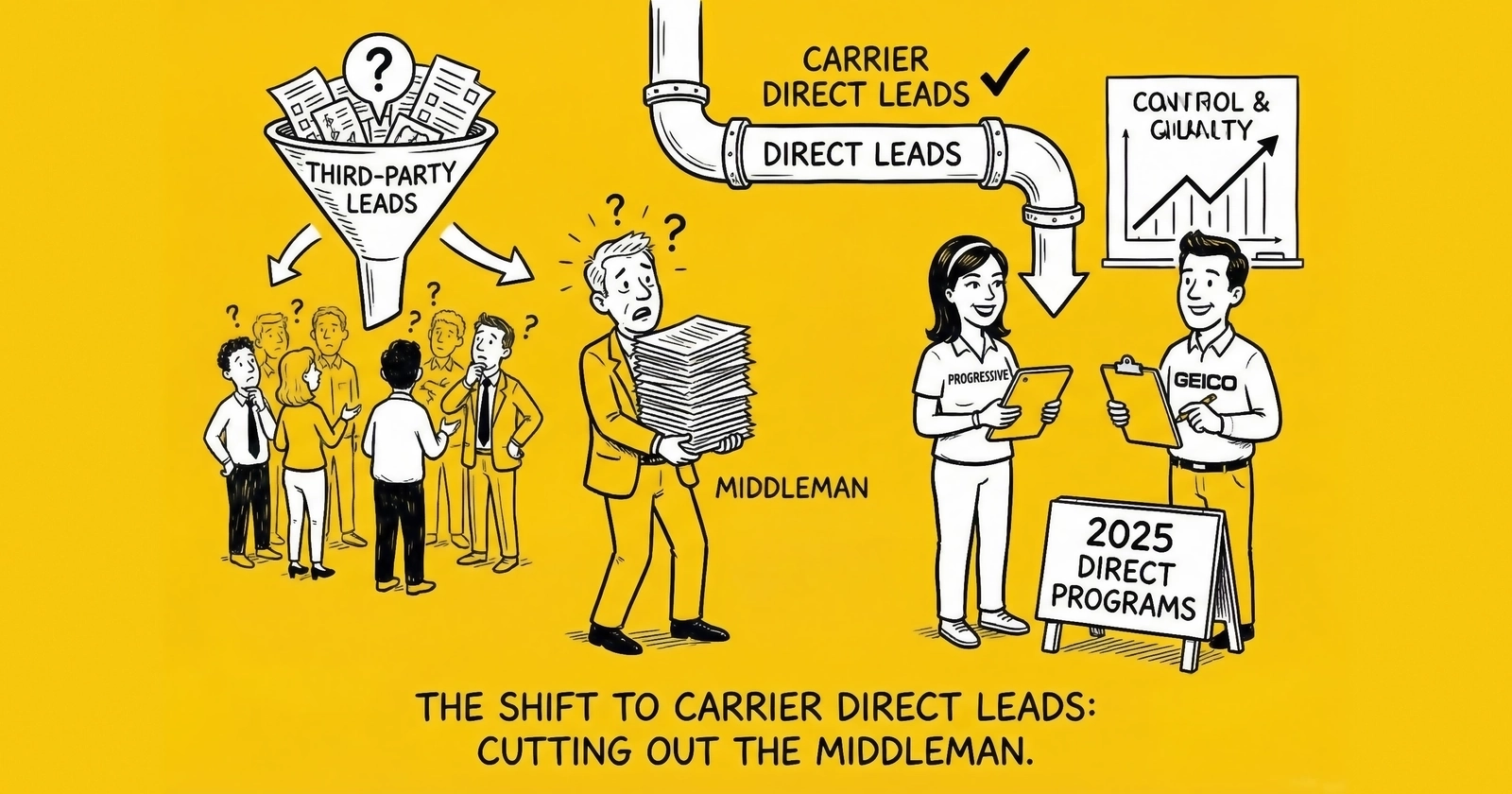
Understanding how major insurance carriers acquire customers directly, what it means for lead generators and agents, and how to position your business in a market dominated by billion-dollar advertising budgets.
When Progressive spent $3.5 billion on advertising in 2024 – a 187% increase from the prior year – they were not simply running television commercials. They were fueling a sophisticated customer acquisition machine that combines direct response marketing, digital lead purchasing, and technology infrastructure refined over decades.
GEICO, Allstate, State Farm, and other major carriers operate similar programs, each with distinct strategies, partner requirements, and economic models. For lead generators, understanding these carrier-direct programs determines whether you can access the largest buyers in the market. For agents, understanding how carriers acquire customers reveals both competitive threats and partnership opportunities.
This guide examines how carrier-direct lead programs actually work, what carriers look for in lead partners, how pricing and quality standards operate, and how the 2024-2025 market surge has reshaped the competitive landscape. The numbers and operational details here come from public filings, industry research, and the experience of operators who have built and maintained carrier relationships.
The Carrier-Direct Model: How Major Insurers Acquire Customers
Insurance carriers acquire customers through three primary channels: direct advertising (television, digital, brand campaigns), agent distribution (captive and independent agents selling policies), and performance marketing (purchasing leads, clicks, and calls from third-party sources).
The carrier-direct model focuses on that third channel – but with the carrier as the direct buyer rather than working through intermediary networks or agent relationships.
What Carrier-Direct Actually Means
When a carrier operates a direct lead program, they function as the end buyer in the lead generation ecosystem. They set their own acceptance criteria, integrate directly with publishers through API connections, operate their own call centers or digital sales teams, and control the entire customer acquisition process from lead receipt to policy binding.
Progressive, GEICO, and other direct writers have built substantial infrastructure to support this model. Progressive operates call centers capable of handling millions of inbound and outbound contacts annually. GEICO built its entire business model around direct sales efficiency, eliminating agent commissions in favor of lower consumer prices and centralized customer service.
The scale of these operations is substantial. Progressive’s 23.8 million private auto policies in force, combined with their $3.5 billion advertising investment, represent an acquisition machine processing hundreds of thousands of new customers monthly. At an estimated customer acquisition cost of $400-600 for direct-written auto policies, the math requires enormous operational efficiency to remain profitable.
The Technology Infrastructure
Carrier-direct programs require sophisticated technology integration that smaller buyers cannot match. Major carriers typically operate:
-
Real-time bidding systems that evaluate and price leads within milliseconds. Progressive and GEICO participate in exchanges like MediaAlpha, where they bid against other carriers for individual leads based on consumer characteristics and current demand.
-
Predictive scoring models that estimate conversion probability and customer lifetime value before accepting a lead. A consumer with a 720 credit score, homeowner status, and clean driving record might receive a bid 3x higher than a riskier profile – carriers use their actuarial data to price leads based on expected profitability.
-
Integrated CRM and dialer systems that route leads to appropriate sales channels within seconds. A lead showing high purchase intent might route to a live agent for immediate follow-up; a lower-intent lead might enter an automated nurture sequence.
-
Consent verification integration with TrustedForm, Jornaya, and internal compliance systems that validate every lead before acceptance. Carriers face substantial TCPA exposure from non-compliant leads and have built rigorous verification processes.
The Economic Engine
Understanding carrier economics explains their lead buying behavior. Insurance carriers evaluate customer acquisition based on lifetime value calculations that extend far beyond first-year premiums.
For auto insurance, a typical customer generates:
| Metric | Typical Range |
|---|---|
| First-year premium | $1,200-$1,800 |
| Policy retention rate | 80-85% annually |
| Average policy lifetime | 3-5 years |
| Cross-sell opportunity (home, life) | 15-25% of customers |
| Lifetime premium value | $4,000-$8,000+ |
Against this lifetime value, carriers can justify substantial acquisition investment. A $500 cost per acquired customer represents a 3:1 to 6:1 lifetime value ratio – well within acceptable range for carriers with strong retention programs.
This lifetime value calculation explains the intensity of carrier advertising. When Progressive reports a combined ratio of 87.4% (meaning they earned $12.60 in profit for every $100 of premium), they have capacity to invest aggressively in growth. The $3.5 billion advertising spend represents roughly $150 per policy in force – substantial, but sustainable when policies renew for years.
Progressive: The Dominant Direct Writer
Progressive has evolved from a specialty insurer focused on high-risk drivers to the third-largest auto insurer in the United States, with particular dominance in direct-to-consumer sales.
The Direct Business Model
Unlike traditional carriers that rely heavily on agent distribution, Progressive built its growth strategy around direct customer acquisition. Their direct channel – consumers who purchase online or through call centers without agent involvement – represents a significant portion of new business, complementing their independent agent channel.
This dual-channel approach gives Progressive flexibility. They can adjust marketing spend between direct acquisition and agent support based on market conditions, competitive positioning, and profitability targets. During the 2024 growth surge, Progressive increased both direct advertising and agent-focused investment, capturing market share across distribution channels.
Lead Acquisition Strategy
Progressive participates actively in the lead generation ecosystem through multiple channels:
-
Programmatic exchanges: Progressive is a major buyer on MediaAlpha and similar platforms, bidding in real-time auctions for leads that match their underwriting appetite. Their data science capabilities allow them to bid precisely based on predicted conversion and customer value.
-
Direct publisher relationships: For publishers generating substantial volume, Progressive establishes direct integration agreements that bypass exchange fees. These relationships typically require 1,000+ leads daily and extensive quality verification.
-
Comparison engine partnerships: Progressive partners with comparison sites like The Zebra and Insurify, appearing in quote comparisons and paying for qualified leads that convert through these platforms.
-
Affiliate programs: Progressive’s affiliate program allows publishers to earn commissions for customers who bind policies. This performance-based model shifts risk to publishers – they only earn when customers actually purchase.
Quality and Compliance Standards
Progressive’s lead acceptance criteria reflect their sophisticated underwriting and strong compliance posture:
-
Data requirements: Leads must include complete driver information (date of birth, license status, violation history), vehicle details (year/make/model, VIN preferred), current insurance status, and verified contact information.
-
Consent documentation: Progressive requires TrustedForm certificates or equivalent consent verification for all leads. Their compliance team audits consent language and form structure to ensure TCPA defensibility.
-
Contact validity: Phone and email validation at point of capture, with real-time verification preferred over batch processing.
-
Response time expectations: Progressive’s internal speed-to-contact standards require reaching consumers within minutes of lead receipt. They measure and optimize this continuously.
Working with Progressive
For lead generators seeking Progressive as a buyer, the path typically begins with their exchange participation. MediaAlpha provides the primary marketplace where publishers can access Progressive demand without direct relationship establishment.
Establishing direct relationships requires:
- Demonstrated volume (typically 500+ leads daily in their target geography and demographic)
- Proven quality metrics (return rates below 10%, verified consent documentation)
- Technical capability for real-time API integration
- Compliance infrastructure meeting their standards
Progressive’s procurement process for direct relationships can take 6-12 months, including pilot programs with reduced volume before scaling. Patience and consistent quality during pilot phases determine long-term relationship viability.
GEICO: The Original Direct Writer
GEICO pioneered the direct-to-consumer insurance model decades before Progressive’s current strategy. Their name – Government Employees Insurance Company – reflects origins selling directly to a defined customer segment without agent intermediation.
The Berkshire Efficiency Model
Warren Buffett acquired GEICO for Berkshire Hathaway in 1996, attracted by their low-cost operating model. GEICO’s expense ratio – the portion of premium consumed by operations rather than claims – consistently ranks among the lowest in the industry.
This efficiency focus shapes their approach to customer acquisition. GEICO invests heavily in brand advertising (the gecko, the cavemen) to generate inbound demand, reducing per-customer acquisition costs by driving consumers to seek them out rather than purchasing leads in competitive markets.
Lead Program Characteristics
GEICO’s lead acquisition strategy differs from Progressive in important ways:
-
Inbound focus: GEICO’s advertising generates substantial organic traffic to GEICO.com, reducing dependence on purchased leads. Their brand recognition drives consumers to begin shopping journeys on their site.
-
Selective lead purchasing: While GEICO participates in lead marketplaces, they historically purchased more selectively than Progressive, focusing on specific demographics and geographies where their pricing is competitive.
-
Recent pullback: Under Berkshire Hathaway’s underwriting discipline, GEICO reduced advertising spend during the 2022-2023 profitability challenges. Their estimated 2024 advertising spend of approximately $1.6 billion represents a pullback from peak levels, reflecting Berkshire’s patience in waiting for rate adequacy before growth investment.
-
Technology investment: GEICO has invested in digital capabilities, including AI-powered claims processing and customer service automation, aiming to maintain cost advantages as customer acquisition costs rise industry-wide.
Market Position Shift
GEICO’s relative position has shifted during 2024-2025. While they remain a top-three auto insurer, Progressive’s aggressive growth has narrowed the gap. Some industry analysts note Progressive’s market share gains came partly at GEICO’s expense during periods when GEICO prioritized profitability over growth.
For lead generators, this creates a nuanced market: GEICO remains a significant buyer but with more selective criteria than during their growth phases. Understanding their current underwriting appetite and geographic focus becomes essential for publishers seeking GEICO as a buyer.
Working with GEICO
GEICO’s lead acquisition operates more internally than Progressive’s exchange-focused approach:
-
Direct partnerships: GEICO establishes relationships with larger publishers generating consistent, high-quality traffic. These relationships often operate on negotiated rates rather than real-time bidding.
-
Comparison site participation: GEICO appears on major comparison platforms, though historically with less aggressive bidding than some competitors.
-
Call programs: GEICO operates substantial call center capacity and purchases live transfers and inbound calls from qualified vendors meeting their compliance requirements.
The path to GEICO relationships typically requires demonstrated scale and quality, with initial conversations often occurring through industry conferences or business development outreach. Their procurement cycles can be longer than Progressive’s, reflecting Berkshire’s deliberate approach to vendor relationships.
Other Major Carrier Programs
Beyond Progressive and GEICO, several carriers operate substantial direct lead acquisition programs with distinct characteristics.
Allstate
Allstate operates a hybrid model combining direct acquisition with a large captive agent force. Their carrier-direct programs focus on:
-
Digital sales: Allstate.com generates direct policy sales, supported by purchased leads and affiliate traffic.
-
Agent support: Allstate provides leads to their captive agent network, balancing direct acquisition with agent relationship maintenance.
-
2024 investment: Allstate maintained approximately $1.87 billion in advertising spend during 2024, supporting both direct and agent channels.
Allstate’s lead requirements emphasize geographic targeting aligned with agent presence, creating opportunities for publishers in specific state markets.
State Farm
State Farm – the largest auto insurer by market share – operates primarily through exclusive agents rather than direct sales. Their approach to lead purchasing differs accordingly:
-
Agent lead programs: State Farm provides leads to their agents through various programs, functioning as an intermediary between publishers and their agent force.
-
Brand advertising: Their $1.11 billion advertising spend focuses heavily on brand awareness, driving consumers to seek local State Farm agents.
-
Lower direct acquisition: State Farm purchases fewer leads for direct call center sales compared to Progressive or GEICO, reflecting their agent-centric distribution model.
Regional and Specialty Carriers
Beyond the nationals, regional carriers and specialty insurers operate lead programs with distinct characteristics:
-
Regional carriers (Erie, AAA, regional mutuals) often focus on specific geographic markets with tailored lead programs.
-
Specialty carriers (high-risk insurers, non-standard markets) purchase leads that national carriers reject, creating secondary markets for certain traffic types.
-
Telematics-focused carriers (Root, Metromile) acquire customers through mobile-first experiences, often purchasing leads for app download and quote completion.
Lead Generator Requirements for Carrier-Direct Relationships
Establishing direct relationships with major carriers requires meeting their technical, quality, and compliance standards. Understanding these requirements helps publishers assess readiness and identify gaps.
Volume Requirements
Carriers typically require minimum daily volumes before establishing direct relationships:
| Carrier Tier | Typical Minimum | Preferred Volume |
|---|---|---|
| Major national (Progressive, GEICO) | 500-1,000 leads/day | 2,000+ leads/day |
| Regional carriers | 100-250 leads/day | 500+ leads/day |
| Specialty markets | 50-100 leads/day | 200+ leads/day |
Below these thresholds, publishers typically access carrier demand through exchanges (MediaAlpha, EverQuote) rather than direct relationships. The exchange model provides access to carrier demand without the integration overhead of direct relationships.
Technical Integration Requirements
Direct carrier relationships require sophisticated technical capabilities:
-
Real-time API integration: Carriers expect leads delivered via API within seconds of capture, not batch files or delayed transmission. Your systems must handle real-time posting with appropriate error handling and retry logic.
-
Ping-post capability: Most carrier integrations use ping-post architecture, where you first ping with partial lead data to receive a bid, then post complete data if you accept the bid. This requires maintaining stateful sessions and handling asynchronous responses.
-
Data standardization: Carrier APIs expect data in specific formats – standardized field names, normalized address formats, consistent date formatting. Mapping your internal data schema to carrier requirements requires development investment.
-
Redundancy and uptime: Carriers expect 99.9%+ availability from integration partners. System downtime during business hours damages relationships and may trigger contract penalties.
Quality Standards
Carrier quality requirements typically include:
-
Return rate thresholds: Most carriers establish maximum return rates, often 8-12%. Exceeding these thresholds triggers review, rate adjustments, or relationship termination. Return causes include invalid contact information, duplicate leads, and qualification mismatches.
-
Contact rate expectations: Carriers track what percentage of leads answer calls within defined timeframes. Fresh leads should achieve 50%+ contact rates; significantly lower rates indicate data quality issues.
-
Conversion monitoring: While carriers may not share exact conversion data, they track source-level performance and adjust bidding accordingly. Consistently low-converting traffic receives lower bids or exclusion.
-
Fraud prevention: Carriers expect sophisticated fraud prevention including bot detection, IP analysis, and behavioral scoring. Leads showing fraud indicators are rejected and may trigger source-level bans.
Compliance Requirements
Insurance lead compliance has intensified significantly, with carriers requiring:
-
Consent documentation: TrustedForm certificates or equivalent on every lead. Certificates must include session replay capability, visible consent language, and matching timestamps.
-
Consent language standards: Carriers often mandate specific consent language, particularly for telemarketing purposes. Generic consent may not meet their requirements.
-
Disclosure compliance: Landing pages must include required state disclosures, clear identification of the advertising entity, and accurate product descriptions.
-
Regular audits: Carriers conduct periodic compliance audits, reviewing landing pages, consent flows, and documentation practices. Audit failures can suspend or terminate relationships.
The Intermediary Layer: MediaAlpha, EverQuote, and Exchange Platforms
For most publishers, accessing carrier demand occurs through intermediary platforms rather than direct relationships. Understanding these platforms helps you maximize yield from carrier demand without meeting direct relationship requirements.
MediaAlpha: The Programmatic Marketplace
MediaAlpha operates the largest programmatic insurance lead marketplace, connecting publishers with carriers and agents through real-time auctions. For an in-depth comparison of major platforms, see our insurance lead exchanges guide.
-
Scale: MediaAlpha reported $864.7 million (2024) in revenue for 2024, with transaction value exceeding $1.5 billion. They connect over 1,200 active partners and generated nearly 119 million consumer referrals.
-
How it works: Publishers integrate with MediaAlpha via API, pinging leads into their system for auction. Multiple carriers bid in real-time based on lead characteristics. The winning bid determines the publisher’s revenue; MediaAlpha takes a platform fee from the transaction.
-
Carrier participation: Major carriers including Progressive participate directly on MediaAlpha, providing access to premium demand without direct relationship overhead. Carriers set their own bidding logic, geographic targeting, and quality filters.
-
Publisher requirements: MediaAlpha evaluates publishers before granting access, requiring compliance documentation, traffic quality evidence, and technical integration capability. Once approved, publishers can access carrier demand immediately.
EverQuote: The Hybrid Model
EverQuote combines a consumer-facing comparison platform with B2B lead distribution, creating a different value proposition.
-
Consumer brand: EverQuote.com provides a comparison shopping experience, generating organic traffic that supplements paid acquisition.
-
Revenue scale: EverQuote crossed $500.2 million in revenue for 2024, with their auto vertical generating $446 million – 96% year-over-year growth.
-
Distribution model: EverQuote sells leads to both carriers and agents, with shared leads going to 3-7 buyers and exclusive leads commanding premium pricing.
-
Publisher opportunities: Publishers can sell to EverQuote as an aggregator, leveraging their carrier relationships without direct integration.
Strategic Platform Selection
Choosing between platforms depends on your operational capabilities:
-
For smaller publishers (under 500 leads/day): Exchange platforms provide access to carrier demand without meeting direct relationship thresholds. The platform fee is the cost of accessing premium buyers without building those relationships yourself.
-
For larger publishers (500+ leads/day): Blended strategies work best – direct relationships for primary demand, exchange platforms for fill and competitive pricing.
-
For quality-focused publishers: Platforms with strong fraud prevention and quality scoring protect your reputation. A lead that passes MediaAlpha’s filters has been pre-validated for carrier standards.
The 2024-2025 Market Surge: What Changed
The insurance lead market experienced dramatic transformation during 2024-2025, driven by carrier profitability recovery and aggressive growth investment.
The Underwriting-to-Advertising Cycle
Insurance carriers operate on a predictable cycle: when underwriting is profitable, they invest in growth; when losses mount, they cut advertising and restrict new business.
2022-2023 represented a contraction phase. Auto insurers faced unprecedented claims inflation from vehicle repair costs, used car valuations, and medical expenses. Carriers responded by raising rates, restricting new business, and cutting advertising spend. Lead prices compressed as demand declined.
2024 marked dramatic reversal. Rate increases earned through, restoring profitability. Progressive’s Q4 2024 combined ratio of 87.4% indicated exceptional underwriting results. Carriers responded by ramping advertising aggressively – Progressive’s near-tripling of ad spend to $3.5 billion was the most dramatic example.
Impact on Lead Economics
The carrier spending surge transformed lead economics across the market:
-
Pricing increases: Shared auto insurance leads that sold for $15-20 during the contraction phase climbed to $25-35. Exclusive leads reached $60-80 in competitive markets, with premium inventory exceeding $100.
-
Volume expansion: MediaAlpha reported 202% year-over-year transaction value growth in Q4 2024. EverQuote’s auto vertical grew 96%. Carriers absorbed inventory that would have struggled to find buyers 18 months earlier.
-
Quality premium: As carriers competed for leads, they bid up high-quality inventory disproportionately. Publishers with strong consent documentation, verified data, and proven conversion rates captured premium pricing.
Cyclical Considerations
The current market represents a cyclical peak. Operators should plan for eventual normalization:
-
Carrier capacity limits: Even aggressive carriers have growth limits. Progressive cannot indefinitely maintain 187% advertising growth. As they approach target market share, spending will stabilize.
-
Competitive response: Other carriers observing Progressive’s gains will respond with their own investment, potentially bidding up lead costs to unprofitable levels.
-
Underwriting cycles: Future claims inflation, catastrophic events, or competitive pricing pressure could compress carrier profitability, triggering another contraction.
-
Smart positioning: Building diversified buyer relationships across carriers and channels provides stability when individual carrier strategies shift. Depending on a single carrier’s aggressive buying phase creates vulnerability.
Pricing and Contract Structures
Carrier-direct lead pricing operates through several models, each with distinct economics and risk profiles.
Real-Time Bidding
On exchange platforms, carriers bid for leads in real-time based on lead characteristics and current demand:
-
Dynamic pricing: The same lead might fetch $25 in low-demand hours and $45 during peak competition. Understanding carrier bidding patterns helps optimize submission timing.
-
Filter-based bidding: Carriers set filters for geography, driver profile, vehicle type, and other characteristics. Leads matching premium filters receive higher bids.
-
Quality adjustments: Historical performance affects bid levels. A source with proven conversion rates commands higher bids than unproven traffic.
Negotiated Rates
Direct carrier relationships often operate on negotiated pricing:
-
Fixed CPL: Carriers agree to pay a set price for leads meeting defined criteria. This provides revenue predictability but may leave money on the table during high-demand periods.
-
Tiered pricing: Different lead tiers (by quality score, geography, or demographic) receive different pricing. Premium leads earn premium rates.
-
Performance bonuses: Some contracts include bonuses for exceeding quality thresholds or delivering above-target volumes during peak periods.
Revenue Share Models
Some carrier relationships operate on revenue share rather than fixed CPL:
-
Commission on bound policies: Publishers earn a percentage of premium when leads convert to policies. This aligns publisher incentives with carrier outcomes but delays payment and creates cash flow challenges.
-
Hybrid models: Fixed CPL plus bonus based on conversion performance, providing base revenue with upside for quality.
Contract Terms
Carrier contracts typically include:
-
Minimum volume commitments: Carriers may require minimum daily or monthly volumes in exchange for premium pricing.
-
Exclusivity provisions: Some carriers require exclusivity – leads sold to them cannot be sold to competitors. This commands premium pricing but limits distribution options.
-
Return policies: Contracts specify return windows (typically 24-72 hours) and valid return reasons.
-
Compliance representations: Publishers warrant that leads comply with applicable regulations and carrier requirements.
-
Termination clauses: Either party can typically terminate with 30-90 days notice, though specific violations may trigger immediate termination.
Compliance Considerations for Carrier Programs
Carrier-direct relationships impose substantial compliance obligations, often exceeding minimum regulatory requirements.
TCPA Compliance
The Telephone Consumer Protection Act creates the primary compliance framework for lead generation:
-
Consent requirements: For autodialed calls or texts, prior express written consent is required. The consent must be “clear and conspicuous” and identify specific parties authorized to call.
-
One-to-one considerations: While the FCC’s one-to-one consent rule was vacated by the 11th Circuit Court in January 2025, many carriers continue requiring specific seller identification in consent language as a risk management measure.
-
Documentation standards: Carriers require consent certificates (TrustedForm, Jornaya) for every lead. Certificates must capture consent language display, user interaction, and submission timestamp.
-
Penalty exposure: TCPA violations carry $500-$1,500 per unsolicited call. Class action lawsuits regularly produce multi-million dollar settlements. Carriers will terminate relationships that generate TCPA complaints.
State Insurance Regulations
Insurance marketing faces state-specific requirements:
-
Licensing considerations: Pure lead generation typically does not require insurance licensing, but the line blurs when forms provide quotes or coverage recommendations.
-
Advertising standards: Many states require specific disclosures and prohibit certain claims about insurance products. Rate claims may require carrier authorization.
-
Do Not Call compliance: Federal and state DNC requirements apply. Scrub against registries before calling; honor internal DNC requests immediately.
Carrier-Specific Requirements
Beyond regulatory minimums, carriers impose additional standards:
-
Brand guidelines: Carriers dictate how their names, logos, and products can be referenced. Unauthorized brand use can terminate relationships.
-
Consent language approval: Carriers may require approval of specific consent language before accepting leads from new landing pages.
-
Periodic audits: Carriers audit landing pages, consent flows, and documentation practices. Audit failures can pause or terminate lead acceptance.
-
Data security standards: Carriers require appropriate data handling practices, often including specific security certifications or documented procedures.
Building Your Carrier-Direct Strategy
Successfully accessing carrier-direct demand requires strategic planning and sustained execution.
Assessment: Are You Ready?
Before pursuing carrier-direct relationships, honestly assess your capabilities:
-
Volume capacity: Can you consistently deliver 500+ leads daily in carrier target markets? Carriers want reliable scale, not sporadic volume.
-
Quality infrastructure: Do you have consent certification, phone/email validation, fraud detection, and quality monitoring? Carriers expect these capabilities as baseline.
-
Technical readiness: Can your systems handle real-time API integration, ping-post architecture, and 99.9%+ uptime? Integration failures damage relationships.
-
Compliance maturity: Are your consent processes, landing pages, and documentation practices audit-ready? Carrier compliance reviews are thorough.
If gaps exist, address them before pursuing direct relationships. The exchange path provides carrier access while you build capabilities.
The Exchange Path
For most publishers, exchanges provide the practical path to carrier demand:
- Start with MediaAlpha or EverQuote to access carrier bidding without direct relationship requirements.
- Build quality metrics demonstrating low return rates, high contact rates, and compliant operations.
- Expand volume through traffic optimization and channel expansion.
- Establish track record that supports direct relationship conversations.
Exchange participation provides revenue while building the metrics that enable direct relationships.
Direct Relationship Development
When ready for direct relationships:
Target appropriate carriers: Match your traffic characteristics with carrier appetite. A publisher generating non-standard auto leads should pursue specialty carriers before Progressive.
Prepare your pitch: Carriers want to see volume capacity, quality metrics, compliance documentation, and technical capability. Prepare a comprehensive overview addressing these areas.
Start with pilot programs: Carriers typically begin with limited volume pilots before scaling. Expect 30-90 day evaluation periods with intensive quality monitoring.
Deliver consistently: Pilot success depends on meeting quality and volume commitments. Inconsistent delivery during pilots prevents scaling.
Build relationships: Carrier partnerships are relationship businesses. Responsive communication, transparent issue resolution, and proactive quality management build trust over time.
Frequently Asked Questions
What is a carrier-direct lead program?
A carrier-direct lead program is when an insurance carrier like Progressive or GEICO purchases leads directly from publishers or through exchange platforms, rather than having leads flow through agents or other intermediaries. The carrier operates their own sales teams to convert these leads into policies. Major carriers spend billions annually on customer acquisition through these programs, with Progressive investing $3.5 billion in advertising during 2024.
How much do carriers pay for auto insurance leads?
Auto insurance lead pricing varies significantly based on lead quality, distribution model, and market conditions. In the 2024-2025 market, shared leads typically price at $25-35, exclusive leads at $50-100, and premium exclusive leads with verified data and real-time delivery can exceed $100. Live transfer calls command $100-200+. Pricing fluctuates based on carrier advertising budgets, geographic targeting, and seasonal patterns.
What volume do I need to work directly with Progressive or GEICO?
Major carriers typically require 500-1,000+ leads per day minimum for direct relationships. Some carriers will consider smaller publishers for specific geographic or demographic niches. Below these thresholds, publishers access carrier demand through exchange platforms like MediaAlpha, which aggregates smaller publishers into volume that attracts carrier participation.
How do I get started selling leads to insurance carriers?
Most publishers start through exchange platforms (MediaAlpha, EverQuote) rather than direct carrier relationships. These platforms provide immediate access to carrier demand without meeting direct relationship volume requirements. To get started: establish compliant lead generation with proper consent documentation, integrate with an exchange platform, build quality metrics over time, then pursue direct relationships once volume and quality support it.
What are the compliance requirements for insurance leads?
Insurance lead compliance requires TCPA-compliant consent documentation, including TrustedForm or Jornaya certificates capturing consent language display and user interaction. Leads must include accurate contact information, meet carrier data requirements, and originate from compliant landing pages with required disclosures. Carriers audit compliance regularly and terminate relationships that generate TCPA complaints or regulatory issues.
Why did carrier advertising spending increase so much in 2024?
Carrier advertising spending surged in 2024 because underwriting profitability returned after difficult 2022-2023 conditions. Auto insurers raised rates to offset claims inflation, and those rate increases earned through by 2024, restoring profit margins. Progressive’s Q4 2024 combined ratio of 87.4% indicated exceptional profitability, enabling their record $3.5 billion advertising investment. Carriers invest in growth when profitable and contract during losses.
What is the difference between Progressive and GEICO lead programs?
Progressive operates more aggressively in lead marketplaces, participating actively in real-time bidding on exchanges like MediaAlpha and pursuing direct publisher relationships at scale. GEICO focuses more on brand advertising to generate inbound demand, purchasing leads more selectively. GEICO recently pulled back spending under Berkshire Hathaway’s underwriting discipline, while Progressive tripled advertising investment. Progressive offers more accessible marketplace participation; GEICO requires more targeted relationship development.
How do carriers evaluate lead quality?
Carriers evaluate lead quality through multiple metrics: return rates (leads rejected for data issues), contact rates (percentage of leads successfully reached), conversion rates (leads that become policies), and customer lifetime value (long-term policy retention and cross-sell). Carriers track these metrics at the source level, adjusting bids and relationships based on performance. Publishers with consistently strong metrics command premium pricing and preferred capacity.
What return rate should I expect on carrier-direct leads?
Industry-acceptable return rates typically range from 8-12%. Rates above 12% trigger carrier concern and potential relationship review. Rates above 15% often result in rate reductions, volume caps, or termination. Common return reasons include invalid phone numbers, duplicate leads, qualification mismatches, and consent documentation issues. Managing return rates requires robust validation, clear buyer criteria matching, and rapid issue resolution.
Is the current high-demand market sustainable?
The 2024-2025 market represents a cyclical peak driven by carrier profitability recovery. This demand level is not permanently sustainable. Carriers will eventually reach growth targets, competitive dynamics will stabilize, and future underwriting cycles may compress profitability. Smart practitioners build diversified buyer relationships and maintain margin discipline rather than depending on peak-market pricing to continue indefinitely. Historical patterns suggest 3-5 year cycles between expansion and contraction phases.
Key Takeaways
-
Carrier-direct programs represent the largest demand source in insurance lead generation. Progressive’s $3.5 billion advertising spend and similar carrier investments create substantial lead purchasing capacity through direct relationships and exchange platforms.
-
Access comes primarily through exchanges for most publishers. MediaAlpha and EverQuote provide carrier demand access without meeting the 500-1,000+ daily lead volume requirements for direct relationships. Start here while building capabilities.
-
Quality standards are non-negotiable. Carriers require consent documentation, validated contact information, fraud prevention, and return rates below 10-12%. Meeting these standards is table stakes for carrier relationships.
-
The 2024-2025 market represents a cyclical peak. Carrier advertising surged due to profitability recovery, not permanent market restructuring. Build for sustainability rather than depending on peak pricing.
-
Technical and compliance infrastructure matters. Real-time API integration, ping-post capability, TrustedForm certification, and audit-ready operations are requirements, not differentiators.
-
Carrier strategies differ significantly. Progressive operates aggressively in exchanges; GEICO focuses on brand-driven inbound demand. Allstate balances direct and agent channels; State Farm operates primarily through agents. Understanding each carrier’s model helps you position appropriately.
-
Direct relationships take time. Expect 6-12 month sales cycles, 30-90 day pilots, and ongoing relationship investment. Consistent quality during evaluation periods determines scaling opportunity.
-
Diversification protects against carrier strategy shifts. When any single carrier adjusts their strategy (as GEICO did during underwriting challenges), diversified buyer relationships provide stability.
Sources
- Insurance Information Institute - Auto Insurance Facts - Industry data on carrier market share, combined ratios, and advertising spend
- MediaAlpha - Insurance lead exchange platform referenced for carrier-direct marketplace dynamics
- EverQuote - Insurance lead marketplace referenced for publisher access to carrier demand
- NAIC Insurance Industry Snapshot - National Association of Insurance Commissioners data on carrier financials
- GEICO - Direct carrier referenced for comparison of lead program strategies
Statistics and market data current as of early 2025. Carrier strategies, pricing, and requirements change based on market conditions and corporate priorities. Verify current requirements through direct carrier communication or exchange platform updates before making significant business decisions.