# ChatGPT Ads at Cannes Lions 2026 – Criteo Activates 2,000 Brands, the $2.5B Revenue Projection, and the Lead-Generation Channel Map
> **Canonical:** https://www.leadgen-economy.com/blog/chatgpt-ads-cannes-2026-criteo-2000-brands-lead-gen/
> **Published:** 2026-06-19
> **Author:** Alex Paddington
> **Source:** LeadGen Economy – https://www.leadgen-economy.com
---
*The Cannes debut formalizes positioning OpenAI built through Q1 and Q2 – and the Criteo 2,000-brand activation tells the lead-gen channel-map story the OpenAI keynote left implicit.*
---
## June 23, 2026 – When ChatGPT Ads Became a Cannes Property
OpenAI's Cannes Lions debut on June 23, 2026 followed Criteo's June 22 investor announcement and Forrester's June 21 contrarian analysis. The three-day cluster compressed what had been a quarter of incremental announcements into a single news cycle. Patrick Dresser, OpenAI Head of Global Advertising, and Sarah Boorstin from OpenAI's commercial team presented "Advertising in the Age of AI" at the Debussy Theatre from 11:45 AM to 12:15 PM. David Dugan, OpenAI Head of Global Ads Solutions, characterized 20 percent of ChatGPT queries as carrying commercial intent during the Cannes press briefing.
The financial frame arrived earlier. Axios reported on April 9, 2026 that OpenAI projects $2.5 billion in 2026 advertising revenue against the company's broader projected topline. The figure sets the scale at which OpenAI's commercial team is operating – large enough to attract Fortune 500 agency relationships, small enough that the company's offering remains under construction. The Criteo June 22 disclosure of 2,000-plus activated brands provides the demand-side confirmation that the offering is shipping to advertisers at meaningful scale.
For lead-generation operators, the Cannes debut is the inflection point at which ChatGPT Ads moves from experimental channel to budgeted channel. Q3 2026 planning conversations now include ChatGPT Ads alongside Google AI Mode, Performance Max, and Meta Advantage+ as line items rather than as exploratory test categories. The article works through the unit economics Criteo disclosed, the Forrester contrarian frame that lands two days before the Cannes session, the vertical-specific compliance gating that constrains insurance and mortgage activation, and the operator decision facing budgeted channel selection.
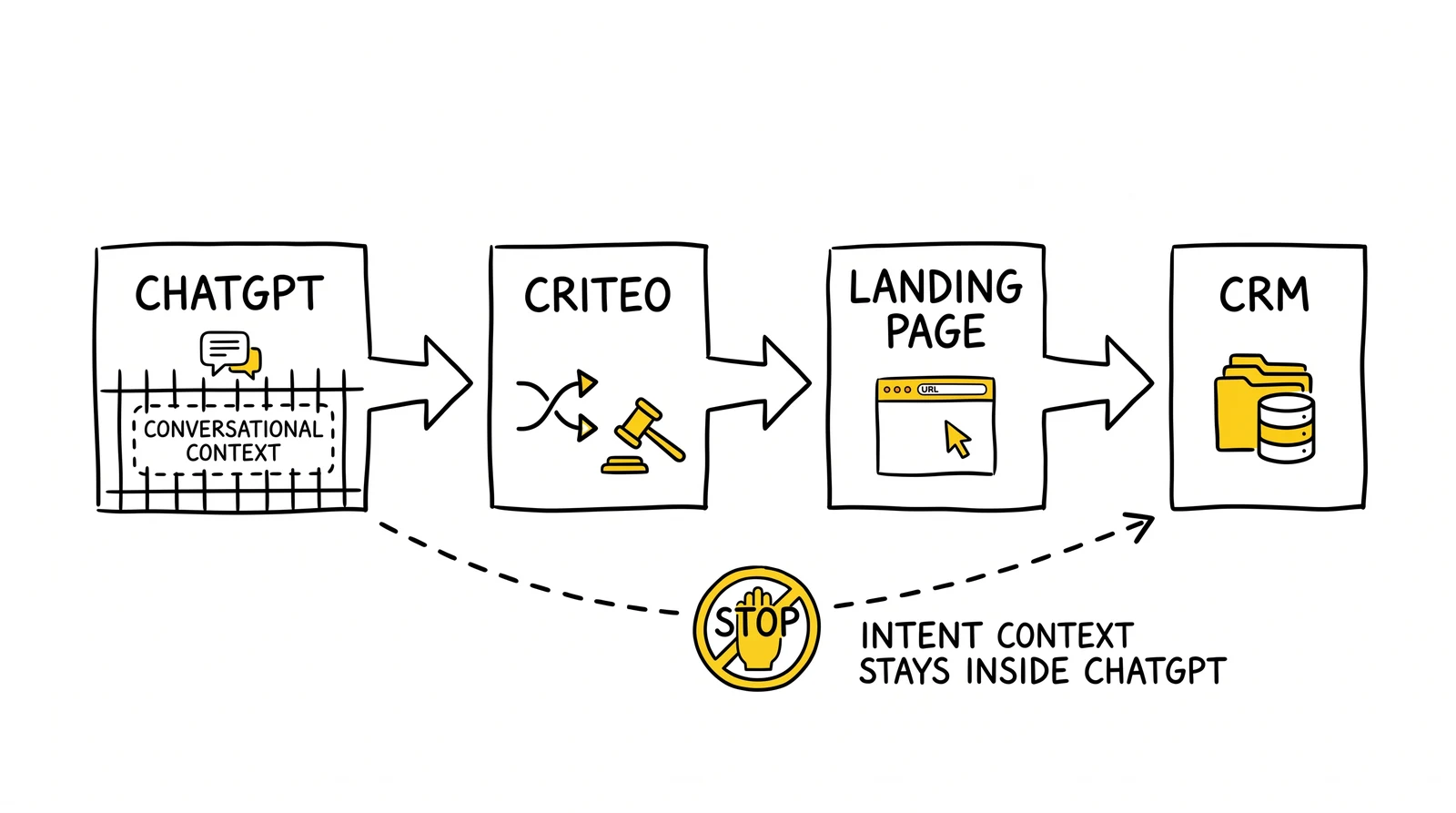
The conversion benefit reaches the CRM. The intent context that lead-scoring models price does not. Buyer waterfalls cannot rank what they cannot see.
---
## What Criteo Actually Disclosed on June 22
The Criteo investor announcement timed for the day before OpenAI's Cannes session was not coincidental. Criteo positioned the 2,000-brand activation milestone as the demand-side proof point for the ChatGPT Ads narrative OpenAI would extend the following day. The numbers in the announcement bear the analytical weight of the lead-gen channel-map decision.
Criteo's published figures: more than 2,000 brands activated on the ChatGPT Ads reseller integration, approximately 4x higher spend after activation versus the pre-activation baseline, click-through rates two to three times higher than comparable formats, and 1.5x conversion lift versus other referral channels. The 2,000-brand figure compares to approximately 1,000 brands reported at Criteo's Q1 2026 earnings call on May 6 – a doubling in approximately seven weeks. The growth-rate signal indicates that advertiser onboarding is the operationally constrained variable rather than buyer demand.
The 4x spend lift after activation reflects two compounding factors. Advertisers that elect ChatGPT Ads activation typically have larger discretionary budgets than the median Criteo client base, which biases the post-activation spend benchmark upward. Activation also unlocks campaign types that drive incremental spend within the activated brand's media plan. The 4x figure is real but conflates onboarding selection with inherent channel productivity.
The CTR and conversion-lift figures are more directly channel-specific. Two-to-three-times higher click-through rates than comparable formats and 1.5x conversion lift versus other referral channels are the headline performance numbers Criteo is offering to support the activation pitch to additional brands. Lead-gen operators should weight the conversion-lift number more heavily than the CTR number for budget-allocation purposes – CTR is upstream of the conversion event that determines unit economics.
The 50 percent drop in cross-out rate cited in some coverage is non-regulated retail data from Criteo's broader portfolio. The number should not be extrapolated to TCPA-governed lead-gen verticals where consent-capture requirements add cost the retail comparison does not bear. Operators in regulated verticals should treat the 50 percent figure as out-of-scope rather than as a benchmark for their own pilots.
---
## The Forrester Contrarian Frame That Landed Two Days Before Cannes
Jay Pattisall and Joe Johnston at Forrester published "Google Dethrones OpenAI as Agencies' Preferred AI Partner" on June 21, 2026 – two days before OpenAI's Cannes session. The timing was not coincidental. Forrester's positioning was to land the contrarian frame before the OpenAI narrative could capture the Cannes media cycle.
The Forrester analysis argues that Google's broader advertising infrastructure and existing agency relationships give it a structural advantage over OpenAI's standalone offering. The structural points include Google's integrated buying surface across Search, AI Mode, Performance Max, and YouTube; the depth of agency-side training and certification on Google Ads compared to the nascent ChatGPT Ads tooling; and the lower switching cost for agencies extending existing Google relationships into AI Mode versus building net-new ChatGPT Ads operations.
Forrester's parallel February 10, 2026 research found 83 percent of consumers would continue using the ChatGPT free tier despite ads, suggesting that consumer tolerance for the ad format is not the binding constraint. The binding constraints sit on the supply side – agency capability, buyer infrastructure, and integration with broader campaign-management workflows. The supply-side constraints favor the incumbent (Google) over the challenger (OpenAI) regardless of consumer tolerance.
For lead-gen operators, the Forrester analysis matters because it tells the budget-allocation story OpenAI's Cannes narrative left implicit. The early-mover positioning on ChatGPT Ads is real, but the channel will continue to compete against Google's deeper infrastructure for the same agency budget. Operators that allocate Q3 2026 budget to ChatGPT Ads should size the allocation against the realistic scenario in which Google AI Mode captures the larger share of agency-mediated AI ad spend through 2026 and 2027.
The contrarian frame also reframes the Criteo activation count. Two thousand brands activated through Criteo represent a substantial volume, but the scale matters relative to the broader Google Ads activated-advertiser count that runs in the hundreds of thousands. ChatGPT Ads is shipping at meaningful scale; it is not yet at infrastructure-class scale relative to incumbent platforms.
---
## Vertical Gating – Why Insurance and Mortgage Wait
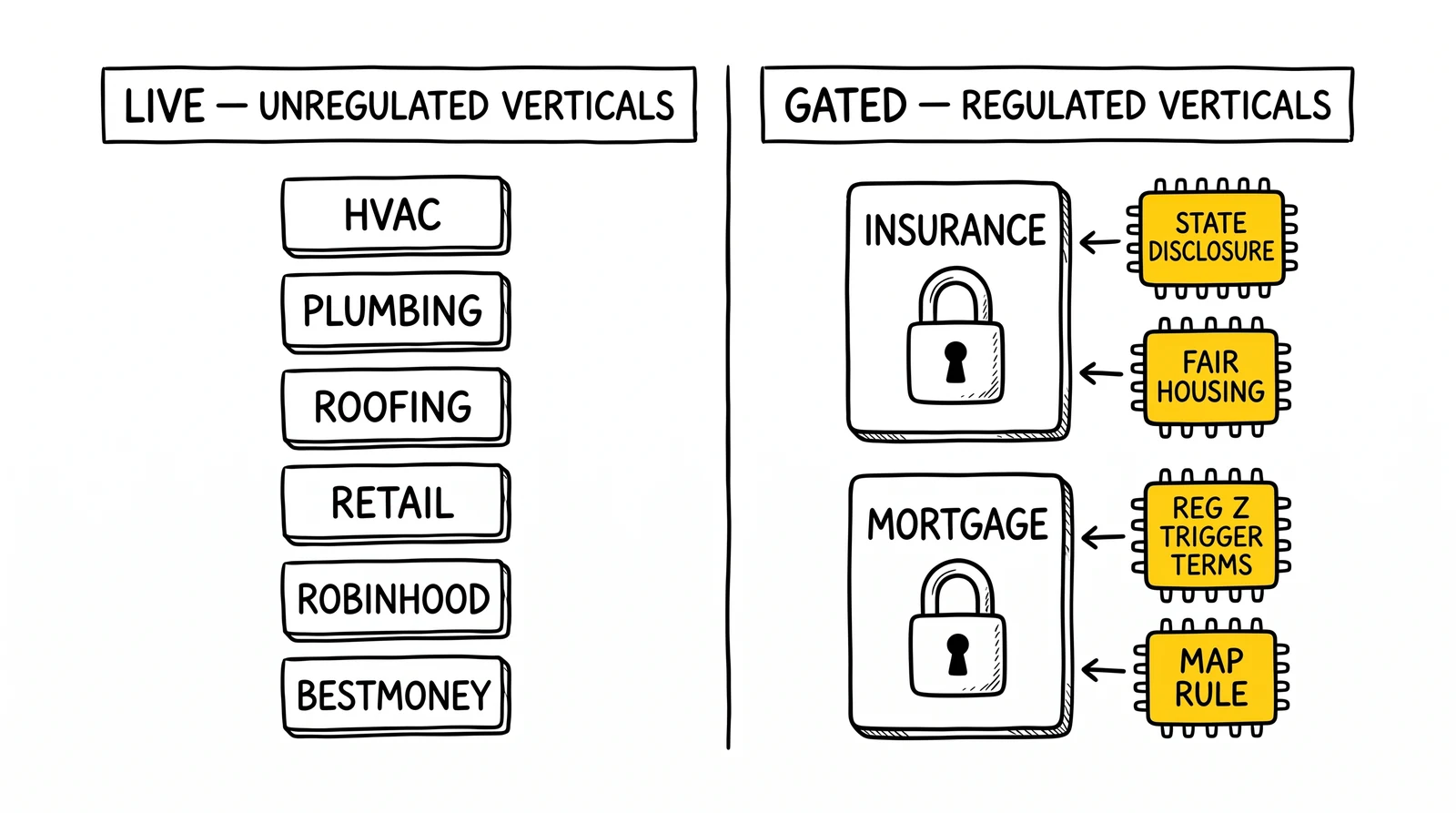
The day-one ChatGPT Ads verticals are local services – HVAC, plumbing, roofing – and consumer retail. Financial services verticals added Robinhood and BestMoney to the activated cohort on May 20, 2026. Insurance and mortgage verticals remain gated by Fair Housing Act, FTC MAP Rule (Regulation O / Mortgage Assistance Relief Services), state insurance department disclosure requirements, and Reg Z trigger-term rules.
Local services pilot now. Insurance and mortgage wait for compliance frameworks the MediaAlpha settlement made non-optional.
The compliance gating reflects structural constraints AI-generated ad copy cannot easily satisfy. State insurance departments require specific disclosure language in insurance advertising – license numbers, plan-name accuracy, and rate-comparison framing – that black-box AI-generated headlines do not reliably produce. The Fair Housing Act prohibits discrimination in housing-related advertising on protected characteristics, and AI-generated audience-targeting decisions create downstream Fair Housing exposure that operators have not yet adequately mapped to ChatGPT Ads architecture.
Reg Z trigger terms under 12 CFR 1026.24 require full disclosure when mortgage ads include APR, monthly payment, or "no money down"-style copy. AI Max URL expansion under Google Ads has produced parallel exposure that mortgage advertisers are still working through; ChatGPT Ads URL routing presents similar exposure. Until operators can demonstrate explicit URL-routing controls and disclosure-completeness verification, mortgage activation is structurally limited.
The MediaAlpha precedent is the cautionary frame. The FTC's August 2025 settlement with MediaAlpha at $45 million (within the $145 million combined Assurance IQ plus MediaAlpha settlement) signaled that lead-gen marketplaces themselves are in regulatory scope, not just installers or carriers. The settlement specifically cited deceptive lead-gen practices around health insurance funnels where AI-generated headlines may have contributed. A solar lead aggregator running ChatGPT Ads with auto-generated "$0 down" headlines is structurally the most enforcement-exposed configuration in performance marketing, layering FTC, state AG (Connecticut, Arizona, Texas, Florida have all opened solar enforcement fronts), and post-MediaAlpha marketplace exposure.
Insurance and mortgage operators should treat 2026 H2 as discovery-only on ChatGPT Ads – establishing measurement infrastructure, monitoring competitor activity, and engaging with OpenAI's compliance roadmap. Full activation likely waits until Q1 or Q2 2027 when vertical-specific compliance frameworks mature. The conservative position protects against the regulatory exposure the MediaAlpha settlement clearly established.
---
## The Three-Hop Attribution Chain and Lead-Gen Operations
ChatGPT Ads attribution flows through a three-hop chain – ChatGPT to Criteo to the advertiser's landing page to the CRM. The chain has architectural consequences for lead-gen operations that intent-context-based lead scoring depends on.
OpenAI does not share conversational context from the ChatGPT side of the interaction with downstream attribution surfaces. The conversational context that would inform intent-based lead scoring – the buyer's question, the buyer's prior turns in the conversation, the LLM's clarifying responses – sits inside ChatGPT and is not visible to the advertiser's CRM or buyer waterfall. Lead scoring models that rely on intent context to prioritize handler routing, buyer bidding, or qualification escalation lose the upstream signal.
The structural insight runs both directions. ChatGPT-originated leads carry conversion-quality benefits – the buyer arrived pre-qualified through the LLM interaction. But the lead-quality signal is asymmetric. The advertiser observes the conversion benefit without observing the intent-context detail. Buyer-waterfall ranking algorithms that price intent context cannot price ChatGPT-originated leads at the same precision they price leads with full attribution chains.
The consent-capture problem extends the attribution-chain challenge into TCPA-defensibility territory. Ping-post lead distribution economics depend on a TrustedForm or Jornaya certificate created at form submission as the TCPA-defensible artifact buyers price against. ChatGPT Ads architecture allows users to complete a lead conversation inside the AI Mode ad without touching the advertiser's form, eliminating the JavaScript session the consent-capture SDK requires for certificate generation.
ActiveProspect's December 2025 Bot Detection product launch, flagging more than 150,000 leads per week, demonstrates the industry doubling down on certificate-level signal exactly as ChatGPT removes the certificate-eligible session. The arms-race dynamic between AI-mediated lead flows and consent-capture infrastructure is now operationally live. Lead operators handling ChatGPT-originated traffic should run parallel pilots to understand certificate-eligibility behavior in the ChatGPT Ads flow before committing budget at scale.
---
## What CPL Looks Like for Lead-Gen Verticals
ChatGPT Ads CPL economics are not yet publicly benchmarked. The exercise of modeling indicative CPL ranges produces directional estimates rather than authoritative numbers.
Modeled estimates based on Criteo's reported 1.5x conversion lift versus other referral channels and typical paid-search CPC ranges of $3 to $5 produce indicative CPL ranges around $35 to $55 for home services verticals. The numbers are competitive with Google Local Services Ads benchmarks for the same vertical, which sit in the $40 to $70 range depending on geography and category. The competitive positioning suggests ChatGPT Ads is a credible alternative to LSA for home services operators, with the early-mover positioning benefit at current activation pricing.
For insurance vertical, the modeling exercise is constrained by the compliance gating. The 2026 H2 discovery-only window precludes pilot CPL measurement against the production buyer base. Insurance operators should model 2027 activation pricing against the 2026 discovery-period learning rather than against current insurance LSA or paid-search benchmarks.
For mortgage vertical, the Reg Z trigger-term exposure adds friction the unit economics need to account for. The same headline-generation flexibility that produces ChatGPT Ads conversion benefits creates compliance review overhead that mortgage operators do not face in the same intensity on tightly-controlled Google Search campaigns. The compliance overhead reduces net per-lead margin relative to controlled-headline channels.
The broader analytical claim is that ChatGPT Ads CPL economics will vary substantially by vertical based on the consent-capture and compliance frictions specific to each. Operators should run their own pilot CPL benchmarks rather than rely on extrapolated industry estimates. The CPL numbers in the early-disclosure phase from Criteo and OpenAI represent activation-side selection bias and should not be treated as steady-state channel benchmarks.
---
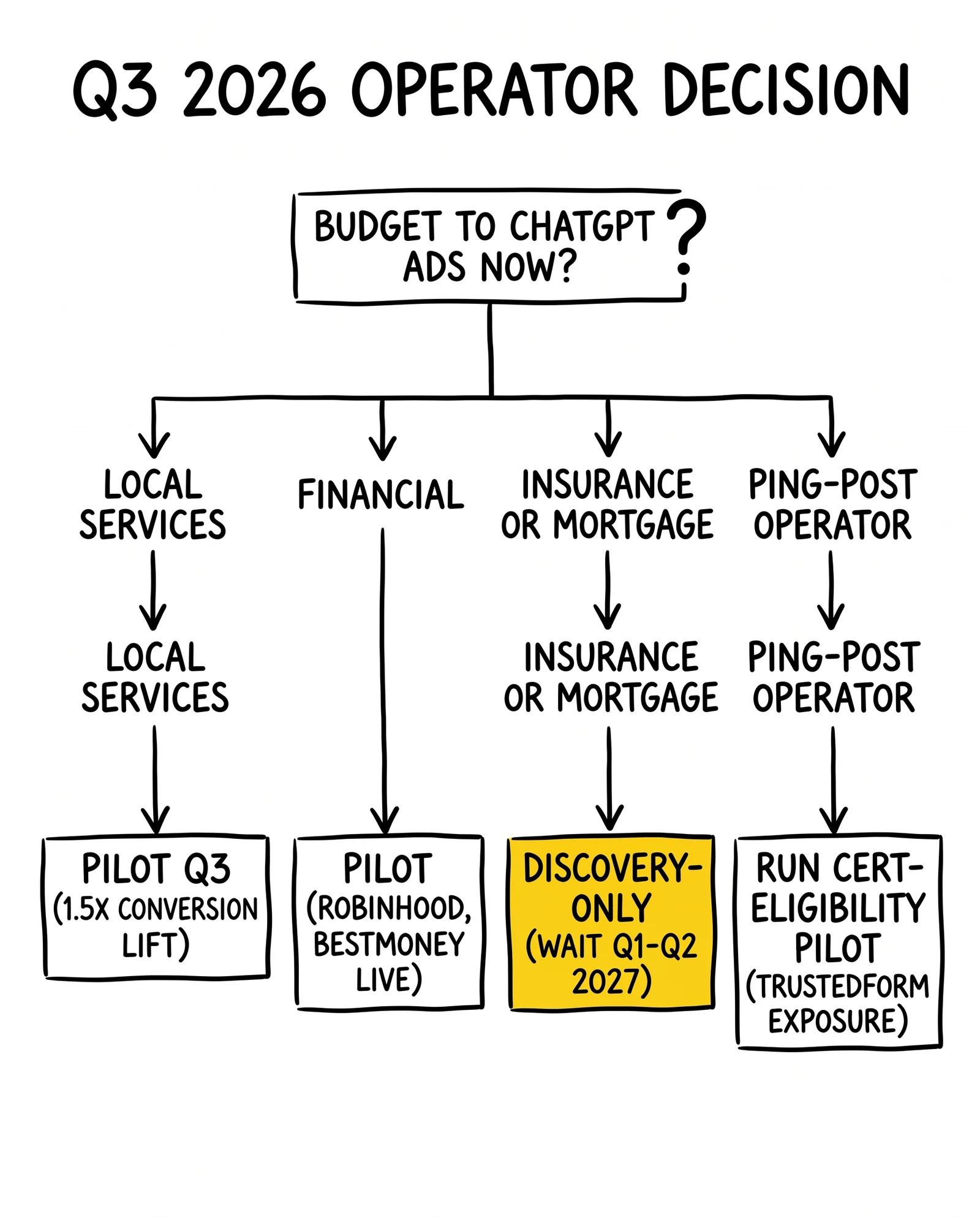
## What Lead Operators Should Do in Q3 2026
The action surface follows from the channel-availability and compliance-gating matrix. Five operator considerations track.
First, local services operators with simple consent capture and Google LSA-style economics should pilot ChatGPT Ads in Q3 2026 to capture the early-mover positioning at the Criteo-reported conversion premium. The 1.5x conversion lift versus other referral channels translates into real margin improvement at competitive activation pricing.
Second, insurance and mortgage operators should treat 2026 H2 as discovery-only. Establish measurement infrastructure, monitor competitor activation status, and engage with OpenAI's compliance roadmap. Plan for Q1 to Q2 2027 activation contingent on vertical-specific compliance frameworks reaching maturity. The MediaAlpha settlement precedent makes premature activation in these verticals genuinely risky.
Third, ping-post operators should run parallel pilots to understand certificate-eligibility behavior in the ChatGPT Ads flow. Determine whether ChatGPT-originated leads clear top-tier buyer waterfalls without certificate documentation, what alternative TCPA-defensibility artifacts are available, and what the per-lead waterfall ranking discount is for certificate-absent leads. The consent-capture infrastructure question is operationally specific and cannot be answered from vendor materials.
Fourth, evaluate the budget-allocation trade-off between ChatGPT Ads and Google AI Mode. The Forrester contrarian frame suggests Google's deeper infrastructure will capture the larger share of agency-mediated AI ad spend through 2026 and 2027. The early-mover ChatGPT Ads positioning is real but should be sized relative to the realistic incumbent advantage Google retains.
Fifth, track the OpenAI-Criteo roadmap for vertical activation. Insurance and mortgage activation will follow the compliance-framework maturation that the operator side cannot directly accelerate. Operators positioned to activate quickly when verticals open will capture early-mover pricing; operators that wait for full general availability will pay competitive-CPM equilibrium pricing.
Pilot where compliance is simple. Wait where it is not. Run a certificate-eligibility test before any ping-post budget moves at all.
---
## Key Takeaways
- OpenAI debuted ChatGPT Ads at Cannes Lions on June 23, 2026 with Patrick Dresser and Sarah Boorstin at the Debussy Theatre 11:45 AM to 12:15 PM. Axios reported $2.5 billion 2026 ad revenue projection on April 9.
- Criteo disclosed more than 2,000 activated brands on June 22 with approximately 4x spend lift, CTR 2-3x higher than comparable formats, 1.5x conversion lift versus other referral channels. Growth from ~1,000 brands at May 6 Q1 earnings.
- Day-one verticals: local services (HVAC, plumbing, roofing) plus consumer retail. Financial services added Robinhood, BestMoney on May 20. Insurance and mortgage remain gated by Fair Housing, MAP Rule, state insurance compliance, and Reg Z trigger terms.
- Forrester June 21 contrarian analysis (Pattisall, Johnston): "Google Dethrones OpenAI as Agencies' Preferred AI Partner." 83% of consumers would keep ChatGPT free tier despite ads per Forrester February 10 research.
- Instant Checkout retreat announced March 5, 2026; only ~30 Shopify merchants ever onboarded. Walmart EVP Daniel Danker characterized it as "a very temporary moment in time" at Morgan Stanley TMT 2026.
- Three-hop attribution chain (ChatGPT → Criteo → landing page → CRM) kills intent-context-based lead scoring because conversational context stays inside ChatGPT.
- TrustedForm and Jornaya certificate problem: ChatGPT Ads architecture allows lead completion without form interaction, eliminating the JavaScript session needed for consent-capture certificate generation.
- Modeled CPL: $35 to $55 for home services verticals (competitive with Google LSA $40-$70). Numbers are modeled estimates, not authoritative benchmarks. Pilot before scale commitment.
- Operator action: local services pilot Q3 2026; insurance/mortgage discovery-only through 2026 H2; ping-post operators run certificate-eligibility pilots; size budget allocation against Forrester contrarian incumbent-advantage frame; track vertical activation roadmap.
---
## Sources
- [Axios – OpenAI $2.5B 2026 Ad Revenue Projection (April 9, 2026)](https://www.axios.com/2026/04/09/openai-advertising-revenue-2026)
- [Criteo – Q2 2026 ChatGPT Ads Investor Announcement](https://investors.criteo.com/news-releases/news-release-details/criteo-2000-brands-chatgpt-ads-q2-2026)
- [Cannes Lions 2026 – Advertising in the Age of AI Program](https://www.canneslions.com/sessions/advertising-in-the-age-of-ai-2026)
- [Forrester – Google Dethrones OpenAI as Agencies' Preferred AI Partner (June 21, 2026)](https://www.forrester.com/blogs/google-dethrones-openai-agencies-preferred-ai-partner/)
- [Forrester – ChatGPT Free Tier Tolerance Despite Ads (February 10, 2026)](https://www.forrester.com/blogs/chatgpt-ads-consumer-tolerance-february-2026/)
- [Walmart EVP Daniel Danker – Morgan Stanley TMT Conference 2026](https://www.morganstanley.com/events/technology-media-telecom-conference-2026/walmart-keynote)
- [CNBC – OpenAI Revamps Shopping Experience After Instant Checkout (March 24, 2026)](https://www.cnbc.com/2026/03/24/openai-revamps-shopping-experience-in-chatgpt-after-instant-checkout.html)
- [ActiveProspect – Bot Detection Launch (December 2025)](https://activeprospect.com/blog/bot-detection-launch-december-2025/)