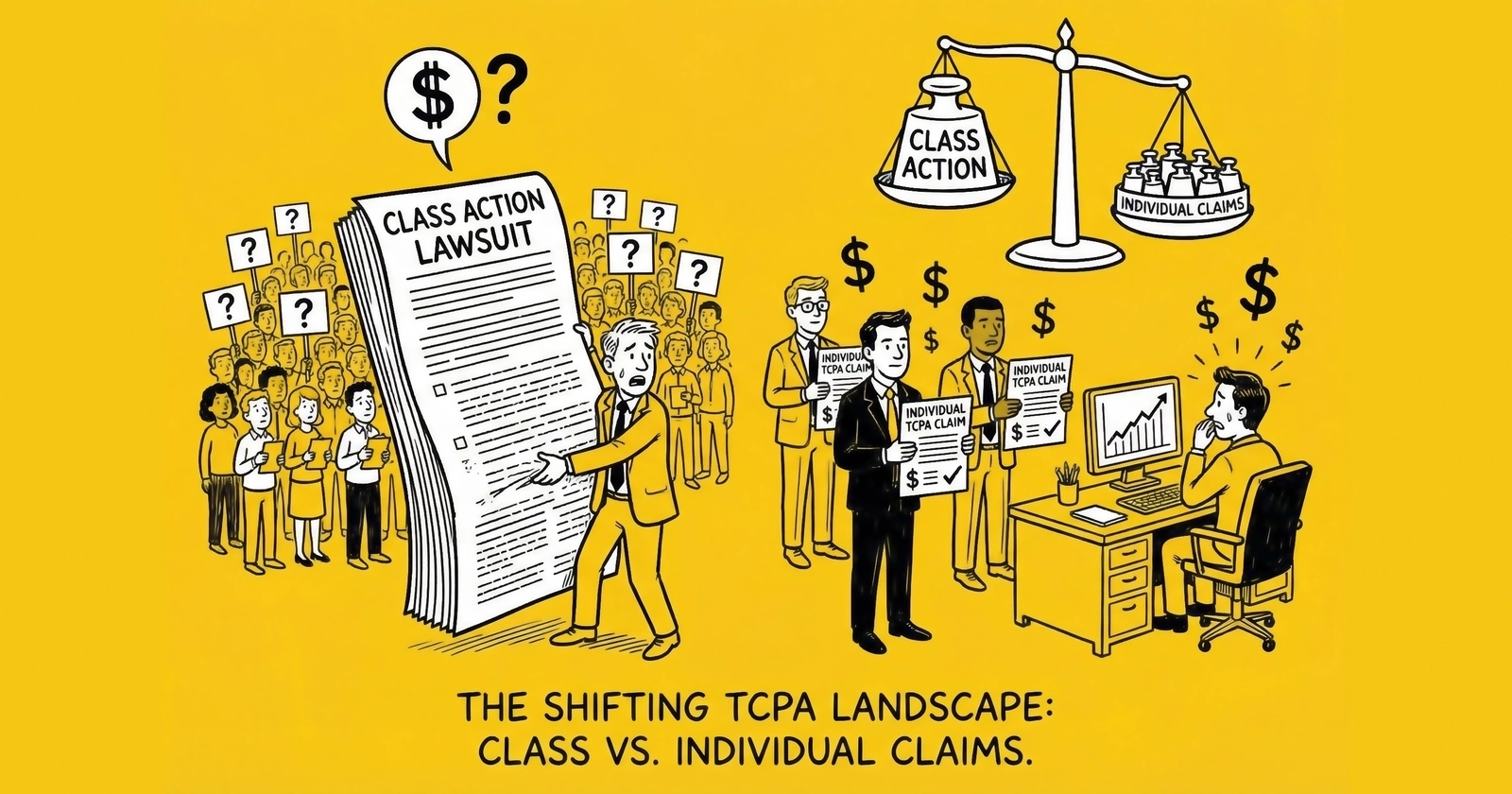
A comprehensive analysis of litigation exposure differences, settlement economics, and strategic risk management for operators navigating the most aggressive TCPA enforcement environment in history.
Introduction: Understanding the Dual Threat Landscape
The phone call that ends a lead generation business rarely announces itself as catastrophic. It might be a process server at the door with a class action complaint. It might be a single demand letter from an attorney representing one angry consumer. Both scenarios can end your company. The difference lies in the mathematics of exposure, the economics of resolution, and the strategic calculus of defense.
In the first quarter of 2025 alone, 507 TCPA class actions were filed, representing a 112% increase over Q1 2024. By September 2025, that number had grown to 1,807 class actions year-to-date, nearly doubling the 915 filed in all of 2024. Meanwhile, individual TCPA claims, while generating less headline exposure, continue to proliferate through demand letters, small claims filings, and individual federal lawsuits that never make the industry news.
For lead generation professionals, the distinction between class action and individual TCPA claims is not academic. It determines settlement economics, defense strategy, insurance coverage applicability, and ultimately, business survival. A single class action can generate exposure exceeding a company’s total enterprise value. A pattern of individual claims can drain working capital through death by a thousand cuts.
This analysis breaks down the risk profiles of both claim types, the strategic considerations that should inform your response, and the operational investments that mitigate exposure to each. For background on the regulatory framework, see our TCPA compliance guide. The goal is not to frighten, but to inform. Those who survive this environment are those who understand the threat landscape with precision.
The Statutory Framework: Why Both Claim Types Exist
The Telephone Consumer Protection Act, enacted by Congress in 1991 and codified at 47 U.S.C. section 227, creates a private right of action that any person may bring for violations. This private right of action, combined with statutory damages of $500 to $1,500 per violation and no cap on aggregate damages, makes the TCPA unlike most consumer protection statutes.
Statutory Damages Structure
The TCPA’s damages framework creates the foundation for both individual and class claims:
- Base damages: $500 per violation. No proof of actual harm required. A single unwanted text message supports a $500 claim. Receipt of one autodialed call without consent generates a $500 claim regardless of whether the recipient was inconvenienced.
- Treble damages for willful violations: $1,500 per violation. If the court finds the violation was willful or knowing, rather than negligent, damages increase threefold. Courts have found willfulness based on failure to implement reasonable compliance procedures, continued calling after receiving complaints, or evidence of deliberate disregard for consent requirements.
- No aggregate cap. Unlike some consumer protection statutes that limit total damages, the TCPA imposes no ceiling. A company that makes 100,000 non-compliant calls faces potential exposure of $50 million to $150 million.
- Four-year statute of limitations. Claims can reach back four years from the filing date, allowing exposure to accumulate over extended periods before litigation materializes.
This structure creates the economic incentive for both individual claims and class aggregation. An individual receiving ten non-compliant calls has $5,000 to $15,000 in potential recovery, which is enough to justify attorney involvement. A class of 50,000 consumers each receiving one non-compliant call creates $25 million to $75 million in aggregate exposure, which is enough to justify substantial litigation investment by plaintiff counsel.
The Class Action Mechanism
The TCPA’s structure is particularly favorable to class certification. Unlike tort claims requiring individualized proof of harm, TCPA claims involve common questions that can be resolved on a class-wide basis:
- Did the defendant use an automatic telephone dialing system?
- Did the defendant use prerecorded messages?
- Did the defendant obtain prior express written consent?
- Were calls placed to numbers on the Do Not Call Registry?
These questions apply identically to every class member. Courts have recognized this uniformity and certified TCPA classes with millions of members. The Caribbean Cruise Line class action involved millions of consumers and settled for $76 million. The Capital One settlement covered hundreds of thousands of consumers and totaled $75.5 million.
This certification-friendly structure explains why approximately 80% of all TCPA lawsuits are filed as class actions, compared to just 2-5% for other consumer protection statutes like the Fair Debt Collection Practices Act.
Class Action Risk Profile: The Existential Threat
Class actions represent the existential risk in TCPA compliance. A single class action can generate liability exceeding a company’s annual revenue, its total assets, or its enterprise value. Understanding this risk profile is the first step toward managing it.
Current Filing Statistics
The numbers tell a story of exponential growth:
- 2024 annual filings: 2,788 total TCPA cases, representing a 67% increase over 2023’s approximately 1,670 filings.
- Q1 2025: 507 class actions filed, a 112% increase over Q1 2024.
- September 2025: 224 class actions filed in a single month, a 283% increase over September 2024’s 79 filings. This single month exceeded total annual filings from the early 2010s.
- Class action percentage: Approximately 80% of all TCPA lawsuits are filed as class actions. In some months, this figure exceeds 95%.
Settlement Value Analysis
Class action settlements provide the clearest picture of actual financial exposure:
-
Average settlement: $6.6 million. This figure represents the arithmetic mean across settled class actions. The median is lower, approximately $3.5 million to $4.5 million, but the average is skewed upward by mega-settlements.
-
Recent major settlements:
- National Grid (2024): $38.5 million
- Citibank (2024): $29.5 million
- Conn’s HomePlus (2024): $25 million
- Realogy (2024): $20 million
- Wells Fargo (2023): $50 million
- Ally Financial (2023): $32 million
-
Historic mega-settlements:
- Caribbean Cruise Line (2016): $76 million
- Capital One (2014): $75.5 million
- DISH Network (2017): $60 million
-
Per-class-member recovery: Most settlements provide between $50 and $500 per class member who submits a valid claim, depending on class size, violation frequency, and liability strength. Claims rates typically run 3-15% of the class.
Defense Cost Economics
Even successful defense of class actions is expensive:
- Early resolution (within 6 months): $40,000 to $50,000 in defense costs, including initial case assessment, answer and preliminary motions, and settlement negotiations.
- Defense through discovery: $100,000 to $300,000, reflecting the costs of document production, depositions, expert witnesses, and motion practice.
- Full defense through trial: $300,000 to $750,000 or more, including class certification briefing, summary judgment motions, trial preparation, and trial itself.
These costs exist regardless of outcome. A company that prevails at trial still incurs $500,000 or more in defense costs. This reality shapes settlement dynamics, as defendants often find settlement economically rational even when they believe their defenses are strong.
Class Certification Dynamics
The class certification stage is often decisive. If a class is certified, settlement pressure increases dramatically. If certification is denied, the case typically becomes economically unviable for plaintiff counsel.
Key certification factors in TCPA cases:
- Commonality: Did the defendant use a common calling system and common scripts for all class members? Common technology and procedures favor certification.
- Typicality: Are the named plaintiff’s claims typical of the class? If the named plaintiff has unusual circumstances or atypical consent documentation, typicality may be challenged.
- Adequacy: Will the named plaintiff adequately represent the class interests? Evidence that the named plaintiff is a professional litigator or has interests adverse to the class can defeat adequacy.
- Predominance: Do common questions predominate over individual questions? TCPA cases typically satisfy this requirement because consent is often captured through uniform processes.
Defense strategies at the certification stage include challenging the adequacy of named plaintiffs, demonstrating individual consent issues that require separate analysis, and exposing serial litigator status of named plaintiffs.
Individual Claim Risk Profile: Death by a Thousand Cuts
While class actions generate the headlines, individual TCPA claims represent a persistent drain on resources that can cumulatively exceed class exposure for some operations. Understanding the individual claim landscape is essential for comprehensive risk management.
The Individual Claim Ecosystem
Individual TCPA claims manifest through several channels:
- Demand letters: Pre-litigation communications from attorneys threatening suit if settlement is not reached. Many demand letters seek $2,500 to $15,000 to resolve alleged violations, depending on the number of calls claimed and the sophistication of the plaintiff or their counsel.
- Individual federal lawsuits: Single-plaintiff cases filed in federal district courts. These cases proceed like any federal litigation but with limited discovery and lower stakes. Defense costs typically run $15,000 to $40,000 if resolved before significant discovery.
- State court lawsuits: Cases filed in state courts, sometimes in small claims divisions to minimize procedural complexity. Small claims TCPA cases have proliferated in some jurisdictions, with filing fees as low as $30 to $100 and simplified procedures.
- Arbitration demands: For defendants with arbitration agreements in their consent flows, individuals may file arbitration demands. Mass arbitration has become a significant plaintiff strategy, with firms filing hundreds or thousands of individual demands simultaneously to overwhelm defendants with arbitration fees.
Serial Litigator Reality
Between 31% and 41% of TCPA cases are filed by individuals who have previously filed TCPA lawsuits. This is not a fringe phenomenon. It is a substantial portion of the litigation landscape.
Documented tactics:
Multiple phone lines: Professional plaintiffs maintain numerous phone numbers (prepaid, VoIP, multiple carriers) to increase the surface area for receiving non-compliant calls. One plaintiff, Melody Stoops, testified in court that she maintained 35 cell phones to support her “business” of being a TCPA plaintiff.
Consent-then-challenge: Providing consent through forms with potential deficiencies, then challenging the validity of that consent in litigation.
Prolonged engagement: Kenneth Johansen, who testified that he had been a plaintiff in about 60 previous TCPA class actions and makes roughly $60,000 a year from TCPA lawsuits since 2014, was found by the court in his case against Bluegreen Vacations to have “deceptively” prolonged calls to bolster his damage claims.
Industry response: Litigator suppression services maintain databases of over 600,000 names, including professional plaintiffs, TCPA attorneys, and individuals who have sent demand letters without filing suit. Services from providers like Contact Center Compliance (Litigator Scrub), PossibleNOW, and Gryphon AI integrate with dialing platforms via API for real-time protection.
Settlement Economics for Individual Claims
Individual claim resolution follows different economics than class actions:
- Nuisance settlement range: $2,500 to $15,000. This range reflects the economics of plaintiff attorney fee recovery and the cost of continued defense. Even defendants with strong defenses may choose to pay these amounts rather than incur greater defense costs.
- Cost of early defense: $15,000 to $25,000 to file an answer, conduct preliminary investigation, and prepare for discovery.
- Full defense costs: $40,000 to $50,000 for cases that proceed through discovery and motion practice but do not reach trial.
- The repeat plaintiff problem: Paying nuisance settlements can attract additional litigation. Serial litigators and plaintiff firms track settlement behavior and target companies known to pay. A company that develops a reputation for quick settlement may face increased claim volume.
Volume Dynamics
Individual claims can accumulate to exceed class exposure for high-volume operations:
Example calculation: A lead generator receiving 100 demand letters annually, each settling for an average of $7,500, pays $750,000 in annual settlements plus $100,000 or more in legal fees for intake, investigation, and negotiation. Over four years (the statute of limitations period), this totals $3.4 million or more, approaching the median class action settlement value.
For operations with deficient consent processes, individual claim volume can explode. A single non-compliant campaign generating widespread complaints may produce dozens or hundreds of individual claims before a class action is even filed.
Comparative Risk Assessment Framework
Understanding how class and individual claims compare across key dimensions enables informed risk management decisions.
Exposure Magnitude
| Factor | Individual Claims | Class Actions |
|---|---|---|
| Maximum single-claim exposure | $1,500 x number of calls to individual | Unlimited (class size x $500-$1,500 per call) |
| Typical settlement range | $2,500 - $15,000 | $500,000 - $38+ million |
| Defense costs | $15,000 - $50,000 | $40,000 - $750,000+ |
| Business survival impact | Cumulative drain | Potentially existential |
Likelihood Assessment
| Factor | Individual Claims | Class Actions |
|---|---|---|
| Probability per violation | Lower (requires individual to pursue) | Higher (plaintiff counsel actively recruits) |
| Serial litigator factor | 31-41% of cases | Named plaintiffs often serial litigators |
| Discovery burden | Limited | Extensive |
| Settlement pressure | Moderate | Severe |
Geographic Concentration
Both claim types concentrate in specific jurisdictions, but the concentration differs:
- Class action hotspots: Florida (330 cases in 2024, 11.8% of national total), California (274 cases, 9.8%), and Texas (170 cases, 6.1%) account for 58% of all TCPA filings despite representing only 27.6% of the U.S. population. South Florida has emerged as the epicenter, with experienced plaintiff counsel and plaintiff-friendly procedural rules.
- Individual claim patterns: Individual claims are more geographically dispersed but still concentrate in states with active consumer protection bars. Florida’s FTSA, with its broader autodialer definition and private right of action, attracts both individual and class filings.
Insurance Coverage Implications
Coverage availability differs significantly between claim types:
- General liability policies: Typically exclude TCPA claims or contain significant limitations. Coverage for class actions is particularly difficult to obtain.
- E&O policies: May or may not cover TCPA claims depending on specific policy language. More likely to cover individual claims than class actions.
- Specialized TCPA insurance: Available but expensive. Average premiums range from $15,000 to $50,000+ annually for $1 million to $5 million in coverage, with higher premiums for companies with significant calling operations or prior claims.
- Class action coverage: Many policies contain sublimits for class action defense costs or exclude class exposure entirely. Review policy language carefully before relying on coverage.
Defense Strategy Differentiation
Optimal defense strategies differ materially between class and individual claims.
Class Action Defense Framework
Immediate response (first 72 hours):
- Stop all calling and texting campaigns related to the alleged violation
- Do not delete anything
- Contact specialized TCPA defense counsel immediately
- Notify insurance carrier in writing
- Issue written litigation hold to all relevant personnel and third-party vendors
Early case assessment:
- Calculate potential exposure based on class size and call volume
- Retrieve and review consent documentation for named plaintiff
- Pull TrustedForm or Jornaya certificates if available
- Identify whether named plaintiff is a serial litigator
- Evaluate indemnification rights against lead vendors or partners
Certification strategy:
- Challenge named plaintiff adequacy based on serial litigator status
- Identify individualized consent issues requiring separate analysis
- Prepare expert testimony on technology and calling practices
- Develop affirmative consent defense with documentary support
Settlement considerations:
- Evaluate economics of settlement versus continued defense
- Consider settlement timing relative to class certification
- Assess indemnification recovery potential
- Weigh business disruption costs of ongoing litigation
Individual Claim Defense Framework
Demand letter response:
- Verify the claim by pulling consent records for the phone number
- Check TrustedForm or Jornaya certificates
- Review call logs to confirm contact history
- Determine whether claimant is a known serial litigator
- Respond professionally within stated deadline
Triage strategy:
Strong consent documentation: Respond firmly with evidence. Share TrustedForm certificates showing clear consent language, timestamp, and consumer action. Many plaintiff attorneys will withdraw rather than pursue cases with documented consent.
Weak or missing documentation: Evaluate settlement economics quickly. Individual settlements in the $2,500 to $10,000 range are dramatically cheaper than litigation costs of $15,000 to $40,000.
Serial litigator identified: Consider defending more aggressively. Courts have denied class certification and individual recovery based on evidence of professional plaintiff status and entrapment tactics. The reputational benefit of fighting serial litigators may outweigh settlement economics.
Repeat claim management:
- Track settlement patterns to identify whether settlements are attracting additional claims
- Consider defending exemplary cases to deter future filings
- Implement litigator suppression to prevent future contact with known plaintiffs
- Audit consent processes to eliminate the underlying violations generating claims
Arbitration as a Strategic Tool
Arbitration agreements with class action waivers can fundamentally alter the risk calculus.
The Arbitration Advantage
For companies that included enforceable arbitration agreements in their consent flows, individual arbitration eliminates class exposure and often makes plaintiff economics unfavorable:
- Class waiver effect: If enforceable, class action waivers prevent certification of a class, limiting exposure to the individual arbitration. This can reduce exposure from millions of dollars to thousands.
- Economic deterrence: Individual arbitration often costs the consumer or their attorney more in filing fees and attorney time than the potential recovery justifies. Many individual claims are abandoned when arbitration is compelled.
- Favorable procedural rules: Arbitration typically involves limited discovery, streamlined procedures, and faster resolution. Defense costs in arbitration often run 50-70% of comparable federal litigation costs.
Arbitration Limitations
Arbitration is not a complete solution:
- Enforceability challenges: Courts scrutinize whether the consumer actually agreed to arbitration and whether the waiver is enforceable under applicable law. Poorly drafted or improperly incorporated arbitration provisions may not be enforceable.
- Mass arbitration threat: Sophisticated plaintiff firms have developed mass arbitration strategies, filing hundreds or thousands of individual arbitration demands simultaneously. Because defendants typically pay arbitration filing fees per case, mass arbitration can create substantial cost exposure, sometimes exceeding $1,500 per claim in filing fees alone before any merits determination.
- Consent integration requirements: The arbitration agreement must be properly incorporated into the consent transaction. Agreements presented separately from the main consent or available only through hyperlinks may face enforceability challenges.
- State law variations: Some states restrict arbitration agreements in consumer contexts. California, for example, has enacted legislation limiting arbitration in certain consumer transactions, though federal preemption under the Federal Arbitration Act often applies.
Proactive Risk Mitigation
The best defense against both class and individual claims is preventing violations in the first place. The cost of compliance infrastructure is a fraction of either claim type’s resolution cost.
Consent Infrastructure Investment
- Third-party verification: TrustedForm or Jornaya documentation for every lead provides independent evidence of consent that can be presented in litigation. Cost: $0.15 to $0.50 per lead. Value: potentially $6.6 million in avoided class action settlement.
- Consent disclosure optimization: Clear, specific identification of calling parties in consent disclosures. Dynamic consent disclosure that identifies specific buyers at the moment of lead capture provides the strongest litigation defense.
- E-SIGN compliance: Electronic consent that fails to satisfy E-SIGN requirements may be unenforceable. Include appropriate E-SIGN disclosures and consent in the electronic consent flow.
Operational Controls
- DNC suppression: Real-time suppression against National DNC Registry, state registries, and internal DNC lists before every call.
- Litigator suppression: Integration of known litigator databases to identify and exclude serial plaintiffs. The cost of suppression services is trivial compared to even one avoided individual claim.
- Time-zone enforcement: Automated controls preventing calls outside permitted hours based on recipient’s local time zone. State variations (Florida and Maryland at 8 a.m. to 8 p.m.) require state-level routing logic.
- Revocation processing: Systems capable of processing opt-out requests within the ten-business-day window required by April 2025 FCC rules. Synchronization across all contact channels within this window is essential.
Vendor Management
Lead vendors represent a significant source of TCPA exposure. Vendor-generated consent deficiencies transfer to the lead buyer:
- Vendor qualification: Before engaging any vendor, conduct due diligence on their TCPA compliance policies, consent capture mechanisms, and litigation history.
- Contractual protections: Vendor agreements should include specific TCPA compliance representations, audit rights, and indemnification provisions covering TCPA claims arising from vendor conduct.
- Ongoing monitoring: Regular audits of vendor consent documentation. Do not assume vendor compliance after initial qualification.
- Indemnification enforcement: When claims arise from vendor-generated leads, immediately review contracts and notify vendors of indemnification claims. Recent case law, including Moore v. Torchlight Technology Group, has reinforced that indemnification provisions can be enforced against lead generators who fail to obtain proper consent.
Crisis Response Protocol
When litigation arrives, response speed and quality determine outcomes.
Class Action Response Timeline
Hours 0-4: Pause all related campaigns. Do not delete records. Contact specialized TCPA defense counsel. Notify insurance carrier.
Hours 4-24: Issue written litigation hold. Pull consent records for named plaintiff. Gather call logs and lead source documentation. Retrieve TrustedForm or Jornaya certificates.
Hours 24-72: Work with counsel to assess exposure and defense strategy. Determine whether early settlement makes economic sense. If contesting, begin preparing opposition to class certification.
First week: Identify and notify vendors of potential indemnification claims. Conduct internal audit to identify root cause. Implement immediate corrective actions.
Individual Claim Response Timeline
Hours 0-24: Verify claim by pulling consent records. Check litigator databases. Calculate exposure based on call history.
Days 1-7: Develop response strategy based on documentation strength. If strong consent, prepare detailed response with certificate evidence. If weak consent, evaluate settlement economics.
Days 7-14: Execute response strategy. Engage with plaintiff counsel as appropriate. Document all decisions and reasoning.
Documentation Preservation
The litigation hold is non-negotiable. The moment you have reasonable anticipation of litigation, you have a legal obligation to preserve relevant evidence:
- Written litigation hold distributed to all relevant personnel
- Notification to third-party vendors of preservation obligation
- Suspension of auto-delete functions on relevant systems
- Preservation of backup tapes and archives
- Documentation of preservation efforts
Courts have imposed severe sanctions for spoliation of evidence, including adverse jury instructions that assume destroyed evidence would have been harmful to the defendant’s case.
Frequently Asked Questions
What is the difference between a class action and individual TCPA claim?
A class action TCPA claim aggregates the claims of many consumers (potentially millions) who were subjected to similar alleged violations, creating combined exposure that can reach hundreds of millions of dollars. An individual TCPA claim involves a single plaintiff seeking damages only for calls or messages they personally received. Class actions are brought by a named plaintiff on behalf of all similarly situated consumers, while individual claims involve only the person filing. Approximately 80% of TCPA lawsuits are filed as class actions because the statutory damages structure makes aggregation economically attractive for plaintiff attorneys.
How much can a TCPA class action cost to defend and settle?
Defense costs for TCPA class actions range from $40,000 to $50,000 for early resolution within six months, $100,000 to $300,000 for cases proceeding through discovery, and $300,000 to $750,000 or more for full defense through trial. The average TCPA class action settlement is approximately $6.6 million, though settlements range from under $1 million for smaller classes to over $75 million for mega-settlements like Capital One and Caribbean Cruise Line. National Grid settled for $38.5 million in 2024, and Citibank settled for $29.5 million the same year. Total resolution costs, including both defense and settlement, commonly exceed $7 million.
What is the typical settlement range for individual TCPA claims?
Individual TCPA claims typically settle in the range of $2,500 to $15,000, depending on the number of alleged calls or messages and the sophistication of the plaintiff or their counsel. Nuisance settlements at the lower end of this range reflect the economics of defense costs, as even defendants with strong defenses may prefer $5,000 settlements over $25,000 or more in litigation costs. Serial litigators often seek settlements in the $5,000 to $10,000 range, knowing defendants will calculate that defense costs exceed settlement demands. Defense costs for individual claims range from $15,000 to $50,000 for cases proceeding through discovery.
What percentage of TCPA cases are filed by serial litigators?
Between 31% and 41% of TCPA cases are filed by individuals who have previously filed TCPA lawsuits. Some individual plaintiffs have filed 60 or more TCPA class actions and generate $50,000 to $60,000 annually from settlements. These professional plaintiffs employ sophisticated techniques including maintaining multiple phone lines (one testified to maintaining 35 cell phones), deliberately providing consent and then challenging its validity, and prolonging calls to increase damage claims. Litigator suppression services maintain databases of over 600,000 names associated with serial plaintiffs and help companies identify and avoid contacting known litigators.
Can an arbitration agreement protect against TCPA class actions?
Enforceable arbitration agreements with class action waivers can dramatically alter TCPA exposure by eliminating class certification and forcing claims into individual arbitration. When enforced, these provisions limit exposure from millions of dollars to thousands. However, arbitration is not complete protection. Courts scrutinize whether consumers actually agreed to arbitration, and poorly drafted provisions may be unenforceable. Additionally, plaintiff firms have developed mass arbitration strategies, filing hundreds or thousands of individual arbitration demands simultaneously. Because defendants typically pay arbitration filing fees (often $1,500 or more per case), mass arbitration can create substantial cost exposure even before any merits determination.
How do state mini-TCPA laws affect class action risk?
State laws like Florida’s Telephone Solicitation Act (FTSA), Oklahoma’s Telephone Solicitation Act (OTSA), and Maryland’s Stop the Spam Calls Act can stack with federal TCPA claims, effectively doubling exposure. Florida generated 330 TCPA-related cases in 2024, nearly 12% of all filings nationwide despite representing only 6.5% of the U.S. population. A single non-compliant call to a Florida consumer can generate liability under both federal TCPA ($500-$1,500 per violation) and FTSA ($500-$1,500 additional per violation), creating combined exposure of $1,000 to $3,000 per call. State laws often have broader autodialer definitions than federal law post-Duguid, creating state liability for conduct that might escape federal exposure.
What documentation is essential for defending against TCPA claims?
Essential documentation includes: consent timestamp with exact date and time; IP address from which consent was submitted; the exact consent disclosure language shown to the consumer; evidence of consumer’s affirmative action (checkbox selection, electronic signature); the specific phone number for which consent was granted; form URL and configuration details; and session recording or replay from services like TrustedForm or Jornaya. This documentation must be retained for at least four years after the last contact made pursuant to that consent (matching the statute of limitations), though industry best practice is five years or longer. The burden of proof rests with the caller. If you cannot prove consent existed at the time of the call, courts will presume non-compliance.
How quickly must companies respond to demand letters and lawsuits?
For demand letters, response within the stated deadline (typically 10-30 days) is essential to demonstrate good faith and potentially resolve claims before litigation. For class action lawsuits, the first 72 hours are critical for containment. Stop all related calling campaigns immediately, do not delete any records, contact specialized TCPA defense counsel, notify your insurance carrier, and issue a written litigation hold to all relevant personnel and third-party vendors. Within 24 hours, pull consent records for the named plaintiff and retrieve TrustedForm or Jornaya certificates. Within 72 hours, work with counsel to assess defense strategy and exposure. The companies that respond well in these first 72 hours dramatically reduce their ultimate exposure.
What role does insurance play in TCPA claim defense?
Standard business insurance policies often exclude TCPA claims or contain significant limitations. General liability policies typically exclude coverage because TCPA violations are regulatory penalties, not traditional tort damages. E&O policies may cover individual claims but often exclude class actions or contain inadequate sublimits. Specialized TCPA insurance has become more available, with average premiums ranging from $15,000 to $50,000+ annually for $1 million to $5 million in coverage. When TCPA claims arise, notify your carrier immediately in writing. Review policy language carefully before relying on coverage, particularly for class actions, which may be specifically excluded or subject to sublimits. A coverage opinion from your broker specifically addressing TCPA scenarios should be obtained before you need it.
How can lead generators reduce exposure to both class and individual claims?
The most effective risk reduction comes from preventing violations through: comprehensive consent verification (TrustedForm or Jornaya for every lead); clear seller identification in consent disclosures; real-time DNC suppression against federal, state, and internal lists; litigator suppression using known plaintiff databases; time-zone enforcement to prevent off-hours calls; and revocation processing systems capable of the ten-business-day timeline. Vendor management is equally critical. Conduct due diligence on lead vendors, require contractual TCPA compliance representations and indemnification, and audit vendor consent documentation regularly. The cost of compliance technology at $0.25 to $0.75 per lead is trivial compared to $6.6 million average class action settlements or the cumulative drain of individual claims.
Key Takeaways
Class actions represent existential risk. With average settlements exceeding $6.6 million, 507 class actions filed in Q1 2025 alone (112% increase over Q1 2024), and approximately 80% of all TCPA cases filed as class actions, this is the primary survival threat for lead generation operations. A single class action can exceed a company’s total enterprise value.
Individual claims impose cumulative burden. While generating less headline exposure, individual claims settling at $2,500 to $15,000 each can accumulate to seven figures over the four-year statute of limitations, draining working capital and management attention. Defense costs of $15,000 to $50,000 per case often make settlement economically rational even with strong defenses.
Serial litigators drive 31-41% of cases. Professional plaintiffs who have made TCPA litigation a business model employ sophisticated techniques to generate claims. Litigator suppression services provide essential protection, and courts have increasingly denied recovery based on evidence of professional plaintiff status.
Defense strategies differ materially. Class action defense focuses on certification opposition, named plaintiff challenges, and exposure management. Individual claim defense emphasizes consent documentation, settlement economics, and deterrence of repeat filings. Applying class action strategies to individual claims, or vice versa, is inefficient.
Arbitration fundamentally alters economics. Enforceable arbitration agreements with class waivers eliminate class exposure and often make individual claim pursuit economically unviable. Mass arbitration creates a counter-risk, but the arbitration tool remains valuable when properly implemented.
State laws multiply exposure. Florida’s FTSA, Oklahoma’s OTSA, and Maryland’s Stop the Spam Calls Act stack with federal TCPA claims, potentially doubling per-violation exposure. Florida alone generated 330 cases in 2024, 12% of national filings from 6.5% of the population.
Prevention economics are unambiguous. Consent verification at $0.15 to $0.50 per lead, DNC suppression, litigator screening, and time-zone management represent a fraction of either individual claim settlements or class action exposure. The ROI on compliance infrastructure is not debatable. It is mathematical certainty.
Documentation is defense. Without TrustedForm, Jornaya, or equivalent third-party verification, consent claims cannot be proven. The burden rests with the caller. Invest in documentation now, or pay for its absence in litigation.
Response speed determines outcomes. The first 72 hours after receiving a class action complaint set the trajectory for everything that follows. Established crisis response protocols, pre-identified specialized counsel, and documented escalation procedures are essential infrastructure.
The threat is accelerating. With 2025 class action filings running 97% ahead of 2024’s record pace, September 2025 seeing a 283% increase over September 2024, and plaintiff bar capacity expanding, the litigation environment is becoming more hostile, not less. Practitioners who have not invested in compliance infrastructure face increasing probability of claims.
Conclusion: Strategic Risk Management
The distinction between class action and individual TCPA claims is not merely academic. It determines settlement economics, defense strategy, insurance coverage, and business survival. Those who thrive in this environment are those who understand both risk profiles with precision and invest accordingly.
Class actions demand robust consent infrastructure, third-party verification for every lead, and crisis response protocols that can be executed within hours of complaint receipt. The $6.6 million average settlement is not a hypothetical. It is the expected value of the risk for operators with deficient compliance.
Individual claims demand efficient triage processes, litigator suppression, and strategic decisions about when settlement makes economic sense versus when defense deters future filings. The cumulative burden of individual claims, while less dramatic, can approach class action exposure for high-volume operations.
The investment required to manage both risk profiles is a fraction of the exposure each represents. Consent verification at $0.15 to $0.50 per lead. DNC and litigator suppression at minimal monthly cost. Time-zone enforcement built into dialing platforms. Revocation processing synchronized across channels.
These investments are not compliance overhead. They are business survival infrastructure.
The math is unforgiving. The plaintiff bar is organized. The litigation trajectory is upward. Those who approach this reality with discipline, investment, and vigilance will build businesses that thrive for decades. Those who treat compliance as a checkbox will eventually learn the cost in federal courtrooms.
Choose your path wisely.
Sources
-
Cornell Law: 47 U.S.C. Section 227 (TCPA) - The full text of the Telephone Consumer Protection Act, establishing the statutory framework for $500-$1,500 per violation damages.
-
eCFR: Title 47, Part 64, Subpart L - Restrictions on Telemarketing - FCC implementing regulations for TCPA requirements including consent standards and revocation rules.
-
GovInfo: TCPA Statute Text - Official government source for TCPA statutory language.
-
TCPA World - Industry resource tracking TCPA litigation trends, case filings, and settlement data referenced throughout this article.
-
JD Supra - Legal analysis platform aggregating TCPA case law developments and enforcement trends.
-
TrustedForm - Consent verification platform referenced for documenting consumer consent in TCPA compliance.
This article provides general information about TCPA litigation risk assessment. It is not legal advice. TCPA requirements change through FCC rulemaking and court decisions. State laws impose additional requirements beyond federal standards. Consult qualified TCPA counsel for guidance on your specific situation.
Statistics current as of late 2025. Sources: WebRecon LLC TCPA litigation data, FCC regulatory filings, public court records, industry settlement data.