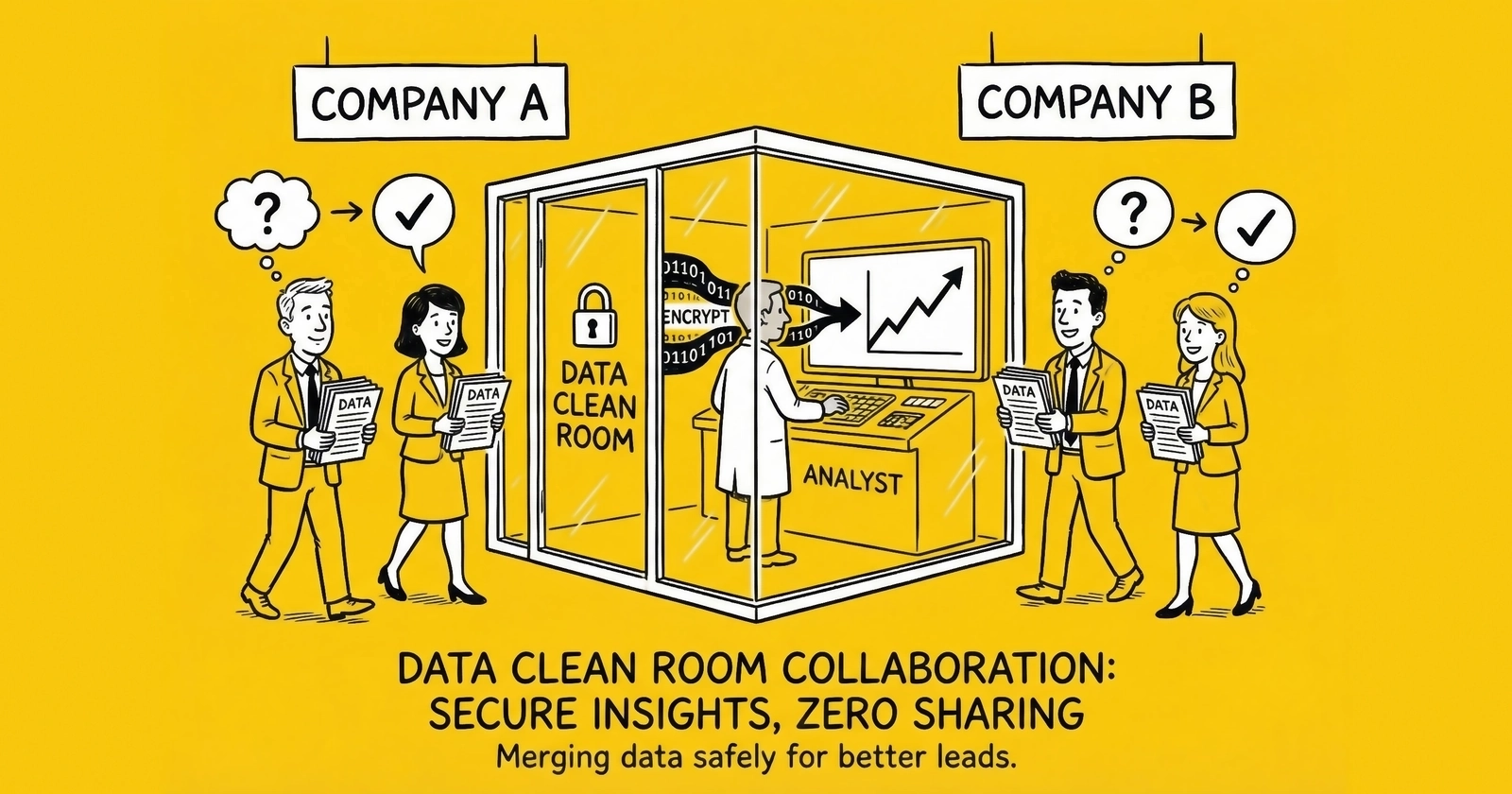
How privacy-preserving data infrastructure enables partner collaboration, cross-organization attribution, and audience intelligence in an era of fragmenting identity signals.
The question arrives with increasing frequency in partnership discussions: “Can we collaborate on data without actually sharing data?”
Five years ago, that question sounded like a riddle. Today, it describes the core capability of data clean rooms - secure computational environments enabling collaborative analysis between organizations without exposing raw customer information to either party.
For lead generation operators, clean rooms represent more than privacy compliance infrastructure. They represent the mechanism through which partnership-driven growth operates at scale. The publisher who can demonstrate lead quality through clean room verification commands premium pricing. The buyer who can match purchase intent signals against conversion data without violating partner agreements closes deals competitors cannot. The network operator facilitating secure collaboration between ecosystem participants captures value that traditional data brokers are losing.
The adoption curve has accelerated beyond early-adopter positioning. Forrester’s Q4 2024 B2C Marketing CMO Pulse Survey found 90% of B2C marketers now use clean rooms for marketing use cases. The 2025 State of Retail Media Report documented 66% adoption among retail media networks. The IAB’s data clean room standards initiative has formalized implementation practices across advertising ecosystems. IDC projects 60% of enterprises will conduct partner collaboration through clean room infrastructure by 2028.
This is no longer emerging technology. This is the infrastructure layer enabling the next generation of data-driven lead generation.
This guide covers clean room architecture for lead operations, specific collaboration patterns that generate measurable value, platform selection based on your existing technology stack, implementation roadmaps with realistic timelines, and the governance frameworks required for compliant operation.
The Collaboration Problem Clean Rooms Solve
Lead generation has always depended on data collaboration. Publishers and buyers share lead records. Networks aggregate performance data across participants. Partners combine audiences for joint campaigns. Enrichment providers append attributes to customer records.
Historically, this collaboration required data transfer. You sent files. Partners received files. Someone held the combined dataset. Every transfer created privacy liability, competitive exposure, and regulatory risk.
The regulatory environment has made this untenable. GDPR enforcement has matured, with fines now reaching 4% of global revenue for data handling violations. The California Consumer Privacy Act and its amendments impose specific requirements on data “sales” - and the definition extends to many traditional collaboration patterns. State privacy laws continue proliferating, with Texas, Colorado, Virginia, Connecticut, Montana, Utah, Oregon, and Delaware all implementing distinct requirements by late 2024.
Simultaneously, technical infrastructure for data protection has degraded. Third-party cookies - the shared identity layer enabling cross-site collaboration - are deprecated across Safari and Firefox, with Chrome’s timeline shifted but direction unchanged. Understanding first-party data strategies becomes essential as this transition accelerates. Apple’s App Tracking Transparency requires explicit opt-in for identifier access, with opt-in rates hovering around 25%. The identity signals that powered collaborative targeting and measurement are fragmenting.
Clean rooms resolve both challenges through a single architectural principle: insights without data transfer.
The “Non-Movement of Data” Principle
The defining characteristic of clean room architecture is that raw data never transfers between parties. Your customer records remain in your infrastructure. Partner records remain in theirs. Analytical computation occurs within a secure environment where neither party accesses the other’s source data.
Consider the traditional approach to evaluating a publisher partnership. You want to understand what portion of their lead audience overlaps with your high-value customer profile. Without clean rooms, this requires either the publisher sharing their lead database with you (exposing their audience to competitive extraction), you sharing your customer profile with the publisher (revealing your targeting criteria), or both parties sharing data with a third party who performs the match (creating liability for all three organizations).
Each option creates exposure someone finds unacceptable. Partnerships stall in legal review. Collaboration that would benefit both parties never happens.
With clean rooms, both parties contribute encrypted, anonymized data to a secure computational environment. Matching occurs through privacy-preserving algorithms. Results emerge: “34% of the publisher’s leads match your high-LTV customer profile, concentrated in the 45-64 age bracket with homeownership signals.” Neither party sees the other’s raw records. Neither party can extract individual identities. But both parties gain actionable intelligence.
This transforms partnership dynamics. Legal teams that rejected data sharing agreements approve clean room participation. Partners who competed for the same customers collaborate on measurement. First-party data assets that sat in organizational silos become analytically valuable through secure collaboration.
How Clean Room Architecture Works
Clean room implementations vary across providers, but core architectural patterns remain consistent across four key phases.
Data Ingestion and Preparation
Each participating organization prepares their data for clean room contribution. Personal identifiers such as email, phone, name, and address are hashed or encrypted using consistent algorithms. Data schemas are standardized to enable matching across parties. Privacy classifications are applied to flag sensitive attributes, and records are validated against quality requirements.
The preparation process typically requires 40-80 hours of data engineering work for initial implementation, declining to 5-10 hours for routine refresh cycles once pipelines are established.
Identity Resolution
Within the clean room environment, records from different parties must be matched. This occurs through deterministic and probabilistic approaches.
Deterministic matching uses hashed email addresses or phone numbers. When both parties capture the same identifier for a customer, the match is certain. Deterministic match rates typically range from 50-70% for overlapping populations when both parties have email addresses.
Probabilistic matching uses combinations of partial signals including name components, address fragments, and behavioral patterns. When deterministic identifiers are unavailable, probabilistic approaches can extend matching, though at lower confidence levels and typically 30-50% of deterministic rates.
Modern clean room platforms incorporate identity resolution partners such as LiveRamp, Experian, and TransUnion to improve match rates through their cross-device identity graphs. For more on third-party consent verification, see our TrustedForm vs Jornaya comparison.
Query Execution and Privacy Controls
Analysts write queries against the matched dataset. Critically, queries execute within the clean room environment, not on exported data. The clean room enforces privacy policies through several mechanisms.
Minimum aggregation thresholds ensure outputs represent sufficient records (typically 25-100) to prevent individual identification. A query returning “3 matched records” would be blocked.
Differential privacy adds mathematical noise to outputs, ensuring that any individual’s presence or absence cannot be determined from results. This enables privacy-safe analysis of sensitive attributes.
Output restrictions limit what data can be extracted. Individual-level records typically cannot be exported. Only aggregated, anonymized insights emerge from analysis.
Audit and Compliance
Every query, every result, every access attempt is logged. This audit trail supports regulatory compliance verification, partner dispute resolution, security incident investigation, and usage monitoring for contract compliance. Organizations typically retain clean room audit logs for 2-7 years depending on regulatory requirements and contractual obligations.
Lead Generation Use Cases That Drive Value
Clean rooms enable specific collaboration patterns across the lead generation value chain. Understanding these use cases helps prioritize implementation and quantify potential returns.
Publisher-Buyer Performance Verification
The foundational use case involves verifying lead performance through secure data collaboration between publishers and buyers.
Publishers report conversion rates. Buyers report different conversion rates. Disputes consume partnership energy. Without neutral measurement, neither party trusts the other’s numbers. Traditional resolution required data sharing where publishers sent lead files with source attribution and buyers shared conversion outcomes. Someone performed the match. This created exposure and rarely satisfied both parties.
Clean room implementation solves this by having both parties contribute data to a shared environment. The publisher contributes lead records with source identifiers, timestamps, traffic type, and campaign attributes. The buyer contributes conversion events with lead identifiers, conversion type, and conversion value.
The clean room matches records and computes verified metrics including conversion rates by traffic source and campaign, time-to-conversion distributions, conversion value distributions, and quality indicators by lead segment. Neither party sees the other’s raw data. Both parties receive verified performance measurement. Disputes based on measurement methodology disappear.
Organizations implementing publisher-buyer clean room verification report 15-25% reduction in partnership disputes requiring management attention, 10-20% improvement in lead pricing accuracy based on verified performance, and faster partnership scaling as verification removes trust barriers. A mortgage lead buyer processing 50,000 leads monthly at $35 CPL can identify 5-15% overpayment through accurate source-level performance measurement, representing $87,500-$262,500 annual value from a single clean room implementation. For comparison, see our CPL benchmarks by industry.
Partner Audience Overlap Analysis
For ecosystem-led growth strategies, understanding account overlap across partner networks enables coordinated go-to-market without exposing competitive intelligence.
You want to know which of your target accounts are already customers of Partner A. Partner A wants to know which of their target accounts are already customers of yours. Neither party will share customer lists. Without clean rooms, this analysis requires manual account-by-account discussion, limiting ecosystem collaboration to a handful of strategic accounts rather than systematic coverage.
Clean room implementation enables both parties to contribute account data including target account lists with scoring and prioritization, customer lists with relationship strength indicators, and optional information like revenue tiers, product adoption, and expansion potential. The clean room computes which target accounts are partner customers (with relationship strength), which partner target accounts are your customers, and account scoring based on combined signals.
Account mapping platforms like Crossbeam and Reveal specialize in this use case, operating purpose-built clean rooms for B2B account matching. Their 2024 benchmarks indicate healthy ecosystem-led growth organizations see 40-60% of target accounts covered by Tier 1 or Tier 2 partnership relationships.
Warm introductions through ecosystem overlap convert at 3-5x the rate of cold outreach. For organizations with average deal sizes of $50,000, systematic ecosystem collaboration through clean room-enabled account mapping can accelerate $500,000-$2,000,000 in pipeline annually.
Suppression Matching
Clean rooms solve the suppression paradox: avoiding marketing to certain populations requires knowing who they are, but learning who they are requires data access you should not have.
You should not market to existing partner customers (damaging partnership relationships), your own existing customers (wasting acquisition budget), or individuals on compliance suppression lists (TCPA litigators, Do Not Call registries). Each suppression requirement traditionally required receiving and storing the suppression list, creating exactly the data exposure you were trying to avoid.
Suppression matching through clean rooms works differently. You upload your target audience with hashed identifiers. The suppression list owner uploads their list with hashed identifiers. The clean room computes matches. You receive suppression flags indicating that 147 of your 5,000 targets should be suppressed. You never see the complete suppression list. They never see your complete target audience.
For TCPA litigator suppression specifically, this approach enables scrubbing against maintained databases of serial plaintiffs without receiving the plaintiff database directly, reducing your data handling liability while maintaining protection.
A solar lead generator suppressing existing partner customers might identify 3-5% of acquisition targets as inappropriate for outreach. At $50 CPL and 10,000 monthly lead volume, this represents $15,000-$25,000 monthly saved from wasted acquisition spend on individuals who would damage partner relationships. TCPA suppression through clean room matching can reduce litigation exposure by 40-60% according to industry compliance consultants, though actual impact depends heavily on outreach patterns and vertical risk profiles.
Cross-Partner Attribution
Understanding customer journeys that span multiple organizations enables accurate partner compensation and strategic investment decisions.
A customer engages with Partner A’s content, then your content, then converts. Your attribution system gives credit to your touchpoints because Partner A’s exposures are invisible to your measurement. This systematic undervaluation of partner influence leads to underinvestment in partner channels and inaccurate ROI calculations on direct channels.
Clean room implementation enables multiple parties to contribute touchpoint data. Partner A contributes content exposures, engagement events, and timing. You contribute your touchpoint data plus conversion events. The clean room computes multi-touch attribution across the combined journey.
Results reveal the complete path: “Customers who engaged with Partner A content converted at 2.3x the rate of customers without partner exposure. Partner influence contributed to 34% of total conversions.”
Organizations implementing cross-partner attribution through clean rooms report 20-40% reallocation of marketing budget based on accurate partner influence measurement, 15-30% improvement in partner program ROI through appropriate investment, and stronger partner relationships based on demonstrated value. For a lead operation spending $500,000 annually on marketing, 20% reallocation based on accurate attribution represents $100,000 in improved budget efficiency.
Lookalike Audience Building
Clean rooms enable collaborative audience modeling based on combined success signals from multiple parties.
Your highest-converting leads share characteristics. Your partner’s highest-value customers share characteristics. The intersection of these characteristics produces better targeting than either party’s data alone. But sharing customer profiles exposes competitive intelligence.
Clean room implementation enables both parties to contribute customer data with success indicators. You contribute converted leads with value tiers. Your partner contributes customers with LTV tiers. The clean room identifies shared characteristics including demographics that correlate with success in both contexts, behavioral signals present in high-value customers of both parties, and geographic or firmographic patterns.
Outputs are modeled characteristics, not customer identities. Neither party can extract individual records, but both can apply shared profile characteristics to their targeting.
Joint lookalike audiences typically improve targeting performance by 15-35% compared to single-party modeling, based on richer signal sets. For a lead generator spending $200,000 monthly on acquisition, 20% targeting improvement could reduce CPL by $4-8, representing $800,000-$1,600,000 annual value.
Platform Selection for Lead Operations
The clean room market has consolidated around several major platforms, each with distinct architectural approaches, integration patterns, and pricing models. Selection depends heavily on existing infrastructure, partner ecosystem compatibility, and specific use case requirements.
Snowflake Clean Rooms (Data Clean Rooms)
Snowflake has emerged as a leading platform for organizations already invested in their data cloud ecosystem.
Snowflake Clean Rooms leverage native data sharing capabilities. Data remains in each party’s Snowflake account. Clean room computation occurs through secure views and controlled access patterns. No data physically transfers between organizations.
The platform offers several strengths for lead generation. The SQL-based interface is accessible to existing data teams. Native integration with Snowflake data infrastructure eliminates data movement. Flexible privacy controls are configurable for specific use cases. Performance is strong on large datasets, tested to billions of records. Cloud-native architecture provides pay-per-compute pricing.
Organizations considering Snowflake should note that it requires Snowflake as the underlying data platform (or partners must have Snowflake). Implementation is more technical than turnkey solutions, requiring 200-500 hours initially. Privacy controls require configuration rather than coming pre-built, and cross-cloud collaboration requires additional coordination.
Snowflake Clean Rooms are included with Snowflake accounts with consumption-based costs: approximately $23-40/TB/month for storage depending on region and tier, $2-4 per credit for compute varying by warehouse size. Typical clean room workloads run $5,000-50,000 annually depending on query volume and data scale.
This platform works best for organizations already on Snowflake seeking flexible, cost-effective clean room capabilities, data teams comfortable with SQL, and companies wanting maximum control over privacy configuration.
AWS Clean Rooms
Amazon’s clean room offering integrates with the broader AWS ecosystem, enabling secure collaboration without data movement between AWS accounts.
AWS Clean Rooms operate within AWS’s secure multi-party collaboration framework. Data remains in each party’s S3 buckets. Analysis rules define what queries are permitted. Cryptographic computing options through AWS Clean Rooms ML enable analysis on encrypted data without decryption.
For lead generation, AWS Clean Rooms provide native AWS integration for organizations on that cloud, cryptographic computing options for strongest privacy guarantees, flexible collaboration patterns supporting multiple analysis models, pay-as-you-go pricing aligned with cloud economics, and machine learning integration for advanced audience modeling.
Organizations should consider that AWS Clean Rooms require AWS infrastructure (or partners must be on AWS), the platform is less mature than specialized clean room providers (GA March 2023), built-in identity resolution is limited and requires partner solutions, and cross-cloud collaboration adds complexity.
AWS Clean Rooms charges $0.01 per GB of data analyzed per query, with storage remaining at standard S3 pricing around $23/TB/month. Typical implementations run $3,000-30,000 annually for moderate query volumes.
This platform suits AWS-native organizations, technical teams comfortable building custom clean room workflows, and organizations prioritizing cryptographic privacy guarantees over turnkey convenience.
LiveRamp Safe Haven
LiveRamp dominates enterprise clean room implementations, particularly for organizations requiring cross-device identity resolution.
LiveRamp’s Safe Haven product combines their RampID identity graph with secure computation capabilities. Data is tokenized against RampID during ingestion, enabling cross-device matching. Analysis occurs within LiveRamp’s secure environment with strong enterprise controls.
The platform excels for lead generation through RampID’s persistent identity resolution across devices and touchpoints, mature clean room implementation with enterprise-grade features, native integrations with major advertising platforms for audience activation, strong cross-device matching critical for mobile-heavy lead generation, and an established partner network enabling pre-built connections.
Organizations should be aware that enterprise pricing puts LiveRamp out of reach for many operations at $100,000-500,000+ annually. Implementation complexity requires dedicated data engineering resources. The platform provides best value when identity resolution is a primary requirement, and there are vendor lock-in concerns for organizations building on proprietary identity.
LiveRamp uses enterprise licensing based on data volume processed, number of partners connected, and feature tier. Typical implementations cost $100,000-500,000+ annually.
This platform works best for enterprise lead buyers with significant scale, large publishers requiring cross-device audience measurement, and organizations where identity resolution across fragmented touchpoints is critical.
Google Ads Data Hub
Google’s clean room provides access to Google advertising data for measurement and analysis.
Ads Data Hub enables joining first-party data with Google advertising data (YouTube, Search, Display, Shopping) within BigQuery. All queries execute within Google’s environment. Outputs enforce minimum aggregation (50 users minimum) to prevent individual identification.
For lead generation, the platform offers direct access to YouTube, Search, and Display campaign data, strong measurement capabilities for Google-driven lead generation, integration with Google Cloud Platform and BigQuery, no additional licensing fee (included with Google Ads spend), and robust privacy controls enforced by the platform.
Organizations should note that Ads Data Hub is limited to the Google advertising ecosystem with no cross-platform matching. Query capabilities are restricted compared to general-purpose clean rooms. The 50-user minimum aggregation limits granular analysis, and there is a learning curve for BigQuery-based analysis.
Ads Data Hub access is included with qualifying Google Ads spend. Standard BigQuery costs apply for analysis at approximately $5-6.25 per TB queried with no additional platform licensing.
This platform suits organizations with significant Google advertising spend seeking measurement improvement, agencies managing large Google campaigns, and publishers measuring audience quality against Google-matched segments.
InfoSum
InfoSum pioneered the “data non-movement” approach, maintaining a decentralized architecture where data never leaves organizational control.
InfoSum’s “bunker” model keeps data within each organization’s infrastructure. Rather than contributing data to a shared environment, organizations connect their data through InfoSum’s secure API. Computation is distributed across participants without any data centralization.
For lead generation, InfoSum provides the strongest privacy guarantees through truly decentralized architecture. Data never leaves organizational control, even encrypted. The platform offers fast time-to-insight for media and advertising use cases, publisher-friendly features designed for audience monetization, and a growing network of connected partners for plug-and-play collaboration.
Organizations should consider that InfoSum has smaller market presence than cloud giants, limiting partner availability. The platform is more specialized for advertising measurement than general analytics. Premium pricing reflects specialized capabilities, and partners must also implement InfoSum for collaboration.
Enterprise pricing is based on number of “bunkers” (data connections), partner connections enabled, and query volume and complexity. Typical implementations run $75,000-300,000 annually.
This platform works best for privacy-conscious organizations requiring the strongest possible data protection, publishers demanding data sovereignty, and organizations unable to contribute data to any third-party infrastructure.
Habu
Habu positions as the interoperability layer across clean room platforms, enabling collaboration across different cloud environments.
Habu connects with multiple underlying clean room platforms including Snowflake, AWS, Google, and Databricks, providing a unified collaboration interface. This enables organizations on different technology stacks to collaborate without platform lock-in.
For lead generation, Habu offers multi-cloud support connecting partners on different platforms, a marketing-focused interface accessible to non-technical users, pre-built activation integrations with advertising platforms, strength in retail media and shopper marketing use cases, and reduced friction when partners have different technology stacks.
Organizations should note that Habu adds another layer to the technology stack with additional complexity and cost. The platform provides best value for organizations needing extensive cross-platform collaboration. As a relatively newer entrant, it is still establishing market position and depends on underlying platform capabilities.
Habu uses platform subscription plus per-partner connection fees. Typical implementations run $50,000-200,000 annually depending on partner network size.
This platform suits organizations collaborating with partners across different cloud platforms, marketing teams wanting an accessible clean room interface without deep technical resources, and retail and CPG companies in shopper marketing ecosystems.
Platform Selection Framework
For lead generation operations specifically, evaluate platforms against these criteria with appropriate weighting.
Infrastructure alignment should receive 30% weight. If you’re on Snowflake, Snowflake Clean Rooms integrate naturally. AWS shop? AWS Clean Rooms reduce friction. Platform misalignment creates integration overhead that delays value realization by 2-4 months.
Partner ecosystem compatibility deserves 25% weight. Your clean room is only useful if partners can connect. Survey your top 5-10 partners on current or planned clean room infrastructure. Select platforms where partner adoption exists or requires minimal effort.
Identity resolution capability warrants 20% weight. Lead generation depends on matching. Platforms with strong identity resolution (LiveRamp, Snowflake with LiveRamp integration) achieve 50-70% match rates. Platforms requiring you to bring your own identity solution may achieve only 30-50%.
Total cost of ownership should factor at 15% weight. Enterprise licensing ($100,000+) may not align with lead generation economics until you’re processing significant volume. Consumption-based pricing (Snowflake, AWS) better aligns costs with actual usage for operations below $10M annual lead volume.
Implementation timeline receives 10% weight. Enterprise implementations require 3-6 months. Turnkey solutions deploy in 4-8 weeks. Match implementation timeline to partnership urgency and technical capacity.
Implementation Roadmap
Clean room implementation involves organizational preparation, technical deployment, and partner coordination. Organizations that sequence these phases correctly achieve value in 8-12 weeks. Those that skip preparation typically require 4-6 months of iteration before achieving reliable operation.
Phase 1: Foundation Assessment (Weeks 1-2)
Before selecting platforms or engaging partners, assess organizational readiness across three dimensions.
Data Infrastructure Audit
Evaluate whether customer data is unified with consistent identity across systems, whether you can produce clean exports with standardized schemas, whether outcome data such as conversions and revenue is reliably connected to lead records, and what data quality issues exist that would degrade match rates.
Organizations typically discover 40-80 hours of data normalization work during this audit. Addressing data quality before clean room ingestion prevents frustrating early results.
Governance Inventory
Determine which data elements may be contributed to external analysis, what consent language covers your data collection, who has authority to approve new data collaboration patterns, and what security requirements apply to external data environments.
Document governance requirements before platform selection. Some requirements such as data residency or specific encryption standards eliminate platform options.
Partner Landscape Mapping
Identify which partnerships would benefit from secure data collaboration, what technology infrastructure key partners have, whether partners have expressed interest in clean room collaboration, and what use cases would generate mutual value.
Prioritize 2-3 partners for initial implementation. Broad launches create coordination complexity that delays value.
Phase 2: Platform Selection (Weeks 2-3)
With assessment complete, evaluate platforms against your specific context through technical fit evaluation, commercial evaluation, and reference validation.
Technical fit evaluation involves requesting technical documentation on integration with your data infrastructure, assessing implementation requirements against your data engineering capacity, validating privacy controls meet your governance requirements, and confirming partner compatibility for priority partnerships.
Commercial evaluation requires requesting pricing based on your expected data volumes and query patterns, understanding minimum commitments and contract terms, evaluating total cost including implementation, ongoing operations, and partner onboarding, and comparing consumption-based versus license-based models for your scale.
Reference validation means requesting references from organizations similar to yours, asking specifically about implementation timeline, unexpected challenges, and time-to-value, and understanding ongoing operational requirements.
Platform selection typically takes 2-3 weeks. Rushing this phase creates painful migrations later.
Phase 3: Technical Implementation (Weeks 3-6)
With platform selected, begin technical deployment across a structured timeline.
During weeks 3-4, focus on infrastructure setup: provisioning the clean room environment, configuring access controls and authentication, establishing network connectivity with data infrastructure, and implementing initial data ingestion pipelines.
During weeks 4-5, concentrate on data preparation: normalizing source data to required schemas, implementing hashing and encryption for identifiers, validating data quality for clean room ingestion, and creating documentation for ongoing data refresh.
During weeks 5-6, conduct testing and validation: executing test queries against sample data, validating match rates against expected baselines, confirming privacy controls function as configured, and testing the end-to-end workflow from ingestion to insight extraction.
Technical implementation requires 60-120 hours of data engineering time depending on infrastructure complexity and data quality starting point.
Phase 4: Partner Onboarding (Weeks 6-10)
With your implementation operational, coordinate partner participation through agreement structure and technical coordination.
Partnership agreements should cover data contribution requirements (what data, what format, what refresh), permitted analysis (what queries each party may execute), output restrictions (aggregation minimums, export limitations), cost allocation (who pays for compute, storage, query fees), and termination procedures (data deletion, audit log retention).
Legal review typically takes 2-4 weeks for initial partner agreements, declining to 1-2 weeks for subsequent partners using established templates.
Partner technical coordination involves providing technical documentation for partner data preparation, coordinating schema alignment and identifier standardization, supporting partner data ingestion and validation, and executing joint testing to validate match quality.
Partner onboarding timing depends heavily on partner technical sophistication. Enterprise partners with data engineering resources may onboard in 2-3 weeks. Smaller partners without dedicated technical teams may require 6-8 weeks with significant hand-holding.
Phase 5: Use Case Deployment (Weeks 8-12)
With infrastructure and partners operational, deploy specific use cases.
During weeks 8-9, implement the initial use case. This involves implementing queries for the primary use case (typically audience overlap or performance verification), validating outputs against known results or manual verification, documenting query templates for ongoing use, and training relevant users on interpretation and application.
During weeks 9-10, focus on operationalization: establishing refresh schedules for ongoing data updates, implementing monitoring and alerting for data quality issues, creating runbooks for common operations, and establishing SLAs with partners for data contribution and query response.
During weeks 10-12, pursue expansion and optimization: deploying additional use cases based on initial learning, refining query patterns based on operational experience, beginning onboarding of additional partners, and measuring and documenting value generated.
Timeline Reality Check
The 12-week timeline assumes moderate data quality requiring standard normalization, clear governance with documented approval authority, technical resources available for implementation, and partners willing and technically capable of collaboration.
Organizations with significant data quality issues, unclear governance, limited technical resources, or unready partners should plan for 4-6 month timelines.
Governance Frameworks for Compliant Operation
Clean room technology enables collaboration. Governance frameworks determine what collaboration is permitted. Organizations that treat governance as an afterthought encounter partnership friction, compliance exposure, and wasted implementation investment.
Data Classification
Before contributing any data to clean room environments, establish clear classification across four tiers.
Tier 1 data is freely contributable and includes anonymized aggregate statistics, non-personal business metrics, and public information already available.
Tier 2 data represents standard clean room contribution and includes hashed personal identifiers (email, phone), non-sensitive demographics (age range, geography), and behavioral signals (engagement, purchase category). This tier represents typical clean room contribution where standard privacy controls such as aggregation minimums and differential privacy provide adequate protection.
Tier 3 data requires enhanced controls and includes precise location history, financial information, health-related signals, and protected class indicators. Contribution requires additional controls including elevated aggregation minimums, restricted query patterns, and enhanced audit requirements. Some organizations exclude Tier 3 data from clean room contribution entirely.
Tier 4 data is prohibited and includes raw personal identifiers, authentication credentials, explicitly opt-out data, and data with expired consent. Never contribute Tier 4 data to clean room environments regardless of technical privacy controls.
Purpose Limitation
Document permitted purposes for clean room analysis before partner negotiations across three categories.
Typical permitted purposes include audience overlap analysis for partnership evaluation, suppression matching for marketing efficiency, performance verification for partnership management, attribution analysis for budget optimization, and lookalike modeling for audience expansion.
Questionable purposes requiring careful evaluation include competitive intelligence gathering, pricing manipulation based on partner data, re-identification attempts (explicitly prohibited), and uses not disclosed in privacy policies.
Prohibited purposes include any analysis enabling individual identification, uses violating partner agreements, analyses creating regulatory exposure, and purposes not contemplated in original data collection.
Purpose limitation should be encoded in query policies enforced by the clean room platform, not merely documented in partnership agreements.
Output Controls
Define what outputs may be extracted from clean room analysis.
Standard outputs include aggregate counts (with minimums enforced), statistical summaries (mean, median, distribution), segment characteristics (demographics, behaviors), and performance metrics (conversion rates, value distributions).
Restricted outputs include record-level data (typically prohibited), small-cell outputs below aggregation minimums (blocked by platform), and sensitive attribute analysis (elevated controls).
Some organizations implement human review for outputs above certain sensitivity thresholds before extraction. This adds latency but provides additional protection against unintended disclosure.
Audit and Retention
Establish audit requirements before operation.
Logging requirements should capture every query executed (text, parameters, requestor), every output generated (results, extraction method, destination), every access attempt (successful and failed), and every data contribution (source, timestamp, record count).
Retention periods vary based on regulatory minimums by jurisdiction (GDPR has no specific minimum but accountability requires records), litigation hold considerations that may extend retention, and typical practice of 2-5 years for standard operations and 7+ years for regulated industries.
Access to audit logs should be granted to internal compliance teams with full access, legal teams with full access upon proper request, partners with access to queries and outputs involving their data, and regulators upon valid request.
Partner Agreement Framework
Standardize partnership agreements to accelerate onboarding using a core terms template.
DATA COLLABORATION AGREEMENT FRAMEWORK

1. PURPOSE
This Agreement governs collaboration through [Platform] for:
- [Specific approved purposes]
- Expressly excluding: [Prohibited purposes]

2. DATA CONTRIBUTION
Party A contributes: [Data elements, format, refresh frequency]
Party B contributes: [Data elements, format, refresh frequency]
Both parties warrant: lawful collection, appropriate consent, accuracy

3. ANALYSIS PERMISSIONS
Permitted queries: [Query types and restrictions]
Aggregation minimums: [Threshold, e.g., 50 records]
Output restrictions: [Export limitations]

4. PRIVACY CONTROLS
Differential privacy: [Yes/No, parameters if applicable]
Encryption requirements: [Standards]
Access controls: [Who may access, approval process]

5. COSTS
Platform fees: [Allocation method]
Storage costs: [Allocation method]
Query/compute costs: [Allocation method]

6. DURATION AND TERMINATION
Term: [Initial period, renewal terms]
Termination: [Notice requirements]
Post-termination: Data deletion within [X] days, audit logs retained [Y] years

7. REPRESENTATIONS AND WARRANTIES
[Standard data protection representations]

8. LIMITATION OF LIABILITY
[Standard commercial terms]
This framework accelerates partner negotiations from 4-6 weeks to 2-3 weeks for subsequent partnerships.
Measuring Clean Room ROI
Clean room implementations represent significant investment. Measuring returns ensures continued support and guides optimization.
Direct Value Metrics
Partnership efficiency metrics include time to partnership decision (before versus after clean room availability), number of partnerships enabled that were previously blocked by data concerns, and reduction in partnership disputes requiring management attention.
Marketing efficiency metrics include waste reduction through suppression matching (leads not purchased or contacts not made), targeting improvement through collaborative audience modeling, and attribution accuracy improvement and resulting budget reallocation.
Premium capture metrics include pricing premium enabled through verified performance demonstration, contract size increase with partners due to measurable collaboration value, and competitive win rate improvement citing clean room capabilities.
Value Calculation Framework
Annual value equals waste reduction plus premium capture plus efficiency gains minus implementation and operations cost.
For waste reduction, consider a monthly lead volume of 50,000 with 4% avoidable through suppression (2,000 leads) at an average CPL of $35. Annual waste reduction equals 2,000 times $35 times 12 months, yielding $840,000.
For premium capture, consider annual lead revenue of $3,000,000 with a 5% premium enabled by clean room verification. Annual premium capture equals $150,000.
For efficiency gains, consider a marketing budget of $2,000,000 with 15% reallocation improvement from attribution. Efficiency value equals $300,000.
Total annual value reaches $1,290,000.
For implementation and operations costs, consider platform licensing of $75,000, implementation (one-time, amortized) of $30,000, ongoing operations (0.5 FTE) of $60,000, and partner coordination of $20,000. Total annual cost equals $185,000.
Net annual value reaches $1,105,000 with a payback period of less than 2 months.
This example represents a mid-scale operation. Smaller operations may see proportionally lower absolute returns but similar ROI percentages. Larger operations typically see higher absolute returns with economies of scale in operational costs.
ROI by Use Case
Historical implementations suggest varying returns by use case:
| Use Case | Typical Annual Value | Implementation Effort |
|---|---|---|
| Publisher-Buyer Verification | $100,000-500,000 | Medium |
| Partner Audience Overlap | $200,000-800,000 | Low-Medium |
| Suppression Matching | $150,000-600,000 | Low |
| Cross-Partner Attribution | $100,000-400,000 | High |
| Lookalike Modeling | $300,000-1,500,000 | High |
Organizations typically begin with lower-effort use cases (suppression, overlap analysis) to demonstrate value, then expand to higher-effort, higher-value use cases (attribution, modeling).
The Strategic Imperative
Clean room adoption has crossed the threshold from competitive advantage to table stakes. Organizations without clean room capability increasingly find themselves excluded from partnerships that require secure data collaboration.
Market Signals
The 2024-2025 adoption trajectory indicates that 90% of B2C marketers now use clean rooms according to Forrester Q4 2024, 66% of retail media networks have implemented clean room infrastructure, IDC projects 60% of enterprises collaborating through clean rooms by 2028, and major CPG, retail, and financial services organizations now require clean room capability from partners.
Ecosystem Effects
As clean room adoption increases, network effects compound. Partners with clean room capability can collaborate with more organizations. Organizations without capability lose access to partnership opportunities. Ecosystem platforms including lead exchanges, networks, and aggregators increasingly require participant clean room compatibility. Premium partnerships require clean room-verified performance as baseline expectation.
Regulatory Trajectory
Privacy regulation continues tightening globally. GDPR enforcement maturity has increased penalty severity. State privacy laws continue proliferating with 20+ states having legislation by 2025. Federal privacy legislation remains possible and likely more restrictive than the current state patchwork. Regulatory guidance increasingly favors privacy-preserving technologies.
Clean rooms align with regulatory trajectory. Building capability now positions organizations for an environment that will become more restrictive, not less.
Frequently Asked Questions
What is a data clean room and how does it work?
A data clean room is a secure computational environment where multiple organizations can analyze combined data without exposing raw information to each other. Each party contributes their data in encrypted or anonymized form. Analysis occurs within the clean room environment, never on exported data. Only aggregated, privacy-protected outputs emerge. Neither party sees the other’s raw data, but both gain insights from combined analysis. The “non-movement of data” principle means your customer records never leave your control - only encrypted versions exist within the clean room for matching and analysis.
How is a data clean room different from data sharing or a data warehouse?
Traditional data sharing transfers actual data files between organizations, creating privacy liability and competitive exposure for both parties. A data warehouse centralizes your own data for internal analysis. A data clean room enables secure analysis of multiple parties’ data without any party seeing the other’s raw data. The key distinction is collaborative analysis with privacy preservation. You could operate a data warehouse with just your data. A clean room only makes sense when collaborating with partners whose data you cannot - and should not - access directly.
What does a data clean room cost to implement?
Implementation costs vary significantly by platform and organizational readiness. Enterprise clean room platforms (LiveRamp, InfoSum) range from $100,000 to $500,000+ annually for licensing. Cloud-native options (Snowflake, AWS Clean Rooms) offer consumption-based pricing starting at $5,000-50,000 annually for moderate usage. Implementation typically requires 200-500 hours of data engineering work ($50,000-150,000 in internal or contractor costs). Ongoing operations require 0.25-0.5 FTE ($30,000-75,000 annually). Total first-year investment ranges from $100,000 for simple implementations to $500,000+ for enterprise deployments.
What match rates can I expect from clean room matching?
Match rates depend heavily on data quality on both sides. Email-based deterministic matching typically achieves 50-70% for overlapping populations when both parties have complete, current email addresses. Phone-based matching reaches 60-80% with standardized data. Probabilistic matching using multiple signals achieves 30-50% of deterministic rates. Match rates decline over time as people change identifiers, requiring regular data refresh. Lower-than-expected match rates usually indicate data quality issues rather than platform problems - investigate match failures to identify improvement opportunities.
How long does clean room implementation take?
Implementation timelines range from 8-12 weeks for organizations with mature data infrastructure, clear governance, and ready partners. Organizations requiring significant data normalization, governance development, or partner alignment may require 4-6 months. The primary timeline drivers are data readiness and organizational alignment rather than pure technology deployment. Partner onboarding adds 2-8 weeks per partner depending on their technical sophistication. Most organizations begin generating value from initial use cases within 3 months of project initiation.
Do I need explicit consent to participate in clean room analysis?
Clean room participation requires a legal basis for processing, which varies by jurisdiction and use case. For B2B contexts, legitimate interest typically supports audience matching and measurement use cases. For consumer data, consent requirements depend on your original collection purposes and the analysis conducted. The “non-movement of data” principle and privacy-preserving outputs may reduce consent requirements compared to raw data sharing, but this is not guaranteed. Consult with legal counsel on consent requirements for your specific situation, particularly for consumer-facing lead generation.
Which clean room platform should I choose?
Platform selection depends primarily on existing infrastructure and partner ecosystem. If you’re on Snowflake, Snowflake Clean Rooms integrate naturally. AWS-native organizations find AWS Clean Rooms reduce friction. If identity resolution across devices is critical, LiveRamp’s enterprise capabilities excel despite higher costs. If partners use different platforms, Habu’s interoperability layer reduces coordination complexity. Evaluate platform options against: infrastructure alignment (30% weight), partner ecosystem compatibility (25%), identity resolution capability (20%), total cost of ownership (15%), and implementation timeline (10%).
What are the main use cases for clean rooms in lead generation?
Lead generation clean room use cases span the value chain: Publisher-buyer performance verification enables neutral measurement both parties trust. Partner audience overlap analysis identifies collaboration opportunities without exposing customer lists. Suppression matching prevents wasteful outreach to inappropriate targets. Cross-partner attribution reveals influence paths invisible to single-party measurement. Lookalike modeling builds audiences from combined success signals. Most organizations begin with lower-complexity use cases (suppression, overlap) to demonstrate value before advancing to higher-complexity applications (attribution, modeling).
Can small lead generation businesses benefit from clean rooms?
Clean rooms provide the most value for organizations with active partnership programs and sufficient data scale (typically 10,000+ monthly leads) to make matching meaningful. Small businesses may find implementation overhead exceeds immediate benefit. However, participation in partner clean rooms does not require running your own infrastructure. If major partners offer clean room collaboration, even smaller organizations can participate as data contributors without significant technology investment. Evaluate whether your partnership opportunities are currently blocked by data sharing concerns - if so, clean room capability may unlock value disproportionate to your scale.
How do clean rooms help with TCPA compliance?
Clean rooms support TCPA compliance through several mechanisms. Suppression matching enables scrubbing against TCPA litigator databases without receiving the complete plaintiff list, reducing your data handling liability. Consent verification through clean rooms allows publishers to demonstrate consent capture without sharing raw lead data, and buyers to verify consent before purchase. Audit trail maintenance provides independent verification of data handling processes - documented clean room procedures support compliance narratives in litigation. Attribution analysis helps identify which lead sources produce compliant conversions vs. those generating regulatory exposure.
What governance framework do I need before implementing a clean room?
Before implementation, establish: data classification (what data elements may be contributed, what requires enhanced controls, what is prohibited), purpose limitation (what analyses are permitted, what is excluded), output controls (aggregation minimums, export restrictions, review requirements), audit requirements (logging detail, retention periods, access permissions), and partner agreement templates (contribution terms, cost allocation, termination procedures). Organizations that establish governance frameworks before implementation onboard partners 50% faster than those developing governance during partnership negotiations.
Key Takeaways
-
Clean rooms enable collaborative analysis without privacy exposure. The “non-movement of data” principle keeps your customer records in your infrastructure. Only encrypted versions exist within the clean room for matching. Aggregated, privacy-protected insights emerge - never raw data.
-
Lead generation use cases span the value chain. Publisher-buyer performance verification resolves measurement disputes. Audience overlap analysis identifies partnership opportunities. Suppression matching prevents wasteful outreach. Attribution analysis reveals cross-partner influence. Each use case generates quantifiable returns.
-
Adoption has crossed from early adopter to mainstream. Ninety percent of B2C marketers now use clean rooms. Sixty-six percent of retail media networks have implemented clean room infrastructure. Organizations without capability increasingly find themselves excluded from partnerships requiring secure collaboration.
-
Platform selection should align with existing infrastructure and partner ecosystem. Snowflake users benefit from native integration. AWS organizations find AWS Clean Rooms reduce friction. Partner compatibility often determines value more than technical features - the best platform fails if partners cannot connect.
-
Implementation requires data readiness and governance clarity. Organizations with unified customer data, documented governance, and clear approval authority implement in 8-12 weeks. Those requiring data normalization, governance development, or organizational alignment may require 4-6 months.
-
Governance frameworks prevent partnership friction and compliance exposure. Establish data classification, purpose limitation, output controls, and audit requirements before partner negotiations. Standardized agreement templates accelerate onboarding from 6 weeks to 2-3 weeks per partner.
-
ROI typically justifies investment within 12-18 months. Waste reduction through suppression, premium capture through verified performance, and efficiency gains through accurate attribution generate returns exceeding implementation and operational costs for organizations with active partnership programs.
-
The strategic imperative extends beyond individual use cases. Clean rooms unlock partnerships that raw data sharing precludes. They align with regulatory trajectory favoring privacy-preserving technologies. Building capability now positions operations for an ecosystem where secure collaboration becomes expected.
Sources
-
AWS Clean Rooms - Amazon Web Services’ data clean room solution enabling privacy-preserving collaboration without sharing raw data.
-
Google Ads Data Hub - Google’s clean room technology for analyzing advertising data with privacy controls.
-
LiveRamp: Data Clean Rooms Explained - Enterprise clean room platform documentation explaining identity resolution and privacy-preserving analysis.
-
Snowflake Data Clean Rooms - Cloud-native clean room solution with built-in governance and collaboration features.
-
Forrester Research - Industry research supporting the 90% B2C marketer adoption statistic and clean room market trends.
Clean room technology represents infrastructure evolution for lead generation operations navigating privacy constraints while maintaining partnership-driven growth. The organizations building these capabilities now will collaborate effectively with partners who increasingly expect privacy-preserving data practices. Those waiting will find themselves unable to participate in the partnerships that define the next era of lead generation. For comprehensive implementation frameworks on data infrastructure transformation, ecosystem-led growth strategies, and privacy-first lead generation architecture, see The Lead Economy covering the complete five-year transformation roadmap from foundation to autonomous operation.