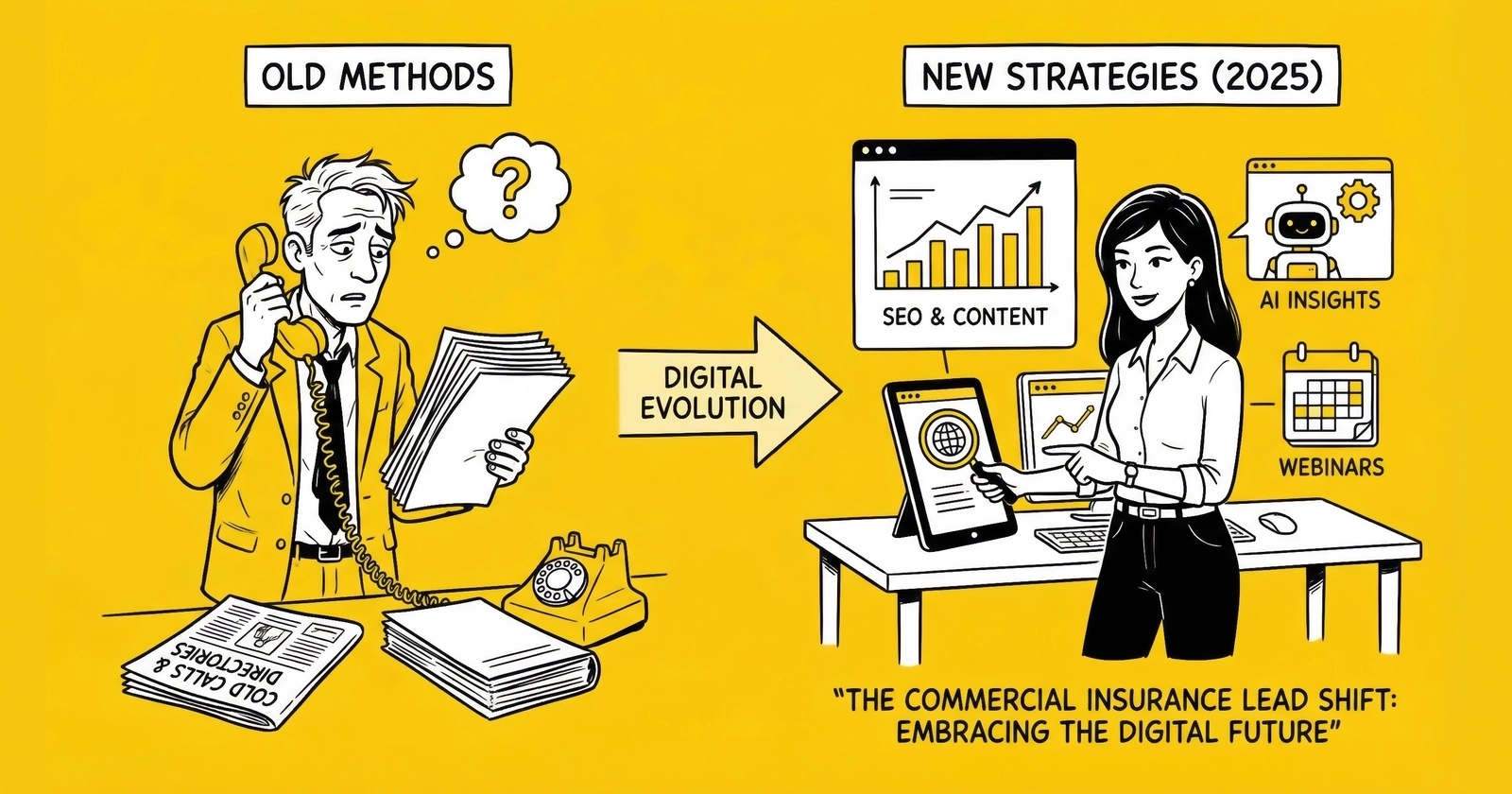
Master the commercial insurance lead market where longer sales cycles, higher policy values, and business buyer dynamics create fundamentally different economics than personal lines. This guide covers B2B targeting, qualification criteria, CPL benchmarks, and the operational requirements that separate profitable operators from those who burn budget on unqualified leads.
The commercial insurance market operates on different physics than personal lines.
When Progressive spends $3.5 billion on advertising, they are buying auto insurance leads at $40-75 each, closing them in a single phone call, and measuring success in days. When a commercial insurance operation generates a general liability lead at $150, they are beginning a multi-week sales process that may involve three decision-makers, two competitor quotes, and a broker relationship that spans decades.
The numbers tell the story. Commercial insurance policies average $5,000-$25,000 in annual premium for small businesses, $25,000-$100,000 for mid-market accounts, and well into six figures for large commercial risks. Commission structures run 10-15% on new business with 3-8% renewals. A single commercial account can generate $10,000-$50,000 in lifetime commission value.
But here is what the pitch deck never mentions: contact rates for commercial leads run 20-40% compared to 45-55% for personal lines. Conversion rates of 3-6% mean you need to work substantially more leads to produce a sale. Sales cycles of 2-8 weeks require operational patience and working capital depth that catches many personal-lines operators by surprise.
This guide covers everything you need to generate and convert commercial insurance leads profitably: market structure, B2B targeting, qualification frameworks, CPL benchmarks, compliance, and operational infrastructure.
Understanding the Commercial Insurance Lead Market
Commercial insurance encompasses any coverage purchased by businesses rather than individuals. This includes general liability, workers compensation, commercial auto, professional liability, property coverage, and bundled commercial packages that combine multiple coverage types.
Market Size and Opportunity
The U.S. commercial insurance market generates approximately $340 billion in annual written premium, representing roughly 40% of total property and casualty insurance volume. Small commercial (businesses with fewer than 100 employees) accounts for an estimated $125 billion of this market, with mid-market and large commercial comprising the remainder.
The lead generation opportunity within commercial insurance is substantially smaller than personal lines in volume terms but potentially larger in per-lead value. Industry estimates suggest $800 million to $1.2 billion in annual commercial insurance lead transaction value, compared to $3-4 billion for auto insurance alone. The difference reflects lower shopping frequency (commercial policies renew annually with less active comparison shopping) and the dominance of broker relationships over direct consumer acquisition.
However, the math works differently. A commercial general liability lead that costs $150 and converts at 4% produces $3,750 cost per acquisition. If average first-year commission is $1,500 and the account retains for 8 years with renewal commissions, lifetime value can exceed $10,000. That 2.7x return compares favorably to personal lines where higher conversion rates are offset by lower policy values.
Key Differences from Personal Lines
Commercial insurance lead generation differs from personal lines across multiple dimensions that affect every aspect of your operation.
Decision-Maker Complexity
Personal insurance decisions typically involve one or two consumers. Commercial decisions involve owners, CFOs, office managers, and sometimes committees. Reaching the right decision-maker is half the battle. A lead capturing the receptionist’s contact information is nearly worthless; a lead verified to reach the business owner or financial decision-maker commands premium pricing.
Sales Cycle Length
Auto insurance leads convert or die within days. Commercial leads may remain active for weeks or months. A business owner requesting workers compensation quotes in March may not make a decision until their policy renewal in September. This extended timeline requires different follow-up sequences, CRM discipline, and patience that personal-lines operations rarely develop.
Information Requirements
A personal auto insurance quote requires VIN, driver information, and coverage selections. A commercial quote may require business classification codes, employee counts by state, revenue figures, loss history, and detailed operations descriptions. Forms that capture insufficient information produce leads that cannot be quoted; forms that require too much information kill conversion rates.
Relationship Dynamics
Personal insurance is increasingly transactional. Commercial insurance remains relationship-driven. Businesses seek trusted advisors who understand their industry, risk profile, and long-term needs. Lead generation in commercial insurance often serves as introduction rather than transaction, beginning relationships that agents nurture over years.
Renewal Patterns
Personal auto shoppers compare quotes whenever their premium increases. Commercial buyers typically review coverage annually at renewal, with many maintaining the same broker for decades. This creates concentrated lead demand around common renewal dates and requires understanding of policy anniversary patterns.
Commercial Lines: Coverage Types and Lead Characteristics
Commercial insurance divides into distinct lines of business, each with unique lead economics, qualification requirements, and operational considerations.
General Liability Leads
General liability (GL) insurance protects businesses against third-party claims for bodily injury, property damage, and personal injury. Nearly every business needs GL coverage, making this the highest-volume commercial line for lead generation.
| Metric | Shared Leads | Exclusive Leads | Live Transfers |
|---|---|---|---|
| CPL Range | $75-150 | $125-200 | $175-300 |
Qualification requires capturing business type and industry classification, years in business, annual revenue or gross receipts, number of employees, current coverage status (new purchase vs. renewal), and policy expiration date if currently insured.
The conversion profile for general liability shows contact rates of 30-40%, conversion rates of 4-6%, average premiums of $800-$2,500 for small business, and sales cycles of 2-4 weeks. General liability leads convert relatively quickly compared to other commercial lines because many small businesses need minimal coverage to satisfy contract requirements. A contractor who needs a GL certificate to bid on a job will move fast. An established business shopping for rate comparison will take longer.
Workers Compensation Leads
Workers compensation (WC) insurance covers employee injuries and illnesses arising from employment. Required in nearly every state for businesses with employees, WC represents a substantial lead generation opportunity with higher complexity and premium values.
| Metric | Shared Leads | Exclusive Leads | Live Transfers |
|---|---|---|---|
| CPL Range | $100-200 | $150-300 | $200-400 |
Workers comp qualification demands more depth than general liability. You need state(s) of operation, industry classification (NAICS or SIC code), employee count by state, annual payroll by state, experience modification rate (EMR) if available, current carrier and policy expiration, and loss history summary.
The conversion profile shows contact rates of 25-35%, conversion rates of 3-5%, average premiums of $3,000-$15,000 for small business, and sales cycles of 3-6 weeks. Workers compensation leads require more detailed qualification because underwriting depends heavily on industry classification and loss history. A lead for a roofing contractor with high EMR faces different placement challenges than a lead for an accounting firm. Premium calculations require accurate payroll projections by classification code and state.
The complexity creates opportunity. Many small business owners struggle to navigate WC markets, particularly in high-risk industries or states with limited carrier appetite. Agents who can place difficult risks build loyal customer relationships.
Commercial Auto Leads
Commercial auto insurance covers vehicles used for business purposes, from single-vehicle operations to large fleets. This line bridges personal and commercial insurance, with economics that vary dramatically based on fleet size and driver profiles.
| Metric | Shared Leads | Exclusive Leads | Live Transfers |
|---|---|---|---|
| CPL Range | $60-125 | $100-175 | $150-275 |
Qualification for commercial auto captures business type and use, number of vehicles, vehicle types (cars, trucks, specialty), driver count and general profile, primary use (delivery, service, sales, hauling), radius of operation, cargo type if applicable, and current coverage and expiration.
The conversion profile shows contact rates of 35-45%, conversion rates of 4-7%, average premiums of $2,000-$10,000 for small fleets, and sales cycles of 2-4 weeks. Commercial auto leads convert faster than most commercial lines because the coverage decision closely mirrors personal auto. However, fleet size dramatically affects economics. A single-vehicle lead may generate $800 premium; a 20-vehicle fleet generates $25,000 or more.
Sophisticated lead forms capture vehicle count and use detailed enough to route leads appropriately. A lead for a long-haul trucking operation goes to specialists; a lead for a three-vehicle landscaping company goes to general commercial agents.
Professional Liability Leads
Professional liability (E&O, malpractice) insurance covers claims arising from professional services, advice, or negligence. Higher complexity and specialized markets create both challenges and opportunities for lead generators.
| Metric | Shared Leads | Exclusive Leads | Live Transfers |
|---|---|---|---|
| CPL Range | $125-250 | $175-350 | $250-450 |
Professional liability qualification requires precision. Capture profession type (specific matters significantly), license type and state, years in practice, revenue or billable hours, prior coverage history, claims history, number of professionals in practice, and specific services offered.
The conversion profile shows contact rates of 25-35%, conversion rates of 2-5%, average premiums of $1,500-$8,000 depending on profession, and sales cycles of 4-8 weeks. Professional liability leads require industry-specific qualification because coverage and pricing vary dramatically by profession. An accountant’s E&O policy differs from an architect’s professional liability, which differs from a consultant’s coverage. Generic professional liability forms that do not capture profession specifics produce leads that are difficult to quote accurately.
The highest-value professional liability leads come from industries with mandatory coverage requirements: attorneys in many states, medical professionals, real estate agents in some states, and licensed contractors.
Business Owner Policy and Commercial Package Leads
Business owner policies bundle general liability with commercial property coverage, often including business interruption. Commercial packages combine multiple coverage lines into comprehensive programs.
| Metric | Shared Leads | Exclusive Leads | Live Transfers |
|---|---|---|---|
| CPL Range | $100-175 | $150-250 | $200-350 |
BOP qualification captures business type and classification, location (owned vs. leased, building characteristics), revenue and employee count, business personal property values, coverage needs checklist, and current insurance situation.
The conversion profile shows contact rates of 30-40%, conversion rates of 3-5%, average premiums of $2,500-$10,000 for small business, and sales cycles of 3-5 weeks. Package leads often represent the best overall value for commercial lead buyers because multiple coverage lines mean higher premium per sale and stronger client relationships. A BOP customer who adds workers comp, commercial auto, and umbrella coverage becomes a significant account.
The challenge with package leads is qualification depth. A form that captures enough information for accurate quoting becomes lengthy; a form that converts well may not capture sufficient detail for quality assessment.
B2B Targeting Strategies for Commercial Insurance
Commercial insurance lead generation requires targeting business decision-makers rather than individual consumers. The approaches, platforms, and qualification requirements differ substantially from personal lines.
LinkedIn Advertising
LinkedIn provides the most precise B2B targeting for commercial insurance leads due to professional profile data unavailable on other platforms. You can target by job title (Owner, CEO, CFO, COO, Office Manager), job function (Finance, Operations, HR), company size using employee count bands, industry across over 100 categories, and geography by state, metro area, or radius.
| Campaign Type | CPL Range |
|---|---|
| Display/Sponsored Content | $150-300 |
| Message Ads (InMail) | $125-250 |
| Lead Gen Forms | $100-225 |
The platform excels when you target job titles with insurance purchasing authority and layer company size filters to match underwriting appetite. Industry targeting works particularly well for specialized coverage campaigns. Test Lead Gen Forms against landing pages to find your optimal approach. Forms typically reduce CPL 30-50% but may reduce qualification depth. Frequency caps prevent burning budget showing the same ad repeatedly to exhausted audiences.
LinkedIn works particularly well for professional liability targeting where profession-specific job titles enable precise audience building. A campaign for accountant E&O can target CPAs, CFOs, and accounting firm owners directly.
Google Search Campaigns
Search advertising captures active intent from business owners researching insurance options. Commercial insurance search campaigns require different keyword strategies than personal lines.
The high-intent keywords that drive commercial insurance searches include “commercial general liability insurance,” “small business insurance quotes,” “workers comp insurance [state],” “professional liability insurance [profession],” and “business insurance near me.”
| Campaign Type | CPL Range |
|---|---|
| Search Campaigns | $100-250 |
| Performance Max | $125-275 |
| Display Remarketing | $75-150 |
Build campaigns around specific coverage types rather than generic business insurance. Use location targeting to match carrier territorial appetite. Implement negative keywords aggressively to eliminate job seekers, salary researchers, and career changers searching terms like “jobs,” “salary,” and “how to become.” Create dedicated landing pages for each coverage type and match ad copy to search intent. Someone searching “commercial auto insurance for contractors” wants contractor-specific messaging.
Conversion rates on search campaigns typically run 20-40% higher than display because searchers have active intent. However, CPCs for commercial insurance keywords run $15-40, requiring strong landing page conversion to maintain viable CPL.
Facebook and Meta Advertising
Facebook offers less precise B2B targeting than LinkedIn but provides scale advantages and lower CPMs that can produce competitive CPL.
Targeting approaches include job title targeting (less precise than LinkedIn), interest targeting (small business, entrepreneurship), behavior targeting (business page admins), lookalike audiences from customer lists, and custom audiences for remarketing.
| Campaign Type | CPL Range |
|---|---|
| Lead Ads (Native Forms) | $75-175 |
| Landing Page Campaigns | $100-225 |
| Remarketing | $50-125 |
Facebook Lead Ads reduce friction but require aggressive lead validation since form completion is easy while lead quality requires verification. Build lookalike audiences from converted customers rather than just leads. Layer targeting to combine job title AND interest AND behavior. Exclude personal insurance interest categories and test video creative for complex products.
Facebook works best for small business general liability and BOP where targeting precision matters less than scale. Professional liability and specialized coverage benefit more from LinkedIn’s precision.
SEO and Content Marketing
Organic search represents a substantial opportunity for commercial insurance lead generation through educational content.
High-value content topics include “How much does [coverage type] insurance cost?”, “[Industry] insurance requirements by state”, “Do I need [coverage type] for my business?”, “[Industry] insurance checklist”, and “Workers comp classification codes explained.” Timeline to results runs 6-12 months to rank for competitive terms and 12-24 months to build significant organic traffic, with ongoing content investment required.
Focus on long-tail, industry-specific keywords initially. Create comprehensive guides that establish expertise. Build location-specific pages for state requirements. Include quote forms throughout content rather than just at article end, and use schema markup for FAQ and how-to content.
Organic traffic typically produces the lowest CPL over time but requires substantial upfront investment and patience. Most commercial insurance operations combine SEO with paid channels that produce immediate volume.
Qualification Criteria and Lead Scoring
Commercial insurance leads require more extensive qualification than personal lines. The difference between a worthless lead and a high-value opportunity often comes down to three or four data points.
Essential Qualification Fields
Every commercial insurance lead should capture three categories of information. Business identification includes business name, contact name and title (critical for B2B), phone number, email address, and business address or at least state/zip. Insurance context covers coverage type(s) needed, current insurance status (new purchase, renewal, additional coverage), policy expiration date if currently insured, and reason for shopping (price, coverage, service, required by contract). Basic business profile captures industry or business type, years in business, employee count, and annual revenue or payroll depending on coverage type.
Enhanced Qualification Fields
Additional fields improve lead quality but may reduce form completion rates. The tradeoff depends on your sales process and target market.
For general liability, enhanced fields include gross annual revenue, number of locations, current carrier (if insured), and specific operations description. For workers compensation, capture payroll by state, NAICS/SIC classification code, experience modification rate, and prior claims history. For commercial auto, collect vehicle count, vehicle types, primary use, and driver count with general profile.
Lead Scoring Framework
Commercial insurance leads benefit from explicit scoring to prioritize sales effort and optimize source quality. A well-designed scoring system assigns points across four dimensions.
The decision-maker score allocates 0-30 points based on title: Owner/CEO earns 30 points, CFO/COO earns 25 points, Office Manager earns 15 points, and Unknown/Other earns 5 points. This scoring reflects the fundamental reality that reaching decision-makers determines conversion probability.
The timing score allocates 0-25 points based on urgency. Policy expiring within 30 days earns 25 points. Policy expiring 31-60 days earns 20 points. Policy expiring 61-90 days earns 15 points. New business with no current policy earns 20 points. Just shopping or unknown timing earns 5 points.
The business quality score allocates 0-25 points based on account potential. Five or more years in business earns 10 points. Ten or more employees earns 5 points. Revenue exceeding $1 million earns 5 points. Multiple coverage needs earns 5 points.
The contact quality score allocates 0-20 points based on data validity. A business email domain earns 10 points. A validated phone number earns 5 points. A complete address earns 5 points.
Total scores between 80-100 indicate priority leads that warrant immediate attention. Scores of 60-79 represent standard leads to work within 24 hours. Scores of 40-59 indicate lower priority leads to work within 48 hours. Scores below 40 should trigger evaluation of source quality.
Form Design Considerations
Commercial insurance forms face an inherent tension: more fields improve lead quality but reduce completion rates. Three approaches exist.
The short form approach using 5-7 fields produces higher completion rates (8-15%) but lower lead quality, requiring more follow-up to gather quotable information. CPL runs lower, but cost per qualified lead may be higher after accounting for incomplete leads.
The long form approach using 12-18 fields produces lower completion rates (3-6%) but higher lead quality with leads closer to quotable. CPL runs higher, but cost per qualified lead may be lower since more leads are immediately workable.
The hybrid approach starts with minimal fields and uses progressive profiling to gather additional data. Multi-step forms capture email early before requesting additional qualification. Different forms serve different traffic sources since search traffic tolerates longer forms than social traffic.
Testing determines optimal form length for your specific operation. The correct answer depends on traffic quality, sales process, and underwriting appetite.
CPL Benchmarks: The Complete Picture
Understanding realistic CPL benchmarks prevents overpaying for leads and enables accurate budget planning. These ranges represent 2026 pricing through established intermediaries.
CPL by Coverage Type
| Coverage Type | Shared CPL | Exclusive CPL | Live Transfer |
|---|---|---|---|
| General Liability | $75-150 | $125-200 | $175-300 |
| Workers Compensation | $100-200 | $150-300 | $200-400 |
| Commercial Auto | $60-125 | $100-175 | $150-275 |
| Professional Liability | $125-250 | $175-350 | $250-450 |
| BOP/Package | $100-175 | $150-250 | $200-350 |
CPL by Business Size
| Business Size | CPL Index | Notes |
|---|---|---|
| Micro (1-5 employees) | 80-100% | Highest volume, lowest premium |
| Small (6-25 employees) | 100-120% | Sweet spot for many buyers |
| Medium (26-100 employees) | 120-150% | Requires broader markets |
| Large (100+ employees) | 150-200%+ | Often handled through brokers |
CPL by Targeting Method
| Channel | Typical CPL Range | Lead Quality |
|---|---|---|
| Google Search | $100-250 | High (active intent) |
| LinkedIn Ads | $125-300 | High (professional targeting) |
| Facebook Lead Ads | $75-175 | Medium (requires validation) |
| Display/Programmatic | $50-125 | Lower (awareness stage) |
| SEO/Organic | $25-75 | High (once established) |
| Referral/Partner | $50-100 | Very high |
Factors Affecting Your Specific CPL
Several variables cause your actual CPL to differ from benchmark ranges.
Industry risk class significantly impacts pricing. High-risk industries like construction, transportation, and healthcare command premium pricing due to limited carrier appetite and higher policy values.
Geographic location matters because certain states including California, New York, and Florida have higher insurance costs. This creates higher policy values but also more competitive lead markets.
Seasonality affects commercial insurance lead demand around common renewal dates. Q1 and Q4 typically see higher CPL as businesses approach fiscal year-end renewals.
Qualification depth commands premium pricing. Leads with verified decision-maker contact, specific policy expiration dates, and complete business information command 20-40% premiums over basic qualification.
Volume commitments reduce pricing. Buyers purchasing 500+ leads monthly typically negotiate 10-20% volume discounts compared to smaller purchasers.
Converting Commercial Insurance Leads
Generating leads is half the challenge. Converting them into customers requires sales processes adapted to commercial insurance’s longer cycles and multiple stakeholders.
Speed-to-Contact: Different but Still Critical
The speed-to-lead principle applies to commercial insurance, though the dynamics differ from personal lines. Speed still matters because businesses receive multiple quotes and choose from first responders. Decision-makers are busy, and catching them when they submit the form maximizes contact probability. Competitors are working the same leads.
The reality check: contact rates for commercial leads run 20-40% compared to 45-55% for personal lines. Even with immediate response, you will reach fewer prospects. This makes each successful contact more valuable.
Respond within 5 minutes during business hours. Use email and SMS alongside phone for multi-channel reach. Research the business briefly before calling by checking the website and understanding what they do. Leave professional voicemails that demonstrate you understand their business.
Multi-Touch Nurture Sequences
Commercial insurance leads require persistent follow-up over extended timelines.
A proven sequence structure begins with a phone call within 5 minutes on Day 1, followed by email if no answer. A second call attempt follows that evening. Day 2 brings a third call attempt with SMS check-in. Days 3-5 feature email with valuable content relevant to their industry. Week 2 includes a phone call and LinkedIn connection request. Weeks 3-4 bring email with a quote for comparison. Monthly contact continues with newsletters or market updates until policy expiration.
The key principles: vary contact methods across phone, email, SMS, and LinkedIn. Provide value in every touch through industry insights and risk management tips. Document all contact attempts in CRM. Note policy expiration for renewal follow-up. Remove or reduce frequency for explicit opt-outs.
Consultative Selling Approach
Commercial insurance buyers seek advisors, not order-takers. The sales approach should emphasize expertise and relationship.
Effective discovery questions include: What prompted you to shop for insurance today? Tell me about your business operations. What concerns you most about your current coverage? Who else is involved in this decision? What is your timeline for making a decision? What would make this an easy decision for you?
Value positioning requires demonstrating industry expertise, identifying coverage gaps or unnecessary coverage, explaining coverage clearly without jargon, providing risk management guidance beyond insurance, and being transparent about what you can and cannot place.
Multiple Stakeholder Management
Commercial decisions often involve multiple people. Understanding the buying committee improves close rates.
Typical stakeholders include the business owner (final decision authority), CFO/Controller (budget approval), Operations manager (coverage requirements), Office manager (often initial contact), and Attorney or accountant (advisory role).
Strategies for multi-stakeholder management begin with identifying all stakeholders early by asking “Who else will be involved in this decision?” Tailor communications to each role with financial emphasis for CFO and coverage details for operations. Provide materials stakeholders can share internally. Offer to present to the group if appropriate. Follow up with each stakeholder separately when possible.
Handling Long Sales Cycles
Commercial insurance sales cycles run 2-8 weeks or longer. Track each opportunity in CRM with clear stage definitions, expected decision dates, and next actions. Set calendar reminders for follow-up and conduct regular pipeline reviews to identify stalled opportunities. Maintain engagement by providing market updates, sharing relevant content, and checking in periodically without being pushy. Accept that some of your best customers will come from leads you nurtured for 6-12 months.
Compliance Considerations for Commercial Insurance Leads
Commercial insurance lead generation operates under multiple regulatory frameworks that differ from personal lines in certain aspects.
TCPA and Commercial Leads
The Telephone Consumer Protection Act (TCPA) applies differently to B2B communications in certain circumstances, but the differences are nuanced and often misunderstood.
The key distinctions involve several factors. TCPA prohibitions on autodialed calls and prerecorded messages apply differently to business numbers. However, many business owners use personal cell phones for business. DNC restrictions apply to residential lines rather than commercial lines, but determining whether a number is “residential” or “commercial” is not always clear.
The safest approach treats all commercial insurance leads as requiring the same consent standards as personal lines. Capture explicit consent regardless of business vs. personal determination. Document consent with timestamps and consent language – following proper consent documentation practices. Honor opt-out requests immediately. Maintain DNC compliance on all lists. Use TrustedForm or similar certification for web-generated leads.
The cost of compliance technology is minimal compared to TCPA litigation risk.
State Insurance Regulations
Insurance is regulated at the state level, with requirements varying by jurisdiction.
Licensing considerations affect lead generators in specific ways. Lead generators typically do not need insurance licenses for merely connecting consumers with agents. However, providing quotes, making recommendations, or discussing coverage terms may trigger licensing requirements in some states. The line between lead generation and solicitation varies by state.
Advertising requirements also vary. Some states require specific disclosures in insurance advertising. Rate and form filing requirements may affect displayed pricing. Carrier authorization may be required before presenting specific products.
Consult with an insurance licensing attorney for your specific model. Include appropriate disclosures on lead forms. Avoid making specific coverage recommendations without licenses. Ensure carrier authorization before representing specific products.
Building Your Commercial Insurance Lead Operation
Whether you are generating commercial insurance leads or buying them, operational infrastructure determines success.
Technology Requirements
Lead generation operations require a landing page platform with form builder, call tracking system, lead distribution platform for selling to multiple buyers, consent certification through TrustedForm or Jornaya, CRM for lead management, and analytics with attribution tracking.
Lead buying operations require CRM with lead management capabilities, telephony system with click-to-call, email marketing platform, lead validation services, and comparative rater integration for multi-carrier agencies.
Staffing Considerations
Commercial insurance lead operations require sales staff with insurance licensing, understanding of commercial underwriting, consultative selling skills, and patience for extended sales cycles. One commercial insurance sales person typically handles 150-300 active leads. Initial contact requires 5-10 minutes per lead; the full sales process requires 1-3 hours per converted customer. Plan staffing based on lead volume and target conversion rates.
Unit Economics Framework
Understanding your unit economics enables sustainable operations.
Lead generation economics follows a simple formula: traffic cost plus creative production plus platform fees plus technology plus labor equals cost per lead generated. For example, with Google Ads spend of $10,000, platform fees (2.8%) of $280, TrustedForm costs of $200, labor allocation of $1,000, and 80 leads generated, true CPL comes to $143.50.
Lead buying economics adjusts for additional costs: lead cost plus labor (contact and sales) plus return rate adjustment equals cost per contacted lead. For example, with a lead purchase at $150, expected return rate of 10% representing $15 equivalent, and sales labor per lead of $15, adjusted cost is $180 per valid lead.
Full funnel economics divides adjusted lead cost by contact rate by conversion rate to reach cost per sale. Using the example above with adjusted lead cost of $180, contact rate of 35%, and conversion rate of contacts at 10%, cost per sale equals $180 / 0.35 / 0.10, which comes to $5,143.
Compare cost per sale against expected commission to determine profitability. For deeper analysis, see the guide on true cost per lead calculation.
Scaling Considerations
Scaling commercial insurance lead operations requires balancing volume against quality. Key constraints include carrier placement capacity, sales staff absorption rates, and geographic focus. Scaling traffic typically reduces average quality, requiring source-level monitoring. Working capital requirements grow with volume, and technology systems may require upgrades. Successful operators scale deliberately, monitoring conversion rates to ensure profitability does not evaporate as volume increases.
Frequently Asked Questions
What is a good cost per lead for commercial insurance?
Commercial insurance CPL ranges from $60-400+ depending on coverage type, qualification depth, and distribution model. General liability leads typically run $75-200; workers compensation $100-300; professional liability $125-350. Shared leads cost 40-60% less than exclusive leads but require faster response and convert at lower rates. Live transfers command premium pricing ($175-400+) but deliver near-certain contact and higher conversion. A “good” CPL is one that produces profitable unit economics when you factor in contact rates (20-40%), conversion rates (3-6%), and customer lifetime value. A $200 lead converting at 4% to a $5,000 annual premium account with 8-year retention can be highly profitable despite appearing expensive compared to personal lines benchmarks.
How do I target business decision-makers for commercial insurance?
LinkedIn provides the most precise B2B targeting through professional profile data including job title, job function, seniority, company size, and industry. Target titles like Owner, CEO, CFO, and Office Manager. Google Search captures active intent from business owners researching insurance, though you cannot target job titles directly. Facebook offers less precise B2B targeting but can reach small business owners through interest and behavior targeting combined with job title. For all channels, develop creative that speaks to business concerns (protecting assets, meeting contract requirements, managing risk) rather than personal insurance messaging. Lead forms should capture contact title to enable qualification scoring.
What qualification criteria matter most for commercial insurance leads?
Four qualification factors most impact commercial insurance lead value. First, decision-maker verification: a lead reaching the business owner is worth 3-5x more than one reaching the receptionist. Second, timing: leads with policy expiration within 60 days convert at significantly higher rates than general shopping inquiries. Third, business profile: years in business, employee count, and revenue indicate stability and premium size. Fourth, coverage specificity: a lead seeking “commercial general liability” provides clearer routing than one seeking “business insurance.” Capture these four elements on every form. Additional qualification (industry codes, current carrier, loss history) improves quotability but may reduce form completion rates.
How long does it take to close a commercial insurance lead?
Commercial insurance sales cycles typically run 2-8 weeks, though they can extend to several months for larger or more complex accounts. General liability and commercial auto for small businesses may close in 2-4 weeks. Workers compensation, professional liability, and larger accounts typically require 4-8 weeks. The timeline reflects multiple factors: decision-maker availability, multi-stakeholder approval processes, information gathering requirements, and the non-urgent nature of many insurance purchases. Unlike personal auto insurance where consumers want immediate coverage, business owners often shop months ahead of renewal dates. Successful operations maintain consistent follow-up over extended periods and track opportunities through clear pipeline stages.
What conversion rates should I expect for commercial insurance leads?
Commercial insurance leads convert at substantially lower rates than personal lines due to decision-maker accessibility, longer sales cycles, and complex underwriting. Expect 20-40% contact rates (compared to 45-55% for personal lines) and 3-6% lead-to-sale conversion (compared to 8-12% for auto insurance). These lower rates are offset by higher policy values and longer customer retention. Contact rates vary by lead source: search traffic (30-40%) outperforms display traffic (20-30%). Conversion rates vary by coverage type: general liability (4-6%) converts better than professional liability (2-5%). Live transfers dramatically improve both metrics, with conversion rates of 8-15%, justifying their premium pricing.
Should I buy exclusive or shared commercial insurance leads?
The optimal distribution model depends on your response infrastructure and sales capacity. Exclusive leads cost 2-3x more than shared leads but eliminate speed competition and typically convert 40-60% better. Shared leads work if you can respond within 5 minutes and have call center infrastructure optimized for rapid outreach. Most agents and smaller agencies benefit from exclusive leads because they lack the systems for speed-based competition. Larger operations with dedicated sales teams may profitably work shared leads. Some operators blend both: exclusive leads for complex, high-value coverage types (professional liability, workers comp) and shared leads for more transactional general liability business. Test both models on your specific operation to determine optimal mix.
How do I handle the longer sales cycle in commercial insurance?
Extended sales cycles require CRM discipline, persistent follow-up, and patience. Implement a structured nurture sequence: multiple contact attempts in the first week, weekly touches for the first month, then monthly contact until policy expiration date. Vary contact methods (phone, email, SMS, LinkedIn) to maximize reach. Provide value in every touch through industry insights, risk management tips, or market updates. Track all opportunities in CRM with clear stage definitions and expected close dates. Set calendar reminders for follow-up rather than relying on memory. Accept that many leads will not convert immediately but may become customers at renewal time months later. Some of your best customers will come from leads you nurtured for 6-12 months.
What industries produce the highest-value commercial insurance leads?
Industry value depends on premium size, placement complexity, and retention patterns. Healthcare and medical practices generate high premiums for professional liability and workers comp. Construction and contractors require multiple coverage lines with significant premium. Transportation and trucking involve high-premium commercial auto and cargo coverage. Manufacturing combines property, liability, and workers comp at scale. Professional services (attorneys, accountants, consultants) need professional liability with strong retention. Technology companies represent growing opportunity with cyber liability and specialized coverage. The highest-value leads come from industries where you have underwriting relationships to place the risk and expertise to advise on coverage. A lead you cannot place has zero value regardless of premium potential.
How do I validate the quality of commercial insurance lead sources?
Validate new lead sources through systematic testing and performance tracking. Start with small volume commitments (100-200 leads) before scaling. Track source-level metrics including contact rate, decision-maker rate (what percentage reach actual decision-makers), conversion rate, and return rate. Compare performance against your benchmark sources. Request sample leads before committing to volume. Verify consent documentation and capture methodology. Ask about lead age, distribution model (exclusive vs. shared), and qualification methods. Quality sources should provide performance data and accept reasonable return policies. Red flags include unwillingness to share methodology, no return policy, significantly below-market pricing, and pressure for large volume commitments before testing. Build relationships with 3-5 quality sources rather than constantly chasing the cheapest option.
What compliance requirements apply to commercial insurance leads?
Commercial insurance leads face overlapping regulatory requirements. TCPA applies to telephone contact, with nuances around business vs. residential lines that require careful navigation. State insurance regulations govern advertising, solicitation, and licensing with variations by jurisdiction. Data privacy laws (CCPA/CPRA in California, expanding to other states) apply to business data, not just consumer data. Best practices include capturing explicit consent on all lead forms regardless of business context, using consent certification (TrustedForm, Jornaya), documenting consent language and timestamps, honoring opt-out requests immediately, and maintaining DNC compliance. The cost of compliance technology and processes is minimal compared to litigation risk. Consult with attorneys specializing in TCPA and insurance regulation for your specific operation.
Key Takeaways
-
Commercial insurance leads operate on fundamentally different economics than personal lines. Lower contact rates (20-40%), lower conversion rates (3-6%), but dramatically higher policy values ($5,000-$100,000+) and longer customer retention (8-15 years) create unit economics that reward patient, relationship-oriented operators.
-
CPL benchmarks range from $60 to $400+ depending on coverage type, qualification depth, and distribution model. General liability ($75-200), workers compensation ($100-300), and professional liability ($125-350) each have distinct economics. Shared leads cost 40-60% less than exclusive leads but require speed-based competition infrastructure.
-
Decision-maker verification is the single most important qualification factor. A lead reaching the business owner converts at 3-5x the rate of one reaching the receptionist. Forms should capture contact title, and scoring systems should prioritize decision-maker access above other factors.
-
B2B targeting requires different platforms and approaches than personal lines. LinkedIn provides precise professional targeting for job titles, company size, and industry. Google Search captures active intent. Facebook offers scale but requires validation. All channels require business-focused creative and longer qualification forms.
-
Sales cycles of 2-8 weeks require CRM discipline and persistent nurture. Multi-touch sequences across phone, email, SMS, and LinkedIn maximize contact probability. Value-add content maintains engagement during extended decision processes. Pipeline management prevents opportunities from falling through cracks.
-
Unit economics determine sustainability. Calculate true cost per sale including contact rates, conversion rates, and return rates. Compare against expected commission to determine profitability before scaling. A $200 lead with 4% conversion and $5,000 average premium can be highly profitable; the same lead with 2% conversion may lose money.
-
Compliance requires the same rigor as personal lines despite B2B context. TCPA, state insurance regulations, and privacy laws apply with nuances. Consent certification, documentation, and opt-out honoring protect against litigation risk that can destroy otherwise profitable operations.
-
Quality sources matter more than lowest CPL. Validate new sources through controlled testing. Track source-level performance metrics. Build relationships with 3-5 reliable sources rather than constantly chasing the cheapest leads. A $100 lead converting at 5% outperforms a $50 lead converting at 2%.
Sources
- Insurance Information Institute - Commercial Lines Facts and Statistics - Industry data on commercial insurance market size, premium volumes, and loss ratios
- NAIC - National Association of Insurance Commissioners - Regulatory guidance and market conduct standards for commercial insurance
- 47 U.S. Code Section 227 - TCPA - Federal statute governing telephone solicitation and consent requirements
- LinkedIn Marketing Solutions - B2B advertising platform specifications and targeting capabilities for commercial lead generation
- ActiveProspect TrustedForm - Consent certification documentation standards for lead generation compliance
- SBA Funding Programs - Loans - Small business financing options relevant to commercial insurance buyers
CPL benchmarks and performance metrics current as of 2025. Commercial insurance markets vary by geography, industry segment, and carrier appetite. Verify current pricing and validate performance through controlled testing before committing significant volume.