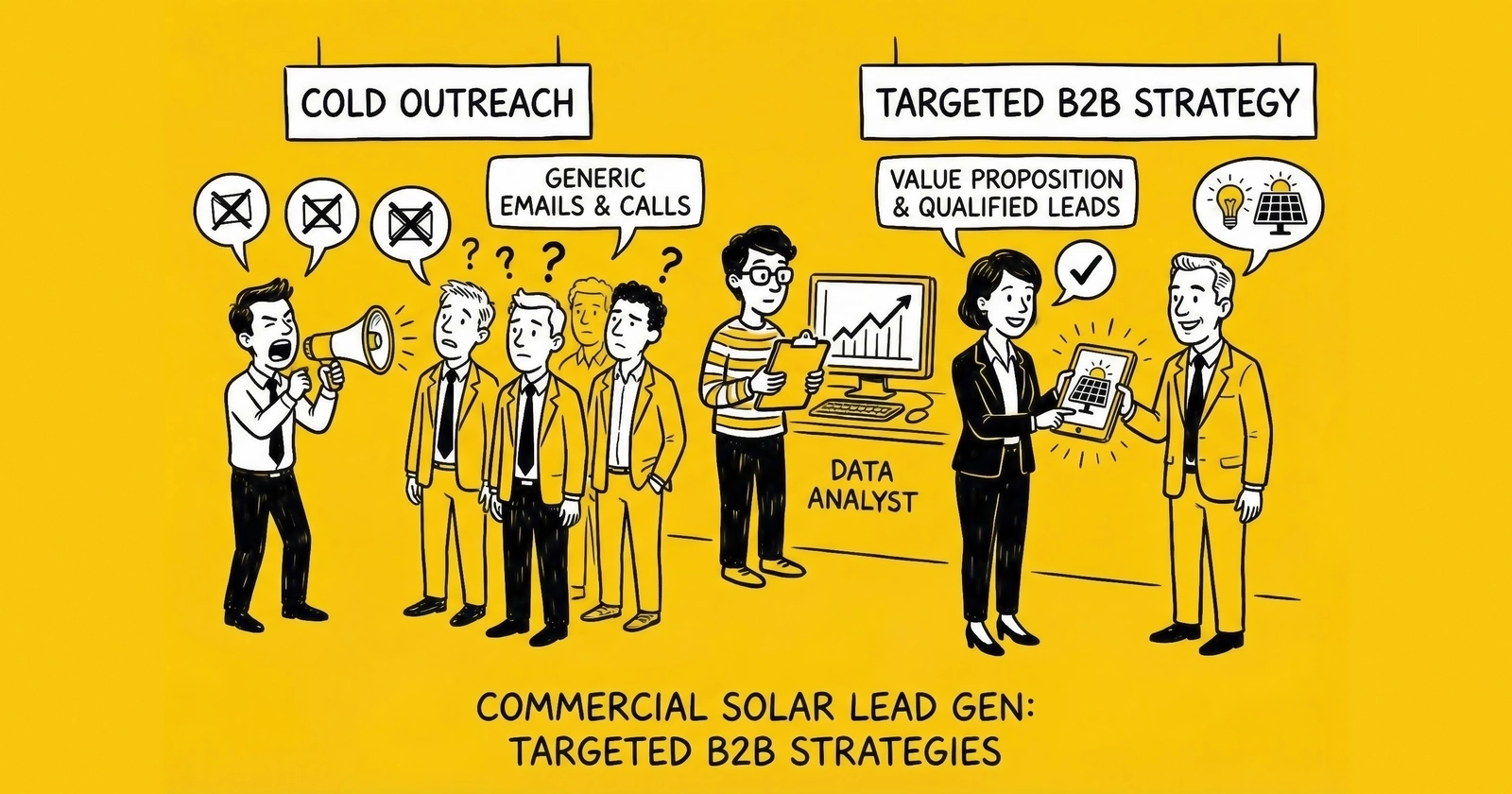
Longer sales cycles, multiple decision makers, and project values that dwarf residential deals. Commercial solar lead generation operates by different rules. Here is how to master them.
The commercial solar market represents a fundamentally different opportunity than residential lead generation. Where residential deals average $25,000-$35,000, commercial projects routinely exceed $200,000 and can reach $2 million or more for larger installations. The margins are different. The decision-making process is different. The sales cycle extends from weeks to months, sometimes years.
Yet most lead generators treat commercial solar as a simple extension of their residential operations. They run the same ad copy targeting “business owners,” capture the same minimal qualification data, and wonder why their buyers complain about unqualified leads that go nowhere.
Commercial solar lead generation rewards specialists who understand B2B buying dynamics. The residential solar playbook does not transfer. What works for homeowners making emotional decisions about their electric bills fails when you are targeting facilities managers navigating capital expenditure approvals, CFOs evaluating ROI projections, and sustainability directors building cases for board presentations.
This guide provides the complete framework for commercial solar lead generation: market dynamics, decision-maker identification, qualification requirements, sales cycle management, and the B2B-specific strategies that separate profitable commercial operations from expensive experiments. The commercial ITC offers a window through July 4, 2026 for projects to begin construction and qualify for the full 30% credit. Those who build commercial capabilities now position themselves for the post-residential-ITC market.
The Commercial Solar Market Landscape
Commercial solar encompasses installations for businesses, nonprofits, government entities, and other non-residential applications. The market segments into distinct categories, each with different economics and lead generation requirements.
Market Segments and Project Values
Small Commercial (10-100 kW) targets small businesses, restaurants, retail locations, and small office buildings. Project values range from $20,000 to $200,000. Decision-making often involves a single owner or property manager. Sales cycles run 2-4 months. This segment most closely resembles residential sales but requires business qualification and property verification.
Mid-Market Commercial (100 kW - 1 MW) serves medium-sized businesses, warehouses, manufacturing facilities, and multi-tenant buildings. Project values range from $150,000 to $1.5 million. Decision-making typically involves 3-6 stakeholders including facilities management, finance, and executive leadership. Sales cycles extend to 4-9 months with formal proposal processes.
Large Commercial (1-5 MW) addresses major corporate facilities, large retail chains, distribution centers, and industrial operations. Project values range from $1 million to $7 million. Buying committees include 6-12 stakeholders across facilities, finance, legal, sustainability, and executive functions. Sales cycles run 6-18 months with extensive due diligence, competitive bidding, and contract negotiation.
Community Solar and Portfolio Projects involve developers aggregating multiple sites or subscribers. Project values can exceed $10 million. Decision-making involves investor groups, municipal authorities, and regulatory approval. Sales cycles extend beyond 12 months with complex permitting and interconnection requirements.
The economics shift dramatically as project size increases. Installation costs per watt decrease with scale: residential projects average $2.50-3.50 per watt while large commercial projects can achieve $1.50-2.50 per watt. This efficiency creates higher margins that justify substantial customer acquisition costs.
The Commercial ITC Advantage
While the residential Investment Tax Credit expires after December 31, 2025, the commercial ITC (Section 48E under the Inflation Reduction Act) follows different timelines. Projects that begin construction by July 4, 2026 can qualify for the full 30% credit if placed in service within four years. Additional bonus credits can increase this to 40-50% for projects meeting prevailing wage, apprenticeship, domestic content, or energy community requirements.
This policy divergence creates a strategic window for lead generators. As the residential market contracts 30-50% in 2026 following ITC expiration, commercial solar offers a growing opportunity with sustained incentive support. Practitioners who build commercial lead generation capability now capture first-mover advantages in a less crowded market.
The math is compelling: a commercial project at $500,000 with a 30% ITC saves the business $150,000 in federal taxes. Add bonus credits and state incentives, and the economics become extremely attractive for qualified businesses with tax liability and capital access.
Commercial Market Growth Trends
Commercial and industrial (C&I) solar represents the fastest-growing segment of the U.S. solar market. Installations reached 5.1 GW in 2024, up 22% year-over-year. The market is projected to exceed 8 GW annually by 2027 as corporate sustainability commitments accelerate, electricity rates rise, and grid reliability concerns intensify.
Corporate renewable energy procurement has fundamentally changed. What began as environmental positioning has become financial strategy. Major corporations including Amazon, Google, Microsoft, and Walmart have committed to 100% renewable energy goals. Their supply chain partners face increasing pressure to demonstrate sustainability credentials, creating cascading demand for commercial solar across industries.
State-level renewable portfolio standards (RPS) and corporate sustainability reporting requirements (including SEC climate disclosure rules) are driving institutional demand. Companies that previously viewed solar as an optional “green” investment now recognize it as a competitive necessity for supplier relationships, ESG reporting, and long-term cost stability.
Understanding B2B Decision-Making in Commercial Solar
The fundamental difference between residential and commercial solar lead generation lies in decision-making structure. A homeowner might decide to install solar in a single conversation with a spouse. A commercial decision involves multiple stakeholders with different priorities, evaluation criteria, and authority levels.
The Commercial Buying Committee
Large commercial solar projects involve committees of 6-10 stakeholders or more. Understanding who sits on this committee and what each role cares about determines whether your leads convert.
Facilities/Operations Director owns the physical infrastructure. They care about roof condition, electrical capacity, installation disruption, maintenance requirements, and operational reliability. They need confidence that solar will not interfere with daily operations or create maintenance burdens. This role often serves as the initial point of contact and internal champion but rarely has final budget authority.
Chief Financial Officer or Finance Director evaluates the investment case. They analyze ROI projections, payback periods, cash flow impact, and financing structures. They compare solar to alternative capital uses and need compelling financial models that account for tax implications, depreciation schedules, and discount rates. CFO approval is essential for projects above typical operating expense thresholds.
Chief Executive Officer or Business Owner makes final investment decisions for significant capital expenditures. In smaller companies, this may be the founder or owner-operator who personally authorizes major purchases. They weigh strategic value, competitive positioning, and risk alongside financial returns.
Sustainability or ESG Director (in larger organizations) advocates for environmental initiatives and tracks progress toward corporate sustainability goals. They provide internal support and may have budget authority for sustainability investments, but often need finance and executive buy-in for major projects.
Legal and Procurement reviews contracts, warranty terms, liability provisions, and vendor qualifications. Complex installations require legal review that can extend timelines significantly. Procurement may manage RFP processes for competitive bidding.
Property Owner or Landlord (for leased facilities) must approve rooftop installations. Tenant-installed solar requires landlord cooperation on roof access, structural modifications, and lease provisions. This stakeholder can block projects regardless of tenant enthusiasm.
Board of Directors (for major investments) may require briefing or approval for capital expenditures above threshold amounts, particularly in publicly traded companies or nonprofit organizations.
Multi-Touch Engagement Strategy
Commercial solar leads require orchestrated multi-touch engagement across the buying committee. A lead generation strategy that captures only the facilities manager’s contact information produces low conversion rates because the facilities manager cannot alone authorize six-figure investments.
Effective commercial lead generation identifies and engages multiple stakeholders simultaneously:
Account Mapping identifies all relevant decision-makers within target organizations. Tools like LinkedIn Sales Navigator, ZoomInfo, or Apollo.io reveal organizational structures and contact information for key roles.
Role-Specific Messaging addresses each stakeholder’s priorities. The CFO receives financial analysis and ROI models. The facilities director receives technical specifications and installation timelines. The sustainability director receives environmental impact data and reporting capabilities.
Coordinated Outreach ensures stakeholders receive consistent information while addressing individual concerns. Multiple decision-makers discovering they have independently received conflicting claims destroys credibility.
Consensus Building Support provides materials that internal champions can use to build support. Case studies, ROI calculators, and presentation decks enable your champion to advocate effectively within their organization.
Decision-Maker Identification and Targeting
Finding the right decision-makers in commercial organizations requires different approaches than residential lead generation. Business owners do not fill out forms seeking solar quotes the way homeowners do. Commercial lead generation demands proactive identification and outreach.
Account-Based Marketing for Commercial Solar
Account-Based Marketing (ABM) inverts the traditional lead generation funnel. Instead of generating high volumes of leads and qualifying down, ABM identifies specific target accounts and pursues them directly.
Ideal Customer Profile Development defines which businesses make good commercial solar prospects. Criteria include:
- Facility size and roof space (minimum 10,000 sq ft for meaningful projects)
- Electricity consumption (minimum $10,000 monthly for compelling economics)
- Ownership status (owned buildings or long-term leases with 10+ years remaining)
- Industry vertical (manufacturing, warehousing, retail, and food processing offer strong fundamentals)
- Geographic location (high electricity rates, favorable net metering, state incentives)
- Financial stability (creditworthy for financing, sufficient tax liability for ITC benefit)
- Sustainability commitments (public ESG goals create internal pressure for action)
Target Account Lists identify specific companies meeting your ICP criteria. Data providers like Dun & Bradstreet, ZoomInfo, and industry-specific databases enable targeted list building. Commercial real estate databases identify property ownership and lease terms.
Intent Signal Monitoring identifies accounts actively researching solar or sustainability solutions. B2B intent data platforms (Bombora, TrustRadius, G2) track content consumption patterns that indicate buying interest. Accounts researching solar financing, commercial solar installers, or sustainability reporting tools signal potential opportunities.
Multi-Channel Engagement reaches target accounts through coordinated touchpoints:
- LinkedIn advertising targeting specific companies and job titles
- LinkedIn InMail outreach to key decision-makers
- Email campaigns with role-specific messaging
- Content syndication on industry publications
- Trade show presence and networking
- Referral programs through existing customers
LinkedIn as Primary B2B Channel
LinkedIn provides unparalleled targeting precision for commercial solar lead generation. Unlike residential solar where Facebook and Google dominate, commercial decision-makers are most accessible through professional networking.
Company Targeting reaches employees at specific organizations on your target account list. Upload lists of up to 300,000 company names; match rates typically run 60-80% depending on name standardization.
Job Title Targeting reaches decision-makers regardless of specific company. Target facilities directors, CFOs, sustainability officers, and business owners across your geographic and industry parameters.
Layered Targeting combines company size, industry, job function, seniority, and geography to reach ideal decision-makers without wasting impressions on irrelevant audiences.
LinkedIn CPLs run significantly higher than consumer platforms, often $75-250 per lead for commercial solar. However, lead quality justifies the premium. A $200 LinkedIn lead that reaches a CFO with budget authority for a $500,000 project represents dramatically better economics than a $20 Facebook lead targeting generic “business owners” who may be sole proprietors with no commercial facility.
Identifying Property Characteristics
Commercial solar leads require property qualification beyond what residential leads need. Key data points include:
Building Ownership vs. Lease Status determines who can authorize installation. Third-party commercial real estate databases (CoStar, Reonomy) provide ownership information. Long-term leases with 10+ years remaining may still be viable if landlord approval processes are understood.
Roof Characteristics affect installation feasibility and cost. Flat roofs common in commercial buildings work well for solar but require ballasted or attached racking systems. Roof age, condition, and remaining useful life impact project timelines if replacement is needed first.
Electrical Infrastructure determines interconnection complexity. Existing electrical capacity, service voltage, and panel availability affect installation design and cost. Buildings with older electrical systems may require upgrades.
Shading and Obstructions reduce production potential. Commercial roofs often have HVAC equipment, skylights, and venting systems that create shading challenges requiring careful system design.
Structural Capacity must support solar panel weight. Some commercial roof structures require engineering analysis to confirm load-bearing capacity.
Satellite imagery tools (Aurora Solar, Helioscope, Google Earth) enable preliminary property assessment before leads reach sales teams. Lead generation operations that pre-qualify properties for basic feasibility deliver higher-value leads that justify premium pricing.
Commercial Solar Lead Qualification Requirements
Commercial solar leads require deeper qualification than residential leads because the sales investment per lead is substantially higher. An installer spending 20-40 hours pursuing a commercial opportunity needs confidence that the prospect can actually proceed.
Financial Qualification Criteria
Tax Liability Confirmation matters because the ITC requires sufficient federal tax liability to utilize the credit. Pass-through entities (S-corps, LLCs) and tax-exempt organizations (nonprofits, municipalities) have different considerations. Nonprofits may benefit from direct pay provisions; municipalities may use tax equity partnerships.
Capital Access Verification establishes ability to fund the project. Options include cash purchase, equipment financing, solar loans, power purchase agreements (PPAs), and operating leases. Different structures suit different financial situations; understanding financing preference during lead capture enables appropriate routing.
Credit Qualification for financed projects requires adequate business credit scores and financial stability. Projects above $100,000 typically require financial statements review. Lead forms cannot verify credit directly but can capture basic financial indicators through appropriate lead validation services.
Budget Authority Confirmation ensures the lead contact can authorize purchases at relevant spend levels. A facilities manager at a Fortune 500 company cannot authorize $500,000 capital expenditures regardless of their enthusiasm.
Project Feasibility Qualification
Electricity Consumption Verification establishes baseline energy needs. Commercial accounts should ideally spend $10,000+ monthly on electricity for compelling economics. Utility bills or annual consumption data enable accurate sizing.
Building Suitability Assessment confirms installation feasibility:
- Roof space adequate for target system size
- Roof age under 10 years or replacement planned
- No major shading obstructions
- Structural capacity sufficient
- Electrical infrastructure compatible
Timeline Expectations identify where prospects fall in the buying journey. Early-stage research leads require nurturing; active project leads with defined timelines merit immediate sales engagement. Mismatched urgency wastes sales resources.
Competitor Engagement reveals whether prospects are already in active sales processes with other installers. Leads already receiving multiple proposals may have lower conversion probability for new entrants.
Decision-Maker Qualification
Authority Level Verification confirms the contact can influence or authorize purchasing decisions. Job title provides initial indication; explicit questions about role in the decision-making process add clarity.
Stakeholder Mapping identifies other decision-makers involved. Understanding the full buying committee enables appropriate engagement strategy.
Timeline and Process clarifies whether formal RFP processes, board approvals, or budget cycles affect timing. A lead in November may not convert until after fiscal year budget resets in January.
Qualification Form Design for Commercial Leads
Commercial lead forms must balance comprehensive qualification against completion friction. More fields improve lead quality but reduce volume.
Essential Fields for Commercial Solar:
- Company name
- Contact name and job title
- Email and phone
- Business address or multiple facility locations
- Approximate monthly electricity cost
- Building ownership status (own/lease/uncertain)
- Approximate roof size or building square footage
- Primary motivation (cost savings/sustainability/energy independence/grid reliability)
- Decision timeline
- Financing preference (purchase/PPA/lease/uncertain)
Valuable Additional Fields:
- Number of facilities interested in solar
- Annual revenue range (indicates company size)
- Current utility provider
- Roof age and type
- Prior solar research or proposals received
- Role in decision-making process
Conversion rates decrease 5-10% per additional field. Test form length against lead quality to find optimal balance. Commercial buyers with serious intent tolerate longer forms because they expect substantive initial conversations.
Sales Cycle Management for Commercial Solar Leads
Residential solar sales cycles run 30-90 days from lead to installation. Commercial projects extend to 6-18 months, requiring fundamentally different lead management approaches.
The Commercial Sales Timeline
Week 1-4: Discovery and Qualification confirms project viability and identifies stakeholders. Sales teams assess site feasibility, electricity consumption, financial capacity, and decision-making authority. Unqualified leads exit the funnel; qualified leads advance to proposal development.
Month 2-4: Proposal and Design develops comprehensive project proposals including system design, production estimates, financial analysis, and contract terms. Site surveys verify preliminary assessments. Multiple proposal iterations may be required as stakeholder feedback refines the scope.
Month 4-8: Evaluation and Negotiation involves formal review by buying committees, competitive comparisons, contract negotiations, and internal approval processes. Procurement departments may request references, financial statements, and insurance documentation.
Month 8-12: Contracting and Approval finalizes legal agreements, secures board or executive approval for major investments, and initiates permitting processes. Complex commercial contracts require legal review on both sides.
Month 12-18: Permitting and Installation includes permit applications, utility interconnection agreements, equipment procurement, construction, inspection, and commissioning. Large commercial projects may take 6-12 months from contract to operation.
Lead Nurturing for Extended Cycles
Commercial leads require sustained engagement throughout extended sales cycles. Leads captured today may not purchase for 12-18 months. Without systematic nurturing, leads go cold and opportunity evaporates. Understanding customer lifetime value helps justify the extended investment in commercial lead nurturing.
Automated Email Sequences provide ongoing value during sales cycles:
- Educational content about commercial solar economics
- Case studies from similar industries and project sizes
- Regulatory updates affecting project economics
- ROI calculator tools and financial modeling resources
- Event invitations and webinar announcements
Personalized Touchpoints maintain human connection:
- Quarterly check-in calls from sales representatives
- Personalized updates on relevant policy changes
- Industry news commentary and analysis
- Introductions to existing customers for reference conversations
Content Marketing establishes expertise and maintains top-of-mind awareness:
- Industry-specific whitepapers on solar economics
- Webinars addressing common questions and concerns
- Blog content targeting commercial solar search queries
- Case study development featuring successful projects
CRM Requirements for Commercial Leads
Commercial solar lead management demands CRM capabilities beyond basic contact databases:
Account-Level Tracking manages companies rather than individual contacts. Multiple contacts at the same organization should connect to a single account record showing aggregate engagement history.
Opportunity Pipeline Management tracks deals through extended sales stages with probability weighting and forecasting. Complex commercial projects may have multiple opportunity types (site survey complete, proposal submitted, contract negotiating).
Multi-Contact Engagement coordinates outreach to multiple stakeholders within the same account. Activity on any contact should be visible in account-level views.
Long Cycle Automation sustains engagement over 12+ month periods with appropriate pacing. Nurture sequences for commercial leads differ from residential sequences in duration and content focus.
Proposal and Document Management tracks quote versions, contract drafts, and supporting documentation through iterative revisions.
Integration with Marketing Automation connects lead generation campaigns with CRM pipeline data for closed-loop attribution and ROI measurement. Understanding lead attribution models becomes essential for accurately measuring commercial campaign performance.
Traffic Sources for Commercial Solar Leads
Commercial solar lead generation requires different traffic strategies than residential operations. Business decision-makers engage with different channels and respond to different messaging.
LinkedIn Advertising
LinkedIn dominates B2B lead generation for commercial solar due to precise professional targeting capabilities.
Sponsored Content places native ads in the LinkedIn feed targeting specific companies, job titles, industries, and company sizes. Single image ads, video ads, carousel ads, and document ads all work for commercial solar content.
Lead Gen Forms capture lead information within LinkedIn, pre-populating with profile data. These reduce friction compared to landing pages and improve conversion rates. However, the ease of submission can reduce lead quality; longer custom question sequences help filter serious prospects.
Message Ads (InMail) deliver personalized messages directly to prospect inboxes. Open rates average 50-60%, far exceeding email marketing. The 45-day frequency cap per user limits campaign scale but ensures message quality.
LinkedIn Cost Benchmarks for Commercial Solar:
- CPM: $35-75 (higher for narrow targeting)
- CPC: $8-20
- CPL via Lead Gen Forms: $75-175
- CPL via Landing Page: $125-250
Google Ads for Commercial Intent
Search advertising captures prospects actively researching commercial solar solutions.
Commercial Solar Keywords include:
- “commercial solar installation [city]”
- “solar panels for business”
- “commercial solar cost per watt”
- “solar for warehouse”
- “commercial solar financing”
- “business solar tax credit”
- “industrial solar installation”
Keyword competition is generally lower than residential solar, but search volume is also smaller. Cost per click ranges from $15-50 depending on geography and competition.
Remarketing re-engages visitors who consumed commercial solar content without converting. Display remarketing maintains awareness during extended consideration periods.
Content Marketing and SEO
Commercial buyers conduct extensive research before engaging sales teams. Content that addresses their questions captures organic traffic and establishes expertise.
High-Value Content Topics:
- Commercial solar ROI calculation methodology
- ITC and bonus credit qualification requirements
- Financing options comparison (purchase vs. PPA vs. lease)
- Industry-specific case studies (manufacturing, retail, warehouse)
- Net metering policies for commercial accounts
- Utility rate analysis and demand charge impacts
- Sustainability reporting and ESG requirements
Long-Form Content including whitepapers, guides, and research reports generates leads in exchange for contact information. Commercial buyers expect substantive content worth their email address.
Industry Trade Shows and Events
Commercial solar buyers attend industry events where in-person relationship building accelerates trust development.
Relevant Events Include:
- Solar Power International (SPI)
- Intersolar North America
- NABCEP Continuing Education Conferences
- Industry-specific sustainability conferences
- Commercial real estate and facilities management events
Trade shows enable direct engagement with decision-makers who are actively evaluating solutions. The cost per lead from events may exceed digital channels, but lead quality and conversion rates often justify the investment.
Referral and Partner Channels
Commercial solar buyers rely heavily on referrals and partner recommendations when evaluating vendors.
Customer Referral Programs incentivize existing customers to recommend your services. Commercial clients with successful installations become powerful advocates.
Commercial Real Estate Partnerships connect with property managers, REITs, and developers who influence tenant solar decisions or pursue projects for their portfolios.
Energy Consultant Partnerships leverage existing relationships between energy consultants and commercial clients. Consultants may refer or broker solar opportunities.
Industry Association Engagement builds visibility within trade groups where decision-makers participate.
Pricing Commercial Solar Leads
Commercial solar leads command premium pricing reflecting higher project values and more complex sales requirements.
Price Benchmarks by Lead Type
Exclusive Commercial Leads (Small Commercial): $100-250 per lead for small businesses and simple commercial projects. Qualification should confirm electricity spend, building ownership, and decision-maker authority.
Exclusive Commercial Leads (Mid-Market): $250-500 per lead for medium-sized commercial projects. Leads should include multiple contacts where possible and detailed qualification data.
Exclusive Commercial Leads (Large Commercial): $500-1,500+ per lead for large commercial and industrial opportunities. These leads often represent specific identified accounts rather than inbound form submissions.
Shared Commercial Leads: Generally not recommended for commercial solar. The extended sales cycle and high-touch sales process make shared leads inefficient for installers. If shared, pricing runs 40-60% of exclusive rates.
Appointment Setting: $200-400 per qualified appointment for small commercial; $400-800 for mid-market. Appointments should confirm decision-maker participation and basic project qualification.
Pricing Model Considerations
Cost-Per-Lead (CPL) works for qualified commercial leads with standard qualification criteria. Clear return policies for unqualified leads maintain buyer confidence.
Cost-Per-Qualified-Opportunity (CPQO) charges for leads meeting additional qualification thresholds verified by the buyer. Higher pricing reflects guaranteed quality; return policies should be minimal for truly qualified opportunities.
Revenue Share structures may work for larger commercial deals where lead generation and sales partner closely. A percentage of project value (typically 2-5% of contract value) aligns incentives for high-value outcomes.
Retainer Plus Performance combines baseline payments for lead generation services with per-lead or per-deal bonuses. This structure suits ongoing relationships where lead generators provide consistent volume.
Return Rate Management
Commercial leads experience lower return rates than residential leads when properly qualified (5-12% versus 15-25% for residential). The investment in qualification pays off through reduced returns and higher conversion rates.
Common return reasons include:
- Business does not own building or lacks landlord approval
- Electricity consumption insufficient for viable project
- Contact lacks decision-making authority
- Building already has solar or is in active proposal process
- Location outside installer service territory
- Business not creditworthy for financing
Clear qualification standards and transparent communication reduce return disputes. Installers should understand exactly what qualification your leads include – following best practices for lead return policies.
Working with Commercial Solar Installers and EPCs
Commercial solar installers differ from residential operations in scale, capability, and expectations. Understanding these differences enables productive partnerships.
Installer Segmentation
National Commercial Installers handle large-scale projects across multiple states. Companies like Nexamp, Pivot Energy, and CS Energy focus exclusively on commercial and utility-scale projects. These buyers want volume, consistent quality, and geographic diversity.
Regional Commercial Specialists dominate specific geographic markets with strong local relationships and permitting expertise. They prefer exclusive territory arrangements and higher-touch partnerships.
Residential Companies Expanding to Commercial represent installers with residential roots adding commercial capabilities. These companies may accept smaller commercial projects that pure commercial installers avoid.
Developer/EPCs design, engineer, and construct projects for investors or customers. They may generate their own leads through project development activities but purchase leads to supplement pipeline.
What Commercial Installers Want
Verified Decision-Maker Access matters more than in residential. Installers investing 20+ hours in proposal development need confidence they are engaging with people who can authorize purchases.
Property Feasibility Pre-Screening saves sales resources. Leads on buildings with inadequate roof space, severe shading, or structural issues waste proposal development effort.
Electricity Consumption Data enables accurate proposal development. Actual utility bills or at minimum verified monthly spend allows precise system sizing and financial modeling.
Financing Readiness Indication helps installers approach leads with appropriate solutions. A prospect considering PPA needs different conversations than one planning cash purchase.
Realistic Timeline Expectations enable pipeline planning. A lead planning 2026 installation requires different treatment than one seeking installation before year-end ITC deadlines.
Clean Contact Information sounds obvious but remains essential. Phone numbers that connect, email addresses that work, and accurate company information reduce friction.
Building Installer Relationships
Commercial solar installer relationships require more investment than residential buyer relationships due to higher lead prices, smaller buyer universe, and longer sales cycles.
Pilot Programs establish credibility before scale commitments. Start with small lead volumes at agreed pricing; use initial results to refine qualification criteria and establish conversion benchmarks.
Performance Transparency builds trust through shared data. Provide contact rate reporting, disposition tracking, and conversion metrics where available. Installers who see consistent data share more feedback.
Qualification Alignment ensures your criteria match installer capabilities and preferences. Different installers have different ideal customer profiles. Customizing qualification to specific buyer needs improves fit and reduces returns.
Regular Communication maintains relationship health. Monthly or quarterly reviews of performance, quality, and volume expectations prevent misalignment from accumulating.
Exclusive Territory Arrangements may be appropriate for strong relationships. Installers who receive exclusive leads in their core markets often pay premium pricing and provide better conversion data.
Frequently Asked Questions
What is the difference between commercial and residential solar lead generation?
Commercial solar lead generation differs from residential in several fundamental ways. Decision-making involves committees of 6-10 stakeholders rather than individual homeowners. Sales cycles extend 6-18 months versus 30-90 days. Project values range from $50,000 to several million dollars versus $25,000-35,000 for residential. Qualification requires business verification, property assessment, and financial capacity confirmation. Traffic sources shift toward LinkedIn and B2B channels rather than Facebook and Google consumer targeting. Lead pricing increases to $100-1,500+ reflecting higher project values and sales complexity. The commercial ITC continues through 2026 for qualifying projects while residential expires December 31, 2025.
How do I identify decision-makers for commercial solar projects?
Commercial solar decisions involve multiple stakeholders. Key roles include Facilities Directors (own physical infrastructure), CFOs (evaluate investment case), CEOs or business owners (authorize major expenditures), Sustainability Directors (advocate for environmental initiatives), and Property Owners (must approve installations for leased facilities). Tools like LinkedIn Sales Navigator, ZoomInfo, and Apollo.io reveal organizational structures and contact information. Account-Based Marketing approaches target specific companies and roles rather than generating undifferentiated lead volume. Effective commercial lead generation maps entire buying committees and coordinates engagement across stakeholders.
What qualification data should commercial solar lead forms capture?
Essential fields include company name, contact name and title, email and phone, business address, approximate monthly electricity cost, building ownership status, approximate roof size or building square footage, primary motivation, decision timeline, and financing preference. Valuable additional fields include number of facilities, annual revenue range, current utility provider, roof age and type, prior solar research, and role in decision-making process. Commercial buyers with serious intent tolerate longer forms because they expect substantive initial conversations. Test form length against lead quality to find optimal balance; conversion rates typically decrease 5-10% per additional field.
How long is the typical commercial solar sales cycle?
Commercial solar sales cycles extend 6-18 months from initial lead to installation completion. Discovery and qualification takes 1-4 weeks. Proposal and design development requires 2-4 months. Evaluation and negotiation spans 4-8 months as buying committees review proposals, compare options, and negotiate terms. Contracting and approval may add another 2-4 months for legal review and executive sign-off. Permitting and installation then takes 6-12 months for larger projects. Lead nurturing strategies must sustain engagement throughout these extended timelines. Leads captured today may not convert for 12-18 months.
What are typical commercial solar lead prices?
Exclusive commercial leads range from $100-250 for small commercial (10-100 kW projects), $250-500 for mid-market commercial (100 kW - 1 MW), and $500-1,500+ for large commercial and industrial opportunities. Appointment setting runs $200-400 for small commercial and $400-800 for mid-market. Shared leads are generally not recommended for commercial solar due to extended sales cycles and high-touch sales requirements. Premium pricing reflects higher project values and the substantial sales investment required to close commercial deals. Return rates for properly qualified commercial leads run 5-12%, lower than residential leads.
How does the commercial ITC differ from the residential credit?
The commercial Investment Tax Credit (Section 48E) remains available for projects beginning construction by July 4, 2026, with the full 30% credit available if projects are placed in service within four years. The residential ITC (Section 25D) expires for new installations after December 31, 2025. Commercial projects can also qualify for bonus credits increasing the total to 40-50% through prevailing wage, apprenticeship, domestic content, and energy community provisions. This policy divergence creates strategic opportunity for lead generators: as residential markets contract 30-50% in 2026, commercial solar offers sustained growth with favorable incentive support.
Which traffic sources work best for commercial solar leads?
LinkedIn dominates B2B lead generation for commercial solar due to precise professional targeting capabilities. Company and job title targeting reaches specific decision-makers at target accounts. LinkedIn Lead Gen Forms capture leads with 10-15% click-to-lead conversion. CPLs run $75-250 depending on targeting and form length. Google Ads capture commercial search intent with keywords like “commercial solar installation” and “solar panels for business.” Content marketing and SEO generate organic traffic through whitepapers, guides, and case studies addressing commercial buyer questions. Trade shows enable direct engagement with decision-makers at industry events. Referral programs leverage satisfied commercial customers as advocates.
How do I build relationships with commercial solar installers?
Start with pilot programs delivering small lead volumes at agreed pricing to establish credibility. Provide performance transparency through contact rate reporting, disposition tracking, and conversion metrics. Align qualification criteria with specific installer capabilities and ideal customer profiles. Maintain regular communication through monthly or quarterly reviews. Consider exclusive territory arrangements for strong relationships; installers receiving exclusive leads in core markets often pay premium pricing. Understand that commercial installers invest 20-40 hours per opportunity and need confidence in lead quality. Build partnerships with regional specialists as well as national players.
What makes a commercial building good for solar installation?
Ideal commercial solar candidates include buildings with large flat or low-slope roofs (minimum 10,000 square feet for meaningful projects), high electricity consumption ($10,000+ monthly), owned buildings or long-term leases with 10+ years remaining, roofs under 10 years old in good condition, adequate structural capacity to support panel weight, sufficient electrical infrastructure for interconnection, and minimal shading from rooftop equipment or adjacent structures. Geographic location matters: high electricity rates, favorable net metering policies, and state incentives improve project economics. Businesses with tax liability can directly benefit from the ITC; tax-exempt organizations may use direct pay provisions or tax equity partnerships.
How do I nurture commercial solar leads through extended sales cycles?
Automated email sequences provide ongoing value with educational content, case studies, regulatory updates, and ROI calculator tools. Personalized touchpoints maintain human connection through quarterly check-in calls, customized policy updates, and reference customer introductions. Content marketing establishes expertise through whitepapers, webinars, and blog content addressing commercial solar questions. CRM systems must support account-level tracking, opportunity pipeline management, multi-contact engagement, and long-cycle automation sequences. Without systematic nurturing, leads captured today that will not convert for 12-18 months go cold. The commercial buying process takes time; sustained engagement maintains opportunity throughout extended evaluation periods.
Key Takeaways
-
Commercial solar represents a fundamentally different market than residential. Project values of $50,000 to millions justify premium lead pricing of $100-1,500+. Decision-making involves committees of 6-10 stakeholders rather than individual homeowners. Sales cycles extend 6-18 months, requiring sustained nurturing strategies.
-
The commercial ITC provides a strategic window while residential expires. Projects beginning construction by July 4, 2026 qualify for the full 30% credit with potential bonus credits to 40-50%. This policy divergence creates opportunity as residential markets contract 30-50% in 2026.
-
Decision-maker identification requires Account-Based Marketing approaches. LinkedIn provides unparalleled targeting for commercial prospects. Map entire buying committees including Facilities Directors, CFOs, CEOs, Sustainability Directors, and Property Owners. Coordinate engagement across stakeholders.
-
Qualification depth determines conversion rates. Verify electricity consumption ($10,000+ monthly ideal), building ownership status, roof feasibility, financing capacity, and decision-maker authority. Commercial buyers tolerate longer forms because they expect substantive conversations.
-
Property assessment before sales engagement saves resources. Pre-screen for roof size, age, shading, structural capacity, and electrical infrastructure. Satellite imagery tools enable preliminary feasibility assessment. Qualified leads with verified property characteristics command premium pricing.
-
Installer relationships require more investment than residential partnerships. Pilot programs establish credibility. Performance transparency builds trust. Qualification alignment with specific installer capabilities reduces returns. Regular communication prevents misalignment.
-
Content marketing and LinkedIn dominate traffic strategy. Commercial buyers research extensively before engaging sales teams. Whitepapers, case studies, and ROI tools capture organic traffic. LinkedIn advertising reaches specific decision-makers at target accounts with CPLs of $75-250.
-
Extended sales cycles demand nurturing infrastructure. Automated sequences, personalized touchpoints, and account-level CRM tracking maintain engagement over 12-18 month periods. Leads captured today may not convert until next year.
-
The post-residential-ITC market belongs to operators who build commercial capabilities now. First-mover advantages accrue to lead generators establishing commercial infrastructure, installer relationships, and market expertise before the residential market contracts in 2026.
Sources
- Solar Energy Industries Association (SEIA) - U.S. solar market data, installation statistics, and industry growth projections including commercial and industrial segment trends
- IRS Residential Clean Energy Credit - Federal tax credit guidance for solar installations and ITC qualification requirements
- LinkedIn Marketing Solutions - B2B advertising platform for commercial solar lead generation targeting decision-makers
- Databricks - Enterprise data platform referenced for commercial solar analytics and account-based marketing infrastructure
- Salesforce Resources - CRM best practices for extended B2B sales cycles and account-level tracking
- LeadIQ - B2B prospecting platform for decision-maker identification in commercial accounts
Market data and policy information current as of late 2025. Commercial ITC provisions reflect the Inflation Reduction Act as amended; verify current requirements before acting. All regulatory claims should be confirmed with qualified tax and legal advisors.