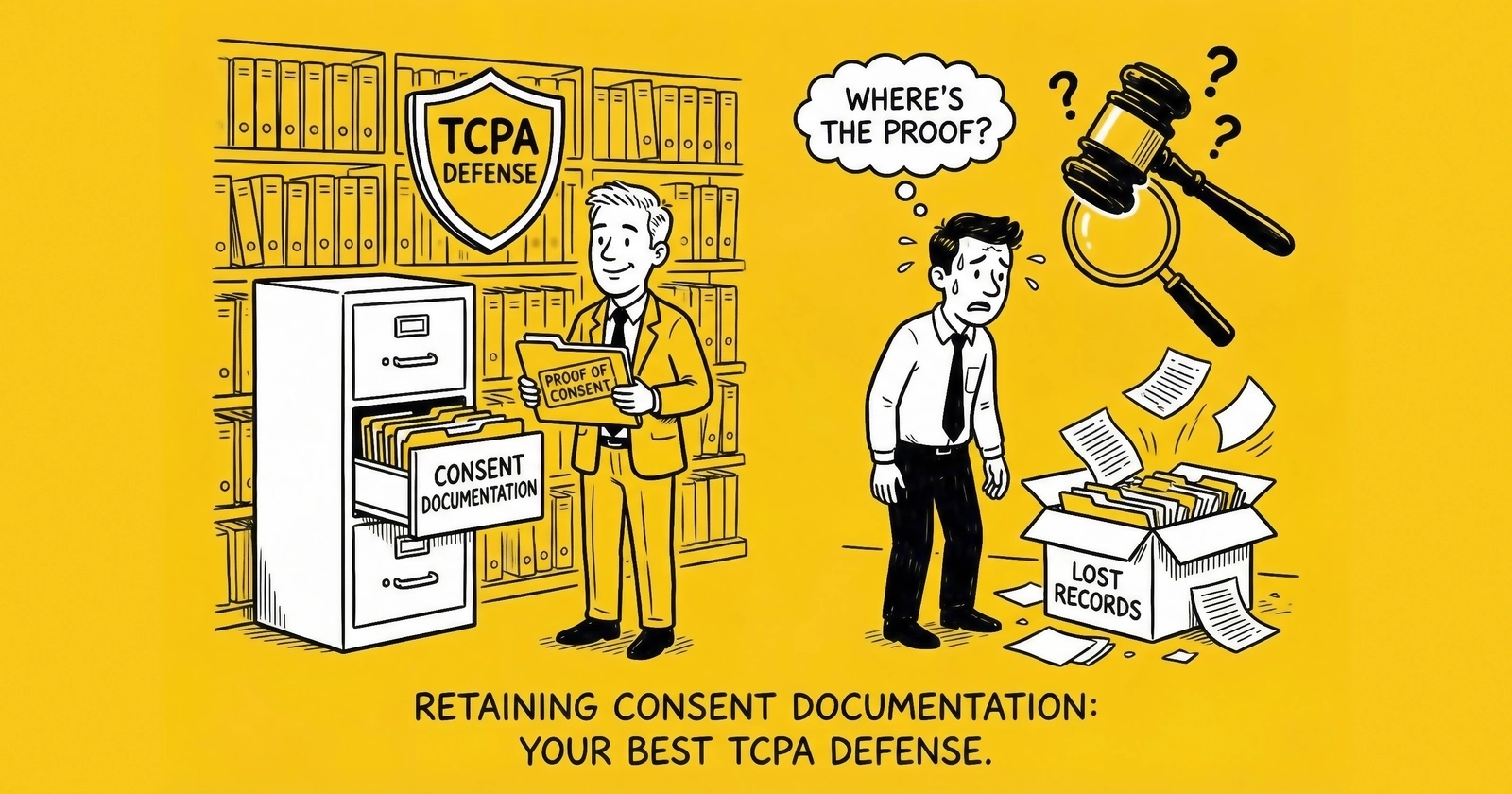
A comprehensive guide to consent record retention requirements for lead generation professionals navigating TCPA compliance, state regulations, and the documentation practices that determine survival when litigation arrives years after the lead was generated.
The Lead You Generated Yesterday May Become a Lawsuit Four Years From Now
The phone rang at a Florida lead generation company in March 2025. A process server delivered a class action complaint alleging 47,000 TCPA violations. Potential exposure: $70.5 million. The company’s annual revenue: $12 million.
The plaintiff’s attorney asked a simple question: Can you prove you had consent for these calls?
The company had obtained consent. They remembered obtaining consent. Their database showed consent checkboxes were clicked. But the TrustedForm certificates had expired after 90 days because no one configured retention. The form page had been redesigned twice since 2021, and no screenshots were archived. The consent language versions were stored on a developer’s laptop that had been wiped and reassigned.
The company settled for $8.2 million.
This scenario plays out regularly in the lead generation industry. Not because operators fail to obtain consent, but because they fail to retain the documentation that proves consent existed. The TCPA’s four-year statute of limitations means leads generated today can become lawsuits in 2029. When that lawsuit arrives, the only thing standing between your business and a multi-million-dollar settlement is your documentation archive.
Consent documentation retention is not a compliance checkbox. It is litigation survival infrastructure. This guide covers exactly how long to retain records, what records to retain, how to structure retention systems, and the regulatory landscape that dictates your obligations.
The Regulatory Framework: Understanding Your Retention Obligations
No single federal statute specifies exactly how long lead generators must retain consent documentation. Instead, retention requirements emerge from a combination of statutes of limitations, regulatory safe harbor provisions, and practical litigation defense needs.
The TCPA Statute of Limitations: Four Years
The Telephone Consumer Protection Act carries a four-year statute of limitations. This means plaintiffs have four years from the date of an alleged violation to file suit. A call made on January 15, 2025, can become a lawsuit filed on January 14, 2029.
But the four-year window does not start from when you generated the lead. It starts from when the call was made. If you generate a lead in January 2025 and a buyer continues calling that consumer monthly for the next two years, the statute of limitations for the final call does not expire until early 2031.
This creates a cascading retention requirement. You must retain documentation not just for four years from lead generation, but for four years after the last contact made pursuant to that consent.
Telemarketing Sales Rule: Five Years
The Federal Trade Commission’s Telemarketing Sales Rule (TSR) establishes record retention requirements for telemarketing operations. As of March 2024, the TSR requires retention of consent records for five years from the last date the consent is relied upon for telemarketing.
This five-year requirement extends beyond the TCPA’s four-year statute of limitations. While the TSR technically applies to telemarketing sales rather than lead generation specifically, the standard provides useful guidance and creates potential FTC enforcement exposure for operations that fall within TSR scope.
For practical purposes, the TSR’s five-year standard has become the industry baseline.
FCC Record Retention Guidance
The FCC has not established specific retention periods for consent documentation in most contexts. However, the Commission’s enforcement history demonstrates that operators bear the burden of proving consent existed at the time of the call. Without documentation, this burden cannot be met.
The FCC’s April 2025 revocation rules added a new dimension: companies must now document revocation requests and demonstrate compliance with the 10-business-day processing requirement. Revocation records should be retained indefinitely, as they represent permanent restrictions on contacting specific consumers.
CMS Medicare Requirements: Ten Years
For operations generating Medicare-related leads, the Centers for Medicare and Medicaid Services imposes the strictest retention requirements. CMS requires retention of enrollment records, including consent documentation, for ten years.
The October 2024 CMS one-to-one consent requirements for Medicare Advantage and Part D marketing make documentation even more critical. Operators in the Medicare vertical must retain evidence of single-seller consent for a full decade.
State-Specific Requirements
State mini-TCPA laws and data privacy regulations create additional retention obligations:
California CCPA/CPRA: No specific retention period mandated, but records must be available to respond to consumer requests. Practical retention of three to five years for consumer interaction records is common.
Florida FTSA: No specific retention period in the statute, but the three-year statute of limitations for certain claims extends exposure beyond federal TCPA.
Maryland, Oklahoma, Washington: Various statutes of limitations ranging from two to four years, with practical documentation needs extending beyond statutory minimums.
The patchwork of state requirements means national operations should apply the most conservative standard across all leads, regardless of the consumer’s location.
The Industry Standard: Five to Seven Years
Given the regulatory complexity, the lead generation industry has converged on retention periods that provide adequate protection across all applicable requirements.
Minimum Defensible Standard: Five Years
Five years represents the minimum defensible retention period for consent documentation. This standard provides coverage for the TCPA’s four-year statute of limitations plus a margin for discovery delays, the TSR’s five-year requirement, most state statutes of limitations, and typical litigation timelines from initial filing through discovery.
At five years, you can produce documentation for most TCPA claims filed within the limitations period, even accounting for delays between alleged violations and lawsuit filing.
Best Practice: Seven Years
Seven years has emerged as the industry best practice for several reasons.
Class action tolling extends the effective statute of limitations. When a class action is filed, the statute of limitations is tolled (paused) for all potential class members. If a class action is filed three years after a campaign, resolution may take two or more years. Individual class members may then have additional time to pursue claims after class resolution. The four-year limitations period can effectively extend to six or seven years in complex class litigation.
Discovery in TCPA litigation often requires documentation from periods preceding the specific calls at issue. Demonstrating consistent consent practices over time supports good-faith defense arguments. A seven-year archive allows you to show the court your 2024 practices were consistent with your 2020 practices.
The cost difference between five-year and seven-year retention is negligible relative to the protection provided. For digital records and consent certificates, extended storage costs represent fractions of a cent per lead.
Medicare Operations: Ten Years Minimum
Operations generating Medicare leads must retain documentation for the full ten-year CMS requirement. No exceptions. The regulatory stakes in the Medicare space, including potential exclusion from Medicare programs, make compliance non-negotiable.
What Records to Retain: The Complete Documentation Package
Consent retention is not simply keeping a database field that says “consent = true.” Litigation-ready documentation requires multiple elements that together prove what the consumer saw, what action they took, and when they took it.
Essential Retention Elements
Consent Timestamp: The exact date and time consent was provided, recorded to the second. Server timestamps in UTC provide the most defensible format. Client-side timestamps can be manipulated and may be challenged.
IP Address and Device Information: The IP address from which consent was submitted, along with browser type, operating system, and device information. This data helps establish that a real person, not a bot, provided consent and can be used to investigate fraud claims.
Consent Language Version: The exact disclosure text displayed to the consumer at the moment of consent. This is not a template that might have changed since 2022. It is the specific language this specific consumer saw on this specific date. Version control with hash verification ensures you can prove the language has not been modified.
Consumer Action Documentation: Evidence of the affirmative action taken by the consumer. Did they check a checkbox? Click a button? Type their name? The documentation must show the action was taken, not just that the form was submitted.
Phone Number Provided: The specific phone number for which consent was granted, as entered by the consumer at the time of consent. Consent is phone-number-specific. Documentation must link the specific number to the specific consent instance.
Form URL and Page State: The URL of the page where consent was captured and the page state at submission. If the form was dynamically generated or A/B tested, documentation should capture which version the consumer experienced.
Third-Party Verification Certificate: TrustedForm certificate URL, Jornaya LeadiD, or equivalent third-party verification token. These certificates provide independent documentation that survives challenges to your internal records.
Third-Party Verification Certificates
TrustedForm and Jornaya have become industry-standard documentation platforms because they provide independent, tamper-resistant records that courts accept as evidence.
TrustedForm Certificates: Generated by JavaScript deployed on your forms, TrustedForm certificates capture timestamp, IP address, page URL, and crucially, a visual session replay showing exactly what the consumer saw and did. The session replay can show cursor movements, scrolling behavior, and the consent disclosure’s visibility at the moment of submission.
TrustedForm certificates must be “claimed” within 90 days or they expire. Once claimed through TrustedForm Retain, certificates can be stored for up to five years. The cost is approximately $0.15 to $0.50 per certificate depending on volume.
Jornaya LeadiD: Each form submission receives a unique identifier that tracks the lead through its lifecycle. Jornaya’s TCPA Guardian product provides compliance reports that can be retrieved for litigation defense. Retention periods vary by product configuration.
Critical Understanding: A certificate documents what happened. It does not guarantee what happened was compliant. If your disclosure language was deficient, the certificate documents your non-compliance. Certificates must be reviewed and validated, not merely collected.
Consent Language Archive
Your consent disclosure language changes over time. Legal counsel updates wording. Marketing tests variations. Regulatory changes require new elements.
Every version of your consent language must be archived with effective dates. When litigation arises over a 2022 lead, you need to produce the exact language displayed in 2022, not your current 2025 disclosure.
Implementation approaches include version control systems tracking all consent language changes, timestamped screenshots of form pages captured at regular intervals, HTML archives of complete form pages with all associated assets, and change logs documenting when language was modified and why.
Revocation Records: Permanent Retention
Consent revocation records require special treatment. When a consumer opts out, that preference should be honored indefinitely. Unlike consent documentation, which has a finite litigation exposure window, revocation records represent permanent restrictions.
Revocation records should include the date and time of the revocation request, the method by which revocation was communicated (text, email, phone call, etc.), the specific opt-out language used by the consumer, documentation of when the revocation was processed, and confirmation that the consumer was added to internal Do Not Call lists.
The FCC’s April 2025 revocation rules require honoring opt-outs within 10 business days. Your records must demonstrate compliance with this timeline.
Retention System Architecture
Documentation that cannot be retrieved when needed provides no protection. Your retention system must be searchable, retrievable, and defensible.
Indexing Requirements
Consent records must be indexed by multiple fields for rapid retrieval. When litigation arrives, plaintiff’s counsel will request documentation for specific phone numbers and date ranges. You need to produce responsive records within days, not months.
Essential index fields include phone number (primary lookup key for litigation), lead ID or transaction ID (links to your internal lead management system), date of consent (enables date-range queries), lead source (identifies forms and campaigns), TrustedForm certificate URL (links to third-party verification), and buyer (if applicable, identifies downstream liability).
Storage Infrastructure
Primary Storage: Your lead management system or CRM should maintain consent documentation as permanent records associated with each lead. Ensure these records cannot be deleted or modified through normal business operations.
Certificate Storage: TrustedForm and Jornaya certificates should be claimed at lead generation and stored with the lead record. The certificate URL must be permanently associated with the lead. If you rely on the third-party platform for long-term storage (TrustedForm Retain), verify the retention period matches your requirements.
Backup Systems: Your primary consent documentation should be replicated to separate storage. If your primary system fails, you need backup access to consent records. Cloud storage with geographic redundancy provides appropriate protection for most operations.
Immutability: Consent records should be stored in a manner that prevents tampering. Write-once storage, blockchain verification, or third-party custody all provide immutability assurance. Courts may be skeptical of records that could have been modified after the fact.
Litigation Hold Procedures
When litigation is reasonably anticipated, you have a duty to preserve relevant evidence. In the lead generation industry, litigation is essentially always reasonably anticipated. However, specific events trigger formal preservation obligations.
Litigation triggers include receipt of a demand letter or complaint, notification of investigation by regulators (FCC, FTC, state AG), identification of patterns suggesting imminent claims, and media coverage of industry-wide enforcement.
When triggered, suspend any automatic deletion of records related to the leads, campaigns, or time periods at issue. Notify relevant personnel of their preservation obligations. Document the hold notice, recipients, and preservation steps taken.
The Cost of Inadequate Retention
The financial case for proper retention is unambiguous when measured against litigation exposure.
Cost of Retention
TrustedForm Retain: $0.15 to $0.50 per certificate for five-year storage
Internal Storage: Negligible for digital records (pennies per lead for cloud storage)
System Development: One-time investment in indexing and retrieval capabilities
For an operation generating 100,000 leads monthly, comprehensive retention costs approximately $15,000 to $50,000 annually.
Cost of Inadequate Retention
Average TCPA class action settlement: $6.6 million
Defense costs through trial: $300,000 to $750,000
Single successful TCPA claim: $500 to $1,500 per violation
Without documentation, you cannot prove consent existed. Courts presume non-compliance absent proof. A single campaign with 50,000 leads and inadequate documentation creates exposure of $25 million to $75 million.
The retention investment pays for itself if it prevents liability on 0.2% of leads. The actual protection rate is far higher for operations implementing comprehensive retention.
The Discovery Problem
When TCPA litigation begins, plaintiff’s counsel issues discovery requests for consent documentation. These requests typically cover all leads generated during a four-year lookback period, all consent language versions used during that period, all calls made to the plaintiff’s number, all opt-out requests received and processed, and all vendor contracts related to consent capture.
If your records are incomplete, you face multiple problems. Adverse inference means courts may instruct juries that missing evidence would have been unfavorable to you. Spoliation claims arise if records were destroyed after litigation was reasonably anticipated, creating sanctions exposure. Settlement leverage increases as gaps in your documentation strengthen plaintiff’s negotiating position.
Implementation Priority Guide
For operations building or upgrading consent retention infrastructure, prioritize investments based on risk reduction.
Immediate Priority: Address Within 30 Days
TrustedForm or Jornaya deployment: If you are generating leads without third-party verification, implement immediately. Every lead generated without a certificate is a lead you cannot defend.
Certificate claiming automation: Configure systems to claim certificates at lead generation, not later. Unclaimed TrustedForm certificates expire after 90 days.
Consent language archiving: Begin capturing and dating all consent disclosure versions. Screenshot form pages weekly until a more robust solution is implemented.
High Priority: Address Within 90 Days
Five-year certificate retention: Upgrade to TrustedForm Retain or equivalent for extended storage. The 90-day default expiration provides no litigation protection.
Database indexing: Ensure consent records are indexed by phone number and date for rapid retrieval. Test retrieval times, as litigation requires production within days.
Revocation record system: Implement permanent storage for all opt-out requests with timestamps and processing confirmation.
Medium Priority: Address Within 180 Days
Version control for consent language: Move from screenshot archives to formal version control with hash verification.
Backup and redundancy: Implement geographic replication for consent documentation.
Litigation response procedures: Document evidence preservation protocols and train relevant personnel.
Ongoing Investment
Retention audits: Quarterly verification that retention systems are functioning correctly.
Vendor compliance: Regular confirmation that third-party verification providers maintain appropriate retention.
Legal counsel review: Annual review of retention practices against evolving regulatory requirements.
Vendor Management Considerations
If you purchase leads from third parties, your consent documentation requirements extend to vendor management.
Vendor Due Diligence
Before purchasing leads, verify that the vendor deploys TrustedForm, Jornaya, or equivalent verification, the vendor retains certificates for adequate periods (verify their retention policy), certificates are provided with each lead (not generated retroactively), and the vendor will cooperate in producing documentation if litigation arises.
Contractual Requirements
Lead purchase agreements should include requirements for consent verification with each lead, retention periods matching your internal standards, audit rights allowing you to verify vendor compliance, cooperation clauses for litigation document production, and indemnification provisions for consent documentation failures.
Certificate Validation
Do not assume a certificate URL means compliant consent. At lead purchase, claim and review a sample of certificates. Confirm the seller’s name appears in the disclosure. Confirm the disclosure was visible without scrolling. Confirm the consumer took affirmative action. Confirm the phone number matches the lead record.
A certificate documenting non-compliant consent is evidence against you, not for you.
Special Considerations by Vertical
Different lead generation verticals face different retention requirements based on regulatory overlays.
Insurance Leads
State insurance regulations may impose documentation requirements beyond TCPA. Some states require retention of marketing materials and consent documentation for periods specified by insurance department rules. California, Florida, and New York have particularly detailed requirements.
Mortgage Leads
RESPA and TILA create documentation requirements that interact with consent retention. The Consumer Financial Protection Bureau (CFPB) has shown interest in lead generation practices, creating potential federal enforcement exposure beyond TCPA. Understanding prior express written consent requirements is essential for mortgage lead operations.
Medicare Leads
The ten-year CMS retention requirement governs. One-to-one consent documentation is mandatory as of October 2024. Medicare operations face the strictest regulatory environment in lead generation.
Legal Leads
State bar rules may regulate lawyer advertising and solicitation. Lead generators serving legal verticals should verify that consent documentation meets any applicable state bar requirements.
Frequently Asked Questions
1. How long must I retain consent documentation for TCPA compliance?
The TCPA has a four-year statute of limitations, meaning claims can be filed up to four years after an alleged violation. However, this period runs from the date of the call, not the date of lead generation. If calls continue for two years after lead generation, documentation must be retained until four years after the final call. The industry standard is five to seven years from lead generation to account for this extended exposure, class action tolling, and discovery requirements. Medicare operations must retain records for ten years per CMS requirements.
2. What is the difference between TCPA and TSR retention requirements?
The TCPA statute of limitations is four years, but the statute does not specify record retention periods. The FTC’s Telemarketing Sales Rule (TSR) explicitly requires five-year retention of consent records from the last date the consent is relied upon. While the TSR technically applies to telemarketing sales operations, the five-year standard has become the industry baseline for all lead generation consent documentation. Operations subject to TSR jurisdiction face direct regulatory exposure for inadequate retention.
3. Do TrustedForm certificates expire, and how do I prevent expiration?
Yes, TrustedForm certificates expire after 90 days if not claimed. To prevent expiration, you must use TrustedForm Retain, which extends storage for up to five years. Certificates should be claimed at the moment of lead generation, before any contact is attempted. Configure your lead management system to automatically claim certificates as leads are created. Unclaimed certificates cannot be recovered after expiration, eliminating your documentation for those leads.
4. What records should I keep beyond just the consent certificate?
A complete documentation package includes the consent timestamp with server-side recording to the second, IP address and device information, the exact consent language displayed to the consumer with version identification, evidence of the affirmative action taken such as checkbox click or signature, the phone number for which consent was granted, the form URL and page state at submission, and the third-party verification certificate URL. You should also retain archives of all consent language versions with effective dates, change logs documenting when and why language was modified, and revocation records showing opt-out requests and processing confirmation.
5. How long should I retain consent revocation and opt-out records?
Consent revocation records should be retained indefinitely. Unlike consent documentation, which has a finite litigation exposure window, opt-out preferences represent permanent restrictions on contacting specific consumers. The FCC’s April 2025 rules require honoring revocation within 10 business days through any reasonable method. Your revocation records must document the date and method of the request, the specific opt-out language used, when processing was completed, and confirmation of addition to internal Do Not Call lists. These records protect you against claims that you continued contacting consumers after revocation.
6. What happens if I cannot produce consent documentation in litigation?
Without documentation, you cannot prove consent existed. Courts will presume non-compliance absent proof, and the burden of proving consent rests entirely on the caller. Discovery failures can result in adverse inference instructions telling juries that missing evidence would have been unfavorable to you. Spoliation claims may arise if records were destroyed after litigation was reasonably anticipated. Practically, documentation gaps strengthen plaintiff’s settlement leverage and make case dismissal nearly impossible. Most cases with inadequate documentation settle regardless of whether valid consent was actually obtained.
7. Should I retain consent documentation for leads I purchase from third parties?
Yes. When you purchase leads and contact consumers, you inherit liability for any consent deficiencies. Your documentation should include the consent certificate received with the lead, ideally claimed and stored in your own systems rather than relying solely on vendor retention. You should also retain lead purchase records linking each lead to its source and certificate, vendor contracts documenting consent requirements and indemnification provisions, and any validation you performed on the certificate before contacting the lead. If the vendor’s consent was deficient, having your own copy of the certificate documenting that deficiency may support indemnification claims against the vendor.
8. How do state mini-TCPA laws affect retention requirements?
State telemarketing laws like Florida’s FTSA, Oklahoma’s OTSA, and Maryland’s Stop the Spam Calls Act create independent claims with their own statutes of limitations, ranging from two to four years depending on the state. National operations should apply the most conservative retention standard across all leads regardless of consumer location. Additionally, state privacy laws like California’s CCPA/CPRA require records be available to respond to consumer requests, creating practical retention needs of three to five years for consumer interaction records. The regulatory patchwork means five to seven year retention provides appropriate coverage for most state-level exposure.
9. What system architecture supports litigation-ready retention?
Litigation-ready retention requires indexing by phone number for primary lookup when claims arrive, lead ID or transaction ID linking to your lead management system, date of consent enabling date-range queries for discovery, and lead source identifying forms and campaigns. Storage should be immutable, preventing modification after the fact through write-once storage, blockchain verification, or third-party custody. Backup redundancy with geographic replication protects against primary system failures. Retrieval must be rapid since litigation discovery typically requires production within days, not months. Test your retrieval capabilities regularly.
10. How much does adequate consent retention cost relative to litigation exposure?
Comprehensive retention costs approximately $0.15 to $0.50 per lead for TrustedForm Retain plus negligible internal storage costs, totaling roughly $15,000 to $50,000 annually for an operation generating 100,000 leads monthly. By comparison, the average TCPA class action settlement is $6.6 million, defense costs through trial range from $300,000 to $750,000, and per-violation statutory damages are $500 to $1,500 with no aggregate cap. A single campaign with 50,000 leads and inadequate documentation creates exposure of $25 million to $75 million. The retention investment pays for itself if it prevents liability on 0.2% of leads.
Key Takeaways
-
Five years is the minimum defensible retention period. The TCPA’s four-year statute of limitations plus the TSR’s five-year requirement establish the floor. Industry best practice is seven years to account for class action tolling and extended discovery.
-
Medicare operations require ten-year retention. CMS requirements for Medicare Advantage and Part D marketing are non-negotiable. The October 2024 one-to-one consent rules make documentation even more critical in this vertical.
-
Retention requires complete documentation packages, not just database fields. You need consent timestamps, IP addresses, exact disclosure language displayed, evidence of affirmative consumer action, phone numbers, form URLs, and third-party verification certificates. Missing any element weakens your defense.
-
TrustedForm certificates expire after 90 days if not claimed. Configure automatic claiming at lead generation and upgrade to TrustedForm Retain for extended storage. Expired certificates cannot be recovered.
-
Consent language versions must be archived with effective dates. When litigation arises over a 2022 lead, you need the exact 2022 disclosure, not your current language. Implement version control with hash verification.
-
Revocation records require permanent retention. Opt-out preferences are indefinite restrictions. Your records must document the request, processing timeline, and confirmation of internal DNC list addition.
-
The cost of retention is trivial relative to exposure. At $0.15 to $0.50 per lead for five-year certificate storage, retention costs represent a fraction of the $6.6 million average class action settlement or the $500 to $1,500 per-violation statutory damages.
-
Documentation that cannot be retrieved provides no protection. Index records by phone number for rapid litigation lookup. Test retrieval capabilities regularly. Maintain backups with geographic redundancy.
-
Vendor-supplied leads require your own documentation. Claim and store certificates for purchased leads. Verify vendor retention policies and include cooperation clauses in contracts.
-
When litigation arrives, production is measured in days, not months. Build infrastructure now that supports rapid document production under discovery deadlines.
The Documentation Imperative
Consent documentation retention is not a compliance exercise. It is litigation survival infrastructure.
The lead you generated yesterday may become a lawsuit four years from now. When that lawsuit arrives, the only thing standing between your business and a multi-million-dollar settlement is your documentation archive. Every certificate claimed, every language version archived, every revocation recorded represents insurance against claims you cannot predict.
Those who thrive in the current environment are those who treat documentation as core business infrastructure, not as overhead. They invest the $0.15 to $0.50 per lead for proper certification. They configure automatic claiming. They implement version control. They maintain seven-year archives.
Those who fail are those who assume consent documentation will sort itself out. They discover their TrustedForm certificates expired months ago. They cannot find the 2022 version of their disclosure. They have no records showing when revocations were processed.
The math is unforgiving. Retention costs pennies per lead. Litigation costs millions.
Build the archive. Your future depends on it.
This article reflects regulatory requirements and industry practices as of late 2025. Record retention requirements evolve through regulatory changes and court decisions. Consult qualified TCPA counsel for current requirements specific to your operations.
Related Resources:
- TCPA Compliance 101: What Every Lead Generator Must Know
- Prior Express Written Consent (PEWC) Complete Guide
- TrustedForm vs Jornaya: Consent Verification Comparison
- TCPA Litigation Statistics 2025
Sources
- 47 U.S. Code Section 227 - TCPA - Federal statute establishing telephone solicitation restrictions and the four-year statute of limitations for TCPA claims
- ActiveProspect TrustedForm - Independent consent certification platform providing session replay and consent documentation for TCPA compliance
- FTC Telemarketing Sales Rule - FTC regulation requiring five-year retention of express informed consent records
- IETF Datatracker - Technical standards for IP address formatting and geolocation data capture referenced in consent documentation
- Forrester Research - Industry research on consent management platform implementation and compliance infrastructure
- IBISWorld - Industry data on lead generation market size and TCPA litigation trends