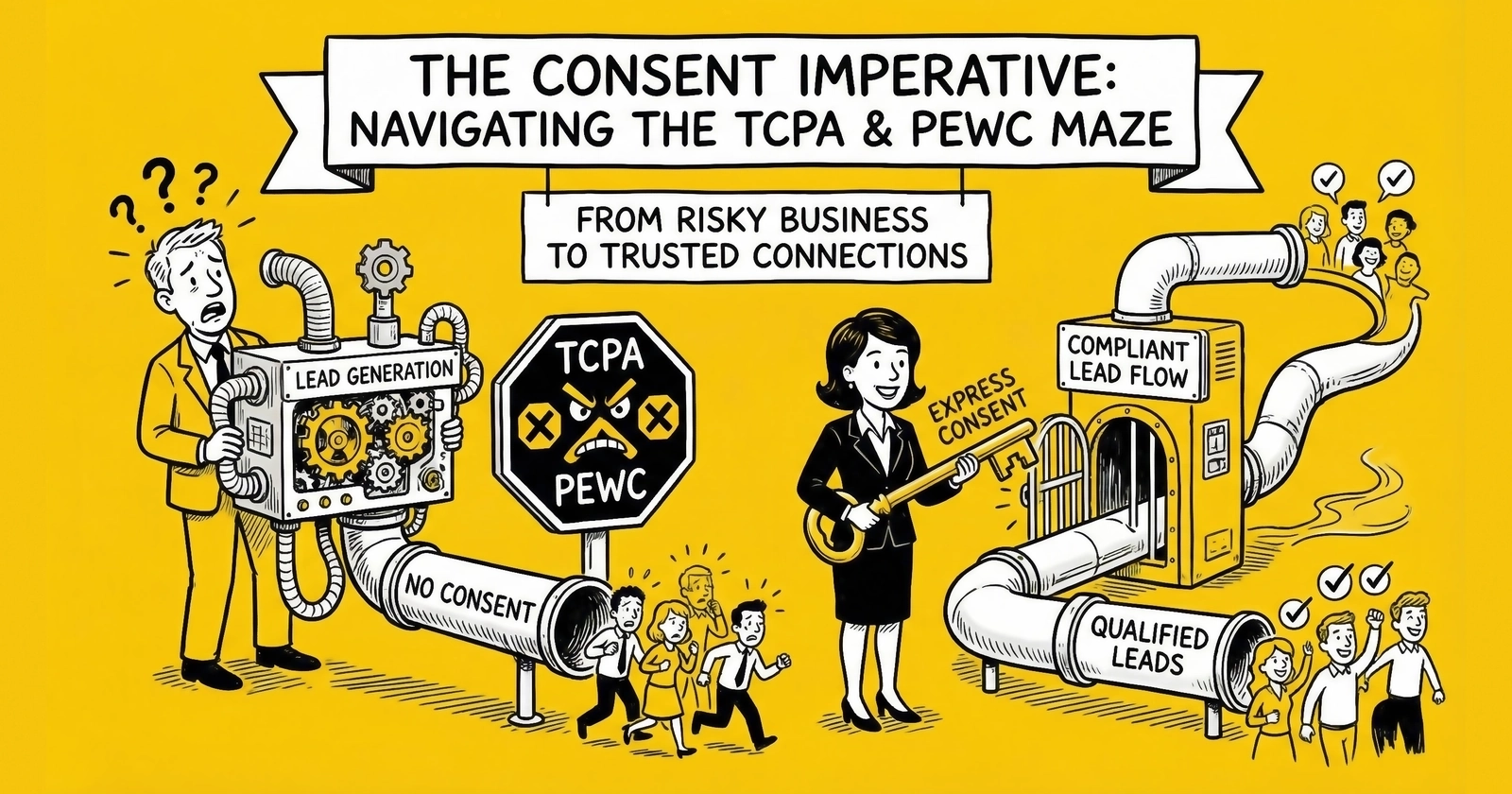
A comprehensive guide to building consent-first lead generation operations in 2026, where proper documentation separates profitable businesses from class action defendants.
The phone rings at 3:17 PM on a Tuesday. A process server hands over a class action complaint alleging 47,000 TCPA violations. Statutory damages: $70.5 million. The company’s annual revenue: $12 million.
This scenario plays out weekly in the lead generation industry. In Q1 2025 alone, 507 TCPA class actions were filed – a 112% increase over the same period in 2024. Average settlements exceed $6.6 million. The companies that survive and thrive in this environment share one characteristic: they treat consent not as a checkbox but as their primary product.
Your lead is not contact information. Contact information is a commodity worth pennies. Your lead is consumer intent, captured at the moment of expression, packaged with documented permission to make contact. Without that permission – properly obtained and meticulously documented – you are not selling leads. You are selling liability.
This guide walks you through exactly how to build consent-first operations that withstand litigation scrutiny.
Why Consent Matters More Than Ever
The TCPA litigation environment in 2026 represents the most aggressive climate in the statute’s 34-year history. Understanding these numbers shapes every decision you make about compliance investment.
The Statistical Reality
| Metric | Value |
|---|---|
| TCPA cases filed (2024) | 2,788 |
| Year-over-year increase (2024 vs. 2023) | 67% |
| Class actions filed Q1 2025 | 507 |
| Q1 2025 vs. Q1 2024 increase | 112% |
| Percentage filed as class actions | 80% |
| Average class action settlement | $6.6M+ |
| Statutory damages per violation | $500-$1,500 |
| Statute of limitations | 4 years |
These numbers translate to existential risk. A company making 10,000 non-compliant calls faces potential exposure of $5 million to $15 million – before attorney’s fees and defense costs. There is no cap on aggregate damages. Class certification is routine.
Where Litigation Concentrates
Florida (330 cases), California (274 cases), and Texas (170 cases) accounted for 58% of all 2024 TCPA filings despite representing only 27.6% of the U.S. population. South Florida has emerged as the epicenter – in March 2025, a single South Florida firm filed over 100 lawsuits alleging time-of-day violations from text messages alone.
The Serial Litigator Factor
Between 31% and 41% of TCPA cases come from repeat plaintiffs who actively seek to receive non-compliant communications. These serial litigators maintain multiple phone numbers, provide consent designed to be challenged later, and time lawsuits to maximize settlement leverage.
The plaintiff’s bar has recognized TCPA as what leading defense attorney Eric Troutman calls “the biggest cash cow in history.” They are organized, well-funded, and systematic. Your compliance program must be equally systematic.
Types of Consent: Understanding the Legal Hierarchy
Not all consent is created equal. Different types of communications require different consent levels, and using the wrong type creates immediate liability.
Prior Express Consent (PEC)
Definition: Oral or written permission to receive calls or texts, which can be inferred from conduct.
When sufficient:
- Non-telemarketing autodialed calls to cell phones
- Non-telemarketing prerecorded calls to cell phones
- Informational messages (appointment reminders, delivery notifications)
How obtained: A consumer providing their phone number during a transaction – such as entering it on an order form – typically grants prior express consent for non-marketing communications related to that transaction.
Limitation: PEC is not sufficient for marketing calls using automated technology or prerecorded voices.
Prior Express Written Consent (PEWC)
Definition: A signed, written agreement specifically authorizing telemarketing calls using automated dialing systems or prerecorded voices.
When required:
- Telemarketing calls to cell phones using ATDS or prerecorded voice
- Telemarketing prerecorded calls to residential landlines
- Any marketing communication using automated technology
How obtained: Through a clear disclosure that the consumer signs (electronically or physically), identifying the specific seller, the phone number, and the nature of calls authorized.
Critical distinction: PEWC cannot be a condition of purchase. If a consumer must consent to receive marketing calls to complete a transaction, that consent is invalid.
Implied Consent
Definition: Consent inferred from an existing business relationship.
Application: Limited to established business relationship (EBR) exceptions for certain landline calls. An EBR exists when a consumer has a transaction with you (valid for 18 months) or has made an inquiry (valid for 3 months).
Limitation: EBR does not provide consent for autodialed or prerecorded calls to cell phones – the categories most relevant to lead generation. For practical purposes in modern lead generation, implied consent provides minimal protection.
Consent Type Quick Reference
| Communication Type | Consent Required | Key Requirements |
|---|---|---|
| Marketing call to cell (autodial/prerecorded) | PEWC | Written, signed, clear disclosure |
| Marketing call to cell (manual dial) | None | DNC suppression only |
| Marketing text to cell | PEWC | Same as autodialed call |
| Marketing prerecorded to landline | PEWC | Written, signed, clear disclosure |
| Informational autodialed call | PEC | Oral or written permission |
| Manual call for any purpose | None | DNC suppression only |
The Six Elements of Valid PEWC
The FCC defines prior express written consent in 47 CFR 64.1200(f)(9). For your consent to hold up in court, it must contain all six elements. Missing even one creates vulnerability.
Element 1: An Agreement in Writing
The consent must exist in written form. Electronic signatures satisfying the E-SIGN Act meet this requirement – but this creates an additional compliance layer discussed below.
-
What works: Web forms with explicit consent language, electronic signature platforms, physical signed documents.
-
What fails: Verbal consent, implied consent from providing a phone number, consent buried in terms of service.
Element 2: The Signature of the Person Called
The agreement must bear the signature of the individual to whom calls will be placed. Courts accept various electronic signature forms:
- Checkbox clicks (when properly implemented)
- Typed names
- Digital signature tools
- Voice recordings (for certain applications)
The signature must be an affirmative action by the consumer. Pre-checked boxes do not satisfy this requirement.
Element 3: Clear Authorization for the Seller
The consent must clearly authorize the seller – not a generic category or unnamed partners – to deliver marketing messages using automated technology.
-
Example of compliant language: “By clicking Submit, I authorize [ABC Insurance Agency] to contact me using automated technology…”
-
Example of non-compliant language: “By clicking Submit, I authorize our partners to contact me…” (fails to identify specific sellers)
Element 4: Identification of the Telephone Number
The agreement must identify the specific telephone number to which the signatory authorizes calls. This requires the consumer to enter their phone number as part of the consent transaction.
The phone number captured must match the number called. If a consumer provides one number but you call another (from a purchased data append, for example), the consent does not apply.
Element 5: Not a Condition of Purchase
The consent may not be a condition of purchasing any property, goods, or services. This prohibition prevents companies from requiring consent as part of mandatory terms of service.
-
Compliant approach: Consent checkbox is optional; consumer can complete transaction without checking it.
-
Non-compliant approach: Form will not submit unless consent checkbox is selected.
Element 6: Clear and Conspicuous Disclosure
The consent language must be “apparent to a reasonable consumer” – not buried in fine print, hidden behind hyperlinks, or obscured by surrounding content.
Best practices:
- Disclosure appears immediately adjacent to the signature/checkbox
- Font size is readable (no smaller than surrounding text)
- Contrasting colors make disclosure stand out
- Disclosure is not collapsed, hidden, or requiring scrolling to reveal
Q&A: What Makes Consent “Clear and Conspicuous”?
Q: Can I put consent language in a scrollable terms box?
A: Risky. Courts have found that consent buried in scrollable text boxes fails the “apparent to a reasonable consumer” standard. The disclosure should be visible without scrolling at the point of signature.
Q: What font size is acceptable?
A: No statutory minimum exists, but the FTC’s guidance on “clear and conspicuous” suggests disclosure should be at least as large as the surrounding text, and courts have found 6-point font or smaller problematic.
Q: Can I use a hyperlink to the full disclosure?
A: Dangerous. Courts have increasingly found that requiring consumers to click through to separate pages to see full disclosures fails clear and conspicuous standards. Keep the essential disclosure visible on the primary form.
Q: Does disclosure location matter?
A: Absolutely. The disclosure must appear in close proximity to the signature mechanism. A disclosure at the top of a long form with the signature at the bottom creates uncertainty about what the consumer actually saw when signing.
Consent Disclosure Language That Holds Up
Effective consent language balances legal requirements with consumer understanding. Overly complex language may be technically compliant but creates litigation risk if consumers claim they did not understand what they signed.
Example: Strong PEWC Disclosure (Lead Generation)
By clicking “Get My Quotes,” I provide my electronic signature and give prior express written consent to be contacted by [ABC Insurance Agency] and its [specifically named partners] at the phone number provided above. I consent to receive marketing calls and text messages using automated technology, including autodialed and prerecorded calls. I understand this consent is not a condition of purchasing any goods or services. Message and data rates may apply. Reply STOP to opt out.
Elements Present in This Disclosure
- Written agreement: “I provide my electronic signature”
- Consumer signature: Triggered by clicking “Get My Quotes”
- Clear seller authorization: “[ABC Insurance Agency]” and specifically named partners
- Phone number identification: “at the phone number provided above”
- Not a condition of purchase: “this consent is not a condition of purchasing”
- Clear and conspicuous: Immediately adjacent to submit button
Language to Avoid
-
Vague seller identification: “our marketing partners,” “third parties,” “affiliated companies”
-
Overbroad authorization: “any purpose,” “unlimited calls,” “forever”
-
Hidden technology disclosure: Failing to mention “automated technology,” “autodialed,” or “prerecorded”
-
Condition of purchase indicators: “required,” “must consent,” “cannot proceed without”
Documenting Consent: TrustedForm and Jornaya Explained
Obtaining valid consent means nothing if you cannot prove it existed when challenged. The burden of proof rests entirely on the caller. Third-party verification services provide independent documentation that survives litigation scrutiny.
TrustedForm (ActiveProspect)
What it does: Deploys JavaScript on lead capture forms that documents the consumer’s interaction in real time.
Certificate contents:
- Exact timestamp of consent
- IP address of the consumer
- Page URL where consent was captured
- Visual recording of the consumer’s session
- Mouse movements and clicks
- Exact disclosure language displayed
How it works:
- JavaScript snippet installed on lead form
- Consumer fills out form and submits
- TrustedForm generates unique certificate URL
- Certificate must be claimed (retrieved) to be usable
- Claimed certificates retained for up to 5 years
Cost: $0.15 to $0.50 per certificate depending on volume and features.
Critical understanding: A TrustedForm certificate documents what happened – it does not ensure what happened was compliant. If your underlying disclosure was deficient, the certificate simply documents your non-compliance.
Jornaya (Verisk Marketing Solutions)
LeadiD: Unique identifier assigned to each form submission, tracking the lead through its lifecycle.
TCPA Guardian: Consent documentation and compliance reporting service. Evidence from TCPA Guardian has been accepted in court proceedings.
Behavioral Intelligence: Unlike TrustedForm’s focused consent documentation, Jornaya collects behavioral data across its publisher network, providing insights into consumer shopping behavior and intent signals.
How to choose:
- Need visual session replay? TrustedForm
- Need cross-publisher behavioral insights? Jornaya
- Need maximum litigation protection? Use both
Certificate Best Practices
-
Claim immediately: Certificates expire if not claimed. Retrieve and store at the time of lead purchase, before any contact is attempted.
-
Retain for 5+ years: The TCPA statute of limitations is 4 years. Retain documentation for at least 5 years to cover the full exposure window.
-
Verify before calling: The presence of a certificate does not guarantee compliant consent. Review the certificate to confirm:
- Correct seller name appears in disclosure
- Disclosure was visible (not hidden or collapsed)
- Consumer took affirmative action
- Phone number matches
-
Store with lead record: Certificate URLs should be permanently associated with the lead record and retrievable by phone number for any future disputes.
The One-to-One Consent Saga: What Happened and What’s Next
The one-to-one consent rule represents one of the most significant regulatory developments in lead generation history – despite never actually taking effect.
Timeline of Events
December 2023: FCC adopts one-to-one consent rule in a 4-1 vote. The rule would require consent for each individual seller, eliminating multi-seller consent lists common in lead generation.
January 24, 2026 (afternoon): FCC postpones the rule’s effective date by one year, citing pending judicial review.
January 24, 2026 (hours later): Eleventh Circuit vacates the rule entirely in Insurance Marketing Coalition v. FCC, finding the FCC exceeded its statutory authority.
The Court’s Reasoning
The TCPA uses “prior express consent” without defining it. The court held that undefined statutory terms receive their “plain and ordinary meaning” under common law. Common law consent requires only that a person “clearly and unmistakably” state willingness to receive communication – no requirement for individual seller identification exists.
The court concluded: “At bottom, the FCC has decreed a duty that the statute does not require and that the statute does not empower the FCC to impose.”
Current Status
The one-to-one consent rule has been formally deleted from the Code of Federal Regulations. Multi-seller consent remains legally valid under federal law.
Why Many Operators Maintain One-to-One Practices Anyway
-
Stronger litigation defense: When a lead buyer can demonstrate the consumer specifically consented to their company by name – documented in a certificate showing their name in the disclosure – the consent is harder to challenge than blanket multi-seller consent.
-
Buyer requirements: Sophisticated lead buyers increasingly demand one-to-one consent or its functional equivalent as a purchase condition.
-
State law requirements: Florida’s FTSA, Oklahoma’s OTSA, and other state laws impose requirements that may exceed federal standards.
-
Medicare marketing: CMS implemented one-to-one consent requirements for Medicare Advantage and Part D marketing in 2024.
-
Regulatory signal: The FCC attempted this rule once. A future FCC could try again through different means, or Congress could amend the TCPA. Building for these possibilities now avoids disruptive transitions later.
Consent Revocation Rules: The 10-Day Requirement
The FCC’s April 2025 revocation rules fundamentally changed how companies must handle consent withdrawal.
Any Reasonable Method
Consumers may revoke consent through “any reasonable manner that clearly expresses a desire not to receive further calls or text messages.” You may not designate an exclusive revocation method that precludes others.
Definitive revocation keywords (text messages):
- STOP
- QUIT
- REVOKE
- OPT OUT
- CANCEL
- UNSUBSCRIBE
- END
These terms trigger immediate revocation obligations regardless of other language in the message.
Broader interpretation required: “No more texts,” “I’m not Mary,” “Please remove me” – any communication reasonably conveying intent to stop receiving calls must be honored. When ambiguous, treat as revocation.
The 10-Business-Day Window
You must honor revocation requests within 10 business days of receipt. This represents significant tightening from prior 30-day practices.
- Operational implication: If consent status is not synchronized across all channels and platforms within 10 days, non-compliant contacts will occur after revocation – and each one creates liability.
Confirmation Messages
You may send one confirmation text after receiving an opt-out, under strict conditions:
- Sent within 5 minutes of the opt-out request
- Contains no marketing content whatsoever
- If consumer consented for multiple message categories, may request clarification
- If consumer does not respond to clarification, revocation applies to all categories
Q&A: Consent Revocation Requirements
Q: A consumer texts “No more insurance offers but keep sending me reminders.” How do I handle this?
A: Honor the partial revocation. Stop marketing messages related to insurance. Continue transactional reminders if they have valid consent for that category. Document the specific revocation scope.
Q: What if someone calls our customer service line and verbally requests opt-out?
A: This constitutes revocation. Train all customer-facing staff to recognize and immediately process verbal opt-out requests. Document the call recording showing the request and your acknowledgment.
Q: Can I require consumers to use a specific opt-out method like clicking a link?
A: No. You may provide a preferred method, but you cannot require its exclusive use. Any reasonable revocation method must be honored.
Q: What happens if our system takes 15 business days to process an opt-out?
A: You are non-compliant. Every contact made between day 11 and day 15 creates potential liability. Fix your systems immediately – this is not a gray area.
Common Consent Mistakes That Lead to Litigation
These errors appear repeatedly in class action complaints. Eliminating them eliminates the majority of consent-based litigation risk.
Mistake 1: Vague Seller Identification
The problem: Consent disclosures referencing “our partners,” “affiliated companies,” or “third parties” without specific identification.
Why it creates liability: Consumers argue they never consented to calls from the specific company that contacted them.
The fix: Name every company that may contact the consumer. If using dynamic matching, display the specific matched buyers in the disclosure before consent is captured.
Mistake 2: Pre-Checked Consent Boxes
The problem: Forms with consent checkboxes already selected, requiring consumers to uncheck if they do not consent.
Why it creates liability: Pre-checked boxes fail the “affirmative action” requirement. The consumer did not actively consent; they simply failed to opt out.
The fix: All consent checkboxes must be unchecked by default. Consumer must actively select to grant consent.
Mistake 3: Consent as Purchase Condition
The problem: Forms that will not submit unless marketing consent checkbox is selected.
Why it creates liability: PEWC explicitly cannot be a condition of purchase. Making consent mandatory invalidates it.
The fix: Consent must be optional. Consumers must be able to complete transactions without granting marketing consent.
Mistake 4: Hidden Disclosures
The problem: Consent language buried in scrollable terms boxes, collapsed accordions, or hyperlinked pages.
Why it creates liability: Consumers argue they never saw the disclosure. Courts find hidden disclosures fail “clear and conspicuous” standards.
The fix: Essential disclosure text appears immediately adjacent to the consent mechanism, visible without scrolling, clicking, or expanding.
Mistake 5: Missing Consent Documentation
The problem: Obtaining consent but failing to capture and retain evidence of that consent.
Why it creates liability: When sued, you cannot prove consent existed. Courts presume non-compliance absent proof.
The fix: Implement TrustedForm or Jornaya. Claim and retain certificates for 5+ years. Associate certificates with lead records permanently.
Mistake 6: Calling Wrong Numbers
The problem: Consent obtained for one phone number, but calls placed to a different number (appended or updated in CRM).
Why it creates liability: Consent is phone-number-specific. Consent for 555-1234 does not authorize calls to 555-5678.
The fix: Only call the specific number for which consent was documented. If a consumer updates their number, obtain new consent.
Mistake 7: Ignoring E-SIGN Requirements
The problem: Capturing electronic consent without complying with E-SIGN Act requirements.
Why it creates liability: In Bradley v. Dentalplans.com (2024), the court held that electronic TCPA consent triggers E-SIGN requirements. Non-compliant electronic consent may be unenforceable.
The fix: Your electronic consent flow must include E-SIGN consumer disclosure, consent to receive electronic records, and hardware/software disclosure.
Mistake 8: Delayed Revocation Processing
The problem: Taking more than 10 business days to process opt-out requests.
Why it creates liability: April 2025 rules require 10-business-day processing. Every contact after that window creates violation.
The fix: Real-time opt-out processing synchronized across all systems. If you cannot achieve 10-day sync, stop calling until you can.
Building a Consent-First Operation
Sustainable TCPA compliance requires more than technology and policies. It requires organizational commitment to treating consent as the foundation of your business.
Executive Ownership
TCPA compliance must have executive-level ownership and visibility. When compliance is delegated entirely to legal or operations, it becomes a cost center to minimize rather than a strategic priority.
- Implementation: CEO or COO receives weekly compliance metrics. Compliance failures trigger executive-level review. Compliance investment treated as business-critical infrastructure.
Economic Alignment
Compensation and incentive structures must align with compliance outcomes.
-
What fails: Sales personnel rewarded purely on lead volume with no compliance consequences.
-
What works: Compliance metrics included in performance evaluations. Returns and complaints tracked against source. Volume incentives balanced against quality requirements.
Quality Over Volume
A lead generated in compliance is worth infinitely more than one generated questionably. A single non-compliant lead can generate hundreds of thousands in liability – far exceeding any revenue.
- Practical application: Reject leads lacking valid consent documentation, regardless of price. Build this requirement into every vendor contract.
Vendor Management Protocol
Your compliance is only as strong as your weakest vendor.
Before engaging any vendor:
- Review their TCPA compliance policies
- Examine their consent capture mechanisms
- Check their litigation history
- Verify their insurance coverage
- Require contractual indemnification
Ongoing monitoring:
- Audit vendor consent documentation quarterly
- Review consumer complaints by source
- Require immediate reporting of any TCPA incidents
- Exercise termination rights for compliance failures
Technology Stack Requirements
| Function | Purpose | Priority |
|---|---|---|
| Consent verification (TrustedForm/Jornaya) | Document PEWC for litigation defense | Immediate |
| DNC suppression (federal + state) | Prevent calls to registered numbers | Immediate |
| Time-zone enforcement | Prevent off-hours calls | Immediate |
| Litigator suppression | Avoid serial plaintiffs | Within 90 days |
| Reassigned number checking | Avoid calls to new owners | Within 90 days |
| Call recording with retention | Document call content | Within 90 days |
Investment Perspective
View compliance as investment, not cost.
Cost of TrustedForm: $0.15 to $0.50 per lead
Revenue per lead: $25 to $100+ depending on vertical
Consent verification cost as percentage of revenue: 0.5% to 2%
Cost of single successful class action defense: $500,000+ in attorney’s fees
Cost of class action settlement: $6.6 million average
If proper consent verification prevents even one in every 10,000 leads from becoming a class action, the ROI is astronomical.
Frequently Asked Questions
1. What is the difference between PEC and PEWC?
Prior Express Consent (PEC) is oral or written permission that can be inferred from conduct, like providing a phone number during a transaction. Prior Express Written Consent (PEWC) requires a signed written agreement with specific disclosures. Marketing calls using automated technology require PEWC. Informational calls may only require PEC.
2. Do I need consent for manual dial calls?
For marketing manual dial calls, you only need to ensure the number is not on the Do Not Call Registry. Manual calls without ATDS or prerecorded voice do not require PEC or PEWC under TCPA, though state laws may differ.
3. How long must I retain consent documentation?
The TCPA statute of limitations is 4 years. Retain consent documentation for at least 5 years after the last contact made under that consent. Industry best practice extends to 6 years – see the detailed guide on consent documentation retention.
4. Can consent be revoked?
Yes. Consumers may revoke consent at any time through any reasonable method. You must honor revocation within 10 business days of receipt.
5. What qualifies as an “automatic telephone dialing system” (ATDS)?
Following the Supreme Court’s 2021 Facebook v. Duguid decision, equipment must use a random or sequential number generator to qualify as ATDS. Systems calling from pre-loaded lists typically do not qualify. However, this does not eliminate consent requirements for prerecorded messages.
6. Are text messages subject to TCPA?
Yes. Text messages are treated as calls under TCPA. Marketing texts to cell phones require PEWC. All calling hour restrictions, DNC requirements, and revocation rules apply equally to texts.
7. What states have additional consent requirements beyond federal TCPA?
Florida (FTSA), Oklahoma (OTSA), and Maryland (Stop the Spam Calls Act) have enacted mini-TCPA laws with requirements exceeding federal standards. Washington, New York, and other states have their own telemarketing laws. National operations must comply with the most restrictive applicable law.
8. How do I verify a TrustedForm certificate?
Claim the certificate using the URL provided with the lead. Review the session replay to confirm: (1) Your company name appears in the disclosure, (2) Disclosure was visible without scrolling, (3) Consumer took affirmative action to consent, (4) Phone number matches the lead record.
9. What happens if I call a reassigned number?
If a consumer who gave consent changes their number, the new owner of that number has not consented. Calling them creates liability. The FCC maintains a Reassigned Numbers Database providing limited safe harbor for certain calls.
10. Can a lead have valid consent for one buyer but not another?
Yes. Consent is seller-specific. If a consumer consented to Company A’s calls, that consent does not authorize Company B to call – even if Company B purchased the lead from Company A. The buyer must verify that valid consent exists naming them specifically.
Key Takeaways
-
Consent is the product. In modern lead generation, properly documented consent is what you are selling. Without it, you are selling liability.
-
507 class actions in Q1 2025. TCPA litigation reached historic highs with average settlements exceeding $6.6 million. The margin for error is zero.
-
PEWC requires six elements. Written agreement, consumer signature, clear seller authorization, identified phone number, not a condition of purchase, and clear/conspicuous disclosure. Missing any element creates vulnerability.
-
Document everything. TrustedForm ($0.15-$0.50/certificate) and Jornaya provide third-party verification that survives litigation scrutiny. The absence of documentation means the absence of defense.
-
One-to-one consent was vacated but remains best practice. Many sophisticated buyers require individual seller consent regardless of federal law changes. Building for this standard now avoids future disruption.
-
10-day revocation processing is mandatory. April 2025 rules require honoring opt-outs within 10 business days through any reasonable method. Delayed processing creates per-contact liability.
-
Compliance is investment, not cost. At 0.5-2% of lead revenue, consent verification provides astronomical ROI when measured against $6.6 million average settlements.
-
Executive ownership drives culture. Sustainable compliance requires treating TCPA infrastructure as business-critical, with executive visibility and accountability.
Sources
- 47 CFR 64.1200 - TCPA Regulations - Federal PEWC requirements and consent definitions
- E-SIGN Act (15 U.S.C. § 7001) - Electronic signature requirements for consent
- FCC TCPA Revocation Rules (2024) - 10-day revocation processing and standard keywords
- Facebook v. Duguid, 592 U.S. ___ (2021) - Supreme Court ATDS definition
- WebRecon LLC - TCPA litigation statistics (filing volumes, settlement data)
- TCPAWorld - Industry litigation analysis and serial litigator data
- National Do Not Call Registry - FTC consumer registration requirements
- Insurance Marketing Coalition v. FCC (11th Cir. 2025) - One-to-one consent rule vacatur
- TrustedForm - Consent verification platform for documenting PEWC compliance
- Jornaya TCPA Guardian - Independent consent verification and compliance documentation service
- FCC Reassigned Numbers Database - Database providing safe harbor for calling reassigned numbers
This article reflects regulatory requirements and industry practices as of late 2025. TCPA requirements evolve continuously through FCC rulemaking and court decisions. Consult qualified legal counsel for current compliance requirements specific to your operations.