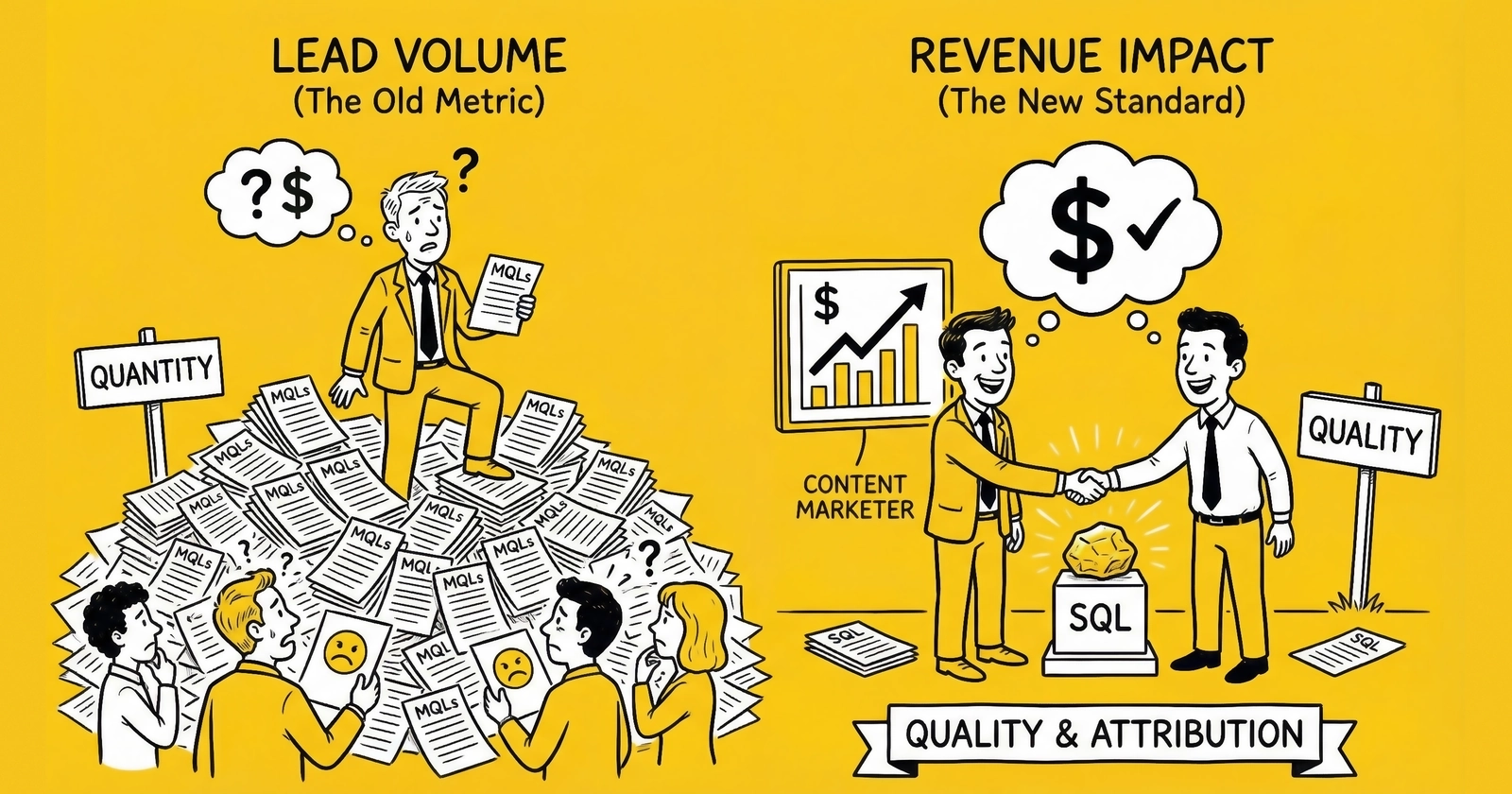
How to measure content marketing ROI for lead generation – from attribution models and benchmark metrics to proving revenue impact across the full funnel.
Content marketing produces leads at 62% lower cost than traditional outbound marketing, yet only 36% of marketers can accurately measure their content ROI. This measurement gap creates a strategic blind spot for lead generation operators who invest billions annually in content – from landing pages and blog posts to lead magnets and email sequences. With the content marketing industry expected to grow by more than $417 billion and 88.2% of teams increasing or maintaining content spend in 2025, proving content’s contribution to lead generation revenue has moved from nice-to-have to operational necessity.
Return on investment in content marketing measures net positive revenue from content investments after expenses, expressed as a percentage. The basic formula:
Content Marketing ROI = (Revenue from Content - Cost of Content) / Cost of Content × 100
For example, if you spent $200,000 on content marketing last year and that content generated $1,000,000 in revenue, your ROI would be:
($1,000,000 - $200,000) / $200,000 × 100 = 400% ROI
This 4:1 return means every dollar invested returned four dollars in revenue.
What Constitutes a Good ROI?
Industry benchmarks vary significantly:
| Business Model | Good ROI | Excellent ROI |
|---|---|---|
| B2B Lead Generation | 300-400% (3x-4x) | 500%+ (5x+) |
| E-commerce | 200-300% (2x-3x) | 400%+ (4x+) |
| SaaS | 500-700% (5x-7x) | 1000%+ (10x+) |
| Agency/Services | 300-400% (3x-4x) | 500%+ (5x+) |
The B2B content marketing benchmark sits at a 5:1 return ratio – $5 in revenue for every dollar invested. Successful brands achieve median 4.33:1 revenue returns, providing a realistic target for well-executed content strategies.
For lead generation specifically, ROI calculations must account for the full funnel: content investment → traffic → leads → qualified opportunities → closed deals → revenue. Each conversion point affects final ROI.
The Time Horizon Challenge
Content marketing ROI operates on fundamentally different timelines than paid advertising. Where PPC delivers measurable returns within days, content requires patience.
Typical Content Marketing Timeline:
- Months 1-3: Content production, initial indexing, minimal traffic
- Months 4-6: SEO rankings begin materializing, traffic accelerates
- Months 7-9: Compounding traffic, lead generation begins
- Months 10-12: Break-even point approaches
- Months 13-24: Profitable returns, ROI compounds
- Year 2+: Content assets continue generating returns at near-zero marginal cost
Research shows 62.8% of content marketers report traffic growth year-over-year, illustrating how compounding content value rewards long-term outlook with increasing ROI over time.
This timeline means short-term ROI measurements systematically undervalue content investments. A piece of content generating leads for three or more years delivers dramatically higher lifetime ROI than 12-month calculations suggest.
Expenses Front-Load, Returns Back-Load
Content marketing economics create a cash flow mismatch:
- Month 1: $50,000 expense, $0 revenue
- Month 6: $300,000 cumulative expense, $50,000 cumulative revenue
- Month 12: $600,000 cumulative expense, $400,000 cumulative revenue (approaching break-even)
- Month 18: $750,000 cumulative expense, $1,200,000 cumulative revenue (60% ROI)
- Month 24: $850,000 cumulative expense, $2,100,000 cumulative revenue (147% ROI)
Lead generation operators who evaluate content on quarterly cycles often kill campaigns before they reach profitability. Understanding this timeline prevents premature optimization decisions.
Channel ROI Benchmarks for Lead Generation
Not all content channels deliver equal ROI. Current benchmarks reveal significant variance:
SEO Content
SEO dominates ROI performance with 748% ROI for B2B companies, outperforming all other marketing investments. Organic search accounts for approximately 52.7% of B2B revenue on average, making SEO content the foundation of cost-effective lead generation.
Average ROI: $22.24 for every dollar spent
SEO content delivers leads at the moment of intent – when prospects actively search for solutions. This intent-alignment makes SEO leads typically higher quality than interruptive channels.
Email Marketing
Email marketing generates an average ROI of $42 for every $1 spent, making it the highest-ROI channel by this metric. However, email requires existing subscribers, making it a nurturing channel rather than an acquisition channel.
For lead generation, email’s role is converting captured leads into customers rather than generating initial leads. The ROI calculation should attribute email’s contribution to lead-to-customer conversion, not lead acquisition. For implementation guidance, see our email drip campaigns guide for lead nurturing.
Paid Search (PPC)
Google Ads deliver approximately $2 in revenue for every $1 spent, representing positive but modest returns compared to organic alternatives. PPC provides immediate results but requires continuous spending – traffic stops when spending stops.
For lead generation operators, PPC often serves as a testing channel: validating offers, landing pages, and audience targeting before investing in longer-term SEO content.
Content Type ROI (2025 Data)
Recent data reveals three clear winners for content format ROI:
- Short-form video: 890% ROI
- AI-enhanced podcasts: 650% ROI
- Interactive content: 520% ROI
Video content delivers ROI 49% faster than text, making video essential for companies needing quick results. For implementation guidance on video content, explore our video-first lead generation strategy.
However, these aggregate figures may not apply uniformly to lead generation. Text-based content – landing pages, comparison guides, buying guides – often performs better for high-intent lead capture than entertainment-focused video.
Attribution: The Core Measurement Challenge
Attribution – determining which content deserves credit for conversions – remains the primary obstacle to accurate ROI measurement. Research shows 84% of marketers struggle with integrating and correlating data across multiple platforms.
Attribution Models
For an in-depth exploration of attribution approaches, see our multi-touch attribution guide for lead generation.
Last-Touch Attribution: Credits the final touchpoint before conversion. Simple but ignores content that influenced earlier stages.
First-Touch Attribution: Credits the initial touchpoint that brought the lead. Valuable for understanding acquisition but ignores nurturing content.
Linear Attribution: Distributes credit equally across all touchpoints. Fair but treats all interactions as equally valuable.
Time-Decay Attribution: Weights touchpoints closer to conversion more heavily. Reflects that recent touches matter more but may undervalue awareness content.
Position-Based Attribution: Gives 40% credit each to first and last touch, distributing remaining 20% across middle touches. Balances acquisition and conversion focus.
Data-Driven Attribution: Uses machine learning to determine credit based on actual conversion patterns. Most accurate but requires significant data volume.
Lead Generation Attribution Complexity
Lead generation faces unique attribution challenges:
Multi-Touch Journeys: A prospect might read three blog posts, download two whitepapers, attend a webinar, and click three emails before converting. Which content gets credit?
Offline Conversions: Leads often convert via phone call or sales conversation. Connecting these offline events to online content requires comprehensive tracking infrastructure.
Long Sales Cycles: B2B lead generation cycles span weeks or months. Attribution windows must extend long enough to capture delayed conversions without inflating false positives.
Multi-Device Behavior: Prospects research on mobile, return on desktop, and convert on tablet. Without cross-device tracking, attribution fragments across sessions.
Publisher-Buyer Complexity: In lead generation, the lead buyer – not the lead generator – ultimately closes the deal. Final revenue attribution requires data sharing between parties.
Practical Attribution for Lead Generators
For lead generation operators, pragmatic attribution often outperforms theoretical perfection:
- Track first meaningful engagement: What content first captured the lead’s attention?
- Track lead capture point: Which landing page or form generated the conversion?
- Track lead quality indicators: Which content sources produce leads that convert?
- Accept partial visibility: Acknowledge that perfect attribution isn’t achievable and optimize for directional accuracy.
Metrics Framework for Content Marketing ROI
Effective measurement requires tracking metrics across the full funnel:
Awareness Metrics
- Organic traffic: Volume of visitors from search engines
- Traffic value: Estimated PPC equivalent (Ahrefs/SEMrush metric)
- Impressions: Search visibility for target keywords
- Brand mentions: Frequency of brand references across web
Engagement Metrics
- Time on page: Depth of content consumption
- Pages per session: Breadth of content exploration
- Scroll depth: Percentage of content actually viewed
- Bounce rate: Percentage leaving without interaction
Conversion Metrics
- Lead conversion rate: Percentage of visitors becoming leads
- Cost per lead (CPL): Total content cost divided by leads generated
- Lead quality score: Qualification metrics (budget, authority, need, timeline)
- Marketing qualified leads (MQLs): Leads meeting qualification criteria
Revenue Metrics
- Lead-to-customer rate: Percentage of leads becoming customers
- Customer acquisition cost (CAC): Total cost to acquire customer
- Customer lifetime value (CLV): Total revenue from customer relationship
- Revenue attribution: Revenue credited to content touchpoints
Efficiency Metrics
- Content production cost: Expense per content piece
- Content velocity: Rate of new content publication
- Content utilization: Percentage of content actively driving results
- ROI payback period: Time to recover content investment
Measuring Content Value in Lead Generation
Lead generation operators need practical methods for valuing content contribution:
Method 1: Traffic Value Comparison
Estimate content value by calculating what equivalent traffic would cost via PPC:
- Identify organic traffic volume from content
- Find average CPC for those keywords
- Multiply traffic × CPC = estimated traffic value
Example: Content driving 10,000 monthly visitors for keywords averaging $15 CPC = $150,000 monthly traffic value
This method provides a conservative baseline – actual value is higher because organic traffic typically converts better than paid traffic.
Method 2: Lead Value Attribution
Calculate content value based on leads generated and lead value:
- Track leads generated by each content piece
- Determine average lead value (revenue ÷ leads)
- Multiply content leads × lead value = content revenue contribution
Example: Landing page generates 500 leads/month × $100 average lead value = $50,000 monthly content contribution
Method 3: Conversion Path Analysis
Analyze multi-touch conversion paths to understand content influence:
- Map all content touchpoints for converting leads
- Apply chosen attribution model
- Distribute conversion value across touchpoints
- Aggregate value by content piece
Example: Blog post appears in 30% of conversion paths with 15% attribution weight × $1M total revenue = $45,000 attributed to blog post
Method 4: A/B Testing Revenue Impact
Measure content changes’ direct revenue impact:
- Create variation of existing content
- Split traffic between control and variation
- Measure conversion rate difference
- Calculate incremental revenue from improvement
Example: New landing page increases conversion from 3% to 4.5% on 10,000 visitors = 150 incremental leads × $100 value = $15,000 incremental revenue
Top Performer Practices
Research reveals distinct patterns among top-performing content marketers:
90% of top performers consistently measure content performance, compared to lower rates among average performers. This measurement discipline creates competitive advantage through continuous optimization.
Top performers differ from peers in several dimensions:
| Dimension | Top Performers | Average Performers |
|---|---|---|
| Leader understanding | High | Mixed |
| Right technology | More likely | Often lacking |
| Cross-silo communication | Better | Fragmented |
| Measurement effectiveness | Strong | Struggling |
| Goal achievement | Higher | Lower |
Success Factors
The most popular factor among successful content marketers: knowing their audience (79%). This aligns with the finding that “creating the right content for audience” is the top challenge – top performers prioritize audience understanding to create content that actually converts.
Additional success factors:
- Setting goals aligned with organizational objectives (68%)
- Effectively measuring and demonstrating content performance (61%)
- Publishing thought leadership content (60%)
- Collaborating with other teams (55%)
- Maintaining documented strategy (53%)
Technology for ROI Measurement
Effective measurement requires appropriate technology stack:
Analytics Platforms
- Google Analytics 4: Free, comprehensive web analytics with event-based tracking
- Adobe Analytics: Enterprise-grade analytics with advanced attribution
- Mixpanel: Product analytics with user journey tracking
- Amplitude: Behavioral analytics with cohort analysis
Attribution Tools
- HubSpot Attribution: Multi-touch attribution within HubSpot CRM
- Bizible: B2B attribution for Salesforce environments
- Dreamdata: Revenue attribution for B2B companies
- Attribution: Independent multi-touch attribution platform
SEO Tools
- Ahrefs: Traffic value estimation, keyword tracking, competitor analysis
- SEMrush: Organic research, position tracking, site audit
- Moz: Domain authority, link tracking, keyword research
CRM Integration
- Salesforce: Enterprise CRM with campaign attribution
- HubSpot: Marketing automation with content tracking
- Pipedrive: Sales-focused CRM with activity tracking
For a comprehensive overview of marketing automation capabilities, see our marketing automation guide for lead nurturing.
Current Technology Reality
Only 31% of content marketers say they have the right technology to manage content across their organization. Another 30% have technology but aren’t using its potential, and 29% haven’t acquired the right technology.
This technology gap creates opportunity: organizations investing in proper measurement infrastructure gain significant advantage over competitors operating blind.
Improving Content Marketing ROI
Strategies to increase ROI from content marketing investments:
1. Prioritize High-Value Keywords
Conduct KOB (keyword opposition to benefit) analysis to identify keywords combining:
- High search volume (demand exists)
- Reasonable difficulty (ranking is achievable)
- High commercial intent (searchers are ready to convert)
- Strong topic relevance (aligns with offering)
Prioritizing high-value, low-difficulty keywords concentrates resources where they’ll generate fastest returns.
2. Optimize Existing Content
Content refresh often delivers better ROI than new content creation:
- Update statistics and data with current numbers
- Expand thin sections with additional depth
- Improve internal linking to newer content
- Refresh meta titles/descriptions for higher CTR
- Add new sections addressing related queries
Annual or semi-annual content audits identify refresh opportunities.
3. Repurpose High-Performing Content
Extract additional value from successful content:
- Convert blog posts to video summaries
- Transform research into infographics
- Adapt webinar recordings to podcast episodes
- Compile blog series into comprehensive guides
- Extract social content from long-form pieces
Repurposing extends content lifespan while reducing production costs.
4. Align Content to Buyer Journey
Map content to buyer stages:
Awareness Stage: Problem identification content
- Industry trend reports
- Problem definition articles
- Benchmark comparisons
Consideration Stage: Solution evaluation content
- Comparison guides
- Case studies
- Expert interviews
Decision Stage: Purchase facilitation content
- Product/service pages
- Pricing information
- Implementation guides
- Free trials/demos
Content gaps at any stage create conversion leakage.
5. Use AI Appropriately
AI can improve content efficiency without replacing quality:
- Research and brainstorming acceleration
- First-draft generation for human refinement
- Data analysis and pattern identification
- Personalization at scale
- Performance prediction and optimization
72% of B2B marketers use generative AI tools, primarily for brainstorming (51%), keyword research (45%), and draft writing (45%). However, 61% lack organizational guidelines for AI use – establishing governance enables confident AI adoption.
Lead Generation-Specific ROI Considerations
Lead generation operators face unique ROI measurement challenges:
Lead Quality Variance
Not all leads are equal. ROI calculations must weight lead quality:
High-Quality Leads: Meet all qualification criteria, ready to purchase Medium-Quality Leads: Partial qualification, require nurturing Low-Quality Leads: Poor fit, unlikely to convert
Content producing fewer high-quality leads may outperform content generating many low-quality leads. Weight ROI calculations accordingly.
Buyer-Side Conversion
Lead generators often can’t track final conversion – buyers close deals in their own systems. Options:
- Negotiated data sharing: Agreements to receive conversion feedback
- Quality proxy metrics: Contact rates, appointment rates as conversion indicators
- Aggregate analysis: Buyers report overall quality, attribute proportionally
- Cohort comparison: Track lead sources against buyer-reported quality tiers
Compliance Documentation Value
Content investments in compliance – consent capture, TCPA documentation, TrustedForm integration – don’t directly generate leads but protect against costly litigation. ROI calculations should credit:
- Litigation cost avoidance
- Buyer confidence premium
- Reduced refund/chargeback rates
- Long-term buyer relationship value
Publisher Traffic Valuation
For lead aggregators working with publishers, content helps attract and retain quality publisher relationships. Publisher-facing content ROI includes:
- Publisher acquisition cost reduction
- Publisher retention rate improvement
- Traffic quality improvements
- Compliance documentation benefits
Common ROI Measurement Mistakes
Avoid these frequent errors in content ROI measurement:
1. Measuring Too Early
Evaluating content ROI at 3 or 6 months guarantees disappointing results. Content needs 12-18 months to demonstrate full value. Patience is prerequisite for accurate measurement.
2. Ignoring Lifetime Value
One-year ROI calculations dramatically undervalue evergreen content. A blog post generating leads for five years delivers 5x the value of one-year calculations. Incorporate content lifetime into ROI models.
3. Over-Attributing or Under-Attributing
Both extremes distort reality. Last-touch attribution ignores awareness content’s contribution. First-touch attribution ignores nurturing content’s role. Use multi-touch models that acknowledge the full customer journey.
4. Comparing Apples to Oranges
Content marketing ROI shouldn’t be compared to PPC ROI without accounting for timeline differences. Content delivers compound returns over years; PPC delivers immediate returns that stop when spending stops. Both have roles; direct comparison misleads.
5. Neglecting Indirect Benefits
Content provides value beyond direct lead generation:
- Brand authority building
- Organic link acquisition
- Social proof generation
- Recruitment attraction
- Partner relationship enablement
Narrow ROI focus misses these cumulative benefits.
Building a Measurement Practice
Establishing systematic ROI measurement requires organizational commitment:
Step 1: Define Success Metrics
Agree on metrics that matter for your business:
- Which KPIs align with business objectives?
- What timeframes are appropriate?
- Which attribution model fits your sales cycle?
- What benchmarks define success?
Step 2: Implement Tracking Infrastructure
Ensure technical capability to measure:
- Analytics properly configured
- Conversion tracking implemented
- CRM integration functioning
- Attribution windows appropriate
- Cross-device tracking enabled
Step 3: Establish Reporting Cadence
Create regular review cycles:
- Weekly: Traffic and engagement metrics
- Monthly: Lead generation and conversion metrics
- Quarterly: ROI and attribution analysis
- Annually: Strategy evaluation and benchmark comparison
Step 4: Build Feedback Loops
Connect measurement to optimization:
- Which content performs best? Produce more.
- Which content underperforms? Analyze and improve or sunset.
- Which channels deliver ROI? Increase investment.
- Which channels disappoint? Reallocate resources.
Step 5: Document and Communicate
Share results across organization:
- Executive summaries for leadership
- Detailed analysis for marketing teams
- Practical insights for content creators
- ROI validation for budget discussions
Conclusion
Content marketing ROI measurement separates strategic operators from those flying blind. With only 36% of marketers accurately measuring content ROI, developing measurement capability creates significant competitive advantage.
For lead generation specifically, content ROI measurement must account for multi-touch attribution, long sales cycles, lead quality variance, and the unique economics of lead buyer relationships. Simple traffic metrics fail to capture content’s full contribution.
The investment required – technology, processes, expertise – pays dividends through optimized resource allocation, validated budget requests, and continuous performance improvement. In an industry where content marketing budgets continue climbing, proving ROI isn’t optional – it’s the foundation of sustainable content investment.
Top performers measure consistently, align content to audience needs, use appropriate technology, and maintain patience through content’s naturally long payback period. These practices, more than any single metric or tool, determine content marketing success.
Key Takeaways
-
SEO-driven content delivers the highest ROI in lead generation at 748% for B2B companies, with organic search accounting for 52.7% of B2B revenue on average.
-
Content marketing ROI requires 9-18 months to materialize, making short-term measurement frameworks inappropriate for long-term content investments – patience is structural.
-
The 5:1 revenue-to-cost ratio represents the B2B content marketing benchmark, meaning every $1 invested should return $5 in revenue (4.33:1 median for successful brands).
-
Attribution remains the primary measurement challenge: 84% of marketers struggle with integrating and correlating data across multiple platforms and touchpoints.
-
Top-performing content marketers (90%) consistently measure performance, creating competitive advantage over the 64% who struggle to prove ROI.
-
Email marketing delivers $42 for every $1 invested – the highest ROI of any direct channel – making it essential infrastructure for lead nurturing.
-
Multi-touch attribution models outperform single-touch for lead generation because the buyer journey involves 15-20 content touchpoints before conversion.
-
The content ROI formula is straightforward but implementation is complex: (Revenue from Content - Cost of Content) / Cost of Content × 100 – the challenge is accurate revenue attribution.
-
Content asset value compounds over time as evergreen pieces continue generating leads years after creation, fundamentally different economics from paid advertising.
-
Only 21% of B2B content marketers rate themselves excellent at using metrics for ROI demonstration – systematic measurement creates differentiation.
Understanding Content Marketing ROI
Frequently Asked Questions
How long should we wait before measuring content marketing ROI?
Content marketing typically requires 9-18 months to reach break-even and demonstrate positive ROI. Measuring earlier produces misleadingly negative results because expenses front-load while returns back-load. For accurate assessment, wait at least 12 months before evaluating campaign-level ROI, though individual content performance can be monitored earlier for optimization purposes.
What’s the most important metric for lead generation content ROI?
Cost per qualified lead (CPQL) provides the most useful single metric for lead generation content. It combines content cost, lead volume, and lead quality into one number directly comparable to alternative acquisition channels. However, comprehensive ROI requires tracking the full funnel from traffic through revenue.
How do we attribute revenue when leads convert with buyer organizations?
Lead generators typically cannot track final conversion in buyer systems. Practical options include: negotiating data-sharing agreements where buyers report conversion rates by source; using proxy metrics like contact rate and appointment rate that correlate with final conversion; conducting periodic cohort analyses comparing lead sources; and accepting that perfect attribution isn’t achievable while optimizing for directional accuracy.
Should we use AI tools for content creation to improve ROI?
AI can improve content efficiency and potentially ROI through faster production, reduced costs, and improved personalization. However, 61% of organizations lack AI guidelines, creating risk. Establish governance first, then use AI for appropriate tasks: research, brainstorming, first drafts, data analysis. Maintain human oversight for quality, accuracy, and brand voice. The ROI improvement comes from efficiency gains, not from replacing human judgment.
What’s a realistic ROI benchmark for B2B lead generation content?
The B2B benchmark sits at 5:1 return ratio – $5 revenue for every $1 invested. Successful brands achieve median 4.33:1 returns. For lead generation content specifically, aim for 300-400% ROI (3x-4x return) as a good result, with 500%+ indicating excellent performance. SEO content typically delivers highest ROI at 748% for B2B companies, while paid content channels deliver lower but faster returns.
How should we allocate budget between content creation and distribution?
Industry benchmarks suggest 60-70% of budget toward content creation (writing, design, production) and 30-40% toward distribution (promotion, advertising, syndication). However, lead generation content often skews heavier toward distribution because reaching qualified audiences matters more than content volume. If your content converts well but lacks traffic, shift budget toward distribution. If traffic is strong but conversion weak, invest in content quality. The optimal split depends on where your funnel breaks down.
Sources
- Content Marketing Institute - B2B Content Marketing Trends Research 2025 — Annual benchmark study surveying 1,015 B2B marketers on content performance, budgets, and measurement practices
- First Page Sage - SEO ROI Statistics 2026 — Research on SEO ROI benchmarks including the 748% three-year ROI figure for B2B companies
- Litmus - The ROI of Email Marketing — Survey of 500 marketing professionals establishing the $42:$1 email marketing ROI benchmark
- Data-Mania - B2B Marketing ROI Benchmarks 2026 — Comprehensive analysis of channel-specific ROI benchmarks including SEO, email, PPC, and content marketing