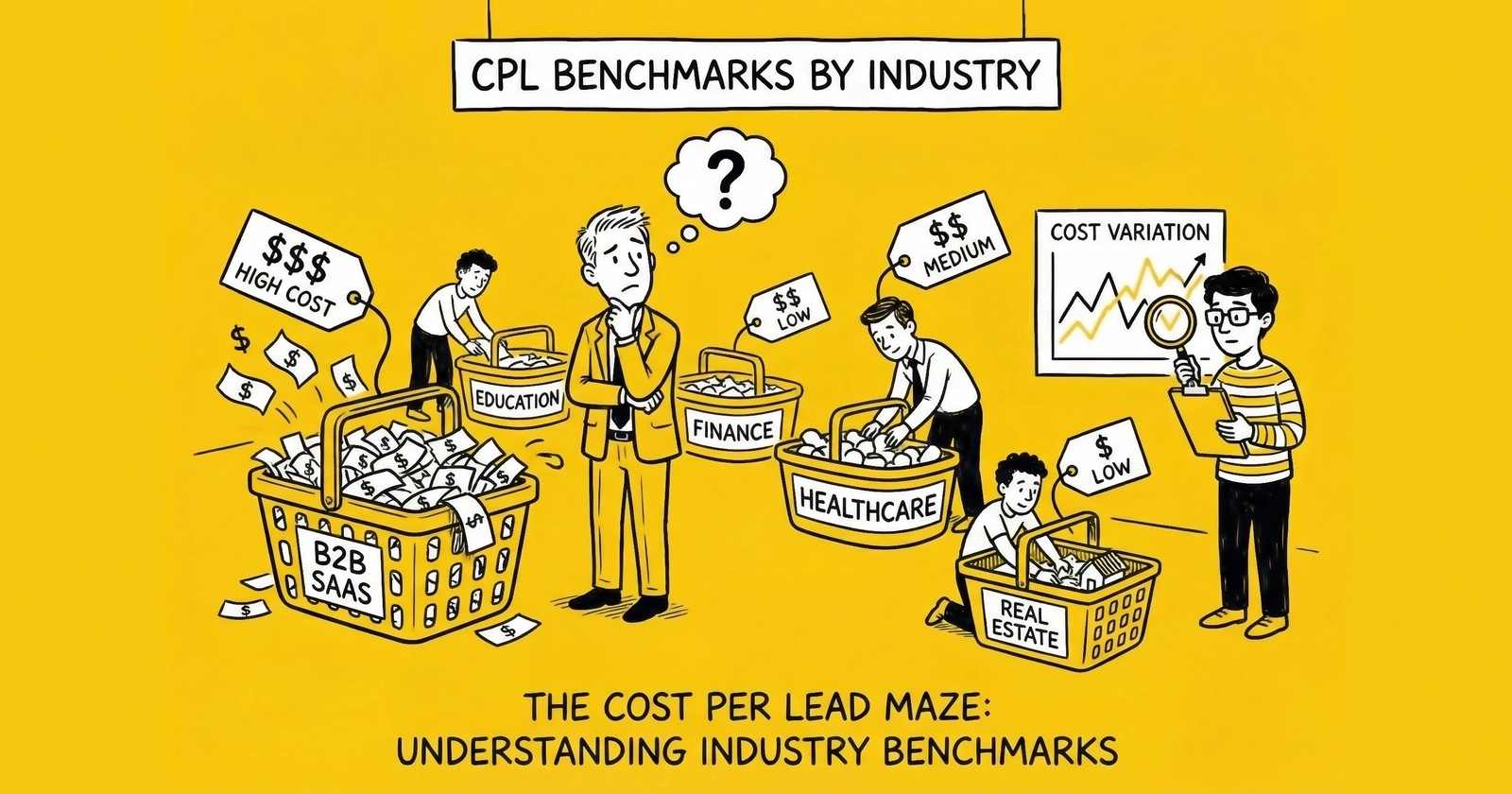
The definitive reference for lead generation professionals planning budgets, evaluating performance, and negotiating with buyers. Updated with 2024-2025 benchmark data across verticals, channels, and geographies.
Why CPL Benchmarks Matter for Your Business
Every lead generation operation lives or dies by one number: the cost to acquire a lead versus what that lead can be sold for. Yet most practitioners fly blind, comparing their performance to industry averages that may be two years outdated or drawn from verticals with completely different economics.
CPL benchmarks serve three critical functions:
Budget planning. Before launching a new vertical or channel, you need realistic acquisition cost projections. A $50,000 monthly budget generates vastly different lead volumes depending on whether your vertical CPL runs $30 or $300.
Performance evaluation. Your campaigns run at $85 CPL. Is that good? Without benchmark context, you cannot answer. If the industry average is $130, you are outperforming. If it is $45, you have optimization work ahead.
Negotiation leverage. When selling leads to buyers, understanding their economics informs your pricing power. When buying traffic or leads from publishers, benchmarks reveal whether quoted prices reflect market reality.
This reference compiles current 2024-2025 CPL data across major lead generation verticals, advertising channels, and geographic markets. The numbers come from platform research, public company filings, and operator experience. Where data conflicts or uncertainty exists, I note it. These are planning benchmarks, not guarantees. Your specific results will vary based on execution, targeting, and market timing.
Overall CPL Trends 2024-2025
The lead generation market experienced significant cost inflation through 2024, with moderation appearing in late 2024 and early 2025.
Google Ads CPL Trends
Google Ads remains the dominant channel for high-intent lead generation. The 2024-2025 benchmark data reveals:
| Metric | 2024 | 2025 | Change |
|---|---|---|---|
| Average CPL (all industries) | $66.69 | $70.11 | +5.1% |
| Average CPC (all industries) | $4.66 | $5.26 | +12.9% |
| Average conversion rate | 7.04% | 6.96% | -1.1% |
The 5% CPL increase represents moderation from the prior year, which saw CPL spikes exceeding 25% in many verticals. Rising CPC partially offset by stable conversion rates kept overall CPL growth contained.
The CPC increase outpacing CPL increase indicates improved conversion optimization across the industry. Advertisers are paying more per click but extracting more value through better landing pages and targeting.
Facebook Ads CPL Trends
Facebook (Meta) advertising shows more pronounced cost increases:
| Metric | 2024 | 2025 | Change |
|---|---|---|---|
| Average CPL (lead campaigns) | $21.98 | $27.66 | +25.8% |
| Average CPC (traffic campaigns) | $0.58 | $0.70 | +20.7% |
The Facebook-to-Google CPL gap remains significant. Facebook CPL runs approximately 60% lower than Google CPL. However, that gap is narrowing as Facebook costs rise faster than Google costs.
The Facebook advantage comes with quality considerations. Google search users have declared purchase intent through their query. Facebook users are scrolling content and may click from mild curiosity. Lower CPL often correlates with lower conversion rates downstream.
Key Trend Observations
Platform maturity compression. As advertising platforms mature, CPL tends to rise. More advertisers compete for finite inventory. AI-powered bidding extracts maximum value from each auction. First-mover advantages erode.
Privacy impact. iOS 14.5 and third-party cookie deprecation degraded tracking accuracy, particularly affecting Facebook. Less precise targeting increases wasted spend, which increases effective CPL even when nominal CPL appears stable.
Vertical cyclicality. Insurance CPLs surged in 2022-2023 during the hard market, then moderated in 2024 as carriers resumed aggressive customer acquisition. Mortgage CPLs tracked interest rate movements. Vertical timing matters as much as optimization skill.
CPL by Vertical: Complete Breakdown
The following table synthesizes CPL benchmarks across major lead generation verticals. Ranges reflect variation by lead quality, geographic market, and channel mix.
Insurance Verticals
| Vertical | CPL Range | Typical CPL | Premium Tier | Notes |
|---|---|---|---|---|
| Auto Insurance | $25-75 | $40-50 | $75+ | Highly competitive; state variation significant |
| Medicare/Medicare Advantage | $30-80 | $45-60 | $80+ | Seasonal (AEP/OEP); compliance-intensive |
| Health Insurance (ACA) | $35-100 | $50-75 | $100+ | OEP-concentrated; subsidy-eligible leads premium |
| Life Insurance | $30-75 | $40-55 | $75+ | Term vs. whole life pricing differs |
| Homeowners Insurance | $35-90 | $50-70 | $90+ | Often bundled with auto; geographic factors |
| Commercial Insurance | $75-300 | $125-200 | $300+ | B2B; longer sales cycles |
Insurance CPL drivers:
- State regulatory environment affects competition density
- Carrier rate changes shift acquisition appetite
- Age and demographic targeting creates premium tiers
- Bundling potential (auto + home) increases lead value
Financial Services Verticals
| Vertical | CPL Range | Typical CPL | Premium Tier | Notes |
|---|---|---|---|---|
| Mortgage (Purchase) | $50-200 | $75-125 | $200+ | Rate-sensitive; geographic variation extreme |
| Mortgage (Refinance) | $40-150 | $60-100 | $150+ | Volume inversely correlated with rates |
| Personal Loans | $25-100 | $40-65 | $100+ | Credit tier creates price segmentation |
| Credit Cards | $30-80 | $45-60 | $80+ | Premium cards command premium CPL |
| Debt Consolidation | $50-150 | $75-110 | $150+ | Compliance requirements increasing |
| Tax Services | $35-100 | $50-75 | $100+ | Highly seasonal (Q1) |
Financial services CPL drivers:
- Interest rate environment dramatically affects mortgage volume
- Credit score qualification creates lead tier pricing
- Loan amount correlates with acceptable CPL (higher LTV supports higher CPL)
- Regulatory scrutiny increasing compliance costs
Home Services Verticals
| Vertical | CPL Range | Typical CPL | Premium Tier | Notes |
|---|---|---|---|---|
| Solar Installation | $75-250 | $100-175 | $250+ | Geographic and policy variation extreme |
| HVAC | $35-120 | $50-80 | $120+ | Emergency vs. planned service pricing differs |
| Roofing | $40-150 | $60-100 | $150+ | Storm-driven demand spikes |
| Windows/Siding | $50-180 | $75-120 | $180+ | Home improvement category |
| Home Security | $25-80 | $35-55 | $80+ | Monitoring contracts drive buyer value |
| Plumbing | $25-90 | $40-65 | $90+ | Emergency premium significant |
| General Contractors | $50-200 | $80-140 | $200+ | Project size creates segmentation |
Home services CPL drivers:
- Project value determines acceptable acquisition cost
- Emergency vs. planned service creates distinct price points
- Geographic density affects installer competition
- Seasonal patterns (roofing in spring, HVAC in summer)
Legal Verticals
| Vertical | CPL Range | Typical CPL | Premium Tier | Notes |
|---|---|---|---|---|
| Personal Injury | $200-500 | $275-400 | $500+ | Case value drives acceptable CPL |
| Mass Tort | $100-400 | $175-300 | $400+ | Campaign-specific; inventory constrained |
| Workers Compensation | $150-400 | $225-325 | $400+ | Employer size and state factors |
| Criminal Defense | $100-300 | $150-225 | $300+ | Urgency creates premium |
| Family Law/Divorce | $75-250 | $125-180 | $250+ | Geographic variation significant |
| Bankruptcy | $50-200 | $85-140 | $200+ | Economic conditions drive volume |
| Immigration | $75-250 | $120-180 | $250+ | Policy changes affect demand |
Legal CPL drivers:
- Case value (PI settlements often 6-7 figures) supports high CPL
- Contingency fee structure creates predictable buyer economics
- Mass tort campaigns have finite inventory windows
- Geographic concentration of plaintiffs affects pricing
Education Verticals
| Vertical | CPL Range | Typical CPL | Premium Tier | Notes |
|---|---|---|---|---|
| Higher Education (for-profit) | $40-150 | $65-100 | $150+ | Regulatory scrutiny increasing |
| Trade Schools | $35-120 | $55-85 | $120+ | Program-specific pricing |
| Online Degrees | $50-180 | $75-120 | $180+ | Competition intensifying |
| Professional Certifications | $40-130 | $60-95 | $130+ | IT certifications premium |
| Test Prep | $25-80 | $40-60 | $80+ | Seasonal (admission cycles) |
Education CPL drivers:
- Tuition revenue per student determines buyer ROI
- Program length affects lifetime value calculations
- Regulatory changes (gainful employment) impact sector
- Enrollment cycle timing creates seasonal patterns
B2B/Technology Verticals
| Vertical | CPL Range | Typical CPL | Premium Tier | Notes |
|---|---|---|---|---|
| SaaS (SMB) | $75-250 | $125-180 | $250+ | ACV determines acceptable CPL |
| SaaS (Enterprise) | $200-800 | $350-550 | $800+ | Longer sales cycles; multi-touch |
| Managed IT Services | $100-350 | $175-275 | $350+ | Monthly recurring revenue drives value |
| Business Software | $50-200 | $90-150 | $200+ | Implementation value adds to LTV |
| Professional Services | $100-400 | $175-300 | $400+ | Engagement size varies dramatically |
B2B CPL drivers:
- Annual contract value (ACV) drives acceptable acquisition cost
- Sales cycle length affects attribution and optimization
- Buying committee size (6-10 stakeholders typical) complicates conversion
- Integration with existing tech stack affects close rates
CPL by Channel: Comparative Analysis
Different advertising channels deliver different CPL profiles. Understanding channel economics enables portfolio optimization.
Google Ads by Campaign Type
| Campaign Type | Average CPL | CPC Range | Conversion Rate | Best For |
|---|---|---|---|---|
| Search (branded) | $20-50 | $1-3 | 8-15% | Bottom-funnel capture |
| Search (non-branded) | $70-150 | $3-12 | 4-8% | High-intent prospecting |
| Display | $50-120 | $0.50-2 | 0.5-2% | Awareness and retargeting |
| YouTube | $40-100 | $0.10-0.30 (CPV) | 1-4% | Consideration stage |
| Performance Max | $60-130 | Blended | 3-7% | Automated optimization |
Google channel strategy:
- Search captures declared intent but faces highest competition
- Display works for retargeting but generates cold leads as prospecting
- YouTube offers storytelling opportunity but requires creative investment
- Performance Max consolidates management but reduces control
Meta (Facebook/Instagram) by Objective
| Objective Type | Average CPL | CPM Range | Conversion Rate | Best For |
|---|---|---|---|---|
| Lead Generation (native forms) | $15-40 | $8-15 | 7-12% | Volume at lower quality |
| Conversions (landing page) | $25-60 | $10-20 | 3-6% | Higher quality, higher cost |
| Traffic | $8-25 | $5-12 | 2-5% | Awareness building |
| Engagement | N/A | $3-8 | N/A | Brand building |
Meta channel strategy:
- Native lead forms reduce friction but may capture lower-intent leads
- Landing page conversions filter intent through friction
- Instagram tends higher CPM but better engagement in visual verticals
- Audience network extends reach but with quality variance
Other Digital Channels
| Channel | Average CPL | CPM/CPC | Notes |
|---|---|---|---|
| TikTok | $20-80 | $6-12 CPM | Younger demographics; creative-dependent |
| $75-300 | $6-12 CPC | B2B premium; detailed targeting | |
| Microsoft/Bing | $50-100 | $2-6 CPC | Older, higher-income demographics |
| Native Advertising | $30-90 | $0.30-1.50 CPC | Taboola, Outbrain; content-style |
| Programmatic Display | $40-120 | $3-8 CPM | Audience targeting; brand safety concerns |
Channel selection principles:
- Match channel demographics to buyer persona
- Test before scaling; performance varies by vertical
- Attribution complexity increases with channel mix
- Creative requirements differ dramatically across channels
Organic vs. Paid Channel Comparison
| Channel | Average CPL | Time to Scale | Sustainability |
|---|---|---|---|
| Paid Search | $70-150 | Immediate | Dependent on spend |
| Paid Social | $25-80 | Immediate | Dependent on spend |
| SEO/Organic Search | $15-50 | 6-12 months | Sustainable with maintenance |
| Content Marketing | $20-60 | 12-24 months | Highly sustainable |
| Email Marketing | $10-35 | Dependent on list | Sustainable with list growth |
| Referral Programs | $25-75 | 3-6 months | Sustainable with incentive structure |
Organic channel CPL advantage:
Organic channels show lower CPL but require upfront investment in content, SEO, and relationship building. The comparison is not purely CPL; it includes time-to-results and sustainability.
A mature organic strategy generating 30% of leads at $25 CPL dramatically improves blended CPL for an operation otherwise dependent on $80 paid leads.
Factors That Impact Your CPL
CPL is not fixed. Multiple levers affect acquisition cost within any given vertical or channel.
Conversion Rate Optimization
Landing page conversion rate is the highest-leverage variable affecting CPL.
The math:
If CPC = $5.26 (2025 average) and conversion rate = 5%, CPL = $105.20 If CPC = $5.26 and conversion rate = 7%, CPL = $75.14 If CPC = $5.26 and conversion rate = 10%, CPL = $52.60
A 2-percentage-point conversion improvement creates a $30 CPL reduction at identical CPC. This is often easier to achieve than CPC reduction through bid optimization.
Conversion rate levers:
- Multi-step forms increase completion by 86% in many studies
- Mobile optimization (60%+ of traffic)
- Page load speed (each second delay costs 7% conversions)
- Trust signals (testimonials, security badges, guarantees)
- Form field reduction (each field reduces completion ~5%)
Audience Targeting Precision
Broad targeting generates volume at higher CPL. Narrow targeting generates quality at lower volume but often lower CPL.
| Targeting Approach | CPL Impact | Volume Impact |
|---|---|---|
| Broad demographic | +20-40% CPL | High volume |
| Interest-based | Baseline CPL | Medium volume |
| Lookalike audiences | -10-25% CPL | Medium volume |
| Retargeting | -30-50% CPL | Low volume |
| Custom audiences | -20-40% CPL | Limited by list size |
The optimal strategy layers targeting approaches: broad for awareness, lookalike for prospecting, retargeting for conversion.
Creative Quality and Fatigue
Creative directly impacts click-through rate (CTR), which affects both CPC (through quality score) and conversion rate.
Creative rotation requirements:
- Facebook: Refresh every 2-4 weeks to combat fatigue
- Google Display: Refresh every 4-6 weeks
- YouTube: Test new creative monthly
- Search ads: Test headline variations continuously
Creative testing budget should represent 15-25% of total media spend. The payoff is lower CPL through improved CTR and conversion rates. See the guide on creative testing frameworks for a systematic approach.
Bidding Strategy Selection
| Strategy | CPL Impact | Best For |
|---|---|---|
| Manual CPC | Variable | High control, experienced practitioners |
| Target CPA | Stable CPL | Consistent volume, established baselines |
| Maximize Conversions | Volume focus | Scale priority, flexible CPL |
| Target ROAS | Value optimization | Variable lead values |
Target CPA bidding typically delivers the most predictable CPL but requires 30-50 conversions per month to optimize effectively.
Geographic CPL Variations
CPL varies dramatically by geography based on competition density, cost of living, and market conditions.
United States Regional Variation
| Region | CPL Index | Notes |
|---|---|---|
| California | 135-150 | Highest competition; largest markets |
| New York | 125-140 | Dense metro competition |
| Texas | 100-115 | Large volume; moderate competition |
| Florida | 110-125 | High competition in insurance |
| Midwest (OH, MI, IN) | 80-95 | Lower competition; smaller markets |
| Mountain West (CO, AZ, UT) | 90-105 | Growing markets; increasing competition |
| Southeast (GA, NC, TN) | 85-100 | Moderate competition |
| Pacific Northwest (WA, OR) | 105-120 | Tech-heavy; higher CPL |
Index based on 100 = national average. A 130 index means CPL runs 30% above national average.
Solar Industry Geographic Example
Solar CPL demonstrates extreme geographic variation:
| State | Average CPL | Customer Acquisition Cost | Notes |
|---|---|---|---|
| California | $175-250 | $1,929 | Saturated market; policy support |
| Texas | $125-200 | $750-1,200 | Growing market; less policy support |
| Florida | $150-225 | $1,100-1,500 | Net metering changes affecting |
| Arizona | $100-175 | $650-1,000 | Strong irradiance; utility rates |
| North Dakota | $50-100 | $225 | Minimal competition; lower volume |
The 8.5x spread between California and North Dakota customer acquisition costs illustrates geographic arbitrage opportunity.
International Markets
| Market | CPL vs. US | Notes |
|---|---|---|
| United Kingdom | 70-85% of US | Smaller market; GDPR affects strategy |
| Canada | 80-90% of US | Similar to US; CAD/USD affects comparison |
| Australia | 60-75% of US | Smaller population; different verticals |
| Germany | 65-80% of US | GDPR complexity; language barriers |
International expansion often offers CPL arbitrage but requires compliance infrastructure and buyer relationship development.
Seasonal CPL Patterns
CPL fluctuates predictably throughout the year based on vertical-specific demand cycles.
Insurance Seasonal Patterns
| Period | Auto Insurance | Medicare | Health (ACA) |
|---|---|---|---|
| Q1 (Jan-Mar) | Baseline | Low season | OEP ends mid-Jan |
| Q2 (Apr-Jun) | Peak (+15-25%) | Low season | Low season |
| Q3 (Jul-Sep) | Moderate | Pre-AEP | Pre-OEP |
| Q4 (Oct-Dec) | Moderate | AEP peak (+40-60%) | OEP starts Nov |
Medicare’s Annual Enrollment Period (October 15 - December 7) creates the industry’s most dramatic seasonal CPL swing.
Financial Services Seasonal Patterns
| Period | Mortgage | Tax Services | Personal Loans |
|---|---|---|---|
| Q1 | Moderate | Peak (+100-150%) | Post-holiday demand |
| Q2 | Peak spring market | Low | Moderate |
| Q3 | Moderate | Low | Back-to-school |
| Q4 | Low | Very low | Holiday spending |
Tax services CPL can triple during Q1 filing season as demand concentrates.
Home Services Seasonal Patterns
| Period | HVAC | Roofing | Solar |
|---|---|---|---|
| Spring | Moderate | Peak (+30-50%) | Peak season |
| Summer | AC peak (+40-60%) | Moderate | Strong |
| Fall | Heating prep | Moderate | Moderate |
| Winter | Heating peak (+30-50%) | Low | Low (northern) |
HVAC demonstrates dual-peak seasonality around cooling and heating demand.
Seasonal Strategy Implications
Budget reallocation. Shift spend away from peak-CPL periods when possible. Capture volume during low-CPL windows.
Inventory building. Accumulate leads during low-CPL periods for distribution during peak-demand (but not necessarily peak-CPL) periods.
Buyer negotiation. Understand buyer seasonal demand to negotiate pricing that reflects their willingness to pay during high-need periods.
Calculating Your Target CPL
Your acceptable CPL depends on downstream economics, not industry benchmarks. Here is the calculation framework.
The Buyer’s Math
Buyers calculate acceptable lead price based on lifetime value and conversion rates:
Maximum CPL = Customer LTV x Conversion Rate x Target ROI Factor
Example for auto insurance:
- Customer LTV: $2,400 (4-year retention at $600 annual premium)
- Lead-to-customer conversion: 5%
- Target 3:1 LTV:CAC ratio
Maximum CPL = $2,400 x 0.05 x 0.33 = $39.60
This buyer can pay up to $40 per lead and maintain target economics.
The Generator’s Math
Generators calculate acceptable CPL based on sale price and required margin:
Target CPL = Lead Sale Price x (1 - Target Margin) - Hidden Costs
Example:
- Lead sale price: $75
- Target 25% margin: $75 x 0.75 = $56.25 available for acquisition
- Hidden costs (returns, compliance, platform): $8 per lead
- Target CPL: $56.25 - $8 = $48.25
This generator must acquire leads below $48 to achieve target margin.
The Complete Economics Table
| Your Role | Revenue Source | Cost Basis | Target CPL Calculation |
|---|---|---|---|
| Direct lead seller | Lead sale price | CPL + hidden costs | Sale price - margin - costs |
| Affiliate | CPA commission | CPL | Commission x conversion - costs |
| Performance agency | Management fee + media margin | Client CPL | Client target CPL - your margin |
| Direct advertiser | Customer LTV | All costs | LTV x conversion x ROI factor |
Hidden Cost Adjustment
True CPL exceeds dashboard CPL by 30-60%. Factor hidden costs into target calculations:
| Hidden Cost Category | Typical Per-Lead Cost |
|---|---|
| Returns/refunds | 8-15% of CPL |
| Compliance (TrustedForm, Jornaya) | $0.25-0.75 |
| Platform fees | $0.10-0.50 |
| Validation services | $0.05-0.25 |
| Labor allocation | $0.50-2.00 |
| Float cost | $0.10-0.50 |
A $50 dashboard CPL often translates to $65-75 true CPL when all costs are allocated. Understanding true cost per lead calculation is essential for accurate budgeting.
CPL vs. True Cost Per Lead: Hidden Costs
Dashboard CPL measures one thing: media spend divided by leads generated. It ignores every cost category between lead capture and revenue collection.
The Hidden Cost Stack
| Category | Description | Typical Impact |
|---|---|---|
| Returns | Leads buyers reject post-purchase | 8-25% of CPL added |
| Compliance | TrustedForm, Jornaya, consent documentation | $0.15-0.75 per lead |
| Validation | Phone, email, address verification | $0.05-0.25 per lead |
| Platform fees | Distribution software | $0.10-0.50 per lead |
| Testing costs | Failed campaigns before finding winners | 15-25% of media spend |
| Creative production | Design, copywriting, video | $0.50-3.00 per lead |
| Agency fees | External campaign management | 10-20% of media spend |
| Labor | Campaign management, processing, QA | $1.00-5.00 per lead |
| Float | Working capital carrying cost | $0.50-1.50 per lead |
Worked Example: Dashboard vs. True CPL
| Line Item | Amount |
|---|---|
| Monthly media spend | $50,000 |
| Leads generated | 700 |
| Dashboard CPL | $71.43 |
| Hidden Costs | |
| Returns (12% at $71) | $8.57/lead |
| Compliance ($0.35) | $0.35/lead |
| Validation ($0.15) | $0.15/lead |
| Platform ($0.25) | $0.25/lead |
| Testing (20% of media) | $14.29/lead |
| Agency (15% of media) | $10.71/lead |
| Labor allocation | $3.50/lead |
| Float | $0.75/lead |
| Total hidden costs | $38.57/lead |
| True CPL | $109.99 |
The true CPL of $110 is 54% higher than the dashboard CPL of $71. Budget planning based on dashboard CPL would show false profitability.
True CPL by Vertical
| Vertical | Dashboard CPL | Typical True CPL | Multiplier |
|---|---|---|---|
| Auto Insurance | $40-50 | $65-85 | 1.55-1.65x |
| Mortgage | $75-125 | $110-175 | 1.40-1.50x |
| Solar | $100-175 | $150-260 | 1.45-1.55x |
| Legal (PI) | $275-400 | $400-580 | 1.40-1.50x |
| Home Services | $50-80 | $75-120 | 1.45-1.55x |
Higher-CPL verticals typically have lower multipliers because fixed costs (compliance, platform) represent a smaller percentage of total cost.
Frequently Asked Questions
Q1: What is a good cost per lead?
A good CPL depends entirely on your downstream economics. A $200 CPL is excellent for legal leads selling at $400 with healthy conversion. The same $200 CPL is catastrophic for insurance leads selling at $75.
Calculate your maximum acceptable CPL based on sale price minus required margin minus hidden costs. If your campaigns run below that threshold, your CPL is good. Industry benchmarks provide context but cannot define good for your specific operation.
Q2: How does CPL differ between B2B and B2C leads?
B2B leads typically cost 2-4x more than comparable B2C leads. B2B average CPL ranges from $75-300 for SMB targets and $200-800 for enterprise targets. B2C CPL ranges from $25-150 for most verticals.
The difference reflects targeting precision (B2B requires firmographic and job title targeting), decision complexity (multiple stakeholders), and lifetime value (B2B contracts often represent 10-100x B2C transaction value).
Q3: Why is my CPL higher than industry benchmarks?
Six common causes:
- Conversion rate below average. Optimize landing pages, forms, and page speed.
- Targeting too broad. Narrow audience definition to increase relevance.
- Creative fatigue. Refresh ads every 2-4 weeks.
- Wrong channel mix. Some channels inherently cost more for your vertical.
- Geographic concentration. High-competition markets inflate CPL.
- Low quality score. Improve relevance between ads, landing pages, and user intent.
Q4: How do I reduce CPL without sacrificing lead quality?
Focus on these high-impact levers:
- Conversion rate optimization. Each percentage point improvement in conversion directly reduces CPL proportionally.
- Audience refinement. Lookalike audiences based on converted leads, not just all leads.
- Retargeting layers. Capture abandoners at lower CPL than cold prospecting.
- Dayparting. Identify high-converting hours and concentrate budget.
- Geographic optimization. Shift budget to lower-CPL markets with acceptable volume.
Q5: What is the relationship between CPL and lead quality?
Generally, higher CPL correlates with higher lead quality. Exclusive leads cost more than shared leads. Verified leads cost more than raw form submissions. Higher-intent channels (search) cost more than lower-intent channels (social).
However, the relationship is not linear. A $100 lead is not necessarily 2x the quality of a $50 lead. Diminishing returns apply. Test quality at various price points to find optimal CPL for your conversion economics.
Q6: How much should I budget for testing before expecting stable CPL?
Budget 15-25% of your total monthly spend for ongoing testing. For new campaign launches, budget 2-3 months of media spend before expecting stable, optimized CPL.
Initial campaigns typically run 30-50% above eventual optimized CPL. Testing discovers winning audiences, creatives, and landing pages that drive performance toward benchmark levels.
Q7: How do CPL benchmarks change during economic downturns?
Economic downturns affect CPL unpredictably by vertical:
- Insurance: Often decreases as carriers reduce acquisition spending
- Mortgage: Increases during high-rate environments (lower volume, same competition)
- Legal (bankruptcy, debt): Decreases as demand increases
- Home services: Mixed; emergency services stable, discretionary projects decrease
Monitor your specific vertical rather than assuming economy-wide patterns.
Q8: What is the difference between CPL and CPA?
CPL (Cost Per Lead) measures the cost to acquire a lead. CPA (Cost Per Acquisition) measures the cost to acquire a customer. See the full guide on CPA benchmarks by vertical for detailed data.
CPA = CPL / Conversion Rate
A $50 CPL with 5% conversion rate yields $1,000 CPA. Both metrics matter. CPL governs media efficiency. CPA governs business profitability.
Q9: How do I benchmark CPL when entering a new vertical?
Follow this research process:
- Platform data. Google Keyword Planner provides CPC estimates. Apply industry conversion rates.
- Industry reports. LocaliQ, WordStream, and HubSpot publish annual benchmarks.
- Competitor research. Estimate competitor spend and lead volume from ad library tools.
- Buyer conversations. Understand what buyers currently pay for leads in the vertical.
- Test campaigns. Run 4-8 week test with realistic budget to establish actual CPL.
Q10: Should I focus on CPL or conversion rate optimization?
Conversion rate optimization offers higher leverage for most practitioners. A 2-point conversion improvement often reduces CPL by $20-40, equivalent to reducing CPC by 30-50%.
CPC is market-determined. Conversion rate is operator-controlled. Focus effort where you have control.
Key Takeaways
-
2025 Google Ads benchmark: $70.11 average CPL across all industries, a 5% increase from 2024’s $66.69. The moderation from prior year’s 25% spikes suggests market stabilization.
-
Facebook CPL rose 26% to $27.66 in 2025, narrowing the gap with Google. The platform remains 60% cheaper but with quality trade-offs.
-
Vertical determines economics more than optimization skill. Legal leads run $200-500 CPL while insurance runs $25-75. Your vertical ceiling is fixed; optimize within realistic bounds.
-
True CPL exceeds dashboard CPL by 30-60%. Returns, compliance, platforms, testing, and labor add $20-50 per lead on a $70 dashboard CPL. Plan budgets on true CPL, not dashboard metrics.
-
Conversion rate is your highest-leverage variable. A 2-point improvement in conversion rate reduces CPL more than most CPC optimization. Prioritize landing page testing.
-
Geographic arbitrage remains significant. California solar CPL runs 2-3x North Dakota. Match your operations to favorable geographies when possible.
-
Seasonal patterns are predictable. Medicare AEP, tax season, and HVAC peak periods create 30-60% CPL swings. Plan budgets and inventory around known cycles.
-
Calculate your target CPL from downstream economics, not industry averages. Your maximum acceptable CPL equals lead sale price times required margin minus hidden costs. Industry benchmarks provide context, not targets.
-
Organic channels offer 50-70% lower CPL but require 6-24 months to scale. A mature organic strategy generating 30% of leads at $25 CPL dramatically improves blended economics for operations otherwise dependent on $80 paid leads.
Sources
- HubSpot Marketing Statistics - Industry benchmark data on lead generation costs, conversion rates, and marketing performance metrics
- Think with Google - Google’s marketing research platform providing insights on digital advertising performance and consumer behavior
- LinkedIn Marketing Solutions - B2B advertising platform with CPL benchmarks for professional audience targeting
- Insurance Information Institute - Insurance industry data on market size, advertising spend, and acquisition costs
- Solar Energy Industries Association (SEIA) - Solar market data including installation costs and regional pricing variations
Benchmark data synthesized from LocaliQ/WordStream 2024-2025 Search Advertising Benchmarks, industry operator data, and public company filings. CPL ranges represent typical market conditions; your results will vary based on execution, targeting, and market timing. Validate current conditions with platform data before making significant investment decisions.