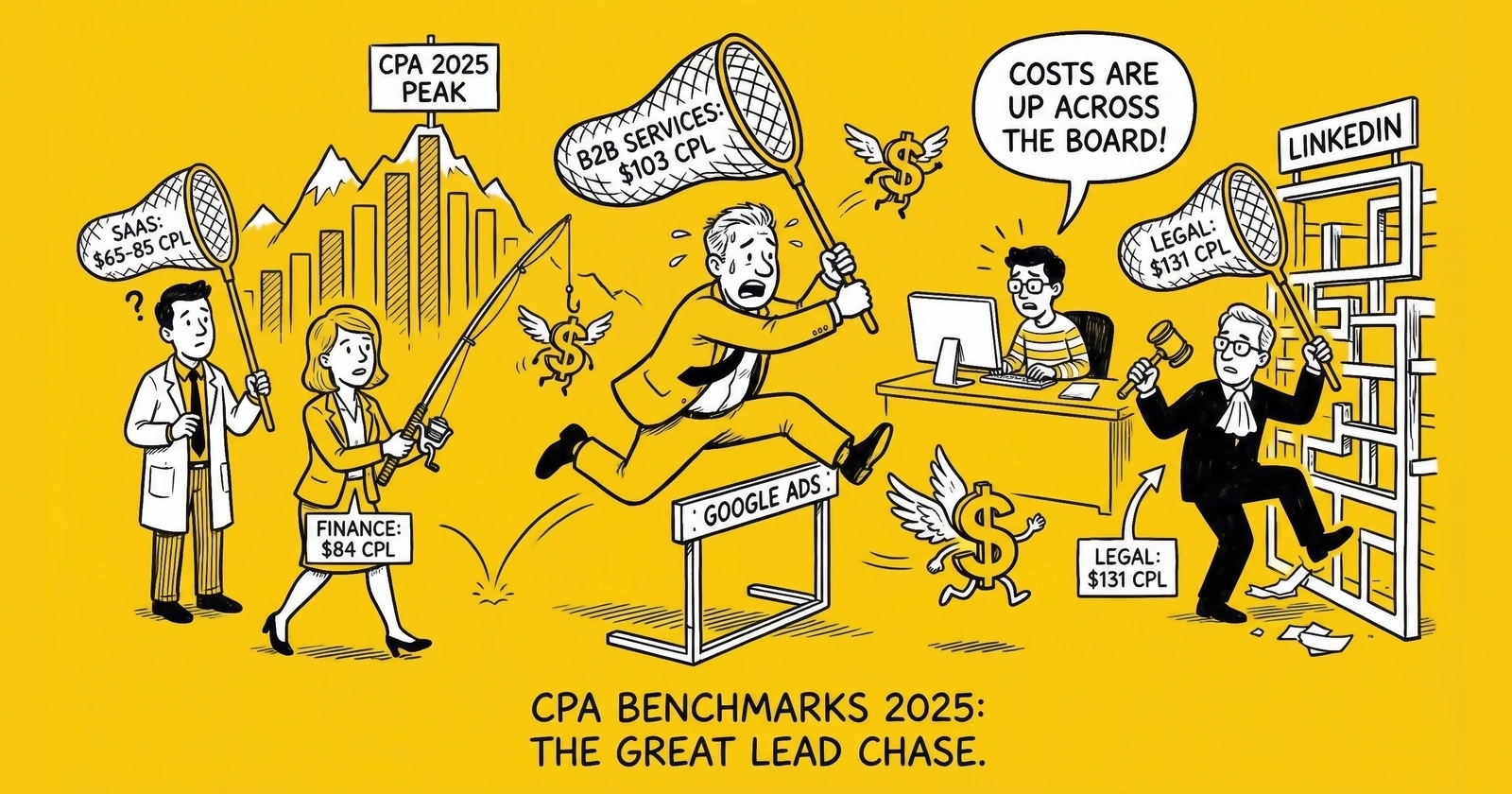
Your CPL means nothing if you do not know your CPA. This comprehensive guide provides current cost per acquisition benchmarks across insurance, mortgage, solar, legal, and home services verticals, plus the calculation methods and optimization strategies that separate profitable operators from those bleeding money.
Why CPA Benchmarks Matter More Than CPL
Most lead generation operators obsess over cost per lead. They celebrate when CPL drops, panic when it rises, and make scaling decisions based on dashboard CPL trends.
They are optimizing the wrong metric.
CPL measures what you spend to generate a lead. CPA measures what it actually costs to acquire a paying customer. The gap between these numbers is where profitability lives or dies. A $50 CPL that converts at 2% produces a $2,500 CPA. A $100 CPL that converts at 8% produces a $1,250 CPA. Understanding true cost per lead calculation helps clarify this relationship. The “expensive” leads are half the cost to acquire a customer.
CPA incorporates everything CPL ignores: conversion rates, return rates, contact rates, sales process efficiency, and downstream economics. It is the metric that actually connects to your P&L.
This guide provides current 2024-2025 CPA benchmarks across the major lead generation verticals. You will find specific ranges by industry, channel, and lead type. You will understand the calculation methodology that produces accurate CPA figures. And you will learn the optimization strategies that reduce CPA without sacrificing quality.
Those who master CPA economics build sustainable businesses. Those who focus only on CPL eventually discover their margins were an illusion.
Understanding CPA: The Complete Formula
Basic CPA Calculation
The simplest CPA formula divides acquisition costs by customers acquired:
Basic CPA = Total Acquisition Costs / Number of Customers Acquired
If you spend $10,000 on leads and acquire 15 customers, your CPA is $667.
This formula works for rough benchmarking but understates true acquisition cost. A more complete calculation accounts for the full cost stack.
True CPA Formula
The comprehensive CPA calculation incorporates all costs between initial contact and closed customer:
True CPA = (Lead Cost + Sales Labor + Technology + Returns + Overhead Allocation) / Net Customers Acquired
Each component deserves attention:
Lead Cost includes not just the purchase price but all costs to acquire and process the lead: media spend, platform fees, validation costs, and compliance documentation. A $50 lead might carry $8-15 in additional processing costs.
Sales Labor represents the cost of human effort to convert leads to customers. If a sales rep earning $60,000 annually (plus 30% benefits and overhead = $78,000) closes 150 customers per year, sales labor per acquisition is $520.
Technology Costs include CRM, dialer, analytics, and sales enablement tools. These typically add $20-100 per acquisition depending on tool sophistication and scale efficiency.
Returns and Refunds reduce effective customer count. If 10% of customers cancel within a refund period, your denominator shrinks by 10%, increasing effective CPA proportionally.
Overhead Allocation captures management, facilities, compliance, and general administrative costs. Allocate based on reasonable activity measures.
The CPL-to-CPA Bridge
Understanding the relationship between CPL and CPA requires knowing your conversion metrics:
CPA = CPL / (Contact Rate x Conversion Rate)
This formula reveals why contact rate and conversion rate are as important as CPL. Consider two scenarios at identical $75 CPL:
Scenario A:
- CPL: $75
- Contact Rate: 55%
- Conversion Rate (of contacts): 12%
- CPA: $75 / (0.55 x 0.12) = $1,136
Scenario B:
- CPL: $75
- Contact Rate: 40%
- Conversion Rate (of contacts): 8%
- CPA: $75 / (0.40 x 0.08) = $2,344
Same lead cost, 2x CPA difference. The leads in Scenario B might look identical on paper but deliver half the value due to lower contact and conversion rates.
Return-Adjusted CPA
Lead returns complicate CPA calculation. Returns represent leads purchased but refunded, consuming processing costs without contributing to the conversion denominator.
Return-Adjusted CPL = CPL / (1 - Return Rate)
A $75 CPL with 15% returns has an effective CPL of $88.24 ($75 / 0.85). This adjusted CPL then flows through the CPA calculation, compounding the impact.
Industry return rates vary significantly, making robust lead return policies essential for accurate CPA calculation:
| Vertical | Typical Return Rate | High-Quality Sources | Poor Sources |
|---|---|---|---|
| Auto Insurance | 8-15% | 5-8% | 20-30% |
| Mortgage | 10-18% | 6-10% | 25-35% |
| Solar | 15-25% | 10-15% | 30-40% |
| Legal | 20-35% | 15-20% | 40-50% |
| Home Services | 12-20% | 8-12% | 25-35% |
Insurance CPA Benchmarks
Insurance represents the most mature lead generation vertical, with public company data providing unusual transparency into acquisition economics. Carrier behavior drives the market: when underwriting improves, carriers increase advertising spend aggressively; when losses mount, they contract.
Auto Insurance CPA
Auto insurance benefits from high shopping frequency, standardized products, and sophisticated carrier buying operations. CPA ranges reflect this maturity.
| Lead Type | CPL Range | Contact Rate | Conversion Rate | CPA Range |
|---|---|---|---|---|
| Shared (3-5 buyers) | $15-35 | 45-55% | 4-7% | $450-800 |
| Semi-Exclusive (2 buyers) | $35-55 | 50-60% | 6-9% | $600-1,000 |
| Exclusive | $55-85 | 55-65% | 8-12% | $700-1,200 |
| Live Transfer | $80-150 | 90-95% | 12-18% | $500-900 |
| Click (Comparison) | $3-12 | N/A | 2-4% | $150-400 |
Key Observations:
Live transfers often produce the lowest CPA despite the highest CPL because contact is guaranteed and prospects are in active shopping mode. The 90%+ contact rate transforms the economics.
Shared leads offer low CPL but typically yield higher CPA due to competition among buyers. When three agents call the same consumer within 15 minutes, conversion rates collapse.
Click-based leads (consumers clicking through to carrier quote pages) can produce exceptional CPA when properly optimized. Progressive’s direct-to-carrier model achieves $150-400 CPA at scale, though this requires massive brand investment.
Carrier Acquisition Benchmarks:
Major carriers disclose acquisition economics through investor presentations and SEC filings:
- Progressive targets approximately 3:1 LTV:CAC ratio, implying sustainable CPA of $400-600 against $1,500-2,400 lifetime value
- Allstate has reported customer acquisition costs in the $500-800 range for new auto policies
- Industry average CPA runs $600-900 for carriers with efficient operations
Geographic Variation:
CPA varies significantly by state due to competition, premium levels, and regulatory factors:
| State | CPA Index | Notes |
|---|---|---|
| California | 130-150 | Highest competition, highest premiums |
| Texas | 95-110 | Large market, moderate competition |
| Florida | 115-130 | High insurance costs, active market |
| Midwest | 75-90 | Lower competition, smaller markets |
| Northeast | 110-125 | High premiums, dense population |
Index based on 100 = national average.
Home Insurance CPA
Home insurance typically accompanies auto insurance in bundling strategies, affecting acquisition economics.
| Lead Type | CPL Range | Contact Rate | Conversion Rate | CPA Range |
|---|---|---|---|---|
| Shared | $20-50 | 40-50% | 5-8% | $500-1,000 |
| Exclusive | $60-100 | 50-60% | 7-10% | $800-1,400 |
| Bundled (with Auto) | $30-75 | 55-65% | 10-15% | $350-700 |
| Real Estate Triggered | $40-90 | 45-55% | 8-12% | $600-1,100 |
Bundled leads (consumers seeking both auto and home quotes) command premium CPA because they represent higher lifetime value. A household with both policies generates 2-3x the retention economics of single-line customers.
Medicare CPA
Medicare operates under strict CMS oversight with pronounced seasonality around enrollment periods.
| Lead Type | CPL Range (AEP) | Contact Rate | Conversion Rate | CPA Range |
|---|---|---|---|---|
| Shared | $50-100 | 35-45% | 4-6% | $1,200-2,500 |
| Exclusive | $100-200 | 40-50% | 6-10% | $1,500-2,800 |
| Live Transfer | $150-300 | 85-95% | 10-15% | $1,200-2,200 |
| Set Appointment | $200-400 | 75-85% | 15-25% | $1,000-2,000 |
Enrollment Period Economics:
AEP (October 15 - December 7) and OEP (January 1 - March 31) create concentrated buying windows. CPL spikes 2-3x during AEP, but so does buyer willingness to pay.
Medicare Advantage commission structures (approximately $600+ for initial enrollments in 2025) create room for $1,500-2,500 CPA while maintaining profitability across the commission stream.
Life Insurance CPA
Life insurance presents unique challenges: longer sales cycles, more complex underwriting, and consumer reluctance to engage with mortality topics.
| Lead Type | CPL Range | Contact Rate | Conversion Rate | CPA Range |
|---|---|---|---|---|
| Term Life (Shared) | $25-50 | 35-45% | 3-5% | $1,200-2,500 |
| Term Life (Exclusive) | $50-100 | 40-50% | 5-8% | $1,200-2,200 |
| Final Expense | $20-50 | 40-50% | 5-8% | $500-1,200 |
| Whole Life | $60-125 | 35-45% | 4-7% | $1,500-3,500 |
Final expense leads (targeting seniors for burial cost coverage) produce lower CPA due to simpler products and smaller face amounts. Term life commands premium CPA but offers correspondingly higher commission potential.
Mortgage CPA Benchmarks
Mortgage lead economics correlate directly with interest rate environment. When rates drop, refinance activity surges and lead demand spikes. When rates rise, volume collapses and buyers become intensely price-conscious.
Purchase Mortgage CPA
| Lead Type | CPL Range | Contact Rate | Conversion Rate | CPA Range |
|---|---|---|---|---|
| Shared | $50-100 | 30-40% | 1-2% | $3,000-6,000 |
| Exclusive | $100-200 | 35-45% | 2-4% | $3,500-7,000 |
| Pre-Qualified | $150-300 | 40-50% | 3-5% | $4,000-8,000 |
| Real Estate Referral | $200-400 | 50-60% | 5-8% | $3,500-6,000 |
Understanding Mortgage Conversion:
Mortgage conversion rates appear low (1-4%) because the decision cycle spans weeks or months. A lead generated in January might close in April. Attribution complexity means many conversions never trace back to their originating lead source.
Effective mortgage CPA requires:
- Extended attribution windows (90-120 days minimum)
- Multi-touch attribution models
- CRM integration for long-term tracking
Loan Amount Impact:
Larger loan amounts support higher CPA. Commission structures typically run 1-2% of loan value:
| Loan Amount | Commission | Supportable CPA |
|---|---|---|
| $200,000 | $2,000-4,000 | $600-1,200 |
| $400,000 | $4,000-8,000 | $1,200-2,500 |
| $600,000 | $6,000-12,000 | $1,800-4,000 |
| $800,000+ | $8,000-16,000 | $2,500-5,500 |
Targeting high-value loans often justifies premium lead pricing because the economics scale with transaction size.
Refinance Mortgage CPA
Refinance leads follow rate sensitivity more closely than purchase leads:
| Rate Environment | CPL Range | Conversion Rate | CPA Range |
|---|---|---|---|
| Rates Dropping | $75-150 | 3-5% | $2,000-4,000 |
| Rates Stable | $50-100 | 2-3% | $2,500-5,000 |
| Rates Rising | $30-75 | 1-2% | $3,000-6,500 |
When rates drop, refinance demand surges, conversion rates improve, and CPA drops despite higher CPL. When rates rise, only rate-insensitive refinance motivations (cash-out, debt consolidation) persist, shrinking the viable market.
Solar CPA Benchmarks
Solar exhibits the most extreme geographic pricing variation of any lead vertical. An 8.5x spread exists between California customer value ($1,929 per sale) and North Dakota ($225 per sale). This variation directly affects sustainable CPA.
National Solar CPA
| Lead Type | CPL Range | Contact Rate | Conversion Rate | CPA Range |
|---|---|---|---|---|
| Shared (2-3 buyers) | $35-125 | 20-30% | 3-5% | $1,200-3,500 |
| Exclusive | $100-200 | 25-35% | 8-15% | $800-2,200 |
| Set Appointment | $150-300 | 70-80% | 15-25% | $750-1,600 |
| Aged (30+ days) | $5-30 | 15-25% | 1-3% | $800-2,500 |
Geographic CPA Variation
State-level economics dramatically affect sustainable CPA:
| State Tier | States | Avg Sale Value | Sustainable CPA |
|---|---|---|---|
| Tier 1 | CA, HI, MA, NY | $1,500-2,000 | $1,200-1,800 |
| Tier 2 | TX, FL, AZ, NJ, CO | $800-1,400 | $800-1,200 |
| Tier 3 | NC, GA, MD, VA | $500-800 | $500-800 |
| Tier 4 | IL, PA, OH, MN | $350-500 | $350-500 |
| Tier 5 | ND, SD, WY, MT | $200-400 | $200-400 |
Policy Impact on CPA:
State incentive changes can shift CPA economics overnight. California’s NEM 3.0 (reducing export compensation by 75%) extended payback periods from 5-6 years to 14-15 years. Residential installations dropped 40% in 2024. Lead demand contracted, CPL dropped, but conversion rates collapsed faster – often increasing effective CPA despite lower lead costs.
Smart solar lead generators track:
- State-level net metering policies
- Utility rate changes
- Incentive expirations
- ITC phase-downs (residential credit expires December 31, 2025)
Installer Type CPA Variation
Different installer business models support different CPA economics:
| Installer Type | Business Model | Sustainable CPA | Notes |
|---|---|---|---|
| National PPA/Lease | Third-party ownership | $1,500-2,500 | Own tax credit; can pay more |
| National Cash/Loan | Financing margin | $1,200-2,000 | Scale advantages |
| Regional | Direct installation | $800-1,500 | Lower overhead |
| Local | Premium service | $600-1,200 | Margin from reputation |
Sunrun and similar lease/PPA companies can afford higher CPA because they monetize the 30% ITC directly, then recoup through 20-year customer relationships. Local installers compete on installation quality and customer service, supporting lower CPA through operational efficiency rather than financing margin.
Legal CPA Benchmarks
Legal leads command the highest CPLs in lead generation because case values justify substantial acquisition investment. A personal injury case settling for $500,000 with 33% contingency fee generates $165,000 in revenue – supporting acquisition costs that would be absurd in other verticals.
Personal Injury CPA
| Lead Type | CPL Range | Contact Rate | Conversion Rate | CPA Range |
|---|---|---|---|---|
| Shared | $200-350 | 15-25% | 2-4% | $4,000-8,000 |
| Exclusive | $350-500 | 20-30% | 3-5% | $5,000-10,000 |
| Qualified (screened) | $400-600 | 25-35% | 5-8% | $6,000-12,000 |
| Signed Retainer | $800-1,500 | 80-90% | 40-60% | $1,500-3,000 |
Case Type Variation:
| Case Type | Typical CPL | Conversion Rate | CPA Range |
|---|---|---|---|
| Auto Accident | $250-450 | 3-6% | $5,000-12,000 |
| Slip and Fall | $200-400 | 2-4% | $6,000-15,000 |
| Medical Malpractice | $400-700 | 1-3% | $15,000-40,000 |
| Product Liability | $350-600 | 2-4% | $10,000-25,000 |
Medical malpractice cases are notoriously difficult to convert because most potential cases don’t meet liability thresholds. The high CPA reflects extensive screening required before case acceptance.
Mass Tort CPA
Mass tort campaigns operate differently from standard legal lead generation:
| Tort Type | CPL Range | Qualification Rate | CPA per Qualified |
|---|---|---|---|
| Active Campaign | $100-300 | 10-20% | $1,000-2,500 |
| Mature Campaign | $200-500 | 5-15% | $2,500-6,000 |
| Late-Stage | $300-800 | 3-8% | $5,000-15,000 |
Mass tort economics favor early entrants. When a new litigation opportunity emerges (a drug recall, device failure, or environmental contamination), early leads qualify at higher rates and lower costs. As the campaign matures, the viable plaintiff pool shrinks, qualification rates drop, and CPA rises.
Other Legal Verticals
| Vertical | CPL Range | Conversion Rate | CPA Range |
|---|---|---|---|
| Criminal Defense | $100-300 | 5-10% | $1,500-4,000 |
| Family Law/Divorce | $75-200 | 8-15% | $800-2,000 |
| Bankruptcy | $50-150 | 10-18% | $500-1,200 |
| Immigration | $75-200 | 8-15% | $800-2,000 |
| Workers Compensation | $150-350 | 4-8% | $3,000-7,000 |
| Estate Planning | $40-100 | 12-20% | $350-700 |
Bankruptcy and estate planning leads convert at higher rates because the services address clear, immediate needs. Personal injury leads require liability determination that excludes most inquiries from viable cases.
Home Services CPA Benchmarks
Home services lead generation connects homeowners with contractors, plumbers, electricians, and specialty service providers. The $600+ billion annual home services market supports substantial lead acquisition investment.
HVAC CPA
HVAC exhibits dual-peak seasonality around cooling (summer) and heating (winter) demand:
| Lead Type | CPL Range | Contact Rate | Conversion Rate | CPA Range |
|---|---|---|---|---|
| Repair (Shared) | $25-50 | 45-55% | 20-35% | $150-350 |
| Repair (Exclusive) | $50-90 | 55-65% | 30-45% | $150-280 |
| Replacement | $75-150 | 40-50% | 10-18% | $500-1,200 |
| Emergency | $100-200 | 70-80% | 40-60% | $200-400 |
Emergency leads command premium pricing but convert exceptionally because the consumer’s urgency eliminates shopping behavior. A homeowner with a failed air conditioner in July will book the first available technician.
Replacement leads (full system installations) support higher CPA because project values run $8,000-15,000+. Even at $1,200 CPA, the acquisition cost represents 8-15% of project value – acceptable margin for most contractors.
Roofing CPA
Roofing exhibits strong geographic and seasonal patterns, with storm damage creating demand spikes:
| Lead Type | CPL Range | Contact Rate | Conversion Rate | CPA Range |
|---|---|---|---|---|
| General Inquiry | $40-100 | 40-50% | 8-15% | $350-800 |
| Insurance Claim | $60-150 | 45-55% | 12-20% | $400-900 |
| Full Replacement | $80-180 | 40-50% | 8-14% | $750-1,500 |
| Storm Response | $75-175 | 60-70% | 15-25% | $350-700 |
Storm response leads convert at exceptional rates when delivered quickly. Homeowners with obvious roof damage after a hailstorm are actively seeking immediate help, not casually comparing quotes.
Plumbing CPA
| Lead Type | CPL Range | Contact Rate | Conversion Rate | CPA Range |
|---|---|---|---|---|
| General Service | $20-50 | 45-55% | 25-40% | $100-250 |
| Emergency | $75-150 | 75-85% | 50-70% | $150-300 |
| Drain/Sewer | $40-80 | 50-60% | 20-35% | $180-350 |
| Water Heater | $50-100 | 45-55% | 15-25% | $300-550 |
Plumbing emergencies (burst pipes, backed-up sewage) create urgency that drives exceptional conversion rates. The homeowner with water flooding their basement will book immediately.
General Home Improvement CPA
| Service Category | CPL Range | Conversion Rate | CPA Range |
|---|---|---|---|
| Windows/Doors | $50-150 | 5-10% | $800-2,000 |
| Kitchen/Bath Remodel | $75-200 | 4-8% | $1,500-3,500 |
| Flooring | $40-100 | 8-15% | $400-900 |
| Painting | $25-60 | 15-25% | $200-400 |
| Fencing | $30-75 | 12-20% | $250-500 |
| Landscaping | $25-65 | 15-25% | $175-400 |
Larger projects (kitchen remodels, window replacements) naturally support higher CPA because project values range from $15,000-75,000. A $3,000 CPA on a $50,000 kitchen remodel represents 6% acquisition cost – entirely reasonable.
Channel Impact on CPA
Different acquisition channels deliver different CPA profiles. Understanding channel economics enables portfolio optimization.
Paid Search CPA
Google Search captures declared purchase intent, producing higher CPL but often lower CPA:
| Vertical | Avg CPC | Conversion Rate | CPA Range |
|---|---|---|---|
| Insurance | $4-12 | 4-8% | $100-300 |
| Mortgage | $6-15 | 1-3% | $300-800 |
| Solar | $8-20 | 2-4% | $400-900 |
| Legal | $20-80 | 3-6% | $500-2,000 |
| Home Services | $3-10 | 5-12% | $50-200 |
Branded search (consumers searching your company name) converts at 2-3x non-branded rates, dramatically lowering CPA. Building brand awareness through other channels reduces downstream CPA on search.
Paid Social CPA
Meta (Facebook/Instagram) offers lower CPL but typically higher CPA due to lower intent:
| Vertical | Avg CPL | Conversion Rate | CPA Range |
|---|---|---|---|
| Insurance | $15-40 | 2-4% | $500-1,500 |
| Mortgage | $25-60 | 0.5-1.5% | $2,000-6,000 |
| Solar | $30-75 | 1-3% | $1,500-4,000 |
| Legal | $50-150 | 1-3% | $3,000-10,000 |
| Home Services | $20-50 | 3-6% | $500-1,200 |
Facebook users are scrolling content, not actively shopping. Lower CPL masks lower purchase intent, often producing higher CPA than more expensive search channels.
Native lead forms (leads captured without leaving Facebook) produce 30-50% lower CPL but often 30-50% lower conversion rates – a wash or net negative on CPA.
SEO/Organic CPA
Organic traffic offers the best CPA economics but requires long-term investment:
| Vertical | CPL Range | Conversion Rate | Effective CPA |
|---|---|---|---|
| Insurance | $15-35 | 5-10% | $200-500 |
| Mortgage | $20-50 | 2-4% | $700-1,500 |
| Solar | $25-60 | 3-6% | $600-1,200 |
| Legal | $40-100 | 4-8% | $800-2,000 |
| Home Services | $10-30 | 8-15% | $150-350 |
Organic CPL appears low because it excludes the upfront content and SEO investment. True organic CPA should amortize content costs (typically $1,000-5,000 per ranking article) and link building ($2,000-10,000 per major ranking improvement) across the leads generated over the content lifetime.
A 24-month content program costing $100,000 that generates 5,000 leads has a $20 effective CPL. If those leads convert at 8%, CPA is $250 – exceptional economics, but achieved only through sustained investment.
Referral and Partner CPA
Referral programs and strategic partnerships often deliver the lowest CPA:
| Source Type | Typical CPL | Conversion Rate | CPA Range |
|---|---|---|---|
| Customer Referrals | $25-75 | 15-30% | $150-400 |
| Strategic Partners | $50-150 | 10-20% | $400-1,000 |
| Affiliate Programs | $30-100 | 5-12% | $400-1,200 |
| Agent Referrals | $75-200 | 12-25% | $500-1,200 |
Customer referrals convert at exceptional rates because the referring customer pre-qualifies and pre-sells the prospect. The trust transfer accelerates conversion and reduces sales friction.
CPA Optimization Strategies
Improving Contact Rate
Contact rate is the first gate in the conversion funnel. No contact means no opportunity to convert.
Speed-to-Contact:
Research consistently shows that leads contacted within one minute convert at 391% higher rates than leads contacted in 30+ minutes. Optimizing speed-to-lead response time is one of the highest-ROI investments for CPA improvement. The first responder wins 78% of the time in competitive situations.
Implementing sub-5-minute contact requires:
- Real-time lead delivery (sub-second routing)
- Immediate CRM notification and assignment
- Automated dialer engagement
- Fallback to automated SMS/email when phone fails
Multi-Channel Contact:
Phone-only outreach misses consumers who don’t answer unknown numbers. Modern contact strategies layer:
- Initial phone attempt (immediate)
- SMS follow-up (within 2 minutes if no answer)
- Email confirmation (within 5 minutes)
- Second phone attempt (within 30 minutes)
- Voicemail drop (if available)
Multi-channel strategies improve contact rates by 30-50% compared to phone-only approaches.
Lead Quality Pre-Filtering:
Not all leads can be contacted. Lead validation services identify:
- Disconnected phone numbers
- Invalid email addresses
- DNC-registered numbers
- Known litigator numbers
Filtering these before purchase eliminates wasted contact attempts and reduces effective CPA by removing leads that never could have converted.
Improving Conversion Rate
Once contact is made, conversion rate determines whether CPL investment generates customers.
Sales Process Optimization:
Top-performing sales operations consistently outperform average performers by 50-100% on conversion rates. The difference comes from:
- Structured call frameworks
- Objection handling training
- CRM-enforced follow-up cadences
- Call recording and coaching
- Performance-based compensation
A 2-percentage-point improvement in conversion (from 8% to 10%) reduces CPA by 20%. Sales process optimization often delivers higher ROI than lead source optimization.
Lead Scoring and Prioritization:
Not all leads deserve equal attention. Scoring leads based on:
- Demographic fit
- Behavioral signals
- Source quality history
- Intent indicators
Directing sales effort toward high-probability leads improves aggregate conversion rate. Low-score leads can route to lower-cost follow-up channels (email nurture, chatbot) rather than consuming expensive sales labor.
Sales and Marketing Alignment:
Conversion rate drops when marketing delivers leads that sales cannot work effectively. Common disconnects:
- Leads generated for products sales cannot offer
- Geographic leads outside service territory
- Credit profiles that cannot qualify
- Timing mismatches (refi leads during rate spikes)
Regular feedback loops between sales and marketing identify these gaps before they waste substantial spend.
Reducing Returns
Returns destroy CPA economics because they consume all acquisition costs with zero revenue contribution.
Validation Before Sale:
Real-time validation reduces returns by 40-60% by catching issues before delivery:
- Phone carrier lookup (is the number valid and active?)
- Email verification (does the inbox exist?)
- Address standardization (is this a real, deliverable address?)
- Duplicate detection (has this consumer already been sold?)
A $0.15-0.50 validation cost is trivial compared to a $50-100 returned lead.
Source Quality Monitoring:
Track return rates by source. Sources with return rates exceeding thresholds should face volume reduction or termination:
- Yellow alert: 10-15% returns
- Red alert: 15-20% returns
- Termination: 20%+ returns for 2+ weeks
The dashboard CPL difference between a 5% return source and a 20% return source is minimal. The CPA difference is enormous.
Buyer Alignment:
Returns often stem from misalignment between what buyers want and what generators deliver. Regular buyer communication reveals:
- Changing qualification criteria
- Geographic restrictions
- Product availability gaps
- Capacity constraints
Generators who understand buyer needs produce leads that convert rather than return.
CPA Benchmarks by Business Model
For Lead Generators
Lead generators (publishers) should understand buyer CPA to price appropriately:
| Vertical | Buyer CPA Range | Typical CPL | CPL as % of CPA |
|---|---|---|---|
| Auto Insurance | $600-1,000 | $30-75 | 5-10% |
| Mortgage | $3,000-6,000 | $75-200 | 2-4% |
| Solar | $1,200-2,000 | $100-200 | 8-15% |
| Legal PI | $5,000-12,000 | $300-500 | 4-8% |
| Home Services | $300-800 | $50-100 | 12-18% |
CPL typically represents 5-15% of buyer CPA. Generators selling leads at $75 CPL to buyers achieving $750 CPA are capturing 10% of customer value. Higher-quality leads (better conversion rates) can command higher CPL percentages.
For Lead Buyers
Lead buyers should calculate maximum sustainable CPL based on their CPA targets and conversion performance:
Maximum CPL = Target CPA x Expected Conversion Rate
Example for an insurance agency:
- Target CPA: $800
- Historical conversion rate: 10%
- Maximum CPL: $800 x 0.10 = $80
If leads cost more than $80 and conversion rate remains 10%, CPA will exceed target. Either negotiate lower CPL, improve conversion rate, or accept higher CPA.
For Lead Brokers
Brokers must maintain margin between acquisition CPL and distribution CPL while accounting for returns, processing costs, and capital:
| Component | Typical % of Spread |
|---|---|
| Returns | 15-30% |
| Processing/Tech | 10-15% |
| Float Cost | 5-10% |
| Operating Overhead | 10-20% |
| Net Margin | 25-40% |
A broker buying at $50 CPL and selling at $80 CPL has $30 gross spread. After 15% returns ($4.50), 12% processing ($3.60), 8% float ($2.40), and 15% overhead ($4.50), net margin is $15 per lead – 50% of gross spread but still profitable.
Frequently Asked Questions
Q1: What is the difference between CPL and CPA?
CPL (Cost Per Lead) measures what you spend to acquire a lead, which is the contact information and intent signal of a potential customer. CPA (Cost Per Acquisition) measures what you spend to acquire an actual paying customer. CPA incorporates CPL plus all downstream costs divided by the number of conversions.
The relationship is: CPA = CPL / (Contact Rate x Conversion Rate)
A $50 CPL with 50% contact rate and 10% conversion rate produces $1,000 CPA. CPA is always higher than CPL because not every lead becomes a customer.
Q2: What is a good CPA for lead generation?
A good CPA depends entirely on customer lifetime value (LTV). The standard benchmark is 3:1 LTV:CAC ratio, meaning you should spend no more than one-third of customer lifetime value on acquisition.
For auto insurance with $1,500-2,400 LTV, sustainable CPA is $500-800. For solar with $5,000-15,000 customer value, sustainable CPA is $1,500-2,500. For legal with $50,000+ case value, CPA of $5,000-10,000 may be appropriate.
Compare your CPA to the vertical benchmarks in this guide and your own LTV calculations to determine if your acquisition efficiency is healthy.
Q3: How do I calculate CPA when leads are shared with multiple buyers?
When selling leads to multiple buyers, calculate CPA from each buyer’s perspective using their specific conversion data. The same lead might yield different CPA for different buyers based on their contact speed, sales process, and product offerings.
For generators selling shared leads, calculate aggregate CPA across all buyers to understand the total customer acquisition the lead enabled. This helps price shared leads appropriately – a lead that produces 3 customers across 3 buyers has different value than a lead that produces 1 customer for 1 buyer.
Q4: Why is my CPA higher than industry benchmarks?
Five common causes of elevated CPA:
-
Low contact rate: If leads aren’t answering, they can’t convert. Improve speed-to-contact, add multi-channel outreach, and filter invalid phone numbers.
-
Poor conversion rate: Sales process issues often cause conversion underperformance. Implement structured frameworks, call recording, and coaching.
-
High return rates: Returns consume costs without contributing conversions. Validate leads before purchase and monitor source quality.
-
Wrong lead sources: Some sources produce inherently lower-quality leads. Track conversion by source and shift budget toward performers.
-
Inefficient sales labor: If sales reps spend time on low-probability leads, overall conversion suffers. Implement lead scoring and prioritization.
Q5: How do returns affect CPA calculation?
Returns increase effective CPL, which flows through to higher CPA. The formula is:
Return-Adjusted CPL = CPL / (1 - Return Rate)
Return-Adjusted CPA = Return-Adjusted CPL / (Contact Rate x Conversion Rate)
Example: $75 CPL with 15% returns, 50% contact rate, and 10% conversion rate:
- Adjusted CPL: $75 / 0.85 = $88.24
- CPA: $88.24 / (0.50 x 0.10) = $1,765
Without return adjustment, you’d calculate $1,500 CPA – understating true acquisition cost by 15%.
Q6: How should I track CPA for long sales cycle verticals like mortgage?
Mortgage and other long-cycle verticals require extended attribution windows. Best practices:
- Use 90-120 day attribution windows (minimum)
- Implement multi-touch attribution to credit leads across the journey
- Integrate CRM with origination systems to capture final conversion
- Track cohort-based CPA (leads generated in Month X, converted by Month X+4)
Rolling 90-day CPA calculations provide operational visibility. Annual CPA calculations capture full conversion cycles for strategic planning.
Q7: What is the relationship between exclusive leads and CPA?
Exclusive leads typically produce 40-60% lower CPA than shared leads despite 2-3x higher CPL. The math works because:
- Higher contact rates (consumer isn’t overwhelmed by multiple calls)
- Higher conversion rates (no competitor comparison during decision window)
- Lower return rates (leads are fresher, less shopped)
For a $50 shared lead with 4% conversion: $1,250 CPA For a $125 exclusive lead with 10% conversion: $1,250 CPA
In this example, exclusive and shared produce identical CPA. In practice, exclusive often beats this parity due to better downstream metrics.
Q8: How does seasonality affect CPA benchmarks?
Seasonal patterns affect both CPL and conversion rates, with unpredictable CPA impacts:
Medicare (AEP): CPL doubles, but conversion rates also improve due to concentrated shopping. CPA often increases only 20-40% despite 100% CPL increases.
HVAC (Summer/Winter peaks): CPL increases with demand, but urgent buyers convert at higher rates. CPA may decrease during peak seasons.
Mortgage (Rate drops): When rates fall, refinance CPL spikes, but conversion rates improve dramatically. CPA often drops despite higher CPL.
Track your own seasonal CPA patterns. Industry benchmarks represent annual averages that may not reflect your specific seasonal experience.
Q9: What CPA should I target for profitability?
Target CPA depends on your business model and customer economics:
For buyers acquiring customers:
- Target CPA = Customer LTV / Target LTV:CAC Ratio
- Example: $2,000 LTV / 3:1 ratio = $667 maximum CPA
For generators selling leads:
- Your buyer’s target CPA determines what they can pay for leads
- Maximum CPL = Buyer’s Target CPA x Buyer’s Conversion Rate
- Maintain margin between your acquisition CPL and sale price
For brokers:
- Target CPA is your blended cost of lead acquisition
- Maintain 25-40% margin between your CPA and distribution price after returns and processing
Q10: How do I benchmark CPA when entering a new vertical?
Before launching in a new vertical, estimate CPA through research and testing:
- Industry benchmarks: Use the ranges in this guide as starting points
- Buyer conversations: Understand what established buyers pay and why
- Competitor analysis: Estimate competitor CPL from ad library tools and scale from benchmarks
- Test campaigns: Run 4-8 week tests at modest budget to establish actual conversion rates
- Conservative modeling: Assume 20-30% worse than benchmark until you have your own data
Model profitability at conservative CPA assumptions. If unit economics work at worst-case conversion rates, you have margin of safety. If profitability requires best-case assumptions, reconsider the vertical.
Key Takeaways
-
CPA matters more than CPL. CPL measures media efficiency; CPA measures business profitability. A $100 lead that converts at 10% beats a $50 lead that converts at 2% every time.
-
The complete CPA formula: (Lead Cost + Sales Labor + Technology + Returns + Overhead) / Net Customers. Dashboard CPL captures one component. True CPA includes all costs between lead capture and customer conversion.
-
CPA benchmarks vary 10-50x across verticals. Legal PI CPA runs $5,000-12,000. Home services CPA runs $150-500. Know your vertical economics before evaluating performance.
-
Returns compound CPA. A 15% return rate increases effective CPL by 18% and flows through to proportionally higher CPA. Track returns by source and terminate underperformers quickly.
-
Contact rate and conversion rate are as important as CPL. A 50% improvement in contact rate or conversion rate reduces CPA by 33% – often easier to achieve than equivalent CPL reduction.
-
Geographic variation creates arbitrage. Solar CPA ranges from $400 in emerging markets to $2,000+ in saturated states. Insurance CPA varies 30-50% between low-competition and high-competition regions.
-
Channel selection affects CPA more than optimization within channel. SEO produces 2-3x better CPA than paid social in most verticals. Choose channels strategically, then optimize within them.
-
Target 3:1 LTV:CAC ratio. Sustainable CPA equals one-third of customer lifetime value. Higher ratios provide margin; lower ratios erode profitability.
Sources
- Insurance Information Institute - Insurance industry acquisition costs, premium data, and market statistics for auto, home, and Medicare verticals
- Solar Energy Industries Association (SEIA) - Solar installation costs per watt, market size by state, and ITC policy information
- HubSpot Marketing Statistics - B2B and B2C lead generation benchmarks, conversion rates, and LTV:CAC ratio research
- LinkedIn Marketing Solutions - B2B channel performance data and professional audience acquisition costs
- Think with Google - Digital advertising benchmarks, search campaign performance data, and conversion optimization research
- SBA Funding Programs - Small business financing information relevant to lead generation working capital
CPA benchmarks based on 2024-2025 industry data from public company filings, industry research, and operator reporting. Ranges reflect typical market conditions; your specific results will vary based on geography, lead quality, sales process efficiency, and market timing. Validate benchmarks against your own conversion data before making significant investment decisions.