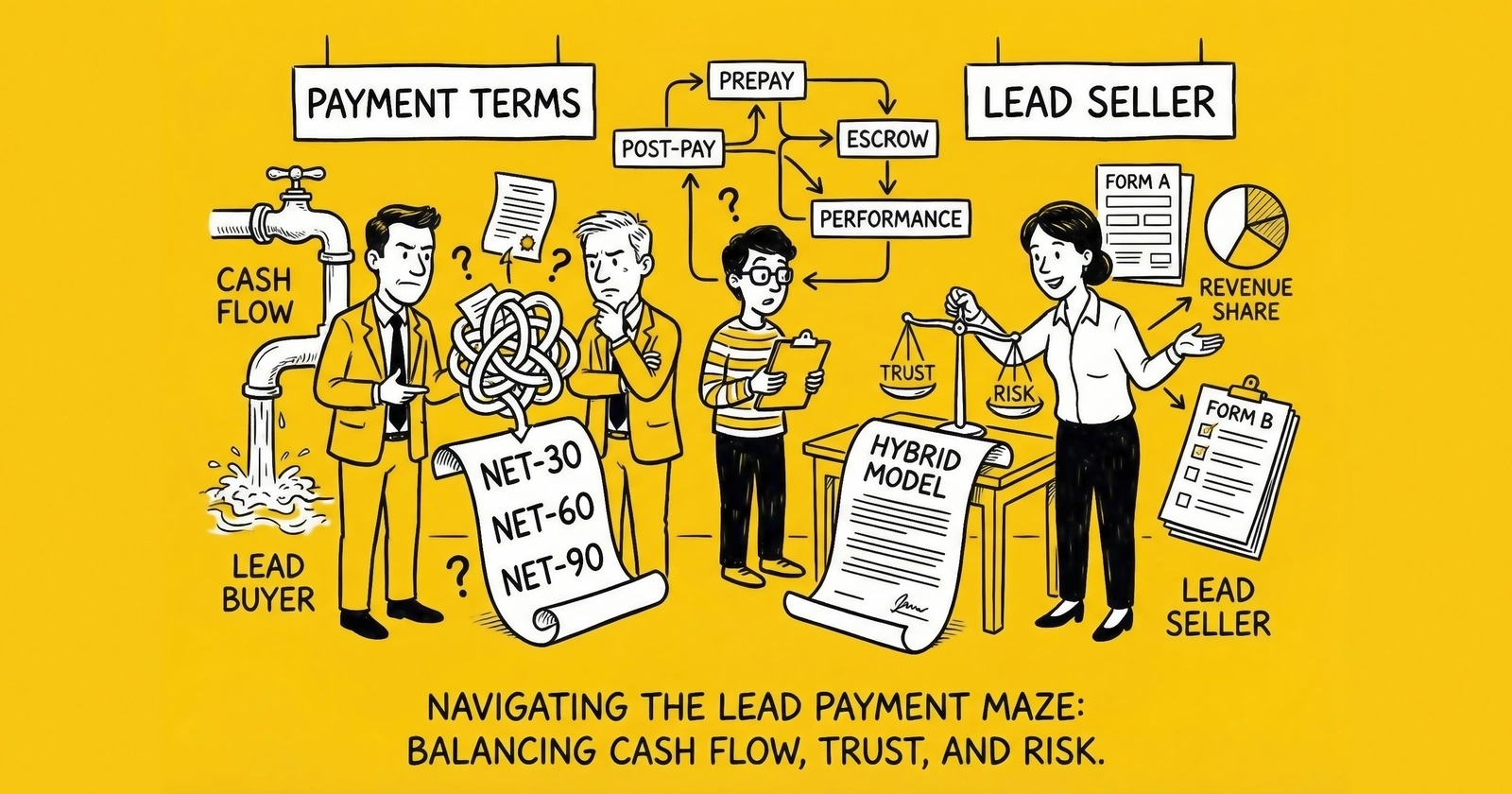
Payment terms determine whether you build a sustainable lead generation business or become another cash flow casualty. This guide covers everything operators need to know about structuring credit, negotiating terms, and managing the timing mismatches that define this industry.
The invoice says you made $50,000 last month. Your bank account says you have $3,000. Both are telling the truth.
This disconnect defines the lead generation industry. Payment terms and credit structures determine not just how much money flows through your business, but whether your business survives long enough to collect it. Those who master credit and payment dynamics build sustainable companies. Those who treat them as administrative details become cautionary tales.
After fifteen years in this industry, I have watched more lead businesses fail from cash flow mismanagement than from competition, bad leads, or regulatory problems combined. The math is unforgiving. You pay for traffic today. You collect from buyers in thirty, forty-five, or sixty days. Every dollar of growth widens that gap. Without understanding credit and payment terms at a structural level, you are building on sand.
This guide covers the complete landscape of payment terms in lead transactions. We will examine industry-standard payment structures, explain the timing mismatches that trap undercapitalized operators, provide frameworks for negotiating better terms, and show you how to build a payment term strategy that supports sustainable growth.
Understanding Payment Terms in Lead Generation
Payment terms govern when money changes hands between parties in a lead transaction. In most industries, this is straightforward. In lead generation, the timing asymmetry creates working capital challenges that catch even experienced business owners off guard.
The Fundamental Timing Mismatch
The lead generation business model creates a structural cash flow challenge that cannot be negotiated away. Here is how money flows through the system:
Outbound payments (you pay first):
- Traffic platforms (Google, Facebook, native networks): Daily or weekly billing, due immediately
- Publishers and affiliates generating leads for you: Net-7 to Net-15 terms
- Validation services (phone verification, email checks, TrustedForm): Often prepaid or Net-7
- Technology platforms and infrastructure: Monthly subscription, often prepaid
Inbound payments (you collect later):
- Small and mid-size lead buyers: Net-30 to Net-45
- Enterprise buyers and carriers: Net-45 to Net-60
- Some corporate buyers with slow AP processes: Net-60 to Net-90
The gap between these timelines creates what operators call “float” – the amount of working capital you need to bridge the gap between paying for leads and getting paid for them. For most lead businesses, this gap runs 45 to 60 days.
Standard Payment Terms by Stakeholder Type
Understanding typical payment terms helps you set realistic expectations and identify negotiation opportunities.
Traffic Platforms:
Google Ads charges your credit card or ACH daily. There is no negotiating Net-30 with Google. Facebook typically bills weekly, with payment due within seven days. Native advertising platforms vary but generally require prepayment or very short terms. This immediate cash outflow while waiting weeks for buyer payments creates the core timing challenge.
Publishers and Affiliates:
When you buy leads from publishers rather than generating them yourself, standard terms range from Net-7 to Net-15. Larger networks may accept Net-30 from established buyers. Some publishers require prepayment or same-day payment, particularly for new relationships. The closer to real-time your payment to publishers, the better quality sources you can attract – they have cash flow needs too.
Lead Buyers (Your Customers):
Small agencies and independent agents: Often pay faster because they lack complex AP systems. Net-15 to Net-30 is achievable. Many will prepay for quality leads.
Mid-size buyers with 10-50 employees: Standard Net-30 terms. May stretch to Net-45 without formal negotiation – watch for this.
Enterprise buyers and carriers: Net-45 is standard. Net-60 is common. Some large insurance carriers operate on Net-75 or Net-90 cycles that are essentially non-negotiable from their procurement departments.
Call centers and aggregators: Varies widely. Some operate on prepayment because they are managing tight margins. Others push for extended terms because they are managing their own float requirements.
Payment Term Benchmarks by Vertical
Different lead verticals carry different payment term norms based on buyer economics and industry structure.
| Vertical | Typical Buyer Terms | Range | Notes |
|---|---|---|---|
| Auto Insurance | Net-30 | Net-15 to Net-45 | Faster payment than most verticals |
| Medicare | Net-30 to Net-45 | Net-15 to Net-60 | AEP seasonality affects timing |
| Mortgage | Net-45 | Net-30 to Net-60 | Slower cycles reflect sales timeline |
| Solar | Net-30 to Net-45 | Net-15 to Net-60 | Wide variation by buyer size |
| Legal (PI) | Net-45 to Net-60 | Net-30 to Net-90 | Longest cycles in the industry |
| Home Services | Net-15 to Net-30 | Prepay to Net-45 | Local buyers often pay faster |
These benchmarks represent starting points for negotiation, not fixed rules. Buyer-specific factors – their cash position, your relationship strength, competitive alternatives – ultimately determine achievable terms.
Calculating Your Float Requirement
The 60-day float rule is not conservative planning. It is survival math.
Maintain a cash reserve equal to sixty days of operating expenses plus media spend before scaling traffic. This number derives from the actual cash conversion cycle in lead generation.
The Cash Conversion Timeline
Here is how the typical cycle works:
Day 1: You run paid campaigns. Your credit card or ad account gets charged.
Days 3-7: Those clicks convert into leads on your landing pages.
Days 7-14: You deliver leads to buyers through your distribution system.
Days 30-45: Buyers process your invoices and issue payment.
Days 45-60: That payment clears into your operating account.
Throughout this entire cycle, you continue spending on media. Day two’s traffic costs hit while day one’s leads have not been invoiced. Day fifteen’s campaigns are running while day one’s payments remain thirty days away.
Float Calculation Formula
Calculate your specific float requirement using this formula:
Float Requirement = (Average Daily Spend x Days to Collection) + Return Reserve
Where:
- Average Daily Spend = Total monthly costs divided by 30
- Days to Collection = Weighted average of buyer payment terms plus processing time
- Return Reserve = 10-20% buffer for disputed leads and returns
Example Calculation:
Monthly media spend: $100,000 Monthly operating costs: $30,000 Total monthly spend: $130,000 Daily spend: $4,333
Weighted average collection: 45 days Basic float: $4,333 x 45 = $195,000
Return reserve (15%): $29,250 Total Float Required: $224,250
Working Capital Requirements by Scale
Working capital requirements scale dramatically with volume. Understanding these thresholds helps you plan financing before hitting crisis points.
| Monthly Media Spend | Working Capital Needed | Typical Funding Source |
|---|---|---|
| Under $50K | $100K-$150K | Personal savings, credit cards |
| $50K-$100K | $150K-$300K | Personal capital plus factoring |
| $100K-$200K | $300K-$600K | Lines of credit, revenue-based financing |
| $200K-$500K | $500K-$1M | Bank credit facilities |
| $500K+ | $1M-$10M+ | Institutional credit, private equity |
The transitions between scales create the most dangerous moments. The capital that worked at $40,000 monthly spend suddenly becomes insufficient at $60,000. Revenue grew 50%, but working capital requirements may have grown 100%.
Extending Credit to Lead Buyers
Every time you deliver leads before receiving payment, you are extending credit. This credit decision deserves the same rigor you would apply to any lending relationship.
Credit Assessment for New Buyers
Before extending payment terms to a new buyer, assess their creditworthiness. The amount of due diligence should scale with your exposure.
For small accounts (under $5,000 monthly):
- Verify business legitimacy (registered entity, physical address, professional website)
- Check for obvious red flags (no online presence, generic email addresses, pressure for immediate high volume)
- Start with prepayment or Net-7 terms until payment history is established
For mid-size accounts ($5,000-$25,000 monthly):
- Request business references from other lead vendors
- Review basic credit reports through services like Dun and Bradstreet
- Verify operational history (how long in business, consistent operations)
- Start with Net-15 terms, extend to Net-30 after three successful payment cycles
For enterprise accounts (over $25,000 monthly):
- Conduct formal credit analysis including financial statement review
- Verify insurance coverage and bonding where applicable
- Check litigation history for TCPA or consumer protection issues
- Review their buyer relationships (if they are a broker, who are their downstream buyers)
- Negotiate terms based on mutual value, typically Net-30 to Net-45
Red Flags That Signal Credit Risk
Over the years, certain patterns emerge as reliable warning signs:
Urgency without substance: A new buyer who needs “maximum volume immediately” but cannot explain their downstream buyer relationships or provide references is often building a house of cards.
Vague business structure: Legitimate buyers have clear answers about their business model, licensing, and compliance practices. Evasive answers suggest problems you do not want to inherit.
Pressure against standard terms: Buyers who insist on Net-60 from day one, refuse deposits, or push back aggressively against normal credit practices often have cash flow problems they are not disclosing.
Inconsistent volume requests: A buyer who wants 500 leads one week, zero the next, then 1,000 the following week may be chasing their own cash flow issues or selling to unreliable downstream buyers.
Slow-paying from the start: A buyer who stretches Net-30 to Net-40 in their first three months will stretch it to Net-60 by month six. Payment patterns established early rarely improve.
Structuring Credit Limits
Credit limits protect you from catastrophic exposure to any single buyer. Set limits based on the maximum loss you can absorb without threatening your operation.
Conservative approach: Credit limit equals one month of anticipated purchases. A buyer expecting to purchase $20,000 monthly gets a $20,000 credit limit.
Standard approach: Credit limit equals 1.5 times monthly anticipated purchases. The same buyer gets a $30,000 limit, allowing for some volume fluctuation.
Aggressive approach: Credit limit equals two times monthly anticipated purchases. Only appropriate for buyers with demonstrated payment reliability and strategic importance.
Review credit limits quarterly and after any significant changes in buyer payment patterns, volume, or business circumstances. A buyer who has always paid on time but suddenly slows down may be signaling trouble before they tell you directly.
Prepayment and Deposit Structures
For buyers who cannot or will not meet your credit requirements, prepayment structures provide alternatives.
Full prepayment: Buyer deposits funds before leads are delivered. Simple to administer but limits your ability to scale with the buyer. Works well for small accounts and new relationships.
Deposit plus Net terms: Buyer provides 25-50% deposit against anticipated monthly volume. Remainder is billed on standard terms. Balances security with operational flexibility.
Prepay reload: Buyer maintains a prepaid balance that is drawn down with each lead delivery. When balance falls below threshold, they must reload before receiving additional leads. Popular with call centers and aggregators.
Credit limit with deposit: Buyer provides deposit equal to their credit limit. Invoices are billed normally; deposit is held as security and applied to final invoice or returned when relationship ends.
The right structure depends on buyer size, relationship strength, and your risk tolerance. Larger, established buyers typically resist deposits, viewing them as unnecessary friction. Newer or smaller buyers often accept deposits as normal business practice.
Negotiating Better Payment Terms
Payment terms are negotiable. The terms you accept define your cash flow reality for the life of each relationship. Negotiating improvements on both sides – faster collection from buyers, slower payment to suppliers – directly impacts your working capital requirement and profitability.
Negotiating Faster Buyer Payments
The goal is reducing your Days Sales Outstanding (DSO) without damaging buyer relationships or losing competitive position.
Early payment discounts: Offer 2% discount for payment within fifteen days instead of thirty or forty-five. Calculate the economics carefully. If your cost of capital is 12% annually (roughly 1% monthly), offering 2% for 15-30 days of acceleration is economically advantageous. Many corporate treasury functions actively seek early payment opportunities to deploy excess cash.
The math: 2% for 30 days early equals roughly 24% annualized return for the buyer. If they have capital available, this is attractive. If your capital cost exceeds 24%, the discount may not make sense.
Tiered payment terms based on volume: Buyers committing to higher volumes may warrant faster terms as incentive. “Net-30 for standard volume, Net-15 for buyers exceeding 2,000 leads monthly.”
Terms tied to payment history: Start all buyers at Net-15 or prepayment. After six months of on-time payment, graduate to Net-30. Reserve Net-45 for your largest, most reliable accounts. This creates incentive for prompt payment.
Relationship leverage: Your best buyers – those with highest volume, lowest returns, and strategic importance – have negotiating power. But you have leverage too: quality leads, reliable service, and operational capability they depend on. Negotiate from this mutual value, not from weakness.
Invoice timing optimization: Invoice immediately upon lead delivery, not at month-end. Buyer AP departments process invoices on receipt. An invoice sent on the 15th gets paid 30 days faster than one sent on the 30th for the same leads.
Negotiating Extended Supplier Terms
The other side of the float equation is delaying your payments to suppliers without damaging those relationships.
Publisher and affiliate terms: Most publishers operate on tight cash flow and need rapid payment. However, larger or established publishers may accept Net-15 or Net-21 from reliable buyers. Position your request around mutual benefit: “Consistent monthly volume in exchange for aligned payment timing.”
Technology platform terms: Some platforms offer annual prepayment discounts that may be economically superior to monthly billing if you have capital available. Others offer Net-30 for enterprise accounts.
Professional services: Legal, accounting, and consulting services often default to Net-30 but may accept longer terms for steady clients. A law firm would rather have a reliable Net-45 client than chase a Net-30 client for payment.
Credit card float strategy: Business credit cards with 30-day billing cycles plus 25-day grace periods provide 55 days of interest-free float. This is not debt if you pay in full – it is timing optimization. Use cards strategically for expenses that otherwise require immediate payment.
The Payment Term Negotiation Script
When negotiating terms with buyers, frame the conversation around mutual benefit rather than your cash flow needs.
Opening: “As we finalize our agreement, I’d like to discuss payment terms that work for both of us. Standard terms for new relationships are Net-15 with 2% early payment discount. What terms are you working with on your other lead sources?”
If they push for longer terms: “I understand Net-45 is your standard. Let’s discuss what would make Net-30 workable – perhaps a volume commitment or pricing adjustment that reflects the faster payment. We’ve found our best buyer relationships include aligned payment timing.”
If they request prepayment: “We typically require a deposit for new relationships until we’ve established payment history together. After three months of on-time payment, we transition to standard Net-30 terms. This protects both of us during the getting-to-know-you phase.”
Closing: “Let’s start with Net-30 and review at 90 days. If the relationship is working well for both of us, we can discuss adjustments then.”
Managing Payment Term Risk
Extended payment terms create exposure. Managing this exposure protects your business from the cash flow crises that sink otherwise profitable operations.
Accounts Receivable Monitoring
Your accounts receivable represents money you have earned but not yet collected. Monitor it aggressively.
Weekly AR aging review: Every week, review invoices by age category. Industry standard categories are Current (0-30 days), 30-60 days, 60-90 days, and Over 90 days. Any movement of significant dollars into older categories warrants immediate attention.
Days Sales Outstanding (DSO) tracking: Calculate DSO weekly using a 13-week rolling average: (Average Accounts Receivable / Revenue) x 91 days. Plot this weekly. Any consistent upward trend over four or more weeks indicates a collection problem in development.
Buyer-specific payment pattern tracking: Track payment timing for each buyer individually. A buyer who paid on Day 28 for six months, then Day 32, then Day 38, then Day 45 is trending toward default – even though they are technically still paying.
Collection escalation protocol: Establish clear escalation triggers. Friendly reminder at Net+5 days. Account manager call at Net+15 days. Reduced volume or pause at Net+30 days. Collections process at Net+45 days. Those who collect best are those who act earliest.
Bad Debt Reserve
Not every buyer will pay. Budget for this reality rather than pretending it does not exist.
Reserve calculation: Based on historical experience, reserve 1-3% of revenue for uncollectable accounts. This percentage should increase if you are extending credit to higher-risk buyers or operating during economic uncertainty.
Reserve treatment: The bad debt reserve is a real cost of doing business. Include it in your unit economics calculations. A lead you sell for $50 on Net-45 terms is not worth $50 – it is worth $50 minus your bad debt reserve percentage minus float cost.
Write-off procedures: When an account becomes clearly uncollectable, write it off against your reserve. Continuing to carry worthless receivables on your books creates false confidence in your cash position.
Collection Strategies
When buyers fall behind, systematic collection processes outperform ad hoc approaches.
Early intervention: The earlier you address payment delays, the higher your collection probability. A call at Day 35 has significantly better outcomes than a call at Day 60. Early calls also signal to buyers that you are paying attention.
Escalation within their organization: If your contact is not getting payments processed, escalate within their organization. Ask to speak with their CFO or controller. Sometimes payment delays result from internal processing issues rather than inability to pay.
Volume leverage: For buyers dependent on your leads, reducing volume is often effective. “We will need to pause deliveries until your account is current” motivates payment faster than collection letters.
Payment plans: For buyers with legitimate cash flow problems but viable businesses, structured payment plans may recover more than aggressive collection. A buyer who can pay $10,000 per month over six months is better than a buyer who defaults entirely.
Legal action: Reserve for clear cases of non-payment with documented delivery and acceptance. The cost of collection lawsuits often exceeds recovery potential for amounts under $25,000. For larger amounts, consult with an attorney specializing in commercial collections.
The Economics of Payment Terms
Payment terms directly impact your profitability through float cost – the expense of capital tied up in accounts receivable.
Calculating Float Cost
Float cost equals your average receivables multiplied by your annual cost of capital:
Annual Float Cost = Average Receivables x Annual Cost of Capital
Monthly Float Cost = Annual Float Cost / 12
Example:
Average receivables: $300,000 Annual cost of capital: 12% (typical line of credit rate) Annual float cost: $300,000 x 12% = $36,000 Monthly float cost: $3,000
That $36,000 is a real business expense that most practitioners never explicitly account for.
Float Cost Per Lead
Translate float cost into per-lead economics to understand its impact on margin.
Float Cost Per Lead = Monthly Float Cost / Monthly Lead Volume
Example:
Monthly float cost: $3,000 Monthly lead volume: 10,000 leads Float cost per lead: $0.30
On a lead with $5 gross margin, this $0.30 represents 6% margin erosion. At higher capital costs or longer collection cycles, this erosion increases significantly.
Cost of Capital by Financing Source
Different capital sources carry different costs. Choose financing that minimizes your effective float cost.
| Financing Source | Approximate Annual Rate | Notes |
|---|---|---|
| Bank line of credit | 8-15% | Best rates for qualified borrowers |
| SBA-backed line | 10-13% | Requires application process |
| Personal capital (opportunity cost) | 8-12% | What else could your money earn |
| Credit card (carrying balance) | 18-26% | Never carry balance if possible |
| Invoice factoring | 15-36% effective | Expensive but accessible |
| Revenue-based financing | 25-45% effective | Very expensive |
The lesson: establish bank credit facilities before you need them. The operators paying 24%+ for factoring or revenue-based financing are often those who failed to establish cheaper credit when their businesses were healthy.
The True Cost of Long Payment Terms
When a buyer requests Net-60 instead of Net-30, quantify what that request actually costs you.
Example calculation:
Monthly purchases: $50,000 Net-30 float: $50,000 (one month of receivables) Net-60 float: $100,000 (two months of receivables) Additional float required: $50,000
At 12% annual capital cost: Additional annual cost: $50,000 x 12% = $6,000
That Net-60 request costs you $6,000 annually or $500 monthly. Is this buyer’s relationship worth that premium? If so, accept the terms. If not, negotiate harder or price accordingly.
Financing Options for Managing Float
When internal capital is insufficient, external financing options can bridge the gap. Each option carries different costs, requirements, and implications.
Business Lines of Credit
A revolving credit facility provides flexible access to capital. You draw when needed, repay when collected, and pay interest only on outstanding balances.
Current rate environment (late 2025):
- Bank lines for well-qualified borrowers: Prime + 1.75% to Prime + 9.75% (roughly 8.75% to 16.75%)
- SBA-backed lines: Starting around 10.5%
- Online lenders: 20% to 35% APR or higher
Qualification requirements:
- Typically two years in business
- Annual revenue above $100,000-$250,000
- Credit scores above 650 (above 700 for best rates)
- Demonstrated positive cash flow
Best practices:
- Establish credit facilities before you need them – lenders respond poorly to desperation
- Maintain utilization below 50% to preserve credit profile
- Draw to cover timing mismatches, not operating losses
- Repay aggressively when collections arrive
Invoice Factoring
Factoring converts accounts receivable into immediate cash by selling invoices to a factoring company at a discount.
How it works:
- You deliver leads and invoice buyers
- Instead of waiting 30-60 days, you sell the invoice to a factor
- The factor advances 85-93% of invoice value immediately
- When your buyer pays the factor, you receive the remaining balance minus fees
Typical costs:
- Advance rate: 85-93% of invoice value
- Factor fee: 1-5% of invoice value depending on payment timing
- Effective APR: 24-36% or higher
Advantages:
- Not debt – does not create leverage on your balance sheet
- Approval depends on your buyers’ creditworthiness, not yours
- Scales automatically with revenue
Disadvantages:
- Expensive compared to traditional credit
- Factor may contact your buyers directly
- Some buyers view factoring negatively (though this stigma has decreased)
When factoring makes sense:
- Growth opportunity exceeds factoring cost
- Your buyers have strong credit profiles
- Your own credit limits traditional financing
- You need capital flexibility rather than fixed debt
Revenue-Based Financing
Revenue-based financing provides capital in exchange for a percentage of monthly revenue until a fixed multiple is repaid.
Example: Receive $200,000 and repay $260,000 over 12-18 months via 10% of monthly revenue.
Advantages:
- No equity dilution
- Flexible payment that scales with revenue
- Faster approval than traditional lending
Disadvantages:
- Effectively high APRs (30-60% when calculated)
- Revenue encumbrance reduces operating flexibility
- Can create stress during slow months
Revenue-based financing is expensive capital. Use it only when growth opportunity clearly exceeds the financing cost and cheaper alternatives are unavailable.
Credit Card Float Strategy
Business credit cards, used strategically, provide interest-free float.
The mechanics:
A credit card with 30-day billing cycles plus 25-day grace periods provides 55 days of interest-free float on purchases. A purchase made on Day 1 of your billing cycle appears on your statement 30 days later, with payment due 25 days after that.
Best practices:
- Maintain multiple cards to maximize available credit
- Never carry balances – this converts free float into 18-26% debt
- Use cards for regular, predictable expenses (subscriptions, travel)
- Track utilization carefully to maintain credit profile
Limitations:
- Credit limits constrain scale
- Not all expenses accept credit cards
- Requires discipline to pay in full monthly
Payment Terms in Buyer Agreements
Your buyer agreements should clearly specify payment terms, return policies, and dispute procedures. Ambiguity creates conflict.
Essential Contract Terms
Payment terms: Specify Net-X clearly. “Payment due 30 days from invoice date” is unambiguous. “Payment due promptly” is not.
Invoice procedures: Define when invoices are issued (upon delivery, weekly summary, monthly summary), how they are delivered (email, portal, EDI), and what information they contain.
Late payment penalties: Include language for interest on overdue balances (typically 1-1.5% monthly) and recovery of collection costs. Even if you never enforce these provisions, they establish expectations.
Credit limits: If you are extending credit, specify the maximum outstanding balance allowed. Include provisions for adjusting limits based on payment history.
Prepayment requirements: For new relationships or buyers not meeting credit requirements, specify deposit amounts and terms for transitioning to standard terms.
Return and Dispute Provisions
Returns complicate payment timing. Clear provisions prevent disputes.
Return windows: Specify how long buyers have to return leads. Industry standards range from 7-14 days for most verticals. Longer windows (30+ days) may be appropriate for legal or other long-cycle verticals.
Valid return reasons: Define acceptable reasons for returns: invalid contact information, duplicate leads, geographic mismatch, failure to meet specified criteria. Equally important, specify what is not a valid return reason: consumer changed their mind, no contact after reasonable attempts, did not convert to sale.
Return procedures: Specify how buyers must submit returns, what documentation is required, and how credits are processed. “Returns must be submitted via the buyer portal within 10 business days of delivery with rejection code and supporting documentation.”
Dispute resolution: Include escalation procedures for disputes that cannot be resolved at the operational level. Specify timelines for each escalation stage and final resolution mechanisms.
Payment Term Modification Provisions
Include provisions for adjusting terms based on relationship performance.
Improvement triggers: “Payment terms may be extended to Net-45 after 12 months of on-time payment and minimum monthly volume of 1,000 leads.”
Deterioration triggers: “Seller reserves the right to reduce credit limits or require prepayment if payment is received more than 15 days past due on two or more occasions within any 90-day period.”
Review periods: “Payment terms will be reviewed quarterly and may be adjusted by mutual agreement based on payment history and volume.”
Industry-Specific Considerations
Payment term dynamics vary by vertical based on buyer characteristics, sales cycles, and industry structure.
Insurance Leads
Insurance buyers range from individual agents to Fortune 500 carriers, with payment terms varying accordingly.
Independent agents: Often pay faster because they operate smaller businesses without complex AP systems. Net-15 to Net-30 is achievable. Many will prepay for quality leads, particularly during competitive enrollment periods.
Captive agency networks: Mid-tier terms, typically Net-30. Larger networks may push for Net-45. Payment generally reliable once terms are established.
Carriers and enterprise buyers: Net-45 to Net-60 standard. Some large carriers operate on Net-75 or Net-90 cycles that are essentially non-negotiable. The volume and reliability may justify the extended terms, but factor the float cost into your pricing.
Seasonal considerations: Open enrollment periods (AEP for Medicare, OEP for health insurance) create volume spikes that stress working capital. Plan float requirements for peak periods, not average periods.
Mortgage Leads
Mortgage buyers operate on longer sales cycles, and payment terms often reflect this.
Mortgage brokers and loan officers: Wide variation in payment practices. Some operate on prepayment; others push for Net-45. Credit check new relationships carefully – the mortgage industry has seen significant consolidation and business failures.
Larger lenders: Standard Net-30 to Net-45. Payment reliability generally good for established institutions.
Rate sensitivity: Mortgage volume fluctuates dramatically with interest rate movements. Buyers who are profitable at 4% rates may struggle at 7% rates. Monitor buyer financial health during rate transition periods.
Solar Leads
Solar lead buyers include installation companies of varying sizes and financial stability.
Small installers: Higher credit risk than insurance or mortgage buyers. Require deposits or prepayment until relationship is established. Many small solar companies operate on thin margins with limited working capital.
Regional players: Generally Net-30 terms with reasonable payment reliability. Verify licensing and bonding before extending significant credit.
National installers: Standard corporate terms, typically Net-30 to Net-45. More reliable but also more demanding on pricing and quality.
Geographic variation: Installer financial health varies by market. Companies in mature solar markets (California, Arizona) may have stronger balance sheets than those in emerging markets.
Legal Leads
Legal leads carry the longest payment cycles and highest credit risk considerations.
Solo practitioners and small firms: Variable payment practices. Some pay promptly; others stretch indefinitely. Require deposits or prepayment for new relationships. Monitor payment timing closely.
Mass tort aggregators: Can be reliable high-volume buyers but often operate on tight margins. Payment terms of Net-45 to Net-60 are common. Verify their downstream relationships before extending significant credit.
Large law firms: Standard corporate AP processes, typically Net-30 to Net-45. Generally reliable once onboarded but slow to make changes.
Case-by-case economics: Legal lead buyers often pay based on case outcomes rather than lead delivery. Consider hybrid models with smaller upfront payments plus contingent payments upon case resolution.
Frequently Asked Questions
What are standard payment terms in the lead generation industry?
Standard payment terms vary by buyer size and vertical. Small and mid-size lead buyers typically pay Net-30, meaning payment is due 30 days from invoice date. Enterprise buyers and large carriers often require Net-45 to Net-60, while some corporate buyers with complex AP processes may push for Net-75 or Net-90. On the supplier side, traffic platforms like Google and Facebook require immediate payment, while publishers and affiliates typically receive payment on Net-7 to Net-15 terms. This timing mismatch – paying immediately while collecting in 30-60 days – creates the working capital challenge that defines lead generation economics.
How much working capital do I need to run a lead generation business?
Working capital requirements scale with volume and payment term dynamics. A business spending $50,000 monthly on media with standard Net-45 buyer terms needs approximately $150,000-$200,000 in working capital. At $200,000 monthly media spend, requirements jump to $400,000-$600,000. The calculation is: (Average Daily Cash Outflow x Days to Collection) + Return Reserve. Most practitioners should maintain 60 days of operating expenses plus media spend as a minimum safety buffer. Growth periods require additional capital since you must fund expanded spending 45-60 days before the corresponding revenue arrives.
Should I offer early payment discounts to buyers?
Early payment discounts can be economically advantageous if your cost of capital exceeds the discount rate. A 2% discount for payment in 15 days instead of 45 days equals roughly 24% annualized return for the buyer. If your cost of capital is 12-15% annually, this exchange favors you – you are paying 2% to receive capital 30 days sooner, saving 2.5-3.75% in financing costs. Many corporate treasury departments actively seek early payment opportunities. The key is calculating whether the discount cost exceeds your capital cost for the acceleration period.
How do I evaluate whether to extend credit to a new lead buyer?
Credit evaluation should scale with exposure level. For small accounts under $5,000 monthly, verify basic business legitimacy and start with prepayment or Net-7 terms until payment history is established. For mid-size accounts, request references from other lead vendors, review credit reports, and start with Net-15 terms that can extend to Net-30 after three successful payment cycles. For enterprise accounts, conduct formal credit analysis including financial statement review, verify insurance coverage, and check litigation history. Red flags include pressure for immediate high volume without substance, vague business explanations, and aggressive pushback against standard credit terms.
What is invoice factoring and when should I consider it?
Invoice factoring converts accounts receivable into immediate cash by selling invoices to a factoring company at a discount. You receive 85-93% of invoice value immediately, with the remainder (minus fees of 1-5%) paid when your buyer settles with the factor. Effective APR ranges from 24-36% or higher. Factoring makes sense when growth opportunity exceeds factoring cost, your buyers have strong credit profiles (factors base rates on buyer creditworthiness), and you lack access to cheaper capital through bank lines of credit. Factoring is not debt and scales automatically with revenue, making it particularly useful for fast-growing operations that cannot qualify for sufficient bank credit.
How do I negotiate better payment terms with enterprise buyers who insist on Net-60?
Enterprise buyers often have procurement policies that make Net-60 standard, but negotiation is still possible. First, quantify the cost: Net-60 versus Net-30 requires an additional month of float, costing you roughly 1% of the invoice value monthly at typical capital costs. With this number in mind, explore options: early payment discounts (2-3% for Net-15), volume commitments in exchange for Net-30, or pricing adjustments that reflect the extended terms. If the buyer genuinely cannot modify terms, build the float cost into your pricing. A $50 lead sold to a Net-60 buyer should be priced $1-2 higher than the same lead to a Net-30 buyer to cover the additional capital cost.
What payment terms should I offer publishers and affiliates who generate leads for me?
Publisher terms depend on your cash flow capacity and competitive positioning. Net-7 to Net-15 is standard for most publishers. Larger networks or aggregators may accept Net-30 from established buyers with reliable payment history. Faster payment attracts better publishers – they have their own cash flow needs. If you are competing for premium traffic sources, consider same-day or next-day payment for validated leads. Build publisher payment timing into your float calculation: if you pay publishers at Net-7 and collect from buyers at Net-45, you are financing 38 days of publisher payments before revenue arrives.
How do returns affect payment terms and cash flow?
Returns complicate cash flow timing in two ways. First, returns reduce the revenue you ultimately collect, often occurring after you have already paid traffic sources. A 10% return rate on $50 leads means $5 per lead sold evaporates as returns. Second, returns create timing uncertainty – you may not know your actual collectible revenue until the return window closes. Build return reserves (10-15% of expected revenue) into your working capital planning. Set clear return windows in buyer agreements (typically 7-14 days), enforce them consistently, and track return patterns by buyer and source to identify problems early.
What legal provisions should I include in buyer agreements regarding payment?
Essential payment provisions include: clear payment terms (Net-X days from invoice date), invoice procedures (timing, delivery method, required information), late payment penalties (typically 1-1.5% monthly interest on overdue balances), credit limits (maximum outstanding balance), and prepayment requirements for new relationships. Include provisions for adjusting terms based on payment history – both improvement triggers for buyers with excellent payment records and deterioration triggers that allow you to require prepayment if a buyer becomes delinquent. Specify dispute resolution procedures and require written notice of disputed invoices within a defined period.
How do I manage cash flow when a major buyer pays late?
Late payment from a major buyer can trigger a cash crisis if you are not prepared. Immediate responses: contact the buyer at Net+5 days to understand the delay, escalate to your relationship manager or their finance department if standard AP processes are not working, and consider reducing or pausing lead deliveries if payment stretches past Net+30. Financial responses: draw on credit facilities if available, delay discretionary spending, and prioritize payments to keep critical traffic sources flowing. Preventive measures: maintain 60-day float reserves, avoid over-concentration (no single buyer should exceed 25% of revenue), and track buyer payment patterns to identify problems early.
Should I require prepayment from new buyers?
Requiring prepayment or deposits from new buyers is standard industry practice and protects against default risk. Common structures include full prepayment (buyer deposits funds before lead delivery), deposit plus terms (25-50% deposit with remainder on Net-30), and prepay reload (buyer maintains a balance that is drawn down with deliveries). Position prepayment as standard onboarding procedure rather than distrust: “We require a deposit for new relationships until we’ve established payment history together. After three months of successful transactions, we transition to standard Net-30 terms.” Most professional buyers understand this and will not object to reasonable security arrangements.
Key Takeaways
-
Payment terms define cash flow reality. The timing mismatch between paying for traffic immediately and collecting from buyers in 30-60 days creates working capital requirements that scale with volume. Understanding this mismatch is fundamental to sustainable operation.
-
The 60-day float rule is survival math. Maintain cash reserves equal to sixty days of operating expenses plus media spend before scaling traffic. This buffer covers the structural gap between outflows and inflows, plus reserves for returns and delays.
-
Every credit extension is a lending decision. Assess buyer creditworthiness before extending terms. Start new relationships with prepayment or short terms, then extend credit based on payment history. Set credit limits that protect against catastrophic exposure.
-
Float has a real cost. Capital tied up in accounts receivable costs 8-24% annually depending on your funding source. Build this cost into your unit economics and pricing decisions. A buyer requiring Net-60 instead of Net-30 costs you roughly 1% of invoice value monthly.
-
Negotiate terms on both sides. Faster buyer payments and slower supplier payments both compress your float requirement. Early payment discounts can be economically advantageous if your capital cost exceeds the discount rate.
-
Establish credit facilities before you need them. Bank lines of credit, factoring relationships, and other financing options should be established when your business is healthy. Lenders respond poorly to desperation, and the operators paying 24%+ for emergency financing are those who failed to plan ahead.
-
Monitor receivables aggressively. Track DSO weekly. Monitor individual buyer payment patterns. Establish clear collection escalation procedures and act early when payments slip. Those who collect best are those who act earliest.
-
Build payment terms into your strategy. Payment terms are not administrative details – they are strategic decisions that affect profitability, risk, and growth capacity. The right terms enable sustainable scaling; the wrong terms create crises that sink otherwise profitable businesses.
Sources
- Federal Reserve - Interest rate data, prime rate information, and commercial lending benchmarks relevant to working capital financing
- SBA Funding Programs - Loans - Small business loan programs, SBA-backed credit lines, and financing options for lead generation businesses
- boberdoo - Lead distribution platform with buyer management and payment term tracking capabilities
- LeadExec - Scalable, automated lead capture, validation, routing, and distribution platform
- LeadsPedia - Lead management platform documentation on invoicing, payment processing, and buyer credit management
- IBISWorld - Industry research on lead generation market size, financing patterns, and business failure rates
- Dun & Bradstreet - Business credit reporting and credit assessment standards for commercial lead buyers
Statistics and financial benchmarks current as of late 2025. Payment terms, interest rates, and market conditions change continuously. Verify current data before making financing decisions.