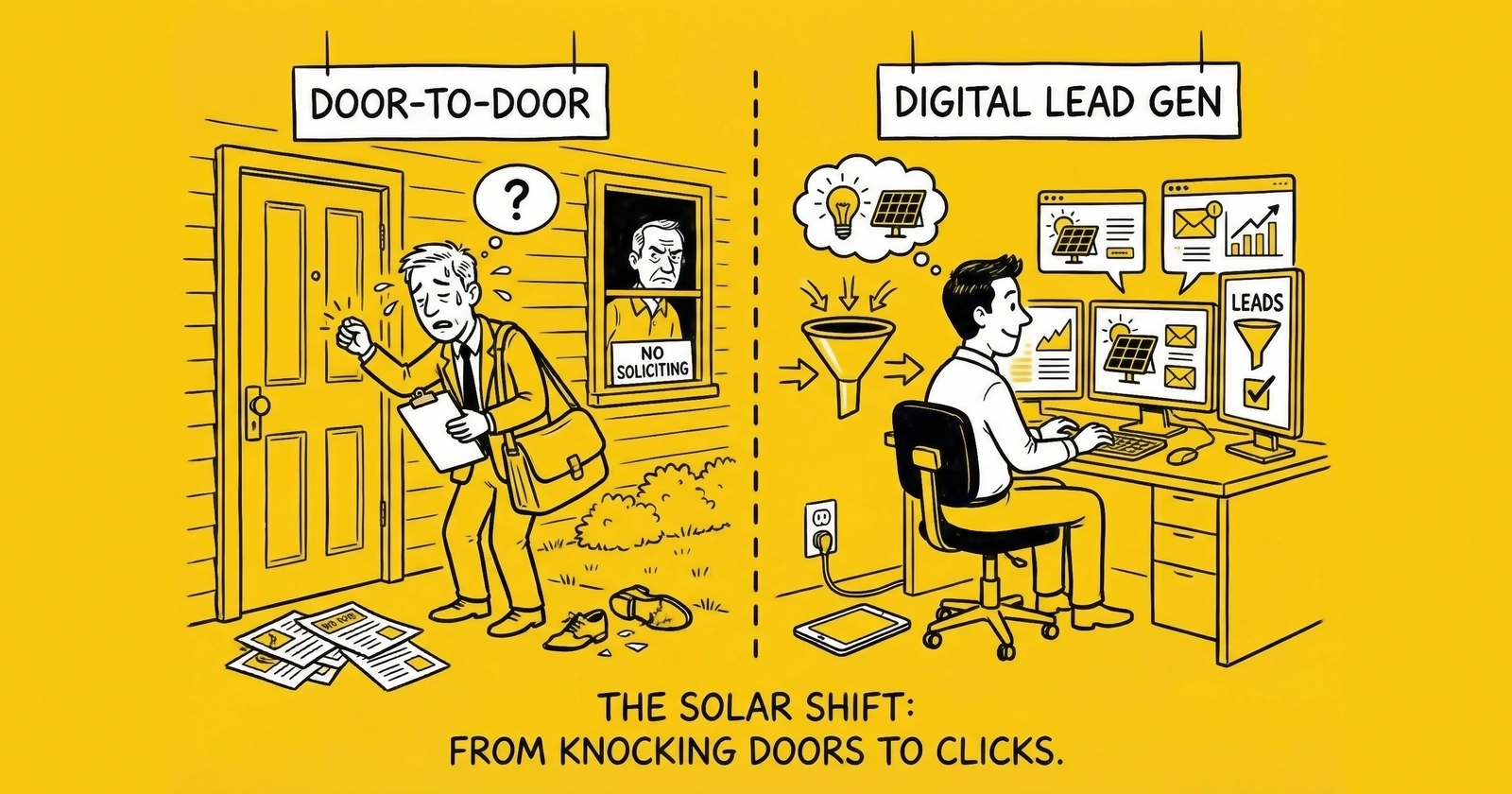
The solar industry’s two dominant customer acquisition channels operate with fundamentally different economics, conversion patterns, and quality profiles. Here is the data-driven analysis operators need to choose, combine, or optimize these approaches.
The solar installation industry runs on two distinct customer acquisition engines. Door-to-door (D2D) sales teams knock on thousands of doors daily across residential neighborhoods, building immediate rapport and closing deals on the spot. Digital lead generation captures intent through paid advertising, SEO, and online marketplaces, routing qualified prospects to installers for follow-up. For a comprehensive overview of solar lead generation strategies, understanding both channels is essential. Each channel has passionate advocates and documented success cases. Each also has failure modes that destroy margins and burn capital.
This guide provides the complete comparison framework for solar customer acquisition: cost structures by channel, conversion rate benchmarks, quality metrics, hybrid approaches, and the operational realities that determine which model works for different installer types. Every number comes from current market data and operational experience. The goal is not to declare a winner but to give operators the analysis they need to make informed decisions for their specific situations.
The Solar Customer Acquisition Landscape in 2024-2025
Understanding the current market context is essential before comparing acquisition channels. The residential solar sector faces unprecedented complexity: policy volatility, interest rate pressure, and regional market divergence create conditions where channel selection matters more than ever.
Market Conditions Shaping Channel Economics
The residential solar market contracted 12% in 2024 compared to 2023. California volumes dropped 41% following NEM 3.0 implementation, which reduced export compensation by approximately 75%. Yet solar still accounted for 58% of new electricity-generating capacity added to the U.S. grid in the first half of 2025. Within this challenged aggregate picture, massive regional variation means the right acquisition strategy depends heavily on geography.
The federal Investment Tax Credit (ITC) expiration after December 31, 2025 adds urgency. Homeowners must have systems installed and operational by year-end to qualify for the 30% credit. This creates a compressed demand window that affects both D2D and digital strategies differently.
Current unit economics frame the channel comparison:
| Metric | Industry Range | Impact on Channel Choice |
|---|---|---|
| Average installation value | $20,000-$30,000 | Justifies high CAC |
| Installer gross margin | 25-35% | Sets CAC ceiling |
| Acceptable CAC range | $1,500-$3,000 | Channel viability test |
| Close rate variation | 3-25% | Determines lead volume needs |
The math works like this: on a $25,000 installation with 30% gross margin, an installer earns $7,500 before customer acquisition costs. If total CAC exceeds $3,000, the remaining $4,500 must cover installation labor, overhead, and profit. The acquisition channel that delivers qualified customers within this constraint wins.
Geographic Segmentation
Channel effectiveness varies dramatically by market type. Premium markets like California, Hawaii, Massachusetts, and New York command lead prices of $150-$300+ but also have sophisticated, comparison-shopping consumers. Developing markets in the Midwest and Mountain states have lower lead costs ($25-$75) but less consumer awareness and installer infrastructure.
D2D teams historically dominated emerging markets where consumer education was part of the sale. Digital leads perform better in mature markets where consumers actively research solar options. This pattern is shifting as digital reach expands and D2D organizations professionalize, but geography remains the primary segmentation variable for channel strategy.
Door-to-Door Solar Sales: Economics and Operations
Door-to-door solar sales emerged as the industry’s dominant growth channel from 2015-2022. Companies like Vivint Solar (acquired by Sunrun), Momentum Solar, and numerous regional players built billion-dollar operations primarily through D2D customer acquisition. Understanding how D2D works reveals both its power and its limitations.
The D2D Cost Structure
D2D customer acquisition costs include components that differ fundamentally from digital lead generation:
Direct labor costs form the foundation. Solar D2D sales representatives typically earn base pay plus commission structures that total $800-$1,500 per closed deal at the representative level. Top performers in strong markets earn $2,000+ per close. Team leaders and managers add overhead of $200-$400 per closed deal across their teams.
Field operations add substantial cost. Transportation (company vehicles or mileage reimbursement), fuel, territory management software, and field supplies typically run $150-$300 per closed deal when amortized across successful sales.
Recruiting and training represent hidden costs that many practitioners undercount. D2D organizations experience 60-80% annual turnover for new representatives. Recruiting costs of $500-$1,500 per hire, combined with 2-4 weeks of training before productivity, add $200-$400 per eventual closed deal when accounting for attrition.
Compliance and oversight requirements have increased substantially since 2020. Local solicitation permits ($25-$200 per municipality), background check requirements, and supervision overhead add $100-$200 per closed deal.
Total D2D customer acquisition costs range from $1,500-$2,500 per closed deal in efficient operations. Poorly managed teams can exceed $3,500-$4,000 per close, destroying margins.
| D2D Cost Component | Low Estimate | High Estimate |
|---|---|---|
| Rep commission + base | $800 | $1,500 |
| Management overhead | $150 | $400 |
| Field operations | $150 | $300 |
| Recruiting/training (amortized) | $200 | $400 |
| Compliance/permits | $100 | $200 |
| Total CAC per close | $1,400 | $2,800 |
D2D Conversion Metrics
Door-to-door solar sales conversion follows a predictable funnel:
Doors knocked to doors answered: 25-35%. Most residents are not home, do not answer, or are not reachable due to gates, apartment buildings, or no-solicitation zones.
Doors answered to conversations: 40-60%. Many residents decline to engage, cite time constraints, or express immediate disinterest.
Conversations to qualified interest: 15-25%. Qualification screens for homeownership, roof condition, electric bill amount, and credit profile eliminate most conversations.
Qualified interest to scheduled appointments: 50-70%. Not all interested homeowners commit to an appointment for a detailed proposal.
Appointments to closed deals: 20-35%. Site assessment, proposal presentation, and closing conversations convert a fraction of scheduled appointments.
Working through the funnel: A D2D representative knocking 100 doors per day might achieve 30 answered doors, 15 conversations, 3 qualified prospects, 2 scheduled appointments, and 0.5 closes per day (one close every two days). Top performers can double these ratios.
The critical insight: D2D conversion rates compress at each stage, requiring high volume to generate closes. A team of 10 representatives knocking 1,000 doors daily might produce 5 closed deals. The math only works with sufficient territory density and representative productivity.
D2D Quality Indicators
Leads generated through D2D interactions have distinct quality characteristics:
Homeownership verification is immediate. The representative is standing at the property, can verify signage, observe the home, and confirm the prospect lives there. This eliminates the ownership fraud that plagues digital leads (25-35% fraud rates for third-party digital leads vs. under 5% for D2D).
Prospect engagement is demonstrated. A homeowner who agrees to a 20-minute conversation and schedules a follow-up appointment has shown genuine interest. Digital form fills can be completed in 30 seconds with minimal commitment.
Credit qualification happens faster. D2D representatives typically run credit checks during the initial appointment, eliminating unqualified prospects before proposal resources are expended. Digital leads often reveal credit issues only after sales team follow-up.
Roof and property assessment occurs in person. Representatives can identify obvious disqualifiers (shade, roof condition, structural issues) during the first visit. Digital leads may look qualified on paper but fail site assessment.
However, D2D quality has limitations:
Impulse purchases create higher cancellation rates. Solar contracts typically have a 3-day rescission period. D2D deals signed on first contact experience cancellation rates of 15-25% vs. 8-12% for prospects who researched independently before engaging.
Credit stretching occurs when representatives push borderline prospects. Commission-driven sales teams may close deals with marginally qualified customers who later fail financing or struggle with payments.
Disclosure issues emerge under pressure. FTC and state AG enforcement actions against solar D2D organizations have increased substantially. NPR reported in August 2024 that “rooftop solar has a fraud problem,” with Florida’s Attorney General receiving 700% more complaints compared to previous years. Much of this relates to D2D sales practices.
When D2D Works Best
Door-to-door solar sales excel in specific conditions:
Emerging markets with low consumer awareness. When homeowners have never considered solar, D2D representatives provide education and create demand that would not exist otherwise. Waiting for digital leads in low-awareness markets means waiting indefinitely.
Neighborhoods with high ownership density. Single-family home neighborhoods with mature demographics (owned homes, paid-off mortgages, stable residency) provide the door density that makes D2D economics work.
Regions with strong solar fundamentals but limited installer competition. Markets where solar economics are compelling but few installers are marketing aggressively allow D2D teams to claim territory.
Installer organizations with strong training and management infrastructure. D2D success depends on recruiting, training, and managing field teams effectively. Companies that excel at people operations can build competitive advantages through D2D that scale with headcount.
Digital Lead Generation: Economics and Operations
Digital solar lead generation captures homeowner intent through paid advertising (Google, Meta, programmatic), search engine optimization, marketplace platforms (EnergySage, SolarReviews), and content marketing. Leads are delivered to installers for follow-up, typically within minutes of form submission.
The Digital Lead Cost Structure
Digital lead costs vary dramatically by source, geography, and qualification level:
Exclusive, qualified leads: $100-$200+ in premium markets (California, Hawaii, Massachusetts, New York), $40-$100 in developing markets. These leads are sold to one installer only and have passed basic qualification (homeownership confirmation, electric bill verification, credit attestation).
Shared leads: $35-$125 per buyer, sold to 2-4 installers. Total revenue to the lead generator is higher, but individual buyer close rates drop as competition increases. Understanding the exclusive vs shared leads comparison helps determine which model fits your operation.
Aged leads: $5-$30 for leads generated 30+ days prior. Volume is available but conversion rates drop to 1-3%.
Set appointments: $150-$200 for pre-scheduled appointments with qualified homeowners. These represent the highest-quality digital product with close rates of 15-25%.
| Digital Lead Type | CPL Range | Typical Close Rate | Effective CPA |
|---|---|---|---|
| Exclusive qualified | $100-$200+ | 8-15% | $1,000-$2,000 |
| Shared (2-3 buyers) | $35-$125 | 3-5% | $1,000-$2,500 |
| Set appointments | $150-$200 | 15-25% | $750-$1,250 |
| Aged leads | $5-$30 | 1-3% | $500-$1,000 |
The math comparison to D2D: An installer buying exclusive leads at $150 with 10% close rates achieves $1,500 effective CPA. This is competitive with well-run D2D operations ($1,400-$2,800 CAC) and substantially better than poorly-run D2D teams ($3,500+).
Digital Lead Conversion Metrics
Digital leads convert through a different funnel than D2D:
Lead delivery to first contact: 50-70%. A significant percentage of digital leads do not answer first contact attempts. Speed-to-lead matters enormously here: leads contacted within 5 minutes convert at 8x the rate of those contacted after 30 minutes.
First contact to appointment scheduled: 30-50%. Many leads are shopping multiple installers, recently contracted with a competitor, or discovered disqualifying factors during the call.
Appointment to closed deal: 25-40%. Digital leads who schedule appointments after research-driven inquiry tend to close at higher rates than D2D appointments, though the sample is pre-filtered by earlier funnel stages.
Overall funnel: 100 exclusive digital leads might produce 60 first contacts, 25 scheduled appointments, and 8-12 closed deals. The 8-12% overall close rate aligns with industry benchmarks for exclusive, qualified digital leads.
Digital Lead Quality Indicators
Digital leads carry different quality characteristics than D2D:
Intent is demonstrated through action. A consumer who searches “solar installation near me,” completes a form, and provides contact information has taken deliberate action. This differs from the interrupted-during-dinner dynamic of D2D.
Research indicates seriousness. Digital leads typically arrive after some consumer research. They have baseline knowledge of solar economics and fewer objections to the fundamental value proposition.
Comparison shopping is inherent. Digital leads, especially from marketplace platforms like EnergySage, are often getting multiple quotes. Installers compete on price, reviews, and responsiveness rather than closing unaware prospects.
However, digital leads have quality limitations:
Fraud rates of 25-35% for third-party leads. Incentive fraud (fake submissions for affiliate payouts), recycled leads (same lead sold to multiple buyers as exclusive), and consumer fraud (information seekers without purchase intent) plague the digital channel.
Homeownership verification challenges. Self-reported homeownership has significant error rates. Without in-person verification, fraudulent or mistaken ownership claims waste installer resources.
Intent quality varies by source. Leads from branded search (consumer searched installer name) convert dramatically higher than leads from generic “solar panels” queries or display advertising. Source transparency matters.
When Digital Leads Work Best
Digital lead generation excels in specific conditions:
Mature markets with educated consumers. When homeowners understand solar economics and actively research options, digital channels capture that intent efficiently. California, Massachusetts, and New York consumers often begin their solar journey with a Google search.
Installers without D2D infrastructure. Building a D2D organization requires recruiting, training, management, and compliance capabilities that many installers lack. Digital leads allow smaller installers to compete for customers without building field sales teams.
High-density digital markets. Urban and suburban areas with strong internet penetration and digital advertising inventory produce abundant digital leads. Rural areas with lower digital engagement require alternative approaches.
Geographic expansion without physical presence. Installers can test new markets by purchasing digital leads before committing to local D2D infrastructure. Digital leads provide market validation with limited fixed investment.
Head-to-Head Comparison: D2D vs Digital
Comparing these channels requires analysis across multiple dimensions. No single metric determines optimal strategy.
Cost Per Acquisition Comparison
When comparing fully-loaded customer acquisition costs:
| Component | D2D | Digital |
|---|---|---|
| Median CAC | $1,800-$2,200 | $1,200-$1,800 |
| CAC floor (best operations) | $1,400 | $900 |
| CAC ceiling (struggling operations) | $3,500+ | $2,500+ |
| CAC variance | High (people-dependent) | Moderate (source-dependent) |
| Fixed cost ratio | High (team overhead) | Low (variable spend) |
Digital leads typically offer lower median CAC with less variance. D2D CAC depends heavily on team quality, which varies substantially. However, these aggregate numbers obscure important nuances:
D2D creates demand that digital captures. In markets where no one is searching for solar, D2D generates awareness that eventually flows to digital channels. Attributing all value to the final-touch digital lead undervalues the D2D awareness creation.
Digital leads in mature markets face price compression. As digital advertising becomes more competitive, CPLs in premium markets increase. California digital CPLs have risen 30-50% since 2020 despite market contraction.
D2D teams scale linearly; digital leads scale with budget. Adding D2D capacity requires hiring and training, which takes months. Digital lead volume can increase within days by adjusting advertising budgets, though cost efficiency may decline.
Quality Comparison
Quality metrics diverge significantly between channels:
| Quality Metric | D2D | Digital |
|---|---|---|
| Homeownership fraud rate | Under 5% | 25-35% (unverified) |
| Contact rate | 90%+ | 50-70% |
| Appointment show rate | 80-90% | 60-75% |
| First-visit close rate | 20-35% | 15-25% |
| Cancellation rate | 15-25% | 8-12% |
| Credit qualification rate | 70-80% | 60-75% |
D2D leads have higher contact rates and in-person verification but suffer higher cancellation rates. Digital leads have lower initial contact rates but represent more deliberate purchase intent when they do engage.
The quality comparison depends on what you measure and when. D2D looks strong at appointment-setting but weaker at contract retention. Digital looks weaker at initial contact but stronger at deal durability.
Scalability Comparison
Scaling each channel involves different constraints:
D2D scaling constraints:
- Recruiting capacity (finding quality candidates)
- Training throughput (weeks to productivity)
- Management span of control (supervisors per rep)
- Territory availability (finite door inventory)
- Compliance complexity (new market permits and regulations)
Digital scaling constraints:
- Advertising inventory (finite premium placements)
- Cost efficiency at scale (diminishing returns)
- Lead source capacity (marketplace volume limits)
- Sales team capacity (leads require follow-up)
- Quality maintenance (scaling often degrades quality)
D2D scales with headcount but faces linear constraints. Digital scales with budget but faces efficiency degradation. Installers with $1 million monthly CAC budgets typically blend both channels rather than maximizing either.
Control and Flexibility Comparison
| Dimension | D2D | Digital |
|---|---|---|
| Geographic targeting | High (select territories) | High (geo-target ads) |
| Volume adjustment speed | Slow (hiring cycles) | Fast (budget changes) |
| Quality control | Direct (rep management) | Indirect (source selection) |
| Cost predictability | Variable | More stable |
| Competitive visibility | Low | High (auction dynamics) |
| Brand control | High (trained reps) | Low (landing page messaging) |
D2D provides more direct control over customer experience but less flexibility in volume adjustment. Digital provides more flexibility but less control over the lead generation experience.
Hybrid Approaches: Combining D2D and Digital
Most successful large-scale solar installers use hybrid models that leverage the strengths of both channels while mitigating weaknesses. Understanding hybrid approaches reveals optimization opportunities beyond either-or thinking.
The Digital-Assist D2D Model
In this model, D2D remains the primary prospecting channel, but digital supports and accelerates the sales process:
Pre-knock digital targeting: Digital advertising in specific neighborhoods creates awareness before D2D teams arrive. Homeowners who have seen social media ads or received display impressions are more receptive to door knocks. This reduces the cold-contact friction that kills D2D conversion.
Post-knock digital nurture: Prospects who express interest but do not close on first contact enter digital nurture sequences. Email and SMS marketing maintains engagement until they are ready to schedule proposals.
Review and reputation building: Digital platforms (Google Reviews, Yelp, EnergySage ratings) build social proof that D2D representatives reference during conversations. “Check our reviews online” becomes a closing tool.
Lead rescue: Digital channels capture prospects who initially rejected D2D contact but later research solar independently. A homeowner who said “not interested” at the door might search for solar three months later and encounter the same company’s digital presence.
Cost impact: This model typically adds $100-$200 to D2D CAC but improves overall conversion rates by 15-25%, often lowering effective CAC despite the additional digital spend.
The D2D-Assisted Digital Model
In this model, digital leads drive the business, but D2D principles enhance sales effectiveness:
In-person proposal delivery: Rather than conducting sales calls remotely, installers send representatives to deliver proposals in person. This combines digital lead quality with D2D closing techniques.
Neighborhood referral systems: After installing in a home, representatives canvass nearby properties with a reference point: “We just installed at your neighbor’s house at [address]. They are saving $X monthly.” This targeted D2D leverages completed installations.
Showroom experiences: Some installers use physical locations where digital leads can experience solar technology and meet with consultants. This creates the in-person engagement of D2D without the interruption dynamic.
Event-based D2D: Home shows, community events, and farmer’s markets provide permission-based face-to-face interaction that generates leads with D2D engagement patterns but digital-like consent dynamics.
Cost impact: This model maintains digital lead costs while adding $100-$300 per lead for in-person follow-up. Close rates typically improve 20-40%, often justifying the additional investment.
Territory-Based Hybrid Strategy
Sophisticated installers segment markets by channel effectiveness:
D2D-primary territories: Emerging markets with low consumer awareness, suburban neighborhoods with high ownership density, and areas with limited digital advertising inventory favor D2D investment.
Digital-primary territories: Mature markets with educated consumers, urban areas with digital saturation, and competitive markets where D2D is over-saturated favor digital investment.
Blended territories: Markets transitioning from emerging to mature benefit from parallel channel operation, with D2D creating awareness and digital capturing converted intent.
Cost impact: Territory-based optimization can reduce overall CAC by 15-30% compared to uniform channel strategies by matching channel investment to local conditions.
Vertical Integration Hybrid
Vertically integrated installers like Sunrun generate, consume, and sometimes resell leads:
Internal lead generation operations: Large installers operate internal digital marketing teams that generate leads for their own sales organizations. This eliminates third-party margins.
D2D as lead generation for internal sales: D2D teams generate appointments that internal sales teams close, separating prospecting from proposal and closing.
Excess lead monetization: When internal demand is satisfied, excess leads from either channel can be sold to other installers, turning customer acquisition into a profit center.
Cost impact: Vertical integration reduces effective CAC by 20-40% but requires scale to justify the infrastructure investment.
Operating Considerations for Each Model
Choosing and executing an acquisition strategy requires understanding operational requirements beyond pure economics.
D2D Operational Requirements
Successful D2D operations require:
Recruiting infrastructure: Continuous hiring pipelines, job posting management, interview processes, and candidate assessment systems. Plan for 60-80% annual turnover among new representatives.
Training programs: 2-4 week initial training covering product knowledge, sales techniques, compliance requirements, and field operations. Ongoing training maintains performance and reduces compliance risk.
Management hierarchy: Field managers supervising 5-10 representatives, regional managers overseeing territories, and executive leadership coordinating strategy. The management burden exceeds most installer expectations.
Compliance systems: Local solicitation permit tracking, background check processing, script approval, and supervision protocols. Regulatory requirements vary by municipality and change frequently.
Technology platforms: Canvassing apps (SalesRabbit, Repsly, or custom solutions), CRM integration, route planning, and performance dashboards. D2D is technology-intensive despite its in-person nature.
Legal preparation: Attorney relationships for permit issues, cease-and-desist responses, and employment matters. D2D generates legal friction that requires professional management.
Digital Lead Operational Requirements
Successful digital lead operations require:
Lead source relationships: Marketplace accounts (EnergySage, SolarReviews), lead aggregator partnerships, and direct advertising capabilities. Diversification across sources protects against any single source failing.
Speed-to-lead infrastructure: Technology systems that route leads to sales teams within minutes. Response time within 5 minutes improves conversion 8x compared to 30-minute response.
Sales team capacity: Inside sales representatives to contact, qualify, and schedule digital leads. Leads that are not contacted quickly become worthless.
Lead quality management: Tracking contact rates, return policies, and source-level performance. Not all digital leads are equal; source optimization determines profitability.
CRM and automation: Systems to capture lead data, schedule follow-ups, and track conversion through the sales funnel. Manual processes cannot handle digital lead volume.
Verification investment: Budget for lead verification services (TrustedForm, ATTOM, utility bill verification) that reduce fraud exposure. Quality verification adds $3-$8 per lead but dramatically improves effective close rates.
Transitioning Between Models
Installers often need to shift channel emphasis as they grow or as markets evolve:
D2D to Digital transition: Start by supplementing D2D with digital leads in strongest territories. Gradually shift budget as digital proves ROI. Maintain D2D in territories where digital underperforms. Plan for management layer reduction as D2D scales down.
Digital to D2D transition: Begin with targeted D2D in highest-potential neighborhoods where digital leads already convert well. Build management infrastructure before scaling headcount. Expect 6-12 months before D2D teams reach productivity.
Scaling both channels: Establish separate leadership for each channel with shared goals but different operating metrics. Prevent internal competition that cannibalizes overall performance.
Regional Considerations and Market-Specific Strategies
Channel effectiveness varies dramatically by geography. Understanding regional dynamics informs channel allocation decisions.
Premium Market Dynamics (California, Hawaii, Massachusetts, New York)
Premium markets feature:
- Educated, comparison-shopping consumers
- High electricity rates justifying solar investment
- Mature installer competition
- Strong digital lead supply
- D2D saturation in many neighborhoods
Recommended approach: Digital-primary with selective D2D in underserved neighborhoods. Focus D2D on areas where digital CPLs exceed profitability thresholds.
California’s NEM 3.0 implementation reduced export compensation by 75%, changing the value proposition. Leads now require battery storage interest qualification. Both D2D and digital strategies must adapt messaging to solar-plus-storage economics.
Strong Market Dynamics (Texas, Florida, Arizona, Colorado)
Strong markets feature:
- Growing consumer awareness but not yet saturated
- Good solar economics with some policy uncertainty
- Expanding installer competition
- Improving digital lead supply
- D2D opportunity in newer developments
Recommended approach: Balanced hybrid with territory-specific optimization. D2D in emerging neighborhoods and suburban sprawl; digital in established areas with active research behavior.
Texas installed 3.8 GW of solar capacity in H1 2025, mostly utility-scale, but the residential market is growing. Early movers in underserved territories can establish D2D presence before markets become competitive.
Developing Market Dynamics (Nevada, Utah, Illinois, Carolinas)
Developing markets feature:
- Lower consumer awareness requiring education
- Moderate solar economics
- Limited installer competition
- Sparse digital lead supply
- D2D can create markets
Recommended approach: D2D-primary with digital capture for created awareness. D2D teams educate consumers and create demand; digital presence captures prospects who research after initial D2D contact.
These markets reward first-mover D2D investment but require patience for market development.
Emerging and Minimal Markets (Midwest, Mountain, Appalachia)
Emerging and minimal markets feature:
- Very low consumer awareness
- Marginal solar economics (low electricity rates)
- Minimal installer presence
- Negligible digital lead supply
- D2D may be the only option
Recommended approach: Selective D2D only if underlying economics justify investment. Digital is not viable due to lack of search volume and advertising inventory. These markets may not be worth pursuing until policy or electricity rate changes improve fundamentals.
The Future: How AI and Technology Are Changing Both Channels
Both D2D and digital lead generation face technological transformation. Understanding these trends informs long-term strategy.
AI Impact on Digital Lead Generation
Artificial intelligence is reshaping digital lead acquisition:
Predictive lead scoring: AI models identify which leads are most likely to convert based on behavior patterns, demographic data, and historical close rates. This improves sales team efficiency by prioritizing high-potential leads.
Conversation intelligence: AI analysis of sales calls identifies successful conversation patterns, objection handling techniques, and optimal talk tracks. Training improves across the organization.
Chatbot qualification: AI-powered chatbots on landing pages qualify prospects 24/7, scheduling appointments without human intervention. Lead quality improves while labor costs decrease.
Predictive advertising: AI optimization of digital advertising campaigns improves targeting and reduces cost per lead. Platforms like Google and Meta increasingly automate campaign management.
Fraud detection: AI systems identify fraudulent lead patterns faster than manual review, reducing exposure to fake submissions and recycled leads.
AI Impact on D2D Operations
Door-to-door operations are also being transformed:
Predictive territory selection: AI models identify neighborhoods with highest conversion probability based on home values, demographics, utility rates, and installer density.
Route optimization: AI-powered routing maximizes doors knocked per hour by optimizing travel patterns and timing based on at-home probability.
Real-time coaching: AI analysis of tablet-based sales presentations provides real-time suggestions to representatives during customer interactions.
Scheduling optimization: AI predicts optimal appointment times based on customer behavior patterns, improving show rates.
Hiring prediction: AI screening of applicants predicts which candidates will succeed in D2D roles, reducing recruiting waste.
Convergence Trends
D2D and digital are converging in several ways:
Video-first digital leads: Virtual sales presentations combine digital lead capture with visual, consultative selling that mimics in-person dynamics.
Augmented D2D: Representatives using AR apps can show homeowners visualizations of solar panels on their roofs during door conversations, enhancing the pitch.
Hybrid attribution: Multi-touch attribution systems track customer journeys that include both D2D contact and digital engagement, revealing how channels work together.
Marketplace + D2D referrals: Platforms like EnergySage are building referral features that let satisfied customers generate leads for installers, blending digital infrastructure with word-of-mouth dynamics.
Frequently Asked Questions
What is the average cost per acquisition for door-to-door solar sales?
Fully-loaded D2D customer acquisition costs range from $1,400-$2,800 per closed deal in efficient operations. This includes representative commissions ($800-$1,500), management overhead ($150-$400), field operations ($150-$300), amortized recruiting and training costs ($200-$400), and compliance expenses ($100-$200). Poorly managed D2D teams can exceed $3,500-$4,000 per close, destroying margins on installations that typically yield $7,500 gross profit.
How does digital lead generation compare to D2D on cost per acquisition?
Digital lead generation typically achieves lower median CAC ($1,200-$1,800) compared to D2D ($1,800-$2,200) with less variance. The best digital operations can acquire customers for under $1,000 CAC using exclusive qualified leads at $100-$150 with 10-15% close rates. However, digital leads in mature markets face increasing CPLs as advertising competition intensifies. The comparison depends heavily on market conditions, lead quality, and operational execution.
What are typical conversion rates for door-to-door solar sales?
D2D conversion follows a multi-stage funnel: 25-35% of doors knocked are answered, 40-60% of answered doors become conversations, 15-25% of conversations yield qualified interest, 50-70% of qualified prospects schedule appointments, and 20-35% of appointments close. A representative knocking 100 doors daily might close 0.5 deals (one every two days). Top performers can double these ratios through superior rapport-building and qualification skills.
What are typical conversion rates for digital solar leads?
Digital lead conversion rates vary by lead type. Exclusive, qualified leads convert at 8-15% from lead to closed deal. Shared leads (2-3 buyers) convert at 3-5%. Set appointments convert at 15-25%. The funnel breaks down as: 50-70% contact rate from lead delivery, 30-50% appointment scheduling from first contact, and 25-40% close rate from scheduled appointments. Speed-to-lead is critical: leads contacted within 5 minutes convert 8x better than those contacted after 30 minutes.
Which channel has higher lead quality: D2D or digital?
Quality depends on what you measure. D2D leads have higher homeownership verification accuracy (under 5% fraud vs. 25-35% for unverified digital leads), higher contact rates (90%+ vs. 50-70%), and higher appointment show rates (80-90% vs. 60-75%). However, D2D deals have higher cancellation rates (15-25% vs. 8-12%) because they often involve impulse decisions rather than research-driven purchases. Digital leads represent more deliberate intent when they engage but require verification investment to filter fraud.
How do I decide whether to focus on D2D or digital lead generation?
The decision depends on your market, organizational capabilities, and scale ambitions. D2D works best in emerging markets with low consumer awareness, when you have strong people operations infrastructure, and when territory density supports efficient door-knocking. Digital works best in mature markets with educated consumers, when you lack D2D management capabilities, and when you want geographic flexibility without physical presence. Most successful large installers use hybrid approaches that leverage both channels based on territory characteristics.
What is the hybrid model for solar customer acquisition?
Hybrid models combine D2D and digital to leverage the strengths of each. Common approaches include digital-assist D2D (pre-knock advertising creates awareness, post-knock nurture maintains engagement), D2D-assisted digital (in-person proposal delivery for digital leads, neighborhood referral canvassing after installations), and territory-based segmentation (D2D in emerging markets, digital in mature markets). Hybrid approaches typically reduce overall CAC by 15-30% compared to single-channel strategies while providing more stable lead flow.
How is AI changing solar lead generation and sales?
AI is transforming both channels. For digital: predictive lead scoring prioritizes high-probability prospects, chatbots qualify leads 24/7, and fraud detection reduces fake submissions. For D2D: predictive territory selection identifies high-conversion neighborhoods, route optimization maximizes doors knocked per hour, and real-time coaching improves representative performance. Convergence trends include video-first digital sales that mimic in-person dynamics and augmented D2D with AR visualization tools.
What are the biggest risks in each acquisition channel?
D2D risks include: high turnover requiring constant recruiting, compliance exposure from representative misconduct, scalability limits tied to hiring speed, and reputation damage from aggressive sales tactics. Digital risks include: fraud rates of 25-35% without verification, lead source dependency if aggregators change terms, cost inflation in competitive advertising markets, and quality degradation when scaling volume rapidly. Both channels require ongoing management attention to maintain performance.
How do regional markets affect channel selection?
Premium markets (California, Hawaii, Massachusetts) favor digital-primary strategies due to educated consumers and D2D saturation. Strong markets (Texas, Florida, Arizona) benefit from balanced hybrid approaches with territory-specific optimization. Developing markets (Nevada, Utah, Carolinas) often require D2D-primary approaches because digital lead supply is limited and consumers need education. Emerging markets (Midwest, Mountain regions) may only be viable with D2D since digital advertising inventory is negligible. Match channel investment to local market conditions rather than applying uniform national strategies.
Key Takeaways
Cost comparison favors digital at median, but variance matters more than median. Digital lead generation typically achieves $1,200-$1,800 CAC compared to D2D’s $1,800-$2,200. However, poorly-run D2D teams can exceed $3,500 CAC while struggling digital operations hit $2,500+. Execution quality within each channel matters more than channel selection.
Quality metrics differ fundamentally between channels. D2D provides immediate homeownership verification, 90%+ contact rates, and in-person qualification. Digital leads suffer 25-35% fraud rates without verification but represent more deliberate purchase intent with lower cancellation rates. Neither channel has universally superior quality.
Geographic segmentation drives optimal channel allocation. Premium markets with educated consumers favor digital-primary strategies. Emerging markets with low awareness require D2D investment. Most installers benefit from hybrid approaches that match channel emphasis to local conditions.
Hybrid models outperform single-channel strategies at scale. Digital-assist D2D (pre-knock awareness, post-knock nurture) and D2D-assisted digital (in-person proposals for digital leads) typically reduce CAC by 15-30% compared to pure approaches while providing more stable lead flow.
Operational requirements differ substantially between channels. D2D requires recruiting infrastructure, training programs, management hierarchy, and compliance systems. Digital requires lead source relationships, speed-to-lead technology, sales team capacity, and verification investment. Choose the channel whose operational requirements match your organizational capabilities.
Technology is transforming both channels. AI-powered lead scoring, chatbot qualification, predictive territory selection, and real-time coaching are reshaping customer acquisition economics. Installers who adopt these technologies gain competitive advantages in both D2D and digital operations.
The federal ITC expiration intensifies channel optimization urgency. With the residential solar tax credit ending after December 31, 2025, customer acquisition efficiency becomes critical. The 2026 market will contract 30-50%, meaning only operators with optimized acquisition strategies will maintain profitability. Inefficient channels become unaffordable when margins compress.
Speed-to-lead determines digital conversion more than any other factor. Leads contacted within 5 minutes convert at 8x the rate of those contacted after 30 minutes. Digital operations require technology infrastructure that routes leads to sales teams within minutes of form submission. Without speed-to-lead systems, digital lead investments underperform regardless of source quality or CPL optimization.
Sources
- SEIA Solar Industry Research Data - Verifies 12% residential solar market contraction in 2024 and 58% of new electricity capacity from solar in H1 2025
- U.S. Energy Information Administration Today in Energy - Federal data on electricity generation capacity additions and solar deployment statistics
- EnergySage Data - Marketplace data on solar lead costs, installation prices, and regional market benchmarks
- NPR Climate Coverage - Referenced for reporting on solar industry fraud problems and D2D sales practice complaints
- TrustedForm - Lead consent certification platform referenced for TCPA compliance and lead verification
Market data and statistics current as of late 2025. Customer acquisition economics vary by installer, market, and operational execution. This analysis provides frameworks for decision-making; actual results depend on implementation quality and market conditions.