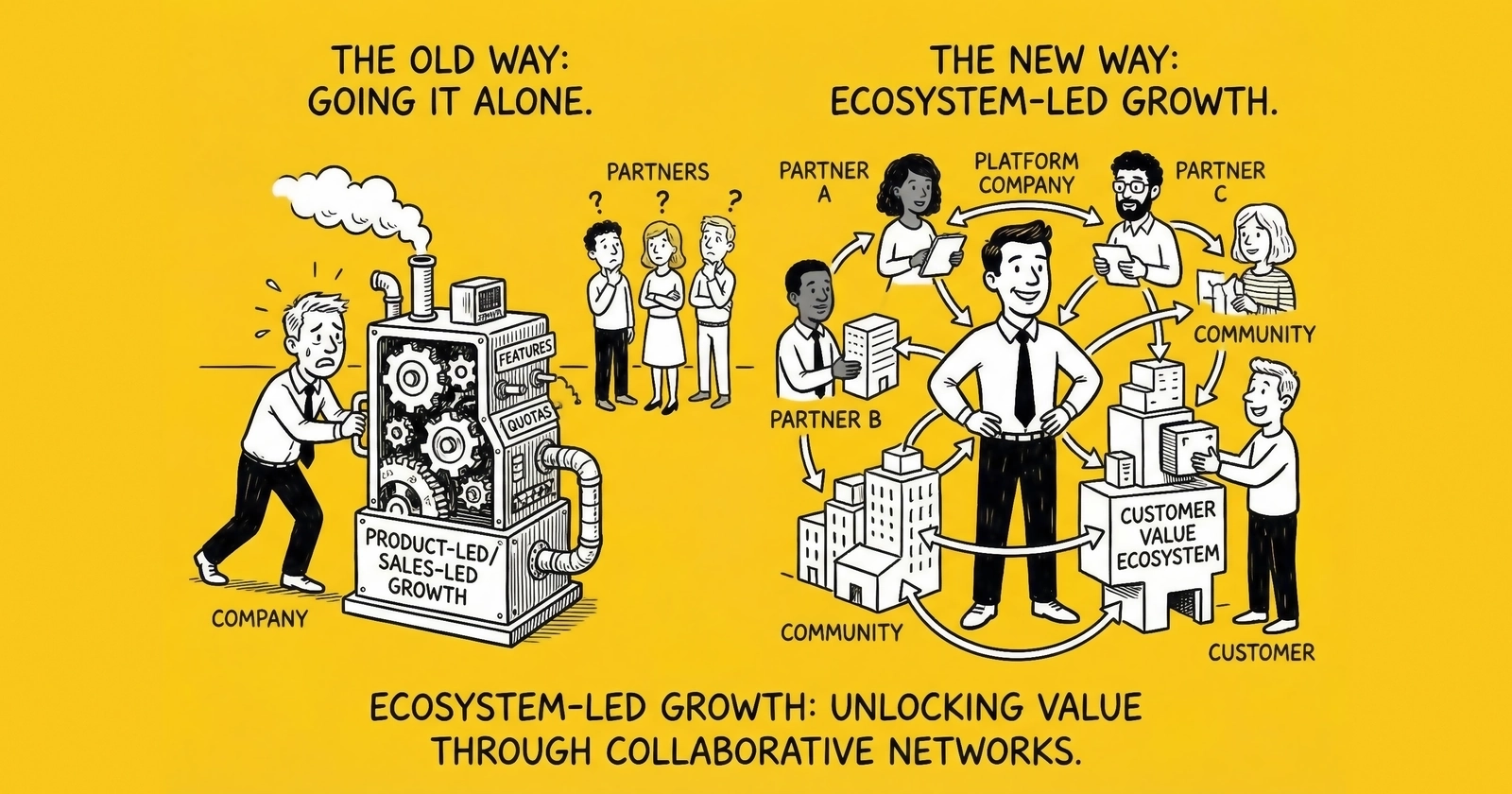
Traditional lead generation is hitting diminishing returns. Cold outreach response rates have fallen to 2-3%. Advertising costs continue rising while signal quality degrades. The companies achieving 40-50% lower customer acquisition costs have discovered a different approach: leveraging partner ecosystems to generate leads through trusted relationships rather than interruption.
The fundamental economics of lead generation are shifting. Customer acquisition costs have increased 222% over the past decade according to Profitwell research. Simultaneously, buyer trust in vendor-direct communications continues eroding – only 3% of B2B buyers trust sales representatives, per the Edelman Trust Barometer.
This creates a paradox. The more companies invest in direct lead generation, the harder and more expensive it becomes. The channels are saturated. The prospects are skeptical. The signals are noisy.
Ecosystem-led growth represents the strategic response. Rather than competing for attention in crowded channels, operators leverage existing trust relationships through partner networks. The insight is simple but powerful: prospects already trust certain vendors, consultants, and advisors. When those trusted parties introduce your solution, you inherit that trust rather than building it from scratch.
This is not a theoretical concept. Crossbeam data from 2024 shows companies with mature ecosystem programs generate 26% of their pipeline through partner sources. HubSpot research indicates partner-sourced deals close 46% faster than cold outreach deals. Forrester projects the ecosystem economy will reach $100 trillion by 2025, representing a fundamental restructuring of how B2B relationships form.
This guide provides the operational playbook for building ecosystem-led lead generation – from partner program architecture to co-marketing execution to referral economics. You will understand how partner ecosystems create sustainable competitive advantage, how to identify and recruit the right partners, how to structure programs that generate consistent lead flow, and how to measure and optimize partner-generated pipeline.
What Is Ecosystem-Led Growth?
Ecosystem-led growth (ELG) is a go-to-market strategy that leverages partner relationships, integrations, and shared customer networks to acquire customers, retain them, and expand revenue. The approach treats your partner ecosystem – technology partners, resellers, consultants, agencies, and complementary vendors – as a primary growth channel rather than a supplementary program.
The concept originated in the technology sector, where integration partnerships became essential to product value. Salesforce’s AppExchange, launched in 2005, pioneered the model by creating a marketplace where third-party developers could build on the Salesforce platform. Today, Salesforce derives significant enterprise value from its ecosystem of 4,000+ app partners and 175,000+ consultants.
But ecosystem-led growth extends far beyond technology platforms. Any business with adjacent relationships can leverage ecosystem dynamics. Insurance agencies partner with mortgage brokers, real estate agents, and financial advisors who serve the same homeowners and families. Solar installers build networks with roofing companies, home improvement contractors, and EV dealers who share the sustainability-minded customer base. Legal practices connect with medical providers, insurance adjusters, and financial planners who encounter clients needing legal counsel. Home service contractors develop referral arrangements with property managers, home inspectors, and real estate professionals who constantly encounter maintenance and repair needs.
The common thread across all these examples: each partner has existing relationships with your target customers. Those relationships carry trust that your direct marketing cannot replicate.
The Nearbound Framework
The most influential framework for ecosystem-led growth comes from Jared Fuller and the Nearbound movement. Fuller distinguishes three relationship categories based on proximity to purchase intent:
- Inbound: Prospects who come to you through content, search, or direct inquiry. These leads found you, which indicates intent but not necessarily urgency or budget.
- Outbound: Prospects you pursue through cold outreach, advertising, or event marketing. These leads did not seek you out, requiring significant effort to establish relevance and trust.
- Nearbound: Prospects introduced or influenced by partners who already have trusted relationships. These leads combine the intent signals of inbound with the targeting precision of outbound, plus the trust inheritance from the introducing partner.
The Nearbound approach recognizes that B2B buyers increasingly rely on trusted networks for vendor evaluation. Gartner research shows that 75% of B2B buyers prefer a rep-free sales experience, yet those same buyers actively seek recommendations from peers and advisors. The disconnect is not about avoiding human interaction – it is about avoiding untrustworthy human interaction.
Partners bridge this trust gap. When a trusted advisor recommends your solution, you bypass the skepticism that kills cold outreach. You enter the conversation as a vetted option rather than an interrupting stranger.
Why Ecosystem-Led Growth Matters for Lead Generation
Traditional lead generation channels face structural headwinds that ecosystem approaches address directly.
The Signal Degradation Problem
Third-party cookie deprecation, ad blockers, and privacy regulations have degraded the targeting precision that made digital advertising effective. Server-side tracking recovers some signal, but the fundamental trend is clear: individual-level targeting is becoming harder and more expensive.
Ecosystem-led growth sidesteps this problem entirely. When partners refer prospects, you receive direct introductions rather than anonymous traffic. The signal is explicit – a named individual with stated interest – rather than inferred from browsing behavior.
The Trust Deficit
Edelman’s research shows trust in businesses declining across all categories. Buyers are skeptical of vendor claims, marketing materials, and sales presentations. This skepticism creates friction at every stage of the funnel.
Partner referrals carry embedded trust. The prospect trusts the partner. The partner vouches for you. That trust transfers, reducing the friction that slows cold-sourced deals.
Research from Crossbeam shows partner-influenced deals have 53% higher win rates compared to deals without partner involvement. The trust inheritance is not abstract – it translates directly to pipeline conversion.
The Economics
Partner-generated leads typically cost 40-60% less than paid advertising leads at equivalent quality levels. The math varies by vertical and partnership structure, but the pattern is consistent across industries. You eliminate media spend to acquire the lead entirely. Higher conversion rates reduce wasted sales effort on prospects who never intended to buy. Faster sales cycles reduce carrying costs and accelerate cash flow. Lower return rates follow naturally because partner pre-qualification aligns with genuine buyer needs rather than algorithmic targeting.
For lead generation businesses specifically, partner channels create defensible supply that competitors cannot easily replicate. Any operator can bid on the same keywords. Building partner networks requires relationship investment that compounds over time. Understanding how the lead economy works helps operators identify partnership opportunities within the value chain.
Partner Ecosystem Models for Lead Generation
Partner ecosystems structure differently depending on value exchange, formality, and strategic depth. Understanding these models helps you design programs appropriate to your business and market.
Referral Partnerships
The simplest ecosystem model: partners refer prospects in exchange for commission or reciprocal referrals. No formal integration, no co-branding, just relationship-based introductions.
- Structure: Partners identify prospects who fit your ideal customer profile and make introductions. You pay a referral fee (typically 10-25% of first-year revenue or a fixed amount per qualified lead) when the referral converts.
- Best for: Service businesses, agencies, local operators, and companies with straightforward qualification criteria.
- Example: A mortgage broker pays insurance agents $50 for each qualified home purchase referral that results in a loan application. The insurance agent benefits from the referral fee while maintaining their client relationship. The mortgage broker acquires leads with explicit intent and trusted introduction.
- Economics: Referral programs typically achieve 15-30% of total lead volume for mature programs. Cost per acquisition runs 30-50% below paid advertising for similar quality leads. The constraint is scale – individual referral relationships generate limited volume.
Integration Partnerships
Technology-driven partnerships where your product integrates with partner products to create combined value. Integration partners share leads because successful mutual customers benefit both parties.
- Structure: You build technical integrations with complementary products. Partners promote the integration to their customer base. Leads flow through co-marketing activities, integration marketplaces, and joint sales motions.
- Best for: Software companies, technology platforms, and businesses where product connectivity creates value.
- Example: A lead distribution platform integrates with major CRMs (Salesforce, HubSpot, Zoho). The CRM partners promote the integration to their users who need lead management capabilities. The lead platform gains visibility and qualified prospects from the CRM’s customer base.
- Economics: Integration partnerships generate 20-40% of enterprise software pipeline according to Crossbeam data. The leads are pre-qualified by technology fit and typically convert at 2-3x cold outreach rates. Investment in integration development creates lasting moat – competitors must build similar integrations to compete.
Channel Partnerships
Formalized reseller relationships where partners sell your product or service under their own brand or as a bundle with their offerings.
- Structure: Partners receive training, sales materials, and pricing that enables them to sell your offering. Revenue splits vary from 15% to 50% depending on partner effort and value-add. Partners may white-label your product or position it as a complementary service.
- Best for: Scalable products, geographic expansion, and reaching markets where you lack direct presence.
- Example: A national lead generation company partners with regional marketing agencies. The agencies sell lead generation services to their local clients using the national company’s infrastructure. The national company provides leads, technology, and fulfillment. The agency provides sales, relationships, and local market knowledge.
- Economics: Channel partnerships trade margin for scale and market access. A 30% channel commission means lower per-lead margin, but enables reaching markets too small for direct sales investment. Mature channel programs generate 30-60% of revenue for companies designed around this model. For practitioners evaluating these arrangements, understanding lead gen revenue share vs fixed fee partnerships helps structure deals appropriately.
Co-Marketing Partnerships
Partners collaborate on marketing activities to generate leads that benefit both parties. Neither partner “owns” the lead – both have rights to work the opportunity.
- Structure: Partners jointly create content, host webinars, produce events, or run campaigns that attract their combined audiences. Leads enter both partners’ pipelines with shared data. Each partner works the leads according to their sales process, often with coordination to avoid conflicting outreach.
- Best for: Non-competing businesses with overlapping audiences, thought leadership positioning, and brand-building campaigns.
- Example: A solar lead generation company partners with a home battery manufacturer. Together they produce educational content about energy independence, host webinars on home electrification, and run joint advertising campaigns. Leads interested in solar also learn about batteries; leads interested in batteries also learn about solar. Both companies nurture the combined audience.
- Economics: Co-marketing reduces individual marketing costs by 40-60% while reaching combined audiences. Lead volume increases because partners amplify each other’s reach. The limitation is lead quality variance – co-marketing attracts broader audiences that require more qualification.
Marketplace Models
Platforms that aggregate multiple vendors and facilitate transactions between buyers and sellers. Marketplace participants benefit from shared traffic and trust.
- Structure: The marketplace operator builds audience and transaction infrastructure. Participating vendors pay listing fees, transaction fees, or both. Leads flow to vendors based on buyer selection, matching algorithms, or auction dynamics.
- Best for: Fragmented markets with many providers, commodity services where comparison drives decisions, and industries with complex buyer journeys.
- Example: Insurance comparison marketplaces (Policygenius, The Zebra, SelectQuote) aggregate carrier offerings and generate leads through consumer comparison shopping. Carriers and agencies participate because the marketplace aggregates demand more efficiently than individual marketing efforts.
- Economics: Marketplace participation trades margin for volume and reduced customer acquisition effort. Vendors typically pay 15-40% of transaction value for marketplace-sourced leads. The best performers optimize their marketplace presence and bidding strategies rather than fighting the model.
Strategic Alliances
Deep partnerships involving shared strategy, joint investment, and aligned incentives over multi-year horizons. Strategic alliances go beyond transactional lead exchange to genuine business collaboration.
- Structure: Partners formalize the relationship through contracts, governance structures, and joint planning processes. Resources flow both directions – investment, personnel, technology, and market access. Success metrics are shared rather than siloed.
- Best for: Market entry, category creation, and building defensible competitive positions that neither partner could achieve alone.
- Example: A mortgage lender and a real estate technology company form a strategic alliance. The technology company integrates lending options into its platform, creating seamless home buying experiences. The lender gains embedded distribution and consumer data. Both partners invest in product development and share in outcomes through revenue sharing and equity arrangements.
- Economics: Strategic alliances require substantial investment before generating returns. The payoff is competitive advantage that compounds over years rather than immediate lead volume. Companies with successful strategic alliances often achieve 2-3x valuation multiples because the partnerships create defensible market positions.
Building Your Partner Ecosystem
Understanding models is the starting point. Execution requires systematic approach to partner identification, recruitment, enablement, and management.
Partner Identification
Not every potential partner is worth pursuing. Effective ecosystem-led growth requires focus on partners who can genuinely contribute to your pipeline.
Ideal partner profile development:
Start with your best customers. What other vendors do they use? What consultants do they employ? What associations do they belong to? These adjacent relationships represent your highest-probability partners because they already serve your target market.
Analyze your competition. Who do competitors partner with? Partner gaps – vendors your competitors work with but you do not – represent opportunities. Partner overlaps require differentiation to win mindshare.
Map the customer journey. Before buying from you, what decisions does your customer make? What problems do they solve? Each upstream decision involves vendors who could refer you. Each downstream decision involves vendors you could refer to, creating reciprocal obligation.
Partner Scoring Criteria
Evaluate potential partners across five dimensions. Market overlap measures what percentage of their customer base matches your ideal customer profile – the higher the overlap, the more relevant their referrals will be. Trust level assesses how much their customers trust their recommendations, which determines how much of that trust transfers to you. Activation potential predicts how likely they are to actively refer rather than passively list your partnership on their website. Strategic fit considers whether partnership advances both parties’ long-term goals beyond immediate transactions. Competitive dynamics examines whether they already partner with your competitors, which may limit their willingness or ability to prioritize your relationship.
Quantify these criteria and score potential partners. Concentrate initial effort on high-scoring partners rather than pursuing breadth prematurely.
Partner Recruitment
Partners receive dozens of partnership inquiries monthly. Most go nowhere. Standing out requires demonstrating clear value and reducing friction to engagement.
The Value Proposition
Lead with what you offer, not what you want. Partners will refer leads if they believe doing so benefits their customers and their business. Your recruitment pitch must answer four fundamental questions. How does partnership help their customers solve problems or achieve goals? How does partnership help their business through revenue, retention, or reputation enhancement? What investment does partnership require from them in terms of time, training, and ongoing effort? What evidence – case studies, testimonials, data – supports your claims about partnership outcomes?
Recruitment Channels
The most effective partner recruitment combines multiple approaches. Direct outreach establishes personal connection to decision-makers, often through mutual relationships cultivated at industry events. Inbound partner marketing creates content and programs that attract partners actively seeking partnership opportunities in your space. Customer introductions leverage your existing relationships – satisfied customers often introduce you to their other vendors enthusiastically. Industry communities including association events, conferences, and online forums gather potential partners who are already engaged in business development.
The First Conversation
Discovery before pitch. Understand the potential partner’s business, their customer challenges, and their current approach to partnerships. Only then position how you can help.
Propose a limited pilot rather than full commitment. “Let’s test with 10 referrals and see how they convert” is easier to agree to than “Let’s sign a comprehensive partnership agreement.”
Partner Enablement
Partners will not actively refer if doing so requires significant effort. Enablement reduces friction between partner intent and partner action.
Essential Enablement Materials
Every partner program needs a core set of materials that make referrals effortless. The one-pager provides a clear explanation of your offering, ideal customer profile, and partnership mechanics in a format partners can share with prospects directly. The referral process documentation specifies exactly how to refer – whether through a form, email, direct introduction, or portal – along with response time commitments so partners know when to expect follow-up. Compensation clarity removes ambiguity about precisely what partners earn, when they earn it, and how they get paid. Objection handling guides address common questions their customers ask and provide effective answers. Success stories demonstrate examples of referred customers who achieved positive outcomes, giving partners confidence in making recommendations.
Training Approaches
Different partners learn differently, so effective programs offer multiple training modalities. Self-service resources including recorded videos, documentation, and FAQs serve partners who prefer learning independently on their own schedule. Live training through webinars or in-person sessions works better for partners who need interaction and the ability to ask questions. Embedded support with dedicated partner managers serves strategic partners requiring hands-on assistance and regular guidance.
Communication Cadence
Partners forget about you without regular contact. Monthly newsletters, quarterly business reviews, and annual planning sessions maintain mindshare and surface issues before they become problems.
Partner Management
Ongoing management determines whether partnerships generate sustained value or fade after initial enthusiasm.
Tracking and Attribution
Every partner-sourced lead requires clear attribution. Use unique tracking links, referral codes, or portal submissions that tie leads to specific partners. Attribution disputes destroy partnerships faster than almost any other issue.
Performance Visibility
Partners need to see their impact. Dashboards showing referral volume, conversion rates, and earnings maintain engagement. Lack of visibility creates suspicion that you are under-reporting or under-paying.
Tiered Structures
Not all partners deserve equal investment. Tiered programs (Bronze/Silver/Gold or similar) allocate resources based on partner contribution. Top performers receive more attention, better economics, and exclusive opportunities. Lower performers receive automated support until they demonstrate commitment.
Tier 1 (Strategic) partners generate 20+ referrals monthly and receive dedicated partner manager attention, the highest commission rates, and executive alignment on joint planning. Tier 2 (Developing) partners deliver 5-20 referrals monthly and receive quarterly business reviews, standard commission rates, and proactive support from the partnership team. Tier 3 (Baseline) partners contribute 1-5 referrals monthly and receive automated communications, standard commission rates, and reactive support when they reach out.
Governance and Escalation
Establish clear processes for resolving disputes, handling customer complaints, and managing competitive conflicts. Written agreements should specify exclusive vs. non-exclusive terms, minimum performance requirements, and termination conditions.
Co-Marketing Execution
Co-marketing with partners extends reach while sharing costs. Effective execution requires alignment on goals, audiences, and execution responsibilities.
Content Collaboration
Joint content creates value neither partner could produce alone. The key is identifying topics where combined expertise exceeds individual capability.
Content Types That Work
The most effective co-marketing content combines partner capabilities in ways neither could achieve alone. Benchmark reports combine data from both partners to create unique insights unavailable elsewhere. Solution guides address problems requiring both partners’ solutions, demonstrating integrated value. Case studies document mutual customer success with attributable results that prove the partnership works. Webinars feature panel discussions with expertise from multiple perspectives, creating richer conversations. Podcast episodes through guest appearances on each other’s shows expose both audiences to new voices and ideas.
Collaboration Process
Successful content collaboration follows a structured process. Begin with scope agreement covering what content you will create, the timeline for completion, and the promotion commitment from each partner. Establish contribution division specifying who provides what expertise, data, and production resources. Define the review process to ensure drafts get approved without endless revision cycles. Set promotion obligations with minimum distribution requirements for each partner. Clarify lead handling to determine how registrants and responders get shared and followed up.
Common Failures
Content collaborations fail in predictable ways. Unequal effort occurs when one partner does the work while both take credit, breeding resentment. Promotion imbalance happens when one partner’s audience never sees the content because they failed to distribute it. Lead hoarding emerges when one partner captures registrations without sharing the data as agreed. Quality variance results when rushed content damages both brands because neither took ownership.
Prevent these failures through explicit agreements and accountability mechanisms before launching joint content.
Joint Events
Events – virtual and in-person – generate concentrated lead flow and relationship acceleration. Partner events share costs and combine audiences for greater impact.
Event Formats
Different event formats serve different purposes and require different investment levels. Webinars offer the lowest investment with the widest reach, though engagement depth remains moderate. Workshops require higher investment but attract skilled audiences and generate strong engagement with excellent qualification. Roundtables convene executive audiences for relationship-focused discussions that produce high-value lead generation. Conferences demand major investment but deliver broad reach with combined brand building and lead generation. Field events target local markets with high-touch experiences that strengthen partner relationships while generating geographically concentrated leads.
Joint Event Mechanics
Successful joint events require clear agreements on four critical questions. Registration ownership determines whose form captures signups, whose branding appears, and whose database receives the data. Cost sharing specifies how production, promotion, and logistics expenses get split between partners. Lead distribution clarifies whether all registrants go to both partners or whether they get qualified and assigned based on fit. Follow-up coordination establishes who contacts leads, when the outreach happens, and what messaging each partner uses.
Success Measurement
Measure joint event performance across multiple dimensions. Track registrations and attendance rates to understand audience interest and show-up behavior. Score lead quality for attendees to assess whether the event attracted your ideal customer profile. Count sales-accepted leads generated to measure immediate sales impact. Monitor pipeline created within 90 days to capture the full revenue effect. Survey partner satisfaction with event execution to maintain relationship health.
Track these metrics by event type and partner to identify high-performing combinations worth repeating.
Integrated Campaigns
Multi-channel campaigns with coordinated messaging across partners create surround-sound effect on target accounts.
Campaign Structure
Effective integrated campaigns follow a five-step planning process. Target alignment ensures both partners agree on the accounts or segments to pursue together. Message coordination aligns positioning so partners reinforce rather than contradict each other. Channel assignment determines which partner covers which channels based on strengths and audience presence. Timing synchronization schedules when each element deploys to create momentum rather than confusion. The attribution framework establishes how influenced pipeline gets credited so both partners understand their contribution.
Example Integrated Campaign
Consider how a lead distribution platform and a CRM partner might run an integrated campaign targeting insurance agencies. In weeks one and two, both partners publish a joint blog post on lead management best practices through their content marketing channels. Week three features a CRM partner webinar with the lead distribution platform appearing as a guest presenter. Weeks four and five activate targeted LinkedIn ads from both partners pointing to a joint landing page. Week six brings a joint case study release with co-branded promotion across both audiences. Weeks seven and eight deploy SDR outreach from both partners to registrants who engaged but have not yet converted.
Each touch reinforces the other. Prospects receive consistent messaging from trusted sources, accelerating awareness and consideration.
Referral Program Design
Structured referral programs systematize partner-generated lead flow. Design choices significantly impact program performance.
Commission Structures
- Percentage of revenue: Partners receive a percentage of first-year revenue (or lifetime value) for referred customers. Common ranges: 10-30% of first-year revenue. Advantages: Aligns partner incentive with customer value. Higher-value referrals earn more, encouraging quality focus. Disadvantages: Complex to calculate. Delayed payment until customer pays. Disputes over customer attribution.
- Fixed fee per lead: Partners receive a fixed amount per qualified lead or per converted customer. Common ranges: $25-500 per lead, $200-5,000 per customer, depending on vertical. Advantages: Simple to understand. Immediate payment upon qualification. Predictable partner economics. Disadvantages: Does not differentiate lead quality. May encourage volume over value. Requires careful qualification criteria.
- Tiered structures: Commission rates increase with volume. Partners referring 1-10 leads monthly earn 15%; 11-25 earn 20%; 26+ earn 25%. Advantages: Rewards commitment. Creates goals for partners to pursue. Concentrates effort among serious partners. Disadvantages: Complexity. May discourage casual referrers who will never reach higher tiers.
- Hybrid models: Combine elements: fixed fee per qualified lead plus percentage of closed revenue. First referral earns $100; if it closes, partner earns additional 10% of contract value. Advantages: Immediate reward plus upside. Balances volume and quality incentives. Disadvantages: Tracking complexity. Requires robust attribution and payment systems.
Qualification Criteria
Clear qualification criteria prevent disputes and align partner effort with valuable leads.
Minimum Viable Qualification
At a minimum, qualified referrals should meet four criteria. Contact information must be valid – the phone answers, the email delivers. The prospect must match ICP criteria including industry, company size, and geography. The prospect should have expressed genuine interest rather than being submitted without their knowledge. There should be no existing relationship with your sales team to avoid double-counting.
Enhanced Qualification
For higher-value deals, require additional qualification elements. Budget should be confirmed or at least estimated within your target range. Timeline should be identified so you know when the prospect intends to make a decision. Decision-making authority should be verified to ensure you are talking to someone who can actually buy. Specific needs should be articulated so your sales team can prepare relevant conversations.
Higher qualification requirements reduce volume but increase conversion rates. Match qualification level to your sales capacity and deal size. High-volume, lower-value businesses accept lighter qualification. Low-volume, higher-value businesses require heavier qualification.
Technology Infrastructure
Scalable referral programs require technology for tracking, attribution, and payment.
Essential Capabilities
Five capabilities form the foundation of partner program technology. The partner portal serves as the hub where partners register, access materials, submit referrals, and view their performance metrics. Referral tracking through unique links, codes, or forms attributes leads to specific partners without ambiguity. CRM integration syncs referral data with your sales process for accurate conversion tracking through the entire funnel. Payment automation calculates and distributes commissions based on defined rules without manual intervention. Reporting provides dashboards for both partners and internal teams showing program performance and trends.
Technology Options
Three categories of solutions serve different program needs. Dedicated platforms like PartnerStack, Impact, and FirstPromoter are purpose-built for partner programs with full-featured capabilities out of the box. CRM extensions including HubSpot Partner Program and Salesforce PRM integrate with existing sales infrastructure, reducing complexity for teams already invested in those ecosystems. Custom builds through internal development address specific requirements with higher initial investment but maximum flexibility for unique business models.
Choose based on program scale and complexity. Small programs with under 50 partners and fewer than 100 monthly referrals can operate with spreadsheets and manual processes. Larger programs require automation to function efficiently.
Program Launch and Growth
Launch Sequence
Successful partner programs follow a staged launch process. The pilot phase engages 5-10 committed partners to test program mechanics and identify friction points. The iteration phase fixes issues identified during pilot before broader launch damages relationships with new partners. Expansion recruits additional partners using the proven program and success stories from pilot participants. Scaling adds technology, automation, and management resources as volume grows beyond what manual processes can handle. Optimization analyzes performance data continuously to improve conversion rates and partner satisfaction.
Growth Tactics
Once the program proves itself, several tactics accelerate partner acquisition. Partner referrals leverage your existing relationships by asking successful partners to introduce you to similar businesses in their network. A public program makes partnership application available on your website for inbound interest. Industry presence through conference speaking, content publishing, and community participation establishes credibility where potential partners gather. Acquisition of smaller companies whose partner relationships complement yours can rapidly expand the ecosystem, though integration requires careful attention.
Marketplace Strategies
Marketplaces aggregate demand and distribute leads to participating vendors. Strategic marketplace participation requires understanding platform dynamics and optimizing within their constraints.
Selecting Marketplaces
Not all marketplaces suit all businesses. Evaluate platforms based on:
- Audience fit: Does the marketplace attract your target customers? Review marketplace traffic sources, user demographics, and published case studies.
- Economic model: How does the marketplace charge? Per-lead, per-transaction, listing fee, or hybrid? Calculate effective cost per acquisition under realistic scenarios.
- Competition intensity: Who else participates? Crowded marketplaces with dominant players offer limited opportunity for new entrants.
- Differentiation potential: Can you stand out? Some marketplaces commoditize vendors; others enable differentiation through reviews, profiles, or featured placement.
- Control retained: What happens to the customer relationship? Some marketplaces intermediate all communication; others provide direct contact.
Marketplace Optimization
Once participating, optimize performance through strategic positioning and operational excellence.
Profile Optimization
Maximize your marketplace presence through systematic profile management. Complete all profile fields because partial profiles signal lack of commitment. Use high-quality visuals that differentiate you from competitors using stock photos. Gather and respond to reviews, as social proof dramatically influences selection. Update content regularly to demonstrate active engagement. Highlight the differentiators that the platform surfaces prominently in search results and comparisons.
Bidding Strategy
For auction-based marketplaces, strategic bidding determines profitability. Analyze historical win rates at various bid levels to understand the competitive landscape. Calculate your maximum profitable bid based on conversion rates and customer lifetime value. Implement dayparting to bid higher during high-intent periods when lead quality justifies premium pricing. Monitor competitive bids and adjust your strategy as the market evolves. Build models predicting lead quality based on available signals to inform bid amounts dynamically.
Response Excellence
Marketplace leads compare vendors simultaneously, so speed and quality of response determine who wins. Respond within minutes, not hours – the first responder captures 35-50% of marketplace conversions. Customize each response to the specific inquiry rather than sending generic templates. Provide immediate value through pricing, availability, and clear next steps. Follow up systematically with non-responders because many marketplace leads need multiple touches to convert.
Building Beyond Marketplaces
Marketplace dependence creates vulnerability. Platforms can change economics, add competitors, or decide to compete directly with vendors.
Use marketplace presence as lead generation while building direct channels. Convert marketplace customers to direct relationships through exceptional service and relationship building. Build brand awareness that drives direct inquiries separate from marketplace traffic. Develop referral networks independent of marketplace traffic through the partner strategies described earlier in this guide. Create content that ranks for searches currently captured by marketplaces, gradually reclaiming organic visibility.
The goal: marketplace participation funds current operations while direct channels build future independence.
Measuring Ecosystem Performance
Ecosystem-led growth requires metrics frameworks distinct from traditional marketing measurement.
Partner Program Metrics
Volume Metrics
Track the fundamentals of program activity. Active partners counts those who referred at least one lead in the trailing 90 days – this reveals true engagement versus paper partnerships. Total referrals submitted measures raw program output. Referrals by partner and tier identifies concentration and helps prioritize relationship investment. Referral trend over time shows whether the program is growing, plateauing, or declining.
Quality Metrics
Measure whether partner referrals convert into business. Qualification rate tracks the percentage of referrals meeting minimum criteria, indicating partner understanding of your ICP. Conversion rate measures qualified referrals that become customers, the ultimate quality signal. Average deal size comparison between partner-sourced and other sources reveals whether partners refer larger or smaller opportunities. Return rate for partner-sourced leads indicates whether partner pre-qualification actually improves customer fit.
Efficiency Metrics
Understand the economics of your partner program. Partner acquisition cost calculates marketing and recruitment investment per active partner, showing what it costs to build the network. Cost per partner-sourced lead enables comparison against other channels. Cost per partner-sourced customer provides the ultimate efficiency benchmark. Partner lifetime value aggregates total referrals over partnership duration, justifying long-term relationship investment.
Relationship Metrics
Monitor partnership health beyond transactions. Partner satisfaction scores from periodic surveys reveal relationship strength. Partner churn rate shows what percentage of partners stop referring, indicating program appeal. Time to first referral after onboarding measures enablement effectiveness. Partner responsiveness to communication signals engagement level and relationship priority.
Attribution Challenges
Ecosystem-led growth complicates attribution because multiple parties influence purchase decisions.
Multi-Touch Scenarios
Consider a common scenario: a prospect sees your content, attends a partner webinar, receives a partner referral, and then searches for your company directly before converting. Which source gets credit? Each touchpoint contributed to the outcome, but most attribution systems force a single answer. Understanding multi-touch attribution for lead generation helps navigate these complexities.
Attribution Approaches
Several models address this challenge differently. First touch credits the initial source – in the scenario above, your content gets full credit. Last touch credits the final source before conversion – the direct search receives credit. Partner-weighted attribution credits the partner referral regardless of sequence, recognizing the trust value partners provide. Multi-touch attribution distributes credit across all touchpoints proportionally or based on position. Influenced pipeline tracks partner involvement without requiring exclusive credit, acknowledging contribution without single-source attribution.
Practical Recommendations
For partner compensation, use clear rules partners can understand and verify. First touch or last touch attribution, applied consistently, avoids disputes even if imperfect. Partners need predictability more than theoretical accuracy.
For internal analysis, use multi-touch models to understand true channel contribution. Partner influence is valuable even when not the exclusive source. Separating compensation logic from strategic analysis prevents conflict between operational simplicity and analytical insight.
Reporting Frameworks
Partner-Facing Reports
Provide partners with visibility into their performance through dedicated reporting. Show referrals submitted so partners can verify their contributions are captured. Display current status of each referral so partners understand where opportunities stand in your pipeline. Report conversion outcomes so partners see the results of their efforts. Detail commissions earned and pending so partners can reconcile payments. Include comparison to program benchmarks so partners understand how they perform relative to peers.
Internal Reports
Track program health for leadership and optimization through comprehensive internal reporting. Measure pipeline sourced and influenced by partners to quantify ecosystem contribution. Track partner-sourced revenue and margin to understand profitability. Monitor partner acquisition and activation metrics to evaluate program growth. Calculate program ROI comparing revenue generated against program investment. Build forecasts based on partner trends to inform resource planning.
Report Cadence
Different timeframes serve different purposes. Monthly metrics support operational management and quick course corrections. Quarterly reviews enable strategic assessment and mid-year adjustments. Annual planning guides resource allocation and program evolution for the coming year.
Ecosystem-Led Growth for Different Business Models
Ecosystem strategies vary based on business model, customer type, and market structure.
For Lead Generators/Publishers
Lead generators can leverage ecosystems in two directions:
Upstream Partners (Traffic Sources)
Partner with content creators, influencers, and publishers who reach your target audience. These partners drive traffic to your capture mechanisms in exchange for revenue share or fixed fees. Identify content creators in your vertical whose audiences match your target demographics. Propose revenue share for traffic that converts, aligning partner incentives with your outcomes. Provide tracking links and performance transparency so partners can optimize their efforts. Build relationships with consistent performers through increased rates and priority communication.
Downstream Partners (Lead Buyers)
Your buyers are partners too. Treating buyer relationships as partnerships rather than transactions creates mutual investment in quality and volume. Share performance data that helps buyers optimize their conversion processes. Provide feedback on lead quality issues so buyers understand the full picture. Collaborate on ideal customer profile refinement to improve targeting over time. Build exclusivity arrangements with strategic buyers who demonstrate commitment and strong performance.
For Lead Buyers
Lead buyers can develop ecosystem advantages through three strategic approaches.
Vendor diversification involves partnering with multiple lead sources to reduce concentration risk and create leverage in negotiations. No single source should represent more than 40% of your lead volume, and diverse partnerships ensure continuity when any single source experiences issues.
Vertical expertise networks build relationships with specialists whose expertise improves lead conversion. A mortgage lender partners with real estate education providers, home inspection services, and title companies – each relationship creates referral potential while enhancing the customer experience.
Customer success partnerships connect you with services that help customers succeed post-sale. Happy customers become referral sources themselves. Partnerships that improve customer outcomes create flywheel effects where satisfaction drives referrals that drive more satisfied customers.
For Platforms and Distributors
Lead distribution platforms occupy ecosystem hub positions. Effective ecosystem strategies for platforms leverage this central role in three ways.
Integration breadth means building integrations with CRMs, dialers, marketing automation, and analytics tools that customers already use. Each integration creates switching costs for customers while opening partnership opportunities with the integrated vendors. The more deeply embedded you become in customer workflows, the more defensible your position.
Data partnerships create clean room collaborations that enhance lead quality through shared data without exposure. Partners gain insights they could not access independently; you gain differentiated quality signals that improve matching and pricing. These partnerships compound over time as data assets grow.
Vertical specialization involves partnering with experts who bring deep domain knowledge. A general platform partners with Medicare specialists, solar consultants, and insurance compliance firms to serve specific verticals more effectively than generalist competitors. The platform provides infrastructure; partners provide vertical expertise.
Common Ecosystem Mistakes
Ecosystem-led growth fails when operators repeat predictable mistakes.
Moving Too Fast
- The mistake: Signing dozens of partners before proving the model works.
- Why it fails: Unready operations disappoint early partners, who disengage and spread negative word-of-mouth. The bad reputation makes future recruitment harder.
- The fix: Pilot with 5-10 committed partners. Perfect the process. Only then scale recruiting.
Treating Partners Transactionally
- The mistake: Viewing partners only as lead sources to be maximized.
- Why it fails: Partners sense exploitation and disengage. The relationship becomes extractive rather than generative.
- The fix: Invest in partner success. Share information. Provide value beyond commission payments. Build genuine relationships.
Ignoring Partner Economics
- The mistake: Commission structures that do not compensate partners adequately for their effort and relationship investment.
- Why it fails: Partners prioritize other activities with better returns. Referral volume stagnates.
- The fix: Model partner economics honestly. If referring a lead requires an hour of relationship work, the commission must exceed what partners earn from that hour doing other things.
Over-Complicating Programs
- The mistake: Complex tier structures, qualification rules, and commission calculations that partners cannot understand.
- Why it fails: Confused partners do not participate. Disputes arise from misunderstanding. Administrative burden exceeds value.
- The fix: Start simple. Add complexity only when necessary and when you have systems to manage it.
Neglecting Attribution
- The mistake: Unclear attribution that allows disputes about which partner (or whether any partner) should receive credit.
- Why it fails: Partners lose trust when they believe referrals are miscredited. Disputes consume management time.
- The fix: Implement clear, technology-enforced attribution from day one. When disputes arise – and they will – have documented processes for resolution.
The Future of Ecosystem-Led Growth
Ecosystem approaches will become more important as traditional channels degrade and buyer behavior evolves.
AI Agent Ecosystems
As agentic commerce emerges, AI agents will form their own ecosystems – preferring vendors recommended by trusted agents, building reputation scores visible to other agents, and executing transactions through ecosystem protocols.
Preparing for agent ecosystems requires investment in four areas. Structured data ensures agents can parse your offerings and capabilities programmatically. APIs enable agent interactions without human intermediation for routine transactions. Reputation signals in formats agents recognize and trust become essential for discovery and selection. Ecosystem participation that creates positive agent references positions you favorably as agent-to-agent recommendations become influential.
Data Clean Room Collaborations
Privacy regulations prevent raw data sharing, but clean room technology enables collaborative analytics without exposure. Future ecosystems will form around clean room partnerships where companies combine data assets for shared insights.
Insurance companies and auto dealers share conversion data to optimize joint marketing. Home service providers and real estate platforms match customer data to identify move-related opportunities. These collaborations create ecosystem value inaccessible to non-participants.
Revenue Engine Integration
The linear funnel – marketing generates leads, sales closes leads, success retains customers – is giving way to circular revenue engines. Ecosystem partnerships will integrate across the entire customer lifecycle rather than focusing narrowly on lead generation.
Future ecosystem programs will span the complete customer journey. Partners will influence awareness, consideration, and purchase decisions in the acquisition phase. They will support onboarding and adoption to ensure customers realize value quickly. They will enable expansion and cross-sell by identifying additional needs partners can address together. They will generate advocacy and referral by creating customer experiences worth recommending.
This integration requires ecosystem thinking throughout the organization, not just in marketing and partnerships.
Frequently Asked Questions
1. How does ecosystem-led growth differ from traditional partner programs?
Traditional partner programs focus on reseller relationships where partners sell your product for commission. Ecosystem-led growth expands beyond resale to include co-marketing, technology integration, referral networks, and strategic alliances. The ecosystem approach treats the entire network of adjacent relationships as a growth channel, not just formal reseller agreements.
2. What percentage of pipeline should come from partner sources?
Mature ecosystem programs generate 20-40% of pipeline from partner sources according to Crossbeam benchmarks. Companies with exceptional ecosystem strategies achieve 40-60%. Starting from zero, reasonable milestones are 5% at year one, 15% at year two, and 25% at year three. The right target depends on your market structure and competitive dynamics.
3. How do I identify the right partners to pursue?
Start with your existing customers. What other vendors do they use? What consultants do they employ? Map the customer journey to identify every decision point that precedes or follows your offering. Score potential partners based on market overlap, trust level, activation likelihood, and competitive dynamics. Focus initial effort on high-scoring partners rather than pursuing breadth prematurely.
4. What commission rate should I offer referral partners?
Commission rates vary by industry, deal size, and partner effort required. Common ranges include 10-25% of first-year revenue for recurring revenue businesses, $25-500 per qualified lead for lead generation, and $200-5,000 per closed customer for high-ticket products. The key principle: commission must exceed what partners earn from equivalent effort on other activities.
5. How do I prevent channel conflict between partners and direct sales?
Clear rules, consistently enforced, prevent most conflict. Define account ownership criteria (first touch, geographic, named accounts), establish protected periods after referral submission, and create escalation processes for disputes. Communicate rules to both partners and sales teams. When conflicts arise – and they will – resolve quickly and fairly to maintain trust.
6. What technology do I need to run a partner program?
Small programs (under 50 partners, under 100 monthly referrals) can operate with spreadsheets, manual tracking, and simple web forms. Growing programs benefit from partner relationship management (PRM) software like PartnerStack, Impact, or CRM-integrated solutions. Essential capabilities include partner portal, referral tracking, attribution, and payment automation.
7. How long does it take to see results from ecosystem investments?
Ecosystem-led growth is a compounding strategy, not a quick win. Expect 6-12 months to establish initial partnerships and prove the model. 12-24 months to build meaningful pipeline contribution. 24-36 months to achieve mature program performance. Companies seeking immediate lead volume should invest in paid advertising while building ecosystem foundations in parallel.
8. How do I measure the ROI of ecosystem programs?
Calculate program ROI by comparing partner-sourced revenue (including influenced pipeline) against program investment (partner management costs, commissions, technology, co-marketing). Include efficiency gains from higher conversion rates and shorter sales cycles. Track cost per partner-sourced lead and customer against other channels. Account for strategic value – market access, competitive positioning, customer relationships – that does not appear in immediate revenue.
9. What are the biggest risks of ecosystem-led growth strategies?
Primary risks include partner dependence (over-reliance on partners you cannot control), channel conflict (partners competing with each other or your direct sales), reputation risk (partner actions reflecting on your brand), and execution complexity (managing multiple relationships requires significant resources). Mitigate through diversification, clear agreements, careful partner selection, and appropriate management investment.
10. How do ecosystem strategies work for local businesses?
Local businesses build ecosystems with other local service providers. A roofing contractor partners with gutter installers, solar companies, and home inspectors. A mortgage broker partners with real estate agents, insurance providers, and financial advisors. The mechanics are identical to enterprise ecosystems – identify adjacent relationships, create mutual value, systematize referral processes – but the scale is local rather than national.
Key Takeaways
Ecosystem-led growth leverages partner relationships to generate leads through trusted introductions rather than interruption marketing, achieving 40-60% lower customer acquisition costs and 46% faster sales cycles.
Partner ecosystems span multiple models including referral partnerships, integration partnerships, channel partnerships, co-marketing partnerships, marketplace participation, and strategic alliances – each with distinct economics and execution requirements suited to different business contexts.
The Nearbound framework distinguishes inbound (prospects who find you), outbound (prospects you pursue), and nearbound (prospects introduced by trusted partners) as fundamentally different lead categories with different trust dynamics and conversion patterns.
Effective partner programs require systematic identification, recruitment, enablement, and management – not just signing agreements and hoping for referrals. The operational infrastructure determines whether partnerships generate sustained value.
Commission structures should align partner incentives with your objectives. Fixed fees encourage volume, percentage-of-revenue encourages quality, and tiered structures reward commitment. Hybrid models balance immediate reward with long-term upside.
Co-marketing with partners extends reach while sharing costs, but requires explicit agreements on contribution, promotion obligations, and lead distribution to prevent common failures like unequal effort and lead hoarding.
Marketplace participation provides lead flow but creates platform dependence. Use marketplace presence to fund current operations while building direct channels for future independence.
Measure ecosystem performance through volume metrics (referrals, active partners), quality metrics (conversion, deal size), efficiency metrics (cost per lead and customer), and relationship metrics (partner satisfaction, churn).
Ecosystem strategies vary by business model. Lead generators leverage upstream and downstream partnerships. Buyers develop vendor and expertise networks. Platforms build integration and data ecosystems.
Avoid common mistakes: moving too fast before proving the model, treating partners transactionally, ignoring partner economics, over-complicating programs, and neglecting attribution.
Sources
- Crossbeam - Partner ecosystem data showing 26% pipeline from partners and 53% higher win rates for partner-influenced deals
- HubSpot State of Marketing - Research on partner-sourced deals closing 46% faster than cold outreach
- ProfitWell (Paddle) - CAC research documenting 222% customer acquisition cost increase over the past decade
- Forrester - Ecosystem economy projections reaching $100 trillion by 2025
- Nearbound - The Nearbound framework distinguishing inbound, outbound, and nearbound lead categories
- PartnerStack - Partner relationship management platform and ecosystem growth strategies
- Salesforce State of Sales - B2B buyer preferences and partner channel performance benchmarks
Statistics and frameworks current as of December 2025. Ecosystem dynamics and partnership economics continue to evolve with market conditions and technology changes.