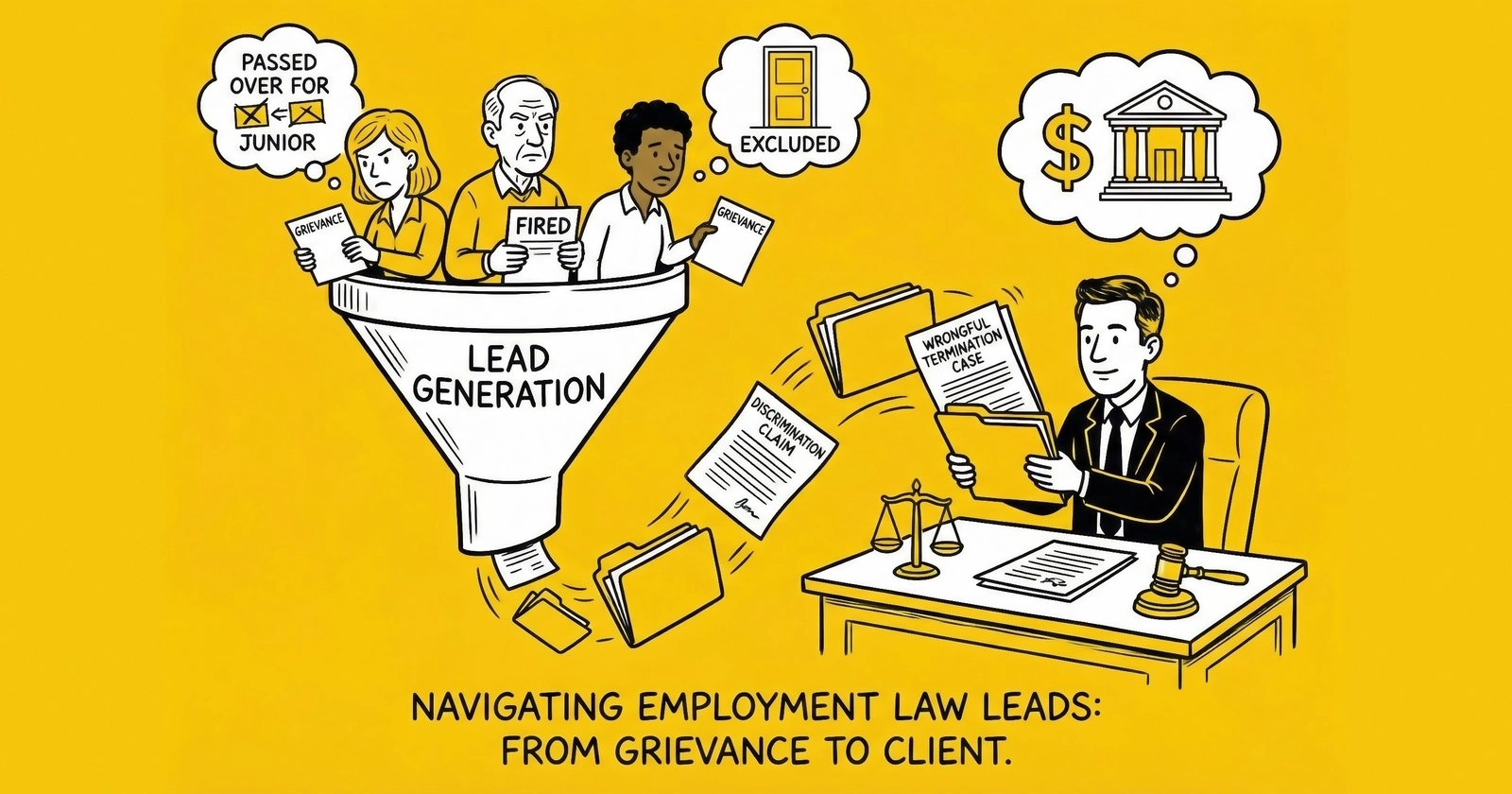
Why employment discrimination and wrongful termination leads represent a massive opportunity, what drives case values, and how to build a compliant operation in a vertical where regulatory complexity meets substantial demand.
Someone just got fired. Maybe they were the only person over 50 in a department that suddenly needed to “restructure.” Maybe they were terminated two weeks after filing a complaint about their supervisor. Maybe they returned from maternity leave to find their position eliminated.
These moments generate high-intent legal searches. And in 2024, the Equal Employment Opportunity Commission received over 81,000 discrimination charges, while private employment litigation filings continue to climb. The demand for employment law leads is driven by a fundamental reality: employees who believe they have been wronged need attorneys, and employment attorneys need clients.
Employment law lead generation occupies a unique position in the legal lead marketplace. The CPLs are lower than personal injury. The case values vary dramatically based on claim type. But the volume is substantial, the demand is consistent, and the barriers to entry are lower than in premium PI verticals. For practitioners seeking a legal vertical with manageable complexity and reliable economics, employment law offers a compelling opportunity.
This guide covers the complete landscape of employment discrimination and wrongful termination lead generation. You will learn the economics that drive buyer demand, the case types that command premium pricing, the compliance requirements that govern operations, and the practical frameworks for building a sustainable business in this space.
Understanding the Employment Law Lead Market
Employment law encompasses claims arising from the employer-employee relationship. For lead generation purposes, the most valuable categories are discrimination claims and wrongful termination. These claims generate significant damages and attorney fees, creating economics that support robust lead acquisition.
The Scope of Employment Litigation
The employment law market is substantial. In fiscal year 2023, the EEOC resolved over 98,000 charges of workplace discrimination and secured $665 million in monetary benefits for victims of discrimination. Private employment litigation adds significantly to these numbers. According to industry data, employment practices liability claims represent one of the fastest-growing areas of business litigation.
The demand drivers are structural. Federal and state anti-discrimination laws cover most employers, creating a broad base of potential claims. Retaliation claims have increased significantly and now represent the largest category of EEOC charges. Remote work disputes have created new friction points around accommodation and termination requests. And the statute of limitations for most claims ranges from 180 days to 4 years, creating ongoing lead inventory that refreshes continuously.
Market Size Indicators
| Metric | Value | Source |
|---|---|---|
| EEOC charges filed (FY 2023) | 81,055 | EEOC Annual Report |
| Monetary benefits obtained (FY 2023) | $665 million | EEOC Annual Report |
| Retaliation claims (% of total) | 55.8% | EEOC Charge Statistics |
| Private employment lawsuits filed | 25,000+ annually | Federal court data |
Why Attorneys Pay for Employment Leads
Employment attorneys operate on multiple fee structures, which affects their lead acquisition economics.
Contingency Fee Cases
Many employment attorneys work on contingency for discrimination and wrongful termination cases, typically taking 33-40% of the recovery. This model creates economics similar to personal injury – attorneys can justify lead acquisition costs based on expected case values.
Hourly and Hybrid Arrangements
Some employment matters, particularly those involving executive disputes or complex discrimination claims, are handled on hourly or hybrid fee arrangements. These cases generate reliable revenue regardless of outcome, making lead acquisition more predictable.
Fee-Shifting Statutes
Federal employment statutes like Title VII, the ADA, and the ADEA include fee-shifting provisions that allow prevailing plaintiffs to recover attorney fees. This means attorneys can recover their fees even on smaller claims where a contingency arrangement would not be economically viable.
The fee-shifting dynamic is significant. An attorney might take a case with $50,000 in damages because the fee-shifting potential could generate $75,000-$150,000 in attorney fees. This expands the range of cases that justify lead acquisition costs.
CPL Benchmarks by Case Type
Employment law leads price differently based on claim type, case strength, and geographic market. Understanding these variations enables accurate budget planning and buyer negotiation.
Discrimination Claims: $75-$300
Discrimination leads encompass claims based on protected characteristics: race, sex, age, disability, national origin, religion, color, and genetic information. Pricing varies by discrimination type and case indicators.
| Discrimination Type | CPL Range | Key Economics |
|---|---|---|
| Race Discrimination | $125-$250 | Strong case values, active enforcement |
| Sex/Gender Discrimination | $125-$275 | Includes pregnancy, LGBTQ+ claims |
| Age Discrimination (ADEA) | $100-$225 | Executive terminations drive value |
| Disability Discrimination (ADA) | $100-$250 | Accommodation failures common |
| Religious Discrimination | $75-$175 | Lower volume, specialized firms |
| National Origin | $100-$200 | Immigration status intersections |
Race discrimination commands strong CPLs due to case values and attorney demand. The combination of Title VII and Section 1981 claims can generate substantial damages including compensatory and punitive damages, with Section 1981 having no damages cap.
Age discrimination under the ADEA often involves executive-level terminations where the displaced employee has significant lost earnings. A $200,000 annual executive terminated at 55 with 10+ years of potential earnings creates substantial damages calculations. These cases justify premium lead acquisition.
Disability discrimination has grown substantially as ADA claims have expanded to include accommodation failures, particularly around mental health conditions and remote work requests. The interactive process requirements create litigation opportunities when employers fail to engage properly.
Sexual Harassment Claims: $150-$350
Sexual harassment leads command premium pricing due to case complexity, media attention potential, and settlement dynamics. The category includes both quid pro quo harassment (explicit exchange of sexual favors for employment benefits) and hostile work environment claims.
| Claim Type | CPL Range | Characteristics |
|---|---|---|
| Hostile Work Environment | $150-$250 | Pattern of behavior required |
| Quid Pro Quo | $200-$350 | Direct evidence often available |
| Executive/C-Suite Perpetrator | $250-$350+ | Higher settlement values |
| Multi-Victim/Pattern | $175-$300 | Class action potential |
Several dynamics affect case value. Severity and duration of harassment matter significantly, as does the availability of documentation and witnesses. The perpetrator’s position plays a major role – cases involving executives or senior managers command higher values. How the employer responded to complaints affects liability and damages. Physical harassment typically generates higher damages than verbal harassment alone.
Sexual harassment cases generate significant media interest, which creates settlement pressure that attorneys factor into case valuation. A case that might attract negative publicity often settles for multiples of what the damages calculation alone would suggest.
Wrongful Termination: $100-$300
Wrongful termination is technically a catch-all category encompassing various legal theories. The pricing reflects the underlying claim type rather than the termination itself.
| Termination Basis | CPL Range | Legal Theory |
|---|---|---|
| Retaliation for Complaint | $125-$275 | Title VII, state whistleblower |
| Retaliation for FMLA Use | $100-$225 | FMLA interference/retaliation |
| Discrimination-Based | $100-$250 | Various anti-discrimination laws |
| Public Policy Violation | $150-$300 | State common law claims |
| Breach of Contract | $75-$200 | Express or implied contracts |
Retaliation claims represent the largest growth area in employment law. The EEOC reports that retaliation claims now constitute 55.8% of all charges filed, up from approximately 22% in the 1990s. This growth reflects both increased awareness and the strong legal protections for employees who report discrimination or participate in investigations.
FMLA claims are attractive because the statute provides clear requirements and damages including back pay, front pay, and liquidated damages (double damages for willful violations). The 12-week leave entitlement creates concrete timelines that make case evaluation straightforward.
Wage and Hour Claims: $50-$150
Wage and hour leads price lower per lead but offer volume and class action potential. The Fair Labor Standards Act and state wage laws create abundant claims inventory.
| Claim Type | CPL Range | Economics |
|---|---|---|
| Unpaid Overtime (Individual) | $50-$100 | Lower per-lead value, volume play |
| Misclassification | $75-$150 | Class action potential |
| Meal/Rest Break Violations | $50-$125 | State law dependent |
| Off-the-Clock Work | $50-$100 | Healthcare, retail common |
| Tip Pool Violations | $50-$125 | Restaurant industry focus |
The economics of wage claims differ from discrimination cases. Individual claims may involve only a few thousand dollars in unpaid wages. But the FLSA provides for liquidated damages (double damages) and attorney fee recovery, making even small claims economically viable.
Class action potential is the key value driver. A lead that reveals a systemic violation affecting hundreds or thousands of employees becomes worth far more than the individual claim. Sophisticated employment attorneys screen wage claims specifically for class potential.
Case Values and Economics
Understanding case economics explains buyer behavior and enables realistic pricing discussions. Employment case values vary dramatically based on claim type, damages calculation, and jurisdictional factors.
Damages Components
Employment cases can include multiple damages categories.
Back Pay
Back pay covers lost wages from termination to judgment or settlement. For a $75,000 employee terminated and out of work for two years, back pay alone reaches $150,000.
Front Pay
Front pay compensates future lost earnings when reinstatement is not feasible. Courts may award front pay for the time an employee would have remained with the employer. For senior employees, this can represent years of earnings.
Compensatory Damages
Compensatory damages cover emotional distress, mental anguish, and other non-economic damages. Title VII and the ADA cap compensatory and punitive damages based on employer size:
| Employer Size | Damages Cap (Combined Compensatory + Punitive) |
|---|---|
| 15-100 employees | $50,000 |
| 101-200 employees | $100,000 |
| 201-500 employees | $200,000 |
| 500+ employees | $300,000 |
Punitive Damages
Punitive damages are available when the employer acted with malice or reckless indifference. They are subject to the same caps as compensatory damages under Title VII and ADA.
Attorney Fees
Fee-shifting provisions allow prevailing plaintiffs to recover reasonable attorney fees. In complex cases, fee awards can exceed the underlying damages. This makes otherwise marginal cases economically viable for attorneys.
Section 1981 Exception
Race and ethnicity claims brought under Section 1981 (rather than Title VII) have no damages caps. This creates significantly higher case values for race discrimination claims against large employers.
Settlement Ranges by Case Type
Settlement values vary based on multiple factors. These ranges represent typical outcomes, not extremes:
| Case Type | Median Settlement | 75th Percentile | Key Drivers |
|---|---|---|---|
| Sexual Harassment | $50,000-$75,000 | $150,000-$250,000 | Severity, documentation |
| Race Discrimination | $75,000-$100,000 | $175,000-$300,000 | Section 1981 availability |
| Age Discrimination | $50,000-$75,000 | $125,000-$200,000 | Lost earnings calculation |
| Disability Discrimination | $40,000-$60,000 | $100,000-$175,000 | Accommodation evidence |
| Retaliation | $50,000-$75,000 | $150,000-$275,000 | Causal connection strength |
| FMLA Violation | $25,000-$50,000 | $75,000-$125,000 | Willfulness determination |
What Drives Value Up
Several factors push settlements higher. Clear documentation of discriminatory intent provides direct evidence that strengthens cases substantially. Witnesses to discriminatory statements corroborate the plaintiff’s account. Pattern evidence showing the discrimination happened to others creates systemic liability concerns. When employers failed to investigate complaints, that failure becomes additional evidence of indifference. High-earning plaintiffs with long careers ahead generate larger damages calculations. Large employers face higher damages caps and have deeper pockets. And Section 1981 availability for race claims removes caps entirely.
What Drives Value Down
Conversely, several factors compress settlement values. Small employers face lower statutory caps and may simply lack the ability to pay large judgments. Short tenure with the employer limits the damages calculation. Performance issues documented in the employee’s file provide the employer with legitimate, non-discriminatory justifications. Minimal emotional distress documentation reduces compensatory damages. And weak causal connections between protected activity and adverse action make the case harder to prove.
The Economics for Lead Buyers
Contingency employment attorneys typically take 33-40% of settlements. On a $100,000 settlement with fee recovery, the attorney might receive $40,000 plus $25,000 in fees – $65,000 total recovery.
At a 15% lead-to-case conversion rate and 60% case success rate, each lead needs to generate approximately $10,000 in expected attorney revenue to justify a $200 CPL. The math works: 100 leads at $200 represents a $20,000 investment. Those 100 leads convert to 15 signed cases at the 15% rate. At 60% success, 9 of those cases achieve successful outcomes. With an average attorney recovery of $50,000 per win, total recovery reaches $450,000 – a 22.5x return on the lead investment.
This explains why employment attorneys pay $100-$300 for quality leads. The conversion funnel and settlement economics support the acquisition costs.
Building a Compliant Operation
Employment law lead generation faces fewer regulatory barriers than personal injury but still requires attention to advertising rules, consent requirements, and state-specific regulations.
Attorney Advertising Rules Apply
Lead generators operating in the legal space must understand that attorney advertising rules extend to those who advertise on behalf of attorneys.
State bar rules require truthfulness in all claims. Avoid promises about outcomes, guarantees about case acceptance, or exaggerated claims about potential recovery. “You may be entitled to compensation” is acceptable. “Win $100,000+ for your wrongful termination” is not.
Many states also mandate specific disclosures. Some require “ADVERTISEMENT” labeling. Others require identification of the attorney or firm responsible for the advertisement. Know the requirements in your target jurisdictions.
The advertising versus solicitation distinction applies in employment law as in personal injury, though the practical implications differ. Employment law leads typically come from individuals actively searching for legal help, not from targeting identified individuals – this generally qualifies as advertising, not solicitation.
TCPA and Consent Requirements
Employment lead generation faces the same TCPA requirements as other verticals.
For automated calls or texts to cell phones, you need Prior Express Written Consent (PEWC) meeting specific regulatory requirements. Though the FCC’s one-to-one consent rule was vacated by the Eleventh Circuit in January 2025, many sophisticated lead buyers still require consent that specifies the particular seller who will contact the consumer. Consent language must be clearly disclosed, not buried in fine print or lengthy terms of service.
Documentation matters as much as the consent itself. Maintain consent records including the language presented, timestamp, IP address, and lead source. Third-party consent verification services like TrustedForm and Jornaya provide additional protection against claims that consent was never actually obtained.
State-Specific Considerations
Some states have additional requirements affecting lead generation.
The California Consumer Privacy Act (CCPA) grants California residents rights regarding their personal information. Lead generators collecting California resident data must provide required disclosures and honor opt-out requests.
Several states have enacted mini-TCPA laws with telemarketing restrictions that exceed federal requirements. Florida, Washington, and Oklahoma have particularly notable state-level rules. Know the requirements in states where you generate leads.
State bar advertising rules add another layer. If you generate leads for attorneys in multiple states, you may need to comply with multiple sets of advertising rules. Texas, California, Florida, and New York have particularly detailed requirements that go beyond the baseline.
Traffic Acquisition Strategies
Employment law leads come from multiple traffic sources, each with different economics and quality characteristics.
Paid Search: The Primary Channel
Google Ads generates the majority of employment law leads for most practitioners. The keywords are competitive but not at personal injury levels.
Keyword Categories and Typical CPCs
| Category | Example Keywords | CPC Range |
|---|---|---|
| Discrimination | ”discrimination lawyer,” “race discrimination attorney” | $15-$45 |
| Wrongful Termination | ”wrongful termination lawyer,” “fired illegally” | $25-$60 |
| Sexual Harassment | ”sexual harassment attorney,” “harassment at work lawyer” | $30-$75 |
| Retaliation | ”retaliation lawyer,” “whistleblower attorney” | $20-$50 |
| Wage Claims | ”unpaid overtime lawyer,” “wage claim attorney” | $10-$35 |
Targeting Considerations
Geographic targeting should align with buyer coverage since employment attorneys typically serve specific metro areas or states. Device targeting may skew mobile for “just fired” searches but desktop for more researched decisions. Time-of-day patterns show spikes after business hours when employees can search privately without coworker observation. Day-of-week patterns reveal Monday spikes as employees reflect on work problems over the weekend, and Friday spikes from end-of-week terminations.
Content Marketing and SEO
Employment law topics generate significant organic search volume. Content strategies work because employees research their rights before consulting attorneys. Searches like “can my employer fire me for…” generate millions of monthly queries. State-specific employment law content attracts geographically targeted traffic that aligns with attorney coverage areas. FAQ content captures long-tail search volume from employees trying to understand their situations.
Effective content topics include state-specific wrongful termination guides, articles about recognizing signs of workplace discrimination, step-by-step guides for what to do if you are fired, explainers on understanding FMLA rights, practical advice on how to document workplace harassment, and statute of limitations guides organized by state.
Content marketing requires longer timeframes to generate returns but produces leads at significantly lower cost than paid search once established.
Social Media Advertising
Facebook and LinkedIn offer targeting capabilities useful for employment leads.
Facebook provides job title targeting for professional-level claims, interest targeting for workplace issues, lookalike audiences built from converted leads, and the ability to run video ads explaining employee rights.
LinkedIn offers industry and company size targeting, seniority level targeting for executive-level claims, and the ability to identify employment status changes as trigger signals.
Social platforms typically generate higher volume at lower CPLs but with lower conversion rates than search. The intent signal is weaker – someone scrolling Facebook is not actively seeking an attorney.
Referral and Partnership Channels
Established employment attorneys often receive referrals from other attorneys, HR professionals, and counselors. Lead generators can access similar channels through partnerships with HR consultants who encounter wrongful termination situations, referral arrangements with attorneys in other practice areas, union relationships for workplace claims, and connections to employee assistance programs.
These channels require relationship investment but generate high-quality leads at low marginal cost.
Qualification Requirements
Employment law buyers have specific qualification requirements. Meeting these requirements enables premium pricing and reduces return rates.
Essential Data Points
Incident Information
Capture the date of termination or adverse action to screen for statute of limitations issues. Record the employer name and approximate size, which determines damages caps and ability to pay. Document the employee’s position and tenure for damages calculations. Note the state of employment to determine applicable law. And capture the reason given for termination, which becomes potential pretext evidence.
Protected Characteristic Information
For discrimination claims, identify the specific discrimination type – race, age, sex, disability, or other protected category. For retaliation claims, document the timing of the protected activity. Explore whether comparator evidence exists, meaning someone outside the protected class was treated differently in similar circumstances. And capture any statements or comments made that could serve as direct evidence of discriminatory intent.
Documentation Status
Assess what documentation the lead has available. Written warnings or performance reviews may help or hurt the case. Complaint history through internal HR provides crucial evidence of notice to the employer. Whether an EEOC charge has been filed matters – some attorneys prefer post-charge leads while others want to control the filing process. Communication with the employer through emails and texts often contains key evidence. And witness availability can make or break a case.
Legal Status
Screen for leads already represented by an attorney, which disqualifies them from contact. Note whether an EEOC charge has been filed and whether a response has been received. And determine if a right-to-sue letter has been received, as some attorneys require this before taking a case.
Disqualifying Factors
Screen for common disqualifiers before delivery.
Already Represented
Leads who already have employment attorneys cannot be contacted. Confirm representation status before delivery.
Statute of Limitations Expired
Employment claims have varying deadlines. Title VII requires filing an EEOC charge within 180-300 days depending on the state. ADEA claims follow the same 180-300 day framework. Section 1981 race claims have a 4-year statute. State claims typically range from 1-3 years. FMLA claims must be filed within 2 years, or 3 years for willful violations.
At-Will Employment Without Exception
Many employees believe any unfair termination is wrongful. In reality, at-will employment allows termination for any reason not specifically prohibited. Leads where no protected characteristic or activity is involved have no case.
Small Employer Not Covered
Federal anti-discrimination laws have employer size thresholds. Title VII requires 15 or more employees. The ADEA requires 20 or more employees. FMLA coverage requires 50 or more employees within 75 miles. State laws may cover smaller employers, but federal claims require meeting these thresholds.
Independent Contractor Status
Employment laws generally apply only to employees, not independent contractors. Leads involving contractor disputes may have misclassification claims but not traditional discrimination claims.
Working with Employment Law Attorneys
Employment law buyers have different characteristics than personal injury buyers. Understanding these differences enables effective buyer development.
Buyer Segmentation
Plaintiff-Side Employment Boutiques
Specialized firms focusing exclusively on employee-side employment litigation have high volume capacity, typically absorbing 50-200 or more leads monthly. They maintain sophisticated intake operations with dedicated staff. They track conversion data by source and price based on cost-per-acquisition targets. These buyers require consistent quality and volume to feed their intake machines.
General Practice Firms with Employment Practice
Firms handling employment alongside other practice areas have lower volume capacity, typically 10-50 leads monthly. They may lack dedicated intake staff, with attorneys handling initial consultations themselves. Their source tracking tends to be less sophisticated. They price based on competitive market rates rather than precise CPA calculations. These buyers value relationship stability over maximum volume optimization.
Solo and Small Firm Practitioners
Individual attorneys or 2-5 attorney firms have very limited capacity, typically 5-25 leads monthly. They handle intake personally. Price sensitivity varies widely depending on their current caseload and practice economics. Many focus on specific claim types rather than general employment law. Collection risk varies with these smaller operations.
Geographic Coverage Patterns
Employment law buyers typically serve specific geographic areas.
Larger firms in smaller states may provide statewide coverage. This pattern is more common in states like Nevada, New Mexico, or Maine where the attorney market is less dense.
Most employment attorneys focus on specific metro areas rather than entire states. A Los Angeles employment attorney may not serve San Diego clients despite both being in California. The economics of travel and local court knowledge drive this geographic concentration.
Some larger firms and case acquisition operations serve multiple states. These buyers can absorb higher volumes but may have stricter qualification requirements to justify the operational complexity of multi-state practice.
Building Buyer Relationships
Employment attorney buyers value several key factors.
Quality consistency matters more here than in some other verticals. Unlike personal injury where volume can compensate for variable quality, employment attorneys often have limited intake capacity. They need leads that meet their specific criteria reliably.
Claim type matching is essential. Many employment attorneys focus on specific claim types. A firm specializing in FMLA cases does not want sexual harassment leads. Understanding buyer specializations prevents wasted leads and damaged relationships.
Documentation status increases lead value significantly. Employment cases depend heavily on documentation. Leads that include information about available documentation are more valuable than those with only an incident narrative.
Post-sale support differentiates premium providers. Employment cases often require additional information gathering. Buyers value generators who facilitate consumer follow-up when needed.
Quality and Conversion Optimization
Quality determines long-term success in employment law lead generation. The vertical rewards operators who understand what makes a case viable.
Lead Quality Metrics
Track these metrics to understand your quality position:
| Metric | Strong Performance | Needs Improvement |
|---|---|---|
| Contact Rate | 65-80% | Below 55% |
| Qualification Rate | 30-50% | Below 20% |
| Case Viability Rate | 40-60% | Below 30% |
| Return Rate | Under 10% | Above 20% |
Contact rate in employment law should be high because leads are typically motivated – they are dealing with an active employment problem.
Qualification rate reflects how well your targeting and form design select leads meeting legal criteria. Low qualification rates suggest targeting employees without claims or failing to capture disqualifying information early.
Case viability rate measures leads that survive initial attorney review for case merit. This depends on the strength of the factual situation, not just legal category matching.
Form Design for Quality
Employment law forms should capture qualification data while maintaining conversion. A well-designed multi-step form walks leads through the qualification process progressively.
The first step should capture claim type selection. Ask what type of workplace issue brought them to the form – discrimination, termination, harassment, or wages. This captures the claim category for routing and determines subsequent questions.
The second step gathers incident details. When did this happen addresses statute of limitations screening. Where do or did you work establishes geographic qualification. Whether they are still employed determines termination versus current employee status. Approximate employer size screens for legal coverage thresholds.
The third step explores the protected characteristic or activity. For discrimination, ask what characteristic was involved. For retaliation, ask what they complained about or reported. For harassment, ask what type of harassment occurred.
The fourth step assesses documentation and evidence. Ask whether they have witnesses, whether they have emails, texts, or documents, whether they reported to HR or management, and whether they have filed an EEOC charge.
The fifth step screens for legal status. Ask whether they have already hired an attorney for this matter and whether they have received a right-to-sue letter.
The sixth step captures contact information including name, phone, and email, along with the best time to call and consent capture with appropriate TCPA-compliant language.
Speed to Contact
Employment leads require fast contact but for different reasons than personal injury.
Employees dealing with termination or discrimination are often in emotional distress. Their engagement level and decision-making clarity may be higher immediately after the event, when the injustice feels fresh and the motivation to act is strongest.
Evidence preservation creates urgency. Employment cases depend on documentation. Employees may have access to emails, performance reviews, or other documents that become unavailable after termination. Fast contact allows attorneys to advise on evidence preservation before the employee loses access to crucial records.
Statute of limitations pressure adds to the urgency. Employment claims have short deadlines. A Title VII claim requires EEOC filing within 180-300 days. Leads contacted quickly can be guided through required administrative processes before deadlines lapse.
While less intense than personal injury, competitive dynamics still exist. Employment leads may contact multiple attorneys. First contact advantage applies.
Target 15-30 minute initial contact for employment leads. Same-day response is essential. Leads older than 48 hours show significant quality degradation. Research on the five-minute rule demonstrates the dramatic conversion impact of rapid response times.
The Distribution Challenge
Employment law lead distribution requires matching leads to buyers based on multiple dimensions: geography, claim type, employer characteristics, and buyer capacity.
Distribution Logic
Effective distribution considers multiple matching dimensions.
Geographic matching is foundational. The lead must be in a jurisdiction the buyer serves. Employment law is state-specific – California employment law differs significantly from Texas employment law. Attorneys generally serve only states where they are licensed, and often only specific metros within those states.
Claim type matching prevents wasted placements. Many employment attorneys specialize. A wage and hour firm does not want discrimination leads. A harassment specialist does not want FMLA cases. Match lead claim type to buyer specialty or risk high return rates.
Case size matching optimizes value extraction. Some attorneys focus on executive-level cases with high damages. Others handle volume of smaller claims. A $500,000 executive termination should not go to a mill handling 200 small claims monthly – and vice versa.
Employer size considerations add another layer. Attorneys may prefer larger employers for their deeper pockets and higher damages caps, or they may avoid certain industries based on experience. Some specialize in public sector employment. Match accordingly.
Ping-Post for Employment Leads
Ping-post distribution works for employment leads but with modifications reflecting the market structure.
The ping data typically includes state, claim type (discrimination, termination, harassment, or wage), employer approximate size, discrimination type if applicable, and termination date as a recency indicator. This gives buyers enough information to bid without exposing personally identifiable information.
The post data after a successful bid includes full contact information, detailed incident narrative, documentation availability, and any additional qualification data captured during intake.
Employment lead ping-post typically involves fewer simultaneous buyers than insurance or home services. The market has fewer large-scale buyers, and many prefer exclusive leads over shared distribution.
Pricing Strategies
Employment law lead pricing reflects the economics of the underlying cases and competitive dynamics in your buyer market.
Pricing by Quality Tier
| Quality Tier | Price Range | Characteristics |
|---|---|---|
| Shared Leads | $40-$75 | Sold to 2-4 attorneys |
| Standard Exclusive | $100-$175 | Basic qualification |
| Premium Exclusive | $175-$275 | Strong documentation, clear timeline |
| Case-Qualified | $200-$300 | Attorney-screened for viability |
| Live Transfer | $150-$350 | Real-time connection to intake |
Pricing by Claim Type
Premium pricing reflects claim types with higher case values. Sexual harassment leads command a 25-40% premium over baseline discrimination pricing due to settlement dynamics and case values. Race discrimination leads with Section 1981 availability warrant a 20-30% premium because of uncapped damages potential. Executive-level terminations justify a 30-50% premium based on the substantial lost earnings calculations involved. Wage claims with class action potential can command 40-60% premiums when the underlying violation appears to affect numerous employees.
Geographic Pricing Variations
Metropolitan areas with high attorney competition and case values support premium pricing.
Premium markets command 20-40% above baseline pricing. These include New York City, Los Angeles, San Francisco, Chicago, and Washington DC. The combination of high case values, strong attorney demand, and sophisticated buyers supports premium rates.
Standard markets represent baseline pricing. Most mid-size metros, state capitals, and secondary cities in major states fall into this category.
Discount markets may require 15-30% below baseline to clear. Rural areas, states with limited attorney demand, and small metros with few employment firms fall into this category. Lower pricing may be necessary to find buyers, and traffic acquisition costs may not justify operations in these markets.
Frequently Asked Questions
1. What is the average cost per lead for employment discrimination cases?
Employment discrimination leads typically range from $100 to $300 for exclusive leads, depending on claim type and quality. Sexual harassment leads command premiums of $150-$350 due to higher case values and settlement pressure. Race discrimination leads price at $125-$250 because Section 1981 claims allow uncapped damages against larger employers. Age discrimination and disability claims typically fall in the $100-$225 range. Wage and hour leads price lower at $50-$150 individually but can command premiums when class action potential exists. Shared leads (sold to multiple attorneys) price 50-60% below exclusive rates.
2. Why are employment law leads less expensive than personal injury leads?
Employment law leads price lower than personal injury because case values are generally lower and more variable. A typical personal injury settlement might be $50,000-$150,000 with potential for much higher in serious injury cases. Employment settlements average $50,000-$100,000 with statutory damages caps limiting recovery in many cases. The contingency fee economics differ as well – employment attorneys also benefit from fee-shifting statutes that provide attorney fee recovery separate from client damages, which changes their acquisition calculus. Additionally, competition for employment leads is less intense than for personal injury, where Google Ads CPCs can exceed $250 for top keywords.
3. What information should I collect on an employment law lead form?
Essential data includes: termination or incident date (statute of limitations), employer name and approximate size (legal coverage thresholds), claim type (discrimination, harassment, retaliation, wage), the specific protected characteristic or activity (race, age, disability, whistleblowing), whether the lead is currently employed or terminated, documentation availability (emails, witnesses, prior complaints), representation status (already have an attorney is disqualifying), and whether an EEOC charge has been filed. Capture consent with appropriate TCPA-compliant language and document the advertising source for compliance purposes.
4. What are the statute of limitations for employment claims?
Statutes vary by claim type and jurisdiction. Title VII discrimination claims require filing an EEOC charge within 180 days (or 300 days in states with fair employment agencies) of the discriminatory act. Age Discrimination in Employment Act (ADEA) claims follow the same timeline. Americans with Disabilities Act (ADA) claims also use the 180/300 day framework. Section 1981 race claims have a 4-year statute running from the discriminatory act. FMLA claims must be filed within 2 years (3 years for willful violations). State law claims vary – typically 1-3 years depending on the state. Always screen for statute of limitations early in the qualification process.
5. How do I ensure my employment law lead generation is compliant with advertising rules?
Compliance requires truthfulness in all claims, appropriate disclosures as required by state bar rules, and adherence to TCPA consent requirements. Avoid guarantees about outcomes or case acceptance. Include required “ADVERTISEMENT” labeling where mandated. Capture prior express written consent meeting FCC requirements. Though the FCC’s one-to-one consent rule was vacated in January 2025, many sophisticated buyers require specification of the particular seller who will contact the consumer. Document consent with timestamps, IP addresses, and consent language presented. Consider third-party consent verification services for additional protection. Review state bar advertising rules in your target jurisdictions, as requirements vary.
6. Should I focus on exclusive leads or shared leads for employment law?
Most successful employment lead operations focus on exclusive leads. Employment attorneys typically have limited intake capacity and prefer leads they do not have to compete for. Shared leads can work for high-volume wage and hour claims where attorneys run efficient screening operations, but conversion rates suffer when multiple attorneys contact the same lead. The economics favor exclusive: a $175 exclusive lead converting at 20% produces better ROI than a $75 shared lead converting at 8%. Shared leads can serve as an overflow channel for leads that do not fit primary buyer specifications.
7. What types of employment cases have the highest lead values?
Sexual harassment cases command the highest premiums due to case values, media attention potential, and settlement dynamics. Cases involving executive-level perpetrators can settle for multiples of underlying damages to avoid publicity. Race discrimination cases brought under Section 1981 (rather than or in addition to Title VII) have no damages caps, creating substantially higher case values against large employers. Executive wrongful termination cases involving high earners generate significant damages from lost earnings calculations. Class action wage and hour cases, while lower on per-lead pricing, can generate substantial attorney fees – a class action affecting 500 employees with $5,000 average recovery each represents $2.5 million in damages plus significant fee awards.
8. How quickly should employment law leads be contacted?
Target 15-30 minute initial contact for optimal conversion. Same-day contact is essential – leads older than 24 hours show significant quality degradation. Employment leads often come from emotional events (just fired, just experienced harassment), and engagement levels are highest near the triggering incident. Fast contact also enables attorneys to advise on evidence preservation – employees may have access to documents, emails, or systems that become unavailable after termination. While less hypercompetitive than personal injury, first-contact advantage exists. Leads contacted within 30 minutes convert at significantly higher rates than those contacted the next day.
9. What are the biggest mistakes in employment law lead generation?
Common mistakes include: failing to screen for statute of limitations (employment deadlines are short and strict), not capturing employer size (many federal claims require minimum employee counts), generating leads without protected characteristics (not every unfair termination is illegal), targeting at-will employment claims without legal theory (most terminations are legal even if unfair), inadequate consent documentation, and failing to match leads to attorney specializations (sending harassment leads to wage attorneys wastes both parties’ time). Quality failures damage buyer relationships quickly – employment attorneys track conversion by source and eliminate underperforming vendors.
10. What is the difference between a wrongful termination lead and a discrimination lead?
Wrongful termination is a result; discrimination is a cause. A lead may involve both – someone terminated because of their race is both a discrimination victim and wrongfully terminated. However, not all wrongful termination claims involve discrimination. Wrongful termination can also stem from retaliation (fired for complaining about something), breach of contract (fired in violation of employment agreement), public policy violations (fired for refusing to do something illegal), or FMLA interference (fired for taking protected leave). When generating leads, capture both the termination fact and the underlying reason – this determines which legal theories apply and which attorneys are appropriate buyers.
Key Takeaways
-
Employment law leads price at $75-$300 depending on claim type, with sexual harassment and race discrimination commanding premiums due to higher case values and damages potential.
-
The economics work because fee-shifting statutes allow attorneys to recover fees even on smaller claims. A $50,000 case might generate $75,000+ in attorney fees, making lead acquisition costs justifiable.
-
Statute of limitations screening is critical. Employment claims have deadlines ranging from 180 days (EEOC filing) to 4 years (Section 1981), and leads with expired deadlines waste buyer resources.
-
Quality requires capturing protected characteristic or protected activity. Not every unfair termination is wrongful – employees must have been discriminated against, retaliated against, or have their contract violated. Leads without legal theories are worthless.
-
Geographic matching matters because employment law varies by state and attorneys serve specific jurisdictions. California employment law differs substantially from Texas employment law.
-
Contact speed affects conversion. Target 15-30 minute initial contact. Employment leads come from emotional events, and engagement is highest near the triggering incident.
-
Buyer relationships require understanding attorney specializations. A harassment specialist does not want FMLA leads. Match claim types to buyer focus areas.
Conclusion
Employment law lead generation offers an accessible entry point into legal lead generation with economics that support sustainable operations. The CPLs are manageable, the compliance requirements are navigable, and the demand is consistent.
The market fundamentals are strong. Over 80,000 discrimination charges filed with the EEOC annually represent only a fraction of potential claims. Private litigation continues to grow as employees become more aware of their rights. The expansion of retaliation claims – now the largest EEOC category – creates ongoing lead inventory.
Success requires understanding what makes a case viable. Not every workplace grievance is a legal claim. At-will employment allows termination for any reason not specifically prohibited. The leads that matter involve protected characteristics, protected activities, or specific legal violations. Your qualification process must distinguish between employees with legal claims and employees with complaints.
The quality bar will rise. As more operators enter the space and attorneys accumulate conversion data, the providers with strong qualification processes will capture premium pricing while commodity providers face margin compression. Invest in understanding case viability now.
Employment law lead generation rewards operators who combine traffic acquisition capability with genuine understanding of the legal landscape. The attorneys buying these leads are spending money that could fund their own marketing. They pay third-party providers because those providers deliver leads that convert to cases. Maintain that standard and you will build a sustainable business in a vertical with reliable demand.
Sources
- U.S. Equal Employment Opportunity Commission - EEOC charge statistics showing 81,055 discrimination charges filed in FY 2023 with $665 million in monetary benefits recovered
- EEOC Enforcement and Litigation Statistics - Retaliation claims representing 55.8% of all EEOC charges
- U.S. Department of Labor: Family and Medical Leave Act - FMLA eligibility requirements and employer coverage thresholds
- U.S. Department of Labor: Fair Labor Standards Act - Wage and hour regulations including overtime and liquidated damages provisions
- ADA.gov - Americans with Disabilities Act requirements for reasonable accommodation
Pricing and regulatory information current as of late 2024 and early 2025. State employment laws and bar advertising rules vary by jurisdiction. This article provides general information and does not constitute legal advice. Consult with an attorney specializing in advertising ethics for jurisdiction-specific guidance.