The solar lead business runs on relationships, not transactions. Building durable partnerships with EPCs and solar installers transforms volatile lead sales into stable, premium-priced revenue streams. Here is everything you need to know about finding, qualifying, and retaining installer partners.
The solar lead generation business has a relationship problem. Too many practitioners treat installer partnerships as transactional commodity sales: generate leads, sell leads, move on to the next buyer. This approach leaves money on the table and creates operational fragility that one buyer departure can destroy.
I watched a lead generator build their entire solar operation around a single regional installer. The relationship was perfect for eighteen months. Then that installer got acquired. The new owners brought their existing lead supply chain. My colleague had six weeks notice and zero buyer diversification. The business did not survive Q1.
This is not an anomaly. It is the predictable outcome of treating EPC partnerships as afterthoughts rather than strategic assets. Those who build durable solar lead businesses understand that the installer relationship determines everything: pricing power, volume stability, return rates, and ultimately profitability.
This guide covers everything you need to build profitable EPC partnerships: understanding installer types and preferences, meeting quality expectations that justify premium pricing, structuring exclusive arrangements, managing capacity constraints, and scaling partnerships without degrading quality. The solar market is contracting after the ITC expiration, making strong installer relationships more valuable than ever.
Understanding the Solar Installer Landscape
Before you can build effective partnerships, you need to understand who you are partnering with. The solar installation industry is not monolithic. Different installer types have fundamentally different lead buying behaviors, quality expectations, and relationship preferences.
What EPC Actually Means
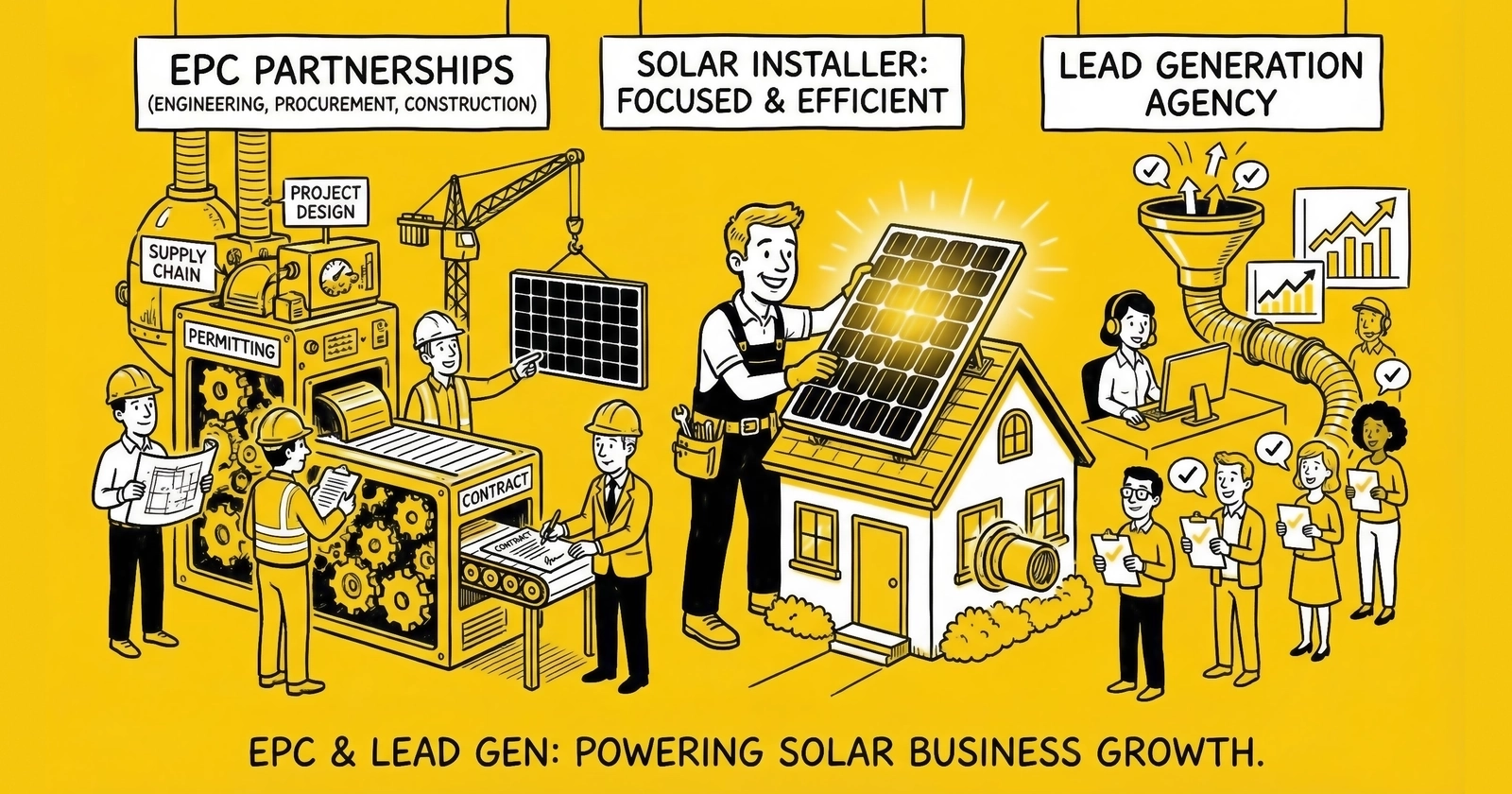
EPC stands for Engineering, Procurement, and Construction. In solar, this describes the companies that design, procure equipment for, and install solar systems. The term encompasses everything from local three-person crews to national operations with thousands of employees.
Understanding the EPC designation matters because it signals a company that handles the complete installation process. Lead generators working with true EPCs deal with one organization from design through commissioning. Some solar companies are sales-only operations that subcontract installation, creating different lead requirements and follow-up dynamics.
When evaluating potential installer partners, confirm their EPC status. Do they have their own installation crews, or do they subcontract? Companies with in-house installation have better control over customer experience, which correlates with higher lead conversion rates and fewer returns. Sales-only operations may close faster but have variable installation quality that affects customer satisfaction and your reputation by association.
National Installers: Scale with Constraints
The largest solar installers operate across dozens of states with sophisticated lead intake processes. Sunrun holds approximately 12% national market share with over one million customers. Freedom Forever captured 7% national share in 2024, up from 5% in 2023. Momentum Solar, ADT Solar, and Trinity Solar maintain significant regional and national presence.
Working with national installers means volume opportunity but also structured constraints:
Volume capacity. Nationals can absorb thousands of leads monthly. If you generate 500 leads per day in their service territory, a national installer might take 200-300 of them. This scale simplifies operations but creates dependency risk if the relationship sours.
System integration requirements. Nationals require specific delivery formats, usually API integration into their CRM systems. They will not accept email delivery or manual uploads. Understanding lead delivery methods helps you prepare for these technical requirements. Plan for 2-4 weeks of technical integration work before leads can flow.
Standardized pricing. National installers publish rate cards with limited negotiation room. They pay what they pay. Your margin optimization comes from traffic efficiency, not price negotiation.
Return policies. Nationals have documented return policies that they enforce consistently. Expect 3-7 day return windows with specific criteria for valid returns. Their legal teams wrote these policies, and they do not make exceptions.
Response time variance. Despite sophisticated intake systems, nationals sometimes have slower response times than local installers. Their sales teams cover large territories. A lead in Phoenix might wait 4-6 hours for callback if the assigned rep is driving to Tucson. This affects close rates and, eventually, what they will pay for leads.
National installer relationships provide stability and scale but limited pricing power. They are excellent for baseline volume but should not be your only buyers.
Regional Installers: The Sweet Spot for Partnerships
Regional installers operate in 5-15 states with focused geographic presence. They combine operational sophistication with relationship flexibility that nationals cannot match. This is where the best EPC partnerships are built.
Characteristics of strong regional partners include:
Territory expertise. Regional installers know their markets deeply. They understand utility programs, permitting processes, and local customer preferences. This knowledge translates to higher close rates, which justifies premium lead pricing.
Exclusivity appetite. Regionals often prefer exclusive lead arrangements in their core territories. They will pay 30-50% more per lead for exclusivity because it eliminates competition and increases close rates. Building exclusive arrangements with strong regionals creates pricing power that transactional sales cannot achieve.
Relationship investment. Regional leadership is accessible. You can build direct relationships with sales directors and ownership. These relationships create mutual investment that survives temporary quality issues or market fluctuations.
Volume predictability. Regionals have relatively stable lead needs based on installation crew capacity. They know they can install 100-150 systems monthly and need 400-600 leads to fill that pipeline. This predictability enables reliable revenue forecasting.
Brand development. Strong regionals build local brand recognition through customer service and referrals. Leads in their core markets convert at 15-20% versus 8-10% in peripheral territories. Understanding their geographic strengths enables premium routing strategies.
The trade-off with regional installers is volume limitation. A regional covering Texas and Oklahoma might need 800 leads monthly. That is meaningful volume but caps your growth in those territories unless you layer additional buyers.
Local Installers: High Touch, High Conversion
Local installers operate with small teams serving specific metro areas or counties. They typically have 2-10 employees, handle 10-30 installations monthly, and depend heavily on lead quality because every sale matters.
Local installer partnerships require different approaches:
Response time is everything. Local installers live or die by speed to lead. A local operation with one sales rep who receives a lead at 2:47 PM and calls at 2:48 PM converts dramatically better than a national competitor calling at 5:30 PM. The five-minute rule applies with particular force here. Deliver leads in real-time during business hours or you waste the local’s primary advantage.
Volume sensitivity. Sending 50 leads per day to a local installer with one sales rep destroys conversion rates and the relationship. They cannot work that volume effectively. Match delivery to capacity, typically 5-15 leads daily maximum for small operations.
Quality premium. Local installers pay premium prices for quality because they cannot absorb wasted leads. A local might pay $175 for exclusive leads with verified homeownership and utility bills versus $100 from a national for the same lead. This premium reflects their constraint.
Relationship depth. You will know the owner’s name, their kids’ ages, and their installation schedule. This relationship depth creates loyalty that survives competitive offers. When a competitor approaches your local installer partner with lower prices, the relationship you built provides switching resistance.
Payment risk. Some local installers have cash flow constraints that create collection risk. Extend credit carefully. Start with prepayment or net-7 terms. Expand to net-30 only after establishing payment history.
The value of local installer partnerships is margin, not volume. Building a network of 20-30 local installers creates diversified revenue with premium pricing that national relationships cannot match.
Finding and Qualifying Installer Partners
Building a strong installer network requires systematic prospecting, rigorous qualification, and strategic prioritization. Not every installer makes a good lead buyer. Finding the right partners saves years of relationship churn.
Where to Find Solar Installers
Industry databases and directories. EnergySage maintains a pre-screened installer network covering all 50 states. The SEIA member directory lists hundreds of installers with contact information. State solar associations publish member lists. These directories provide starting points for outreach, though directory presence does not guarantee lead buying interest or capacity.
Trade shows and conferences. Solar industry events bring installers actively seeking lead sources. Intersolar, Solar Power International, and state-level solar conferences provide face-to-face relationship opportunities. A three-day industry event can generate 50+ qualified installer contacts. The relationship depth from in-person meetings accelerates partnership development.
Referrals from existing partners. Your best installer partners know other installers. Ask for referrals explicitly. “Who else in adjacent markets should I talk to?” yields warm introductions that convert to partnerships at 3-4x the rate of cold outreach.
LinkedIn and industry social media. Solar sales directors, operations managers, and company owners are active on LinkedIn. Targeted outreach to sales leadership at regional and local installers generates response rates of 15-25% with compelling value propositions.
Google and local search. Searching “solar installer [city]” reveals the local operators who would benefit from third-party leads. Review their websites to understand service areas, company size, and sophistication level before outreach.
Competitor analysis. Research where other lead generators sell. Lead buyers tend to work with multiple sources. Understanding existing supplier relationships helps position your offering as complementary or superior.
Qualifying Installer Partners
Not every installer who wants leads should become a partner. Poor partners create collection problems, return disputes, and reputation damage. Qualification prevents these problems.
Installation volume and capacity. Ask directly: “How many installations did you complete last year? This month?” Installers completing fewer than 5 installations monthly may lack the cash flow to pay for leads consistently. Those completing 50+ monthly have proven operational capacity. Request general ranges if they hesitate on specifics.
Current lead sources. Understanding their existing lead mix reveals opportunity and competition. “Where do your leads come from today?” If 80% comes from referrals and they have never worked third-party leads, expect a learning curve and potential quality complaints as they adapt to lead buying. If they work with five lead sources already, you are competing for share of wallet but selling to experienced buyers.
Sales team structure. “How many sales reps work leads?” A solo owner-operator cannot work 50 leads daily regardless of quality. A team of eight reps with defined territories can absorb significant volume and convert efficiently. Team structure indicates capacity and sophistication.
CRM and lead management. Ask what systems they use to track leads. Installers with Aurora Solar, Enerflo, Salesforce, or similar platforms can provide feedback on lead performance that improves your operations. Those managing leads in spreadsheets will struggle with volume and provide limited visibility.
Response time capability. “What’s your typical response time on new leads?” If the answer is “same day” or “within 24 hours,” their conversion rates will underperform and they will blame lead quality. Target partners committed to 5-minute response time for real-time leads.
Financial stability. Check for recent news about layoffs, restructuring, or acquisition rumors. Review public filings if available. SunPower’s bankruptcy in August 2024 caught many lead generators with outstanding receivables. Installers aggressively purchasing leads while simultaneously cutting staff signal trouble.
Payment history. For established installers, ask references about payment reliability. “Have you worked with [installer]? How’s their payment?” Fellow lead generators often share this intelligence.
Geographic coverage alignment. Ensure their service territory matches your traffic geography. An installer who covers metro Phoenix does not help if your traffic comes from Flagstaff and Tucson.
Red Flags in Installer Qualification
Walk away from potential partners showing these warning signs:
Unrealistic expectations. An installer who expects 50% close rates on shared leads does not understand the market. They will blame your lead quality when reality arrives.
History of disputes. References mentioning payment disputes, return rate arguments, or relationship conflicts indicate patterns that will repeat with you.
Declining to share information. Installers unwilling to discuss volume, team size, or current lead sources may be hiding problems or testing whether you will sell without qualification.
Pressure for extended terms. New partners requesting net-60 or net-90 terms before establishing history are cash flow constrained. Start with prepayment or net-15.
Excessive return rate claims. “Our return rate with other sources is 40%” indicates either terrible lead quality from current sources or unreasonable return expectations. Either way, you will face the same issue.
Single person contact. If only one person at the company responds to emails and calls, key-person risk threatens the partnership. What happens when that person leaves?
Meeting Quality Expectations
Installer quality expectations determine whether you command premium pricing or compete on commodity volume. Understanding what installers actually measure and how to exceed their expectations creates durable pricing power.
Contact Rate: The Foundation Metric
Nothing matters more to installers than contact rate. A lead that never answers the phone has zero value regardless of how well it scores on other criteria.
Industry benchmarks. Average solar lead contact rates run 45-55%. Top performers achieve 65-75%. Operations below 40% face buyer churn as installers conclude the leads are worthless or fraudulent.
Factors affecting contact rate:
- Phone verification at form submission adds 10-15 points to contact rate
- Real-time delivery versus batched delivery affects rate by 5-10 points
- Time of day matters: leads delivered during business hours contact at 15-20% higher rates than evening or weekend delivery
- Day of week shows Thursday leads contact best, Monday and Friday worst
- Mobile phones contact better than landlines
Improvement tactics:
- SMS verification during form completion confirms working numbers
- Callback scheduling during form flow (“When is the best time to call you about your solar quote?”) sets expectations and identifies preferred contact windows
- Dual-channel confirmation requiring both email and phone verification eliminates many fake submissions
- Speed to delivery: the installer who calls first wins the contact
Measure and share contact rate data with installer partners. Transparency builds trust, and data-driven conversations about improvement benefit both parties.
Homeownership Verification
Renters cannot authorize solar installation. Self-reported homeownership is unreliable, with error rates of 10-15% even without fraud. Verification is essential.
Verification methods by cost and effectiveness:
| Method | Cost per Lead | Error Rate | Notes |
|---|---|---|---|
| Self-reported only | $0 | 10-15% | Baseline, unacceptable for premium leads |
| Property database match | $0.50-$2.00 | 3-5% | ATTOM, CoreLogic, or similar services |
| Utility bill upload | $0 (friction cost) | 1-2% | Highest accuracy but reduces volume |
| Identity + property match | $1.00-$3.00 | 2-3% | Combines name verification with property data |
For premium exclusive leads, property database verification is table stakes. Installers paying $150+ per lead expect ownership confirmation. The $1-2 verification cost is trivial against the lead price.
For shared leads at lower price points, self-reported ownership with fraud scoring may suffice. But track return rates by verification level. If unverified leads generate 25% returns versus 8% for verified, the verification cost pays for itself many times over.
Electric Bill and Usage Qualification
Solar economics depend on electricity consumption. A homeowner paying $75 monthly has marginal solar motivation. One paying $300 monthly has compelling financial incentive.
Sweet spot for solar qualification: $150-$400 monthly electric bills. This range indicates meaningful savings potential without suggesting unusually large homes that may face installation challenges.
Bill verification options:
- Self-reported bill amount: standard approach, 20-30% error rate in either direction
- Bill upload requirement: highest accuracy, creates friction that reduces volume 15-25%
- Utility API integration: some utilities offer account verification APIs, enabling real-time usage confirmation
- Credit header data: in limited cases, utility account information appears in credit data
The trade-off between verification depth and volume is real. Some installers prefer verified electric bill data even at lower volume. Others want volume and will accept self-reported data. Understand partner preferences and price accordingly.
Beyond bill amount, utility provider matters significantly. An SDG&E customer in San Diego has different economics than a LADWP customer in Los Angeles due to rate structures, net metering rules, and incentive programs. Accurate utility data enables correct quoting and avoids the frustration of redesigning systems after incorrect initial estimates.
Property Qualification
The property itself must be suitable for installation. Leads on unsuitable properties waste installer time and create returns.
Key property qualification factors:
Roof age. Roofs over 20 years old typically need replacement before solar installation, adding $10,000-$25,000 to project cost. Pre-qualification questions about roof age or recent replacement filter these prospects. Most installers cannot close deals requiring simultaneous roof replacement.
Roof orientation. South-facing roofs produce optimal solar output in the Northern Hemisphere. East-west orientations produce 10-15% less. North-facing roofs produce so poorly that installation rarely makes economic sense. Self-reported orientation data has limited accuracy, but asking creates awareness and filters obvious misfits.
Shading. Trees, buildings, or other obstructions casting shade on roof sections reduce production significantly. Even partial shading can cut output 25-50%. Self-reported shading assessment helps, though satellite imagery review provides more reliable qualification.
Property type. Single-family homes are the primary market with clear ownership and full roof access. Townhomes may have HOA restrictions that add 30-60 days to sales cycles and often block deals entirely. Condos typically cannot install rooftop solar. Mobile and manufactured homes have structural limitations and financing restrictions that most installers avoid.
Structural condition. Some older homes cannot support the 3-4 pounds per square foot that solar panels add. Asking about previous roof work, structural modifications, or known issues identifies potential problems.
For premium lead products, satellite imagery pre-screening using tools like Google Project Sunroof or Aurora Solar identifies obvious disqualifiers before routing. The cost is $0.50-$2.00 per lead but dramatically reduces returns on unsuitable properties.
Credit and Financing Qualification
Solar installations cost $20,000-$30,000, and most customers finance. Financing typically requires FICO scores above 650, sometimes 680 for optimal rates.
Credit qualification approaches:
Self-attested. Asking consumers to indicate “excellent,” “good,” “fair,” or “poor” credit provides rough filtering. Those selecting “poor” or indicating recent bankruptcy are unlikely to qualify for financing.
Soft pull verification. For premium leads, soft credit pulls verify qualification without affecting consumer credit scores. This adds $1-3 per lead but eliminates clearly unqualified prospects before delivery.
Income indicators. Questions about homeownership tenure, employment stability, and general financial comfort provide proxy signals for credit qualification without explicit credit questions.
Installers who offer financing through Goodleap, Sunlight Financial, or similar providers have specific credit requirements. Understanding your partners’ financing thresholds enables qualification that matches their approval criteria.
Structuring Exclusive Arrangements
Exclusive arrangements with strong installer partners create pricing power, volume stability, and competitive moats that transactional relationships cannot provide. Building effective exclusives requires understanding both parties’ interests and structuring terms that align incentives.
Why Exclusives Matter
Price premium. Exclusive leads command 30-50% higher prices than shared leads. An installer buying exclusive leads pays $150-$175 for the same lead that sells for $100-$125 when shared with two competitors. The premium reflects the value of no competition for the customer.
Higher close rates. Without competitor calls, installers convert exclusive leads at 12-18% versus 4-8% for shared leads. First contact advantage, uncluttered messaging, and customer relationship control drive this difference.
Reduced return rate. Exclusive leads generate fewer returns because the definition of “exclusive” is binary and verifiable. Shared lead disputes (“your lead was actually sold to five competitors”) disappear.
Relationship depth. Exclusive arrangements create mutual investment. The installer depends on your leads for significant pipeline. You depend on their volume for revenue stability. This interdependence motivates both parties to resolve issues rather than walking away.
Structuring Effective Exclusive Arrangements
Territory definition. Define exclusivity geographically with precision. “Exclusive for Texas” is insufficient. “Exclusive for the Dallas-Fort Worth Metroplex, defined as these 47 ZIP codes” eliminates ambiguity. Use ZIP code lists rather than metro area names that allow interpretation disputes.
Volume commitments. Exclusives should include minimum volume commitments from you and minimum purchase commitments from the installer. “I will deliver at least 150 exclusive leads monthly in your territory. You will purchase at least 120 of those that meet our agreed quality criteria.” This creates predictability for both parties.
Quality criteria. Document quality standards explicitly. What constitutes a valid lead? What triggers legitimate return requests? Specific criteria prevent disputes:
- Verified homeowner status
- Working phone number (SMS verified)
- Electric bill above $150 monthly (verified or self-reported)
- Property suitable for installation (not rental, condo, or mobile home)
- Consumer genuinely interested in solar (not clicking for sweepstakes entries)
Pricing structure. Lock pricing for defined periods, typically quarterly or annually. Include provisions for price adjustments based on market conditions, quality metrics, or volume changes. Example: “Base price of $165 per exclusive lead for Q1 2025. Price review at quarter-end with adjustments of plus or minus 10% based on contact rate and close rate performance.”
Return policy. Agree on return windows (typically 3-7 days), valid return reasons, and maximum return rates. Build in consequences for excessive returns: “Return rates exceeding 15% trigger joint quality review. Return rates exceeding 20% for two consecutive months enable price renegotiation.”
Term and termination. Six-month or annual terms provide stability while enabling exit if the relationship fails. Include notice periods (30-60 days) and post-termination obligations (settling outstanding payments, data handling).
Managing Exclusive Relationship Risks
Exclusives create dependency that must be managed:
Partner financial monitoring. Your exclusive partner’s financial health affects your business. Monitor for warning signs: delayed payments, reduced volume requests, layoffs, or acquisition rumors. SunPower’s bankruptcy caught many lead generators with concentration risk.
Geographic diversification. Do not build exclusive arrangements that concentrate more than 25% of revenue with any single partner. If Texas represents 40% of your volume, have at least three exclusive partners covering different Texas metros rather than one statewide partner.
Performance tracking. Measure and share conversion data. Exclusive partners should provide appointment rates, close rates, and feedback on lead quality. This transparency enables optimization and early identification of problems.
Relationship maintenance. Quarterly business reviews with exclusive partners strengthen relationships. Review performance data, discuss market conditions, and address concerns before they become disputes. The time investment pays dividends in partner retention.
Capacity Management and Seasonal Dynamics
Solar installation is capacity-constrained and seasonal. Understanding installer capacity dynamics prevents oversupply that degrades conversion rates and undersupply that leaves money on the table.
Understanding Installer Capacity
Installer capacity to purchase and convert leads depends on:
Installation crew availability. A company with four installation crews completing one installation per day each can handle roughly 80 installations monthly. At 10% lead-to-installation conversion, they need approximately 800 leads monthly. Exceeding this volume overwhelms their sales team and installation capacity.
Sales team capacity. Each sales representative can effectively work 15-25 leads per day. A team of six reps handles 90-150 daily leads maximum. Beyond this threshold, follow-up degrades and conversion suffers.
Permitting and interconnection backlogs. Even with sales capacity, permitting delays can create installation backlogs that reduce new lead appetite. When an installer has 200 sold projects awaiting permits, they may pause lead purchasing until the backlog clears.
Seasonal workforce changes. Some installers reduce crews in winter months (northern markets) or expand in spring. Understanding seasonal staffing patterns enables volume planning.
Signals of Capacity Constraints
Watch for these indicators that installer partners are at capacity:
Increased return rates. When overwhelmed sales teams cannot work leads properly, return rates climb. “We couldn’t reach this lead” returns often indicate capacity problems rather than lead quality issues.
Slower response times. Partners tracking speed to lead should share this data. Response time degradation from 5 minutes to 30 minutes signals capacity problems.
Reduced daily caps. Partners requesting lower daily volume or implementing hard caps indicate capacity limits.
Payment delays. Cash flow follows installation completions. If installations back up, payments to lead suppliers slow. Delayed payments often precede capacity-driven volume reductions.
Communication gaps. Partners who stop responding to emails and calls are often dealing with operational overwhelm. Reduced communication correlates with capacity problems.
Seasonal Patterns Affecting Installer Capacity
Q1 (January-March). Slower installation season due to weather in northern markets. Installers have sales capacity and welcome leads. Lead prices soften 10-20% from peak. This quarter is ideal for testing new installer partnerships when they have bandwidth to evaluate your leads carefully.
Q2-Q3 (April-September). Peak installation season. Demand for leads is high. Premium pricing is achievable. Capacity constraints emerge by July-August as installation crews fall behind accumulated sales. Some partners reduce lead purchasing in late Q3 to clear backlogs.
Q4 (October-December). Historically, year-end tax credit deadlines created urgency and premium demand. After the ITC expiration at end of 2025, this pattern will moderate. Q4 2025 saw exceptional demand as installers raced to complete installations before the deadline. Q4 2026 and beyond will likely see softer demand without year-end urgency.
Managing Volume Through Seasonal Fluctuations
Multi-partner distribution. Having 10 partners with 50 leads daily capacity each provides flexibility that one partner taking 500 leads cannot. When Partner A hits capacity, redirect to Partners B-J.
Geographic balancing. Northern markets slow in winter while southern markets continue. Shift traffic and partner volume between regions seasonally. Florida, Texas, and Arizona capacity remains available when Minnesota and Michigan partners pause.
Inventory buffering. During peak generation periods (spring), some lead generators create “inventory” through extended nurture sequences. Leads generated in April can sell in May when buyer demand exceeds immediate generation capacity. This approach requires sophisticated lead aging management and buyer willingness to accept nurtured leads.
Pricing flexibility. In high-demand periods, increase prices to capture value. In low-demand periods, reduce prices to maintain volume and partner relationships. Quarterly pricing reviews enable this flexibility.
Scaling Partnerships Without Degrading Quality
Growth creates quality risk. As you scale from 50 to 500 to 5,000 leads daily, maintaining the quality standards that built your reputation requires systematic processes and continuous investment.
Quality Monitoring at Scale
Automated quality scoring. At scale, manual quality review is impossible. Implement automated scoring that evaluates every lead against quality criteria:
- Phone verification pass/fail
- Property database match score
- Email validity check
- Form completion behavior patterns
- Fraud indicators
Leads failing quality thresholds should not route to premium partners. Tier leads by quality score for appropriate distribution.
Partner feedback loops. Establish structured feedback processes with each partner:
- Daily: automated disposition data (if partner CRM integrates)
- Weekly: contact rate and appointment rate summaries
- Monthly: close rate data and quality review calls
- Quarterly: business reviews with performance analysis
Partners who share data enable improvement. Partners who refuse visibility limit your optimization capability.
Return analysis. Track returns by source, geography, time of day, and verification level. Patterns reveal root causes:
- Returns concentrated on specific traffic sources indicate source quality problems
- Returns concentrated on specific geographies indicate targeting or installer coverage issues
- Returns concentrated at specific times indicate delivery timing problems
Systematic return analysis converts reactive complaints into proactive improvement.
Verification Stack Investment
As volume scales, verification costs represent smaller percentage of revenue while quality benefits increase:
| Monthly Lead Volume | Verification Cost @ $5/lead | Revenue @ $100 CPL | Verification % of Revenue |
|---|---|---|---|
| 500 | $2,500 | $50,000 | 5.0% |
| 2,000 | $10,000 | $200,000 | 5.0% |
| 10,000 | $50,000 | $1,000,000 | 5.0% |
The percentage remains constant, but absolute capability grows. At scale, you can afford sophisticated verification that smaller companies cannot:
- Satellite imagery pre-screening for every lead
- Soft credit verification for premium leads
- Real-time utility account verification where available
- Machine learning fraud detection trained on your specific data
Investment in verification compounds. Better verification reduces returns, enables premium pricing, and improves partner retention.
Partner Portfolio Management
At scale, managing 50+ installer partnerships requires systematic approaches:
Partner tiering. Segment partners by value:
- Tier 1: Exclusive partners, highest prices, priority traffic, quarterly reviews
- Tier 2: Significant volume partners, competitive pricing, monthly reviews
- Tier 3: Fill partners, standard pricing, as-needed communication
Allocate relationship investment proportionally to partner value.
Performance benchmarking. Compare partners on key metrics:
- Contact rate by partner (identifies integration or delivery problems)
- Return rate by partner (identifies quality expectation mismatches)
- Payment speed by partner (identifies collection risk)
- Volume stability by partner (identifies reliable versus volatile relationships)
Partners significantly underperforming benchmarks warrant investigation or replacement.
Onboarding process. Standardize new partner onboarding:
- Day 1: Agreement execution, credit check, integration requirements shared
- Week 1: Technical integration completed, test leads delivered
- Week 2-4: Pilot volume (25-50 leads) with intensive quality monitoring
- Month 2: Full volume ramp based on pilot performance
- Month 3: First formal performance review
Standardized onboarding prevents quality degradation from rushed partner additions.
The Post-ITC Partnership Landscape
The residential Investment Tax Credit expiration at end of 2025 fundamentally changes the installer landscape. Building partnerships that survive this transition requires understanding how the market will evolve.
Market Contraction Effects on Installers
Volume decline. The market will contract 30-50% in 2026 as the 30% tax credit disappears. Payback periods extend approximately 30%. Consumer demand softens proportionally.
Margin compression. Without the ITC, installers cannot maintain current margins. Customer acquisition cost tolerance decreases. Lead prices will compress 20-40% as buyers pay less.
Consolidation acceleration. SunPower’s 2024 bankruptcy previews what is coming. Smaller installers with thin margins will exit. Acquisition activity will increase as stronger players absorb struggling competitors.
Quality focus intensification. In a contracting market, installers cannot afford wasted leads. Return policies will tighten. Quality requirements will increase. Marginal lead sources will be cut.
Partnership Strategies for the Post-ITC Environment
Prioritize financially stable partners. Installers with strong balance sheets, diverse revenue streams, and experienced management will survive. Those living project-to-project may not. Concentrate partnerships with survivors.
Accept pricing compression gracefully. Fighting the market reality damages relationships. When partners need 20% price reductions to maintain profitability, negotiating reasonable adjustments preserves relationships that confrontation would destroy.
Emphasize quality differentiation. As lead sources compete for reduced buyer demand, quality becomes the primary differentiator. Invest in verification. Accept lower volume at higher quality. Position as a premium source worth premium prices.
Explore commercial solar. The commercial ITC follows different timelines with projects begun by July 4, 2026 qualifying for the full credit if placed in service within four years. Building commercial solar lead capability provides counter-cyclical opportunity as residential contracts.
Support battery storage integration. Battery attachment rates reached 79% in California post-NEM 3.0. The value proposition increasingly centers on self-consumption and backup power rather than grid export. Partners embracing battery storage and EV charger cross-selling will outperform those selling solar-only systems.
Relationship Maintenance Through Market Turbulence
Market contraction creates stress that damages relationships:
Proactive communication. Do not wait for partners to complain about quality or request price cuts. Initiate conversations about market conditions and their impact. “I know the market is changing. How can we adjust our partnership to work for both of us in 2026?”
Flexibility on terms. Partners facing cash flow pressure may need extended payment terms, temporary price reductions, or volume adjustments. Rigidity loses partners. Reasonable accommodation preserves relationships.
Shared investment in quality. Propose joint initiatives to improve lead quality: shared verification costs, feedback integration, optimization collaboration. Partners who invest together stay together.
Honest assessment. If a partner’s situation becomes untenable, honest conversation beats surprise default. “I’m seeing signals that concern me about your business. Can we talk about what’s happening?”
Frequently Asked Questions
What is an EPC in the solar industry?
EPC stands for Engineering, Procurement, and Construction. In solar, this describes companies that handle the complete installation process from system design through equipment procurement and physical installation. True EPCs have their own installation crews and control the customer experience end-to-end. Some solar companies are sales-only operations that subcontract installation, creating different operational dynamics. When qualifying installer partners, understanding their EPC status helps predict lead conversion rates, customer satisfaction, and payment reliability.
How do I find solar installers who want to buy leads?
Multiple channels yield installer contacts. Industry databases like EnergySage and SEIA member directories provide starting points. Trade shows including Intersolar and Solar Power International bring together installers actively seeking lead sources. Referrals from existing partners are highly effective since installers network with peers in adjacent markets. LinkedIn outreach to sales directors and operations managers generates 15-25% response rates with compelling value propositions. Local search reveals smaller installers who may welcome quality lead sources.
What conversion rates should I expect for solar leads?
Conversion rates vary significantly by lead type and quality. Exclusive, verified leads convert at 10-18% from lead to closed installation. Shared leads (sold to 2-3 buyers) convert at 4-8% per buyer due to competition effects. Aged leads (30+ days old) convert at 1-3%. Set appointment leads (where appointment is confirmed before delivery) convert at 15-25% from appointment to close. These benchmarks assume appropriate lead qualification including homeownership verification and electric bill screening.
How should I price exclusive versus shared solar leads?
Exclusive leads command 30-50% premiums over shared leads. In premium markets like California, Hawaii, and Massachusetts, exclusive qualified leads sell for $150-$200+ while shared leads run $100-$125. For a detailed comparison of these models, see our guide on exclusive vs. shared leads. In developing markets, exclusives might sell for $75-$100 versus $50-$75 shared. Price based on your verification depth, close rate data, and competitive positioning. Partners track effective cost per acquisition, so leads that convert better justify higher prices.
What quality metrics matter most to solar installers?
Contact rate ranks as the most critical metric. Leads that never answer the phone have zero value. Target 65-75% contact rate. Beyond contact rate, installers measure homeownership accuracy (returns for renter leads indicate verification failures), electric bill accuracy (proper sizing depends on accurate usage data), appointment rate (percentage of contacts becoming appointments), and close rate (appointments becoming installations). Track and share these metrics to build partner confidence.
How do I structure exclusive territory agreements?
Define territories precisely using ZIP code lists rather than geographic names that allow interpretation disputes. Include minimum volume commitments from you and minimum purchase commitments from the installer. Document quality criteria explicitly to prevent return disputes. Lock pricing for defined periods (quarterly or annually) with adjustment provisions. Establish return policies including windows, valid reasons, and maximum rates. Include term lengths (typically 6-12 months) with notice periods and termination provisions.
What happens to installer partnerships when the market contracts?
Market contraction after the ITC expiration will reduce lead demand 30-50%. Expect pricing compression of 20-40%. Some installers will exit the market or be acquired. Financially stable partners with diverse operations will survive and value quality lead sources. Maintain relationships through proactive communication, flexibility on terms, and quality investment. Partners who survive the contraction will value suppliers who supported them through the transition.
How do I handle installer capacity constraints?
Watch for signals including increased return rates, slower response times, reduced daily caps, and payment delays. When partners approach capacity, reduce volume before quality suffers. Maintain multiple partners per territory so capacity constraints at one can be absorbed by others. Understand seasonal patterns (spring peak, winter trough) and geographic variations (southern markets active year-round). Communicate openly with partners about their capacity so you can match delivery to their ability to work leads effectively.
What payment terms are standard for solar lead buyers?
National installers typically operate on Net-30 terms with automated payment processing. Regional installers range from Net-15 to Net-30 depending on relationship history. Local installers often start with prepayment or Net-7 until establishing payment history. Extend credit carefully, especially with smaller operations that may face cash flow constraints. Payment delays often signal deeper financial problems. Consider credit insurance for significant receivables with any single partner.
How do I build long-term installer relationships rather than transactional sales?
Invest in relationship depth beyond transactions. Share performance data transparently. Conduct quarterly business reviews to discuss performance, market conditions, and mutual optimization opportunities. Provide value beyond leads through market intelligence, best practices sharing, and problem-solving support. Be accessible and responsive. Build relationships with multiple contacts at each partner organization to reduce key-person risk. Long-term relationships survive temporary quality issues that transactional relationships cannot tolerate.
Key Takeaways
-
Installer relationships determine solar lead profitability more than traffic quality or volume. Partners who trust your data, value your responsiveness, and depend on your leads create pricing power and revenue stability that transactional sales cannot match.
-
Different installer types require different partnership approaches. National installers offer scale and stability with limited pricing flexibility. Regional installers provide the best opportunity for exclusive arrangements with premium pricing. Local installers pay highest per-lead prices but require careful volume management and credit monitoring.
-
Contact rate is the foundation metric. Nothing matters to installers more than leads who answer the phone. Phone verification, real-time delivery during business hours, and rapid follow-up optimization drive contact rates that justify premium pricing.
-
Verification investment pays for itself. The $3-8 per lead cost for homeownership verification, property qualification, and electric bill confirmation reduces return rates from 25% to under 10%. This quality improvement enables premium pricing that exceeds verification costs many times over.
-
Exclusive arrangements create competitive moats. Installers paying premium prices for exclusive leads become dependent on your supply. This mutual investment creates switching costs and relationship depth that survive market fluctuations and competitive pressure.
-
Capacity management prevents quality degradation. Understanding installer crew capacity, sales team bandwidth, and seasonal patterns enables volume matching that maintains conversion rates. Oversupplying leads destroys the close rates that justify your pricing.
-
The post-ITC environment will favor quality-focused operators. Market contraction of 30-50% in 2026 will compress prices, accelerate consolidation, and intensify quality requirements. Partnerships with financially stable installers, flexible pricing, and premium verification will survive while transactional operators struggle.
-
Build partnerships before you need them. Relationship depth takes time to develop. Start building diverse installer networks now. Partners who know and trust you will remain accessible when market conditions tighten and competition for diminished buyer attention intensifies.
Sources
- SEIA Solar Industry Research Data - Industry statistics on solar market share, installation volumes, and national installer rankings
- EnergySage Marketplace - Pre-screened installer network used for finding and evaluating solar installers across the U.S.
- CPUC Net Energy Metering - California NEM 3.0 policy details affecting solar economics and battery attachment rates
- IRS Residential Clean Energy Credit - Federal Investment Tax Credit requirements and expiration timelines
- NABCEP Certification - Industry certification standards for solar installers and EPC qualification criteria
Market data current as of late 2025. The ITC expiration and market contraction projections reflect the post-One Big Beautiful Bill environment. All regulatory and policy information should be verified before acting, as conditions continue to evolve.