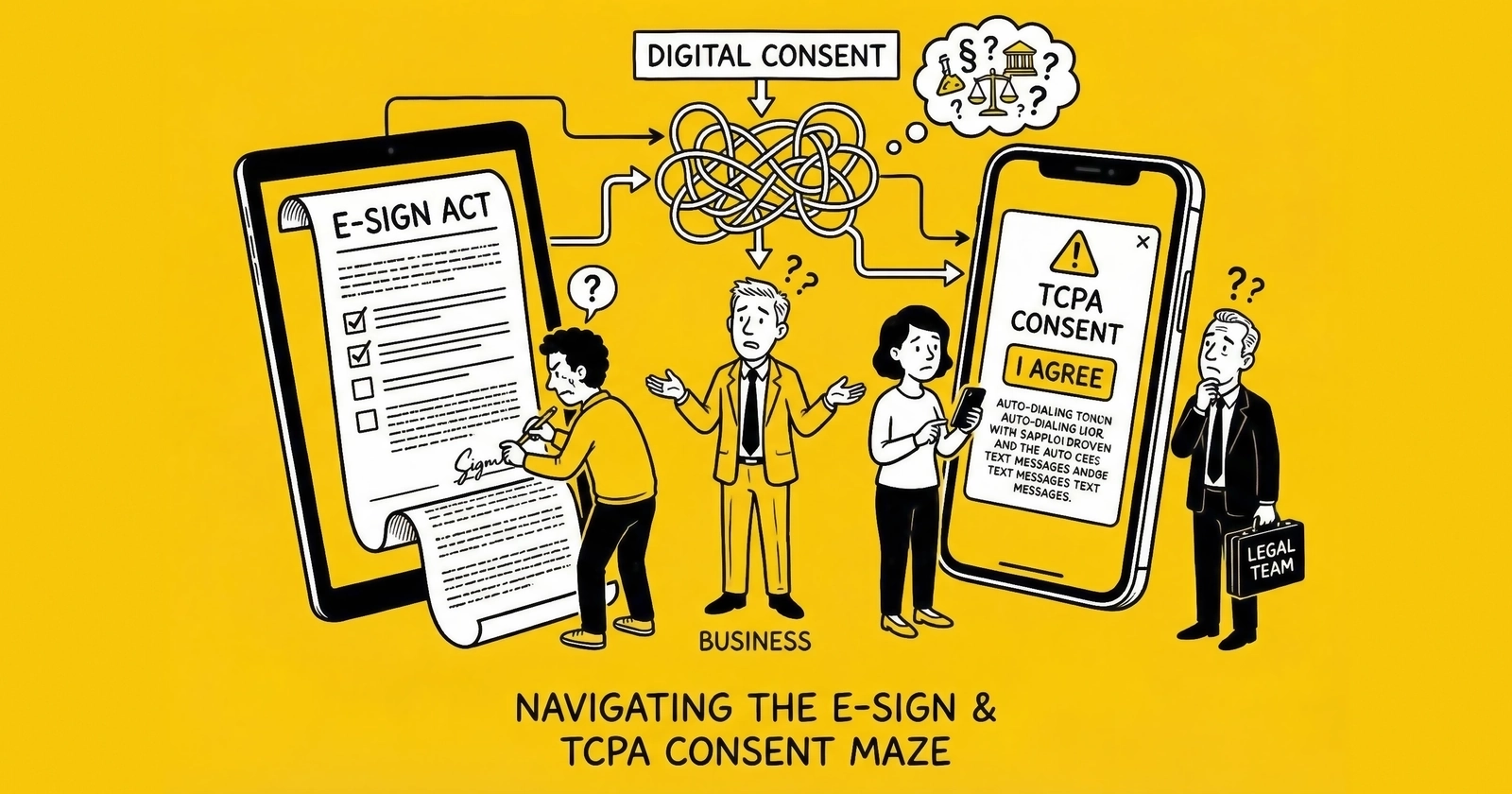
The federal E-SIGN Act creates additional compliance layers for electronic TCPA consent that most lead generators ignore until litigation exposes the gap. Understanding the intersection of these two laws separates defensible consent from documentation that crumbles under scrutiny.
Introduction: The Hidden Compliance Layer Most Lead Generators Miss
Your lead form captures consent electronically. Every consumer who submits their phone number and checks your TCPA disclosure box does so on a screen, not with pen and paper. Your TrustedForm certificates document the interaction. Your consent language meets all six PEWC requirements.
You are likely still exposed.
The Electronic Signatures in Global and National Commerce Act – commonly called the E-SIGN Act – creates additional requirements that apply whenever a federal statute requires “written” consent or disclosures and those requirements are satisfied electronically. The TCPA requires written consent. Electronic lead forms satisfy that requirement digitally. Therefore, E-SIGN requirements layer on top of TCPA requirements.
This is not theoretical. In Bradley v. Dentalplans.com (D. Md. 2024), the court held that because TCPA requires “written” consent with specific disclosures, obtaining that consent electronically triggers E-SIGN’s consumer disclosure and consent requirements. Electronic TCPA consent captured without E-SIGN compliance may be unenforceable – creating a secondary attack vector that plaintiffs are beginning to exploit.
The lead generation industry operates almost exclusively through electronic consent. Web forms, mobile apps, and digital signature platforms capture billions of consent instances annually. If E-SIGN requirements apply – and courts are increasingly finding that they do – the compliance gap affects virtually every lead generator in the market.
This article breaks down exactly what E-SIGN requires, how it intersects with TCPA, what the Bradley decision means for your operations, and how to implement compliant electronic consent flows that withstand litigation.
Understanding the E-SIGN Act: Foundational Principles
Legislative Purpose and Scope
Congress enacted the Electronic Signatures in Global and National Commerce Act in 2000 to facilitate interstate and international commerce by removing barriers to electronic transactions. The statute establishes that electronic signatures and records have the same legal validity as their paper counterparts, provided certain consumer protection requirements are met.
The core principle is simple: electronic signatures work. A checkbox clicked on a website, a typed name in a signature field, or a digital signature through a platform like DocuSign can satisfy legal requirements for “written” agreements and “signatures” under federal law.
But this validation comes with conditions. When a statute or regulation requires that information be provided to a consumer “in writing,” the E-SIGN Act allows electronic delivery only if specific requirements are satisfied first. These requirements protect consumers from having important disclosures delivered in formats they cannot access or retain.
The Consumer Consent Requirement
Section 101(c) of the E-SIGN Act establishes the consumer consent framework that creates compliance complexity for lead generators. The statute provides that when a federal law requires a business to provide information to a consumer “in writing,” electronic delivery is valid only if:
The consumer affirmatively consents to receive the information electronically. This consent must be separate from – and precede – the underlying transaction. The consumer must understand they are agreeing to receive disclosures in electronic format rather than on paper.
The consumer has not withdrawn consent. Electronic delivery remains valid only while consent to electronic records remains in effect. If a consumer revokes E-SIGN consent, subsequent electronic disclosures become problematic.
The business provides specific disclosures before obtaining consent. These pre-consent disclosures inform the consumer about:
- The right to receive records in paper form
- The right to withdraw consent to electronic records
- The procedures for withdrawing consent
- Whether consent withdrawal affects the underlying transaction
- The hardware and software requirements to access electronic records
- How to request a paper copy after electronic consent
The consumer demonstrates the ability to access electronic records. The business must confirm the consumer can actually access the electronic format being used – whether through a test email, display confirmation, or other verification method.
What “In Writing” Triggers E-SIGN
E-SIGN requirements activate when a federal statute requires something to be provided or obtained “in writing.” The TCPA contains such a requirement: prior express written consent must be in writing, with specific disclosures, signed by the consumer.
The analytical framework is straightforward:
- Does the underlying law require written consent or written disclosure?
- Is that requirement being satisfied electronically?
- If yes to both, E-SIGN consumer consent requirements apply.
For lead generation, the answer to questions one and two is almost always yes. PEWC is required for telemarketing calls using automated technology. Lead forms capture that consent electronically. E-SIGN applies.
The Bradley v. Dentalplans.com Decision: A Wake-Up Call
Case Background
The Bradley v. Dentalplans.com case arose from a consumer who allegedly received telemarketing calls without proper consent. The defendant argued it had obtained valid electronic consent through its website. The plaintiff challenged the consent’s validity on multiple grounds, including E-SIGN non-compliance.
The United States District Court for the District of Maryland, in a 2024 decision, addressed whether electronic TCPA consent must satisfy E-SIGN requirements. The court’s analysis has significant implications for the lead generation industry.
The Court’s Reasoning
The court applied the E-SIGN framework systematically:
First, the court identified that TCPA requires “prior express written consent” with specific disclosures for telemarketing calls using automated technology. The statute explicitly requires written consent – triggering E-SIGN analysis when that consent is obtained electronically.
Second, the court examined whether E-SIGN’s consumer consent provisions applied. Because TCPA requires disclosures to be made to consumers “in writing” (through the consent language), and those disclosures were provided electronically, E-SIGN section 101(c) requirements activated.
Third, the court evaluated whether the defendant satisfied E-SIGN requirements. The defendant had obtained electronic consent but had not provided the required E-SIGN disclosures or obtained separate E-SIGN consent before the TCPA consent.
The court found the electronic consent potentially deficient because E-SIGN requirements were not satisfied.
Implications for Lead Generators
The Bradley decision establishes that E-SIGN compliance is not optional for electronic TCPA consent. The ruling creates several operational imperatives:
Electronic TCPA consent has two consent layers. The consumer must consent to receive disclosures electronically (E-SIGN consent), and separately consent to receive telemarketing calls (TCPA consent). These are distinct consents serving different purposes.
E-SIGN disclosures must precede TCPA consent. The consumer must receive and consent to electronic records before the TCPA disclosure is presented. Presenting TCPA consent first, then obtaining E-SIGN consent afterward, inverts the required sequence.
Documentation must demonstrate E-SIGN compliance. Just as TrustedForm certificates document TCPA consent, your systems must capture evidence that E-SIGN requirements were satisfied – including the disclosures provided and the consumer’s affirmative consent to electronic records.
Non-compliance creates an independent attack vector. Even if your TCPA consent language is perfect, failure to satisfy E-SIGN requirements provides a separate basis for challenging consent validity.
E-SIGN Requirements for Electronic TCPA Consent
The Pre-Consent Disclosure Package
Before obtaining electronic TCPA consent, E-SIGN requires providing consumers with specific disclosures. These disclosures must include:
Statement of the right to paper records. Consumers must be informed they have the right to receive the consent disclosure and any related information in paper form, even though they are currently viewing it electronically.
Statement of the right to withdraw E-SIGN consent. Consumers must understand they can revoke consent to electronic records at any time.
Description of withdrawal procedures. The disclosure must explain how to withdraw consent – whether by email, phone, mail, or other method.
Consequences of consent withdrawal. If withdrawing E-SIGN consent affects the consumer’s ability to complete the transaction or receive services, this must be disclosed.
Hardware and software requirements. Consumers must be informed of the technical requirements to access electronic records. This typically includes browser requirements, PDF reader requirements if applicable, and any other software needed.
Paper copy procedures. The disclosure must explain how consumers can obtain paper copies of electronic records, and whether fees apply.
The Affirmative Consent Requirement
After providing E-SIGN disclosures, the business must obtain the consumer’s affirmative consent to receive information electronically. This consent must be:
Affirmative. The consumer must take a positive action to consent. Pre-checked boxes or passive acceptance do not satisfy E-SIGN requirements – the same standard that applies to TCPA consent.
Prior to electronic delivery. E-SIGN consent must be obtained before the disclosures that require it are provided electronically. For TCPA purposes, this means E-SIGN consent must precede the TCPA consent disclosure.
Demonstrating electronic access capability. The statute requires “affirmative consent” that “reasonably demonstrates that the consumer can access information in the electronic form that will be used to provide the information.” This typically means the consumer must demonstrate ability to access the electronic format – by successfully viewing a webpage, opening a PDF, or similar action.
Hardware and Software Requirements
The E-SIGN disclosure must inform consumers of the hardware and software requirements to access electronic records. For web-based lead forms, this typically includes:
Browser requirements. Minimum browser version and types supported.
Internet connection. Statement that internet access is required.
Display requirements. Screen resolution or device type requirements if applicable.
PDF capability. If disclosures will be provided in PDF format, Adobe Reader or equivalent must be specified.
Email capability. If electronic records will be delivered by email, email access requirements must be disclosed.
For most lead generation operations using standard web forms, these requirements are relatively simple – modern browsers accessing standard web pages. But the disclosure must still be provided.
Implementing E-SIGN Compliant TCPA Consent
Consent Flow Architecture
Proper implementation requires structuring your consent flow to address E-SIGN requirements before TCPA consent. There are several architectural approaches:
Sequential Page Approach. A dedicated E-SIGN consent page appears before the lead form. Consumers review E-SIGN disclosures, provide E-SIGN consent, then proceed to the lead form where TCPA consent is captured.
Same-Page Sequential Approach. E-SIGN disclosures and consent appear in a distinct section above the TCPA consent disclosure on the same page. The flow is: E-SIGN disclosure, E-SIGN consent checkbox, TCPA disclosure, TCPA consent checkbox.
Integrated Disclosure Approach. A comprehensive disclosure covers both E-SIGN and TCPA requirements, with clear language addressing all required elements. Single consent applies to both, but language must be carefully drafted to satisfy all requirements.
The sequential approaches provide cleaner compliance documentation but add friction to the user experience. The integrated approach is more streamlined but requires meticulous drafting to ensure all requirements are addressed.
Sample E-SIGN Disclosure Language
A compliant E-SIGN disclosure for lead generation might read:
Electronic Records Disclosure
You are about to provide consent electronically. By proceeding, you consent to receive disclosures and conduct transactions electronically. You may request paper copies of any disclosures by contacting us at [contact information]. To access electronic disclosures, you need a device with internet access, a current web browser (Chrome, Firefox, Safari, Edge), and the ability to view and print web pages.
You have the right to withdraw this consent to electronic records at any time by contacting us at [contact information]. Withdrawing consent will not affect the validity of any prior electronic transactions. If you withdraw consent, we will provide subsequent disclosures in paper form at no additional cost.
By checking this box, I confirm I have reviewed this disclosure, I consent to receive disclosures electronically, and I confirm I can access information in electronic form.
[ ] I consent to electronic records and disclosures
This disclosure addresses: right to paper records, right to withdraw consent, withdrawal procedures, consequences of withdrawal, hardware/software requirements, and paper copy procedures.
Sample Integrated E-SIGN/TCPA Disclosure
An integrated approach combining both consents might read:
Electronic Records and Marketing Consent
Electronic Records: By submitting this form, you consent to conduct transactions electronically and receive all disclosures electronically. You may request paper copies by contacting [Company] at [contact information]. Technical requirements: internet access, modern web browser (Chrome, Firefox, Safari, Edge), ability to view web pages. You may withdraw consent to electronic records at any time by contacting [contact information], which will not affect prior transactions.
Marketing Consent: By checking the box below and clicking Submit, I provide my prior express written consent to receive marketing calls and text messages from [Company Name] at the phone number I provided above. Calls and texts may use automated dialing technology and prerecorded or artificial voice messages. This consent is not required to purchase any goods or services. Message frequency varies. Message and data rates may apply. Reply STOP to opt out.
[ ] I confirm I can access electronic records and I consent to receive marketing calls and texts as described above.
[Phone Number Field]
[Submit Button]
This approach combines both consents but clearly addresses all required elements. The challenge is ensuring the disclosure remains “clear and conspicuous” as the length increases.
Documentation Requirements
Satisfying E-SIGN requirements means nothing if you cannot prove compliance when challenged. Your documentation systems must capture:
E-SIGN disclosure delivery. Evidence that the E-SIGN disclosures were presented to the consumer – timestamp, page URL, disclosure content.
E-SIGN consent capture. Evidence of affirmative consent to electronic records – checkbox selection, timestamp, consumer identifier.
Electronic access demonstration. Evidence the consumer successfully accessed the electronic disclosure – page load confirmation, interaction data.
TCPA consent capture. Standard PEWC documentation including disclosure language, consent action, timestamp, and phone number.
Third-party verification services like TrustedForm can document both E-SIGN and TCPA consent if properly configured. The session replay must show both disclosures and both consent actions. For a comprehensive overview of TCPA requirements, see our TCPA compliance guide.
Why TCPA Consent Alone Is Not Enough
The Two-Law Problem
Lead generators often treat TCPA compliance as the beginning and end of consent requirements. If the six PEWC elements are satisfied and documented, the lead is compliant. This analysis is incomplete.
The E-SIGN Act creates a foundational layer that must be satisfied before the TCPA layer can be validly constructed. The analytical sequence is:
- E-SIGN disclosures provided
- E-SIGN consent obtained
- Consumer demonstrates electronic access capability
- TCPA disclosure provided (now validly delivered electronically)
- TCPA consent obtained
Skipping steps one through three does not invalidate the TCPA disclosure – it means the TCPA disclosure may not have been validly delivered at all. The “written” consent required by TCPA was provided electronically without first establishing the consumer’s consent to receive written materials electronically.
The Litigation Exposure
Plaintiff attorneys are increasingly sophisticated about E-SIGN arguments. The typical attack proceeds:
Phase 1: Plaintiff alleges TCPA violation for receiving unauthorized marketing calls.
Phase 2: Defendant produces TrustedForm certificate or similar documentation showing TCPA consent.
Phase 3: Plaintiff challenges consent validity on E-SIGN grounds – no E-SIGN disclosure provided, no separate E-SIGN consent obtained, no demonstration of electronic access capability.
Phase 4: Court must evaluate whether electronic consent is valid without E-SIGN compliance.
Following Bradley, defendants face significant headwinds in this analysis. The court’s reasoning applies broadly: if a statute requires written consent or disclosure, and that requirement is satisfied electronically, E-SIGN applies.
The Documentation Gap
Even companies that have implemented E-SIGN compliant flows often have a documentation gap. TrustedForm certificates document what happened on the page – but if the E-SIGN elements were not captured in the session, the certificate documents their absence as much as their presence.
Review your existing certificates. Can you demonstrate from the documented session:
- E-SIGN disclosure was visible before TCPA consent
- Consumer took affirmative action to consent to electronic records
- Consumer successfully accessed the electronic disclosure
If not, your documentation may be insufficient to defend against E-SIGN challenges.
Common E-SIGN Compliance Failures in Lead Generation
Failure 1: Missing E-SIGN Disclosure Entirely
The most common failure is simply omitting E-SIGN disclosures entirely. Many lead forms jump straight to TCPA consent language without any acknowledgment of electronic records requirements.
The problem: No disclosure about the right to paper records, right to withdraw E-SIGN consent, or hardware/software requirements.
The risk: Consent may be invalid from the foundation because electronic delivery was not properly authorized.
The fix: Add E-SIGN disclosure language to your consent flow, either as a separate step or integrated with TCPA consent.
Failure 2: E-SIGN Consent After TCPA Consent
Some operations have added E-SIGN disclosures but placed them in the wrong sequence – after the TCPA consent has already been obtained.
The problem: The consumer saw and consented to the TCPA disclosure before consenting to receive disclosures electronically.
The risk: The TCPA disclosure was delivered electronically before electronic delivery was authorized – potentially invalidating the consent.
The fix: Restructure your flow so E-SIGN disclosure and consent precede TCPA disclosure.
Failure 3: No Separate E-SIGN Consent Action
Some operations display E-SIGN language but do not capture separate consent – relying on the TCPA consent checkbox to cover both.
The problem: E-SIGN requires affirmative consent to electronic records. If no separate action is captured, there may be no evidence of E-SIGN consent.
The risk: Plaintiff argues consumer consented only to marketing calls, not to electronic records, and therefore the electronic consent was invalid.
The fix: Either add a separate E-SIGN consent checkbox or use integrated language that clearly encompasses both consents in a single action.
Failure 4: Inadequate Hardware/Software Disclosure
E-SIGN requires informing consumers of the technical requirements to access electronic records. Many lead forms omit this entirely or provide vague language like “internet access required.”
The problem: Insufficient specificity about browser requirements, PDF capability, or other technical needs.
The risk: Disclosure non-compliance creates a technical attack vector.
The fix: Add specific hardware/software requirements to your E-SIGN disclosure. For standard web forms, this can be relatively simple: “Modern web browser (Chrome, Firefox, Safari, Edge) with internet access.”
Failure 5: No Withdrawal Procedure Disclosure
E-SIGN requires disclosing how consumers can withdraw consent to electronic records and the consequences of withdrawal.
The problem: Disclosure omits withdrawal procedures or consequences.
The risk: Incomplete E-SIGN disclosure invalidates the consent.
The fix: Add clear language about how to withdraw E-SIGN consent (email, phone, mail) and state that withdrawal will not affect prior transactions but will result in paper delivery going forward.
Failure 6: Documentation Does Not Capture E-SIGN Elements
Even when E-SIGN disclosures are present, the consent verification system may not capture them properly.
The problem: TrustedForm certificate shows TCPA consent but E-SIGN elements are not visible or timestamped.
The risk: Unable to prove E-SIGN compliance when challenged.
The fix: Configure your verification system to capture the full consent flow, including E-SIGN disclosures and consent action.
Practical Implementation Guide
Step 1: Audit Current Consent Flows
Before implementing changes, document your current state:
- Review all lead forms capturing TCPA consent
- Identify whether E-SIGN disclosures are present
- Determine the sequence of disclosures and consent actions
- Review TrustedForm certificates to see what is actually documented
- Identify gaps between requirements and current practice
Create a compliance gap analysis that maps each required element to your current implementation status.
Step 2: Draft Compliant Disclosure Language
Develop disclosure language that addresses all requirements. Your E-SIGN disclosure must include:
Checklist for E-SIGN Disclosure:
- Statement of right to receive records in paper form
- Procedure for requesting paper copies
- Statement of right to withdraw E-SIGN consent
- Procedure for withdrawing E-SIGN consent
- Consequences of consent withdrawal (if any)
- Hardware requirements (device types)
- Software requirements (browsers, PDF readers)
- Internet access requirement
Checklist for TCPA Consent:
- Written agreement present
- Signature/consent mechanism
- Clear seller identification
- Phone number identification
- Not a condition of purchase statement
- Clear and conspicuous presentation
- Automated technology disclosure
- Prerecorded/artificial voice disclosure
Step 3: Restructure Consent Flow
Implement one of the following architectures:
Option A: Sequential Pages
- Landing page with initial content
- E-SIGN disclosure page with consent checkbox
- Lead form with TCPA consent
- Confirmation page
Option B: Same-Page Sequential
- E-SIGN disclosure section (top)
- E-SIGN consent checkbox
- Visual separator
- Lead form fields
- TCPA disclosure section
- TCPA consent checkbox
- Submit button
Option C: Integrated Single Consent
- Combined E-SIGN/TCPA disclosure
- Single consent checkbox covering both
- Lead form fields
- Submit button
Option A provides the clearest compliance documentation but adds friction. Option C is most streamlined but requires careful drafting. Option B balances both considerations.
Step 4: Configure Documentation Systems
Ensure your consent verification captures all elements:
TrustedForm Configuration:
- Deploy script to capture full session
- Verify E-SIGN disclosures appear in session replay
- Confirm E-SIGN consent action is documented
- Verify timestamp sequence shows E-SIGN before TCPA consent
Internal Documentation:
- Store E-SIGN consent timestamp
- Store TCPA consent timestamp
- Retain disclosure language version
- Link to verification certificate
Step 5: Test and Validate
Before launching, validate compliance:
Legal review. Have TCPA counsel review disclosure language and consent flow architecture.
User testing. Confirm real users can navigate the flow and understand what they are consenting to.
Certificate review. Submit test leads and review verification certificates to confirm all elements are documented.
Regression testing. As forms are updated, re-validate that E-SIGN elements remain properly implemented.
Step 6: Ongoing Monitoring
Implement ongoing compliance monitoring:
Monthly audits. Review sample certificates to verify E-SIGN elements are documented.
Version control. Track changes to consent language and forms to maintain compliance history.
Legal updates. Monitor for case law developments interpreting E-SIGN requirements in TCPA context.
State Law Considerations
State E-SIGN Equivalents
The federal E-SIGN Act provides a baseline, but state laws may impose additional requirements. The Uniform Electronic Transactions Act (UETA) has been adopted by 47 states and generally aligns with E-SIGN, but variations exist.
New York has not adopted UETA and has its own Electronic Signatures and Records Act (ESRA) with somewhat different provisions.
Illinois requires specific disclosures for certain electronic transactions.
California has adopted UETA but with modifications to consumer protection provisions.
For national lead generation operations, compliance with federal E-SIGN requirements typically satisfies state requirements, but review state-specific provisions when operating in New York or other non-UETA jurisdictions.
Intersection with State Mini-TCPAs
State telemarketing laws – Florida’s FTSA, Oklahoma’s OTSA, Maryland’s Stop the Spam Calls Act – may have their own consent requirements that interact with E-SIGN.
When state law requires written consent for telemarketing and that consent is obtained electronically, the same E-SIGN analysis applies. The state’s consent requirement, satisfied electronically, triggers E-SIGN consumer consent provisions.
This creates compound compliance requirements: federal E-SIGN + federal TCPA + state E-SIGN equivalent + state mini-TCPA. Proper implementation must address all applicable layers.
Frequently Asked Questions
1. Does the E-SIGN Act apply to all electronic TCPA consent?
Yes. When TCPA requires “written” consent and that consent is obtained electronically, E-SIGN’s consumer consent provisions apply. This covers virtually all web-based lead generation where TCPA consent is captured through online forms.
2. What is the difference between E-SIGN consent and TCPA consent?
E-SIGN consent authorizes the business to provide disclosures and conduct transactions electronically rather than on paper. TCPA consent authorizes the business to make marketing calls using automated technology. They are separate consents serving different purposes – one addresses the delivery method, the other addresses the communication itself.
3. Can I combine E-SIGN and TCPA consent into a single disclosure?
Yes, but carefully. An integrated disclosure must address all E-SIGN required elements (right to paper, withdrawal procedures, hardware/software requirements) and all TCPA required elements (seller identification, phone number, not a condition of purchase, automated technology disclosure). The combined language must remain “clear and conspicuous” despite increased length.
4. What if my TrustedForm certificates do not show E-SIGN disclosures?
This creates documentation vulnerability. Even if E-SIGN disclosures exist on your form, you cannot prove they were displayed to specific consumers if they are not captured in the certificate. Reconfigure your consent flow and verification system to document E-SIGN elements.
5. Does Bradley v. Dentalplans.com apply nationally?
The Bradley decision is from a federal district court in Maryland and is not binding precedent in other jurisdictions. However, its reasoning – that electronic TCPA consent triggers E-SIGN requirements – is grounded in statutory analysis that other courts may find persuasive. Operators should not assume the ruling’s impact is limited to Maryland.
6. What happens if E-SIGN consent is obtained after TCPA consent?
The consent sequence may be defective. E-SIGN consent authorizes electronic delivery of disclosures – if it comes after the TCPA disclosure was already delivered electronically, the TCPA disclosure was delivered without valid authorization. Restructure your flow so E-SIGN consent precedes TCPA disclosure.
7. Are there E-SIGN requirements for consent revocation?
Yes. E-SIGN requires disclosing the right to withdraw consent to electronic records and the procedures for doing so. This is separate from TCPA consent revocation. If a consumer withdraws E-SIGN consent, you must provide subsequent disclosures in paper form – though prior electronic transactions remain valid.
8. What hardware and software requirements must I disclose?
Disclose the actual requirements to access your electronic disclosures. For standard web forms, this typically includes: internet access, modern web browser (specify versions if relevant), and any additional software like PDF readers. Be specific enough to be useful but recognize that overly technical disclosures may confuse consumers.
9. Does E-SIGN apply to text message consent?
Yes. If you are obtaining TCPA consent for marketing text messages through an electronic form, E-SIGN applies to that consent transaction. The same disclosure and consent requirements apply regardless of whether the authorized communications will be calls, texts, or both.
10. How long must I retain E-SIGN consent documentation?
E-SIGN does not specify a retention period, but TCPA has a four-year statute of limitations. Retain E-SIGN consent documentation for at least five years – matching your TCPA consent documentation retention – to ensure both can be produced if consent is challenged. Understanding the FCC enforcement landscape helps you appreciate why this documentation matters.
Key Takeaways
-
Electronic TCPA consent triggers E-SIGN requirements. When you obtain “written” consent electronically, the E-SIGN Act requires specific disclosures and separate consent to electronic records before the TCPA consent can be validly captured.
-
The Bradley v. Dentalplans.com decision is a warning shot. The 2024 Maryland federal court ruling held that electronic TCPA consent must satisfy E-SIGN requirements. Plaintiffs are increasingly using E-SIGN non-compliance as an attack vector against consent validity.
-
E-SIGN requires specific pre-consent disclosures. Before obtaining electronic consent, you must disclose: the right to paper records, withdrawal procedures, consequences of withdrawal, and hardware/software requirements. Missing any element creates vulnerability.
-
E-SIGN consent must precede TCPA consent. The consumer must consent to receive disclosures electronically before the TCPA disclosure is presented. Inverting this sequence may invalidate the consent.
-
Documentation must capture both consent layers. TrustedForm certificates and other verification must document E-SIGN disclosures and consent actions, not just TCPA consent. Certificates that show only TCPA elements may be insufficient to defend against E-SIGN challenges.
-
Implementation requires architectural changes. Adding E-SIGN compliance is not a matter of adding a paragraph – it requires restructuring consent flows to ensure proper sequencing and documentation of all required elements.
-
The cost of non-compliance is severe. If E-SIGN requirements are not satisfied, electronic TCPA consent may be unenforceable. Every lead with defective consent becomes potential liability at $500-$1,500 per violation with no aggregate cap.
-
Most lead generators have compliance gaps. The industry has focused on TCPA compliance while largely ignoring E-SIGN. Auditing your current consent flows will likely reveal gaps that require remediation.
Conclusion: Building Defensible Electronic Consent
The lead generation industry has spent years optimizing TCPA compliance – perfecting disclosure language, implementing TrustedForm verification, training on consent requirements. This work remains essential. But it is incomplete without E-SIGN compliance.
The two statutes work together. TCPA defines what consent you need. E-SIGN defines how you can obtain it electronically. Satisfying TCPA while ignoring E-SIGN is like building a house on an unpermitted foundation – it may look complete, but it is vulnerable to challenge at the most fundamental level.
The Bradley decision has elevated E-SIGN from an obscure technical requirement to an active litigation weapon. Plaintiff attorneys now have case law supporting the argument that electronic TCPA consent requires E-SIGN compliance. Defendants without documentation of E-SIGN compliance face an uphill battle.
The remediation is not complicated. Add E-SIGN disclosures to your consent flow. Obtain E-SIGN consent before presenting TCPA consent. Configure your verification systems to document both. Retain documentation for the full limitations period.
These changes require investment – legal review, development work, testing, documentation system updates. But the investment is trivial compared to the exposure it mitigates. A single successful E-SIGN challenge to a class of leads generates liability in the millions.
Every lead you generate with defective electronic consent is a liability waiting for a plaintiff to discover the gap. Every lead generated with proper E-SIGN and TCPA compliance is an asset that can withstand litigation scrutiny.
The choice is yours. The deadline was yesterday. The consequences are permanent.
Build it right. Document it completely. Sleep better knowing your consent foundation is solid.
Sources
- E-SIGN Act Full Text (15 U.S.C. Chapter 96) - Complete statutory text of the Electronic Signatures in Global and National Commerce Act
- E-SIGN Act Section 101 Consumer Consent - Specific statutory requirements for electronic consent disclosures
- TCPA Statute (47 U.S.C. 227) - Telephone Consumer Protection Act statutory text
- Uniform Electronic Transactions Act - Uniform Law Commission’s model act adopted by 47 states
- 47 CFR Part 64 Subpart L - FCC implementing regulations for TCPA consent requirements
- TrustedForm - Consent verification platform for documenting E-SIGN compliant electronic consent
- Jornaya TCPA Guardian - Independent consent verification and compliance documentation service
This article provides general information about E-SIGN Act and TCPA compliance for educational purposes. It is not legal advice. The intersection of these statutes involves complex legal analysis that varies by jurisdiction and circumstance. Consult qualified legal counsel for guidance specific to your operations.
Legal and regulatory information reflects understanding as of late 2025. E-SIGN and TCPA requirements evolve through case law and regulatory action. Monitor developments and update compliance practices accordingly.