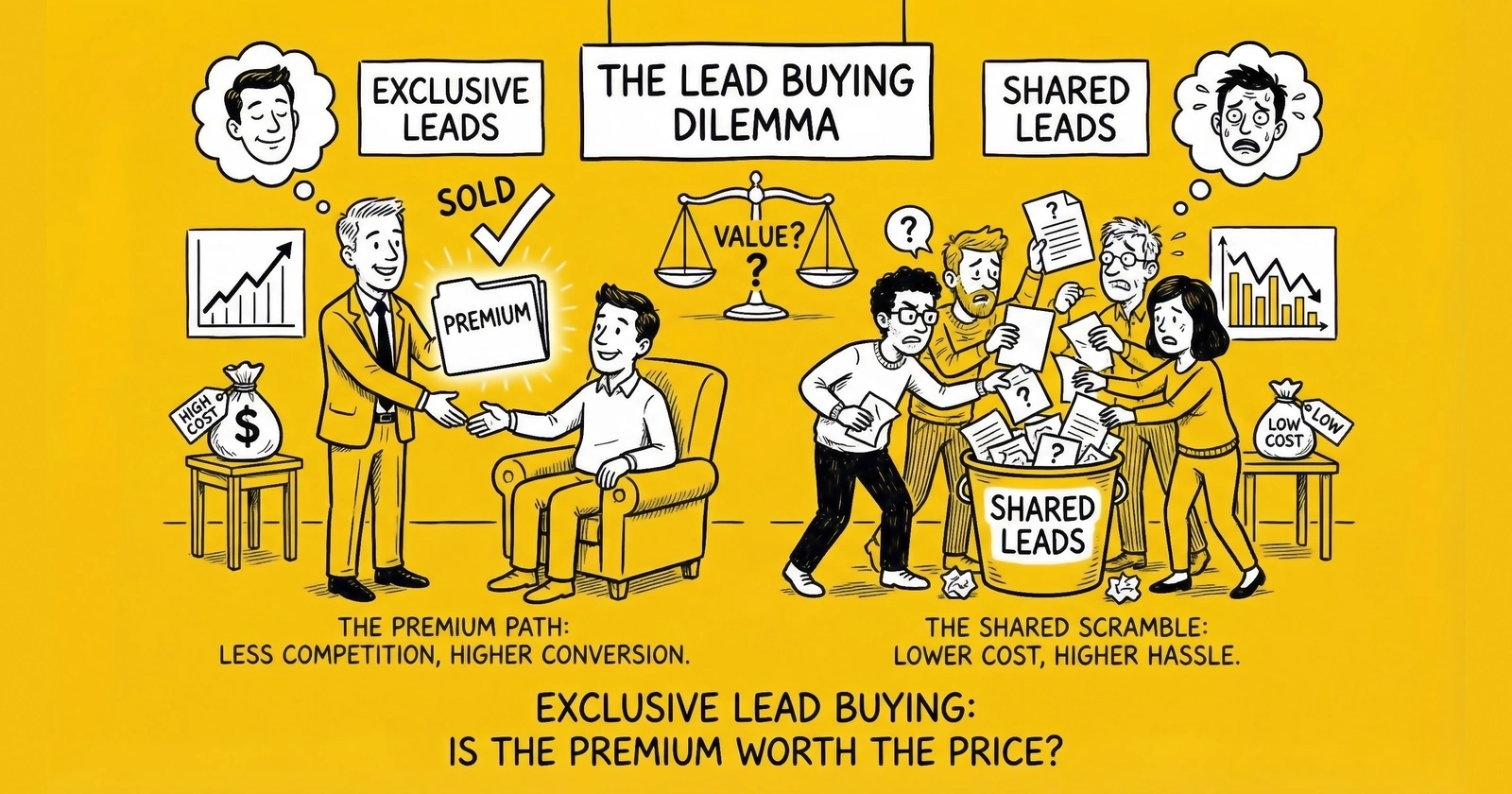
The complete buyer’s guide to understanding when exclusive leads deliver real ROI versus when you’re overpaying for a false sense of security.
Every lead buyer eventually faces the same question: should I pay 2-3x more for exclusive leads, or stretch my budget across higher volume shared leads? The answer matters more than most practitioners realize. Get it right, and you build sustainable customer acquisition economics. Get it wrong, and you either leave money on the table or burn through budget on leads that never had a chance.
After fifteen years of buying, selling, and distributing leads across insurance, mortgage, solar, and legal verticals, I can tell you the conventional wisdom is incomplete. “Exclusive is better” sounds logical, but the real answer depends on your operational capabilities, competitive position, and honest assessment of your sales infrastructure.
This guide breaks down the exclusive versus shared decision with the specificity it deserves. We will examine the actual economics, analyze when each approach makes sense, identify the hidden costs buyers overlook, and provide a framework for making this decision intelligently.
What Makes a Lead “Exclusive”
An exclusive lead sells to exactly one buyer. When a consumer fills out a comparison form for auto insurance quotes, an exclusive arrangement means their information goes to a single carrier or agent. That buyer has no direct competition for the contact. They are the only entity calling that specific consumer based on that specific form submission.
The term requires precision because the industry uses it loosely. True exclusivity means the lead never enters distribution to additional buyers at any point in its lifecycle. Some vendors sell “exclusive” leads that they later recycle into aged lead pools after 30-60 days. Others offer “semi-exclusive” arrangements where leads go to 2-3 buyers instead of 5-7. These distinctions affect economics significantly.
Shared leads, by contrast, sell to multiple buyers simultaneously. The typical shared lead in insurance goes to 3-5 buyers, though some high-volume comparison sites distribute to 7 or more. Each buyer receives identical information at approximately the same time, creating direct competition for who contacts the consumer first and converts them into a customer.
The pricing differential between exclusive and shared leads reflects this competitive dynamic. Exclusive auto insurance leads typically command $60-75 versus $20-30 for shared leads in the same vertical. Exclusive mortgage leads might run $100-150 while shared equivalents price at $40-60. The 2-3x pricing multiple is consistent across most consumer finance and home services verticals.
The Real Economics of Exclusive Leads
The case for exclusive leads starts with conversion mathematics. Industry data consistently shows exclusive leads converting at higher rates than shared leads, often 50-100% higher in comparable conditions. The explanation involves several interconnected factors.
Contact Rate Advantages
Exclusive leads eliminate the race-to-call dynamic that degrades consumer experience and frustrates conversion. When a prospect receives four phone calls within minutes of form submission, the third and fourth callers often reach someone who is already annoyed and disengaged. A single, prompt call from an exclusive buyer creates a more positive interaction that supports conversion.
Contact rates for exclusive leads typically run 50-55% compared to 40-50% for shared leads. This gap reflects both the improved consumer disposition and the fact that exclusive lead buyers can invest more effort in systematic follow-up sequences without feeling they are wasting effort on prospects being simultaneously pursued by competitors.
Conversion Rate Improvements
Beyond contact rates, exclusive leads convert at higher rates once contact is made. The absence of competition means the sales conversation starts from a stronger position. The consumer made one inquiry and received one response, matching their expectation for how the process should work.
When you pay $75 for a lead versus $15, you structure your follow-up differently. Exclusive lead buyers build comprehensive nurture sequences with thoughtful voicemails, personalized emails, and multiple contact attempts across channels. Shared lead buyers, by economic necessity, favor high-volume, low-touch approaches that sacrifice conversion rate for efficiency.
The data supports meaningful conversion differentials. In auto insurance, shared leads contacted in competitive races convert at 8-10% of contacts. Exclusive leads with dedicated follow-up convert at 12-16% of contacts. Similar patterns appear across mortgage, solar, and legal verticals.
Quality Correlation
Exclusive distribution often correlates with higher lead quality because publishers commanding exclusive pricing typically maintain stricter traffic quality standards. They cannot afford the reputational damage of delivering bad leads when buyers have clear attribution. If your shared lead from Source A performs poorly, it gets lost in the aggregate metrics alongside leads from Sources B through F. If your exclusive lead from Source A fails, the accountability is direct and immediate.
This creates positive selection effects. Publishers earning exclusive premiums invest more in traffic quality, validation, and consent documentation. The higher price point justifies the additional overhead. Shared lead economics, by contrast, often push publishers toward volume optimization at quality’s expense.
The Mathematics in Practice
Abstract economics only matter when translated into operational reality. Consider how two identical agencies might approach lead buying with the same monthly budget.
Shared Lead Scenario
Agency A allocates $20,000 monthly to shared auto insurance leads at $20 each. They purchase 1,000 leads distributed to 4-5 other agencies simultaneously.
- Leads purchased: 1,000
- Contact rate at 45%: 450 contacts
- Conversion rate at 8% of contacts: 36 sales
- Cost per sale: $556
Exclusive Lead Scenario
Agency B allocates the same $20,000 to exclusive leads at $55 each. They purchase 364 leads sold only to them.
- Leads purchased: 364
- Contact rate at 55%: 200 contacts
- Conversion rate at 14% of contacts: 28 sales
- Cost per sale: $714
At first glance, Agency A appears to win. They generated more total sales (36 vs 28) at a lower cost per sale ($556 vs $714). But this comparison ignores several factors that sophisticated buyers track.
The Complete Picture
Agency A’s 36 sales came from working 1,000 leads. Their sales team touched 1,000 records, attempted contact on all of them, and managed the complexity of rapid outreach against four competitors on each lead. The operational overhead is substantial.
Agency B’s 28 sales came from working 364 leads. Their sales team spent more time on fewer, higher-probability opportunities. The relationship-building possibility with each prospect was higher, and the sales experience was less transactional.
If average customer lifetime value is $2,000 and there is any correlation between acquisition experience and retention, Agency B’s customers may prove more valuable over time. Customers acquired through professional, relationship-oriented sales processes often retain better than those acquired through rapid-fire competitive races.
The calculation also ignores opportunity cost. Agency A’s sales team spent capacity on 1,000 leads. If exclusive leads allowed them to process the same 364 leads with better results and freed capacity for other activities, referral development, service quality, or expansion, the comparison shifts.
When Exclusive Leads Make Sense
Not every buyer should pursue exclusive leads. The right choice depends on operational realities, competitive positioning, and honest self-assessment.
Limited Speed-to-Contact Infrastructure
If your operation cannot consistently contact leads within 60-90 seconds, shared leads become problematic. Research from Velocify demonstrates that leads contacted within the first minute convert 391% better than those contacted later. The five-minute rule is fundamental to lead economics. The Lead Connect Survey found that 78% of customers purchase from the first responder.
When five buyers compete on a shared lead, position matters more than quality. The buyer with the fastest dialer and the most available agents wins, regardless of whether they offer the best product or provide the best service. If your infrastructure positions you as caller number three or four, you are competing for the 22% of customers who did not buy from someone faster.
Exclusive leads neutralize speed disadvantage. You are competing against the consumer’s inertia and alternative information sources, not against four simultaneous callers with faster dialers.
Relationship-Based Sales Models
Some sales processes thrive on relationship development rather than transactional efficiency. Insurance agents who build multi-policy relationships, mortgage brokers who guide clients through complex financial decisions, or solar consultants who conduct detailed property assessments all benefit from the depth that exclusive leads enable.
These sales processes require time. You cannot build a comprehensive insurance relationship in a 3-minute race against competitors. You cannot properly qualify a mortgage applicant while rushing to beat another caller. Exclusive leads create space for the consultative approach that complex products require.
Lower Volume, Higher Margin Operations
Small agencies, independent agents, and boutique operations often lack the infrastructure to efficiently process high lead volumes. They have two agents, not twenty. They can work 50 leads per week carefully, not 500 leads hastily.
For these operators, exclusive leads match capacity to quality. Fewer leads, worked more thoroughly, producing conversion rates that justify premium pricing. The alternative, flooding a small team with shared leads they cannot possibly work effectively, wastes money and frustrates staff.
Geographic or Niche Focus
Buyers with narrow targeting benefit disproportionately from exclusive arrangements. If you only serve three zip codes, or only write commercial policies over $10,000, or only work specific case types, the shared lead pool for your specifications may be limited anyway.
In narrow markets, you are often competing against the same 2-3 other specialists repeatedly. Exclusive arrangements remove that repetitive competition and let you work your niche without constant races against familiar competitors.
When Shared Leads Make Sense
The exclusive versus shared decision is not simply “exclusive is better.” Shared leads dominate many high-performing operations for legitimate reasons.
Sophisticated Call Center Operations
Large carriers like Progressive and GEICO built direct sales models on high-volume shared lead acquisition. Their infrastructure supports this approach through technology investments that enable sub-30-second response times, predictive dialers that ensure agents are calling before competitors finish receiving the lead, training systems that optimize quick-close techniques, and scale that provides diversification against individual lead quality variation.
If you can consistently be the first caller and you have trained your team for high-velocity sales conversations, shared leads provide superior economics. The lower per-lead cost stretches budget further, and the speed advantage converts competitive pressure into market share gains.
Testing and Market Entry
New market entrants benefit from shared lead volume during learning phases. When you do not yet know which lead sources perform best, which geographic areas convert highest, or which lead attributes predict success, higher volume provides faster feedback loops.
Paying exclusive premiums during testing phases means slower learning. A $20,000 test budget buys 1,000 shared leads or 350 exclusive leads. The larger dataset reveals patterns faster, even if individual lead quality is lower.
Price-Sensitive Customer Segments
Some customer segments respond better to rapid outreach and competitive pricing than to relationship-oriented sales processes. A price shopper looking for the cheapest auto insurance wants quick quotes from multiple sources. They entered a comparison site expecting multiple calls. The shared lead experience matches their shopping behavior.
Exclusive approaches that emphasize relationship-building may frustrate these customers. They want transaction efficiency, not consultation. Shared lead economics support the low-touch, high-velocity approach these customers prefer.
Capacity Utilization Optimization
Operations with variable capacity benefit from shared lead volume during low-utilization periods. If your call center has unused capacity at certain hours or days, filling that capacity with lower-cost shared leads makes sense even if per-lead conversion is lower.
The marginal cost of working an additional shared lead, when agents are already staffed and available, is minimal. As long as the lead covers its own cost and contributes to fixed expense coverage, volume helps.
Hidden Costs of Exclusive Leads
The case for exclusive leads often ignores costs that emerge in operational reality.
Opportunity Cost of Lower Volume
Every dollar spent on exclusive leads is a dollar not spent on volume. If exclusive leads cost 2.5x shared leads, you are buying 60% fewer leads. Even with higher conversion rates, total sales may be lower.
For growth-focused operations, this opportunity cost matters. Building market share often requires volume presence. Sacrificing volume for per-lead quality may slow growth below strategic requirements.
Return and Rejection Complexity
Exclusive leads create cleaner attribution but messier disputes. When a lead fails, the accountability is binary. Either the lead was bad (seller’s fault) or you failed to convert (your fault). This clarity sounds good until you realize that return negotiations become more contentious.
With shared leads, underperformance blends into aggregate metrics. A 10% return rate across a shared lead pool is manageable. A single bad exclusive lead at $75 creates immediate friction.
Quality Variability Exposure
Exclusive lead quality varies more than shared lead quality at the source level. A shared lead distributor aggregates multiple sources, smoothing quality variation. An exclusive lead relationship concentrates exposure to a single source’s quality fluctuations.
If your exclusive source has a bad week, whether due to traffic quality issues, system problems, or operational challenges, your entire lead flow suffers. Shared lead buyers drawing from multiple sources experience less acute quality disruption.
Premium Pricing Without Premium Results
Some sellers charge exclusive premiums for leads that do not deliver exclusive-level performance. The label “exclusive” does not guarantee quality. Traffic could be low-intent, validation could be minimal, and consent could be questionable.
Due diligence on exclusive lead sources requires more effort precisely because you are concentrating spend. Vetting five shared lead sources at $20 each matters less than vetting one exclusive source at $75. Our guide on evaluating lead vendors provides a framework for this assessment. The exclusive relationship carries more risk if the vetting is inadequate.
Evaluating Exclusive Lead Sources
Before committing premium pricing to exclusive leads, systematic evaluation protects your investment.
Conversion Performance Tracking
Track conversion rates by source over meaningful time periods. Short-term performance variation is normal; pattern recognition requires at least 100-200 leads from any source before drawing conclusions.
Compare exclusive source performance against your shared lead baseline. If exclusive leads are supposed to convert 50-100% higher, verify that they actually do. Some sources charge exclusive premiums while delivering shared-lead performance.
Contact Rate Analysis
Exclusive leads should deliver higher contact rates if they are truly fresh and of higher quality. Monitor contact rate differential between exclusive and shared sources. If contact rates are similar, the premium may not be justified.
Phone validation, in particular, matters more for exclusive leads. At $75 per lead, every disconnected number costs significantly more than at $20 per lead. Demand verification of phone validation practices before committing to exclusive arrangements.
Consent Documentation Quality
TCPA litigation risk applies more acutely to exclusive leads because attribution is clear. If a TCPA claim arises from a lead, the source of that lead is unambiguous in exclusive arrangements.
Require TrustedForm certificates or equivalent consent documentation for exclusive leads. The 2024 TCPA litigation volume of 2,788 cases, up 67% year-over-year, with average settlements exceeding $6.6 million makes consent documentation non-optional. Exclusive lead sources should provide robust consent evidence as a baseline requirement.
Return Policy Terms
Exclusive leads typically come with shorter return windows and stricter return criteria than shared leads. Understand these terms before purchasing. A 24-hour return window for exclusive leads means you must contact and evaluate the lead within one business day, which may not align with your operational rhythm.
Negotiate return terms that match your reality. If you cannot work leads on weekends, ensure weekend lead purchases do not start the return clock until Monday.
Building a Hybrid Strategy
The most sophisticated lead buyers avoid the exclusive-versus-shared binary entirely. They build hybrid strategies that deploy each lead type where it performs best.
Premium Leads for Premium Prospects
Route exclusive leads to your best closers handling high-value opportunities. If a lead matches ideal customer profile criteria, credit score above 720, property value above $500,000, coverage needs exceeding $500 annually, the premium pricing for exclusivity makes sense. These prospects justify investment because their lifetime value supports higher acquisition costs.
Volume Leads for Capacity Utilization
Use shared leads to maintain team productivity during slower periods and to build market presence in developing territories. Shared leads keep the pipeline full and the team engaged, even when premium opportunity flow is limited.
Source Diversification
Maintain relationships across exclusive and shared sources to avoid concentration risk. If your exclusive source has supply constraints or quality issues, shared lead fallback maintains continuity. If shared lead competition intensifies, exclusive alternatives provide escape valves.
Performance-Based Rebalancing
Continuously analyze economics by lead type and source. When exclusive leads outperform sufficiently to justify their premium, increase allocation. When shared leads deliver better cost-per-sale, shift budget accordingly. The optimal mix changes over time as market conditions, source quality, and your operational capabilities evolve.
Speed-to-Contact Reality Check
Any discussion of exclusive versus shared leads must address speed-to-contact because it determines which approach matches your capabilities.
The data is unambiguous. Research demonstrates that leads contacted within one minute convert 391% better. Teams calling within five minutes are 100 times more likely to connect than those waiting an hour. First responders win 78% of the time.
Yet Drift research found only 7% of companies respond to inbound leads within five minutes. More than half fail to respond within five business days. This gap between best practice and typical practice creates the strategic context for exclusive lead decisions.
If you are in the 7% who respond within five minutes, shared leads often outperform. Your speed advantage converts competitive pressure into wins. The lower per-lead cost maximizes the value of your operational excellence.
If you are in the 93% who respond slower, exclusive leads neutralize your disadvantage. You are not competing against faster callers. You are competing against consumer inertia. That is a different, often easier, competition to win.
Honest self-assessment matters more than aspiration. If your speed-to-contact averages 15 minutes, do not assume you will suddenly achieve 60 seconds. Build strategy around your actual capabilities while working to improve them.
Vertical-Specific Considerations
Exclusive versus shared economics vary by vertical, reflecting differences in sales cycles, competitive dynamics, and customer behavior.
Auto Insurance
The auto insurance vertical features the highest contact rates (45-55%) and most competitive speed-to-call environments. Large carriers with sophisticated call centers thrive on shared leads. Independent agents and smaller agencies typically prefer exclusive arrangements to avoid competing against Progressive’s sub-30-second response times.
Exclusive auto leads typically command $60-75 versus $15-25 for shared. The 2.5-3x multiple reflects intense carrier competition for quality traffic.
Mortgage
Mortgage leads involve longer sales cycles and more complex qualification. The consultative nature of mortgage sales favors exclusive leads for most buyers. Borrowers navigating rate comparisons, document requirements, and closing timelines benefit from relationship-oriented service that exclusive leads enable.
Exclusive mortgage leads price at $100-150 for well-qualified prospects, with shared alternatives at $40-60. Rate sensitivity in 2024-2025 has compressed volumes but maintained price discipline.
Solar
Solar sales require property qualification, site assessment, and financing discussion. The multi-touch sales process aligns poorly with shared lead racing. Most successful solar lead buyers prefer exclusive arrangements or live transfer models that guarantee contact.
Geographic arbitrage opportunities in solar create additional exclusive lead value. Customer acquisition costs vary 8.5x between high-incentive and low-incentive states. For more on solar economics, see our solar lead generation guide. Exclusive leads in favorable geographies justify significant premiums.
Legal
Personal injury and mass tort leads represent the highest CPL verticals, with exclusive leads reaching $300-500 for quality intake-ready cases. The legal vertical’s ethical requirements and case screening complexity favor exclusive arrangements almost universally.
Shared legal leads exist but typically serve high-volume intake operations with sophisticated screening processes. Most law firms and legal marketing agencies strongly prefer exclusive distribution.
Making the Decision
The exclusive versus shared decision ultimately requires answering several honest questions about your operation.
What is your realistic speed-to-contact capability?
Measure actual performance, not aspirational targets. If your average time-to-first-dial exceeds 5 minutes, shared leads carry significant disadvantage.
What is your sales team structure?
Large call centers with predictive dialers and available agent pools can compete on shared leads effectively. Small teams without dedicated lead-working capacity typically perform better with exclusive leads.
What is your customer relationship model?
Transactional sales to price-focused customers align with shared lead economics. Relationship-based sales to value-focused customers benefit from exclusive lead depth.
What are your volume requirements?
Growth-focused operations may need shared lead volume to build market presence. Profitability-focused operations may prefer exclusive lead quality to maximize return on limited budget.
What is your risk tolerance for concentration?
Exclusive leads concentrate spend with fewer sources. Shared leads diversify across multiple sources. Your comfort with concentration risk should influence allocation.
Real Talk: The Uncomfortable Truth
The exclusive lead premium is not always justified. Some buyers pay 2-3x more for exclusive leads and achieve only 30-40% better conversion, a negative ROI on the premium. Others pay the premium and discover their “exclusive” leads were resold after 30 days, undermining the entire value proposition.
The vendors selling exclusive leads have incentive to emphasize their advantages. The actual performance varies enormously based on source quality, lead attributes, and buyer capabilities. The premium is sometimes worth it and sometimes not.
The sophisticated approach treats exclusive versus shared as an empirical question, not a philosophical position. Test both approaches with adequate sample sizes. Track performance rigorously by source and lead type. Let data drive allocation rather than assumption.
What vendors and partners will not tell you: exclusive leads fail at meaningful rates too. Contact rates of 55% mean 45% of prospects never answer. Conversion rates of 14% mean 86% of contacts do not purchase. The premium pricing does not eliminate failure; it reduces failure rates and increases per-success economics.
Key Takeaways
-
Exclusive leads typically command 2-3x the pricing of shared leads, with pricing multiples of $60-75 versus $20-30 for auto insurance and similar ratios across verticals.
-
Conversion rate advantages for exclusive leads run 50-100% higher than shared leads in comparable conditions, driven by improved contact rates, reduced consumer fatigue, and higher sales effort per lead.
-
Speed-to-contact capability determines which approach fits your operation. Organizations responding within 60 seconds often outperform with shared leads, while slower responders benefit from exclusive arrangements.
-
Sophisticated buyers build hybrid strategies that deploy exclusive leads for premium prospects and shared leads for volume, capacity utilization, and market testing.
-
The exclusive premium is not automatically justified. Rigorous performance tracking by source and lead type reveals whether the premium delivers sufficient conversion improvement to generate positive ROI.
-
Source evaluation matters more for exclusive leads because spend concentration increases risk. Demand consent documentation, phone validation evidence, and clear return policies before committing premium pricing.
-
Vertical dynamics affect the calculation. Auto insurance features intense speed competition favoring scale operators on shared leads. Mortgage, solar, and legal typically favor exclusive arrangements due to longer sales cycles and consultative requirements.
Frequently Asked Questions
What is an exclusive lead?
An exclusive lead is consumer information sold to exactly one buyer. When someone submits an insurance quote request, an exclusive lead arrangement means their information goes to a single agent or carrier who has no direct competition from other buyers working the same inquiry. This differs from shared leads, which typically sell to 3-7 buyers simultaneously. The exclusivity applies to that specific form submission; the consumer may have submitted forms elsewhere, but each lead source honors exclusivity within their distribution.
How much more do exclusive leads cost compared to shared leads?
Exclusive leads typically cost 2-3 times more than shared leads in the same vertical. Auto insurance exclusive leads price at $60-75 versus $20-30 for shared. Mortgage exclusive leads run $100-150 versus $40-60 for shared. The premium reflects reduced buyer competition and typically higher lead quality from publishers who can maintain stricter standards when commanding higher prices.
Do exclusive leads actually convert better than shared leads?
Yes, industry data consistently shows exclusive leads converting 50-100% higher than shared leads when other factors are comparable. This improvement stems from multiple factors: higher contact rates (50-55% versus 40-50%), improved consumer disposition when receiving one call instead of four or five, and greater sales effort per lead when economics justify relationship-building approaches. However, total sales volume from the same budget may still favor shared leads depending on operational capabilities.
When should I buy exclusive leads instead of shared leads?
Consider exclusive leads when your speed-to-contact averages more than 5 minutes (eliminating your speed disadvantage), when your sales model emphasizes relationship-building over transaction efficiency, when your team capacity limits how many leads you can work effectively, or when you serve narrow geographic or specialty niches where the shared lead pool is limited anyway. The decision should align with honest assessment of your operational reality, not aspirational capabilities.
How do I know if my exclusive leads are truly exclusive?
Verify exclusivity policies directly with your lead source. Ask specifically whether leads are ever resold to aged lead pools after a certain period (30-60 days is common), whether “exclusive” means sold to one buyer or means “semi-exclusive” sold to 2-3 buyers, and whether the source operates other brands or properties that might generate leads from the same consumers. Request written confirmation of exclusivity terms in your contract.
What return policies should I expect for exclusive leads?
Exclusive lead return windows are typically shorter than shared leads, often 24-72 hours versus 5-7 days. Acceptable return reasons usually include invalid contact information (disconnected phone, bouncing email), duplicate leads already in your system, and filter criteria mismatches where leads do not match your specified targeting. Return policies should be clarified in writing before purchasing, with particular attention to how weekend purchases are handled if your operation does not work weekends.
How does speed-to-contact affect the exclusive versus shared decision?
Speed-to-contact is the single most important variable in this decision. Research shows first responders win 78% of the time on shared leads, and leads contacted within one minute convert 391% better than those contacted later. If you can consistently respond within 60 seconds, shared leads may deliver better economics because your speed advantage converts competitive pressure into wins. If you cannot compete on speed, exclusive leads neutralize the disadvantage by eliminating the competition entirely.
Can I mix exclusive and shared leads in my buying strategy?
Yes, hybrid strategies often outperform exclusive-only or shared-only approaches. Sophisticated buyers deploy exclusive leads for premium prospects matching ideal customer profiles, use shared leads for capacity utilization and market testing, and maintain diversified source relationships across both types. The optimal mix evolves over time based on performance data, operational capabilities, and market conditions.
What should I track to evaluate exclusive lead performance?
Track conversion rate, contact rate, and cost-per-sale separately for exclusive versus shared leads. Compare exclusive lead sources against your shared lead baseline to verify the premium delivers sufficient conversion improvement. Monitor return rates by source, as exclusive lead quality varies significantly between providers. Track these metrics over at least 100-200 leads before drawing conclusions, as short-term variation is normal.
Are exclusive leads better for certain industries?
Yes, vertical dynamics significantly affect the calculation. Auto insurance features intense speed competition where large carriers with sophisticated call centers often outperform on shared leads. Mortgage, solar, and legal verticals involve longer sales cycles and consultative requirements that favor exclusive leads for most buyers. Medicare leads face strict CMS compliance requirements that make consent documentation (more robust in exclusive arrangements) particularly important.
Sources
- ActiveProspect TrustedForm - Consent verification platform providing documentation for TCPA compliance
- National Do Not Call Registry - FTC-administered registry for consumers opting out of telemarketing
- TCPA Statute (47 U.S.C. 227) - Telephone Consumer Protection Act statutory text governing telemarketing calls
Statistics and industry data current as of late 2025. Lead prices, conversion rates, and market conditions shift continuously. Validate current benchmarks before making significant purchasing decisions.