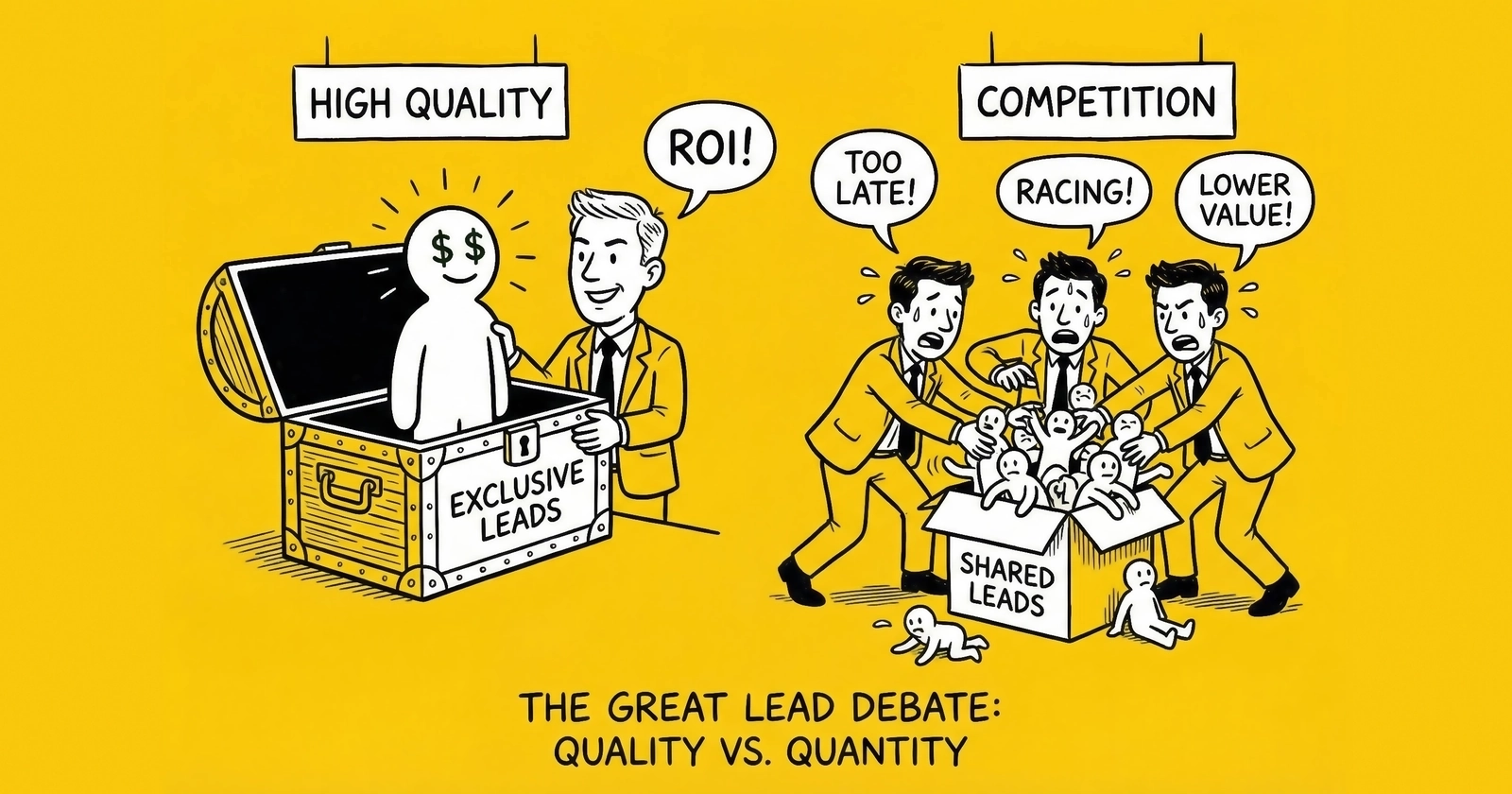
Every lead buyer faces the same fundamental decision: pay premium prices for exclusive access to a prospect, or accept lower prices knowing competitors receive the same information simultaneously. This choice shapes your contact rates, conversion performance, and ultimately your cost per acquisition.
The math appears simple. Exclusive leads cost 2-3x more than shared leads. Shared leads go to 3-7 competing buyers. But the real economics depend on your speed-to-contact infrastructure, sales capacity, and vertical dynamics. Get this decision wrong and you either overpay for exclusivity you cannot capitalize on, or underpay for shared leads where you consistently lose to faster competitors.
This guide breaks down the pricing structures, performance differentials, and ROI calculations that determine which lead type fits your operation.
What Are Exclusive Leads?
An exclusive lead is consumer information sold to exactly one buyer. When a consumer submits an inquiry through a lead generation form, that information goes to a single company – no other buyer receives it, contacts it, or knows it exists.
Exclusivity creates a protected window for engagement. The buyer can call, email, or text the prospect without competing against other companies who received the same information at the same time. The consumer receives one call rather than seven. This reduces the “lead bombardment” experience that damages contact rates industry-wide.
How Exclusive Lead Distribution Works
The technical process follows a straightforward path. A consumer completes a lead form on a publisher website or comparison platform. The lead management system validates the data – phone verification, email deliverability, address confirmation. Once validated, the system routes the lead to a single buyer based on predefined criteria: geography, capacity, price agreement, or real-time auction result.
The buyer receives the lead through API delivery, CRM integration, or portal access. From submission to delivery typically takes under 30 seconds. The buyer’s sales team initiates contact – ideally within one minute, as research shows leads contacted within one minute convert 391% better. The five-minute rule is foundational to understanding lead economics.
The exclusive buyer knows they have first-mover advantage. No competitor is racing to reach the same prospect. This allows for more strategic follow-up sequences rather than frantic speed-dialing.
What Exclusive Lead Pricing Looks Like
Exclusive leads command premium pricing across all verticals. The typical premium runs 2-3x the shared lead price for equivalent quality and targeting.
Insurance verticals demonstrate this clearly. Shared auto insurance leads trade at $15-25 per lead. Exclusive auto insurance leads command $55-75 for the same consumer profile. The exclusive buyer pays more but faces no competition for that prospect’s attention.
Mortgage leads show similar dynamics. Shared purchase leads trade at $20-50. Exclusive purchase leads range from $50-300 depending on geography, credit profile, and loan amount. California coastal markets command the premium end; Midwest markets trade lower.
Legal leads exhibit the widest spreads. Exclusive personal injury leads range from $200-400 for quality traffic, with premium leads exceeding $600-800. Shared personal injury leads might trade at $60-150.
The premium reflects the value of exclusivity: higher contact rates, reduced competition, and better consumer experience.
What Are Shared Leads?
A shared lead is consumer information sold to multiple buyers simultaneously. When a consumer submits an inquiry, that same information goes to 3-7 competing companies – sometimes more in aggressive verticals.
Each buyer pays less per lead than exclusive pricing. The lead generator collects revenue from multiple buyers for the same consumer submission, often exceeding total exclusive revenue. A $75 exclusive lead might generate $15 each from five buyers for $75 total – or the generator might sell to seven buyers at $12 each for $84 total.
How Shared Lead Distribution Works
The distribution mechanics differ from exclusive routing. When a validated lead enters the system, the routing logic identifies all qualified buyers – those whose geographic coverage, capacity limits, and filter criteria match the lead attributes.
The system then posts the lead to all qualifying buyers simultaneously or in rapid succession. Each buyer receives identical information at nearly the same moment. The race begins immediately: whichever buyer contacts the consumer first captures the dominant advantage.
Research from the Lead Connect Survey found that 78% of customers purchase from the first company that responds to their inquiry. In shared lead scenarios, this means 78% of value accrues to the fastest responder. The remaining buyers compete for 22% of potential conversions.
Typical Distribution: 3-7 Buyers
Most lead generators sell shared leads to 3-7 buyers. This range balances revenue maximization against buyer satisfaction and consumer experience.
Fewer than three buyers reduces revenue potential without providing meaningful exclusivity benefits. More than seven buyers typically degrades the experience enough that contact rates and conversions suffer for everyone – leading to higher return rates and buyer complaints.
The exact number varies by vertical. Insurance leads commonly sell to 4-5 buyers. Home services leads might go to 6-7. Solar leads often stay at 3-4 given the longer sales cycles and higher individual lead values.
Some aggressive generators sell to 8-10 or more buyers. This maximizes short-term revenue but typically damages buyer relationships and increases the pool of dissatisfied consumers – leading to higher complaint rates and potential compliance issues.
Pricing Differences: The 2-3x Premium
The exclusive premium exists because exclusivity delivers measurable performance advantages. Buyers pay more because they get better results – higher contact rates, better conversion rates, and improved customer experience.
Why Exclusive Leads Cost More
Scarcity drives value. An exclusive lead can only be sold once. The lead generator sacrifices potential revenue from additional buyers in exchange for the premium price. If shared distribution to five buyers would generate $75, the generator needs at least $75 from the exclusive buyer to maintain revenue – plus a margin to compensate for buyer concentration risk.
Quality signaling matters. Generators who offer exclusive leads typically implement higher quality standards. Buyers paying premium prices expect premium results. This creates positive selection: exclusive programs often feature better validation, stricter source controls, and more rigorous filtering than shared programs.
Operational costs increase. Exclusive programs require tighter quality control (10-15% of leads rejected to maintain standards), dedicated account management, and capacity matching infrastructure. The generator cannot oversell – if buyer capacity is 200 leads but production hits 300, the excess has no exclusive home.
Pricing by Vertical
The specific premium varies by vertical economics:
| Vertical | Shared Price Range | Exclusive Price Range | Typical Premium |
|---|---|---|---|
| Auto Insurance | $15-25 | $55-75 | 2.5-3x |
| Home Insurance | $20-35 | $60-100 | 2-3x |
| Life Insurance | $25-45 | $75-150 | 2.5-3.5x |
| Mortgage (Purchase) | $20-50 | $50-300 | 2-6x |
| Solar | $40-80 | $95-150 | 2-2.5x |
| Personal Injury | $60-150 | $200-400+ | 2.5-4x |
| Family Law | $30-90 | $100-300 | 2.5-3.5x |
These ranges represent quality leads with proper validation and consent documentation. Aged leads, partial data, or questionable sources trade at significant discounts.
Conversion Rate Comparison: Exclusive vs Shared Performance
The performance differential between exclusive and shared leads follows predictable patterns. Exclusive leads convert better – but the margin varies by vertical, speed-to-contact capability, and sales process sophistication.
How Much Better Do Exclusive Leads Convert?
Industry data suggests exclusive leads convert 15-40% better than shared leads of equivalent quality, depending on vertical and operational factors.
The improvement comes from multiple sources:
Consumer experience matters. A prospect contacted by one company has a different experience than one contacted by five. The exclusive scenario feels like responsive service. The shared scenario feels like harassment. Consumer receptivity declines with each additional call.
Speed pressure reduces quality. Shared lead buyers prioritize speed over conversation quality. The first caller wins regardless of their pitch quality. This creates incentive for rapid-fire dialing over thoughtful engagement. Exclusive buyers can take thirty additional seconds to review the lead before calling – improving the quality of initial contact.
Follow-up sequences work better. Shared lead buyers often abandon prospects after initial contact fails. Why invest in nurture sequences when competitors will keep calling? Exclusive buyers can deploy multi-touch sequences knowing no competitor will interrupt the relationship.
Vertical-Specific Conversion Differentials
Insurance: Exclusive leads typically show 15-25% higher quote rates and 20-30% higher bind rates compared to shared leads of equivalent quality. The improvement is most pronounced for complex products (life insurance, commercial lines) where consultative selling matters more than speed.
Mortgage: Exclusive leads show 25-40% higher application rates. The longer sales cycle (30-90 days from inquiry to funded loan) rewards sustained nurture – difficult to maintain when competitors keep calling the same prospect.
Solar: Exclusive leads convert 20-35% better in this consultation-heavy vertical. Solar sales require in-home appointments and multiple touchpoints. Shared leads often burn out before reaching appointment stage.
Legal: Exclusive leads show 15-30% higher case acceptance. The professional nature of attorney-client relationships makes multi-vendor contact particularly damaging to conversion.
Contact Rate Differences: The First-Mover Advantage
Contact rate – the percentage of leads where you successfully reach the prospect – may be the most important metric in shared vs exclusive analysis. Everything downstream depends on making contact.
Exclusive Lead Contact Rates: 60-80%
Exclusive leads typically achieve 60-80% contact rates depending on vertical, speed-to-contact, and data quality. The absence of competing callers creates significant advantages:
Consumers answer unfamiliar numbers. A prospect expecting a call about their insurance inquiry is more likely to answer an unknown number. That expectation dissipates after the first few calls from competitors.
Voicemail callbacks work. An exclusive buyer leaving a voicemail often receives callbacks – the consumer remembers submitting the inquiry and recognizes the message as relevant. With shared leads, voicemails from multiple vendors create confusion about which company to call back.
Multi-channel contact succeeds. Email and SMS work better when the consumer isn’t simultaneously receiving messages from competitors. The exclusive buyer’s text feels like service; the shared buyer’s text feels like spam.
Shared Lead Contact Rates: 40-60%
Shared leads show contact rates of 40-60% – sometimes lower in aggressive verticals where leads sell to 6+ buyers.
The degradation follows predictable patterns:
First caller captures most value. The 78% first-responder statistic means most shared lead value accrues to whoever dials fastest. If you are not consistently the first caller, your contact rates will be substantially lower than the leader.
Consumer fatigue sets in quickly. By the third or fourth call, many consumers stop answering. They have already spoken with someone or decided the experience is too aggressive. Late callers contact an increasingly resistant prospect pool.
Bad experiences poison the well. One aggressive or unprofessional caller damages receptivity for everyone. The consumer who receives a hard-sell pitch from Buyer A is less likely to engage professionally with Buyer B.
What This Means for Your Operation
If your infrastructure ensures you are consistently the first caller on shared leads, shared economics may work. Some operations invest heavily in speed – dedicated dialers, instant lead alerts, response time under 30 seconds – specifically to win the shared lead race.
If you cannot guarantee first-caller status, exclusive leads offer better contact rate economics despite higher prices. Paying 2.5x for a lead that contacts 70% of the time versus 45% of the time may represent better unit economics.
Which Lead Type Is Right for Your Business?
The exclusive vs shared decision depends on your operational capabilities, capital position, and growth strategy. Neither choice is universally correct.
When to Buy Exclusive Leads
Your speed-to-contact cannot compete. If your sales team cannot consistently respond within 60 seconds, shared leads systematically disadvantage you. Exclusive leads remove the speed race, allowing effective performance at 2-5 minute response times.
Your sales process requires consultation. Complex products – life insurance, solar installations, legal services – benefit from unhurried conversations. Exclusive leads enable consultative selling without competitors interrupting the relationship.
Quality matters more than quantity. Operations focused on conversion optimization rather than volume maximization often find exclusive leads deliver better ROI despite higher CPL.
Your buyers demand exclusivity. Some end buyers (the companies purchasing leads for their own use) refuse shared leads entirely. They’ve experienced the competition dynamics and concluded the contact rate degradation isn’t worth the savings.
When to Buy Shared Leads
Your speed infrastructure is unbeatable. Operations with sub-30-second response times, dedicated inbound dialers, and optimized routing can win the shared lead race consistently. If you’re reliably first, you capture 78% of value at 40% of cost.
Your volume requirements exceed exclusive supply. Exclusive lead supply is inherently constrained – each consumer inquiry generates only one lead. High-volume operations may need shared leads to hit scale requirements.
Your vertical favors transactional decisions. Some products don’t require consultation. A consumer shopping auto insurance may happily take the first reasonable quote they receive. Speed-focused shared lead strategies can work in transactional verticals.
Your margins require lower CPL. Early-stage operations with tight capital may find shared leads necessary to achieve unit economics during growth phases.
Decision Framework Questions
Answer these questions to guide your choice:
- What is your average speed-to-contact? (Under 60 seconds favors shared; over 2 minutes favors exclusive)
- What percentage of first contacts result in meaningful conversation? (High rates suggest exclusive value is being captured)
- Can you track which caller position you achieve on shared leads? (If not, you cannot optimize for it)
- Does your product require multiple touchpoints to close? (Yes favors exclusive)
- What is your current contact rate? (Below 50% suggests exclusive may improve economics)
Semi-Exclusive and Hybrid Models
The market has developed intermediate options between pure exclusive and fully shared distribution. These semi-exclusive and hybrid models offer compromise positions for specific use cases.
What Are Semi-Exclusive Leads?
Semi-exclusive leads sell to 2-3 buyers rather than 1 (exclusive) or 5-7 (shared). The consumer information goes to a limited set of competitors – enough to generate additional revenue for the lead generator, but few enough to preserve meaningful first-mover opportunities.
Pricing typically falls at 60-80% of exclusive rates. A lead that would cost $100 exclusive might trade at $65-80 semi-exclusive.
The performance sits between categories. Contact rates typically run 50-70% – better than fully shared, worse than exclusive. Conversion rates show similar intermediate performance.
Semi-exclusive works for buyers who want less competition but cannot justify full exclusive pricing – or for lead generators who want to maximize revenue without destroying buyer satisfaction through aggressive multi-selling.
Hybrid Distribution Models
Some operations use hybrid approaches that vary distribution by lead quality or buyer tier:
Quality-tiered distribution. Premium leads (high validation scores, strong intent signals) sell exclusive. Standard leads sell shared. Buyers can choose their tier based on quality and price preferences.
Time-based exclusivity. Leads sell exclusive for 24-48 hours, then revert to shared distribution. The exclusive buyer gets first-mover advantage; remaining leads generate additional revenue.
Buyer-specific exclusivity. Top-tier buyers receive exclusive access for leads matching their specifications. Leads not matching premium buyer criteria sell shared.
Auction-determined exclusivity. Real-time bidding determines distribution. A buyer willing to pay exclusive pricing receives exclusive access. No premium bid triggers shared distribution to multiple buyers.
Negotiating Hybrid Arrangements
Sophisticated lead buyers negotiate custom distribution terms:
- “I will pay exclusive pricing for leads matching these specific filters – homeowner, credit score above 700, specific geographies – and shared pricing for leads outside those criteria.”
- “I want 48-hour exclusivity before you sell to other buyers. I will pay 80% of exclusive pricing for that window.”
- “Give me first look at all leads in my territory. If I pass within 10 seconds, you can sell shared.”
These arrangements require platform sophistication and relationship depth. They are not available from all lead sources but represent optimization opportunities for experienced buyers.
Calculating True ROI for Each Model
The exclusive vs shared decision ultimately comes down to ROI calculation. Higher CPL does not mean worse economics if conversion performance improves proportionally.
ROI Framework: Cost Per Acquisition Analysis
The fundamental calculation is cost per acquisition (CPA) – total lead cost divided by resulting sales. This incorporates both lead price and conversion performance.
Formula: CPA = Lead Cost / (Contact Rate x Conversion Rate)
Lower CPA represents better economics, regardless of whether it comes from lower lead prices or higher conversion rates.
Worked Example: Insurance Leads
Consider an auto insurance operation evaluating exclusive vs shared leads:
Shared Lead Scenario:
- Lead cost: $20
- Contact rate: 45%
- Conversion rate (quote to bind): 15%
- Effective conversion: 45% x 15% = 6.75%
- CPA: $20 / 0.0675 = $296
Exclusive Lead Scenario:
- Lead cost: $60
- Contact rate: 72%
- Conversion rate (quote to bind): 18%
- Effective conversion: 72% x 18% = 12.96%
- CPA: $60 / 0.1296 = $463
In this scenario, shared leads deliver better CPA despite lower contact rates. The 3x price premium for exclusive leads is not offset by the performance improvement.
Modified Exclusive Scenario (Strong Sales Team):
- Lead cost: $60
- Contact rate: 75%
- Conversion rate (quote to bind): 25%
- Effective conversion: 75% x 25% = 18.75%
- CPA: $60 / 0.1875 = $320
With stronger conversion performance on exclusive leads, the economics shift. This operation would pay $24 more per acquisition for exclusive leads – but might value the better consumer experience, reduced complaints, and higher policy quality.
Worked Example: Solar Leads
Solar has longer sales cycles and higher per-sale values, changing the calculus:
Shared Lead Scenario:
- Lead cost: $60
- Contact rate: 40%
- Appointment rate: 20%
- Close rate: 25%
- Effective conversion: 40% x 20% x 25% = 2.0%
- CPA: $60 / 0.02 = $3,000
Exclusive Lead Scenario:
- Lead cost: $120
- Contact rate: 70%
- Appointment rate: 35%
- Close rate: 30%
- Effective conversion: 70% x 35% x 30% = 7.35%
- CPA: $120 / 0.0735 = $1,633
The exclusive leads cost 2x more but deliver nearly 4x better conversion. CPA drops 46%. For solar operations with $15,000+ average sale values, this difference represents substantial profit improvement.
When Each Model Wins
Shared leads win when:
- You can consistently achieve first-caller status
- Your contact-to-close conversion matches or exceeds industry benchmarks
- The vertical favors speed over consultation
- Exclusive premiums exceed 3x shared pricing
Exclusive leads win when:
- Your speed-to-contact lags competitors
- Your sales process benefits from reduced competition
- Contact rate differential exceeds 25 percentage points
- The vertical has long sales cycles
Negotiating Exclusive vs Shared Terms
Lead buying is negotiable. The posted prices and standard terms represent starting points. Sophisticated buyers negotiate improved economics.
Tactics for Exclusive Lead Negotiations
Volume commitments unlock pricing. Lead generators offer volume discounts for committed capacity. “I will take 500 exclusive leads per month at $85 each” often beats “I will take leads as available at $100 each.”
Performance-based pricing shares risk. Some arrangements tie pricing to outcomes. “I will pay $120 base plus $50 bonus for leads that result in closed sales” aligns generator and buyer incentives.
Geographic or demographic carve-outs reduce costs. “I only want homeowners in these 50 ZIP codes” commands premium pricing. But precision targeting often improves conversion enough to justify the cost.
Quality guarantees with return rights. “I can return leads that don’t meet validation standards within 24 hours for full credit” protects against bad data without reducing generator revenue on quality leads.
Tactics for Shared Lead Negotiations
Position in the waterfall matters. Negotiate for first or second position in shared distribution rather than fifth. Earlier position improves your odds in the speed race.
Limit competitive distribution. “I will pay 20% more if you limit distribution to three buyers rather than five” improves your competitive position.
Time-of-day preferences. “I want shared leads only during business hours when my team is fully staffed” ensures you compete when you can respond fastest.
Exclusive trial periods. “Give me 100 exclusive leads at my current shared pricing so I can measure the performance differential” provides data for optimization.
Contract Terms to Address
Regardless of exclusive or shared arrangement, negotiate these provisions:
Return rate caps. Establish maximum return rates (typically 8-12%) with consequences for excessive returns.
Quality documentation requirements. Specify TrustedForm certificates, phone validation, email verification, and other quality markers.
Source transparency. Understand where leads originate. Performance varies dramatically by source even within the same lead type.
Capacity management. Define how capacity caps work – daily, weekly, monthly – and what happens when limits are reached.
Billing terms. Net 7, Net 15, or Net 30 payment terms affect your working capital requirements significantly.
Frequently Asked Questions
What is the typical price difference between exclusive and shared leads?
Exclusive leads typically cost 2-3x more than shared leads of equivalent quality. In insurance, a shared auto lead at $20 becomes a $60 exclusive lead. In mortgage, shared leads at $30 become exclusive leads at $75-150. In legal, the spread is even wider – shared personal injury at $100 versus exclusive at $300+. The premium reflects reduced competition, better contact rates, and improved consumer experience.
How many buyers typically receive the same shared lead?
Most lead generators sell shared leads to 3-7 buyers. This range balances revenue optimization for the generator against buyer satisfaction. Some aggressive generators sell to 8-10+ buyers, but this typically damages contact rates and conversion for everyone. Fewer than three buyers provides limited cost benefit versus exclusive while still introducing competition.
What contact rate should I expect from exclusive versus shared leads?
Exclusive leads typically achieve 60-80% contact rates. Shared leads typically achieve 40-60% contact rates, with significant variance based on your position in the distribution sequence. The first caller on shared leads may achieve near-exclusive contact rates, while later callers face substantially degraded performance.
Is the exclusive premium worth it if I have fast speed-to-contact?
Not necessarily. Operations with sub-30-second response times often outperform on shared leads because they consistently capture first-mover advantage. If you can reliably be the first caller, shared leads may deliver better ROI. Track your actual caller position and contact rate to determine whether your speed advantage offsets the exclusive premium.
What are semi-exclusive leads?
Semi-exclusive leads sell to 2-3 buyers rather than one (exclusive) or 5-7 (shared). They typically price at 60-80% of exclusive rates and deliver intermediate performance – contact rates around 50-70%. Semi-exclusive represents a middle ground for buyers who want reduced competition without paying full exclusive premiums.
How do I calculate ROI for exclusive versus shared leads?
Calculate cost per acquisition (CPA) for each: Lead Cost / (Contact Rate x Conversion Rate). Compare the resulting CPA figures. Lower CPA wins, regardless of whether it comes from lower lead prices or higher conversion rates. A $60 exclusive lead with 12% effective conversion ($500 CPA) outperforms a $20 shared lead with 3% effective conversion ($667 CPA).
Should I negotiate for better position in shared lead distribution?
Yes. Your position in the distribution sequence significantly affects contact rates. First and second position buyers achieve substantially better contact rates than fifth or sixth position. Negotiate for earlier position, limit total distribution count, or accept leads only during hours when your team can respond fastest.
Do exclusive leads work better in certain verticals?
Exclusive leads tend to perform best in verticals with consultative sales processes, longer sales cycles, and higher per-sale values. Solar, mortgage, legal, and complex insurance products favor exclusive distribution. Transactional verticals where speed matters more than consultation may favor shared distribution for fast operators.
What contract terms matter most when buying exclusive leads?
Key terms include return rate caps (typically 8-12%), quality documentation requirements (TrustedForm, phone validation), source transparency, capacity management provisions, and billing terms. For a comprehensive vendor evaluation framework, see our guide on evaluating lead vendors. Ensure you understand what quality standard triggers return eligibility and how disputes are resolved.
How do I transition from shared to exclusive leads without disrupting volume?
Transition gradually. Start with 20-30% exclusive allocation while maintaining shared volume. Measure performance differential over 60-90 days. Increase exclusive allocation as data confirms ROI improvement. Maintain some shared capacity for volume flexibility. Communicate transition timeline to lead sources to ensure exclusive supply matches your scaling requirements.
Key Takeaways
-
Exclusive leads cost 2-3x more than shared leads but deliver higher contact rates (60-80% versus 40-60%) and better conversion performance (15-40% improvement depending on vertical).
-
Shared leads go to 3-7 buyers simultaneously, creating a speed race where 78% of value accrues to the first responder. If you cannot consistently be first, shared lead economics work against you.
-
Calculate cost per acquisition, not cost per lead. A $60 exclusive lead with 12% effective conversion ($500 CPA) outperforms a $20 shared lead with 3% effective conversion ($667 CPA).
-
Semi-exclusive options exist for operations seeking middle ground – 2-3 buyer distribution at 60-80% of exclusive pricing with intermediate performance.
-
Your speed-to-contact capability determines which model fits. Sub-60-second response times favor shared leads. Response times above 2 minutes favor exclusive leads.
-
Negotiate everything. Volume commitments, performance pricing, return policies, distribution position, and quality requirements are all negotiable elements that affect true ROI.
-
Track the metrics that matter: contact rate, conversion rate by lead type, caller position on shared leads, and cost per acquisition. Without this data, you cannot optimize your lead buying strategy.
Sources
- ActiveProspect TrustedForm - Consent verification platform for lead quality documentation
- ZeroBounce Email Verification - Email validation service for verifying lead data quality
- TCPA Statute (47 U.S.C. 227) - Telephone Consumer Protection Act governing telemarketing calls
This guide draws on industry research including the Lead Connect Survey (78% first-responder statistic), Velocify research (391% conversion improvement for 1-minute response), and operational benchmarks from insurance, mortgage, solar, and legal lead markets.