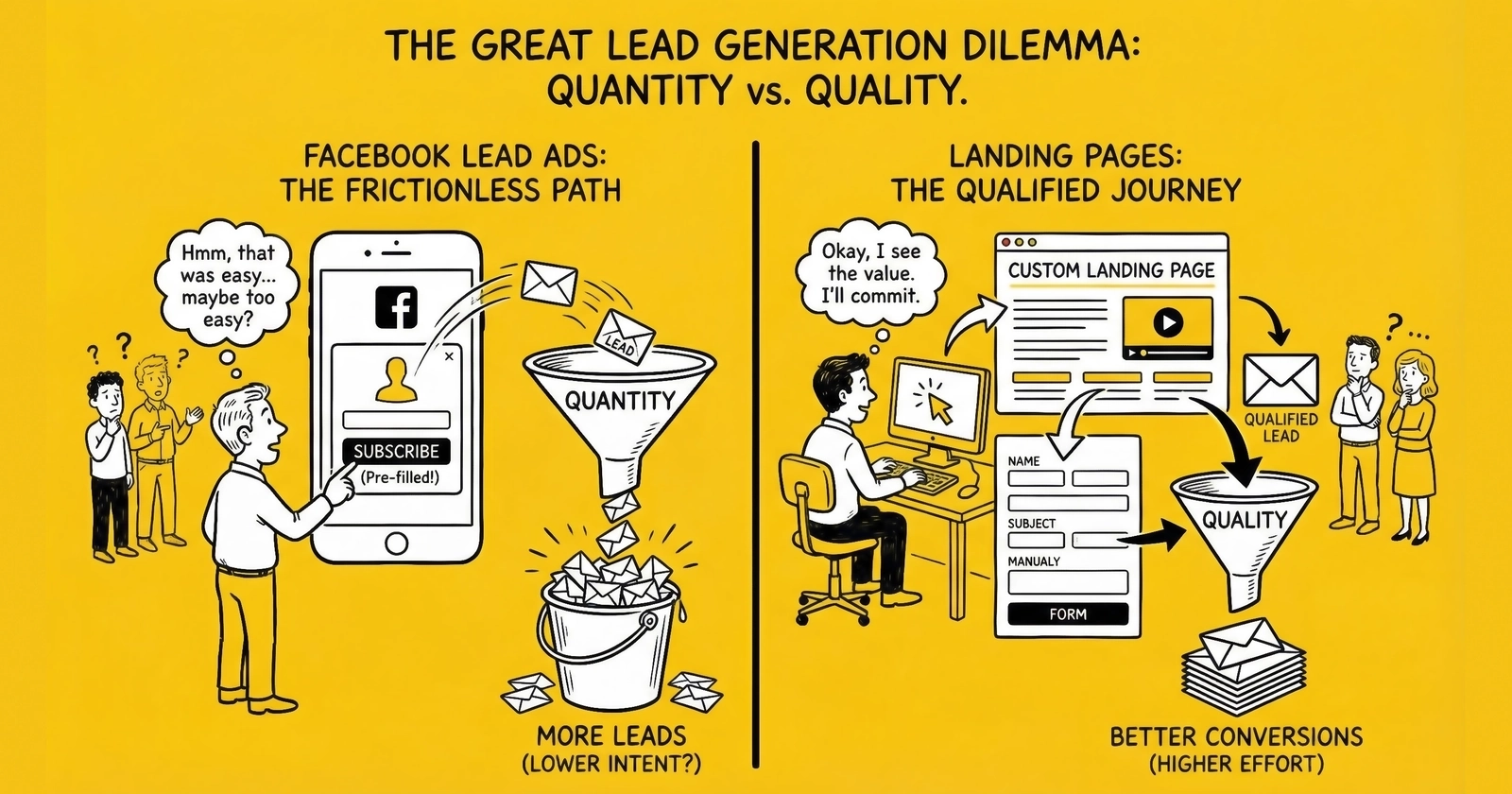
A data-driven comparison of native Facebook forms versus owned landing pages for lead generation professionals – with CPL benchmarks, quality metrics, and compliance considerations that determine real ROI.
You face a fundamental decision every time you launch a Facebook campaign: send traffic to Meta’s native Lead Ads forms, or drive clicks to your own landing page.
The wrong choice costs you money. Not in the obvious “my CPL went up” sense – though it often does that too – but in the downstream conversion rates, compliance exposure, and lead quality that determine whether your campaigns actually generate profit.
This question has become more critical for three reasons. First, Facebook’s native Lead Ads CPL averaged $27.66 in early 2025 – up 21% year-over-year but still 60% cheaper than Google’s $70.11 average. That gap creates pressure to use native forms. Second, TCPA litigation reached 507 class actions in Q1 2025 alone, making consent documentation a survival issue rather than a legal checkbox. Third, lead buyers have become increasingly sophisticated about measuring downstream quality, paying premiums for leads that actually convert to customers.
This article breaks down exactly when Lead Ads win, when landing pages win, and how to optimize both approaches for maximum ROI in your vertical.
How Facebook Lead Ads Work
Facebook Lead Ads (also called Instant Forms) allow users to submit their contact information without leaving the Facebook or Instagram app. When someone clicks your ad, a form opens within the platform, pre-populated with information from their Facebook profile.
The Native Form Experience
The user journey works like this:
- User sees your ad in their Facebook or Instagram feed
- User taps the call-to-action button
- A native form opens within the app
- Fields for name, email, and phone are pre-filled from their Facebook profile
- User confirms pre-filled data or makes corrections
- User taps “Submit”
- Thank you message appears, optionally linking to your website
The entire process happens in 5-10 seconds for simple forms. The user never leaves the app, never waits for a page to load, and never needs to type contact information from memory.
Lead Ads Form Types
Meta offers two form configurations:
More Volume (Standard Forms). Pre-filled information appears ready to submit. One tap to confirm. This maximizes completion rates but captures the most accidental and inattentive submissions.
Higher Intent Forms. Adds a review step before submission, asking users to confirm their information is correct. Reduces volume by 10-20% but improves lead quality by screening out casual clickers.
What Data You Can Collect
Lead Ads support pre-filled fields (name, email, phone, address, job title, company), custom questions (short answer, multiple choice, conditional), and appointment scheduling. You can add up to 15 questions per form, though each additional question reduces completion rates by 10-15%.
Lead Ads vs Landing Pages: The Data
The numbers tell a clear story – but it requires looking at the complete picture, not just cost per lead.
Cost Per Lead Comparison
| Metric | Facebook Lead Ads | Facebook to Landing Page |
|---|---|---|
| Average CPL (2026) | $27.66 | $35-55 (varies by optimization) |
| CPL Range by Vertical | $15-75 | $25-120 |
| Year-Over-Year Change | +21% | +12-18% |
Meta’s native Lead Gen Forms reduce CPL by 25-30% compared to landing page conversions in most campaigns. This isn’t subtle. A campaign spending $10,000/month saves $2,500-3,000 in direct acquisition costs by using native forms.
Conversion Rate Comparison
| Metric | Facebook Lead Ads | Facebook to Landing Page |
|---|---|---|
| Form Conversion Rate | 7-9% | 4-8% |
| Click-to-Lead Rate | 8-12% | 3-6% |
| Mobile Conversion Rate | 9-13% | 3-5% |
Native forms convert at nearly double the rate of landing pages on mobile devices. This gap reflects reality: mobile users abandon slow-loading pages, struggle with small form fields, and drop off when asked to leave the app environment they were browsing.
Lead Quality Comparison
Here the picture reverses.
| Quality Metric | Facebook Lead Ads | Facebook to Landing Page |
|---|---|---|
| Contact Rate (First Attempt) | 25-35% | 40-55% |
| Qualified Lead Rate | 15-30% | 35-55% |
| Downstream Conversion to Customer | 1.5-3% | 3-6% |
| Invalid/Fake Data Rate | 10-20% | 3-8% |
Landing pages produce leads that are 50-100% more likely to become customers. The higher friction filters out casual interest, requiring users who complete forms to demonstrate genuine intent.
The Math That Actually Matters
Raw CPL comparisons miss the point. What matters is cost per qualified lead – or better, cost per customer.
Lead Ads Example:
- CPL: $27.66
- Qualified rate: 25%
- Cost per qualified lead: $110.64
- Conversion to customer: 2%
- Cost per customer: $1,383
Landing Page Example:
- CPL: $45.00
- Qualified rate: 45%
- Cost per qualified lead: $100.00
- Conversion to customer: 4%
- Cost per customer: $1,125
Despite 63% higher raw CPL, the landing page delivers customers for 19% less. This math varies by vertical, offer, and sales process – but operators who track only CPL routinely overspend on low-quality leads.
When Lead Ads Win: The Cases for Native Forms
Despite quality concerns, native Lead Ads outperform landing pages in specific scenarios.
Mobile-First Audiences
If 80%+ of your traffic comes from mobile devices – which is increasingly common in consumer verticals – native forms eliminate the friction that kills mobile conversion. Landing page load times average 3-5 seconds on mobile. Each second costs you 7% of conversions. Native forms load instantly.
The data supports this: mobile conversion rates for native forms (9-13%) exceed landing page conversion rates (3-5%) by 2-3x. That gap often outweighs quality differentials.
Simple Offers With Low Consideration
Products requiring minimal qualification benefit from volume-first approaches. A home warranty quote request, a credit card comparison, or a local service estimate doesn’t require extensive prospect education. The faster you get contact information, the faster you can call.
For simple offers, the speed advantage of native forms – leads delivered in seconds rather than minutes – compounds into significant contact rate improvements. First response within 1 minute produces 391% higher conversion rates than 2-minute response times. The five-minute rule for response time applies even more critically to these low-friction leads.
Retargeting Warm Audiences
Users who have already visited your website, engaged with your content, or interacted with previous ads have demonstrated intent. For retargeting campaigns, native forms capture conversion from warm prospects who don’t need another landing page to convince them.
Retargeting with Lead Ads typically produces quality metrics much closer to landing page traffic because the audience has already self-selected.
Testing and Validation
When launching new markets or offers, native forms provide faster feedback loops. Test whether an audience exists before investing in landing page development.
High-Volume, Low-Touch Models
Business models that monetize through volume – such as lead aggregators selling to multiple buyers – sometimes favor native forms. If you resell leads at fixed prices, minimizing acquisition cost maximizes margin. Monitor buyer satisfaction carefully.
When Landing Pages Win: The Cases for Owned Funnels
Landing pages outperform native forms when quality, compliance, and conversion depth matter more than raw volume.
Complex Products Requiring Education
Mortgage quotes, solar installations, insurance products, and financial services require qualification questions that determine lead value. A generic “interested in solar” lead differs dramatically from a homeowner with south-facing roof, $200/month electricity bill, and good credit.
Landing pages allow progressive qualification – starting with basic interest, then gathering qualifying attributes that determine buyer fit and willingness to pay.
High-Value Lead Verticals
Personal injury leads sell for $200-500+. Medicare leads during Annual Enrollment Period command $40-80. At these price points, a 10% quality improvement represents significant revenue. The 25-30% CPL savings from native forms rarely justifies the quality gap in premium verticals.
TCPA Compliance Requirements
This deserves its own section, but the summary: native forms create compliance uncertainty that landing pages eliminate. If your buyers require documented Prior Express Written Consent, if your leads will be called using automated dialers, if you operate in litigious states like Florida or California – landing pages provide control that native forms cannot match.
Multi-Buyer Distribution
When the same lead may be sold to multiple buyers, each with different consent requirements, landing pages allow granular consent language that identifies each potential seller. Native forms offer limited customization of disclosure language and don’t support the seller-specific consent some buyers require.
Brand Building and Trust
Landing pages allow you to establish credibility before asking for contact information. Testimonials, trust badges, company information, and professional design signal legitimacy. Native forms present only the minimal branding that fits Meta’s constrained format.
For high-consideration purchases where prospects research before committing, landing pages convert skeptics that native forms lose.
Lead Quality: The Critical Difference
The quality gap between native forms and landing pages deserves detailed examination because it determines actual campaign profitability.
Why Native Forms Capture Lower Quality
Several factors contribute to the quality differential:
Pre-filled Data Creates Passive Submissions. When name, email, and phone number appear automatically, users can submit without conscious engagement. Some submit accidentally while scrolling. Others submit out of curiosity with no actual interest. Pre-filled forms capture casual attention, not purchase intent.
Minimal Friction Doesn’t Filter. The absence of obstacles that slow conversion also eliminates obstacles that screen non-buyers. A user who won’t type their phone number probably won’t answer that phone when your sales team calls.
Outdated Profile Information. Facebook profile data can be years old. Email addresses users no longer check. Phone numbers they no longer own. Pre-filled forms deliver data that looks valid but doesn’t reach actual humans.
Bot and Fraud Exposure. While Meta implements fraud prevention, native forms attract more invalid submissions than owned landing pages where you control validation and verification.
Quantifying the Quality Gap
| Quality Indicator | Lead Ads | Landing Pages |
|---|---|---|
| Phone Valid & Active | 75-85% | 90-95% |
| Answers First Call | 20-30% | 35-50% |
| Qualified After Contact | 15-30% | 35-55% |
| Converts to Customer | 1.5-3% | 3-6% |
These gaps compound through the funnel, producing dramatically fewer customers per lead generated.
Improving Native Form Quality
If you choose Lead Ads despite quality concerns, several tactics improve outcomes:
Use Higher Intent Forms. The review step adds friction that filters casual submissions. The 10-20% volume reduction typically produces 20-30% quality improvement.
Add Qualifying Questions. Include one or two multiple-choice questions that require actual thought: “When are you looking to purchase?” or “What’s your budget range?” Prospects who won’t answer questions won’t buy your product.
Implement Phone Verification. Call or text leads immediately to verify phone validity. Remove non-responsive numbers from buyer delivery within the first hour.
Block Suspicious Domains. In Lead Form settings, exclude email domains associated with spam (mailinator.com, guerrillamail.com, etc.). This reduces fake submissions.
Track Downstream Metrics. Monitor not just CPL but cost per contact, cost per qualified lead, and cost per customer. Optimize toward the metric that drives actual revenue.
TCPA Compliance Considerations
The Telephone Consumer Protection Act creates specific risks for Facebook Lead Ads that every lead generator must evaluate.
The Consent Documentation Challenge
TCPA requires Prior Express Written Consent (PEWC) before making telemarketing calls or texts to cell phones using automated technology. Valid PEWC requires:
- A written agreement signed by the person called
- Clear authorization identifying the seller making calls
- Disclosure that calls will use automated technology
- The specific phone number authorized for contact
- Statement that consent is not required for purchase
Native Lead Ads present documentation challenges at multiple points.
Facebook’s Form Limitations
Seller Identification. Your Lead Ads form must clearly identify who will call. If you resell leads to third-party buyers, those buyers must be identifiable before consent is given. Native forms limit your control over consent language placement and prominence.
Disclosure Clarity. The FCC requires consent disclosures to be “clear and conspicuous.” Native form layouts prioritize completion over disclosure visibility. Courts have not definitively ruled on whether Lead Ads disclosures meet TCPA standards.
Documentation. Unlike landing pages where you control every pixel, native forms provide limited data about what the user actually saw. If challenged in litigation, proving consent requires demonstrating what appeared on the user’s screen – harder with platform-controlled forms.
Litigation Exposure Assessment
TCPA litigation reached unprecedented levels in 2024-2025:
- 2,788 cases filed in 2024 (67% increase over 2023)
- 85-95% of monthly filings sought class certification
- Average settlements exceed $6.6 million
- No cap on aggregate damages ($500-$1,500 per violation)
- September 2025 saw 224 class action filings (up 283% year-over-year)
Operators generating leads through native forms face specific vulnerabilities:
Consent Scope. If your disclosure doesn’t clearly identify all parties who will call, each call from an unidentified seller represents a potential violation.
Documentation Gaps. Lead buyers increasingly require consent documentation. Landing pages with TrustedForm or Jornaya certificates provide defensible records. Native forms provide Facebook’s lead export – less comprehensive evidence.
Serial Litigator Targeting. Professional plaintiffs submit through forms seeking non-compliant communications. Approximately 31-41% of TCPA cases are filed by repeat plaintiffs. Your forms are visible targets.
The Landing Page Advantage
Landing pages eliminate many TCPA concerns:
Complete Control. You design the consent language, control its placement, and determine its prominence. No platform constraints.
Third-Party Documentation. TrustedForm and Jornaya provide independent certificates recording exactly what appeared when consent was captured. Courts have accepted these certificates as evidence.
Seller Identification. Your form can list every potential buyer by name, satisfying one-to-one consent expectations even though the FCC’s strict rule was vacated.
Integration With Compliance Systems. Landing pages integrate with litigator suppression lists, phone validation services, and consent management platforms. Native forms have limited integration options.
Practical Compliance Approach
For practitioners using Lead Ads: customize disclosures in the privacy policy field, add consent confirmation questions, implement real-time phone validation against litigator lists, document everything including form configurations, and consult TCPA counsel before scaling in litigious states.
For high-risk operations – lead aggregation, multi-buyer distribution, insurance – landing pages provide compliance control that native forms cannot match.
Optimizing Facebook Lead Ads
If you choose native forms, these optimizations maximize both volume and quality.
Form Design Best Practices
Keep Forms Short. Each additional field reduces completion by 10-15%. Capture minimum viable information – typically name, phone, email – and qualify through follow-up.
Use Conditional Logic. Show qualifying questions only to prospects who meet initial criteria. A homeownership question that appears only to users who indicate interest in solar filters without adding friction to everyone.
Choose “Higher Intent” Format. The review step before submission reduces casual completions. The 10-20% volume reduction produces proportionally larger quality improvement.
Customize Thank You Screen. The post-submission screen can drive immediate action. Include a click-to-call button, appointment scheduler link, or “we’ll call you within 5 minutes” expectation-setting message.
Audience Optimization
Build Lookalikes From Customers, Not Leads. Standard practice builds lookalike audiences from lead lists. Better practice: build lookalikes from people who became customers, weighted by purchase value. This optimizes toward downstream conversion, not form completion.
Exclude Low-Quality Segments. Review contact rates and qualification rates by audience segment. Exclude demographics or interest groups that produce volume without quality.
Layer Behavioral Targeting. Combine broad demographics with behavioral signals: recent life events (new home, new job), purchase behavior indicators, and category engagement signals.
Use Engaged Retargeting. Retarget website visitors, video viewers, and page engagers with Lead Ads. Warm audiences convert at higher quality than cold prospecting.
Creative Optimization
Set Clear Expectations. Ad copy should explain what happens after submission. “Get a callback within 5 minutes” prepares prospects for follow-up contact.
Qualify in the Ad. Include qualifying criteria in ad copy to screen non-buyers before they click. “For homeowners with $150+ monthly electric bills” reduces wasted form completions.
Test Value Propositions. Different benefits attract different quality levels. “Get the lowest price” attracts price-shoppers. “Find the best coverage” attracts value-buyers. Test which messaging produces downstream conversion.
Technical Optimization
Enable Instant Form Load. Use “Open Form on Ad Load” to eliminate click-to-form latency. This improves conversion rates, especially on slow connections.
Integrate Real-Time Sync. Connect Lead Ads to your CRM through Zapier, LeadsBridge, or direct API integration. Every minute between submission and contact reduces conversion probability.
Implement Lead Scoring. Not all leads are equal. Score leads based on qualifying question responses, time of submission, and device type. Route high-score leads to immediate follow-up; batch lower-score leads for later contact.
Optimizing Landing Page Campaigns
When landing pages are the right choice, these practices maximize their advantage.
Page Design for Conversion
Mobile-First Design. Facebook traffic is 80%+ mobile. Design for thumb scrolling, tap targets, and small-screen forms.
Above-the-Fold Form. The form should be visible without scrolling. Many users won’t scroll – give them the conversion opportunity immediately.
Progressive Profiling. Start with minimal fields, then ask qualifying questions in subsequent steps.
Trust Signals. Include testimonials, review ratings, and trust badges near the form.
Speed Optimization
Target Sub-3-Second Load. Every second of load time costs 7% of mobile conversions. Use PageSpeed Insights to identify slowdowns. Minimize redirects, compress images, and use CDNs for national campaigns.
Form Optimization
Minimize Required Fields. Every required field reduces completion. Ask only what you need to follow up and qualify.
Use Smart Defaults. Pre-populate city and state from ZIP code. Format phone numbers automatically. Reduce typing on mobile.
Implement Real-Time Validation. Validate email format, phone length, and required fields before submission.
Conversion Tracking
Implement Server-Side Tracking. Browser-based tracking loses 20-40% of conversion data from ad blockers and iOS privacy restrictions. Server-side tracking recovers signal, and Facebook CAPI implementation specifically addresses Meta platform attribution.
Import Offline Conversions. Feed CRM outcomes back to Facebook for optimization. This teaches the algorithm to find users who become customers, not just users who complete forms.
Hybrid Strategies: Using Both Approaches
The either/or framing is false. Sophisticated practitioners use both Lead Ads and landing pages strategically.
The Audience Segmentation Approach
Cold Prospecting: Lead Ads. For broad awareness campaigns reaching users unfamiliar with your brand, native forms maximize response. The lower quality matters less because cold audiences produce lower quality regardless of form type.
Warm Retargeting: Landing Pages. Users who have engaged with your brand – website visitors, video viewers, previous form submitters who didn’t convert – receive landing page experiences. Their demonstrated interest justifies the additional friction.
Hot Audiences: Either. Users with strong intent signals (multiple website visits, high-engagement retargeting) convert well through either channel. Test both and optimize toward quality.
The Vertical Segmentation Approach
Low-Value Leads: Lead Ads. For lead types that monetize at $10-25, the 25-30% CPL savings often exceeds quality costs. Home warranty quotes, credit card comparisons, and generic insurance interest often favor volume.
High-Value Leads: Landing Pages. For leads worth $50-200+, quality differentials dominate. Mortgage, solar, legal, and high-intent insurance leads typically favor landing pages.
The Funnel Stage Approach
Use Lead Ads for awareness (capturing initial interest), and landing pages for consideration and decision stages where prospects need education and trust signals before converting.
The Testing Approach
Run parallel campaigns – identical targeting, identical creative, different destinations – to measure actual performance in your vertical. Measure cost per qualified lead and cost per customer, not just CPL. The approach that wins on raw CPL often loses on downstream metrics.
CRM Integration Requirements
Lead capture is worthless without effective follow-up. Integration between Facebook and your CRM determines whether leads become customers.
Speed-to-Contact Integration
Responding within 1 minute produces 391% higher conversion rates than 2-minute response. Your integration must deliver leads to sales agents within seconds.
Lead Ads Integration Options:
| Integration Method | Speed | Cost |
|---|---|---|
| Manual CSV Download | Hours | Free |
| Zapier/Make | 5-15 minutes | $20-100/month |
| LeadsBridge | 1-5 minutes | $100-300/month |
| Direct CRM Integration | 10-60 seconds | Development cost |
For high-value leads, invest in real-time integration. The cost of a 5-minute delay exceeds integration investment.
Data Quality Systems
Implement phone validation (verify numbers are real and not on DNC registry lists), email verification (check deliverability before nurture), duplicate detection (prevent repeat submissions), and litigator suppression (screen against known TCPA plaintiff databases).
Sales Process Alignment
Your CRM integration should support lead routing (by geography, product, or agent capacity), activity tracking (all contact attempts and outcomes), pipeline management, and disposition reporting that feeds outcomes back to marketing. Without closed-loop reporting, you optimize toward form completions rather than customers.
Frequently Asked Questions
What is the average cost per lead for Facebook Lead Ads in 2026?
The average Facebook Lead Ads CPL reached $27.66 in early 2025, up 21% year-over-year. CPL varies by vertical: insurance $40-60, home services $25-45, legal $60-100+.
Do Facebook Lead Ads convert better than landing pages?
Lead Ads have higher form completion rates (7-9% vs. 4-8%), but landing pages produce leads that convert to customers at roughly 2x the rate. For most verticals, landing pages deliver lower cost per customer despite higher CPL.
Are Facebook Lead Ads TCPA compliant?
Facebook Lead Ads can be TCPA compliant with careful configuration. You must include clear consent disclosures, identify all parties who will call, and maintain documentation. For high-risk operations, consult TCPA counsel before scaling.
How do I improve Facebook Lead Ads quality?
Use “Higher Intent” form types that require review before submission. Add qualifying questions. Implement phone validation. Build lookalike audiences from customers rather than leads. Track downstream metrics and optimize toward qualified leads.
Should I use Lead Ads or landing pages for insurance leads?
Insurance leads typically favor landing pages because of high lead values ($40-100+), TCPA compliance requirements, and buyer expectations for documented consent. Test both approaches and measure cost per qualified lead.
How fast should I respond to Facebook leads?
Respond within 1 minute for maximum conversion. Research shows 391% higher conversion rates for 1-minute versus 2-minute response. This requires real-time CRM integration.
What CRM integrations work with Facebook Lead Ads?
Facebook Lead Ads integrate with major CRMs including Salesforce, HubSpot, Zoho, and Pipedrive through Zapier or direct API. Choose integration speed over feature complexity – faster delivery beats fancier features.
How do I track Facebook Lead Ads quality?
Track contact rate, qualification rate, and conversion to customer. Import CRM outcomes back to Facebook through offline conversion tracking to enable algorithm optimization toward leads that convert.
What conversion rate should I expect from landing pages with Facebook traffic?
Facebook traffic to landing pages converts at 4-8% on average. Mobile traffic converts 30-50% lower than desktop. Retargeting converts 2-3x higher than cold prospecting. Top performers achieve 10-15%.
Can I use both Lead Ads and landing pages in the same campaign?
Yes. Use Lead Ads for cold prospecting where volume matters, and landing pages for warm retargeting where quality matters. Test both and let data guide allocation.
Key Takeaways
-
Lead Ads reduce CPL by 25-30%, but landing pages produce 50-100% better downstream conversion. Choose based on cost per customer, not cost per lead.
-
Mobile traffic (80%+ of Facebook) converts 2-3x better on native forms. If your audience is mobile-first and your product is simple, Lead Ads often win on total economics.
-
TCPA compliance is harder with Lead Ads. Limited control over consent language, documentation gaps, and seller identification constraints create litigation exposure. For high-risk operations, landing pages provide necessary control.
-
Speed-to-contact determines lead value regardless of source. Integrate for real-time delivery – 1-minute response produces 391% better conversion than 2-minute response.
-
Quality improvements compound through the funnel. A 20% improvement in lead quality produces 30-40% improvement in cost per customer when contact, qualification, and close rates all improve.
-
Test both approaches with downstream tracking. Measure cost per qualified lead and cost per customer, not just cost per lead. The winner on CPL often loses on revenue.
-
Hybrid strategies outperform either/or choices. Use Lead Ads for cold prospecting and landing pages for warm audiences. Segment by audience temperature, lead value, and compliance requirements.
-
Higher Intent form types reduce volume by 10-20% but improve quality by 20-30%. The review step before submission filters casual clickers, delivering prospects more likely to answer calls and convert.
-
Build lookalike audiences from customers, not leads. Optimizing toward downstream conversion rather than form completion teaches the algorithm to find users who actually buy, not just users who click.
Sources
- Meta Lead Ads API Documentation - Official Meta documentation for Lead Ads implementation and integration
- Meta Lead Ads Setup Guide - Meta’s guide to creating and configuring Lead Ads forms
- TCPA Statute (47 U.S.C. 227) - Telephone Consumer Protection Act statutory text governing telemarketing calls
- ActiveProspect TrustedForm - Consent verification platform for TCPA compliance documentation