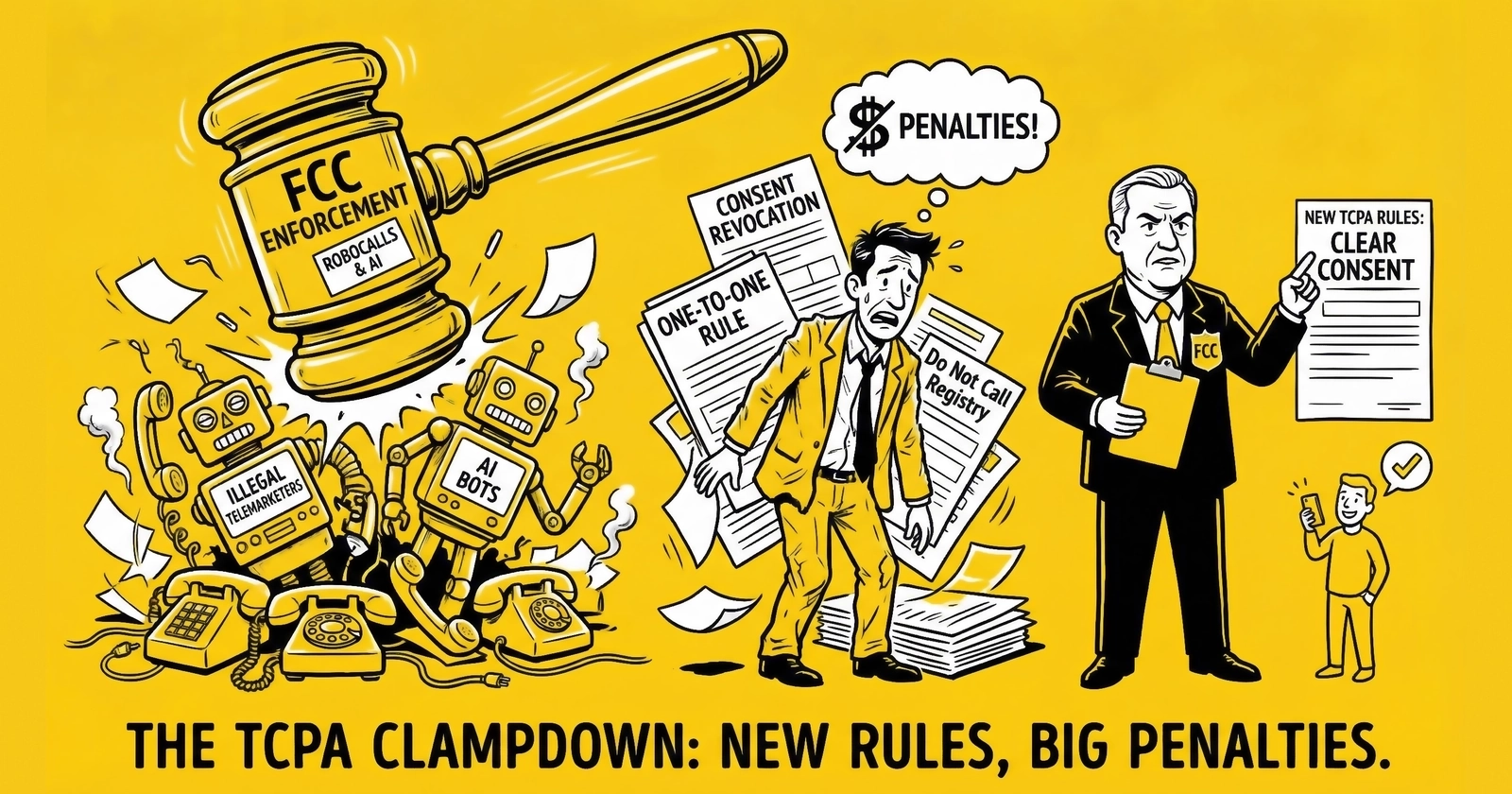
An operational analysis of how the FCC pursues TCPA violations, what triggers enforcement, and what lead generation professionals can learn from the most significant penalty cases in the statute’s history.
The Two Enforcement Tracks
The Telephone Consumer Protection Act creates two distinct enforcement paths, and lead generation professionals must understand both. The first is the private right of action that generates the class action lawsuits dominating industry headlines. The second is direct FCC enforcement, which operates through different mechanisms, produces different outcomes, and often signals regulatory priorities before private litigation catches up.
When the FCC pursues enforcement, it does so with capabilities unavailable to private plaintiffs. The agency can issue citations and warnings, impose forfeiture penalties without going to court, and refer egregious cases to the Department of Justice for criminal prosecution. The FCC can also coordinate with state attorneys general, the Federal Trade Commission, and international regulators in ways that amplify enforcement impact.
Understanding FCC enforcement patterns provides operational intelligence that private litigation data cannot. When the FCC identifies a violation type worth pursuing, it signals regulatory priority. When the agency issues record-breaking fines, it establishes precedent that shapes private plaintiff strategy. When the FCC announces enforcement initiatives, it previews the compliance requirements that will matter most in the years ahead.
This analysis examines how the FCC enforces TCPA violations, the largest penalties in the statute’s history, and the operational lessons embedded in each case.
How FCC Enforcement Works
The FCC’s Enforcement Bureau handles TCPA matters through a process that differs fundamentally from private litigation. Understanding this process helps operators recognize where their greatest enforcement exposure lies.
The Complaint Process
The FCC receives consumer complaints through multiple channels: the online Consumer Complaint Center, telephone calls to the agency, and referrals from other government agencies. The volume is staggering. In fiscal year 2024, the FCC received over 300,000 consumer complaints related to unwanted calls, with robocalls and telemarketing violations comprising the largest category.
Not every complaint triggers enforcement. The FCC lacks resources to investigate each individual complaint, so the agency uses complaint data to identify patterns. A single complaint about one unwanted call rarely generates agency attention. But when the FCC sees hundreds of complaints about the same caller, the same campaign, or the same spoofed number, investigation becomes likely.
The Enforcement Bureau also proactively monitors calling patterns through the Robocall Mitigation Database, traceback consortium data, and information sharing with industry stakeholders. This proactive monitoring has become increasingly sophisticated, allowing the FCC to identify problematic calling patterns before consumer complaints accumulate.
Citation and Notice of Apparent Liability
When the FCC determines that a violation has occurred, it typically issues a Citation (for first-time violations by entities not otherwise subject to FCC jurisdiction) or a Notice of Apparent Liability (NAL) proposing a specific forfeiture amount.
For entities holding FCC licenses or otherwise subject to agency jurisdiction, the process moves directly to the NAL stage. The proposed forfeiture in an NAL is not final; the target has the opportunity to respond, contest the findings, and negotiate. However, NAL amounts provide a useful signal of FCC enforcement priorities and the severity of perceived violations.
The forfeiture amounts the FCC can impose are substantial. The base forfeiture for TCPA violations is $23,727 per violation. Unlike private litigation where each call might constitute a separate violation, the FCC often calculates violations per day of violation or per campaign, which can aggregate rapidly. The maximum forfeiture per case is currently $2,579,988 for a single violation or $28,619,922 for continuing violations.
The Consent Decree Path
Many FCC enforcement actions resolve through consent decrees rather than contested proceedings. In a consent decree, the target company admits no liability but agrees to pay a civil penalty and implement specific compliance measures under FCC oversight.
Consent decrees typically include requirements beyond monetary payment: mandatory compliance plans, regular reporting to the FCC, third-party auditing, and ongoing monitoring for a period of years. These non-monetary requirements can impose significant operational burden and cost.
For sophisticated practitioners, consent decree terms often provide more valuable intelligence than the penalty amount. The specific compliance requirements the FCC negotiates reveal what the agency considers adequate compliance infrastructure.
Referral to DOJ for Criminal Prosecution
The FCC’s most severe enforcement tool is referral to the Department of Justice for criminal prosecution. While relatively rare, criminal referrals have increased in recent years as the FCC has prioritized combating illegal robocalling operations.
Criminal prosecution typically targets the most egregious violations: large-scale fraud schemes, caller ID spoofing operations, and organized criminal enterprises using telecommunications to victimize consumers. The penalties include imprisonment, which creates deterrence that monetary fines alone cannot.
Record-Breaking FCC Enforcement Actions
The FCC’s largest enforcement actions reveal the agency’s priorities and the violation patterns that trigger maximum penalties. These cases provide operational lessons for every lead generation professional.
Rising Eagle and JSquared: $225 Million (2021)
In February 2021, the FCC issued its largest-ever fine under Section 227: $225 million against John Spiller and two related companies, Rising Eagle and JSquared Telecom. The case involved an estimated one billion robocalls over a three-month period in 2019, promoting health insurance plans.
The operation used spoofed caller ID numbers to mask the true origin of calls, transmitted misleading information about the purpose and identity of callers, and targeted consumers across the country with prerecorded sales pitches. The calls pitched fraudulent health insurance plans, and the operation continued even after receiving warnings from the FCC.
Operational Lessons:
The Rising Eagle case demonstrates that scale matters to the FCC. One billion calls in three months is roughly 11 million calls per day. At that scale, enforcement becomes inevitable regardless of other factors.
The case also illustrates the compounding effect of multiple violations. The $225 million penalty reflected not just TCPA violations but also Truth in Caller ID Act violations for spoofing. When multiple violations overlap, penalties multiply.
Perhaps most importantly, the case shows that the FCC prioritizes enforcement against operations that continue despite warnings. John Spiller had received multiple cease-and-desist letters before the enforcement action. Ignoring regulatory warnings dramatically increases enforcement risk.
Lingo Telecom: $2 Million Consent Decree (2024)
In March 2024, the FCC reached a consent decree with Lingo Telecom for $2 million in civil penalties related to the company’s role in transmitting illegal robocall traffic. Lingo, operating as a voice service provider, failed to implement adequate robocall mitigation measures and continued transmitting traffic from known bad actors.
The case represented the FCC’s intensified focus on the voice service provider ecosystem. Under the TRACED Act and subsequent FCC rules, providers must implement STIR/SHAKEN caller ID authentication and maintain effective robocall mitigation programs. Lingo’s failure to block traffic from callers identified through traceback investigations triggered enforcement.
Operational Lessons:
Lead generators do not typically operate as voice service providers, but the Lingo case carries implications for the entire industry. The FCC is systematically addressing the infrastructure that enables illegal robocalling, and voice providers are now incentivized to scrutinize their customers’ calling practices.
As voice providers face greater enforcement pressure, they will pass that pressure to customers. Lead generators and their call center partners should expect increased scrutiny from carriers, more aggressive traffic blocking, and requirements to demonstrate TCPA compliance as a condition of service.
Jones Day Study and Largest Private Settlements
While not FCC enforcement actions, the largest private TCPA settlements provide context for understanding the full scope of TCPA exposure. The FCC’s enforcement data does not exist in isolation; private litigation and FCC enforcement interact in ways that shape industry compliance.
The largest private settlements on record include:
- Caribbean Cruise Line: $76 million (2016) - Prerecorded telemarketing calls
- Capital One: $75.5 million (2014) - Debt collection autodialer violations
- DISH Network: $60 million (2017) - Do Not Call Registry violations
- Wells Fargo: $50 million (2023) - Autodialed debt collection calls
- National Grid: $38.5 million (2024) - Prerecorded marketing messages
These settlements dwarf most FCC forfeitures, but the two enforcement tracks serve different purposes. FCC enforcement often targets the most egregious operators who might judgment-proof themselves against private suits. Private litigation provides broader coverage but depends on plaintiffs identifying and pursuing viable defendants.
The DISH Network Trilogy: $280 Million Total
The DISH Network cases deserve special attention because they demonstrate how enforcement can compound over time. DISH has faced three major TCPA enforcement actions totaling over $280 million:
DISH Network v. United States (2017): $61 million - This case addressed Do Not Call Registry violations by DISH and its third-party retailers. The court found that DISH was vicariously liable for calls made by independent retailers selling DISH service. The decision established that companies cannot escape TCPA liability by outsourcing calling to independent contractors.
FTC/State AG Action (2017): $168 million - A coordinated enforcement action by the Federal Trade Commission, the Department of Justice, and attorneys general from four states resulted in $168 million in penalties for over 66 million violations. The case addressed both the calls DISH made directly and calls made by its retailer network.
Ongoing Enforcement - DISH continues to face enforcement actions and has been subject to enhanced monitoring and compliance requirements following its settlements.
Operational Lessons:
The DISH cases establish three critical principles. First, vicarious liability is real. Using third-party lead generators, call centers, or retailers does not insulate you from TCPA liability if those parties violate the law while marketing your products or services.
Second, enforcement compounds. The initial penalties against DISH led to enhanced scrutiny, additional violations being discovered, and follow-on enforcement. A company’s first TCPA violation may not be its last enforcement action.
Third, multiple regulators can pursue the same conduct. DISH faced private litigation, FTC action, state attorney general enforcement, and FCC scrutiny. Coordinated enforcement multiplies exposure beyond what any single agency could impose.
FCC Enforcement Priorities for 2025 and Beyond
The FCC has signaled its enforcement priorities through public statements, rulemakings, and enforcement actions. Understanding these priorities helps operators allocate compliance resources effectively.
Robocall Mitigation Program Compliance
The TRACED Act, enacted in December 2019, required voice service providers to implement STIR/SHAKEN caller ID authentication and file certifications with the FCC’s Robocall Mitigation Database. As of the 2024-2025 period, the FCC is actively enforcing these requirements.
The FCC has issued warning letters to hundreds of providers with deficient certifications and has removed non-compliant providers from the database. Because intermediate and originating providers are prohibited from accepting traffic from providers not in the database, removal effectively cuts off a provider’s ability to transmit calls.
For lead generation operations, the implication is clear: voice service providers are under pressure to police their traffic. Providers found transmitting illegal robocall traffic face enforcement; this creates downstream incentives for providers to scrutinize customer calling practices.
Consent and Telemarketing Rules
The FCC’s December 2023 adoption of the one-to-one consent rule (later vacated by the Eleventh Circuit in January 2025) signaled regulatory intent that persists despite the legal setback. The FCC clearly views lead generation consent practices as a priority area, and future rulemaking or enforcement may attempt to achieve similar goals through different means.
The April 2025 revocation rules, which require companies to honor consent revocation within ten business days through any reasonable method, are now in effect and enforceable. The FCC has indicated it will monitor compliance with these requirements.
AI-Generated Voices and Robocalls
In February 2024, the FCC issued a Declaratory Ruling clarifying that calls made using AI-generated human voices qualify as “artificial voice” calls under the TCPA. This ruling brings AI voice technology within existing consent requirements and enforcement jurisdiction.
The FCC has stated it will prioritize enforcement against operations using AI voices to deceive consumers, particularly in contexts involving political calls, scam operations, and unauthorized celebrity voice cloning.
Do Not Call Registry Enforcement
The National Do Not Call Registry remains an active enforcement priority. The FCC continues to issue enforcement actions against telemarketers calling registered numbers and has enhanced its data sharing with the FTC to improve enforcement coordination.
The FCC has also emphasized that the ten-year renewal requirement for Do Not Call registrations (implemented in 2021) has refreshed the registry’s accuracy, making enforcement more straightforward.
What Triggers FCC Investigation
Understanding what attracts FCC attention helps operators assess their enforcement risk and prioritize compliance investments.
Volume Thresholds
The FCC does not publish specific call volume thresholds that trigger investigation, but enforcement patterns suggest that scale matters significantly. Operations making millions of calls per month face higher enforcement probability than operations making thousands. This reflects both the FCC’s limited enforcement resources and its prioritization of cases with broad consumer impact.
Consumer Complaint Patterns
The FCC’s Consumer Complaint Center data drives enforcement prioritization. Operations generating disproportionate complaint volumes attract investigation. Complaint spikes following new campaigns, complaint clustering around specific caller IDs, and complaints alleging specific harms (fraud, impersonation, harassment) all increase enforcement probability.
Traceback Investigations
The Industry Traceback Group, operating under FCC authorization, traces illegal robocalls from terminating carriers back through the call path to originating sources. When traceback investigations identify the origin of illegal traffic, that information flows to the FCC Enforcement Bureau.
Operators whose traffic appears in multiple traceback investigations face elevated enforcement risk. The FCC has explicitly stated that it prioritizes enforcement against entities identified through traceback.
Referrals from Other Agencies
The FCC receives enforcement referrals from the FTC, state attorneys general, and international regulators. Cross-agency coordination has increased significantly since the TRACED Act, and operations that attract attention from any regulator may find themselves facing multiple investigations.
Provider Certification Failures
Voice service providers must certify their robocall mitigation practices in the FCC’s database. Providers that make false certifications, fail to update their certifications, or are identified as transmitting illegal traffic despite their certifications face enforcement action.
For lead generators, this means that using voice providers with certification problems creates risk. If your carrier faces enforcement, your operations may face disruption even if you are not the direct enforcement target.
Anatomy of FCC Enforcement: Case Studies
Examining specific enforcement actions in detail reveals patterns that inform compliance strategy.
Case Study: Texas-Based Caller ID Spoofing Operation (2023)
In 2023, the FCC proposed a $299 million fine against a Texas-based operation that transmitted billions of illegal robocalls using spoofed caller IDs. The calls promoted a vehicle service warranty scam and targeted consumers nationwide.
The case illustrates several enforcement triggers. The operation spoofed caller IDs to display local numbers, making calls appear to originate from the recipient’s area code. It ignored cease-and-desist letters from the FCC. And it used multiple voice providers in an apparent attempt to evade blocking.
The FCC’s investigative approach involved traceback from consumer complaints, coordination with voice providers who were ordered to stop transmitting the traffic, and analysis of call detail records from multiple network points. The enforcement action not only proposed penalties against the originator but also issued warning letters to intermediate providers.
Operational Lesson: The FCC will pursue originators through the voice network infrastructure. Using multiple providers or obscure origination paths does not provide effective concealment.
Case Study: Health Insurance Robocall Campaign (2024)
A 2024 enforcement action addressed a health insurance marketing operation that made millions of robocalls during the Open Enrollment Period. The operation used prerecorded messages to promote Medicare Advantage and supplement plans, often to consumers who had not consented to the calls.
The FCC’s investigation revealed that the operation acquired lead lists from third parties without adequate verification of consent. The leads had been generated through forms that captured consent for unrelated purposes or through incentive programs that made consent a condition of receiving rewards.
The consent documentation proved inadequate under FCC review. While the operation had TrustedForm certificates for some leads, the certificates showed consent disclosures that did not identify the specific health insurance marketers who would call. The multi-seller consent language was too vague to satisfy TCPA requirements.
Operational Lesson: Third-party consent verification (TrustedForm, Jornaya) documents what happened but does not guarantee compliance. Inadequate consent disclosures documented by these services become evidence against you, not for you.
Case Study: Political Campaign Robocalls with AI Voices (2024)
Following the February 2024 Declaratory Ruling on AI-generated voices, the FCC pursued enforcement against an operation that used AI voice cloning to create fake endorsements by political figures. The AI-generated calls urged voters to take specific actions and created the false impression of celebrity or political endorsement.
The FCC characterized the conduct as both a TCPA violation (prerecorded voice without consent) and a Truth in Caller ID Act violation (misleading caller identification). The case demonstrated that AI voice technology receives no special exemption from existing TCPA requirements.
Operational Lesson: Emerging technologies like AI voices are subject to existing regulatory frameworks. The FCC has explicitly stated it will prioritize enforcement against AI-enabled TCPA violations, particularly when consumer deception is involved.
Lessons for Lead Generation Operations
The patterns in FCC enforcement translate to specific operational recommendations for lead generation professionals.
Lesson 1: Consent Quality Beats Consent Volume
Every major FCC enforcement action involving lead-based calling has identified consent deficiencies. The operations that face enforcement typically acquired leads through forms with inadequate disclosure, purchased leads without verifying consent quality, or called leads beyond the scope of consent obtained.
Quality consent costs more to acquire but creates defensible calling programs. High-quality consent means:
- Clear identification of the specific seller(s) who will call
- Conspicuous disclosure that is actually visible to consumers
- Consent that is not a condition of receiving something else
- Documentation that captures exactly what the consumer saw and did
The prior express written consent (PEWC) guide provides detailed requirements for implementing compliant consent capture.
Lesson 2: Vendor Due Diligence Is Not Optional
The DISH Network cases established that companies face vicarious liability for the calling practices of third parties. If your lead sources, call center partners, or marketing affiliates violate the TCPA while working on your behalf, you share their liability.
Effective vendor due diligence requires:
- Contractual representations about TCPA compliance
- Audit rights allowing you to verify compliance claims
- Indemnification provisions (though these only help if the vendor can pay)
- Regular review of vendor consent documentation
- Monitoring of consumer complaints associated with vendor traffic
Lesson 3: Warning Letters Demand Response
Multiple FCC enforcement actions have noted that targets received warning letters before enforcement. Continuing operations unchanged after receiving a warning dramatically increases enforcement probability and penalty severity.
If you receive any communication from the FCC, FTC, a state attorney general, or an industry traceback group:
- Engage counsel immediately
- Document your existing compliance measures
- Implement remedial measures promptly
- Prepare to demonstrate responsive action
Lesson 4: Voice Provider Relationships Matter
The FCC’s increasing focus on voice service providers creates ripple effects throughout the telecommunications ecosystem. Providers under enforcement pressure will scrutinize customer traffic more aggressively, implement more aggressive blocking, and require more documentation of calling legitimacy.
Lead generators should:
- Work with established voice providers who have strong FCC certifications
- Maintain documentation demonstrating compliance that can be shared with providers
- Expect increased questions from providers about calling practices
- Have backup provider relationships in case of service disruption
Lesson 5: Scale Attracts Attention
High-volume operations face higher enforcement probability simply because they generate more consumer complaints and more traceback investigations. This does not mean high volume is prohibited, but it does mean high-volume operations must maintain proportionally stronger compliance programs.
For operations making millions of calls, compliance infrastructure should include:
- Real-time consent verification before calls are placed
- Automated DNC suppression against federal and state registries
- Known litigator suppression
- Time-zone management to prevent off-hours calls
- Call recording for compliance verification
- Regular third-party auditing
FCC Coordination with Other Enforcers
The FCC does not operate in isolation. Understanding cross-agency coordination helps operators assess their full enforcement exposure.
FCC-FTC Coordination
The FCC and FTC have overlapping jurisdiction over telemarketing. The FTC enforces the Telemarketing Sales Rule, which addresses many of the same practices covered by TCPA. The agencies have formalized information sharing and often coordinate enforcement.
When one agency investigates, information may flow to the other. A company facing FTC investigation for telemarketing practices may simultaneously face FCC scrutiny, and vice versa.
State Attorney General Coordination
State attorneys general have become increasingly active in telemarketing enforcement, often coordinating with federal agencies. Multi-state enforcement actions can multiply penalties by including violations under multiple state laws.
The DISH Network cases demonstrated this coordination: the FTC action involved attorneys general from four states, creating a combined penalty far exceeding what any single enforcer could achieve.
International Cooperation
For operations with international calling components, the FCC coordinates with regulators in other countries. This coordination targets operations that use offshore calling centers or international voice routes to evade U.S. enforcement.
Compliance Infrastructure That Reduces Enforcement Risk
Based on enforcement patterns, the following compliance infrastructure reduces FCC enforcement risk:
Consent Management
- Capture PEWC that specifically identifies your company or specific buyers
- Use third-party verification (TrustedForm, Jornaya) for every lead
- Retrieve and review certificates before calling, not after complaints
- Retain consent documentation for five or more years
- Implement systems to track consent scope and ensure calls stay within scope
List Hygiene
- Suppress against the National Do Not Call Registry before every calling day – see DNC registry compliance requirements for complete guidance
- Suppress against state-specific registries where applicable
- Maintain internal DNC lists and suppress against them
- Check the Reassigned Numbers Database to avoid calls to new number owners
- Consider litigator suppression services to identify serial TCPA plaintiffs
Calling Controls
- Enforce time-of-day restrictions based on recipient time zone
- Implement call attempt frequency limits
- Record calls for quality assurance and compliance verification
- Monitor for consumer complaints and respond promptly
Vendor Management
- Conduct due diligence before engaging lead sources or call center partners
- Include TCPA compliance requirements in all vendor contracts
- Audit vendor compliance regularly
- Monitor complaint patterns associated with vendor traffic
Response Protocols
- Establish procedures for responding to regulatory inquiries
- Train personnel on complaint handling and escalation
- Document remedial actions taken in response to compliance issues
- Maintain relationships with TCPA-specialized legal counsel
Frequently Asked Questions
What is the maximum penalty the FCC can impose for TCPA violations?
The FCC can impose forfeitures of up to $23,727 per violation, with a maximum of $2,579,988 for a single violation or $28,619,922 for continuing violations. However, these statutory caps have not prevented the FCC from proposing penalties in the hundreds of millions when violations involve billions of calls over extended periods. The Rising Eagle case proposed a $225 million penalty based on the volume and duration of violations.
How does FCC enforcement differ from private TCPA litigation?
FCC enforcement operates through administrative processes rather than courts, can impose penalties without proving actual consumer harm, and can coordinate with other federal and state agencies. Private litigation requires plaintiffs to file individual or class action lawsuits and prove violations to courts. The FCC can also issue cease-and-desist orders, require compliance plans, and refer cases for criminal prosecution. Private plaintiffs can recover statutory damages but cannot impose operational requirements or pursue criminal penalties.
Can the FCC pursue enforcement against companies not licensed by the FCC?
Yes. While the FCC directly regulates voice service providers and others holding FCC licenses, the TCPA itself applies to any caller making prohibited calls. The FCC can pursue enforcement against unlicensed entities for TCPA violations and can work with the Department of Justice to pursue court enforcement when necessary. The agency also pressures the telecom ecosystem by ordering voice providers to block traffic from bad actors, effectively cutting off their ability to place calls.
What triggers an FCC investigation into TCPA violations?
FCC investigations are triggered by multiple factors: high volumes of consumer complaints about specific callers or campaigns, traceback investigations that identify originating sources of illegal robocalls, referrals from other agencies like the FTC or state attorneys general, voice provider reports about suspicious traffic patterns, and proactive monitoring of calling patterns. Operations making millions of calls that generate disproportionate complaint volumes face higher investigation probability.
How does the FCC’s Robocall Mitigation Database affect lead generation operations?
The Robocall Mitigation Database requires voice service providers to certify their robocall mitigation practices. Providers not in the database, or removed for non-compliance, cannot have their traffic accepted by other providers. For lead generators, this means your voice providers must maintain compliant certifications. If your carrier is removed from the database, your calling operations may face disruption. The FCC’s enforcement against providers also creates downstream pressure on their customers to demonstrate TCPA compliance.
What should I do if I receive a warning letter from the FCC?
Treat any communication from the FCC as requiring immediate action. Engage TCPA-specialized legal counsel immediately. Document your existing compliance measures thoroughly. Implement any remedial measures that address the specific concerns raised. Prepare to demonstrate responsive action if the agency follows up. Do not ignore the communication or continue operations unchanged, as continuing despite warnings dramatically increases enforcement probability and penalty severity.
Are AI-generated voice calls subject to TCPA enforcement?
Yes. In February 2024, the FCC issued a Declaratory Ruling clarifying that calls made using AI-generated human voices qualify as “artificial voice” calls under the TCPA. This means AI voice calls require the same consent that prerecorded voice calls require. The FCC has stated it will prioritize enforcement against AI-enabled TCPA violations, particularly when AI is used to deceive consumers through fake endorsements or impersonation.
How long does the FCC retain complaint data for enforcement purposes?
The FCC maintains consumer complaint data in its systems and can use historical complaint data in enforcement proceedings. There is no formal retention limit that would prevent the agency from considering older complaints in building an enforcement case. However, the TCPA’s four-year statute of limitations constrains the violations that can be pursued. For lead generators, this means complaint patterns from years ago may still inform FCC enforcement priorities.
Can FCC enforcement affect my ability to continue operating?
Yes. Beyond monetary penalties, FCC enforcement can result in consent decrees requiring specific compliance measures, ongoing monitoring and reporting, third-party auditing requirements, and in extreme cases, referral to the Department of Justice for criminal prosecution. The FCC can also order voice providers to stop transmitting your traffic, effectively ending your ability to make calls. Criminal prosecution can result in imprisonment for individuals involved in egregious violations.
How does vicarious liability work in FCC enforcement?
The DISH Network cases established that companies can be held liable for TCPA violations committed by third parties marketing their products or services, even if those third parties are independent contractors rather than employees. If your lead generators, call center partners, or marketing affiliates violate the TCPA while working on your behalf, you share their liability. Contractual indemnification may shift the financial burden but does not prevent regulatory enforcement against you.
Key Takeaways
-
FCC enforcement operates differently than private litigation. The agency can impose administrative penalties, require compliance plans, coordinate with other regulators, and refer cases for criminal prosecution. Maximum forfeitures reach $28.6 million, but proposed penalties have exceeded $225 million for high-volume violations.
-
The largest FCC enforcement actions target scale and recidivism. Operations making billions of calls, using spoofed caller IDs, and ignoring warning letters face the most severe penalties. The Rising Eagle case ($225 million) and DISH Network trilogy ($280 million combined) demonstrate enforcement at the extreme end.
-
Vicarious liability is real and enforceable. The DISH cases established that companies face liability for third-party violations by lead generators, call centers, and marketing affiliates. Vendor due diligence is mandatory, not optional.
-
Warning letters demand immediate response. Continuing operations unchanged after receiving FCC warnings dramatically increases penalty severity. Document compliance measures, implement remediation, and engage counsel immediately.
-
Voice provider enforcement creates downstream pressure. The FCC’s focus on the robocall mitigation database and provider compliance means carriers will scrutinize customer calling practices more aggressively. Expect increased documentation requirements and potential service disruption for non-compliant traffic.
-
Consent quality determines enforcement vulnerability. Every major enforcement action identifies consent deficiencies. Third-party verification documents what happened but does not guarantee compliance. Inadequate disclosures become evidence against you.
-
AI voice technology is subject to existing TCPA requirements. The February 2024 Declaratory Ruling clarified that AI-generated voices are “artificial voices” under the TCPA. The FCC will prioritize enforcement against AI-enabled violations.
-
Cross-agency coordination multiplies exposure. The FCC coordinates with the FTC, state attorneys general, and international regulators. Investigation by one agency may trigger investigation by others, compounding enforcement risk.
-
Compliance infrastructure is enforcement insurance. Consent management, list hygiene, calling controls, vendor oversight, and response protocols reduce enforcement probability. The cost of compliance is a fraction of enforcement penalties.
Building Enforcement Resilience
Those who build sustainable lead generation businesses treat FCC enforcement risk as a strategic concern, not a legal afterthought. This means investing in compliance infrastructure before enforcement threatens, maintaining documentation that can withstand regulatory scrutiny, and responding immediately when any regulator communicates. For the complete foundation, see our TCPA compliance guide.
The FCC has made clear that illegal robocalling remains a top enforcement priority. The agency has developed increasingly sophisticated tools for identifying violation sources, coordinating with industry stakeholders to block bad traffic, and pursuing penalties that make non-compliance economically irrational.
For lead generation professionals, the path forward is clear: build operations that would survive FCC investigation. That means quality consent, verified documentation, vendor oversight, and the discipline to stop calling when compliance is uncertain. The alternative is joining the list of enforcement case studies.
The math favors compliance. The evidence is in the enforcement data.
Sources
- FTC Business Guidance - Telemarketing Sales Rule - Federal requirements for telemarketing compliance and coordination with FCC enforcement
- FTC Legal Library - Cases and Proceedings - Database of FTC enforcement actions including TCPA-related cases
- Federal Register - Official publication for FCC rulemaking and enforcement orders
- TRACED Act (S.151) Congressional Record - Legislative history establishing robocall mitigation requirements
- Forrester Research - Industry research on TCPA litigation trends and compliance benchmarks
- Law360 - Legal news source tracking TCPA settlements including Caribbean Cruise Line, Capital One, and DISH Network cases
This article provides analysis of FCC enforcement patterns for informational purposes. It is not legal advice. TCPA requirements evolve through FCC rulemaking and court decisions. Consult qualified legal counsel for guidance on your specific compliance situation.
Data current as of Q4 2025. Sources: FCC Enforcement Bureau releases, public consent decrees, court filings in referenced cases.
Related Resources: