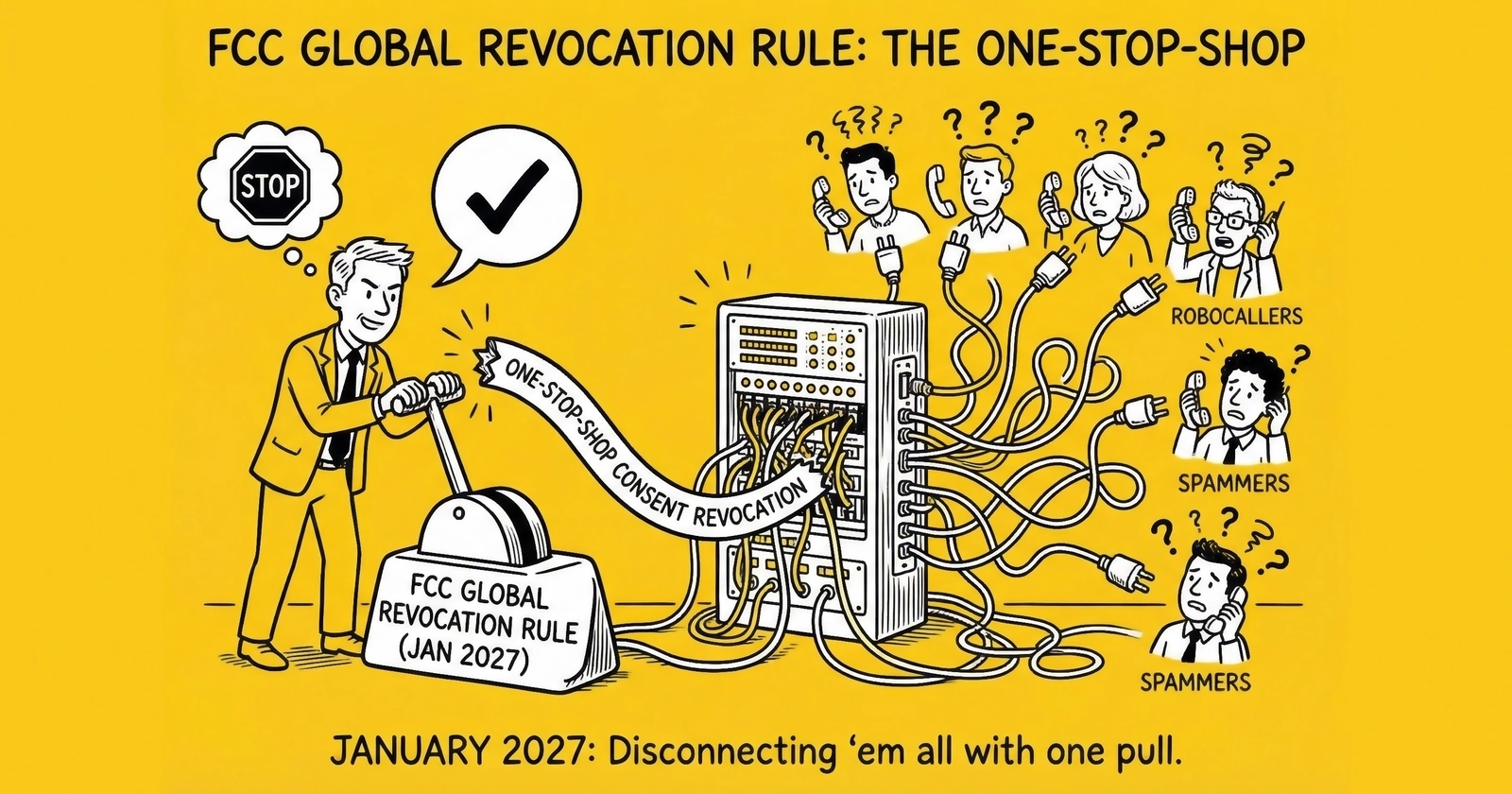
Understanding the FCC’s delayed cross-business-unit revocation requirement and how to prepare multi-brand lead operations before the January 2027 effective date.
In December 2023, the FCC adopted sweeping changes to TCPA consent and revocation requirements. The one-to-one consent rule was vacated by the 11th Circuit in January 2025. Other provisions – including the 10-business-day revocation window and standard opt-out keywords – took effect in April 2025.
One requirement has been delayed twice: the “global revocation” rule under 47 CFR § 64.1200(a)(10). This provision requires that when a consumer revokes consent for one type of robocall or robotext, that revocation must apply to all future automated calls and texts from that caller on unrelated matters.
On January 6, 2026, the FCC Consumer and Governmental Affairs Bureau issued Order DA-26-12, extending the effective date to January 31, 2027. This is the second extension; the first (Order DA-25-312, April 2025) pushed the date from April 11, 2025 to April 11, 2026.
For lead operations with multiple brands, business units, or product lines, this creates a compliance timeline – and a systems problem.
What the Global Revocation Rule Requires
The Core Requirement
Under 47 CFR § 64.1200(a)(10), when a consumer revokes consent for robocalls or robotexts from a caller:
The revocation must be applied to all future robocalls and robotexts from that caller on unrelated matters.
This means a consumer who texts “STOP” to your auto insurance campaign has effectively opted out of:
- Your home insurance campaigns
- Your Medicare supplement campaigns
- Your solar financing campaigns
- Any other product line you operate under the same legal entity
The rule treats the caller as a single entity, not as a collection of separate campaigns or brands.
What “Caller” Means
The critical question is entity scope. The FCC’s rule applies to the “caller” – the party initiating the communication. For lead generators, this typically means:
- Single corporate entity: All campaigns under one LLC or corporation share the same revocation pool
- Multi-brand operations: If Brand A and Brand B operate under the same legal entity, a revocation from Brand A applies to Brand B
- Affiliated entities: The FCC has indicated that callers cannot use separate legal entities solely to circumvent revocation requirements
What the Rule Does NOT Require
The global revocation rule is narrow in scope:
- Does not require one-to-one consent. The vacated consent rule is separate. Multi-seller consent remains legal under federal law.
- Does not affect non-automated calls. Calls made by live agents without ATDS technology are not covered by this specific provision.
- Does not apply to different callers. If Lead Gen Company A sells leads to Insurance Agency B, a revocation from Company A does not automatically apply to Agency B.
The rule addresses the problem of consumers who opt out of one campaign only to receive calls about different products from the same company.
Why the FCC Extended the Deadline Again
The April 2025 Extension
The first extension (Order DA-25-312, April 7, 2025) delayed the requirement from April 11, 2025 to April 11, 2026. The FCC cited industry concerns about operational complexity:
The Bureau recognizes that compliance with this requirement may necessitate significant changes to caller systems and processes.
The extension acknowledged that most calling operations were not architected to share revocation data across business units in real time.
The January 2027 Extension
The second extension (Order DA-26-12, January 6, 2026) pushed the effective date to January 31, 2027. The FCC’s reasoning:
- Pending judicial review: Litigation challenging the underlying rule remains active
- Implementation complexity: Industry continues to report challenges building unified revocation systems
- Regulatory certainty: The Commission prefers to provide clarity before enforcement begins
The extension is narrow. It applies only to § 64.1200(a)(10) – the cross-business-unit element. Other revocation requirements from the December 2023 order remain in effect:
| Requirement | Status | Effective Date |
|---|---|---|
| 10-business-day revocation window | In effect | April 11, 2025 |
| Standard opt-out keywords (STOP, etc.) | In effect | April 11, 2025 |
| Any reasonable revocation method | In effect | April 11, 2025 |
| Global revocation across unrelated matters | Delayed | January 31, 2027 |
What This Means for Lead Generation Operations
The Multi-Brand Problem
Most lead generation operations are not single-product businesses. A typical operation might include:
- Multiple verticals (insurance, mortgage, solar, home services)
- Multiple brands or DBAs within each vertical
- Multiple campaigns with separate consent flows
- Separate suppression lists per campaign or brand
Under current systems, a consumer who opts out of “ABC Insurance Leads” campaign might continue receiving calls from “XYZ Solar Savings” campaign – even though both operate under the same corporate entity.
The global revocation rule treats these as a single caller. Once effective, opting out of ABC Insurance means opting out of XYZ Solar.
The Systems Architecture Challenge
Most lead distribution platforms manage suppression at the campaign level, not the entity level. To comply with global revocation, you need:
- Unified suppression database across all campaigns, brands, and business units
- Real-time propagation of opt-outs across that database
- Entity-level matching that connects consumer phone numbers to a single “caller” identity
- Audit capability to demonstrate compliance across the entire operation
This is not a policy update. It is a systems architecture change. Operations already tracking consent at the individual level under prior express written consent requirements have a foundation to build on.
The Vendor Coordination Challenge
Lead operations involve multiple parties: publishers, aggregators, distribution platforms, dialers, and buyers. The global revocation requirement applies to the caller – but opt-outs might be received at any point in the chain.
If a consumer texts “STOP” to a number operated by your dialer vendor, that revocation must propagate to your internal systems, across all campaigns, in time to suppress the next outbound attempt. For operations with multiple vendors and platforms, this coordination becomes complex.
Timeline for Preparation
January 2027 Is Not Far Away
The extension provides runway, but 12 months is not excessive for the required changes:
| Phase | Timeline | Activities |
|---|---|---|
| Assessment | Q1 2026 | Map all campaigns, brands, and legal entities; identify suppression data flows |
| Architecture | Q2 2026 | Design unified suppression system; evaluate platform capabilities |
| Build | Q3 2026 | Implement unified database; build API integrations; test propagation |
| Testing | Q4 2026 | Validate cross-campaign suppression; audit edge cases |
| Go-Live | January 2027 | Full compliance with global revocation requirement |
What to Do Now
1. Map Your Entity Structure
Document every brand, DBA, campaign, and product line that operates under each legal entity. The global revocation requirement applies at the entity level – you need to know where those boundaries are.
2. Audit Current Suppression Architecture
How does your current system handle opt-outs? Per-campaign suppression lists? Shared database? Manual processes? Understanding the current state reveals the gap to close.
3. Evaluate Platform Capabilities
Does your lead distribution platform support entity-level suppression? Can your dialer propagate opt-outs across campaigns in real time? Talk to vendors now about their global revocation roadmap.
4. Build the Business Case
Unified suppression infrastructure requires investment. Quantify the cost of non-compliance (TCPA statutory damages of $500-$1,500 per violation, class action exposure) against the cost of implementation.
5. Coordinate with Buyers and Partners
If you sell leads to buyers who make calls, discuss how revocations will be communicated. The global revocation requirement creates coordination obligations across the lead supply chain. See our TCPA compliance guide for lead generators for broader context on managing consent across distribution networks.
Relationship to Other TCPA Requirements
Internal DNC Lists
The TCPA already requires maintaining internal Do Not Call lists for consumers who request not to be called. The global revocation rule expands this: a revocation for one product line must now appear on suppression lists for all product lines under the same caller.
Consent Documentation
Prior express written consent remains required for telemarketing robocalls. Global revocation does not change consent capture requirements – it changes how revocations are processed after consent is granted and later withdrawn.
State Mini-TCPA Laws
Some states impose stricter revocation requirements than federal law. Virginia’s updated telemarketing law, effective January 1, 2026, requires honoring opt-out requests for at least 10 years and explicitly covers text messages. State requirements may exceed the federal global revocation rule. Maintaining proper consent documentation and retention practices becomes essential for demonstrating compliance across jurisdictions.
Frequently Asked Questions
Does this rule affect leads I’ve already sold?
No. The global revocation rule applies to the caller – the party making the call. If you sell leads to a buyer and the buyer is the caller, revocations received by the buyer apply to the buyer’s operations. Revocations you receive apply to your operations. The rule does not create automatic propagation across unrelated legal entities.
What if different business units have different consent?
The global revocation rule does not require one-to-one consent. A consumer might have consented separately to auto insurance calls and home insurance calls. The global revocation rule means that if they revoke consent for auto insurance calls, that revocation applies to home insurance calls as well – even though separate consent exists for both.
Can I structure separate LLCs to avoid this?
The FCC has indicated that callers cannot use separate legal entities solely to circumvent revocation requirements. If your LLC structure has legitimate business purposes, entities may be treated separately. If the structure exists primarily to avoid unified suppression, the FCC may treat the entities as a single caller for enforcement purposes. Consult counsel before relying on entity separation.
What about leads purchased from aggregators?
When you purchase leads from an aggregator and make calls as the caller, your revocation obligations apply. If the aggregator operates a unified consent capture across multiple buyers, revocations received by the aggregator should be communicated to buyers – but the global revocation rule applies to your calling operations, not to the aggregator’s data distribution.
How do I handle opt-outs received by vendors?
Build contractual and technical mechanisms to receive opt-out data from every vendor in your calling stack. Dialer vendors, text message platforms, and call centers all receive “STOP” requests. Those requests must flow back to your unified suppression system to comply with the global revocation requirement.
Key Takeaways
-
The effective date is January 31, 2027. Order DA-26-12 extended the deadline from April 11, 2026. This is the second extension; the first moved the date from April 2025.
-
Other revocation rules are already in effect. The 10-business-day window, standard opt-out keywords, and “any reasonable method” provisions took effect April 11, 2025. Only the cross-business-unit element was delayed.
-
This is an architecture problem, not a policy problem. Most systems manage suppression per-campaign. The global revocation rule requires entity-level suppression across all campaigns, brands, and product lines under a single caller.
-
Entity structure matters. The rule applies to the “caller.” Operations with multiple business units under one legal entity face unified suppression requirements. Legitimate multi-entity structures may be treated separately, but structures designed to circumvent the rule will not.
-
Start preparing now. Twelve months is not excessive for the systems changes required. Map your entity structure, audit current suppression architecture, and build the unified infrastructure before enforcement begins.
The Bottom Line
The FCC has given the industry additional runway to build compliant systems. Use it.
The global revocation requirement addresses a legitimate consumer concern: opting out of one campaign only to receive calls about unrelated products from the same company. The January 2027 effective date is not a signal that the rule will be abandoned – it is an acknowledgment that implementation requires time.
Lead operations that wait until late 2026 to address this will face rushed implementations and elevated compliance risk. Operations that treat the extension as preparation time will be ready when enforcement begins.
The question is not whether to build unified suppression infrastructure. The question is whether you build it on your timeline or the FCC’s.
Sources
- FCC Order DA-26-12 (January 6, 2026): https://docs.fcc.gov/public/attachments/DA-26-12A1.pdf
- FCC Order DA-25-312 (April 7, 2025): https://docs.fcc.gov/public/attachments/DA-25-312A1.pdf
- 47 CFR § 64.1200(a)(10): https://www.ecfr.gov/current/title-47/chapter-I/subchapter-B/part-64/subpart-L/section-64.1200