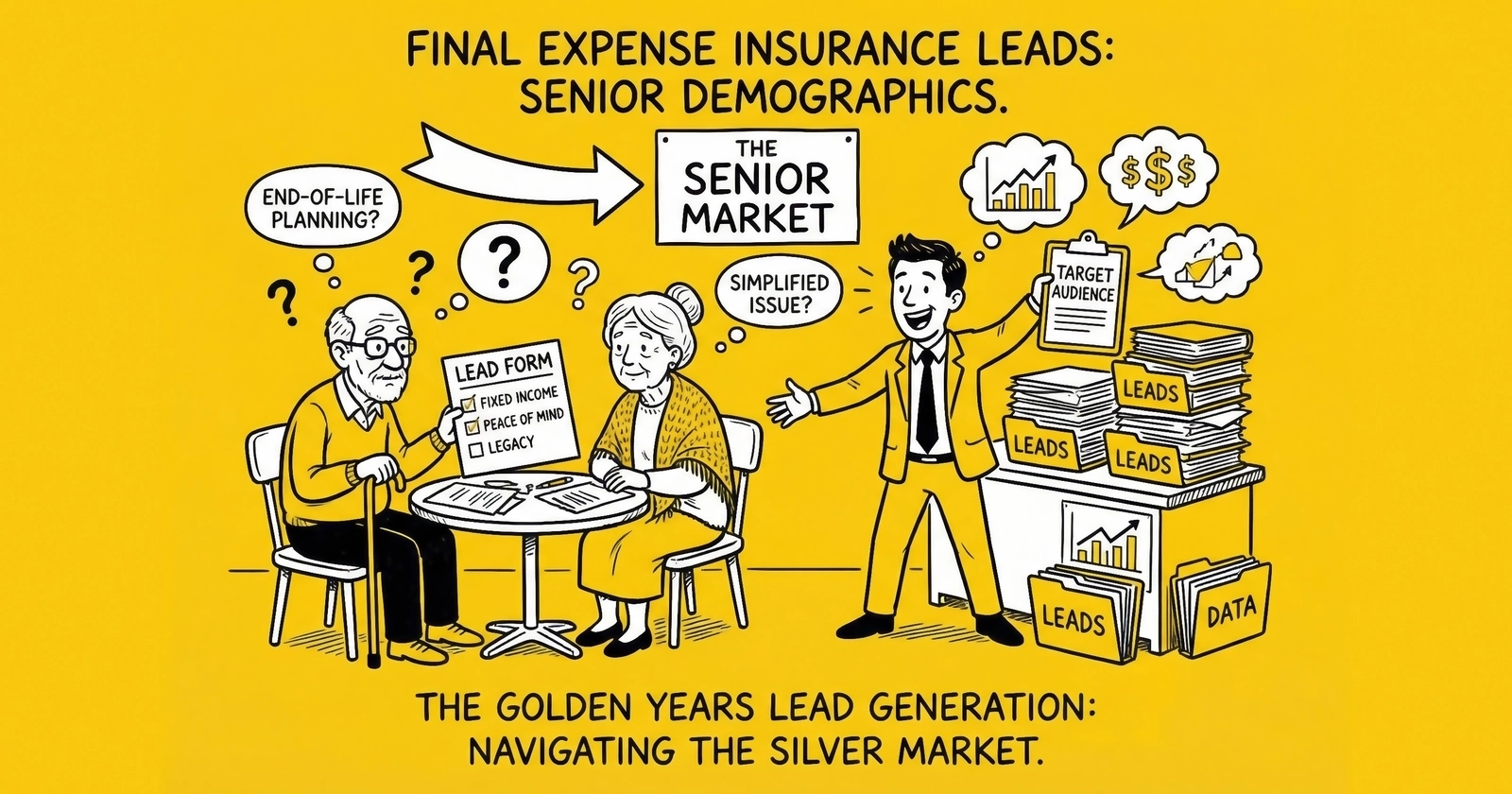
The $5 billion final expense insurance market requires a fundamentally different approach to lead generation than mainstream insurance verticals. Master senior demographic engagement, compliance requirements, and channel strategies that convert consumers aged 50-85 into enrolled policyholders.
A 72-year-old widow in Oklahoma types “burial insurance no medical exam” into her phone at 9 PM. Within seconds, her information flows through a lead distribution system, gets evaluated by multiple insurance agents, and lands in the CRM of an agent 800 miles away who specializes in final expense policies. By morning, she will receive a phone call from someone offering to help protect her family from funeral costs.
This is final expense lead generation. It operates at the intersection of mortality anxiety, fixed-income economics, and family obligation in ways that require sensitivity, compliance expertise, and deep understanding of how seniors engage with insurance products.
Final expense insurance represents one of the fastest-growing segments in the life insurance market, driven by demographic expansion as 10,000+ Americans turn 65 daily and cultural shifts toward planning for end-of-life costs. The market reached $5 billion in annual premium in 2024, with projections suggesting continued 5-7% annual growth through 2030.
For lead generators and insurance agents, final expense offers a distinct opportunity. The product is simpler than traditional life insurance. The sales cycle is shorter. The target demographic is highly motivated by specific, emotional concerns. But the regulatory environment is complex, the marketing requires specialized approaches, and the ethical considerations demand careful attention.
This guide provides the complete framework for final expense lead generation: market dynamics, senior demographic targeting, channel strategies, CPL benchmarks, compliance requirements, and the operational practices that separate sustainable businesses from those that generate complaints and regulatory scrutiny.
Understanding the Final Expense Market
Final expense insurance, also called burial insurance or funeral insurance, covers end-of-life costs including funeral expenses, medical bills, and small debts. Policies typically range from $5,000 to $35,000 in coverage, with the average policy around $10,000-15,000.
What Makes Final Expense Different
Final expense differs from traditional life insurance in several fundamental ways that affect lead generation strategy:
Simplified underwriting eliminates the medical exam requirement that slows traditional life insurance sales. Most final expense policies use guaranteed issue or simplified issue underwriting, asking health questions but not requiring blood tests, paramedical exams, or extensive medical records review. This enables faster sales cycles and phone-based closing.
Face amounts are smaller with average policies providing $10,000-15,000 in coverage. This reduces premium costs, making the product accessible to fixed-income consumers, but also compresses per-policy commission value.
Target demographic skews older with the primary market being consumers aged 50-85. This population has distinct communication preferences, technology adoption patterns, and decision-making processes that require specialized marketing approaches.
Emotional drivers are specific centered on preventing family burden from funeral costs. The average funeral costs $7,000-12,000, with cremation averaging $6,000-7,000. Consumers seeking final expense are typically motivated by not wanting children or grandchildren to bear these costs.
Competitive positioning differs from traditional life insurance. Final expense agents compete primarily on trust, accessibility, and simplified process rather than on rate comparisons or product features.
Market Size and Growth Trajectory
The final expense insurance market generates approximately $5 billion in annual premium, representing one of the fastest-growing segments within life insurance. Several demographic and social factors drive this growth:
Population aging provides structural tailwind. The 65+ population in the United States reached 60 million in 2024 and is projected to exceed 80 million by 2040. This demographic expansion creates sustained demand growth independent of economic cycles.
Funeral cost inflation exceeds general inflation. Funeral costs have increased approximately 4-5% annually over the past decade, outpacing CPI and increasing the dollar amount of coverage consumers need.
Under-insurance prevalence creates persistent opportunity. Research consistently shows that 40-50% of Americans lack sufficient life insurance coverage, with the gap most pronounced among older, lower-income populations who represent the core final expense market.
Social awareness has increased through media coverage, funeral industry marketing, and word-of-mouth as more families experience the financial burden of unplanned funeral costs.
Industry Players and Distribution Channels
The final expense market operates through several distribution channels, each with distinct lead generation implications:
Independent agents and agencies represent the largest distribution channel. Independent agents contract with multiple carriers, offering consumers choice among products. They purchase leads from aggregators, generate their own leads through local marketing, or receive leads from FMOs and IMOs.
Captive agents work exclusively for specific carriers, receiving leads through carrier marketing programs or generating their own. Lincoln Heritage and Security National are examples of carriers with significant captive agency forces.
Field Marketing Organizations (FMOs) and Independent Marketing Organizations (IMOs) serve as intermediaries, contracting agents, providing training and support, and often distributing leads to their agent networks.
Direct-to-consumer carriers have entered the market, selling policies online or through call centers without agent intermediation. These include digital-first insurers and traditional carriers with direct channels.
Major carriers in the final expense space include Mutual of Omaha, AIG, Transamerica, Foresters Financial, Aetna, and numerous specialty carriers focused exclusively on the senior market.
Senior Demographic Targeting: The 50-85 Market
Effective final expense lead generation requires understanding how the target demographic differs from younger insurance buyers. Assumptions that work for auto insurance or mortgage leads fail when applied to consumers aged 50-85.
Communication Preferences and Channels
The senior demographic maintains distinct communication preferences that shape effective marketing:
Phone remains dominant. Research consistently shows that 65-75% of seniors aged 65+ prefer phone communication for financial and insurance decisions. This preference strengthens with age. While younger seniors (50-64) show greater digital comfort, the core 65-85 demographic strongly prefers voice interaction.
Trust builds through relationship. Unlike younger consumers who transact digitally with brands they have never spoken with, seniors prioritize human connection. A friendly, patient phone conversation establishes trust that enables closing. Rushed or pushy interactions create resistance.
Mail maintains relevance. Direct mail produces response rates 10-30x higher with the 65+ demographic compared to younger segments. Seniors open physical mail at rates exceeding 90%, and direct mail triggers phone calls and website visits at higher rates than digital-only approaches.
Television drives awareness. Final expense television advertising, particularly during daytime programming, reaches the target demographic with high frequency. Major carriers spend significantly on television advertising during news programs, talk shows, and programming with older viewership.
Facebook reaches seniors effectively. The 65+ demographic represents Facebook’s fastest-growing user segment, with approximately 70% of Americans 65+ using the platform. Targeting capabilities enable reaching seniors based on age, location, interests, and behaviors.
Device and Technology Considerations
Technology adoption patterns require accommodation in lead generation:
Desktop usage exceeds mobile for the senior demographic. While general internet usage has shifted 70%+ to mobile devices, seniors aged 65+ still complete approximately 50-55% of form submissions on desktop computers. They prefer larger screens for reading detailed information and completing forms.
Tablet usage is significant. Many seniors use tablets (iPad in particular) as primary computing devices. Landing pages must render properly on tablet screens, which differ from both phone and desktop in dimension and interaction pattern.
Form complexity tolerance is lower. Seniors abandon complex multi-step forms at higher rates than younger users. Simplified forms with larger fonts, fewer fields per page, and clear progress indicators improve completion rates.
Accessibility requirements matter. Age-related vision changes require larger fonts (minimum 16px, preferably 18px), high contrast between text and backgrounds, and generous spacing between form elements. Age-related motor changes require larger click targets (minimum 44x44 pixels) and tolerance for imprecise input.
Geographic Concentration and Variation
Final expense demand concentrates in specific regions with demographic and cultural characteristics that affect lead generation strategy:
Southern states including Texas, Florida, Georgia, North Carolina, and Tennessee represent the largest market concentrations. These states combine large senior populations with cultural attitudes favorable to insurance purchase.
Rural areas often show higher response rates to final expense marketing than urban areas. Lower cost of living creates price sensitivity that final expense products address. Stronger church and community ties reinforce the family obligation message central to final expense marketing.
State regulation varies affecting marketing approaches. Some states have specific requirements for insurance advertising, telemarketing, or senior-targeted products. Understanding state-level requirements prevents compliance issues.
CPL Benchmarks and Lead Economics
Final expense lead pricing reflects the unique characteristics of the market: targeted demographic, emotional purchase drivers, and simplified product structure. Understanding accurate benchmarks enables appropriate budget planning and source evaluation.
Lead Type Pricing Tiers
Final expense leads price across a wide range depending on lead type, freshness, and qualification depth.
Exclusive Real-Time Leads: $25-70
Exclusive leads sell to a single agent, eliminating competition for the prospect. Pricing within this range depends on multiple qualification factors. Age verification distinguishes between confirmed 50-85 eligibility versus self-reported claims. Current coverage status matters – whether the consumer has no existing coverage, seeks to add supplemental protection, or wants to replace an existing policy. Health qualification through pre-screening for simplified issue eligibility commands premium pricing. Geographic targeting at the state level versus national distribution affects costs, as does delivery method (real-time API integration versus batch delivery). Consent documentation quality also influences price, with TrustedForm-certified leads commanding higher rates than basic documentation.
Premium exclusive leads at $50-70 include verified contact information, confirmed age eligibility, health pre-qualification, and documented consent. Basic exclusive leads at $25-40 may lack these verification and pre-qualification elements.
Shared Leads: $10-25
Shared leads sell to 3-5 agents simultaneously. The lower per-lead cost reflects the competitive dynamics inherent in this model. Speed-to-contact becomes critical when multiple agents pursue the same prospect, and conversion rates compress compared to exclusive leads. This model suits operations with rapid-response capability that can compete effectively against other purchasers.
Shared final expense leads typically cost less than shared auto insurance leads because the smaller policy size supports lower acquisition investment.
Live Transfers: $40-100
Live transfers connect consumers directly with agents while in active shopping mode. The consumer is already on the phone, engaged, and ready to discuss coverage options. Call center pre-qualification verifies intent before transfer, resulting in higher conversion rates of 15-30% compared to 8-15% for form leads. Premium pricing reflects the near-certain contact and elevated conversion potential.
Live transfer pricing varies by qualification depth, required call duration minimums, and whether transfers are exclusive or shared.
Aged Leads: $2-12
Leads 30-90+ days old price at 10-25% of fresh lead costs. The economics shift as leads age, with lower pricing reflecting reduced conversion probability.
| Lead Age | Typical Pricing | Expected Conversion |
|---|---|---|
| Fresh (real-time) | $30-60 | 12-18% |
| 30-day aged | $8-15 | 6-10% |
| 60-day aged | $4-8 | 4-7% |
| 90+ day aged | $2-5 | 2-4% |
Aged leads work for operations with systematic nurture capabilities and patience for longer sales cycles.
Direct Mail Response Leads: $20-45
Direct mail campaigns generate leads when recipients call or return response cards. These leads demonstrate higher intent because the consumer initiated contact rather than responding to an interruption. Contact rates exceed 90% for phone responders since they actively reached out. Volume flows more slowly than digital channels because it depends on campaign timing and mail delivery. List quality ultimately determines response rates and downstream conversion.
Television Response Leads: $35-75
Television advertising generates inbound calls from viewers with the highest intent level – consumers who initiated contact after seeing an ad demonstrate immediate purchase readiness. Premium pricing reflects this quality, and the channel is dominated by carriers with sufficient scale and large FMOs who can absorb the media investment required for meaningful television presence.
Conversion Rate Benchmarks
Final expense conversion rates differ from other insurance verticals due to the emotional purchase drivers and simplified product:
| Metric | Exclusive Leads | Shared Leads | Live Transfers |
|---|---|---|---|
| Contact rate | 45-55% | 40-50% | 95%+ |
| Appointment set rate | 35-45% | 25-35% | 50-65% |
| Show rate (for appointments) | 70-80% | 60-70% | N/A |
| Conversion rate (of contacts) | 12-18% | 8-12% | 15-30% |
These rates assume competent sales process and appropriate lead quality. Poor lead quality, inadequate follow-up, or aggressive sales tactics compress rates significantly.
Unit Economics Calculation
The final expense unit economics equation differs from higher-premium insurance products.
Average Policy Economics
The typical final expense policy has a face amount of $10,000-15,000 and generates annual premiums of $600-1,200. First-year commissions run 100-115% of annual premium, translating to $600-1,380 per policy. Renewal commissions add 2-5% annually for policies that remain in force.
Lead-to-Sale Economics Example
Consider an operation purchasing 100 exclusive leads at $40 each for a total spend of $4,000. With a 50% contact rate, the operation generates 50 conversations. At a 15% conversion rate, those conversations yield 7.5 sales, producing a cost per sale of $533. With first-year commission averaging $800 per sale, the net first-year margin is $267 per policy. Each policy continuing generates $30-50 in annual renewal commission.
The math works because of the high first-year commission rates (often exceeding annual premium) and long-term renewal streams. However, slim first-year margins require attention to persistency (policies staying in force) and chargebacks (commission recovery when policies lapse).
Lead Generation Channels for Final Expense
Multiple channels generate final expense leads, each with distinct characteristics, costs, and quality profiles. Successful operations typically use multiple channels to diversify risk and optimize overall economics.
Digital Channels
Facebook Advertising
Facebook has become the dominant digital channel for final expense lead generation due to its targeting capabilities and strong senior demographic usage. The platform enables direct age targeting of 50-85+ ranges, interest targeting around final expense insurance, funeral planning, life insurance, and senior topics, and behavioral targeting based on purchase behaviors, life events, and financial indicators. Geographic targeting reaches consumers at the state, city, or ZIP code level. Average CPL runs $15-35 for form leads, with quality varying based on age verification, health pre-screening, and benefit amount selection in the form flow.
Effective Facebook creative for final expense differs from other insurance verticals. Emotional resonance around family protection, dignity in death, and preventing burden on loved ones outperforms rate-focused or feature-focused messaging.
Compliance considerations apply. Facebook policies restrict certain insurance advertising approaches, and state regulations may limit claims or guarantees. Review platform policies and state requirements before launching campaigns.
Google Ads (Search)
Google search captures high-intent consumers actively seeking information. Core keywords include “burial insurance,” “funeral insurance,” “final expense insurance,” and “life insurance no medical exam.” Average CPC runs $8-20 for these terms – moderate compared to auto or health insurance. Intent level is high because consumers are actively searching rather than being interrupted. Landing pages must load fast, optimize for mobile, and present simple forms.
Google search produces lower volume than Facebook but often higher quality. Consumers typing “burial insurance quotes” have immediate purchase intent that differs from interrupted Facebook browsing.
Native Advertising
Native ad platforms like Taboola, Outbrain, and RevContent reach seniors on news and content sites. The content-style ad format blends with editorial content, generating CPLs of $10-25 at significant scale. Quality varies and requires source-level optimization. The best practice involves advertorial landing pages that educate consumers before asking for lead information.
Native advertising works for final expense because the content format allows emotional storytelling that resonates with the demographic. “The Burial Insurance Secret Nobody Talks About” outperforms direct offer headlines.
Traditional Channels
Direct Mail
Direct mail remains a primary acquisition channel for final expense despite digital growth. Response rates run 0.5-2% for cold lists and 3-8% for house lists (previous responders). Cost per piece averages $0.50-$1.50 including postage, translating to cost per response of $25-$150 depending on list quality and creative. Letter format outperforms postcards for the senior demographic. Timing requires patience – expect a 2-3 week lag from mail drop to response.
Effective direct mail creative emphasizes accessibility, emotional benefits, and clear response mechanisms. “Simply Mail This Card” call-to-action with prepaid business reply produces consistent response.
List quality determines direct mail success. Age-targeted lists with insurance buyer indicators outperform general senior lists. Recency matters – consumers who recently responded to insurance direct mail are more likely to respond again.
Television
Television advertising reaches the senior demographic through daytime and news programming, generating broad awareness at significant cost. Meaningful campaigns require budgets of $50,000-$500,000 or more. The response mechanism is inbound phone calls to tracked numbers, producing high-intent leads from consumers who initiated contact after viewing. Carriers with scale and large FMOs dominate this channel.
Television works as a branding and lead generation channel for organizations with sufficient budget. Smaller operations typically cannot compete economically and should focus on digital and direct mail.
Radio
Radio advertising targets seniors during drive time and talk programming. AM talk radio often performs best for the demographic. Costs are more accessible than television, with response typically coming through phone numbers that emphasize local presence. Local and regional campaigns are more common than national buys.
Radio enables geographic targeting and builds local presence for agencies seeking regional dominance.
Telemarketing (Outbound) Considerations
Outbound telemarketing for final expense faces significant regulatory constraints that have fundamentally reshaped the industry.
TCPA requirements mandate prior express written consent for autodialed calls. Though the FCC’s one-to-one consent rule was vacated by the Eleventh Circuit in January 2025, many sophisticated buyers still require one-to-one consent as a practical matter. DNC compliance is mandatory, and state mini-TCPA laws add additional requirements that vary by jurisdiction.
The practical reality is stark. Cold calling without consent creates substantial litigation risk. Warm calling to consumers with existing relationships requires careful documentation to prove the relationship exists and consent was obtained. Most successful operations have shifted to inbound models where the consumer initiates contact, eliminating the consent requirement for the initial conversation. For detailed compliance guidance, see TCPA compliance requirements and the prior express written consent guide.
The regulatory environment has shifted final expense lead generation away from outbound cold calling toward inbound-response models (direct mail, television, digital) that generate consumer-initiated inquiry.
Compliance Framework for Final Expense Leads
Final expense lead generation operates under multiple regulatory frameworks with enhanced scrutiny due to the senior demographic. Non-compliance creates liability that destroys profitable operations and harms vulnerable consumers.
TCPA Compliance Essentials
The Telephone Consumer Protection Act governs how leads can be contacted.
Prior Express Written Consent Requirements
PEWC is required before making autodialed calls or sending texts to leads. The consent must be “clear and conspicuous” on the page where consumers submit their information. The consent language should identify the specific seller or sellers authorized to call – though the FCC’s one-to-one consent rule was vacated by the Eleventh Circuit in January 2025, specific seller identification remains the safest compliance posture and is increasingly required by sophisticated buyers.
Documentation Best Practices
Implement TrustedForm or Jornaya consent certificates to create independent verification of consent. Capture the IP address, timestamp, and user agent for each form submission. Record the exact consent language displayed at the moment of submission. Retain all documentation for at least five years, with seven years or more recommended given statute of limitations considerations.
Penalty Exposure
TCPA violations carry penalties of $500-$1,500 per violation. Class action lawsuits multiply this exposure across entire call volumes, with the average TCPA settlement reaching $6.6 million. Senior-targeted marketing faces enhanced scrutiny from both regulators and plaintiff’s attorneys.
Senior-Specific Considerations
Regulatory agencies and plaintiff’s attorneys view senior-targeted marketing with heightened attention. Consumer complaints from seniors receive particular attention from state attorneys general. Aggressive tactics that might be tolerated with younger demographics trigger enforcement action when applied to elderly populations.
State Insurance Regulations
Insurance marketing faces state-specific requirements that vary significantly across jurisdictions.
Licensing Requirements
Lead generators typically do not need insurance licenses for pure lead generation activity. However, the line blurs when forms provide quotes, recommendations, or specific product information – activities that may constitute insurance solicitation. Some states define “solicitation” broadly enough to include lead generation activities. Agents receiving leads must be licensed in the state where the consumer resides.
Advertising Requirements
Many states require specific disclosures in insurance advertising materials. Claims about “no medical exam” or “guaranteed acceptance” face regulatory scrutiny and may require specific disclaimers. Rate claims may require carrier authorization and accuracy verification. Comparative statements must be substantiated with documentation.
Senior Protection Statutes
Several states have enacted specific protections for seniors in financial product marketing. These include age-based restrictions on certain marketing tactics, mandatory cooling-off periods for some insurance products, and enhanced disclosure requirements designed to ensure informed decisions.
FTC Advertising Standards
The Federal Trade Commission applies general advertising standards to final expense marketing.
Truthful Advertising
All claims must be substantiated with evidence. Disclaimers must be clear and conspicuous – not hidden in fine print or difficult to find. Material information cannot be omitted if its absence would mislead consumers. Testimonials must reflect typical results, not exceptional outcomes presented as representative.
Native Advertising Disclosure
Paid content must be clearly identified as advertising. This requires “Ad,” “Sponsored,” or similar disclosure that is prominent and visible, not hidden in a corner or formatted to blend with editorial content.
Ethical Considerations Beyond Compliance
Legal compliance represents the floor, not the ceiling. Sustainable final expense operations observe additional ethical standards:
Target appropriate consumers. Not everyone who responds to final expense advertising is an appropriate buyer. Consumers with advanced dementia, those already adequately insured, or those who cannot afford premiums should not be sold policies.
Avoid exploiting vulnerability. The emotional nature of end-of-life planning creates vulnerability. Marketing that generates excessive fear, exploits grief, or pressures immediate decisions causes harm even if technically legal.
Disclose material information. Premiums, coverage limitations, waiting periods, and exclusions must be clearly communicated before sale. Consumers deserve to understand what they are purchasing.
Honor do-not-contact requests. When consumers ask not to be contacted, honor that request immediately and permanently. No sale is worth the harm and liability of pursuing unwilling prospects.
Maintain quality standards. Leads generated through deceptive advertising, incentivized surveys, or co-registration without clear disclosure create downstream problems even if you did not generate them directly.
Building a Final Expense Lead Operation
Whether you are generating leads, buying leads, or building an agency, understanding the operational requirements for final expense success positions you appropriately.
For Lead Generators
Traffic Source Selection
Not all traffic sources produce quality final expense leads. Prioritize sources that deliver consumers with genuine purchase intent, allow proper consent capture and documentation, maintain quality through feedback and optimization, and operate within platform policies and regulations.
Facebook, Google, and direct mail form the core acquisition mix for most successful final expense lead generators. Native advertising provides supplemental volume. Incentivized surveys, misleading co-registration, and low-quality affiliate traffic create quality problems that damage buyer relationships.
Form Design for Senior Users
Lead capture forms for the 50-85 demographic require specific optimization for age-related vision and motor changes. Use large fonts with a minimum of 16px and preferably 18px for body text. Ensure high contrast with black text on white or light backgrounds. Keep the layout simple with single column design and generous whitespace. Make click targets large – minimum 44x44 pixels for buttons. Include clear progress indicators showing where users are in multi-step forms. Display the phone number prominently to allow direct calling as an alternative to form completion. Write error messages that actually help by clearly explaining what is wrong and how to fix it.
Quality Assurance
Implement validation before lead delivery to ensure quality. Phone number verification should include line type, carrier lookup, and active status. Email verification covers syntax, domain validation, and deliverability. Verify age where possible. Run duplicate detection against recent submissions. Apply fraud scoring based on behavioral signals. Match IP geolocation to stated location.
Buyer Relationship Management
Long-term success requires buyer satisfaction. Respond quickly when quality issues arise. Maintain fair return policies for legitimately defective leads. Provide source-level transparency when requested. Continuously optimize based on buyer feedback. Honor volume commitments reliably.
For Lead Buyers
Source Evaluation
Not all lead sources produce equal results. Evaluate sources on contact rate (percentage of leads you successfully reach), conversion rate (percentage of contacts who purchase), return rate (percentage you reject for quality issues), cost per sale (total spend divided by policies sold), and commission chargebacks (policies that lapse affecting compensation).
Test sources with small volume before committing significant spend. Track source-level performance from first contact through policy issue and persistency.
Speed-to-Contact Infrastructure
Final expense leads reward rapid response, though the dynamics differ slightly from auto insurance. Target response time should be five minutes or less for digital leads – the goal is to contact consumers while purchase intent remains high. CRM integration should route leads directly to dialers or agents without manual steps. Establish backup systems to handle situations when the primary agent is unavailable.
Speed matters, but relationship matters more. A rushed, pressured first call that alienates a senior prospect loses the sale regardless of response time. Balance speed with appropriate pacing for the demographic. The five-minute rule for response time applies, though senior demographics require softer initial approaches.
Sales Process Optimization
Final expense sales require specific approaches tailored to the senior demographic. Patience is essential because senior prospects take longer to build trust. Listening helps you understand their specific concerns and family situation. Education matters since many prospects need to understand what final expense insurance actually is. Empathy allows you to acknowledge the emotional nature of the conversation. Simplification means avoiding jargon and complex explanations. Follow-up is often required because multiple touches typically precede a decision.
Agents who succeed in final expense combine sales competence with genuine care for the consumer. Transactional approaches that work in auto insurance often fail with senior prospects.
For Insurance Agencies
Agent Training Requirements
Final expense agents require specific training beyond general life insurance licensing. Senior communication techniques differ substantially from approaches used with younger consumers. Final expense product knowledge must cover the distinctions between simplified and guaranteed issue products, waiting periods, and coverage limitations. Compliance requirements for senior-targeted marketing carry enhanced obligations. Ethical standards and vulnerable population considerations require explicit training. Phone sales effectiveness matters particularly because the majority of final expense sales close by phone rather than in person.
Technology Stack
Effective final expense agencies implement integrated technology systems. A CRM system tracks leads, calls, appointments, and policies through the lifecycle. A dialer or phone system provides power dialing or preview dialing capability for efficient outreach. Lead distribution routes leads to appropriate agents based on availability, territory, and specialty. Policy management tracks submissions, underwriting status, issue, and persistency. Call recording supports training, compliance documentation, and dispute resolution.
Carrier Relationships
Final expense agencies typically contract with multiple carriers including Mutual of Omaha, Transamerica, AIG, Foresters Financial, Aetna, Colonial Penn, and various specialty final expense carriers.
Multiple carrier contracts enable matching products to consumer health profiles and preferences. Guaranteed issue products serve consumers who cannot qualify for simplified issue. Premium carriers serve consumers seeking specific brand relationships.
Measuring Success: Key Metrics for Final Expense
Track these metrics to optimize final expense lead operations:
Lead Quality Metrics
| Metric | Definition | Target |
|---|---|---|
| Valid phone rate | Percentage with working phone numbers | Greater than 92% |
| Email deliverability | Percentage with valid email addresses | Greater than 88% |
| Age eligibility rate | Percentage in target 50-85 age range | Greater than 95% |
| Duplicate rate | Percentage matching recent leads | Less than 5% |
| Return rate | Percentage rejected by buyers | Less than 12% |
| Consent documentation | Percentage with TrustedForm certificates | 100% |
Sales Performance Metrics
| Metric | Definition | Target |
|---|---|---|
| Speed-to-contact | Time from receipt to first dial | Less than 5 minutes |
| Contact rate | Percentage reached by phone | Greater than 45% |
| Appointment rate | Percentage scheduling appointments | Greater than 30% |
| Show rate | Percentage who keep appointments | Greater than 70% |
| Conversion rate | Percentage purchasing policies | Greater than 12% |
| Cost per sale | Total spend divided by policies | Less than $600 |
Policy and Persistency Metrics
| Metric | Definition | Target |
|---|---|---|
| Issue rate | Applications that become issued policies | Greater than 80% |
| 13-month persistency | Policies in force after 13 months | Greater than 75% |
| Chargeback rate | Commissions recovered due to lapse | Less than 15% |
| Average face amount | Average coverage per policy | $10,000-15,000 |
| Average premium | Average annual premium per policy | $600-1,200 |
Source-Level Analysis
Critical: track all metrics by lead source. A $25 lead with 6% conversion costs more per sale than a $45 lead with 15% conversion. Without source-level tracking, you optimize for the wrong variable.
Calculate true cost per sale including all costs: lead cost, call center labor (if applicable), overhead allocation. Compare to commission economics including chargebacks for accurate profitability assessment.
Seasonal Patterns and Strategic Timing
Final expense lead generation follows seasonal patterns that affect demand, pricing, and strategy:
Annual Demand Patterns
| Period | Demand Level | Typical CPL Impact |
|---|---|---|
| January | High | +10-20% |
| February-March | Moderate-High | +5-10% |
| April-May | Moderate | Baseline |
| June-July | Moderate-Low | -5-10% |
| August-September | Moderate | Baseline |
| October-November | Moderate-High | +5-15% |
| December | Low-Moderate | -5-15% |
January peak reflects New Year resolution energy and post-holiday reflection on family financial protection. Tax season approaching reminds consumers of financial planning.
Spring moderate demand provides stable lead generation environment with predictable pricing.
Summer lull creates opportunities for lower-cost lead acquisition as competition reduces. Some carriers pull back spending, softening demand.
Fall increase aligns with open enrollment periods for health insurance, which brings insurance generally to consumer attention. Holiday season approaching prompts family protection considerations.
December mixed combines holiday distraction (reducing shopping) with family gatherings (increasing mortality awareness and planning conversations).
Time-of-Day Patterns
Final expense leads perform differently by time of day. Morning hours from 9 AM to 12 PM produce the best contact rates as seniors are often at home and alert. Early afternoon from 12 PM to 2 PM shows moderate performance with some lunch disruption. Mid-afternoon from 2 PM to 5 PM returns to good contact rates before dinner routines begin. Evening hours from 5 PM to 8 PM see declining contact rates as family time takes priority. Weekend performance varies – Saturday mornings are often productive while Sundays show lower engagement.
Staffing and calling schedules should align with these patterns. Calling a senior prospect at 9 PM creates negative experience regardless of lead quality.
Event-Driven Demand
Certain events trigger increased final expense interest. The death of a public figure, especially beloved entertainers or politicians of similar age to the target demographic, prompts reflection on mortality and planning. Health scares in the news create anxiety that drives insurance consideration. Economic uncertainty generates concerns about leaving debt to family. Natural disasters in a region heighten awareness of life’s uncertainty. Personal life events including spouse death, diagnosis, or attending a family member’s funeral directly trigger coverage consideration.
These events cannot be predicted precisely but create opportunity for increased marketing during heightened awareness periods.
Frequently Asked Questions
What is the difference between final expense insurance and traditional life insurance?
Final expense insurance is a type of whole life insurance designed specifically to cover end-of-life costs including funeral expenses, medical bills, and small debts. Policies typically range from $5,000 to $35,000 in coverage with simplified or guaranteed issue underwriting that does not require medical exams. Traditional life insurance often has higher face amounts ($100,000+), may require medical underwriting, and serves broader protection purposes like income replacement. Final expense targets the 50-85 age demographic who may not qualify for or need larger traditional policies.
How much do final expense insurance leads cost in 2025?
Final expense lead pricing ranges from $2-100 depending on lead type and quality. Exclusive real-time leads cost $25-70, with premium leads at the higher end including age verification, health pre-qualification, and documented consent. Shared leads cost $10-25 for simultaneous distribution to 3-5 agents. Live transfers command $40-100 for warm phone connections with pre-qualified consumers. Aged leads (30-90+ days old) price at $2-12. These benchmarks reflect 2025 market conditions through established lead sources.
What conversion rates should I expect from final expense leads?
Industry benchmarks show 45-55% contact rates for exclusive leads, 40-50% for shared leads, and 95%+ for live transfers. Conversion rates (contacts who purchase) typically range from 12-18% for exclusive leads, 8-12% for shared leads, and 15-30% for live transfers. These rates assume competent sales process and appropriate lead quality. Speed-to-contact significantly impacts results – leads contacted within 5 minutes convert at substantially higher rates than those contacted hours later.
What is the best channel for generating final expense leads?
No single channel dominates for all operations. Facebook advertising provides scale with good targeting for the senior demographic at CPLs of $15-35. Google search captures high-intent shoppers at higher CPLs ($20-50) but with stronger purchase readiness. Direct mail produces response rates 10-30x higher with seniors than younger demographics. Television reaches broad audiences but requires significant budget. Most successful operations use multiple channels to diversify risk and optimize overall economics based on their specific situation.
What compliance requirements apply to final expense lead generation?
Final expense lead generation faces TCPA requirements (prior express written consent for autodialed calls, with many sophisticated buyers requiring one-to-one consent, DNC compliance), state insurance regulations (advertising standards, licensing requirements, senior protection statutes), and FTC advertising standards (truthful advertising, native advertising disclosure). Enhanced scrutiny applies to senior-targeted marketing – regulatory agencies and plaintiff’s attorneys view marketing to vulnerable populations with heightened attention. Documentation through TrustedForm or Jornaya certificates is essential.
How does senior demographic marketing differ from other insurance verticals?
Senior demographic marketing requires fundamentally different approaches. Phone remains the dominant communication channel (65-75% preference vs. digital). Direct mail produces response rates 10-30x higher than with younger demographics. Form design must accommodate vision changes (larger fonts, higher contrast) and motor changes (larger click targets). Trust builds through relationship rather than transaction. Sales cycles may be longer, requiring patience and multiple touches. Desktop usage exceeds mobile for this demographic (50-55% vs. 30-35% in other verticals).
What are the most common mistakes in final expense lead generation?
Common mistakes include purchasing low-quality leads from incentivized or co-registration sources without understanding the quality implications, failing to optimize for the senior demographic (small fonts, complex forms, mobile-only design), aggressive sales tactics that create resistance and complaints, inadequate consent documentation creating TCPA exposure, and neglecting source-level performance tracking that obscures which leads actually produce profitable sales. Another common mistake is underestimating the importance of persistency – policies that lapse create commission chargebacks that erode apparent profitability.
Should I buy exclusive or shared final expense leads?
The choice depends on your operation. Exclusive leads cost 2-3x more but eliminate competition for each prospect, enabling higher conversion rates and better consumer experience. Choose exclusive if you want to build relationship-based sales process, cannot compete on speed with call center operations, or prioritize quality over volume. Choose shared leads if you have rapid-response infrastructure (calling within 60 seconds), want to lower per-lead costs, and can accept the competitive dynamics. Many operations blend both types based on capacity and objectives. For a deeper analysis, see exclusive vs shared leads comparison.
How important is speed-to-contact for final expense leads?
Speed matters significantly but requires balance with the senior demographic. Target response within 5 minutes for digital leads. However, unlike auto insurance where sub-minute response is critical for shared leads, final expense success depends more on relationship quality than pure speed. A rushed, pressured call that alienates a 75-year-old prospect loses the sale regardless of response time. The first-responder advantage still applies, but the response must be patient, friendly, and relationship-focused to convert effectively.
What technology do I need to run a final expense lead operation?
Essential technology includes a CRM system for lead and policy management, phone/dialer system with recording capability, lead distribution system (if multiple agents), consent documentation platform (TrustedForm or Jornaya), phone validation service, and analytics/reporting tools. Optional but valuable additions include automated SMS for appointment reminders, email nurture sequences for longer sales cycles, and integration with carrier systems for application submission and status tracking.
How do I evaluate final expense lead source quality?
Evaluate sources on multiple metrics: contact rate (are phone numbers valid and do people answer), conversion rate (do contacts buy), return rate (how many leads do you reject for quality issues), cost per sale (total spend divided by policies), and commission chargebacks (do policies stay in force). Test sources with small volume before scaling. Track performance through the full cycle – a cheap lead that produces chargebacks may be more expensive than a premium lead that produces persistent policies.
Key Takeaways
-
Final expense represents a distinct market with approximately $5 billion in annual premium, driven by demographic expansion (10,000+ Americans turning 65 daily) and funeral cost inflation. The product serves consumers aged 50-85 seeking to protect families from end-of-life costs without the complexity of traditional life insurance.
-
Senior demographic targeting requires specialized approaches. Phone remains the dominant communication channel (65-75% preference). Direct mail produces response rates 10-30x higher than with younger consumers. Forms must accommodate vision and motor changes. Trust builds through patient relationship rather than transactional speed.
-
Lead pricing follows clear tiers: exclusive leads at $25-70, shared leads at $10-25, live transfers at $40-100, and aged leads at $2-12. Pricing varies by qualification depth, consent documentation, and market conditions.
-
Conversion benchmarks differ from other insurance verticals. Contact rates of 45-55% for exclusive leads, conversion rates of 12-18%, with cost-per-sale typically in the $400-700 range for efficient operations. The economics work through high first-year commissions (100-115% of premium) and long-term renewal streams.
-
Facebook has become the dominant digital channel for final expense lead generation due to targeting capabilities and strong senior demographic usage (70%+ of Americans 65+ use the platform). Google search, direct mail, and native advertising provide complementary volume.
-
Compliance requirements include enhanced scrutiny for senior-targeted marketing. TCPA consent documentation is essential, state insurance regulations vary significantly, and ethical considerations beyond legal compliance matter for sustainable operations. Regulatory agencies and plaintiff’s attorneys view marketing to vulnerable populations with heightened attention.
-
Sustainable success requires quality focus over volume. Lead quality, conversion effectiveness, and policy persistency matter more than raw lead volume. Source-level tracking through the full policy lifecycle reveals true profitability. Chargebacks from lapsed policies erode apparent margins if not tracked. The principles in evaluating lead vendors apply when selecting sources for final expense leads.
-
The demographic opportunity continues expanding. With the 65+ population projected to reach 80 million by 2040 and funeral costs continuing to rise, final expense insurance demand will grow structurally. Practitioners who build compliant, quality-focused operations position themselves for sustained participation in this expanding market.
Sources
- National Funeral Directors Association Statistics - Industry data on funeral costs ($7,000-$12,000 average burial, $6,000-$7,000 cremation)
- Kaiser Family Foundation - Medicare Overview - Data on Medicare-eligible population demographics and growth projections
- Pew Research - Social Media Fact Sheet - Statistics on Facebook usage among seniors (70%+ of Americans 65+ use the platform)
- Pew Research - Internet/Broadband Fact Sheet - Senior internet adoption and device usage patterns
- AARP - Research on senior financial planning, life insurance ownership, and burial cost concerns
- Statista - Social Media Users by Age - Demographic breakdown of social media platform usage
Statistics and pricing benchmarks current as of 2025. Market conditions, regulatory requirements, and platform policies change – verify current data before making significant operational decisions. This content does not constitute legal, compliance, or business advice. Consult appropriate professionals for your specific situation.