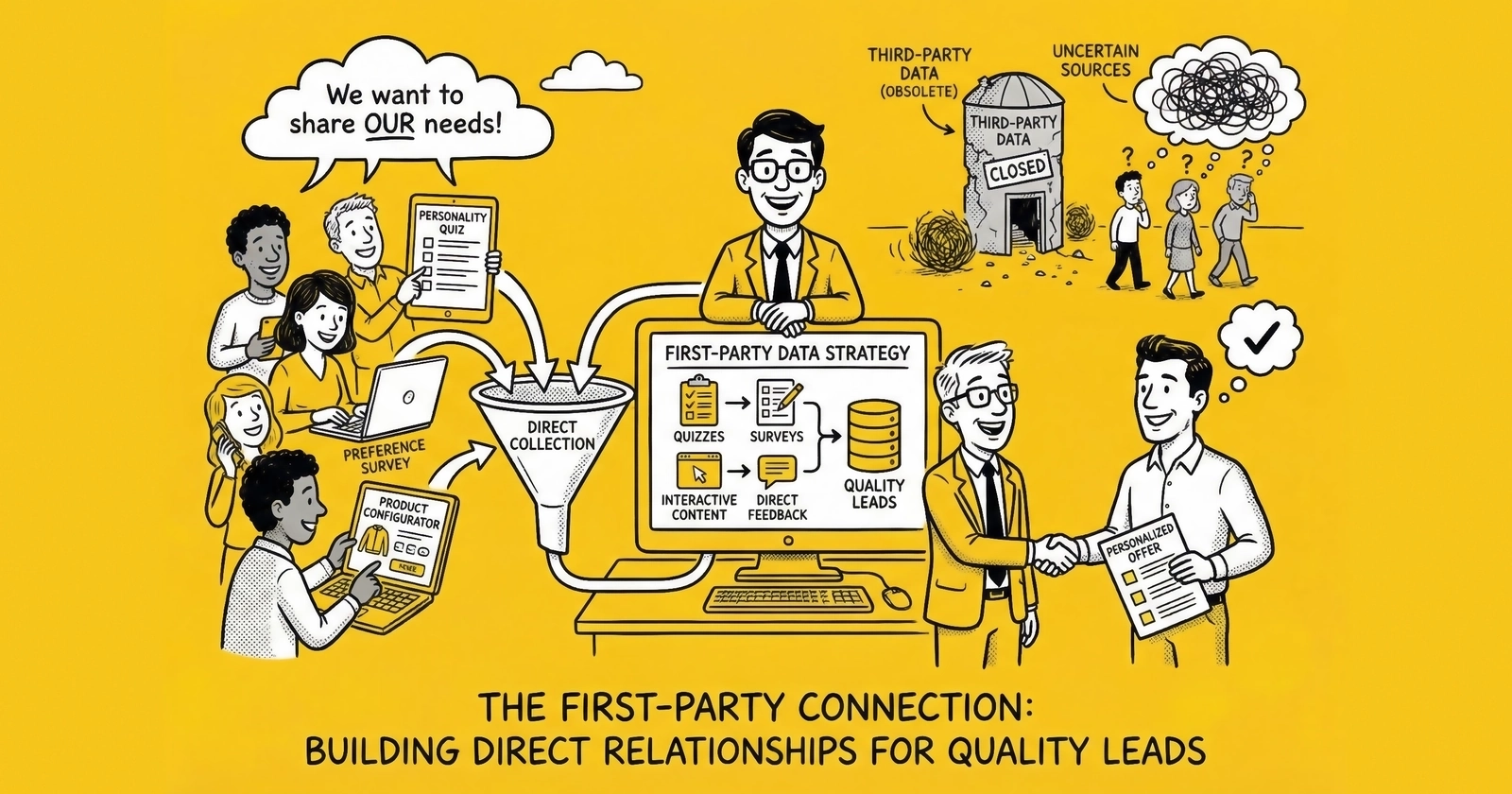
The third-party data ecosystem is fragmenting. Cookie deprecation, privacy regulation, and platform restrictions are systematically dismantling the infrastructure that powered lead generation for two decades. Here is how to build a first-party data foundation that survives – and thrives.
The numbers are stark. Over 30% of your website visitors are invisible to tracking systems right now. Safari and Firefox block third-party cookies by default. Ad blockers run on 31% of browsers worldwide, rising to 42% among users aged 18-34. iOS users opt out of tracking at rates exceeding 75%. The infrastructure that made modern lead generation possible is eroding beneath you.
This is not a future threat. This is current reality.
For lead generation professionals, the implications are fundamental. Your attribution models are broken. Your retargeting audiences are shrinking. The traffic arbitrage economics that power your business depend on knowing which sources deliver profitable leads. When 30-40% of conversion signals vanish, you are optimizing toward a distorted picture of reality.
But here is what separates operators who thrive from those who struggle: the shift to first-party data is not just a defensive move against privacy restrictions. It represents a genuine competitive advantage that compounds over time. First-party data achieves approximately 90% match rates compared to 50-60% for third-party data sources. That accuracy gap translates directly to targeting precision, campaign performance, and ultimately lead quality.
Research indicates that 61% of marketers are increasing their first-party data budgets, recognizing that owned data provides both better results and reduced regulatory risk. Companies effectively using first-party data report up to 15% revenue increases while reducing marketing spend by 20%, according to McKinsey analysis. Google reports that advertisers using first-party data alongside their click identifiers see a median 10% increase in conversions compared to standard tracking implementations.
This guide covers the complete first-party data strategy for lead generators: what to collect, how to collect it, how to enrich and activate that data, and how to build the competitive moat that privacy-conscious operations require in 2025 and beyond.
Understanding First-Party Data: The Foundation of Modern Lead Generation
First-party data is information you collect directly from consumers through interactions on your owned properties. This data bypasses browser restrictions entirely because no third-party tracking is involved. Unlike cookies dropped by advertising platforms that browsers increasingly block, first-party data flows directly from consumer to your systems with explicit consent.
The distinction matters for more than technical reasons. First-party data carries implicit intent signals that purchased data lacks. Someone who visited your solar comparison page three times this week is a fundamentally different prospect than someone whose email appeared on a bought list. You know how, when, and why the user provided their information. That clarity reduces compliance risk at a time when TCPA litigation increased 67% year-over-year in 2024 and continues accelerating.
The Strategic Shift
For two decades, lead generation relied on third-party data: cookies tracking behavior across sites, device graphs connecting identities, data brokers enriching profiles. That infrastructure is failing.
First-party data reverses the dependency. Instead of tracking what consumers do across the web, you capture data when they interact with your properties. Instead of relying on ad platforms to identify your audience, you identify them yourself and tell platforms who to target.
Those who built their businesses on rented data access face an uncomfortable reality: that data is becoming unreliable, expensive, and increasingly unavailable. First-party data represents the sustainable alternative – and increasingly, the only viable path forward.
Why First-Party Data Outperforms Third-Party Sources
The performance differential is substantial and measurable:
Match rates reach 90% versus 50-60%. When you upload your first-party audience lists to advertising platforms, approximately 90% of records successfully match against user databases. Third-party data sources achieve only 50-60% match rates. That 30-40 percentage point gap means your targeting reaches nearly twice the intended audience.
Intent signals are explicit, not inferred. Third-party data guesses what consumers might want based on observed behavior across the web. First-party data captures what consumers actually did on your properties – which pages they viewed, which forms they started, which calculators they used, which content they downloaded. Direct behavioral observation beats algorithmic inference.
Data freshness is immediate. Third-party data degrades rapidly as it passes through aggregation and distribution chains. By the time it reaches you, weeks or months may have passed since collection. First-party data is current by definition – you captured it in real-time interactions.
Consent documentation is clear. You know exactly how and when each piece of data was collected, with what disclosures, and for what purposes. That clarity becomes critical when regulators or litigators examine your practices. The regulatory environment punishes businesses built on ambiguous consent; it rewards those with clear first-party relationships.
The data improves with scale. As you accumulate more interactions with more users, you develop proprietary insights about your specific audience – behavioral patterns, conversion indicators, quality predictors – that no data vendor can replicate. This creates genuine competitive advantage that compounds over years.
First-Party Data Collection: Capturing Information That Matters
Collecting first-party data requires creating legitimate value exchanges that motivate users to share information willingly. Nobody provides their email address because you asked nicely. They provide it because you are offering something they want.
Email Capture Architecture
Email addresses are the most valuable first-party identifier. They persist indefinitely, match across devices, and provide 60-80% match rates on major advertising platforms.
Capture strategies that work for lead generation:
Progressive form design. Request email in step one of multi-step forms. Even if visitors abandon later steps, you have captured the email. This approach typically increases email capture by 40-60% compared to forms that request email later in the sequence.
Multi-step forms that progressively collect information typically outperform single-step forms by significant margins – research suggests up to 86% higher completion rates compared to single-step alternatives. Each step should provide visible progress and clearly communicate the value being unlocked.
Exit-intent capture. Deploy popups that trigger when visitors move to leave the page. Offer quote delivery via email, rate alerts, or educational content in exchange for the address. The value exchange must feel proportionate – asking for an email in exchange for a comprehensive guide feels fair; asking for it in exchange for permission to browse your site feels extractive.
Partial form capture. Implement form field tracking that captures data as users type, before submission. If a visitor fills email and phone but abandons before completing, you have those identifiers for retargeting. Technical implementation requires real-time field capture that stores partial submissions, but the additional capture rate justifies the development investment.
Gated content. The classic value exchange: provide your email, receive a comprehensive guide or report. This works when the content genuinely provides value worth the exchange. Too many practitioners gate mediocre content behind forms, training users to expect disappointment. The sustainable approach gates only your best content – material genuinely worth the information exchange.
Phone Number Capture
Phone numbers provide even higher match rates than email on some platforms. For lead generation verticals where phone contact is the sales mechanism, capturing phone early serves dual purposes: retargeting and sales outreach.
SMS opt-in. Offer quote delivery or status updates via text message. The opt-in captures phone for both communication and advertising. Compliance requires proper disclosure of how the number will be used.
Click-to-call tracking. Implement dynamic number insertion that captures incoming caller ID. Every inbound call becomes a first-party data point with high intent signal.
Callback requests. Position callback scheduling as a convenience feature. The phone number becomes your identifier while the consumer perceives it as a service enhancement.
Value Exchange Mechanisms
The most effective first-party data strategies create explicit value exchanges where users understand exactly what they are receiving in return for their information.
Personalized tools. A mortgage calculator that provides generic estimates requires minimal information. One that provides personalized rate quotes based on credit profile, location, and loan parameters requires more – and delivers more. Users willingly provide significant information when the personalization meaningfully improves their outcome.
Exclusive access. Early access to rate changes, priority matching with providers, or invitation to private communities all create value that cannot be replicated by keeping information private. These mechanisms work especially well with high-intent users who are already engaged with your brand.
Comparison results. The comparison site that shows rates before requiring lead information converts better than the one that gates everything behind a form. Provide visible value first, then request additional information to improve results further.
Calculators and assessments. Interactive tools that help consumers understand their situation naturally collect the data needed to provide useful output. A solar calculator that asks about roof type, energy bill, and financing preferences captures declared intent through the process of providing helpful information.
Progressive Profiling: Building Complete Pictures Over Time
Progressive profiling collects data across multiple interactions rather than demanding everything upfront. First visit captures email for a basic tool. Second interaction adds location for personalized results. Third engagement includes financial information for premium matching. Each step provides incremental value while building a comprehensive profile over time.
Why Progressive Profiling Outperforms Single-Capture Approaches
The cognitive and emotional barriers to data sharing compound with each additional field. A form requesting 15 fields triggers abandonment rates approaching 50%. The same 15 fields spread across 5 interactions over 3 weeks faces dramatically lower resistance at each step.
Progressive profiling also produces higher-quality data. When you request information immediately, consumers often provide minimal or inaccurate responses to move past the barrier. When you request it after demonstrating value, they invest more effort in accuracy because they have seen that accuracy improves their outcomes.
Implementation Architecture
Progressive profiling requires CRM systems that recognize returning visitors and display different forms based on existing data. Most modern marketing automation platforms support progressive profiling natively, but implementation requires careful planning:
Visitor identification. First-party cookies tied to your domain persist longer than third-party alternatives and enable recognition across sessions. Authenticated states (logged-in users) provide the most reliable identification.
Field mapping. Map which fields should be collected at each stage. Essential identifiers (email, phone) come first. Qualifying information (location, product interest) comes second. Detailed attributes (budget, timeline, specific requirements) come last.
Value progression. Each data request should unlock corresponding value. Asking for more without delivering more trains users to resist subsequent requests.
Data unification. Progressive profiles must consolidate across channels and sessions. A visitor who provides email via exit popup and phone via callback request should have both attributes in a single unified profile.
Progressive Profiling in Practice
Consider a solar lead generation operation:
Interaction 1 (Landing Page): Visitor enters zip code for basic “Does solar work in my area?” assessment. No personal information required, but you capture location and behavioral signals.
Interaction 2 (Email Capture): Visitor receives assessment and option to get personalized savings estimate via email. Email address captured with clear value exchange.
Interaction 3 (Return Visit): Recognized visitor sees form requesting monthly electric bill and roof type for refined estimate. Email prefilled; only new fields requested.
Interaction 4 (High Intent): Engaged visitor who has used calculator multiple times sees option for personalized installer quotes. Full qualification form presented, but with context and trust established.
This progression converts more visitors to leads because friction is distributed across multiple low-resistance interactions rather than concentrated in a single high-resistance form.
Data Enrichment: Turning Sparse Records Into Qualified Profiles
Raw form submissions contain only what consumers provide – often minimal information sufficient to express intent but insufficient for qualification or routing. Data enrichment appends additional information from external sources, transforming sparse records into actionable profiles.
The Match Rate Challenge
The fundamental problem is coverage. Any single enrichment provider typically achieves only 50-60% match rates. Provider A has data on some consumers; Provider B has data on others. If you rely on one provider, you are missing data on nearly half your leads.
Waterfall Enrichment Architecture
Waterfall enrichment solves this by cascading through multiple providers sequentially. Query Provider A first; if no match, try Provider B; if still no match, try Provider C. This approach achieves 80-93% match rates – nearly doubling single-source coverage.
The orchestration is more complex than it sounds:
Cost-based sequencing. Put cheaper providers first and reserve expensive premium lookups for leads that failed earlier stages. There is no point in paying $0.50 per lookup when $0.10 lookups match 60% of records.
Response validation. Confirm data quality before accepting results. Enrichment providers sometimes return outdated or inaccurate information. Cross-reference across sources when possible.
Cost tracking. Ensure you are not overspending on enrichment relative to lead value. A $45 lead does not justify $15 in enrichment costs. Track enrichment spend per lead and per successful match.
What Data to Enrich
For consumer lead generation, valuable enrichment attributes include:
Demographic data. Age range, household income estimate, homeownership status, length of residence. These attributes enable routing to appropriate buyers and pricing based on lead characteristics.
Credit indicators. Credit tier estimates (not scores) help route leads to lenders with appropriate underwriting criteria. A premium lead with excellent credit indicators commands different pricing than a subprime lead.
Intent signals. Third-party intent data – other sites visited, content consumed, comparisons initiated – adds context that form submissions lack. These signals are degrading with privacy restrictions but remain partially available.
Firmographic data (B2B). Company size, industry, revenue range, technology stack. These attributes enable account-based targeting and qualification.
Enrichment Provider Options
Platforms like Clay, Persana, and FullEnrich provide managed waterfall orchestration across dozens of data providers. If you are building in-house, each provider requires separate API integration, authentication, rate limit handling, and response normalization.
Store enrichment metadata alongside enriched fields. Capture which provider supplied each data point, when, at what confidence level, and at what cost. This metadata enables provider performance analysis: Which providers deliver highest match rates for your lead profile? Which provide most accurate data based on downstream validation? These insights let you refine your waterfall sequence over time rather than accepting whatever the default configuration produces.
Zero-Party Data: Explicit Intent From Willing Consumers
Zero-party data is information consumers proactively share voluntarily. Unlike first-party data captured through observation, zero-party data comes from explicit consumer declaration.
Why Zero-Party Data Matters
Zero-party data carries distinct advantages:
Accuracy. Consumers tell you directly what they want. No inference required.
Consent. Voluntarily provided information comes with implicit consent for its use.
Durability. Does not expire or get blocked by privacy restrictions.
Intent signals. Declared preferences reveal intent that behavioral observation misses.
Zero-Party Data Collection Mechanisms
Preference centers. Let visitors specify what types of offers interest them, their timeline, budget range, or specific requirements. This data improves lead quality and routing while providing targeting parameters.
Interactive tools. Quote calculators, comparison widgets, and assessment quizzes generate zero-party data through the questions answered. A solar calculator that asks about roof type, energy bill, and financing preferences captures declared intent.
Pre-qualification questions. Add questions that segment leads by value before capture. A mortgage form that asks “When are you looking to purchase?” separates hot prospects from researchers. A question about credit self-assessment helps route leads appropriately.
Post-conversion surveys. After lead capture, follow-up surveys can gather additional preference data. “What factors are most important in your insurance decision?” provides routing information without requiring form completion.
The key principle: consumers share zero-party data when the exchange feels fair. They tell you their preferences, needs, and intent in return for personalized value that generic approaches cannot provide.
Privacy Compliance: Building Trust Through Transparency
Privacy is not an obstacle to navigate around. It is a competitive advantage for operators who embrace it.
The Consumer Expectation Shift
Consumer tolerance for surveillance-based marketing has collapsed. Research from Cisco found that 86% of consumers care about data privacy and want more control over how their information is used. Younger demographics show even stronger privacy preferences.
At the same time, consumers still want relevant offers. The paradox: they expect personalization without feeling watched. Practitioners who solve this paradox build sustainable advantages. Those who continue extracting data without clear value exchange face increasing friction.
Building Trust Through Practice
Transparent collection. Tell visitors exactly what data you collect and how it will be used. Specificity builds trust. “We collect your email to send personalized rate comparisons” outperforms “We collect your email for marketing purposes.”
Value-first exchange. Provide something genuinely useful before requesting personal information. Quote comparisons, calculators, and educational content create reciprocity that makes data exchange feel fair rather than extractive.
Consent documentation. Maintain verifiable records of consent. TrustedForm certificates and Jornaya tokens provide proof of what disclosure language appeared, whether consent boxes were actively selected, and the complete user interaction. When regulators or litigators come calling, documented consent is your defense.
Regulatory Requirements
Regulatory requirements continue expanding:
TCPA. Though the FCC’s one-to-one consent rule was vacated by the Eleventh Circuit in January 2025, many sophisticated buyers require explicit consumer consent for each company that will contact them. “Seller X may call or text you at the number provided” appearing for each seller provides stronger litigation defense and satisfies buyer requirements.
State privacy laws. California’s CPRA, Virginia’s CDPA, Colorado’s CPA, and similar state laws grant consumers rights to know what data is collected, request deletion, and opt out of sales. Different thresholds and requirements create compliance complexity.
GDPR. For operations with any European audience, GDPR imposes strict consent requirements with substantial penalties for violations.
Operators who build compliance into their foundation avoid reactive scrambles when regulations tighten. The consent management infrastructure you implement now prevents costly remediation later.
Activating First-Party Data: Turning Collection Into Competitive Advantage
First-party data creates value only when activated. Collection without activation is cost without return.
Platform Integrations
The primary activation channels for lead generation:
Custom Audiences (Meta). Upload customer lists to create targeting audiences. Match rates of 60-80% enable retargeting to known contacts and suppression of existing customers from acquisition campaigns.
Customer Match (Google). Similar functionality for Google Ads. Upload email lists for search, display, and YouTube targeting. Enhanced Conversions integration further improves attribution accuracy.
TikTok Custom Audiences. Upload phone and email for targeting on TikTok. Particularly valuable for younger demographics where third-party targeting options have degraded most.
LinkedIn Matched Audiences. Upload company lists for B2B account-based targeting. Match rates vary by data completeness but typically range 30-60%.
Lookalike and Similar Audiences
Your first-party data becomes the seed for scaled targeting:
Meta Lookalike Audiences. Upload your highest-value converters. Meta finds users with similar characteristics. Start with 1% lookalikes (most similar) and expand as you scale.
Google Similar Audiences / Optimized Targeting. Google deprecated explicit Similar Audiences in 2023, replacing them with Optimized Targeting that uses your first-party data as signals for automated expansion.
The quality of your seed audience directly determines lookalike performance. Clean, accurate first-party data produces better lookalikes than third-party lists with low match rates and questionable accuracy.
Retargeting Without Cookies
First-party data enables retargeting that bypasses browser restrictions entirely:
List-based retargeting. Upload email and phone lists to create Custom Audiences. These audiences work regardless of browser settings because matching occurs through deterministic identity rather than probabilistic cookie matching.
Email capture before abandonment. Capture email in form step one. Even if visitors abandon later steps, you can retarget them via uploaded lists.
Server-side tracking. Route conversion data through your servers before forwarding to ad platforms. Server-to-server connections cannot be blocked by ad blockers or browser privacy features.
Server-Side Tracking and First-Party Data
Server-side tracking recovers 20-40% of conversion signals lost to client-side restrictions. The architecture works:
- User submits lead form on your website
- Your server receives the form data (this works regardless of browser settings)
- Your server retrieves stored click identifiers from first-party cookies
- Your server fires API calls directly to Google, Meta, TikTok, and other platforms
- Conversion data reaches ad platforms via server-to-server connection
Companies implementing server-side tracking report 20-40% more tracked conversions compared to client-side only implementations. The specific recovery depends on your audience composition – operations with high mobile and young demographics see the highest recovery rates.
Server-Side Implementation Costs
Server-side tracking requires infrastructure investment. Understanding the cost structure helps justify ROI:
| Tier | Monthly Hosting | Implementation | Best For |
|---|---|---|---|
| SMB | $100-500 | Self-managed GTM Server-Side | Low volume, technical team |
| Mid-market | $500-2,000 | Vendor-assisted (Stape, etc.) | Moderate volume, limited DevOps |
| Enterprise | $5,000-25,000 | Full custom implementation | High volume, data teams |
Platform Options:
- Google Tag Manager Server-Side: Most common starting point, integrates with existing GTM workflows
- Meta Conversions API: Required for Facebook/Instagram optimization in iOS 14.5+ environment
- TikTok Events API: Essential for TikTok advertisers as browser signals degrade
- Custom server implementations: Maximum control, highest complexity
ROI Justification: If server-side tracking recovers 25% of lost conversions and you spend $50,000 monthly on paid media, a 25% recovery represents $12,500 in attribution value. Even at enterprise-tier implementation costs, ROI is typically 3-5x within the first year.
Use the server-side layer to enrich events with first-party data before forwarding. A conversion event that includes customer value, product category, or lead quality enables platform optimization unavailable from basic pixel data. This “value-based bidding” trains algorithms to find leads that generate revenue, not just leads that complete forms.
Building the First-Party Data Infrastructure
Implementing a comprehensive first-party data strategy requires specific infrastructure components working together.
Customer Data Platforms (CDPs)
CDPs unify first-party data from multiple sources into coherent customer profiles. Options by scale:
Enterprise: Segment, mParticle, Tealium – comprehensive solutions with extensive integrations but significant cost and implementation complexity.
Mid-market: RudderStack, Hightouch – growing alternatives with lower cost structures and strong technical communities.
SMB: Some lead distribution platforms include basic CDP functionality. Marketing automation platforms like HubSpot and ActiveCampaign provide profile unification for smaller operations.
Consent Management Platforms
A consent management platform (CMP) captures, stores, and enforces consent preferences across your properties. Leading solutions include OneTrust, Cookiebot, TrustArc, and Usercentrics.
Key requirements:
Integration with form systems. Consent must flow with lead records, not exist separately.
Granular preference management. Consumers may consent to some uses but not others. Your CMP must capture and enforce these distinctions.
Audit trail. Regulators and litigators require proof of what was disclosed and how consent was obtained.
Data Warehouse and Analytics
First-party data requires storage infrastructure that supports both operational use and analytical insight:
Data warehouse. Snowflake, BigQuery, Redshift, or Databricks provide the foundation for storing, transforming, and analyzing first-party data at scale.
ETL pipelines. Moving data from collection points to warehouse to activation platforms requires reliable extraction, transformation, and loading processes.
BI layer. Visualization and analysis tools – Looker, Tableau, Metabase – enable insight extraction from accumulated first-party data.
Identity Resolution
The same consumer submits forms on multiple properties, responds to different campaigns, and appears in various systems under slightly different identifiers. Identity resolution connects these records into unified profiles.
Deterministic matching. Exact field matches – same email or same phone – provide highest confidence connections.
Probabilistic matching. Similarity algorithms – similar names plus same address suggests the same person – extend coverage but introduce uncertainty.
For most lead distribution operations, robust deduplication at ingestion provides sufficient protection. Full identity resolution becomes valuable when managing suppression lists, tracking cross-device journeys, or analyzing household-level behavior patterns.
The Timeline for Implementation
First-party data strategy is not a discrete project with a completion date. It is an ongoing capability that improves continuously. However, implementation follows a logical sequence:
Phase 1: Foundation (Months 1-3)
Audit current collection. Inventory what data you currently capture, where it lives, how it connects, and what gaps exist.
Implement basic capture improvements. Move email to form step one. Add exit-intent capture. Implement partial form tracking.
Establish consent infrastructure. Deploy CMP. Update privacy policies. Create consent audit trails.
Phase 2: Enrichment and Activation (Months 3-6)
Deploy waterfall enrichment. Connect to multiple providers. Implement cost-based sequencing. Track provider performance.
Configure platform integrations. Set up Custom Audiences and Customer Match. Establish regular list upload cadence.
Implement server-side tracking. Deploy GTM Server-Side or equivalent. Connect to major ad platform APIs. Validate signal recovery.
Phase 3: Advanced Capability (Months 6-12)
Deploy CDP. Unify profiles across touchpoints. Enable cross-channel activation.
Implement progressive profiling. Configure recognition and field mapping. Design value progression.
Develop predictive models. Use accumulated first-party data to predict quality, conversion likelihood, and lifetime value.
Phase 4: Continuous Optimization (Ongoing)
Refine collection. Test new value exchanges. Optimize field sequencing. Improve capture rates.
Improve activation. Test audience strategies. Refine lookalike parameters. Optimize bidding based on first-party signals.
Extend data usage. Apply first-party insights to content, creative, pricing, and product decisions beyond advertising.
Measuring First-Party Data Success
Track specific metrics to validate first-party data investment:
Collection Metrics
Email capture rate. Percentage of visitors who provide email. Benchmark against industry standards (typically 2-5% for cold traffic, 15-30% for engaged visitors).
Progressive profile completion. Percentage of records with multiple interaction data points.
Zero-party data capture. Volume and completeness of explicitly declared preferences.
Quality Metrics
Platform match rates. Percentage of uploaded records that successfully match against ad platform user databases. Target 60-80% for email, higher for phone.
Enrichment coverage. Percentage of leads successfully enriched through waterfall process. Target 80-93%.
Data freshness. Average age of data at time of activation. Fresher data performs better.
Performance Metrics
First-party audience performance. CPL and conversion rates for campaigns using first-party data versus third-party targeting.
Retargeting reach. Size and reach of retargeting audiences built on first-party data.
Attribution accuracy. Conversion attribution rates with server-side tracking versus client-side only.
Business Metrics
Customer acquisition cost. Total cost to acquire a customer, incorporating first-party data advantages.
Margin by data source. Profitability comparison between leads with first-party enrichment versus those without.
Regulatory incidents. Compliance violations or claims related to data practices.
Competitive Advantage: The Long Game
First-party data strategy is fundamentally about building defensible competitive advantage:
Data quality compounds. Every interaction adds to your understanding of your audience. Competitors starting later begin with blank slates while you operate with accumulated insight.
Switching costs increase. Once consumers have invested in building profiles on your properties, they have reason to return. Their personalization improves with each interaction.
Targeting precision improves. As third-party data degrades industry-wide, operations with strong first-party data maintain targeting capability that competitors lose.
Regulatory exposure decreases. Clear consent documentation and transparent practices reduce the litigation and enforcement risk that threatens operations built on ambiguous data relationships.
AI readiness builds. First-party data becomes the training foundation for AI systems. Operations without quality first-party data cannot effectively deploy the AI capabilities that will differentiate leaders over the next five years.
Those who invest in first-party data infrastructure now will operate with visibility their competitors lack. Those who wait find the gap widening with each quarter.
Frequently Asked Questions
What is the difference between first-party data and third-party data in lead generation?
First-party data is information you collect directly from consumers through your own properties – form submissions, site behavior, email captures, and phone collections. You control its accuracy, freshness, and consent documentation. Third-party data is purchased from aggregators who collect information across multiple sources. First-party data achieves approximately 90% match rates when used for advertising, compared to 50-60% for third-party sources. First-party data comes with clear consent, while third-party data often has ambiguous provenance that creates compliance risk.
How much does first-party data improve advertising performance compared to third-party targeting?
Google reports that advertisers using first-party data alongside click identifiers see a median 10% increase in conversions compared to standard tracking implementations. McKinsey research indicates companies effectively using first-party data report up to 15% revenue increases while reducing marketing spend by 20%. The performance differential varies by vertical and audience composition, but first-party targeting consistently outperforms third-party alternatives because of higher match rates, better accuracy, and stronger intent signals.
What is progressive profiling and why does it matter for lead generators?
Progressive profiling collects data across multiple interactions rather than demanding everything upfront. Instead of a 15-field form that triggers high abandonment, you capture essential identifiers (email) first, then gather additional information through subsequent interactions as the relationship develops. Research shows multi-step forms can achieve 86% higher completion rates than single-step alternatives. Progressive profiling also produces higher-quality data because consumers invest more effort in accuracy after seeing that accuracy improves their outcomes.
How does first-party data enable retargeting without third-party cookies?
First-party data enables list-based retargeting that bypasses browser restrictions entirely. You capture email and phone through your forms and direct interactions, then upload those lists to advertising platforms to create Custom Audiences (Meta) or Customer Match (Google). These audiences work regardless of browser settings because matching occurs through deterministic identity – the platform matches your known contacts against their logged-in users – rather than probabilistic cookie matching that browsers can block.
What data enrichment coverage should lead generators expect?
Individual enrichment providers typically achieve 50-60% match rates. Waterfall enrichment – cascading through multiple providers sequentially – achieves 80-93% match rates by trying alternative sources for records that fail initial lookups. Cost-based sequencing places cheaper providers first, reserving expensive premium lookups for leads that failed earlier stages. Store enrichment metadata (which provider, when, at what confidence) to enable continuous optimization of your waterfall sequence.
How does server-side tracking work with first-party data?
Server-side tracking routes conversion data through your own servers before forwarding to ad platforms. When a lead form submits, your server receives the data regardless of browser configuration, then makes direct API calls to advertising platforms. Server-to-server connections cannot be blocked by ad blockers or browser privacy features. Companies implementing server-side tracking report 20-40% more tracked conversions compared to client-side only implementations. Use the server-side layer to enrich events with first-party data before forwarding – customer value, product category, or lead quality enables value-based bidding that trains algorithms toward revenue, not just form completions.
What consent documentation is required for TCPA compliance with first-party data?
Though the FCC’s one-to-one consent rule was vacated by the Eleventh Circuit in January 2025, many sophisticated buyers require explicit consumer consent for each company that will contact them. TrustedForm certificates and Jornaya tokens provide verifiable proof of what disclosure language appeared, whether consent boxes were actively selected, and the complete user interaction. Store certificate URLs permanently with lead records – the five-year retention requirement for TCPA compliance means your architecture must support long-term retention of rarely-accessed compliance records. The few hundred dollars monthly for proper compliance storage is trivial compared to the seven-figure TCPA settlement you are avoiding.
How do I measure the ROI of first-party data investment?
Track collection metrics (email capture rate, progressive profile completion), quality metrics (platform match rates, enrichment coverage), performance metrics (first-party audience CPL versus third-party), and business metrics (customer acquisition cost, margin by data source). Compare campaigns using first-party targeting against those relying on third-party data. Monitor retargeting audience size and reach as a proxy for first-party data asset value. Calculate signal recovery rate from server-side tracking – the 20-40% of conversions recovered directly translates to optimization improvement.
What technology stack is required for first-party data strategy?
Essential components include consent management platform (OneTrust, Cookiebot), form system with progressive profiling capability, data warehouse for storage and analysis (Snowflake, BigQuery), ETL pipelines for data movement, and platform integrations for activation. Larger operations benefit from customer data platforms (Segment, RudderStack) that unify profiles across touchpoints. Server-side tracking infrastructure (Google Tag Manager Server-Side or equivalent) recovers signals lost to browser restrictions. Start with basics and add sophistication as volume justifies investment.
How long does it take to build effective first-party data capabilities?
Foundation building (audit, basic capture improvements, consent infrastructure) typically takes 1-3 months. Enrichment and activation (waterfall enrichment, platform integrations, server-side tracking) takes 3-6 months. Advanced capabilities (CDP deployment, progressive profiling, predictive models) take 6-12 months. But first-party data strategy is not a discrete project with a completion date – it is an ongoing capability that improves continuously. The operations investing now will have 1-2 years of compounded advantage by the time competitors begin their implementations.
Key Takeaways
-
First-party data achieves approximately 90% match rates compared to 50-60% for third-party sources. This accuracy gap translates directly to targeting precision, campaign performance, and lead quality.
-
61% of marketers are increasing first-party data budgets. Companies effectively using first-party data report up to 15% revenue increases while reducing marketing spend by 20%.
-
Progressive profiling increases completion rates up to 86% compared to single-step forms. Capture email first, then gather additional information through subsequent interactions as the relationship develops.
-
Waterfall enrichment achieves 80-93% match rates by cascading through multiple providers. Single providers typically match only 50-60% of records.
-
Server-side tracking recovers 20-40% of conversion signals lost to browser restrictions. Use the server-side layer to enrich events with first-party data for value-based bidding.
-
Zero-party data – information consumers proactively share – provides the most accurate intent signals. Design value exchanges that motivate explicit preference sharing.
-
First-party data enables retargeting without third-party cookies. Upload email and phone lists for Custom Audiences and Customer Match that work regardless of browser settings.
-
Consent documentation is non-negotiable. TrustedForm certificates and Jornaya tokens provide the proof required for TCPA compliance and litigation defense.
-
First-party data advantage compounds over time. Every interaction adds to your understanding while competitors starting later begin with blank slates.
-
Implementation is an ongoing capability, not a discrete project. Start with foundation elements and expand sophistication as volume and capability justify investment.
Sources
- Cisco Data Privacy Benchmark Study - Research showing 86% of consumers care about data privacy and want more control over their information
- Google Analytics 4 Documentation - Technical guidance on first-party data collection and Enhanced Conversions implementation
- Meta Conversions API Documentation - Implementation guide for server-side tracking achieving 60-80% match rates
- Snowflake - Data warehouse platform for first-party data storage and activation
- Twilio Segment - Customer data platform (CDP) for unifying first-party data across touchpoints
- Forrester Research - Industry analysis on first-party data adoption trends and marketer budget allocation
The third-party data ecosystem that powered lead generation for two decades is fragmenting. Cookie deprecation, privacy regulation, and platform restrictions are dismantling the infrastructure that operations relied upon. First-party data represents not just the sustainable alternative but the foundation for competitive advantage in 2025 and beyond. Those who build this capability now will operate with targeting precision, attribution accuracy, and regulatory safety that their competitors cannot match. For comprehensive frameworks on first-party data architecture, server-side tracking implementation, and privacy-compliant lead generation, see The Lead Economy covering the complete transformation roadmap.