The definitive guide to understanding attribution models, measuring marketing effectiveness, and allocating budget based on reality rather than platform self-reporting.
Attribution determines where your money goes.
Every dollar you spend on lead generation flows toward activities you believe produce results. But belief and reality often diverge. The Facebook campaign showing 400% return on ad spend (ROAS) in platform reporting might deliver 30% incremental lift when properly tested. The Google brand campaign claiming credit for 2,000 conversions might be capturing demand you would have won anyway. Meanwhile, the awareness campaign that looks expensive and ineffective might be the only thing creating the demand your closing channels harvest.
This is the attribution problem. And for lead generation businesses operating on thin margins, solving it correctly can mean the difference between sustainable growth and slow margin erosion.
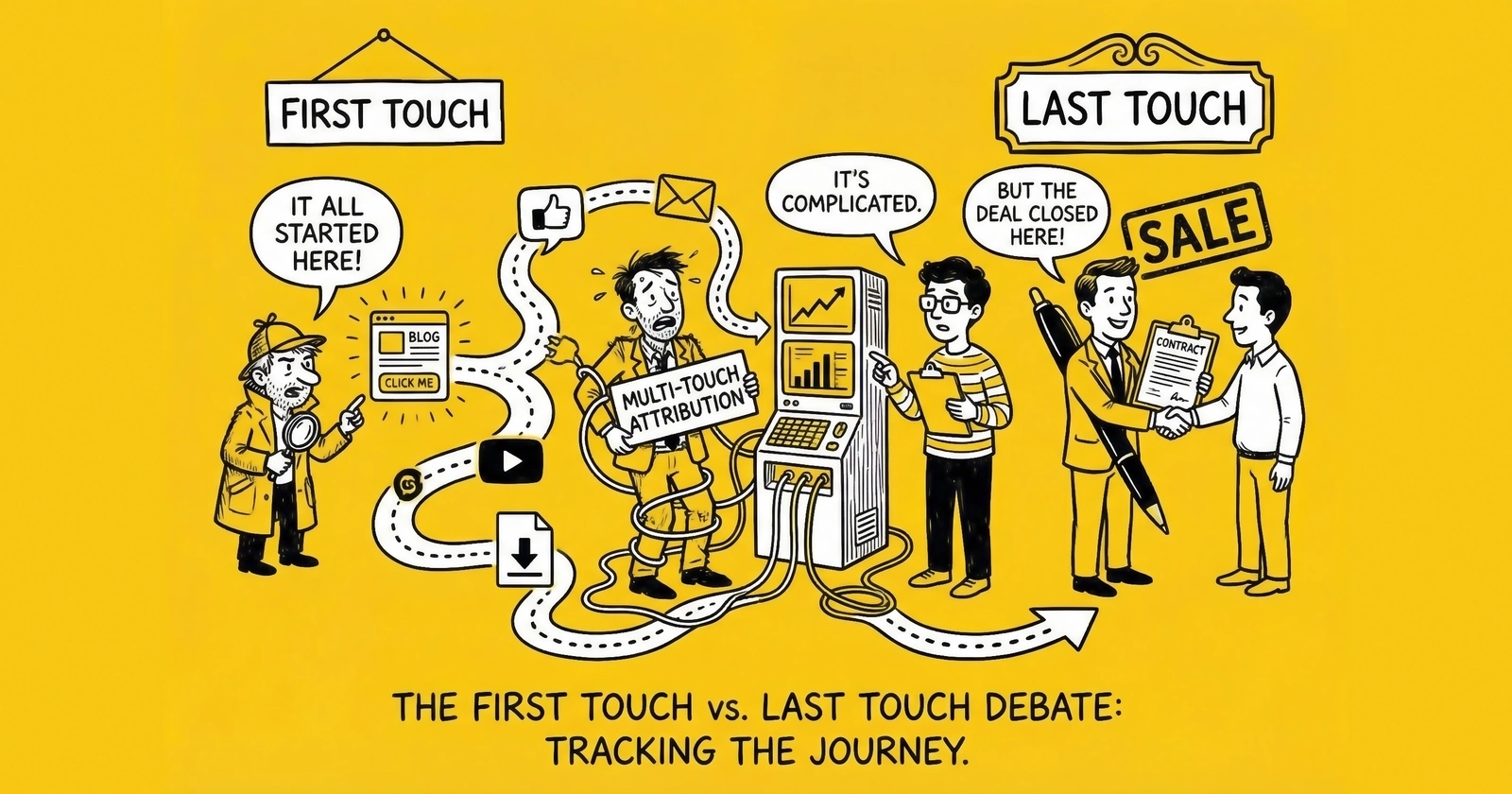
First-touch attribution gives all credit to the channel that introduced a consumer to your brand. Last-touch attribution gives all credit to the channel that closed the deal. Both models have advocates. Both have limitations. Neither tells the complete truth.
This article breaks down how each model works, when each makes sense, and how to choose the right approach for your specific operation. You will understand the mechanics, see real examples, and develop a framework for attribution decisions that improve rather than distort your budget allocation.
The math determines your margin. Let’s get it right.
Why Attribution Matters for Lead Generation
Lead generation operates on thin margins. A typical operation buying leads at $30 and selling at $50 generates $20 gross margin before returns, processing, compliance costs, and float erode that number to $8-12 in actual profit. At those margins, budget allocation mistakes compound quickly.
Consider an operation spending $100,000 monthly across five channels. Standard attribution reporting shows:
| Channel | Spend | Reported Conversions | Reported CPA | Reported ROAS |
|---|---|---|---|---|
| Facebook Prospecting | $25,000 | 400 | $62.50 | 180% |
| Google Non-Brand | $30,000 | 600 | $50.00 | 240% |
| Google Brand | $15,000 | 500 | $30.00 | 400% |
| Native Ads | $20,000 | 300 | $66.67 | 150% |
| Retargeting | $10,000 | 350 | $28.57 | 420% |
Looking at these numbers, the obvious move is shifting budget from Facebook and Native to Retargeting and Brand, where efficiency appears highest.
But this analysis contains a fundamental error. Retargeting and Brand capture demand that other channels created. Without Facebook prospecting introducing new consumers to your brand, there would be no one to retarget. Without non-brand search driving research-stage traffic, fewer consumers would search your brand name. The “efficient” channels are harvesting crops planted by the “inefficient” ones.
Proper attribution reveals this dynamic. And it changes every strategic decision you make.
According to Forrester Research, companies using advanced attribution models achieve 15-30% improvement in marketing ROI through more effective budget allocation. That improvement represents real money. On a $1 million annual marketing spend, proper attribution can recover $150,000-$300,000 in wasted allocation.
The stakes extend beyond marketing efficiency. Lead generation businesses that misattribute performance make systematic errors:
They cut awareness spending and wonder why retargeting audiences shrink. They double down on brand search and watch branded query volume decline. They celebrate short-term efficiency gains that erode long-term competitive position. Attribution accuracy determines not just campaign performance but business survival.
Understanding Attribution: The Foundation
Attribution is the practice of assigning credit for conversions to the marketing touchpoints that influenced them. When a consumer fills out your lead form, attribution answers: which ads, content, emails, and interactions deserve credit for that conversion?
The challenge arises because modern customer journeys involve multiple touchpoints. A typical lead generation conversion path might look like this:
- Consumer sees Facebook ad while scrolling (impression, no click)
- Consumer searches “[problem] solutions” on Google, clicks your organic result
- Consumer reads your blog post, leaves without converting
- Consumer sees retargeting ad on news site (impression)
- Consumer searches your brand name, clicks paid ad
- Consumer fills out lead form
Six touchpoints contributed to one conversion. Attribution models determine how credit distributes across them.
Why Lead Generation Attribution Is Uniquely Challenging
Lead generation businesses face attribution challenges that differ from ecommerce:
The conversion event and the revenue event are disconnected. A lead form submission happens at moment A. The lead sale to a buyer happens at moment B. The buyer’s acceptance (no return) confirms at moment C. Value realization can span weeks, making it harder to connect marketing activity to actual revenue.
Lead quality varies independently of conversion. Two leads captured from identical ad sets might generate completely different outcomes. One sells for $50 exclusive; the other gets returned. Attribution that stops at form submission misses the quality dimension entirely.
Multi-buyer distribution complicates revenue attribution. A single lead might sell to three buyers for a total of $75. Which touchpoint gets credit for which portion of that revenue?
Consent compliance adds friction. TCPA requirements mean lead generation forms must capture prior express written consent (PEWC), which adds complexity to the conversion flow that general ecommerce doesn’t face.
These complications make attribution both more difficult and more important for lead generation. Getting it wrong doesn’t just misallocate marketing spend. It distorts your understanding of which leads actually make money.
First-Touch Attribution: Complete Analysis
Definition and Mechanics
First-touch attribution assigns 100% of conversion credit to the initial marketing interaction that introduced the consumer to your brand.
If a consumer first encountered you through a Facebook ad, then visited via organic search, then converted through retargeting, first-touch gives all credit to Facebook. The logic: without that initial introduction, nothing else would have happened. First touch created the opportunity.
In practice, first-touch measurement requires identifying and storing the original traffic source for every consumer. This typically happens through:
- UTM parameters captured on first website visit
- First-party cookies storing initial referrer data
- CRM or analytics platforms tracking acquisition source
- Server-side event logging preserving the original source
The technical implementation matters. If your tracking only captures the converting session, you cannot measure first-touch. You need persistent storage of the original acquisition source tied to each user or lead record.
When First-Touch Attribution Works
First-touch attribution serves specific strategic needs:
Measuring demand generation effectiveness. If your business depends on continuously reaching new consumers, first-touch reveals which channels successfully expand your addressable audience. Facebook prospecting, display campaigns, and content marketing often look weak in last-touch but strong in first-touch because they introduce rather than close.
Short sales cycles. When consumers convert within hours or days of first exposure, first and last touch may be the same interaction anyway. First-touch keeps measurement simple without sacrificing accuracy. For impulse verticals like home services emergency calls, first-touch often provides sufficient accuracy.
Growth-stage businesses. New operations need to understand what creates awareness and initial interest. First-touch illuminates top-of-funnel effectiveness when building market presence matters more than optimizing existing demand.
Budget justification for awareness spending. Marketing teams struggling to justify awareness campaigns often use first-touch to demonstrate that prospecting creates the opportunity for downstream conversion. Without first-touch data, awareness spending looks purely like cost with no attributable return.
Multi-channel campaign coordination. When you’re testing new channels or creative approaches, first-touch helps you understand which introductions lead to eventual conversions, even if the final click happens elsewhere.
The First-Touch Advantages
First-touch attribution offers several concrete benefits:
Clarity on demand creation. You can clearly see which channels and campaigns introduce consumers to your brand. This visibility is essential for maintaining a healthy top-of-funnel that feeds downstream conversion activities.
Protection against demand harvesting bias. Unlike last-touch, first-touch does not systematically overvalue channels that merely capture existing demand. Brand search and retargeting campaigns that would look exceptional in last-touch show their actual introduction rate in first-touch.
Strategic planning support. For long-term planning and market expansion, first-touch data helps you understand where new audiences come from and how to replicate successful introduction strategies in new markets or demographics.
Simple implementation and interpretation. First-touch requires only one data point per user: their original source. This simplicity makes it accessible to operations without sophisticated data infrastructure.
Limitations of First-Touch
First-touch creates blind spots that distort decision-making:
Ignores nurture effectiveness. A consumer who first saw your Facebook ad but needed six retargeting impressions and three emails before converting received no value from those touchpoints according to first-touch. This undervalues the middle and bottom of the funnel, potentially leading to underinvestment in conversion optimization.
Overvalues broad reach channels. Channels that create many first touches but few conversions look artificially strong. A display campaign introducing 100,000 consumers who mostly never convert appears more valuable than a targeted campaign introducing 10,000 consumers who convert at high rates.
Fails for long consideration cycles. In verticals like mortgage or solar where consumers research for weeks or months, first-touch attributes value to interactions so temporally distant from conversion that the causal link becomes questionable. A first touch from 90 days ago may have been forgotten entirely by the converting consumer.
Platform gaming. Sophisticated ad platforms engineer first-touch impressions. A consumer planning to search for insurance might see a display ad first because the platform predicted their intent. First-touch credits display for demand that search would have captured anyway.
No quality differentiation. First-touch treats all introductions equally. The channel that introduced a consumer who eventually becomes a high-value exclusive lead receives the same credit as one that introduced a consumer who returns as invalid.
First-Touch in Practice: A Real Example
Consider a solar lead generation operation spending $50,000 monthly across four channels:
| Channel | Spend | First-Touch Credit | Last-Touch Credit |
|---|---|---|---|
| Facebook Prospecting | $20,000 | 450 leads (44%) | 180 leads (18%) |
| Google Non-Brand | $15,000 | 320 leads (31%) | 350 leads (34%) |
| Google Brand | $10,000 | 120 leads (12%) | 280 leads (27%) |
| Retargeting | $5,000 | 140 leads (13%) | 220 leads (21%) |
Using first-touch, Facebook appears to be the most productive channel, introducing 44% of eventual conversions despite representing 40% of spend. But using last-touch, Facebook appears least productive, closing only 18% of conversions.
Which is correct? Both are accurate descriptions of different parts of the journey. First-touch shows Facebook’s role in demand creation. Last-touch shows its role in conversion. The complete picture requires understanding both.
Last-Touch Attribution: Complete Analysis
Definition and Mechanics
Last-touch attribution assigns 100% of conversion credit to the final marketing interaction before conversion.
Using the same journey example, if a consumer first saw a Facebook ad, then engaged with organic content, then clicked a retargeting ad, then converted through brand search, last-touch gives all credit to the brand search campaign. The logic: whatever happened last was decisive. The consumer had opportunities to convert earlier but didn’t until that final touch.
Last-touch is the default attribution model in most analytics and ad platforms because it’s straightforward to measure. You simply look at the referrer or UTM source for the converting session. No historical tracking required.
When Last-Touch Attribution Works
Last-touch serves specific strategic needs:
Optimizing conversion efficiency. When you have sufficient demand and need to maximize conversion rates on that demand, last-touch identifies which channels close effectively. Retargeting, email nurture, and brand search often excel at last-touch because they reach consumers already inclined to convert.
Short, impulse-driven cycles. When decisions happen quickly with minimal research, the final touch genuinely represents most of the influence. Simple lead magnets and immediate-response offers often show minimal gap between first and last touch anyway.
Budget-constrained operations. With limited resources, prioritizing proven converters over uncertain demand generators reduces risk. Last-touch identifies reliable closing channels, which matters when you cannot afford to fund speculative awareness campaigns.
Sales team alignment. Last-touch resembles how sales teams think about closing. The final interaction that triggered the conversion gets credit, matching the mental model of operators focused on immediate results.
Direct response campaigns. When running campaigns designed to generate immediate action – especially with limited consideration windows – last-touch attribution aligns with campaign design and expectations.
The Last-Touch Advantages
Last-touch attribution offers several concrete benefits:
Immediate actionability. You can quickly identify which channels and creatives are currently closing business and shift budget accordingly. This speed of feedback enables rapid optimization cycles.
Clear ROI calculation. Connecting spend to conversions is straightforward when the converting channel gets full credit. This simplicity makes it easier to calculate and communicate return on investment.
Alignment with platform reporting. Since most ad platforms default to last-touch or last-click models, your internal reporting aligns with platform-reported performance, reducing confusion and data reconciliation effort.
Conversion rate optimization focus. Last-touch helps you optimize the final steps of your funnel, identifying which landing pages, offers, and calls-to-action actually trigger conversions.
Limitations of Last-Touch
Last-touch creates perhaps more dangerous blind spots than first-touch:
Credits harvesters, starves planters. Brand search and retargeting campaigns excel at last-touch because they reach consumers who already intend to convert. But that intent was created elsewhere. Overinvesting in harvesters while cutting planters eventually depletes the demand pool.
Cannibalizes organic demand. A consumer who would have typed your URL directly might click a branded paid ad first. Last-touch credits that ad for a conversion that would have happened anyway. This dynamic makes brand bidding look more valuable than it is.
Ignores assist value. The retargeting impression that reminded someone to return, the email that educated them about your offering, the comparison content that positioned you favorably – none of these get credit despite genuinely influencing the outcome.
Encourages short-term thinking. If last-touch drives budget decisions, marketers stop investing in awareness and education. Short-term efficiency improves as you harvest accumulated demand. Then demand depletes and you have no first-touch pipeline to replenish it.
Creates dangerous optimization loops. Operations that optimize purely on last-touch often find themselves in a declining spiral: they cut awareness spending because it looks inefficient, which reduces their retargetable audience, which reduces retargeting performance, which forces further cuts, until the funnel collapses.
Last-Touch in Practice: A Real Example
Consider this example: An insurance lead generation operation cuts Facebook prospecting because it shows poor last-touch performance. Retargeting and brand search maintain strong numbers for two months as they harvest existing cookies and brand awareness.
By month three:
- The retargetable audience pool has shrunk 40%
- Brand search volume has declined 25%
- Overall lead volume is down 30% despite stable spend
- Cost per lead has increased 35%
The “efficient” channels were parasites feeding on a host the operator killed. Without the prospecting campaigns introducing new consumers, there was no one left to retarget or brand search.
This pattern repeats across the industry. Operations that chase last-touch efficiency without protecting top-of-funnel health optimize their way into stagnation.
Comparing First-Touch and Last-Touch: Direct Analysis
The Fundamental Trade-Off
First-touch and last-touch represent opposite ends of a spectrum:
| Dimension | First-Touch | Last-Touch |
|---|---|---|
| Credit allocation | Initial introduction | Final conversion |
| Channel favoritism | Awareness channels | Conversion channels |
| Budget bias | Upper funnel | Lower funnel |
| Strategic focus | Demand generation | Demand capture |
| Time horizon | Long-term growth | Short-term efficiency |
| Risk profile | May overfund awareness | May starve awareness |
| Data requirement | Full journey tracking | Converting session only |
Neither model is objectively correct. The right choice depends on your business situation, strategic priorities, and data capabilities.
When Each Model Misleads
First-touch misleads when:
- Sales cycles are short and consideration is minimal
- Awareness channels have high waste rates
- Your business is mature with established demand
- You need to optimize conversion efficiency urgently
Last-touch misleads when:
- Sales cycles are long with significant research phases
- You’re trying to grow market share
- Your retargeting audiences are declining
- Brand search volume is stagnating or shrinking
The Hidden Costs of Wrong Attribution
Misattribution doesn’t just waste money. It creates systematic errors that compound over time.
Under last-touch optimization: A $100,000 monthly budget shifts toward retargeting and brand search. Initial results look strong – cost per lead drops 15%. But retargetable audiences shrink 8% monthly as prospecting declines. Within six months, lead volume is down 35% despite “optimized” spending.
Recovery cost: You must rebuild prospecting infrastructure, retrain algorithms that have forgotten your audiences, and wait 3-6 months for new awareness to generate retargetable pools. Total recovery cost often exceeds $200,000 in lost efficiency and rebuilding expense.
Under pure first-touch optimization: A $100,000 monthly budget shifts toward awareness channels. Introduction volume grows, but conversion rates decline as closing channels are underfunded. Lead volume stays stable, but cost per lead increases 25% as you pay more for leads that take longer to convert.
Recovery cost: You must rebuild conversion infrastructure and accept temporary efficiency losses while rebalancing. Total recovery cost typically $75,000-$150,000.
The asymmetry is notable: over-investing in awareness is easier to correct than destroying your demand pipeline by chasing last-touch efficiency.
Moving Beyond Single-Touch: Multi-Touch Attribution Overview
Why Multi-Touch Exists
Both first-touch and last-touch share a fundamental flaw: they give 100% credit to a single touchpoint when multiple touchpoints contributed.
Multi-touch attribution distributes credit across all touchpoints in the customer journey, acknowledging that modern paths to conversion involve multiple interactions.
In 2024-2025, industry surveys show that 57% of brands and agencies use multi-touch attribution despite significant implementation challenges. The methodology beats alternatives for understanding complex journeys, even when implementation is imperfect.
Common Multi-Touch Models
Linear attribution splits credit equally across all touchpoints. Five touches mean each receives 20% credit. Simple to explain and implement, but treats a fleeting impression the same as an engaged session.
Time-decay attribution weights recent touchpoints more heavily. Credit diminishes backward through the journey. The conversion-proximate touch might receive 40% credit, with diminishing weights backward. This acknowledges recency while recognizing earlier contributions.
Position-based (U-shaped) attribution emphasizes first and last touches – typically 40% each – with the remaining 20% spread across middle interactions. This honors both introduction and closing while acknowledging the nurture path.
W-shaped attribution adds weight to the lead creation moment, distributing perhaps 30% to first touch, 30% to lead creation, 30% to conversion, and 10% across other touchpoints. This works well for B2B and longer cycles.
Data-driven (algorithmic) attribution uses machine learning to assign credit based on actual conversion patterns in your data. Requires significant volume (600+ monthly conversions) but reflects actual behavior rather than predetermined rules.
When to Graduate to Multi-Touch
Consider multi-touch attribution when:
- Your average consideration window exceeds 7 days
- Consumers typically have 4+ touchpoints before converting
- You have the technical infrastructure to track cross-session behavior
- Your monthly conversion volume exceeds 300 leads
- First-touch and last-touch tell dramatically different stories
Stick with single-touch when:
- Sales cycles are under 7 days
- Most conversions happen in a single session
- You lack cross-session tracking capabilities
- Monthly conversion volume is below 300
- Resource constraints require simpler approaches
Incrementality: The Ground Truth
What Incrementality Testing Reveals
The limitations of all attribution models drive growing interest in incrementality testing – the practice of measuring what actually changes when you turn marketing on or off.
Attribution tells you which touchpoints were present. Incrementality tells you which touchpoints actually caused conversions.
A 2024-2025 industry report showed 52% of brands and agencies now use incrementality testing, up significantly from prior years. The methodology provides ground truth that attribution models, by design, cannot.
How Incrementality Testing Works
Geo experiments compare geographic regions where you advertise versus similar regions where you don’t. If sales increase 15% in test markets and 2% in control markets, you have 13% incremental lift.
Holdout tests randomly exclude a portion of your audience from campaigns and compare their conversion rates to exposed audiences. If the exposed group converts at 4% and the holdout at 3.2%, your incremental lift is 0.8 percentage points (25% relative lift).
Platform lift studies (Meta Conversion Lift, Google Conversion Lift) handle randomization and measurement within their ecosystems, reporting incremental conversions attributable to platform campaigns.
Why Incrementality Matters for Attribution Debates
Incrementality testing often resolves first-touch vs last-touch debates by showing what actually happens when channels are turned off.
Consider this common finding: A retargeting campaign shows 800% ROAS in last-touch reporting. Incrementality testing reveals only 20% incremental lift – meaning 80% of those “attributed” conversions would have happened anyway through other channels or direct navigation.
This changes the conversation entirely. The question shifts from “should we credit first-touch or last-touch?” to “how much does this channel actually contribute?”
Companies implementing proper incrementality measurement have achieved 10-20% improvements in marketing efficiency by reallocating spend from campaigns that look good to campaigns that actually work.
Implementation: Building Your Attribution Framework
Assessment Framework
Before choosing an attribution model, assess your business reality:
Question 1: What is your typical consideration window?
- Under 7 days: First-touch and last-touch likely produce similar results. Simpler models suffice.
- 7-30 days: Multi-touch models add value by capturing middle-journey influence. Consider position-based.
- Over 30 days: Multi-touch essential; consider W-shaped for B2B or complex B2C.
Question 2: What is your monthly conversion volume?
- Under 300: Data insufficient for algorithmic models. Use rule-based approaches.
- 300-600: Algorithmic models possible but may be unstable. Test with caution.
- Over 600: Algorithmic models viable if tracking infrastructure supports them.
Question 3: How sophisticated is your tracking infrastructure?
- Basic (platform pixels only): Limited to platform-native attribution. Focus on incrementality testing.
- Intermediate (CDP or unified tracking): Rule-based multi-touch across channels possible.
- Advanced (data warehouse, identity resolution): Algorithmic attribution and cross-channel models viable.
Question 4: What strategic questions are you trying to answer?
- “Which channels introduce consumers?” → First-touch
- “Which channels close consumers?” → Last-touch
- “How does the full journey contribute?” → Multi-touch
- “What actually moves the needle?” → Incrementality testing
Recommendations by Business Stage
Early-stage lead generators (under 1,000 monthly leads): Start with platform-native attribution plus simple incrementality tests (geo or holdout). Focus on understanding channel contribution before investing in complex modeling. Priority: establish consistent tracking before worrying about sophisticated attribution.
Recommended approach: Use first-touch for demand generation assessment, last-touch for conversion optimization. Accept that you’re seeing two partial pictures and make decisions accordingly.
Scaling operations (1,000-10,000 monthly leads): Implement position-based (U-shaped) attribution as baseline. Add incrementality testing for major channels quarterly. Begin building first-party data infrastructure for future algorithmic capability.
Recommended approach: U-shaped model (40% first, 40% last, 20% middle) provides balanced view. Run incrementality tests on your two largest channels annually to validate attribution assumptions.
Mature operations (10,000+ monthly leads): Deploy algorithmic attribution where data volume supports it. Conduct incrementality testing on every major channel annually. Build custom attribution models reflecting your specific business dynamics.
Recommended approach: Data-driven attribution as primary model, validated by quarterly incrementality testing. Custom models for specific strategic questions.
The Multi-Model Approach
Sophisticated operations don’t choose one model. They use multiple models for different purposes:
- Last-touch for daily campaign optimization and rapid feedback
- First-touch for demand generation assessment and growth planning
- Position-based for monthly budget allocation decisions
- Incrementality testing for ground-truth validation and major reallocation decisions
When models tell consistent stories, confidence is high. When they conflict, investigation reveals underlying dynamics that single-model views would miss.
Practical Challenges and Solutions
Privacy and Tracking Degradation
The 30% of traffic using privacy-first browsers or settings represents lost signal. You cannot attribute what you cannot track.
Impact on first-touch: Particularly affected because first-touch requires storing original source data that privacy measures may block. Without persistent cookies or logged-in sessions, the initial touchpoint gets lost.
Impact on last-touch: Less affected because last-touch only requires session-level tracking. The converting session is typically visible even when earlier sessions are not.
Solutions:
- Server-side tracking recovers 20-40% of signals lost to client-side blocking
- First-party data strategies extend attribution visibility
- Email capture early in journey enables identity-based tracking
- Incrementality testing provides ground truth independent of tracking
Platform Walled Gardens
Facebook knows what happened on Facebook. Google knows what happened on Google. Neither shares complete data with the other, and neither provides you the complete cross-platform picture.
Each platform optimizes for their own measurement. When Facebook and Google both claim credit for the same conversion, your total “attributed” conversions exceed actual conversions.
Solutions:
- Implement consistent UTM parameters across all campaigns
- Use landing pages that capture UTM data into lead records
- Build lead-level P&L connecting marketing source to revenue outcome
- Accept that cross-platform attribution will be directional, not precise
- Use incrementality testing to validate platform-reported performance
Cookie Deprecation
Third-party cookies enable cross-site tracking that multi-touch attribution depends on. Chrome’s deprecation timeline has shifted, but the direction is clear: third-party cookies are going away.
Impact on attribution: Multi-touch models that rely on cross-site tracking become less accurate. First-touch attribution for anonymous visitors becomes harder.
Solutions:
- Accelerate first-party data collection
- Implement server-side tracking infrastructure
- Explore Privacy Sandbox APIs and data clean rooms
- Increase reliance on incrementality testing as ground-truth validation
- Consider identity resolution through authenticated sessions
Making the Decision: A Framework
Decision Matrix
Use this matrix to guide your attribution model choice:
| Business Situation | Primary Model | Secondary Model | Validation Method |
|---|---|---|---|
| Early stage, short cycles | Last-touch | First-touch | Geo test |
| Early stage, long cycles | First-touch | U-shaped | Holdout test |
| Growth stage, short cycles | U-shaped | Last-touch | Platform lift studies |
| Growth stage, long cycles | U-shaped | Data-driven | Quarterly incrementality |
| Mature, high volume | Data-driven | Custom | Continuous incrementality |
The Right Answer for Most Lead Generators
For most lead generation operations in the 1,000-10,000 monthly lead range, the practical answer is:
-
Use both first-touch and last-touch to understand different parts of the journey. Neither is “right” – they answer different questions.
-
Implement position-based (U-shaped) attribution for budget allocation decisions. The 40/40/20 split provides reasonable balance without requiring sophisticated infrastructure.
-
Run incrementality tests on your largest channels at least annually. This validates your attribution assumptions with ground truth.
-
Accept imprecision but strive for directional accuracy. Perfect attribution is impossible. Directional improvement is achievable and valuable.
-
Protect demand generation even when last-touch metrics suggest cutting it. The long-term cost of starving your funnel exceeds the short-term savings.
What Success Looks Like
Successful attribution implementation produces these outcomes:
- Budget allocation decisions are informed by multiple perspectives, not single metrics
- Demand generation spending is protected based on first-touch evidence
- Conversion optimization spending is validated by incrementality evidence
- Channel-level performance debates are resolved with data, not opinions
- Month-over-month efficiency improves without volume decline
- Marketing and finance teams use consistent definitions and measurements
Frequently Asked Questions
Q: Which attribution model is best for lead generation?
No single model fits all lead generation businesses. For short consideration windows under 7 days, last-touch often provides sufficient accuracy for conversion optimization. For longer cycles, position-based (U-shaped) attribution offers good balance between simplicity and accuracy. For high-volume operations with sophisticated tracking, data-driven algorithmic models optimize based on actual patterns. Most mature operations use multiple models for different purposes.
Q: Is first-touch or last-touch more accurate?
Neither is inherently more accurate – they measure different things. First-touch accurately measures which channels introduce consumers. Last-touch accurately measures which channels convert consumers. The question is which measurement matters more for your specific decisions. For demand generation assessment, first-touch is more relevant. For conversion optimization, last-touch is more relevant.
Q: How do I know if my attribution is wrong?
Warning signs include: retargetable audiences shrinking over time despite stable or increased retargeting spend; brand search volume declining while brand campaigns maintain strong last-touch metrics; first-touch and last-touch telling dramatically different stories; and incrementality tests showing much lower lift than attribution reports suggest.
Q: What data do I need for first-touch attribution?
Effective first-touch attribution requires user-level tracking of the original acquisition source, typically through UTM parameters stored in first-party cookies or tied to user identifiers. You need persistent storage connecting users to their first touchpoint, which becomes challenging in privacy-constrained environments.
Q: What data do I need for last-touch attribution?
Last-touch is simpler – you need only the referring source or UTM parameters from the converting session. Most analytics platforms provide this by default. No cross-session tracking required, which is why last-touch remains accessible even as privacy restrictions tighten.
Q: How often should I review attribution data?
Daily for anomalies and campaign pacing. Weekly for source-level performance trends. Monthly for channel allocation decisions. Quarterly for incrementality validation and model assessment. Annually for comprehensive model evaluation and potential methodology updates.
Q: Should I trust attribution data from ad platforms?
Platform-provided attribution data is useful but biased. Platforms benefit from showing strong performance and use favorable attribution windows. Use platform data for within-platform optimization (which creative performs best), but validate with independent measurement for cross-channel budget decisions.
Q: How does privacy affect attribution accuracy?
Privacy restrictions – including Safari ITP, Chrome’s cookie deprecation, and App Tracking Transparency – reduce tracking coverage. Current estimates suggest 30% of traffic uses privacy-first browsing. First-touch attribution is more affected than last-touch because it requires cross-session tracking. Server-side tracking and first-party data strategies help recover lost signal.
Q: What is incrementality testing and why does it matter for attribution?
Incrementality testing measures the true causal impact of marketing by comparing outcomes between groups exposed to marketing versus control groups that were not. While attribution tells you which touchpoints were present, incrementality tells you which actually caused conversions. 52% of sophisticated marketers now use it because it resolves attribution model debates with ground truth.
Q: Can I use first-touch and last-touch together?
Absolutely – and most sophisticated operations do. Use first-touch to understand demand generation and protect awareness spending. Use last-touch to optimize conversion efficiency. Use the combination to identify channels that both introduce and convert versus those that only do one or the other.
Q: How do I get started improving my attribution?
Start by establishing consistent tracking across all channels using UTM parameters. Capture the original source and the converting source for every lead in your CRM or lead management system. Compare first-touch and last-touch views of your data to understand where they agree and diverge. Run a simple incrementality test (pause one major channel for 2-4 weeks in selected markets) to validate assumptions. For a complete tracking foundation, see our GA4 lead generation tracking guide.
Key Takeaways
-
First-touch attribution credits the initial brand interaction. It works best for measuring demand generation, understanding top-of-funnel effectiveness, and justifying awareness spending that looks inefficient in last-touch metrics.
-
Last-touch attribution credits the final interaction before conversion. It serves conversion optimization needs but dangerously overvalues channels that harvest rather than create demand.
-
Neither model is wrong – they answer different questions. First-touch answers “who introduced this consumer?” Last-touch answers “what made them convert?” Both questions matter.
-
The biggest attribution mistake is optimizing purely on last-touch, cutting awareness spending, and then wondering why your retargeting audiences shrink and brand search volume declines. Demand harvesting without demand generation is unsustainable.
-
Companies using advanced attribution models achieve 15-30% improvement in marketing ROI through more effective budget allocation.
-
Incrementality testing provides ground truth that resolves attribution debates. 52% of sophisticated marketers now use it because it shows what actually changes when marketing turns on or off.
-
Privacy restrictions affect first-touch more than last-touch because first-touch requires cross-session tracking that privacy measures increasingly block. Server-side tracking and first-party data strategies help recover lost signal.
-
Most mature operations use multiple models for different purposes: first-touch for demand generation assessment, last-touch for conversion optimization, position-based for budget allocation, and incrementality for validation.
-
Start with your current capabilities but build toward more sophisticated measurement. Even imperfect multi-touch attribution beats systematic single-touch bias.
-
Protect demand generation spending even when last-touch metrics suggest cutting it. The cost of rebuilding a depleted funnel exceeds the short-term savings from cutting awareness.
Sources
- Forrester Research - Research on attribution models showing 15-30% marketing ROI improvement for companies using advanced attribution
- Google Analytics 4 Attribution - Documentation on data-driven attribution model requirements and implementation
- Meta Attribution Documentation - Platform guidance on conversion lift studies and incrementality measurement
- Nielsen Marketing Effectiveness - Multi-touch attribution research and incrementality testing methodologies
- eMarketer/Insider Intelligence - Industry benchmarks on attribution model adoption (57% using MTA, 52% using incrementality testing)
Statistics and methodologies current as of late 2025. Attribution models and privacy regulations evolve continuously; validate current platform capabilities and industry benchmarks before implementation.