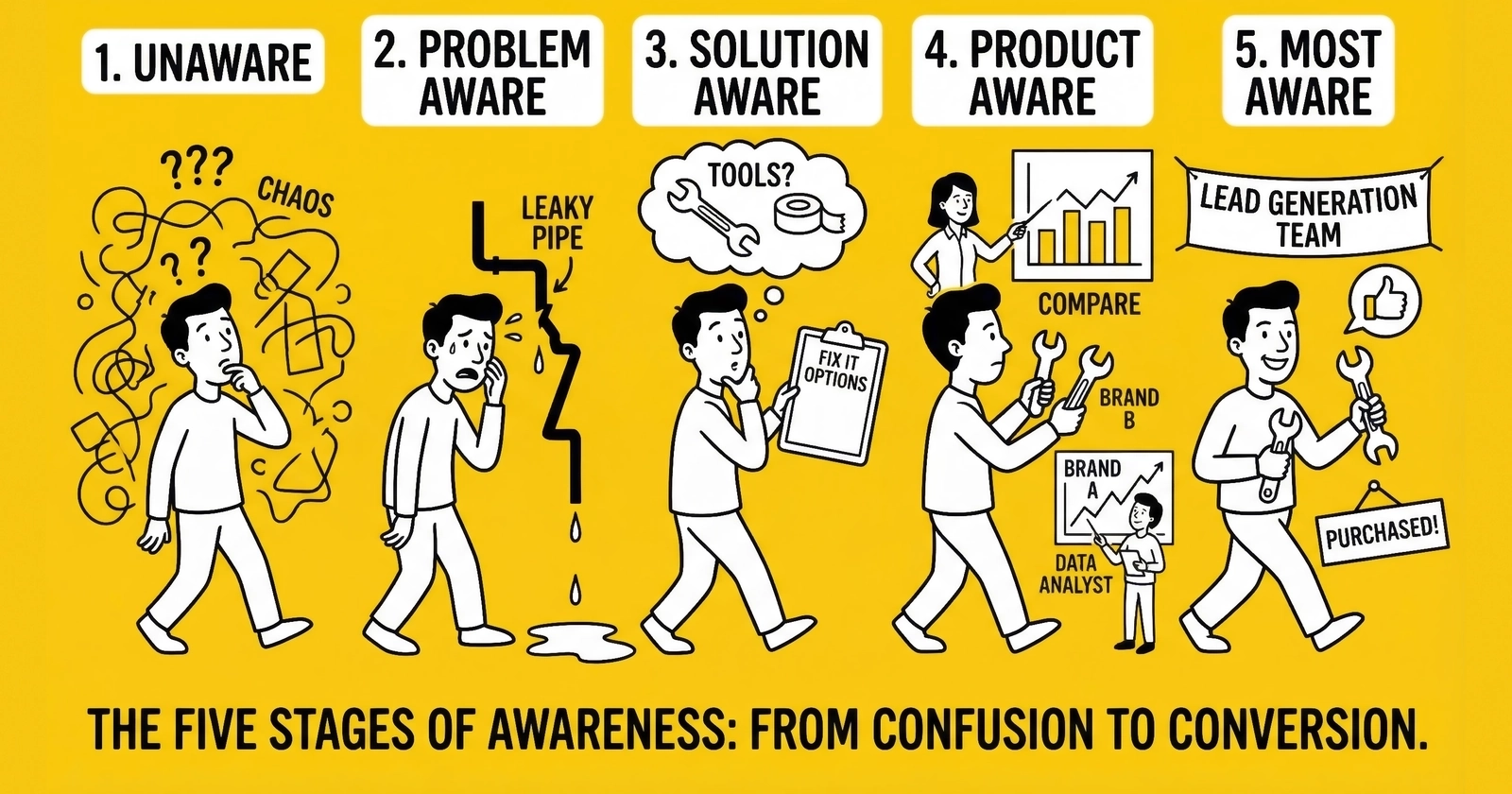
How to apply Eugene Schwartz’s awareness framework from Breakthrough Advertising to lead generation, content strategy, and conversion optimization.
In 1966, Eugene Schwartz published Breakthrough Advertising, a book that would become the most influential copywriting text ever written. While the advertising landscape has transformed beyond recognition – from print ads to pay-per-click, from direct mail to demand generation – one concept from that book remains as relevant as the day Schwartz wrote it: the five stages of customer awareness.
Schwartz’s insight was deceptively simple. Before you write a single word of copy, you need to answer one question: how much does your prospect already know?
The answer determines everything – your headline, your opening hook, your proof points, your call to action. A message that resonates perfectly with a prospect who already knows your product falls completely flat with someone who doesn’t yet recognize they have a problem. The same product, the same benefits, the same price – but radically different persuasion requirements based solely on where the prospect sits on the awareness spectrum.
For lead generation operators, this framework isn’t just useful – it’s essential. Every piece of your marketing infrastructure, from ad creative to optimized landing pages to email sequences, either aligns with your prospects’ awareness stage or wastes money talking past them.
The Five Stages Defined
Schwartz identified five distinct stages that every prospect passes through on their way to purchase:
Stage 1: Unaware. The prospect doesn’t know they have a problem. They’re living their life, running their business, going about their day – completely oblivious to the issue your product solves. They’re not searching for solutions because they don’t perceive a gap between their current state and a better state.
Stage 2: Problem Aware. The prospect recognizes something is wrong. They feel the pain, see the symptoms, experience the frustration – but they don’t know what’s causing it or how to fix it. They’re beginning to search, but they’re searching for understanding, not products.
Stage 3: Solution Aware. The prospect knows that solutions exist. They’ve identified the category of fix they need – they just haven’t selected a specific vendor or product. They’re actively comparing alternatives, reading reviews, and evaluating options.
Stage 4: Product Aware. The prospect knows your product exists and understands it might solve their problem. But they haven’t committed. Maybe they’re concerned about price. Maybe they’re comparing you to competitors. Maybe they’re not convinced you can deliver. They need reassurance, not introduction.
Stage 5: Most Aware. The prospect knows your product, trusts your claims, and is ready to buy. They just need the right offer at the right moment. The persuasion work is done – now it’s about removing friction and providing the final push.
As Schwartz observed, “In its natural development, every market’s awareness passes through several stages. The more aware your market, the easier the selling job, the less you need to say.”
Why Awareness Matters More Than Messaging
Most marketing failures aren’t messaging failures – they’re targeting failures. Companies craft compelling copy about their products and broadcast it to audiences who aren’t ready to hear it.
Consider a home services contractor buying leads from a lead aggregator. (To understand how the lead economy works, see our industry primer.) The contractor receives leads described as “interested in solar installation” and treats them uniformly – same sales pitch, same follow-up cadence, same closing tactics. Some leads convert easily. Others never respond to calls. The contractor blames lead quality.
But the problem isn’t quality – it’s awareness. Some of those leads are Most Aware: they’ve already decided they want solar panels and are just comparing quotes. Others are Solution Aware: they know solar exists but are weighing it against battery storage, energy efficiency upgrades, or doing nothing. Still others are Problem Aware: they noticed high electric bills but haven’t connected that problem to any specific fix.
Same “quality” of lead. Radically different readiness to buy. Different awareness stages require different sales approaches – but the contractor treated them identically and wondered why close rates varied wildly.
Stage 1: Reaching Unaware Prospects
Unaware prospects represent the largest potential audience and the most difficult marketing challenge. By definition, they’re not searching for what you sell because they don’t know they need it.
The Challenge
You can’t advertise to people searching for solutions when those people aren’t searching. Unaware prospects don’t respond to product-focused ads because products are irrelevant to people who don’t perceive problems.
In lead generation terms, unaware audiences generate cheap traffic and expensive conversions. You can reach millions of people for pennies per impression – but converting those impressions to qualified leads requires massive educational investment.
Content Strategy
Content for unaware audiences must focus entirely on the problem, not the solution. The goal is recognition: helping prospects see that something in their life or business isn’t working as well as it could.
Effective content types include:
Diagnostic content that helps prospects identify whether they have the problem. “10 Signs Your Email List Is Dying” works better than “How Email Verification Works” because it targets symptom recognition rather than solution understanding.
Trend content that highlights industry shifts prospects may be missing. “Why 60% of Home Insurance Quotes Never Convert” catches attention from insurance agents who haven’t connected their quote-to-bind ratio to broader market dynamics.
Problem amplification content that quantifies the cost of inaction. “The $2,400 Annual Cost of Slow Lead Response” makes abstract inefficiency concrete and personal.
Lead Generation Application
For most lead generation operations, aggressive pursuit of unaware audiences isn’t economically viable. The conversion timeline is too long and the nurture cost too high.
However, unaware audiences become valuable when you’re building long-term brand assets. A mortgage company creating content about “How Rising Interest Rates Affect Your Monthly Budget” captures unaware prospects who may become refinance leads twelve months later when rates drop.
The key is understanding that unaware traffic requires a completely different funnel architecture – one designed for education and long-term nurture rather than immediate conversion.
Stage 2: Engaging Problem Aware Prospects
Problem aware prospects know something is wrong but haven’t identified the category of solution. They’re searching, but their queries are symptom-based rather than solution-based.
The Opportunity
This is where content marketing earns its ROI. Problem aware prospects actively seek understanding, and companies that provide that understanding earn trust that translates to preference later.
In search terms, problem aware prospects use queries like:
- “Why is my email bounce rate so high?”
- “Why aren’t leads returning my calls?”
- “What’s causing low close rates in insurance?”
These aren’t commercial queries – they’re informational. But the companies that answer them well become the obvious choice when prospects advance to solution evaluation.
Content Strategy
Problem aware content should validate the prospect’s frustration, diagnose likely causes, and introduce the category of solution without pushing specific products.
Validation content acknowledges that the problem is real and significant. Prospects need to know they’re not alone and their frustration is justified.
Diagnostic content helps prospects understand root causes. “Why Your Leads Don’t Answer: 5 Factors That Kill Contact Rates” educates without selling.
Framework content provides mental models for thinking about the problem. “The Lead Response Time Curve: How Every Minute Costs You Money” teaches a concept that naturally points toward solutions.
Lead Generation Application
Problem aware prospects represent ideal content marketing targets. They’re actively searching, they’re qualified by problem relevance, and they’re receptive to education.
For lead gen operators, problem aware traffic converts to lead captures (email signups, guide downloads, webinar registrations) at high rates. These captures then enter nurture sequences that advance them toward solution awareness.
The mistake is trying to close problem aware prospects immediately. They’re not ready to buy – they’re ready to learn. Push too hard and you lose them; educate patiently and you earn their business when they’re ready.
Stage 3: Converting Solution Aware Prospects
Solution aware prospects know what type of solution they need but haven’t selected a vendor. They’re comparing alternatives, reading reviews, and evaluating options.
The Competitive Landscape
This is where competition becomes direct. Solution aware prospects are explicitly shopping, and every vendor in your category is competing for their attention.
At this stage, generic benefit claims fall flat. “We help businesses grow” means nothing to someone comparing five similar services. Differentiation – why you instead of alternatives – becomes the central marketing task.
Content Strategy
Solution aware content should position your offering against alternatives while demonstrating competence without hard-selling.
Comparison content directly addresses the evaluation process. “Lead Distribution Software: Ping-Post vs. Round-Robin vs. Waterfall” helps prospects understand their options while positioning your approach favorably.
Case studies and success stories show rather than tell. Prospects at this stage want evidence that your solution works for people like them.
Expert positioning content demonstrates depth of understanding that competitors can’t match. Thought leadership at this stage isn’t about awareness – it’s about credibility.
Lead Generation Application
Solution aware prospects are the primary target for most lead generation campaigns. They’re actively seeking what you sell, they understand the category well enough to evaluate options, and they’re close enough to purchase that marketing investment yields reasonable payback periods.
For lead gen operators, solution aware traffic responds to:
- Specific product landing pages with high-converting form design
- Social proof and testimonials from similar buyers
- Clear differentiation from named competitors
- Free trials, demos, or consultations that reduce purchase risk
The conversion from solution aware to product aware often happens through direct engagement – a demo call, a free trial, a consultation. Marketing gets them interested; sales or product experience gets them convinced.
Stage 4: Reassuring Product Aware Prospects
Product aware prospects know your offering exists and understand it might solve their problem. They just haven’t committed.
The Hesitation Point
Something is holding them back. Maybe they’re unconvinced about ROI. Maybe they’re worried about implementation complexity. Maybe they’re comparing your price to a cheaper alternative. Maybe they’re just procrastinating.
Whatever the specific hesitation, the marketing task at this stage is reassurance and objection resolution.
Content Strategy
Product aware content should anticipate objections and address them proactively.
Objection-handling content directly confronts the concerns that prevent purchase. “Will Lead Verification Slow Down My Form Submissions?” addresses a technical concern that product aware prospects commonly raise.
ROI calculators and projections quantify the value of purchase. Prospects who understand the numbers – using accurate ROI calculation methods – feel more confident committing.
Implementation guides and onboarding previews reduce perceived complexity. “What Happens After You Sign Up” shows prospects exactly what they’re committing to.
Expanded social proof goes deeper than awareness-stage testimonials. Case studies with specific metrics, named client references, and industry-specific examples build confidence.
Lead Generation Application
Product aware prospects often exist in your pipeline already – they’ve engaged with sales, received proposals, or started free trials. Marketing to product aware prospects frequently takes the form of remarketing, email nurture, and sales enablement content.
For lead gen operators, product aware prospects respond to:
- Detailed case studies with quantified outcomes
- Competitive comparison that addresses specific alternatives they’re considering
- Time-limited offers that create urgency without feeling manipulative
- Personal outreach from sales or success teams
The goal is moving from “I’m interested” to “I’m ready” – and that transition often requires removing the specific blocker that’s keeping them stuck.
Stage 5: Closing Most Aware Prospects
Most aware prospects know your product, trust your claims, and are ready to buy. The persuasion work is complete.
The Execution Challenge
At this stage, marketing’s job isn’t convincing – it’s enabling. Most aware prospects don’t need more information, more proof, or more reassurance. They need a clear path to purchase and a reason to act now.
The biggest mistake at this stage is overcomplicating the conversion process. Long forms, confusing pricing, complicated checkout flows, and unnecessary friction kill conversions from ready-to-buy prospects.
Content Strategy
Most aware content should be direct, simple, and action-oriented.
Clear pricing and offers remove the need for prospect research. If pricing is competitive, show it prominently. If pricing is complex, provide easy consultation booking.
Simplified calls to action tell prospects exactly what to do. “Start Free Trial,” “Get Your Quote,” “Book Demo” work better than clever button copy.
Urgency triggers provide reason to act now rather than later. Limited-time discounts, capacity constraints, and bonus offers encourage immediate action without feeling pushy.
Frictionless conversion paths minimize the steps between decision and purchase. Every additional form field, every extra page, every moment of confusion costs conversions.
Lead Generation Application
For lead gen operators, most aware prospects should convert almost immediately. If they don’t, something is broken in the conversion path.
Common friction points include:
- Forms that ask for unnecessary information
- Unclear next steps after form submission
- Slow response to inbound inquiries
- Payment or commitment processes that feel complicated
The goal at this stage is removing obstacles, not adding persuasion. These prospects already want to buy – make it easy for them.
Mapping Lead Generation Funnels to Awareness Stages
Understanding awareness stages transforms how you architect lead generation campaigns.
Traffic Acquisition by Stage
Different traffic sources deliver different awareness levels:
Search advertising captures prospects across multiple stages. High-intent commercial keywords (“lead distribution software pricing”) attract product aware or most aware prospects. Informational keywords (“how to improve lead conversion rates”) attract problem aware or solution aware prospects. Bid and budget accordingly.
Social media advertising typically reaches less aware audiences. Interruption-based advertising works best for problem aware messaging – highlighting pain points that resonate with prospects who haven’t started searching.
Content marketing and SEO attract problem aware and solution aware prospects actively seeking information. Long-form educational content serves problem aware audiences; comparison and evaluation content serves solution aware audiences.
Remarketing targets existing visitors who’ve demonstrated awareness through prior engagement. Tailor remarketing creative to the awareness stage implied by their previous behavior.
Landing Page Strategy by Stage
Different awareness stages require different landing page architectures:
Problem aware landing pages should lead with the problem, not the solution. Extended education, diagnostic tools, and lead magnets that offer deeper understanding convert better than product pitches.
Solution aware landing pages should differentiate and demonstrate competence. Comparison charts, case studies, and social proof from buyer personas similar to your target address the evaluation mindset.
Product aware landing pages should address objections and reduce risk. FAQ sections, guarantee statements, and implementation previews build the confidence needed for commitment.
Most aware landing pages should be simple and action-oriented. Minimal copy, clear pricing, obvious CTAs, and streamlined conversion flows maximize close rates.
Email Nurture by Stage
Email sequences should advance prospects through awareness stages rather than pushing premature sales:
Problem aware nurture provides educational content that helps prospects understand their situation. Multiple emails can explore different dimensions of the problem before introducing solution categories.
Solution aware nurture introduces your approach while addressing competitive alternatives. Case studies, methodology explanations, and expert positioning content move prospects toward product awareness.
Product aware nurture handles objections and builds urgency. ROI calculators, implementation guides, and time-limited offers encourage commitment.
Most aware nurture shouldn’t be nurture at all – it should be direct sales contact. Don’t email-nurture someone ready to buy; get them on the phone.
The Economics of Awareness-Based Lead Generation
Different awareness stages have dramatically different economics.
Cost Per Acquisition by Stage
Unaware traffic is cheap to acquire but expensive to convert. CPMs on broad social targeting might be $5, but conversion rates of 0.1% mean effective CPAs of $50+ per lead – and those leads require extensive nurture before becoming sales opportunities.
Problem aware traffic costs more to acquire but converts better. Informational SEO and content marketing require significant investment, but traffic that arrives with problem recognition converts at meaningfully higher rates.
Solution aware traffic commands premium pricing but delivers near-term pipeline. Commercial-intent search advertising costs $10-50 per click in competitive verticals, but prospects clicking “lead distribution software comparison” are close to purchase.
Most aware traffic is the most expensive and the most valuable. Branded search, direct navigation, and referral traffic from existing customers represent prospects ready to buy today.
Funnel Economics
The optimal awareness mix depends on your sales cycle, average deal value, and margin structure.
High-ACV, long-cycle businesses can afford extensive problem aware investment because large deal values justify extended nurture timelines. A company selling $50,000 annual contracts can nurture problem aware leads for six months profitably.
Low-ACV, short-cycle businesses need solution aware and product aware concentration. A company selling $50/month subscriptions can’t afford twelve-month nurture cycles – they need prospects who convert within weeks.
Lead generation businesses typically optimize for solution aware and product aware traffic, where conversion timelines match economic requirements. But smart operators build problem aware content assets that generate compounding traffic over time.
Common Mistakes and How to Avoid Them
Mistake 1: Treating All Leads Identically
The form fill from a Most Aware prospect and the form fill from a Problem Aware prospect look identical in your CRM – same fields, same timestamp, same source attribution. But they require completely different treatment.
Most Aware leads should be contacted immediately by sales. They’re ready to buy; delays cost deals.
Problem Aware leads should enter educational nurture. Aggressive sales calls before they’re ready will push them away, not pull them closer.
Solution: Qualify awareness level through form design, source attribution, or behavioral signals. Route leads to appropriate follow-up paths based on awareness, not just demographic qualification.
Mistake 2: Skipping Stages
Marketers sometimes try to accelerate the awareness journey by skipping stages – presenting product pitches to problem aware prospects or making purchase asks to solution aware prospects.
This rarely works. Prospects who aren’t ready to hear a message will ignore it. Worse, premature sales pressure can destroy trust that took months to build.
Solution: Design nurture sequences that respect the natural awareness progression. Provide value at each stage before attempting to advance prospects to the next.
Mistake 3: Ignoring Awareness in Ad Creative
Many advertisers run the same creative to all audiences – product-focused ads regardless of prospect awareness level. This wastes budget on unaware and problem aware audiences who aren’t ready for product messaging.
Solution: Create awareness-appropriate creative for each audience segment. Problem aware audiences see problem-focused ads; solution aware audiences see differentiation-focused ads; product aware audiences see conversion-focused ads.
Mistake 4: Over-Educating Most Aware Prospects
Conversely, some marketers subject ready-to-buy prospects to extensive nurture sequences, education that delays rather than accelerates conversion.
Most Aware prospects don’t need more webinars, more case studies, or more email touches. They need a simple path to purchase.
Solution: Identify signals that indicate purchase readiness and route those prospects to direct conversion paths. Pricing page visits, demo requests, and trial signups suggest Most Aware status – respond accordingly.
Key Takeaways
-
Eugene Schwartz’s 5 Stages of Awareness (Unaware → Problem Aware → Solution Aware → Product Aware → Most Aware) is a 60-year-old framework from Breakthrough Advertising that remains the most practical model for matching marketing messages to buyer psychology.
-
The core insight is diagnostic, not tactical: Before writing copy, landing pages, or ad campaigns, identify which stage your prospect occupies – then craft messages that meet them there, not where you wish they were.
-
Unaware prospects require education about the problem itself, not product pitches. Most lead generation campaigns fail here because they advertise solutions to people who don’t yet recognize they have a problem.
-
Problem Aware prospects are actively researching what’s wrong but haven’t identified fix categories. Content should validate their frustration and introduce solution categories without hard-selling specific products.
-
Solution Aware prospects are shopping alternatives – they know what type of solution they need but haven’t selected a vendor. Differentiation and competitive positioning become critical at this stage.
-
Product Aware prospects know your offering exists but haven’t committed. Objection handling, social proof, and risk reduction are the conversion levers that move them forward.
-
Most Aware prospects need friction removed, not persuasion added. Clear CTAs, simple checkout, and time-sensitive offers close these ready-to-buy leads.
-
Lead generation economics differ by awareness stage: Unaware traffic is cheap but converts poorly; Most Aware traffic is expensive but closes quickly. The optimal mix depends on your sales cycle and margin structure.
-
Content marketing maps directly to awareness stages: Blog posts for Problem Aware, comparison guides for Solution Aware, case studies for Product Aware, and pricing pages for Most Aware create a progressive nurture path.
-
The biggest mistake is treating all leads identically. A form fill from a Most Aware prospect requires immediate sales contact; a form fill from a Problem Aware prospect requires educational nurture – different awareness, different treatment.
Frequently Asked Questions
What is the 5 Stages of Awareness framework?
The 5 Stages of Awareness is a marketing framework developed by Eugene Schwartz in his 1966 book Breakthrough Advertising. It identifies five levels of customer awareness: Unaware (no problem recognition), Problem Aware (recognizes the problem but not solutions), Solution Aware (knows solutions exist but hasn’t selected one), Product Aware (knows your product but hasn’t committed), and Most Aware (ready to buy). The framework helps marketers craft messages that match where prospects actually are in their buying journey.
Who is Eugene Schwartz and why does this framework matter?
Eugene Schwartz (1927-1995) was a legendary direct response copywriter whose clients included Rodale Press, Boardroom, and dozens of major publishers. Breakthrough Advertising distilled his decades of experience into principles that remain relevant today. The 5 Stages of Awareness matters because it shifts marketing from product-centric (“what we offer”) to customer-centric (“what they’re ready to hear”) – a perspective that consistently improves conversion rates.
How do I identify which awareness stage my prospects are in?
Awareness stage can be inferred from traffic source, search query, content engagement, and behavioral signals. Prospects arriving via branded search or pricing page visits are typically Most Aware. Those finding you through informational content or comparison queries are Solution Aware or Problem Aware. Email subscribers who haven’t engaged with product content are likely still Problem Aware. Survey forms, quiz tools, and progressive profiling can explicitly qualify awareness level.
What content works best for Problem Aware prospects?
Problem Aware prospects respond to content that validates their frustration, diagnoses causes, and introduces solution categories. Effective formats include diagnostic guides (“10 Reasons Your Email Campaigns Aren’t Converting”), industry reports that quantify the problem, and framework content that helps prospects understand their situation. Avoid product pitches – Problem Aware prospects aren’t ready to evaluate solutions yet.
How should I handle Solution Aware prospects differently?
Solution Aware prospects are actively comparing options. They need differentiation content that explains why your approach is superior: comparison guides, case studies from similar customers, methodology explanations, and expert positioning content. Social proof becomes important at this stage – prospects want evidence that your solution works for people like them.
What’s the biggest mistake marketers make with awareness stages?
The biggest mistake is treating all leads identically regardless of awareness level. A Most Aware prospect who submits a demo request should be contacted immediately by sales – not enrolled in a six-week nurture sequence. A Problem Aware prospect who downloads an educational guide should receive educational follow-up – not a pushy sales call. Different awareness levels require different treatment, and failing to differentiate wastes both marketing investment and sales time.
How do awareness stages connect to the marketing funnel?
The awareness stages map closely to traditional funnel terminology. Unaware and Problem Aware correspond to Top of Funnel (ToFu) – where education and awareness-building happen. Solution Aware corresponds to Middle of Funnel (MoFu) – where evaluation and comparison occur. Product Aware and Most Aware correspond to Bottom of Funnel (BoFu) – where conversion happens. Understanding both frameworks helps align marketing teams around consistent terminology.
Can prospects move backward in awareness stages?
Yes. Prospects who were Product Aware can become dormant and effectively reset to Solution Aware if competitors introduce better alternatives or their situation changes. Long gaps between engagement can cause regression as prospects forget what they learned. Re-engagement campaigns should assess current awareness rather than assuming prospects remain where they were months earlier.
How do I build campaigns for multiple awareness stages simultaneously?
Segment your campaigns by awareness level. Use separate ad groups, landing pages, and email sequences for different awareness stages. Attribution and analytics should track which stage each conversion came from so you can optimize investment allocation. Don’t try to build single campaigns that speak to all stages – the messaging requirements are too different.
What metrics should I track by awareness stage?
Track different metrics for different stages. For Problem Aware: content engagement, email signups, and time on educational pages. For Solution Aware: demo requests, comparison guide downloads, and sales conversation requests. For Product Aware: proposal views, pricing page engagement, and trial conversions. For Most Aware: close rate, time to close, and average deal value. Each stage has different success indicators that inform optimization.
How does this framework apply to B2B versus B2C marketing?
The framework applies equally to both, though the timeline differs. B2C purchases often progress through all stages within a single session – a Facebook ad triggers problem recognition, the landing page educates on solutions, and checkout happens immediately. B2B purchases typically span weeks or months, with different content touchpoints advancing prospects through each stage. The principles are identical; the execution timeline varies.
Should I focus on Most Aware prospects since they convert fastest?
Not necessarily. Most Aware prospects convert fastest but are also the most expensive to acquire and the most heavily competed. Companies that only chase Most Aware traffic face intense competition and rising costs. Building assets that capture Problem Aware and Solution Aware prospects creates a pipeline of future Most Aware leads at lower acquisition costs – though it requires patience and longer-term thinking.
Sources
- Schwartz, Eugene. Breakthrough Advertising. Boardroom Books, 1966 (reprinted editions available).
- Outbrain - The 5 Stages of Customer Awareness
- MarketingProfs - Customer Awareness Stages
- Demand Gen Report - B2B Buyer Journey Research
- Content Marketing Institute - Creating Content for Buyer Stages