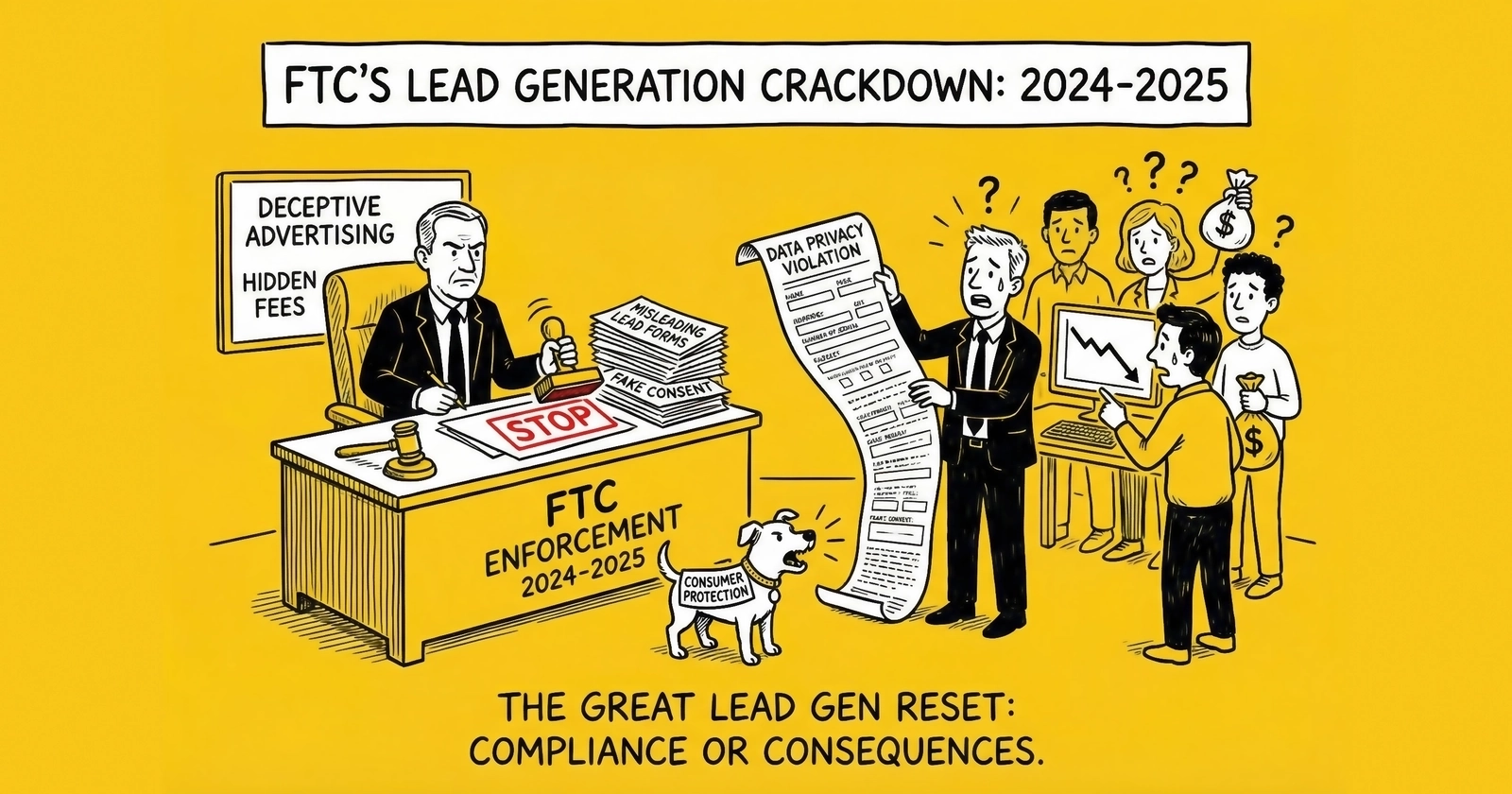
How the Federal Trade Commission’s enforcement actions are reshaping lead generation compliance requirements, and what the major settlements reveal about regulatory priorities.
Introduction: The FTC’s Lead Generation Focus
The Federal Trade Commission has made lead generation enforcement an explicit priority. In public statements, FTC officials have declared that “a priority at the FTC is coherently and systematically addressing unlawful lead generation.” The results speak through enforcement actions: $145 million in settlements during 2024-2025 from three major cases targeting different segments of the lead generation ecosystem.
These actions signal a fundamental shift in regulatory posture. The FTC is not merely responding to complaints – it is proactively investigating lead generation business practices, challenging industry-standard approaches to consent, and holding companies accountable for downstream harms caused by leads they generate or distribute.
For lead generation operators, understanding these enforcement actions is not optional. The cases establish precedents that affect how consent is documented, how advertising claims are substantiated, and how compliance responsibilities flow through the lead generation supply chain. These FTC actions work alongside TCPA regulations to define the legal boundaries of lead generation.
This guide analyzes the three landmark FTC enforcement actions of 2024-2025, extracts the compliance lessons from each, and provides operational guidance for building FTC-compliant lead generation operations.
The Three Landmark Cases
MediaAlpha: The $45 Million Health Insurance Settlement
Case: FTC v. MediaAlpha (August 2025) Settlement: $45 million Allegations: Deceptive practices in health insurance lead generation
MediaAlpha, one of the largest publicly traded lead generation companies ($864.7 million in 2024 revenue), agreed to a $45 million settlement with the FTC in August 2025. The case centered on practices in health insurance lead generation, particularly around consumer disclosure and consent.
Key Allegations:
The FTC alleged that MediaAlpha’s health insurance comparison platform deceived consumers about the nature of their interaction. Specifically:
-
Advertiser List Disclosure: MediaAlpha displayed hyperlinked lists of advertisers who might contact consumers. The FTC rejected claims that these hyperlinked lists constituted valid consent for contact by those advertisers.
-
Consumer Expectations: The FTC argued that consumers submitting information through comparison shopping experiences did not reasonably expect the volume and nature of contacts they subsequently received.
-
Third-Party Contact Authorization: The settlement addresses how consent for third-party contact must be obtained and documented, with implications for the entire comparison shopping and lead aggregation model.
Settlement Terms
Beyond the $45 million payment, the settlement imposes significant operational requirements. MediaAlpha must enhance disclosure of how consumer information will be used and provide clearer presentation of which companies may contact consumers. The company faces new documentation requirements for consent verification and ongoing compliance monitoring to ensure adherence to settlement terms.
Industry Implications
The MediaAlpha settlement challenges practices common throughout the insurance lead generation industry. Comparison sites must reconsider how they present advertiser relationships to consumers. Lead aggregators can no longer rely on generic consent language that obscures the true scope of data sharing. Downstream buyers face increased scrutiny for contacts made based on questionable consent obtained upstream.
The settlement establishes that merely listing potential recipients does not constitute informed consent, even if the list is accessible via hyperlink.
Assurance IQ: The $100 Million Telemarketing Settlement
Case: FTC v. Assurance IQ (2024) Settlement: $100 million Allegations: Deceptive telemarketing practices
Assurance IQ, a health insurance and Medicare marketing company, agreed to the largest FTC lead generation settlement in history: $100 million. The case focused on telemarketing practices and consumer deception.
Key Allegations:
-
Deceptive Call Practices: The FTC alleged that Assurance IQ telemarketers made misleading statements about insurance products and coverage during calls.
-
Consent Manipulation: Evidence suggested that consent documentation did not accurately reflect consumer understanding of what they were consenting to.
-
Vulnerable Population Targeting: The case highlighted concerns about marketing practices targeting Medicare-eligible consumers and others in vulnerable populations.
Settlement Terms
The $100 million settlement included prohibition on specific deceptive practices and enhanced call monitoring requirements. Assurance IQ must now provide mandatory disclosures during telemarketing calls and submit to third-party compliance auditing. The settlement also requires cooperation with ongoing FTC investigations, potentially exposing other participants in the lead generation ecosystem.
Industry Implications
The Assurance IQ settlement has particular relevance across the insurance lead generation supply chain. Medicare lead generators face increased scrutiny of their marketing practices, while telemarketing operations must invest in enhanced compliance infrastructure. Insurance lead buyers now bear explicit responsibility for how purchased leads are contacted, extending liability beyond the initial point of consumer engagement.
The settlement amount – $100 million – signals that the FTC views deceptive telemarketing in lead generation as a serious violation warranting substantial penalties.
Response Tree: The Industry Ban
Case: FTC v. Response Tree LLC (January 2024) Action: Permanent industry ban Allegations: Operating “consent farms” using dark patterns
Response Tree LLC represents the most aggressive FTC action against a lead generator: a complete ban from the industry. The case exposed practices that had generated enormous lead volume through fundamentally deceptive means.
Key Allegations:
-
Consent Farms: Response Tree operated what the FTC characterized as “consent farms” – websites designed to extract consumer consent through deceptive interfaces and dark patterns.
-
Volume of Violations: At its peak, Response Tree offered 10,000-50,000 illegally farmed leads per day to buyers in the lead generation ecosystem.
-
Dark Pattern Usage: The websites employed manipulative design elements that obscured what consumers were consenting to, obtained consent for contact by parties consumers never intended to authorize, and made opt-out mechanisms difficult to locate or use.
-
Supply Chain Contamination: The case highlighted how consent farm leads entered the broader lead ecosystem, contaminating supply chains and creating liability for downstream purchasers.
Enforcement Terms
Rather than a monetary settlement, the FTC obtained the ultimate remedy: a permanent ban on Response Tree and its principals from the lead generation industry. The enforcement action included asset freezes and disgorgement of profits obtained through deceptive practices. Response Tree must cooperate with ongoing investigations, and the case establishes precedent for industry bans as an available enforcement tool.
Industry Implications
The Response Tree case carries warnings for the entire lead generation ecosystem. Lead buyers bear responsibility for vetting lead sources – ignorance of upstream practices is not a defense. Dark patterns in consent collection now face severe penalties including permanent exclusion from the industry. Supply chain diligence has shifted from best practice to legal requirement.
The case demonstrates that the FTC will pursue not just financial penalties but complete removal of bad actors from the industry.
Compliance Lessons from Enforcement Actions
Lesson 1: Consent Disclosure Must Be Meaningful
The MediaAlpha settlement establishes that consent disclosures must actually communicate to consumers what they are agreeing to. Hyperlinked lists of potential contacts, dense legal language, and buried disclosures do not constitute meaningful consent.
Compliant Practices
Effective consent collection requires clear, plain-language explanation of who may contact the consumer. This includes explicit listing of contact methods – phone, email, and text – so consumers understand exactly how they may be reached. The number of potential contacts must be reasonable, not an exhaustive list of hundreds of advertisers. Consumers should affirmatively acknowledge specific disclosure content rather than passively accepting generic terms.
Non-Compliant Practices
The FTC has signaled clear opposition to several common industry practices. Generic “partners may contact you” language fails to inform consumers of actual contact scope. Hyperlinks to extensive advertiser lists do not constitute meaningful disclosure. Consent language hidden within terms of service or privacy policies goes unread and therefore unacknowledged. Pre-checked consent boxes improperly shift the burden to consumers to opt out rather than opt in.
Lesson 2: Telemarketing Requires Enhanced Oversight
The Assurance IQ settlement emphasizes that companies are responsible for the conduct of their telemarketing operations, whether in-house or outsourced.
Compliant Practices
Robust telemarketing compliance begins with comprehensive call recording and quality monitoring programs. Script compliance verification ensures agents deliver approved messaging and disclosures. Regular auditor review of call samples – not just those flagged by automated systems – catches issues that algorithm-based monitoring may miss. When monitoring identifies problems, immediate remediation within 24 hours demonstrates the commitment to compliance that regulators expect. All training must be documented with agent certification records maintained for regulatory inspection.
Non-Compliant Practices
The FTC has demonstrated intolerance for operational gaps in telemarketing oversight. Unmonitored telemarketing operations create unacceptable compliance risk regardless of call volume. Reliance on agent self-reporting fails to detect the very deception it purports to prevent. Incentive structures that reward sales volume without compliance metrics actively encourage the behavior the FTC prosecutes. Insufficient complaint investigation – treating consumer complaints as one-off issues rather than systemic indicators – allows problems to compound until they attract regulatory attention.
Lesson 3: Source Verification Is Required
The Response Tree case establishes that lead buyers cannot claim ignorance of lead source practices. Purchasing leads from consent farms creates liability even if the buyer did not directly participate in the deceptive practices.
Compliant Practices
Source verification must begin before any lead purchase with comprehensive vendor due diligence. This includes verification of corporate registration, review of consent collection methodology, and assessment of quality control procedures. Ongoing monitoring of lead source practices ensures that initial compliance does not erode over time. TrustedForm certificates or equivalent consent verification technology provides independent documentation of consent collection. Contracts must reserve the right to audit lead source operations. When compliance concerns arise, immediate termination of the relationship is the only acceptable response.
Non-Compliant Practices
Purchasing from unknown or unvetted sources exposes buyers to liability for upstream violations they cannot control. Prioritizing price over compliance verification – choosing the cheapest leads without examining their origin – creates a race to the bottom that attracts consent farm operators. Ignoring red flags in lead quality or volume, such as suspiciously high volumes from unknown sources, demonstrates willful blindness that regulators will not excuse. Continuing purchases despite compliance concerns, hoping problems will resolve themselves, compounds liability with each additional lead purchased.
Lesson 4: Vulnerable Populations Receive Enhanced Protection
Multiple cases highlight FTC concern about marketing to vulnerable populations, particularly Medicare-eligible seniors.
Compliant Practices
Marketing to vulnerable populations requires enhanced disclosures that account for the audience. Health insurance marketing in particular demands clear, jargon-free explanations of coverage and costs. Understanding prior express written consent (PEWC) requirements is especially critical when marketing to seniors. Age-appropriate communication approaches recognize that Medicare-eligible consumers may need more time to process information and should never feel rushed. High-pressure tactics have no place in these interactions. Extended cancellation and cooling-off periods give consumers opportunity to reconsider decisions made during emotionally charged moments. Specialized compliance monitoring for Medicare leads ensures that the enhanced protections are actually implemented.
Non-Compliant Practices
Aggressive sales tactics targeting seniors represent exactly the behavior the FTC prosecutes. Confusing product comparisons that obscure rather than illuminate differences between options exploit consumer confusion. Urgency pressure without factual basis – artificial deadlines and “limited time” offers – manipulate decision-making. Failure to verify consumer understanding of what they have purchased leads to buyer’s remorse, complaints, and regulatory attention.
Building FTC-Compliant Operations
Consent Architecture
Design consent collection systems that would withstand FTC scrutiny.
Form Design
Compliant consent forms begin with a clear header identifying the purpose of data collection. A plain-language description of data use explains what will happen with submitted information. The form explicitly lists potential contact parties, keeping the number reasonable rather than exhaustive. Each contact method – phone, email, text – receives separate consent rather than bundled authorization. Clear opt-out mechanisms appear prominently, not buried in fine print. No consent boxes come pre-checked; consumers must affirmatively opt in. The entire experience must be mobile-optimized, as many consumers complete forms on smartphones where small text and crowded layouts impede comprehension.
Documentation Requirements
Every consent event requires comprehensive documentation. Capture the timestamp of consent along with IP address and geolocation data that can verify the consumer’s location. Preserve the full text of consent language shown to the consumer at the moment of submission – forms change over time, and you must prove what version the consumer saw. Session recording or TrustedForm certificates provide independent verification of the consent experience. Assign a unique consent identifier to enable tracking through your systems and correlation with downstream activities.
Retention
Consent records require minimum 5-year retention to address potential enforcement actions and litigation. For Medicare and health insurance leads, indefinite retention is prudent given the extended statute of limitations and regulatory interest in these verticals. All records must be maintained in an accessible format suitable for legal discovery – data trapped in legacy systems or proprietary formats creates problems when regulators request documentation.
Vendor Management
Establish vendor management practices that demonstrate supply chain diligence.
Pre-Qualification
Before purchasing leads from any vendor, conduct thorough pre-qualification due diligence.
| Requirement | Documentation |
|---|---|
| Corporate registration verification | Secretary of State filing |
| Compliance program description | Written policies |
| Consent collection methodology | Sample forms and flow |
| Quality control procedures | QA documentation |
| Insurance coverage | Certificate of insurance |
| Reference verification | Client references |
Ongoing Monitoring
Pre-qualification alone is insufficient. Ongoing monitoring ensures that initial compliance does not degrade over time. Require monthly compliance attestations from vendors confirming continued adherence to agreed practices. Reserve quarterly audit rights and exercise them – rights that are never exercised provide little protection. Vendors must provide immediate notification of any regulatory inquiries they receive, as these may affect leads you have purchased. Conduct annual comprehensive reviews of vendor relationships. Random sample verification of consent documentation catches issues that scheduled audits might miss.
Contract Requirements
Vendor contracts must include specific compliance provisions. Require compliance representations and warranties that the vendor will operate in accordance with applicable law and industry standards. Include indemnification for regulatory violations that protect you from liability arising from vendor misconduct. Reserve audit and termination rights that can be exercised without cause or with abbreviated notice periods. Specify data handling and retention requirements that align with your compliance program. Mandate cooperation with regulatory inquiries, ensuring vendors will assist if you face investigation.
Telemarketing Compliance
For organizations conducting telemarketing with purchased or generated leads, the Assurance IQ settlement establishes clear expectations for oversight infrastructure.
Call Monitoring
Comprehensive call monitoring forms the foundation of telemarketing compliance. Record 100% of calls – partial recording leaves gaps that create liability. Review a minimum 5% random sample of calls; higher percentages are appropriate for new campaigns or agents. Document all review findings in a format that demonstrates systematic oversight. When reviews identify issues, remediate within 24 hours; delayed response suggests tolerance of non-compliance. Track agent-level compliance scores to identify patterns and training needs.
Script Compliance
Every campaign requires approved scripts that agents must follow. Deploy deviation detection technology that flags departures from approved language. Update scripts regularly based on regulatory guidance and enforcement trends. Explicitly prohibit unapproved claims – agents must understand that freelancing on product benefits or pricing creates organizational liability.
Training
Initial compliance certification ensures agents understand requirements before making calls. Annual recertification refreshes knowledge and addresses regulatory changes. All training content must be documented and version-controlled. Competency verification testing confirms that agents actually absorbed training material rather than merely sitting through presentations.
Internal Compliance Structure
Build organizational infrastructure for FTC compliance.
Compliance Officer
Designate a specific individual with authority over compliance decisions – vague distributed responsibility fails when tested. This person should report directly to senior leadership, not through operational management that might prioritize revenue over compliance. Allocate dedicated budget for compliance activities including training, technology, and outside counsel. Most importantly, ensure independence from revenue pressure; a compliance officer whose compensation depends on sales volume cannot objectively assess compliance risk.
Documentation
Maintain written compliance policies that describe your standards and procedures. Keep training records that prove who received training and when. Archive audit reports showing systematic review of operations. Document incident response activities so you can demonstrate how problems were identified and resolved. Maintain regulatory correspondence files containing all communications with FTC, state attorneys general, and other regulatory bodies.
Response Procedures
Establish a consumer complaint investigation protocol that treats complaints as early warning indicators rather than isolated incidents. Develop a regulatory inquiry response plan before you need it – the middle of an investigation is too late to establish procedures. Define internal escalation procedures that ensure serious issues reach appropriate decision-makers quickly. Specify board or executive notification triggers so leadership learns of significant risks before they become crises.
Industry Impact Assessment
Comparison Shopping Model Under Pressure
The MediaAlpha settlement directly challenges the comparison shopping business model as traditionally operated. Sites that collect consumer information and distribute it to multiple advertisers must reconsider their approach.
Model Adjustments Required
The comparison shopping model must evolve to meet new consent requirements. Explicit consent for each potential contact party replaces generic authorization for unspecified partners. Reasonable limits on the number of contacts protect consumers from the overwhelming outreach that triggered FTC attention. Clear disclosure of contact frequency expectations helps consumers understand what submitting their information actually means. Consumer control over contact preferences shifts power from lead generators to the individuals whose information is being monetized.
Business Implications
These adjustments carry significant business implications. Potentially fewer advertisers per lead reduces the revenue multiple that made comparison shopping attractive. Higher per-lead pricing becomes necessary to maintain revenue when lead distribution narrows. Enhanced technology for consent management requires capital investment and operational complexity. The silver lining: compliance leaders gain competitive advantage as non-compliant competitors face enforcement risk.
Medicare Marketing Transformation
The Assurance IQ settlement, combined with CMS regulatory changes, is fundamentally reshaping Medicare lead generation.
Compliance Requirements
Medicare lead generation now operates under heightened compliance requirements from multiple regulatory sources. The CMS one-to-one consent rule prohibits sharing Medicare leads with multiple buyers, fundamentally changing the economics of the vertical – affecting the exclusive vs shared lead calculation entirely. FTC requirements demand enhanced telemarketing oversight including call recording, quality monitoring, and script compliance. Vulnerable population protections apply enhanced scrutiny to marketing tactics used with seniors. Extended record retention – potentially indefinite – ensures that consent documentation remains available for the life of any potential investigation.
Market Effects
These compliance requirements are reshaping the Medicare lead generation market. Higher barriers to entry favor established operators with existing compliance infrastructure. Consolidation accelerates as smaller players lack resources to meet compliance requirements and larger operators acquire their customer relationships. Premium pricing for compliant leads reflects the additional cost of proper consent collection and documentation. Non-compliant players face a choice: invest in compliance or exit the market.
Supply Chain Accountability
The Response Tree case establishes that every participant in the lead generation supply chain bears compliance responsibility.
Publisher Obligations
Publishers who collect consumer information directly bear primary responsibility for compliant consent collection. This includes implementing consent forms that meet FTC standards, maintaining documentation and verification records, and providing source transparency to downstream participants. Publishers cannot hide behind aggregators or brokers – they touch the consumer first and must ensure that interaction is compliant.
Aggregator and Broker Obligations
Aggregators and brokers who stand between publishers and buyers have their own compliance responsibilities. Vendor due diligence requires verification that publisher partners operate compliantly. Quality verification ensures that leads entering distribution meet established standards. When selling leads downstream, aggregators must make compliance representations to buyers – not just price and volume guarantees. These representations create accountability that flows upstream to publisher practices. Proper vendor evaluation frameworks help buyers assess aggregator compliance capabilities.
Buyer Obligations
Lead buyers bear ultimate responsibility for how leads are used. Source verification requires due diligence on where leads originate, not just who sold them. Contact practice compliance ensures that outreach adheres to consent scope and regulatory requirements. Consumer complaint monitoring serves as an early warning system for problems anywhere in the supply chain – complaints about aggressive calling may indicate upstream consent issues rather than just buyer behavior.
Frequently Asked Questions
What is the FTC’s authority over lead generation?
The FTC enforces Section 5 of the FTC Act, which prohibits “unfair or deceptive acts or practices in or affecting commerce.” This broad authority allows the FTC to pursue lead generators for deceptive advertising, misleading consent practices, unfair telemarketing, and other practices that harm consumers. The FTC can seek injunctions, civil penalties, consumer redress, and industry bans. Unlike TCPA enforcement (which allows private lawsuits), FTC actions are brought by the government and can result in settlements requiring operational changes beyond financial penalties.
How do the FTC settlements affect my lead generation business?
The settlements establish compliance standards that affect all lead generation participants. If you operate comparison sites, the MediaAlpha case requires meaningful consent disclosure rather than hyperlinked advertiser lists. If you conduct telemarketing, the Assurance IQ case requires enhanced oversight and monitoring. If you purchase leads, the Response Tree case requires vendor due diligence and source verification. Even if you were not a party to these cases, the FTC’s interpretation of “unfair or deceptive” practices now includes these precedents. Proactive compliance adjustment is strongly recommended.
Can I be held liable for leads I purchase from non-compliant sources?
Yes. The Response Tree case establishes that lead buyers cannot claim ignorance of source practices. If you purchase leads generated through deceptive means (consent farms, dark patterns, misleading advertising), you may face FTC enforcement even if you did not directly participate in the deceptive practices. The FTC’s position is that lead buyers have a responsibility to verify that their lead sources operate compliantly. This requires vendor due diligence, ongoing monitoring, consent verification (TrustedForm or equivalent), and willingness to terminate non-compliant sources.
What documentation should I maintain for FTC compliance?
Maintain comprehensive documentation including: consent records (timestamp, IP, full consent language, session recording or certificate), vendor agreements with compliance representations, due diligence records for lead sources, call recordings and quality monitoring reports, compliance training records, complaint investigation files, and audit reports. Retain consent records for minimum 5 years; health insurance and Medicare records should be retained indefinitely. Documentation should be organized for potential regulatory discovery – if the FTC requests records, you should be able to produce them promptly and completely.
How should I respond to an FTC inquiry?
FTC inquiries require careful handling. Do not ignore any communication from the FTC. Immediately engage legal counsel experienced in FTC matters. Preserve all potentially relevant documents – document destruction after receiving an inquiry can result in additional violations. Respond within requested timeframes, seeking extensions if needed. Provide requested information accurately and completely; misrepresentations to the FTC can result in separate violations. Consider whether voluntary cooperation might result in more favorable treatment. Never assume an inquiry will not result in enforcement – the MediaAlpha, Assurance IQ, and Response Tree cases all began with investigations.
What penalties can the FTC impose?
FTC remedies include: civil penalties up to $50,120 per violation (adjusted for inflation), injunctive relief prohibiting specific practices, consumer redress requiring refunds to harmed consumers, disgorgement of ill-gotten profits, compliance monitoring requirements, and industry bans prohibiting individuals or companies from operating in the sector. The Response Tree case demonstrates that the FTC will pursue industry bans for egregious violations. Settlement amounts have reached $100 million (Assurance IQ), establishing that lead generation violations can result in substantial financial consequences.
Key Takeaways
-
The FTC has explicitly prioritized lead generation enforcement, with $145 million in settlements during 2024-2025 targeting comparison shopping (MediaAlpha), telemarketing (Assurance IQ), and consent farms (Response Tree).
-
Consent disclosure must be meaningful, not merely technically present – the MediaAlpha settlement rejected hyperlinked advertiser lists as valid consent, requiring explicit, understandable disclosure of who will contact consumers.
-
Telemarketing operations require enhanced oversight including call recording, quality monitoring, script compliance verification, and immediate remediation of issues identified through monitoring.
-
Lead buyers bear responsibility for source compliance – the Response Tree case establishes that purchasing from non-compliant sources creates liability even without direct participation in deceptive practices.
-
Vulnerable populations receive enhanced protection, particularly Medicare-eligible consumers, with both FTC and CMS enforcement focused on marketing practices targeting seniors.
-
Industry bans are now an available remedy as demonstrated by Response Tree, meaning bad actors face not just financial penalties but complete exclusion from the industry.
-
Supply chain diligence is legally required, with every participant – publisher, aggregator, buyer – bearing compliance responsibility for leads they touch.
-
Documentation and retention practices must support regulatory scrutiny, with minimum 5-year retention for consent records and indefinite retention for health insurance and Medicare.
Sources
- FTC Press Releases - Official announcements of MediaAlpha ($45M), Assurance IQ ($100M), and Response Tree enforcement actions
- FTC Cases and Proceedings - Case documents and settlement terms for lead generation enforcement actions
- FTC Enforcement Overview - Information on FTC enforcement authority and penalty structures
- FTC Telemarketing Sales Rule - Federal requirements for telemarketing compliance
- FTC Act, Section 5 - Statutory authority prohibiting “unfair or deceptive acts or practices”
- CMS.gov - Medicare marketing regulations including one-to-one consent requirements
Enforcement actions and settlement terms based on FTC public announcements and case documents through December 2025. Regulatory interpretations evolve – consult qualified legal counsel for specific compliance guidance.