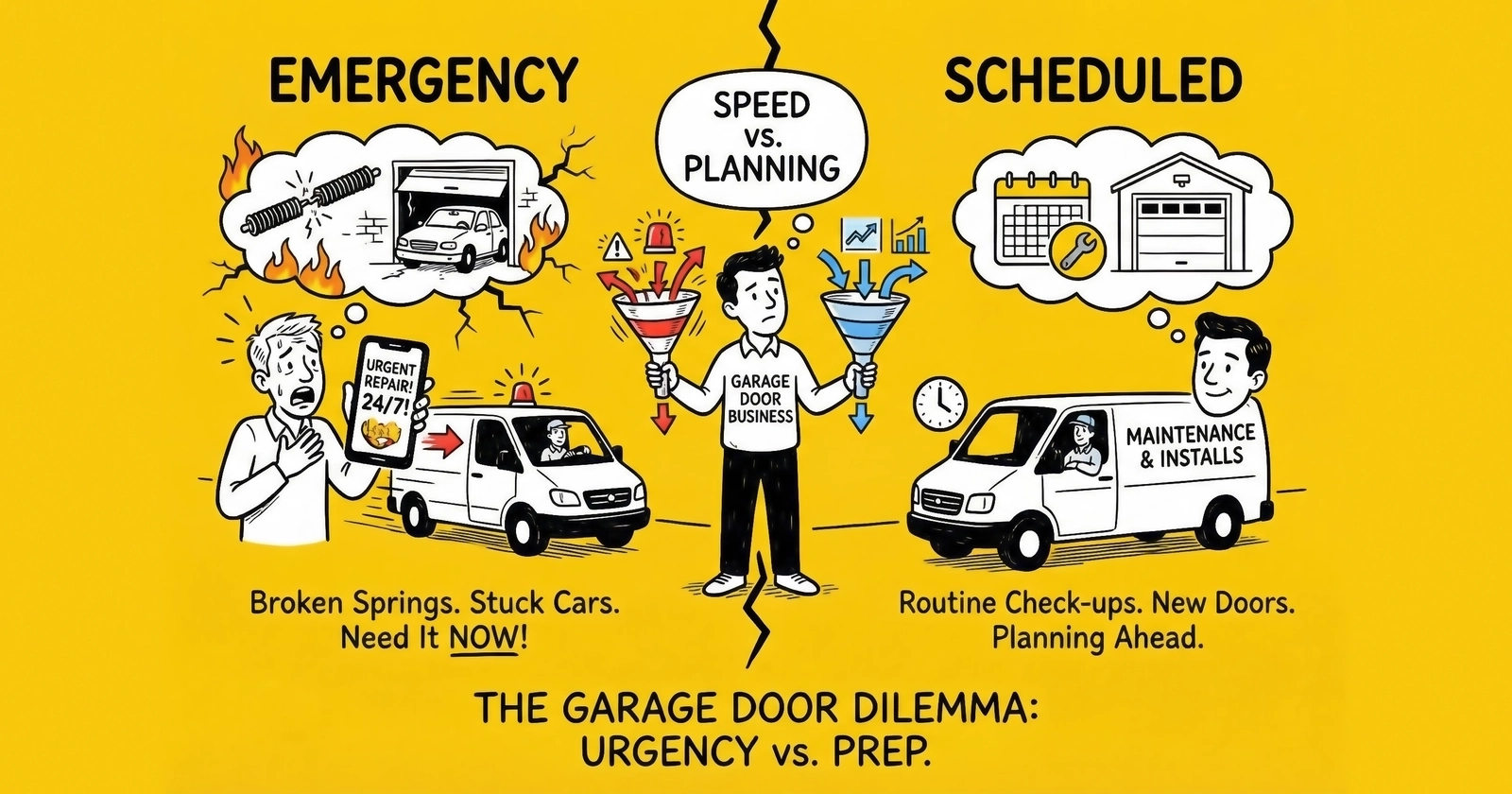
The distinction between a homeowner trapped in their garage and one planning a cosmetic upgrade creates entirely different lead economics. Understanding this divide determines profitability in garage door lead generation.
Garage door lead generation operates at the intersection of home improvement and emergency services. A broken spring at 6 AM trapping a car in the garage creates a lead worth $80-$150. A homeowner researching new door styles for a renovation project creates a lead worth $25-$45. Same vertical, fundamentally different economics.
This guide provides the complete framework for garage door lead generation: emergency versus scheduled lead dynamics, local marketing strategies, marketplace platform optimization, conversion rate benchmarks, pricing intelligence, and the operational considerations that separate profitable garage door lead businesses from those losing money on the wrong lead types.
The garage door industry generates approximately $4.5 billion in annual revenue in the United States, with residential services representing roughly 65% of that total. The lead generation market serving garage door contractors has matured into a competitive but underserved niche – large enough to support serious operators, small enough that many aggregator platforms underinvest in optimization.
Understanding the Garage Door Market
The garage door vertical sits in an unusual position within home services lead generation. It combines elements of emergency repair (like HVAC and plumbing), high-ticket installation sales (like windows and roofing), and recurring maintenance (like lawn care). This combination creates opportunities for operators who understand the market’s unique dynamics.
Market Size and Structure
The U.S. garage door market is dominated by approximately 10,000 active contractors, ranging from single-technician operations to multi-location regional companies. The industry structure breaks down approximately as follows:
| Company Type | Market Share | Average Annual Revenue |
|---|---|---|
| Single technician | 35% | $75,000-$200,000 |
| Small team (2-5 technicians) | 40% | $200,000-$750,000 |
| regional companies (6-20 technicians) | 20% | $750,000-$3,000,000 |
| Large regional/national | 5% | $3,000,000+ |
The fragmented market structure creates lead generation opportunities. Unlike HVAC or plumbing where national brands and franchises capture significant market share, garage door services remain predominantly local. Local contractors need lead sources but often lack sophisticated marketing capabilities.
Service Type Segmentation
Garage door services divide into distinct categories with different lead economics. Each category demands its own acquisition strategy, pricing model, and contractor capabilities.
Emergency Repair Services include broken spring replacement (the most common emergency), off-track door repair, opener malfunction, door damage from vehicle impact or weather, cable replacement, and sensor realignment.
Installation Services encompass new door installation for replacement projects, new construction installations, opener installation and upgrades, insulated door upgrades, and smart opener conversions.
Maintenance Services cover annual tune-ups, lubrication and adjustment, safety inspections, weatherstripping replacement, and balance testing.
Commercial Services include commercial door installation, loading dock doors, roll-up doors, access control integration, and preventive maintenance contracts.
The service type directly affects lead value. Emergency spring replacement leads convert at 40-60% but require rapid response capability. New installation leads have longer consideration cycles but average ticket sizes of $2,500-$8,000. Commercial leads can generate tickets of $15,000-$75,000 but require specialized contractor capabilities.
Lead Pricing Benchmarks
Garage door lead prices vary significantly by lead type, urgency, and geographic market:
| Lead Type | Price Range | Typical Booking Rate |
|---|---|---|
| Exclusive emergency | $60-$150 | 40-60% |
| Exclusive repair (non-emergency) | $35-$70 | 25-40% |
| Exclusive installation | $40-$90 | 15-30% |
| Shared emergency (2-3 buyers) | $30-$60 | 25-40% |
| Shared repair/installation | $15-$35 | 10-20% |
| Live transfer | $75-$150 | 50-70% |
| Aged leads (30+ days) | $3-$12 | 5-12% |
The math behind these premiums makes sense when examined against ticket sizes. A spring replacement averages $200-$400 for the service call. A full door replacement averages $2,500-$5,000 for residential, higher for custom doors. Even at the upper end of lead costs, a $150 emergency lead converting at 50% yields an effective CPA of $300 against a $350 repair ticket – viable economics for contractors who can execute.
Emergency Leads: The High-Value, High-Stakes Segment
Emergency garage door leads represent the premium segment of the vertical. A homeowner cannot get to work because their car is trapped in the garage. A family cannot secure their home because the door will not close. The urgency is real, conversion rates are high, and competition for these leads is intense.
Emergency Lead Characteristics
Emergency garage door situations share common attributes that shape lead generation strategy.
The defining characteristic is immediate need. Unlike a planned installation that might develop over weeks of research, emergency leads require same-day service. The homeowner is not comparison shopping – they need someone who can arrive now.
This urgency drives high conversion intent. Emergency leads convert at 40-60% because the alternative is an unacceptable status quo. The homeowner will accept the first qualified contractor who can arrive within their timeline.
Time sensitivity makes these leads particularly valuable – and perishable. Lead value decays rapidly. An emergency lead that is 5 minutes old is worth $100. The same lead at 30 minutes is worth $60. At 2 hours, it may already be served or the homeowner has given up trying to reach contractors.
Seasonal patterns affect volume predictably. Emergency lead volume increases during extreme weather. Cold weather causes spring failures as metal contraction increases stress. Summer heat can cause opener failures. Storms create door damage. Spring and fall see relatively lower emergency volume.
Geographic concentration also matters. Urban and suburban markets generate more emergency leads due to higher garage door density. Rural areas have lower volume but often less competition.
Common Emergency Scenarios
Understanding what creates emergency leads helps target acquisition efforts.
Broken springs represent the most common garage door emergency. Torsion springs have a limited cycle life – typically 10,000-20,000 cycles, or 7-12 years of normal use. When springs break, the door becomes extremely difficult or impossible to open manually. Homeowners with their car inside the garage have no choice but to seek immediate repair.
Spring replacement leads are the bread and butter of emergency garage door work. The repair is relatively quick (30-60 minutes for an experienced technician), ticket sizes are consistent ($200-$400 for torsion spring replacement), and the emergency nature justifies premium lead pricing.
Off-track doors create both inconvenience and safety hazards. These repairs are often more complex than spring replacement and can escalate to replacement recommendations if the track system is damaged.
Opener malfunctions on modern garage doors with smart openers create emergency situations when openers fail. Homeowners who rely on remote access may not know how to manually open their door, creating urgency even for relatively simple repairs.
Storm and vehicle damage creates both emergency situations (security concerns) and near-term replacement leads. These situations often convert to full door installation rather than repair.
Emergency Lead Acquisition Strategies
Capturing emergency leads requires different tactics than scheduled lead acquisition.
Paid Search with Urgency Keywords
The primary acquisition channel for emergency garage door leads is paid search targeting urgency-modified keywords: “emergency garage door repair,” “garage door repair near me now,” “broken garage door spring repair today,” “24 hour garage door service,” and “garage door stuck [city name].”
Emergency search campaigns should bid aggressively for top positions. Position 3 or 4 will not capture emergency searchers who need immediate solutions. The economics support higher CPCs when conversion rates are 40-60%.
Mobile-First Landing Pages
Emergency searchers are often on mobile devices, standing in their garage or sitting in their car outside. Landing pages must be optimized for immediate action. The click-to-call button belongs above the fold, with the phone number prominently displayed. Messaging should emphasize “24/7 Emergency Service” alongside service area confirmation and a response time commitment like “Technician dispatched within 30 minutes.”
Form-based lead capture is secondary for emergencies. The priority is immediate phone connection.
Call-Only Campaigns
Google Ads call-only campaigns connect searchers directly to contractors, eliminating landing page friction entirely. These campaigns convert at higher rates for emergencies because they match the immediate-need psychology.
Local Services Ads
Google Local Services Ads with the “Google Guaranteed” badge perform exceptionally well for emergency garage door leads. The trust signal reduces friction for homeowners who need immediate service but are wary of unknown contractors. LSA operates on a pay-per-lead model with garage door leads typically costing $30-$75.
Display and Remarketing for Awareness
Emergency leads are not typically generated through display advertising – the intent timing is wrong. However, display campaigns can build awareness that pays off when emergencies occur. Homeowners who have seen your brand may search for it specifically when a spring breaks.
Emergency Response Requirements
Generating emergency leads without contractor partners capable of emergency response creates refund liability and reputation damage. True emergency lead programs demand specific capabilities from contractor partners.
Contractors must have 24/7 dispatch capability. True emergency leads require around-the-clock response. Contractors must have on-call technicians or answering services that can dispatch during off-hours.
A rapid response commitment is equally essential. Emergency leads require same-day service, often within 2-4 hours. Contractors must have technicians available, not scheduled wall-to-wall with appointments.
Parts inventory matters because common emergency repairs – torsion springs, cables, rollers – require parts in the truck. Technicians who must order parts lose emergency jobs.
Geographic coverage determines response times. Contractors must have service area capacity matching their lead purchasing geography.
Quality standards protect everyone in the chain. Emergency situations create vulnerability for homeowners. Contractors who exploit emergencies with excessive pricing damage the lead generator’s reputation when reviews mention the referral source.
Scheduled Leads: The Long-Cycle, High-Ticket Segment
Scheduled garage door leads represent planned purchases: new door installations, opener upgrades, cosmetic replacements, and non-urgent repairs. These leads convert at lower rates than emergencies but offer larger ticket sizes and more predictable volume.
Scheduled Lead Characteristics
Planned garage door work follows different patterns than emergency repairs.
The extended consideration cycle sets scheduled leads apart from emergencies. Homeowners researching new garage doors may take weeks or months from initial research to purchase decision. They compare styles, materials, brands, and contractors before committing.
Price comparison behavior dominates the scheduled segment. Unlike emergencies where speed trumps price, scheduled leads involve quote collection. Homeowners typically get 2-4 quotes before deciding. The first contractor to quote does not automatically win.
The longer timeline creates a relationship building opportunity. Extended sales cycles allow contractors to build relationships through follow-up, demonstrations, and consultative selling. The contractor who educates best often wins.
Seasonality affects installation work more than repairs. Scheduled work concentrates in spring and fall when weather is moderate for outdoor installation. Summer and winter see reduced installation volume because heat and cold affect installation quality and crew comfort.
The payoff comes through higher average tickets. While emergency repairs average $200-$400, new door installations average $2,500-$5,000 for standard residential doors and $5,000-$12,000 for premium or custom doors.
Installation Lead Dynamics
New door installation leads require understanding what drives replacement decisions.
Curb appeal motivates many door replacements. Many door replacements are aesthetic upgrades. Homeowners planning home sales, completing renovations, or simply wanting improved appearance represent significant lead volume. These leads respond to visual content – before/after photos, style galleries, and design visualization tools.
Energy efficiency concerns drive another segment. Insulated garage doors can reduce energy costs for attached garages. This value proposition resonates with environmentally conscious homeowners and those with home offices or living spaces above garages.
Functionality upgrades create additional demand. Replacing old chain-drive openers with quiet belt-drive models, adding smart home integration, or upgrading to battery backup openers creates non-emergency replacement leads.
Safety and security motivate replacement even without failure. Aging doors with failing springs, worn cables, or obsolete openers create safety concerns that motivate replacement even without emergency failure.
Real estate transactions trigger many decisions. Home sales often trigger garage door replacement as sellers prepare properties or buyers plan immediate improvements.
Scheduled Lead Acquisition Strategies
Capturing scheduled leads requires different approaches than emergency acquisition.
SEO and Content Marketing
Scheduled leads often begin with informational searches: “garage door replacement cost,” “best garage door styles 2025,” “insulated vs non-insulated garage doors,” “smart garage door openers,” and “how long do garage doors last.”
Content that answers these questions captures leads early in the consideration process. Contractors or lead generators with strong organic presence for these queries build pipelines of scheduled leads without per-click costs.
Paid Search with Consideration Keywords
Non-urgent search campaigns target planning-stage keywords: “garage door installation [city],” “new garage door cost,” “garage door replacement near me,” and “best garage door company [city].”
Bid strategies for scheduled leads can be more conservative than emergency campaigns. Position 2-4 is acceptable when the homeowner is comparing options rather than seeking immediate help.
Social Media Advertising
Facebook and Instagram ads work well for installation leads because garage doors are visual products. Before/after galleries, style inspiration content, and video testimonials generate leads at $20-$50 for form submissions. Lead quality tends to be lower than search due to weaker intent, but volume and cost efficiency can compensate.
Home Improvement Platforms
Houzz, Pinterest, and home design platforms drive consideration-stage traffic. Presence on these platforms builds awareness and captures homeowners in early research phases.
Direct Mail in Targeted Neighborhoods
Neighborhoods with aging housing stock – 20-30 year old homes with original doors – respond to direct mail campaigns. Geographic targeting based on home age data can yield efficient CPLs for installation leads.
Partnership Referrals
Real estate agents, home inspectors, and renovation contractors encounter homeowners planning garage door work. Referral relationships generate warm leads with higher conversion rates than cold acquisition.
Nurturing Scheduled Leads
The extended consideration cycle for scheduled work requires lead nurturing capabilities.
Email Sequences
Leads who submit forms but are not ready to schedule require ongoing engagement. A typical sequence might include a thank you email with company overview and portfolio in week one, educational content like door style guides and material comparisons in week two, a case study or testimonial feature in week three, a special offer or consultation invitation in week four, and monthly newsletters with seasonal content ongoing.
Phone Follow-Up Cadence
Multiple phone attempts over 2-4 weeks capture leads as they progress through decision-making. The typical cadence starts with an initial call within 5 minutes of submission on day one, a follow-up attempt on days 2-3, a third attempt in week one, a fourth attempt with an offer in week two, and a final attempt in week four.
Retargeting Campaigns
Website visitors who do not convert should see retargeting ads reinforcing brand presence: display ads with style imagery, social ads with testimonials, and YouTube pre-roll with installation videos.
SMS Engagement
For leads who provided mobile numbers, SMS nurturing achieves higher response rates than email. This channel works well for initial confirmation texts, appointment reminders, limited-time offer messages, and response prompts.
The Economics of Emergency vs Scheduled
Understanding the financial dynamics of each lead type enables portfolio optimization. Neither type is inherently “better” – the optimal mix depends on contractor capabilities and market conditions.
Emergency Lead Economics
Emergency leads convert at higher rates but cost more and create operational complexity.
Consider a typical revenue calculation: an average spring replacement ticket of $350, an emergency lead cost of $100 for exclusive delivery, an emergency lead booking rate of 50%, yielding an effective CPA of $200. With a 50% gross margin on repair ($175), the net contribution after lead cost is $75 per booked lead.
The margin analysis reveals the challenge. At $350 average ticket with 50% gross margin, the contractor earns $175 gross profit per job. If leads cost $100 each and convert at 50%, the effective lead cost per job is $200 – higher than the gross profit per job.
This math only works if emergency jobs lead to additional revenue through upselling door replacement when repairs are temporary fixes, maintenance contract enrollment, referrals from satisfied emergency customers, or lifetime value from repeat business.
Contractors who treat emergency calls as one-time transactions cannot afford premium emergency leads. Contractors who use emergencies as relationship starters can justify the economics.
Volume considerations add complexity. Emergency lead volume is inherently variable. Spring failures cluster during weather changes. A week with three cold fronts generates 5x the emergency leads of a mild week. Operators need contractors who can absorb variable volume without constant capacity constraints.
Scheduled Lead Economics
Scheduled leads convert at lower rates but offer higher ticket sizes and more predictable volume.
The revenue calculation looks different: an average door installation ticket of $4,000, an installation lead cost of $60 for exclusive delivery, an installation lead booking rate of 20%, yielding an effective CPA of $300. With a 35% gross margin on installation ($1,400), the net contribution after lead cost is $1,100 per booked lead.
The margin analysis favors installation leads despite lower conversion rates. A $4,000 installation with 35% gross margin generates $1,400 in gross profit. Even at 20% conversion ($300 effective CPA), net contribution exceeds $1,000 per sale.
However, installation leads require longer sales cycles (4-6 weeks average), multiple follow-up touches per lead, estimate appointments and presentations, higher sales skill requirements, and larger service area coverage.
Cash flow considerations matter too. Emergency repairs collect payment immediately. Installation projects may involve deposits and completion payments, extending the cash cycle. Lead generators selling to installation-focused contractors should understand payment timing implications for their float.
Portfolio Optimization
The optimal lead mix depends on contractor profile and market conditions.
For contractors focused on repair volume, emergency leads should comprise 60-70% of the mix with scheduled at 30-40%. Priority goes to rapid response capability and parts inventory. Upselling to installation creates high-margin opportunities.
For contractors focused on installation revenue, scheduled leads should comprise 70-80% of the mix with emergency at 20-30%. Priority goes to sales capability and project management. Emergency service maintains customer relationships and generates repair revenue during installation slow periods.
For lead generators, diversification across lead types reduces risk from seasonal variation and contractor capacity constraints. Pure emergency lead businesses face volume volatility. Pure installation lead businesses face longer sales cycles and higher return rates.
Seasonal adjustment optimizes results further. Shift portfolio toward emergency during weather transition periods when spring failures peak. Shift toward scheduled during mild weather when installation conditions are optimal. Summer and winter represent challenging periods for different reasons.
Local Marketing Strategy for Garage Door Leads
Garage door services are inherently local. Homeowners need contractors who can arrive quickly and service their specific market. Local marketing strategy determines competitive positioning.
Google Business Profile Optimization
Google Business Profile is the foundation of local garage door marketing. Appearing in the Local Pack for “garage door repair near me” generates significant lead volume.
Profile completion requires attention to several elements. The primary category should be Garage Door Supplier or Garage Door Repair Service, with secondary categories including Gate Repair Service, Garage Builder, and Door Supplier. The service area should specify cities and zip codes served. Hours must be accurate, including 24/7 notation if applicable. Attributes should include emergency service, 24-hour service, free estimates, and same-day service. Products and services should list all offerings with descriptions and price ranges. Photos should show completed projects, team members, vehicles, and before/after transformations.
Review generation deserves strategic focus because reviews are the primary trust signal for local services. Garage door businesses should target a minimum of 5-10 new reviews monthly with an average rating above 4.5 stars. All feedback deserves responses, and photo reviews showing completed work add credibility when possible.
Effective review generation tactics include post-service email requests with direct links to Google review, post-service SMS requests (which achieve higher response rates), technician asks at job completion, follow-up calls 48 hours post-service with review requests, and review incentive programs within Google guidelines.
Weekly GBP posts signal active business and provide additional ranking signals. Effective post content includes project showcases with before/after photos, seasonal tips about winterizing doors or spring maintenance, special offers and promotions, team and company updates, and community involvement.
Local SEO Strategy
Beyond GBP, organic local search requires website and citation optimization.
Local landing pages should target each major service area: “[City] Garage Door Repair,” “[City] Garage Door Installation,” and “Emergency Garage Door Service in [County].” Each page should include city or neighborhood in the title tag, H1, and throughout content, along with local content mentioning specific areas, landmarks, and conditions. Local reviews and testimonials, schema markup for local business, embedded Google Maps, and consistent NAP (Name, Address, Phone) information round out the requirements.
Citation building across directories reinforces local search presence. Key directories include Google Business Profile as the foundation, plus Yelp, BBB (Better Business Bureau), Angi/HomeAdvisor, Thumbtack, industry directories like the IDA (International Door Association), local Chamber of Commerce, and local business directories. NAP consistency across all citations is critical – inconsistent information confuses search engines and reduces ranking potential.
Local link building signals geographic relevance. Opportunities include local sponsorships of youth sports and community events, Chamber of Commerce membership, local business associations, community partnerships, local news coverage, and guest posts on local blogs.
Paid Local Advertising
Google Local Services Ads positions appear above traditional search ads. For garage door services, the “Google Guaranteed” badge builds trust, with leads typically costing $30-$75. LSA is particularly effective for emergency leads where the trust signal accelerates decision-making.
Geotargeted paid search should target specific cities and zip codes within the service area, exclude areas outside service capability, and use location extensions to display the address.
Social advertising on Facebook and Instagram should use radius targeting, demographic targeting focused on homeowners, interest targeting around home improvement, and lookalike audiences based on customer lists.
Marketplace Platforms for Garage Door Leads
Lead marketplace platforms provide access to homeowner demand without requiring contractors to build comprehensive marketing operations.
Angi/HomeAdvisor dominates the market with leads typically shared with 3-4 contractors at $15-$45 per lead. Emergency leads command premiums of $30-$60. Success requires fast response, strong reviews, and follow-up persistence. Operators should set spending caps, dispute invalid leads promptly, and monitor ROI by lead type.
Thumbtack uses a quote-based model where contractors pay $10-$35 to submit quotes on homeowner projects. This platform works better for scheduled installation leads than emergencies.
Google Local Services offers pay-per-lead with the “Google Guaranteed” badge. Lead costs range $30-$75 for garage door services. Requirements include background checks, licensing verification, and insurance verification.
The winning platform strategy maintains presence on 2-3 platforms while tracking performance rigorously with unique tracking numbers. Allocate budget toward highest-performing sources based on ROI analysis.
Conversion Optimization for Garage Door Leads
The booking rate – the percentage of leads that convert to service appointments – determines profitability more than lead cost alone. A $75 lead with a 40% booking rate outperforms a $40 lead with a 15% booking rate.
Speed-to-Contact Benchmarks
Response time is the single most important factor in lead conversion.
Optimal response times vary by lead type. Emergency leads demand response under 2 minutes, ideally immediate. Repair leads should receive contact under 5 minutes. Installation leads can tolerate up to 15 minutes, though faster is always better. After-hours leads should receive first-thing-next-business-day contact with immediate acknowledgment.
Research across home services consistently demonstrates the impact. Leads contacted within 5 minutes are 8x more likely to convert than those contacted after 30 minutes. First responder advantage captures 78% of bookings on shared leads. Each 5-minute delay reduces conversion probability by 10-15%.
Achieving these response times requires real-time lead delivery through API, webhook, or immediate notification, dedicated intake staff during business hours, on-call response for after-hours emergency leads, automated acknowledgment for leads that cannot be called immediately, and handoff procedures when the primary responder is unavailable.
Follow-Up Sequences
Not all leads answer the first call. Systematic follow-up captures leads who were busy, distracted, or need multiple touches.
Emergency lead follow-up should begin with an immediate call upon lead receipt, followed by SMS within 1 minute if no answer, a second call 15-30 minutes later, SMS at the 1-hour mark with an urgency message, and a third call 2-4 hours later. Emergency leads that do not respond within 4 hours have likely found alternative service.
Scheduled lead follow-up extends over a longer period. Day 1 should include a call within 5 minutes, SMS if no answer, and a second call 2-4 hours later. Day 2 brings a morning call and mid-day SMS. Day 3 features an evening call. Week 1 includes an email with portfolio and offer. Week 2 brings a final call attempt and follow-up email. Ongoing monthly nurture emails maintain contact with non-responsive leads.
Phone Script Framework
What contractors say during calls directly affects booking rates.
An effective emergency call opening might sound like: “Hi, this is [Name] from [Company]. I received your request for emergency garage door repair. I understand your door is not working – that is stressful, and we are here to help. I have a technician who can be at your location within [timeframe]. Can you tell me briefly what is happening with the door?”
A scheduled call opening takes a different tone: “Hi, this is [Name] from [Company]. Thank you for your interest in a new garage door. I would love to learn more about what you are looking for and provide some options. Is this a good time to talk for about 5 minutes?”
Discovery questions should cover the specific issue or goal, how long the problem has persisted for repairs, the age and type of the current door, whether other quotes have been obtained, when the homeowner hopes to have the work addressed, and availability for a service call or estimate.
The booking transition should summarize understanding of the need, confirm service area and address, offer specific appointment times, explain what to expect regarding arrival window and service process, confirm contact information, and send immediate confirmation.
Objection Handling
Common objections require prepared responses.
When asked “What does it cost?”, the response varies by context. For emergency repairs: “Our service call fee is $[amount], which includes diagnosis and covers the first 30 minutes of labor. Most spring repairs are in the $[range] range, but I will give you an exact quote before we do any work.” For installations: “New garage doors range from $[low] to $[high] depending on the style, material, and features you want. I would be happy to provide a free estimate at your home so I can give you an exact quote for what you are looking for.”
When the homeowner says “I am getting other quotes,” respond with: “I completely understand – it is smart to compare options. I am confident we offer the best combination of quality and value, and I would love the chance to show you why. Can we schedule an estimate for [time]?”
When price exceeds expectations, acknowledge the concern: “I hear that. We are not the cheapest option, but our technicians are trained and certified, we use quality parts with warranty coverage, and we stand behind our work. Many customers who went with cheaper options have come to us when they needed it fixed again. Would you like me to walk through what is included?”
Pricing Strategy for Garage Door Leads
Lead pricing should reflect acquisition cost, conversion rates, and contractor willingness to pay. Finding the right price point maximizes revenue without losing contractor relationships.
Cost-Based Pricing Floor
Understanding your true cost per lead establishes the pricing floor.
Paid search leads involve average CPCs for garage door keywords of $8-$25, landing page conversion rates of 8-15%, and form submission to qualified lead rates of 70-85%. The resulting cost per qualified lead ranges from $60-$200 depending on market.
SEO and organic leads require monthly SEO investment of $2,000-$5,000 with monthly lead volume at maturity of 30-100 leads. The resulting cost per lead ranges from $20-$150 depending on competition.
Marketplace leads carry purchase prices of $15-$75 depending on platform and lead type. With an additional margin requirement of 30-50%, the resulting sell price ranges from $20-$110.
Market-Based Pricing
Competitor pricing and contractor willingness to pay establish market rates.
Emergency leads command $25-$50 when shared, $60-$150 for exclusive delivery, and $75-$150 for live transfer.
Repair leads (non-emergency) price at $15-$35 shared and $35-$70 exclusive.
Installation leads range from $20-$45 shared and $40-$90 exclusive.
Several factors affect pricing within these ranges. Geographic market matters, as larger metros command premiums. Seasonality plays a role, with emergency leads priced higher during weather events. Lead quality metrics including verified phone, specific intent, and fresh timing justify premiums. Exclusivity commands 2-3x shared pricing. Delivery method affects value, with live transfers commanding premiums.
Contractor ROI Analysis
Pricing that contractors can profitably pay ensures sustainable relationships.
For emergency repair contractors, the math works like this: average ticket of $350, gross margin of 50% ($175), acceptable CPA of $100-$150, which at a 50% booking rate translates to an acceptable lead price of $50-$75.
For installation contractors, the economics differ: average ticket of $4,000, gross margin of 35% ($1,400), acceptable CPA of $500-$700, which at a 20% booking rate translates to an acceptable lead price of $100-$140.
Contractors can justify higher lead prices than many generators charge – if lead quality supports the expected booking rates. Quality issues like wrong service area, fake contacts, or tire-kickers destroy the math and justify lower pricing or contractor departure.
Building Contractor Relationships
For lead generators selling to garage door contractors, relationship quality determines long-term success. Contractors who trust their lead sources pay premium prices and remain loyal through competitive pressure.
Contractor Selection Criteria
Not all contractors make good lead buyers.
Operational requirements include adequate technician capacity for timely response, dispatch systems (phone, software, or answering service), parts inventory for common repairs, service area coverage matching lead geography, and sales capability for installation leads.
Financial stability indicators include an established business of 2+ years, consistent payment history, credit line adequate for lead purchasing volume, and no history of chargebacks or disputes.
Quality indicators include Google reviews (4.0+ average with 25+ reviews preferred), verified licensing for the jurisdiction, current and adequate insurance, no significant complaint patterns, and professional presentation through website, vehicles, and uniforms.
Onboarding and Performance Management
Effective onboarding establishes expectations during Week 1 with orientation, integration setup, and close monitoring. Volume ramps during Weeks 2-4 and transitions to monthly reviews with quarterly business analysis.
Key metrics to track include lead-to-contact rate, contact-to-booking rate, return/dispute rate, response time, and revenue per lead.
Intervention triggers include response time increasing (indicating capacity constraints), booking rate declining (suggesting quality or sales issues), return rate increasing (pointing to quality problems), or payment delays (signaling cash flow issues).
Relationship health indicators include regular communication, proactive capacity updates, performance improvement over time, and multi-year retention.
Frequently Asked Questions
Q: What is a good cost per lead for garage door services?
A: Garage door lead costs vary significantly by type and urgency. Emergency exclusive leads typically range $60-$150, while non-emergency repair leads cost $35-$70 and installation leads $40-$90 for exclusive delivery. Shared leads cost 40-60% less but convert at lower rates. The critical metric is cost per acquisition, not cost per lead. A $100 emergency lead that converts at 50% yields a $200 CPA, while a $50 lead converting at 15% yields a $333 CPA. Calculate your acceptable CPA based on ticket size and margin, then work backward to acceptable lead costs.
Q: How do emergency garage door leads differ from scheduled leads?
A: Emergency leads involve immediate need – typically broken springs, off-track doors, or opener failures trapping cars in garages. These leads convert at 40-60% because homeowners cannot wait but cost more ($60-$150 exclusive) and require 24/7 response capability. Scheduled leads involve planned purchases – new door installations, opener upgrades, or non-urgent repairs. These convert at 15-30% but offer higher ticket sizes ($2,500-$8,000 for installations) and more predictable volume. Successful operators maintain both lead types, adjusting the mix by season and contractor capacity.
Q: Which platforms work best for garage door lead generation?
A: Google Local Services Ads performs well for garage door leads, particularly emergency repairs, due to the trust signal from the “Google Guaranteed” badge. Lead costs typically run $30-$75. Angi/HomeAdvisor provides volume but delivers shared leads requiring fast response. Thumbtack works better for scheduled installation leads than emergencies. Direct lead generation through paid search offers the most control but requires marketing expertise and often higher per-lead costs ($60-$150 for emergency leads). Most successful contractors use 2-3 platforms while tracking ROI rigorously and shifting budget toward top performers.
Q: What booking rate should contractors expect from purchased garage door leads?
A: Booking rates vary significantly by lead type and contractor execution. Emergency exclusive leads should book at 40-60%. Non-emergency repair leads book at 25-40%. Installation leads book at 15-30% due to longer consideration cycles and quote competition. Shared leads book at roughly half these rates. Response speed is the primary driver of booking rate improvement – contractors who call within 2-5 minutes book at 3-5x the rate of those who wait an hour. Systematic follow-up sequences capture an additional 20-30% of leads that do not answer the first call.
Q: How important is Google Business Profile for garage door lead generation?
A: Google Business Profile is essential. The Local Pack (map results) captures significant search volume for local garage door queries, and GBP is the primary factor in Local Pack rankings. Contractors with complete profiles, active review generation (5-10 new reviews monthly), regular posts, and professional photos capture leads that never reach paid channels. A strong GBP can generate 30-50% of total lead volume through organic search – essentially free leads that improve overall acquisition economics.
Q: What is the best response time for garage door leads?
A: For emergency leads, response within 2 minutes is optimal, with 5 minutes as the maximum acceptable delay. Emergency homeowners often call multiple contractors simultaneously; the first to answer typically wins the job. For non-emergency repair leads, respond within 5 minutes. For installation leads, 15 minutes is acceptable, though faster is always better. After-hours leads should receive immediate automated acknowledgment with callback commitment first thing next business day. Every 5-minute delay reduces conversion probability by 10-15%.
Q: How does seasonality affect garage door lead generation?
A: Garage door leads exhibit moderate seasonality. Emergency leads peak during weather transition periods – spring and fall when temperature changes stress springs. Cold snaps also increase emergency volume as cold-contracted metal fails more readily. Installation leads peak in spring (March-May) and fall (September-November) when weather is moderate for outdoor installation work. Summer heat and winter cold reduce installation volume. Smart practitioners shift their portfolio toward emergency leads during weather events and scheduled leads during mild weather with optimal installation conditions.
Q: Should I focus on repair leads or installation leads for garage door?
A: The answer depends on contractor capability and business goals. Repair leads convert at higher rates (40-60% emergency, 25-40% non-emergency) but average $200-$400 per ticket. Installation leads convert at 15-30% but average $2,500-$8,000 per ticket. The net contribution per installation lead is typically higher despite lower conversion rates. However, installation leads require longer sales cycles, multiple follow-ups, estimate appointments, and stronger sales skills. Most successful operators pursue both, using repair relationships to generate installation opportunities and maintaining installation focus for revenue growth.
Q: How do I handle lead quality issues with garage door leads?
A: Establish clear quality criteria: valid phone number, genuine service need, correct service area, no duplicate within 30 days, real property address. Track quality metrics by source to identify problem suppliers. Implement validation at capture: phone verification, address validation, and specific service type confirmation. When purchasing leads, negotiate clear return policies – 15-20% return rate is typical for garage door leads. Returns exceeding 25% indicate source quality problems requiring renegotiation or termination. Document all return reasons to provide actionable feedback to lead sources.
Q: What technology do I need for garage door lead management?
A: Minimum requirements include real-time lead delivery (API, email, or SMS notification), a CRM or lead management system for tracking, call tracking with recording for quality analysis, and automated acknowledgment capability. For scale, add lead distribution software (boberdoo, LeadsPedia, or similar), advanced analytics for source-level ROI tracking, and integration with contractor dispatch systems. Mobile capability is essential – technicians and dispatchers must access leads instantly from any location. Investment in technology infrastructure typically pays for itself through improved response times and conversion rates.
Q: How do I compete with large garage door franchises for leads?
A: Large franchises have brand recognition but often higher overhead and less local flexibility. Independent contractors compete effectively by emphasizing local expertise, faster response times, and personalized service. Local SEO and GBP optimization let independents appear alongside franchises in local results. Reviews often favor independents when service is genuinely better. Price positioning can differentiate – either premium (better service justifies higher cost) or value (local overhead advantages enable competitive pricing). Focus lead generation on platforms where independents compete on merit (response time, reviews) rather than brand recognition.
Key Takeaways
-
Garage door leads divide into two fundamentally different categories: emergency leads (broken springs, trapped cars) convert at 40-60% and command $60-$150 for exclusive delivery, while scheduled leads (installations, upgrades) convert at 15-30% but offer $2,500-$8,000 average tickets.
-
Response speed determines conversion more than any other factor. Emergency leads require response within 2-5 minutes. First-to-call advantage on shared leads captures 70-80% of bookings. Every 5-minute delay reduces conversion probability by 10-15%.
-
Google Business Profile is the foundation of local garage door marketing. Complete profile optimization, systematic review generation (5-10 monthly with 4.5+ average rating), and regular posts drive Local Pack visibility that generates free leads.
-
Lead economics favor installation leads despite lower conversion rates. A $90 installation lead converting at 20% ($450 CPA) against a $4,000 ticket yields $950+ net contribution. A $100 emergency lead converting at 50% ($200 CPA) against a $350 ticket yields only $75 net contribution unless upselling occurs.
-
Platform diversification reduces risk. Use 2-3 platforms (Google LSA, Angi, Thumbtack, direct generation) while tracking ROI rigorously by source. Shift budget toward top performers while maintaining minimum presence on secondary platforms.
-
Contractor relationships are the foundation of sustainable lead generation. Select contractors with operational capacity, track performance transparently, and adjust volume proactively based on response time and booking rate signals.
-
Seasonal patterns create optimization opportunities. Emergency leads peak during weather transitions (spring and fall). Installation leads peak during moderate weather (spring and fall). Adjust portfolio mix and marketing investment to match seasonal demand patterns.
-
Follow-up sequences capture 20-30% additional conversions. Leads that do not answer the first call are not dead leads. Systematic multi-touch follow-up over 1-2 weeks significantly improves booking rates for both emergency and scheduled leads.
Sources
- Grand View Research: Garage Door Market Analysis - Industry market size and growth projections
- Door and Access Systems Manufacturers Association (DASMA) - Industry standards and manufacturer specifications
- Door & Access Systems Magazine - Trade publication covering garage door industry trends
- Statista: U.S. Garage Door Market Value - Market revenue and size data
- InsideSales: Lead Response Management - Research on lead response time impact on conversion rates
- SEIA Solar Market Research Data - Industry research methodology reference for home services market sizing
The distinction between emergency and scheduled garage door leads is not merely academic – it determines everything from acquisition strategy to contractor requirements to pricing models. Practitioners who understand these dynamics build sustainable businesses. Those who treat all garage door leads identically leave money on the table or burn contractor relationships with mismatched expectations.