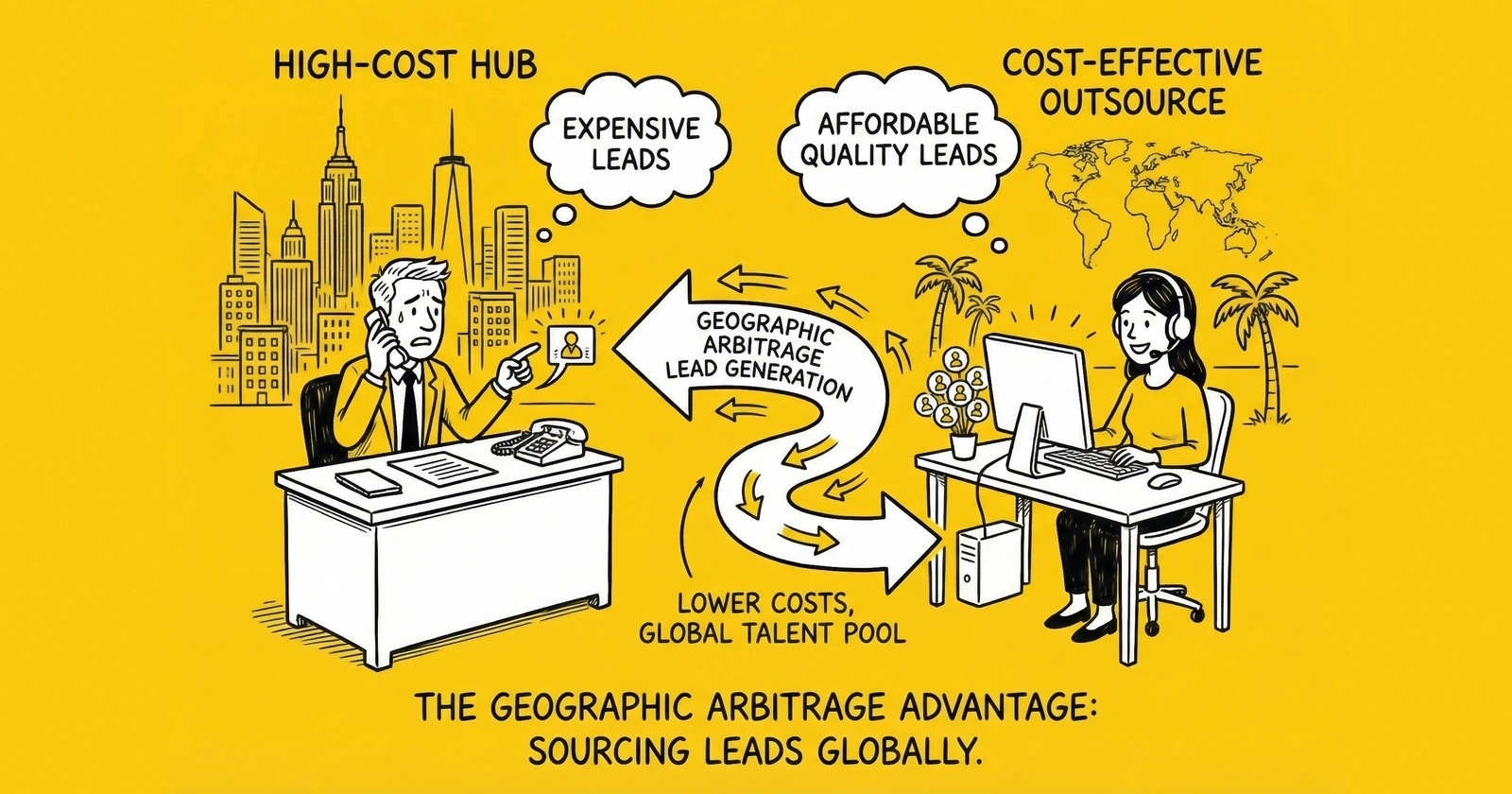
The same lead sells for $1,929 in California and $225 in North Dakota. That 8.5x pricing spread exists because most lead generators treat markets as monolithic. Smart practitioners exploit the gaps.
A lead is not a lead is not a lead.
The same consumer intent – someone requesting solar installation quotes – commands wildly different prices depending on where that consumer lives. California installers pay premium CPLs because their customers face $0.25/kWh electricity rates and complex net metering policies. North Dakota installers pay a fraction because their customers face $0.10/kWh rates and minimal incentive structures.
This is geographic arbitrage: the systematic practice of identifying markets where traffic costs less to acquire than the leads are worth to buyers, then exploiting that spread at scale. It works in solar. It works in insurance. It works in mortgage, legal, and home services. The underlying mechanics are the same: local conditions create value variations that national pricing models miss.
Lead generators who master geographic arbitrage consistently outperform those who treat the United States as one market. They pay less for traffic, charge more for leads, and build competitive moats around hyper-local market intelligence that commodity operators cannot replicate.
This guide maps how geographic arbitrage works, where the spreads exist, and how to operationalize this strategy in your lead generation business.
What Is Geographic Arbitrage in Lead Generation?
Geographic arbitrage is the practice of generating leads in markets where the relationship between traffic acquisition cost and lead sale value creates above-average margins.
The concept is simple: buy low, sell high – but across geography rather than time.
A lead generator practicing geographic arbitrage might discover that:
- Traffic acquisition in Phoenix costs 40% less than in Los Angeles due to lower competition
- Yet lead buyers in Phoenix pay only 20% less than Los Angeles buyers
- The spread creates 20 percentage points of additional margin
Multiply that spread across thousands of leads monthly, and geographic arbitrage becomes the difference between a marginally profitable operation and a highly profitable one.
Why Geographic Spreads Exist
Geographic pricing variations persist because of structural market differences that cannot be arbitraged away:
Policy and regulatory differences: State incentives, tax credits, net metering rules, and licensing requirements create permanent value differentials. California’s solar market operates under fundamentally different economics than Texas, regardless of sunshine hours.
Local cost structures: A home services lead in San Francisco has different value than one in Phoenix because labor costs, permit fees, and material costs differ. Buyers adjust CPL willingness based on their local margins.
Competitive density: Markets with more buyers create upward price pressure on leads. Markets with fewer buyers – even if underserved – may have lower CPLs despite adequate demand.
Consumer behavior patterns: Conversion rates vary by geography based on local norms, economic conditions, and competitive alternatives. A market where consumers convert at 12% justifies higher CPLs than one converting at 6%.
Market maturity: Emerging markets often have lower traffic costs (less advertiser competition) but also lower buyer CPLs (fewer established operations). The ratio between these determines arbitrage potential.
The Arbitrage Formula
Geographic arbitrage profitability follows a simple formula:
Margin = (Lead Sale Price - Traffic Cost - Variable Costs) / Lead Sale Price
Where:
- Lead Sale Price varies by state, metro, and sometimes ZIP code
- Traffic Cost varies by platform, keyword, and targeting granularity
- Variable Costs include validation, consent certification, and delivery
The arbitrage opportunity exists when you can acquire traffic in a geography where costs are proportionally lower than the reduction in sale price – or where traffic costs are similar but sale prices are higher.
The Solar Example: An 8.5x Geographic Spread
Solar leads provide the clearest example of geographic arbitrage because the pricing spreads are enormous and well-documented.
The California-to-North Dakota Spread
At the extremes, solar lead value varies from approximately $1,929 per closed sale in California to $225 in North Dakota. This 8.5x differential reflects the convergence of multiple factors:
| Factor | California | North Dakota |
|---|---|---|
| Electricity Rate | $0.25+/kWh | $0.10/kWh |
| State Tax Credit | None (expired) | None |
| Net Metering | NEM 3.0 (reduced) | Minimal |
| Payback Period | 9-12 years | 18+ years |
| Installer Density | Hundreds | Handful |
| Close Rate | 8-12% | 3-5% |
The implication for lead generators: a lead in California might sell for $150-200 while a lead in North Dakota might sell for $25-40. But if your traffic acquisition costs are similar in both states (they often are for national display campaigns), California delivers 4-6x the revenue per lead generated.
State Tier Analysis
For practical lead generation purposes, solar markets cluster into five tiers:
Tier 1: Premium Markets ($150-$300+ per lead)
- California, Hawaii, Massachusetts, New York
- Highest electricity rates, strongest policy support, most installer competition
- Traffic costs are higher, but sale prices justify the premium
Tier 2: Strong Markets ($100-$150 per lead)
- Texas, Florida, Arizona, New Jersey, Colorado
- Growing markets with solid economics
- Best arbitrage potential often exists here – lower traffic costs than Tier 1, still-strong sale prices
Tier 3: Developing Markets ($50-$100 per lead)
- Nevada, Utah, Illinois, Virginia, Georgia, Carolinas
- Lower competition creates traffic cost advantages
- Sale prices are lower but can support profitable campaigns with efficient acquisition
Tier 4: Emerging Markets ($25-$50 per lead)
- Most Midwest and Mountain states
- Very low traffic costs but also low buyer demand
- Profitability requires extremely efficient acquisition
Tier 5: Minimal Markets (Generally unprofitable)
- North Dakota, South Dakota, Wyoming, Appalachia
- Low electricity rates, minimal policy support, sparse population
- Even cheap traffic generates leads buyers do not want
Where the Arbitrage Exists
The highest-margin opportunities typically exist in Tier 2 and Tier 3 markets where traffic costs are significantly lower than Tier 1 but sale prices remain strong relative to acquisition cost.
Consider this comparison:
| Metric | California | Texas |
|---|---|---|
| Average CPC (Solar keywords) | $8.50 | $5.20 |
| Landing Page Conversion | 5% | 5% |
| Raw CPL | $170 | $104 |
| Lead Sale Price | $175 | $125 |
| Gross Margin | $5 (2.9%) | $21 (16.8%) |
Texas delivers nearly 6x the margin percentage despite lower absolute sale prices. This is geographic arbitrage in action.
Where Geographic Spreads Exist Across Verticals
Geographic arbitrage is not limited to solar. Every major lead generation vertical exhibits geographic pricing variations driven by local market conditions.
Solar: State Incentive Variations
Solar’s geographic spread is driven primarily by:
- Electricity rates: The higher the rate, the faster the payback, the easier the sale
- Net metering policies: Full retail credit vs. avoided cost creates 3-5x value differences
- State incentives: Tax credits, SRECs, and rebates layer on top of federal credits
- Installer density: More installers create competition that drives up lead prices
Policy changes can shift markets between tiers within months. California’s NEM 3.0 implementation in 2023 contracted the residential market by 40% in 2024. Lead generators who anticipated this shift – pivoting traffic to Texas and Florida in late 2022 – preserved profitability while competitors absorbed losses. Understanding solar incentive changes helps operators stay ahead of market shifts.
Insurance: State Premium Differences
Auto and home insurance leads exhibit geographic variation based on:
- State minimum requirements: Higher mandatory coverage creates larger policy values
- Loss ratios by state: Carrier profitability affects willingness to buy leads
- Competitive intensity: States with more carriers see higher CPLs
- Regulatory environment: Some states restrict pricing, affecting carrier economics
Premium states for auto insurance include Florida (high premiums due to no-fault and PIP requirements), Michigan (highest average premiums in the nation), and California (large market, high policy values). Lower-value states include Ohio, Iowa, and Maine where premiums and carrier competition are lower. For detailed benchmarks, see our insurance lead CPL data by sub-vertical.
The spread in auto insurance leads typically ranges from 2-4x between highest and lowest value states – not as extreme as solar but significant for margin optimization.
Legal: Jurisdiction Value Differences
Legal leads – particularly personal injury – exhibit extreme geographic variation based on:
- Venue favorability: Plaintiff-friendly jurisdictions command premiums
- Damage cap laws: States without caps justify higher case investment
- Statute of limitations: Longer windows create more lead opportunities
- Average settlement values: Higher awards justify higher acquisition costs
A personal injury lead in Philadelphia (known plaintiff-friendly jurisdiction) might sell for $300-500. The same lead in Delaware (shorter statutes, lower average settlements) might sell for $100-150. Legal lead generators who understand jurisdiction economics target campaigns accordingly.
Mortgage: Loan Size Variations
Mortgage leads value correlates strongly with:
- Median home prices: Higher home values mean larger loans and larger origination revenue
- Refinance potential: Rate environments affect geographic refinance activity
- Purchase activity: Local housing market health drives purchase lead demand
- Lender competition: Markets with more lenders see higher CPLs
A mortgage lead in the San Francisco Bay Area (median home price $1.2 million+) commands significant premiums over a lead in Cleveland (median home price $200,000). The loan amount differential directly affects lender origination revenue and thus CPL willingness.
Home Services: Local Market Economics
HVAC, roofing, plumbing, and electrical leads vary by:
- Average job size: Coastal markets often have higher project values
- Seasonal patterns: HVAC leads in Phoenix spike in April-May; heating leads in Minnesota peak in September-October
- Competitive density: Markets with more contractors see higher CPLs
- Labor costs: Higher-wage markets can support higher acquisition costs
Geographic arbitrage in home services often focuses on seasonal timing as much as location – generating HVAC leads in emerging-season markets before the seasonal surge hits.
Finding Underpriced Markets
Identifying underpriced markets requires systematic analysis of the relationship between traffic acquisition costs and lead sale prices across geographies.
The Market Analysis Framework
For each geography, evaluate four indices:
Traffic Cost Index: Search volume, CPC ranges, CPM estimates, and competitive density from Google Ads Keyword Planner and Facebook Audience Insights.
Buyer Demand Index: Number of active buyers, fill rates from distribution platforms, bid prices in ping/post auctions.
Conversion Quality Index: Historical contact rates, close rates, return rates, and customer lifetime value by geography.
Arbitrage Opportunity Score: The ratio between traffic costs and buyer demand relative to national averages determines opportunity magnitude.
Signals of Underpriced Markets
Look for markets exhibiting these characteristics:
Growing population with lagging advertiser attention: Markets experiencing population growth often have buyer demand exceeding advertiser investment. Phoenix, Austin, and Raleigh demonstrated this pattern in the 2010s.
Recent policy changes creating buyer demand: When a state implements new incentives or regulations, buyers enter before advertisers fully adjust. The first 6-12 months after favorable policy changes often present arbitrage windows.
Seasonal opportunity windows: Traffic costs often lag seasonal demand patterns. Entering markets as seasonal demand begins – before CPCs adjust – captures above-average margins.
Platform-specific gaps: A market may be expensive on Google but cheap on Facebook, or vice versa. Testing multiple platforms by geography reveals platform-specific arbitrage.
Buyer Demand by Geography
Understanding buyer demand patterns is as important as understanding traffic costs. A cheap lead that no one wants is worthless.
How Buyers Evaluate Geographic Value
Lead buyers – insurance agents, solar installers, mortgage originators – evaluate geographic value based on:
Close rate history: Buyers track conversion rates by geography and adjust CPL willingness accordingly. A market where they close at 12% justifies higher CPLs than one where they close at 6%.
Customer lifetime value: Some geographies produce customers with higher retention, larger policies, or more referrals. Buyers pay premiums for these markets.
Operational efficiency: Buyers with physical presence in a geography can serve leads more effectively. A solar installer with crews in Phoenix values Phoenix leads more than one dispatching from Los Angeles.
Competitive positioning: Buyers with strong local brand recognition convert better and pay more for leads in their core territories.
Matching Supply to Demand
The arbitrage opportunity is maximized when you can:
- Identify geographies where buyer demand exceeds lead supply
- Acquire traffic in those geographies at below-market costs
- Build relationships with buyers who will pay premiums for guaranteed supply
Some lead generators build exclusive arrangements with regional buyers: “I’ll deliver 500 exclusive leads per month in your territory at $X CPL.” These arrangements provide pricing stability and often command premiums over auction pricing.
Geo-Targeting Strategies
Executing geographic arbitrage requires precise geo-targeting across advertising platforms and campaign structures.
Campaign Structure for Geographic Testing
A systematic approach to geographic arbitrage:
Phase 1: National Baseline - Run campaigns nationally with geographic breakdown reporting to establish baseline economics.
Phase 2: Geographic Segmentation - Split campaigns by state or region, apply differential budgets based on Phase 1 data.
Phase 3: Optimization - Shift budget toward highest-margin geographies, exclude lowest-performing areas.
Phase 4: Hyperlocal Scaling - For proven markets, target at ZIP code or utility-territory level.
Utility-Level Targeting (Solar Example)
In solar, utility territory often matters more than state. Within California, three investor-owned utilities (PG&E, SCE, SDG&E) have distinct rate structures and net metering rules. Sophisticated solar lead generators map utility territories to ZIP codes, create separate campaigns for each territory, and price leads based on utility economics. Execution requires ZIP-code-targeted campaigns corresponding to utility boundaries and territory-specific landing pages.
Local Landing Pages at Scale
Geographic arbitrage extends beyond traffic acquisition to conversion optimization. Local landing pages convert better and enable geographic price differentiation.
Why Local Pages Convert Better
Consumers respond to local relevance:
- Trust signals: “Serving Phoenix since 2012” creates credibility
- Specificity: Local climate, regulations, and conditions resonate
- Social proof: Reviews and testimonials from local customers
- Contact information: Local phone numbers and addresses
Testing consistently shows that geo-specific landing pages convert 15-40% better than generic national pages for the same traffic.
Building Local Pages at Scale
Creating local landing pages at scale requires template-based generation. Build a master template with dynamic content zones, then populate city/state names, local statistics, and relevant details programmatically.
Key elements for local page differentiation:
- Local regulatory information (state-specific compliance language)
- Geographic-specific benefits (electricity rates, weather patterns)
- Local social proof (reviews mentioning the location)
- Area-specific imagery (recognizable landmarks)
Technical options include subdomain structures (phoenix.example.com), subdirectory structures (example.com/phoenix), or dynamic content with server-side geographic detection.
Avoid thin content penalties by ensuring substantive local uniqueness – pull current local data (electricity rates, home prices, permit costs) and integrate user-generated content like local reviews.
Compliance Considerations by State
Geographic arbitrage in lead generation operates within a patchwork of state-specific regulations. Compliance requirements vary by state and vertical, creating both risks and opportunities.
Key State-Level Variations
The federal TCPA sets baseline requirements, but states add their own layers. California’s CCPA/CPRA requires “Do Not Sell” disclosures and stricter consent requirements. Florida has enhanced telemarketing restrictions and registration requirements. New York requires telemarketing registration and state DNC list compliance. Washington’s My Health My Data Act affects health-related leads.
Each vertical adds state-specific requirements: insurance producer licensing, solar contractor licensing, mortgage NMLS requirements, and legal bar rules that vary by jurisdiction.
Building Compliance Into Geographic Strategy
Geographic arbitrage must account for compliance costs. Maintain a compliance matrix by state and vertical. Build required disclosures into geographic landing page templates. Ensure consent language meets the strictest applicable standard. Confirm buyers are licensed in geographies where you generate leads.
Compliance costs affect arbitrage economics. A state with high lead value but onerous requirements may be less attractive than a lower-value state with simpler compliance.
When Geographic Arbitrage Doesn’t Work
Geographic arbitrage is not universally applicable. Understanding its limitations prevents wasted investment.
Market Size Constraints
Some geographic opportunities are too small to matter:
Low-population markets: Even if unit economics are favorable, a market with 50,000 residents cannot support meaningful volume. Fixed costs for local campaigns may exceed potential revenue.
Declining markets: Markets losing population or economic vitality may have temporarily favorable economics that deteriorate over time.
Saturated micro-markets: Some small markets have intense local competition that makes entry uneconomical despite apparent opportunity.
Buyer Coverage Gaps
Lead value depends on buyer demand. Some geographies lack buyers:
No service coverage: Buyers who cannot fulfill leads in a geography will not purchase them. A solar lead in a county with no installers has zero value regardless of consumer intent.
Buyer capacity constraints: Even with coverage, buyer capacity may be insufficient. Generating 1,000 leads monthly for a market with two installers who can handle 100 leads each creates waste.
Quality concerns: Some buyers avoid certain geographies due to historical quality problems, regulatory risks, or operational challenges.
Traffic Quality and Complexity Costs
Some geographies have higher bot traffic rates, fraud scheme concentration, or demographic mismatches that erode lead quality. Geographic diversification also adds operational complexity – more campaigns, more compliance requirements, more buyer relationships to manage. At some point, the marginal return from additional geographic expansion is negative. Focus on markets where you can develop deep expertise rather than spreading thin across many.
Signs to Exit a Geographic Market
Exit a geographic market when:
- CPL consistently exceeds sale price minus target margin
- Fill rates drop below 60% indicating weak buyer demand
- Return rates exceed 15% indicating quality problems
- Policy changes permanently impair market economics
- Competitive entry compresses margins below acceptable thresholds
Quick exits from underperforming markets preserve capital for markets that work.
Frequently Asked Questions
What is geographic arbitrage in lead generation?
Geographic arbitrage is the practice of generating leads in markets where the spread between traffic acquisition cost and lead sale price creates above-average margins. It exploits the fact that local conditions – policy, regulations, competition, consumer behavior – create pricing variations that national campaigns miss. A lead generator practicing geographic arbitrage might find that Phoenix traffic costs 40% less than Los Angeles traffic while Phoenix lead prices are only 20% lower, creating a 20-point margin advantage.
Which lead generation verticals have the biggest geographic spreads?
Solar leads exhibit the largest geographic spreads – up to 8.5x between highest-value (California) and lowest-value (North Dakota) markets. This extreme variation reflects policy differences (net metering, state incentives), electricity rates, and installer density. Legal leads have 2-4x spreads based on jurisdiction favorability. Insurance leads vary 2-3x based on state premium levels and regulatory environment. Mortgage leads correlate with home prices, creating 3-5x spreads between coastal and inland markets.
How do I identify underpriced lead generation markets?
Analyze the relationship between traffic acquisition cost (CPC/CPM by geography) and lead sale price (buyer bid levels by geography). Look for markets where traffic costs are proportionally lower than the reduction in sale prices. Signals of underpriced markets include growing populations with lagging advertiser attention, recent favorable policy changes creating buyer demand, and seasonal opportunity windows before CPCs adjust. Tools include Google Ads Keyword Planner for geographic CPC estimates and lead distribution platform data for fill rates and bids.
What tools do I need for geographic lead generation?
Essential tools include: Google Ads and Facebook Ads for geographic traffic acquisition with location targeting, a landing page builder supporting geographic page variants, lead distribution software with geographic routing capabilities, consent verification (TrustedForm/Jornaya) for compliance documentation, and analytics platforms with geographic breakdown reporting. Advanced operations add SEMrush or Ahrefs for competitive intelligence by geography, census data for demographic targeting, and CRM systems tracking performance by geography.
How granular should geographic targeting get?
Targeting granularity depends on market size and value variation. Start with state-level campaigns to establish baseline economics. Progress to DMA or metro targeting for markets that justify the complexity. For high-value verticals like solar, utility-territory targeting (via ZIP code groupings) captures value variations within states. The most advanced operations target at ZIP code level in their highest-value markets. Granularity adds complexity – only go deeper when the margin improvement justifies the operational overhead.
Do local landing pages really convert better?
Yes. Testing consistently shows geo-specific landing pages convert 15-40% better than generic national pages for the same traffic. Local relevance creates trust: city names, local testimonials, regional imagery, and state-specific regulatory language all contribute. The conversion lift often more than offsets the cost of building and maintaining local page variants. Template-based generation enables local pages at scale – build once, deploy across hundreds of geographies with dynamic content population.
What compliance issues vary by state for lead generation?
Key state-level variations include: CCPA/CPRA requirements in California for data handling and “Do Not Sell” disclosures, state telemarketing registration requirements (Florida, New York), state DNC list compliance, vertical-specific licensing (insurance producer, NMLS for mortgage), and disclosure requirements on lead forms. Some states have stricter consent language requirements than federal TCPA. Compliance costs should factor into geographic arbitrage economics – a high-value state with onerous requirements may be less attractive than a moderate-value state with simpler compliance.
How do I match lead supply to buyer demand geographically?
Start by mapping buyer coverage – identify which buyers serve which geographies. Lead distribution platforms provide fill rate data showing where buyer demand exceeds supply. Build relationships with buyers who want guaranteed geographic supply; exclusive arrangements often command premiums. Avoid generating leads in geographies with weak buyer coverage, regardless of traffic economics. The best arbitrage opportunities combine low traffic costs with strong buyer demand – finding geographies where both conditions exist is the goal.
When should I exit a geographic market?
Exit when: CPL consistently exceeds sale price minus target margin (unprofitable unit economics), fill rates drop below 60% (weak buyer demand), return rates exceed 15% (quality problems), policy changes permanently impair economics, or competitive entry compresses margins below acceptable levels. Quick exits preserve capital for markets that work. Monitor geographic performance weekly and act decisively when metrics indicate sustained deterioration rather than temporary fluctuation.
Can geographic arbitrage work for small lead generation operations?
Yes, but with focus. Small operations should concentrate on 3-5 geographies where they develop deep expertise rather than spreading thin across many markets. The arbitrage opportunity exists at any scale – even $5,000/month in ad spend can exploit geographic variations. Start with state-level targeting to establish baseline economics, identify your best-performing geographies, and progressively narrow focus to those markets. Operational complexity scales with geographic breadth; small operations benefit from depth over breadth.
Key Takeaways
-
Geographic arbitrage exploits local market variations that national pricing misses. The same lead can be worth 8.5x more in one state than another due to policy, rates, and buyer density. Practitioners who price by geography capture value that uniform-pricing competitors leave on the table.
-
The arbitrage formula is simple: buy traffic where costs are proportionally lower than sale price reductions. Tier 2 and Tier 3 markets often offer the best margins – lower traffic costs than premium markets with still-strong buyer demand.
-
Every major vertical exhibits geographic spreads. Solar (8.5x), legal (2-4x), insurance (2-3x), and mortgage (3-5x) all have documented geographic pricing variations driven by local policy, regulation, and market conditions.
-
Local landing pages convert 15-40% better than generic national pages. Geographic relevance creates trust. Template-based generation enables local pages at scale without prohibitive content creation costs.
-
State-level compliance requirements vary significantly. CCPA in California, telemarketing registration in Florida, industry-specific licensing everywhere. Build compliance costs into geographic arbitrage economics.
-
Not every geography works. Market size constraints, buyer coverage gaps, and traffic quality issues can make apparently attractive markets unprofitable. Quick exits from underperforming markets preserve capital.
-
Policy changes can shift markets between tiers within months. California’s NEM 3.0 contracted the residential solar market 40% in one year. Lead generators who anticipated the shift preserved profitability; those who reacted late absorbed losses.
-
Depth beats breadth for smaller operations. Focus on 3-5 geographies where you develop expertise rather than spreading thin. Geographic arbitrage works at any scale – the key is matching complexity to resources.
Sources
- EnergySage: Local Electricity Costs - State-by-state electricity rate comparisons that drive solar lead value
- SEIA Solar Market Research Data - Industry installation data and market sizing by state
- CPUC Net Energy Metering - California NEM 3.0 policy details and residential solar market impact
- Insurance Information Institute: Auto Insurance Facts - State-by-state auto insurance premium data and carrier statistics
- NAIC Auto Insurance Study - State regulatory environment and market competition data
- California Attorney General CCPA - California Consumer Privacy Act requirements for lead generation
This guide provides strategic information about geographic approaches to lead generation. Market conditions, regulations, and pricing dynamics change continuously. Verify current data and consult with legal counsel regarding compliance requirements before implementing geographic strategies.