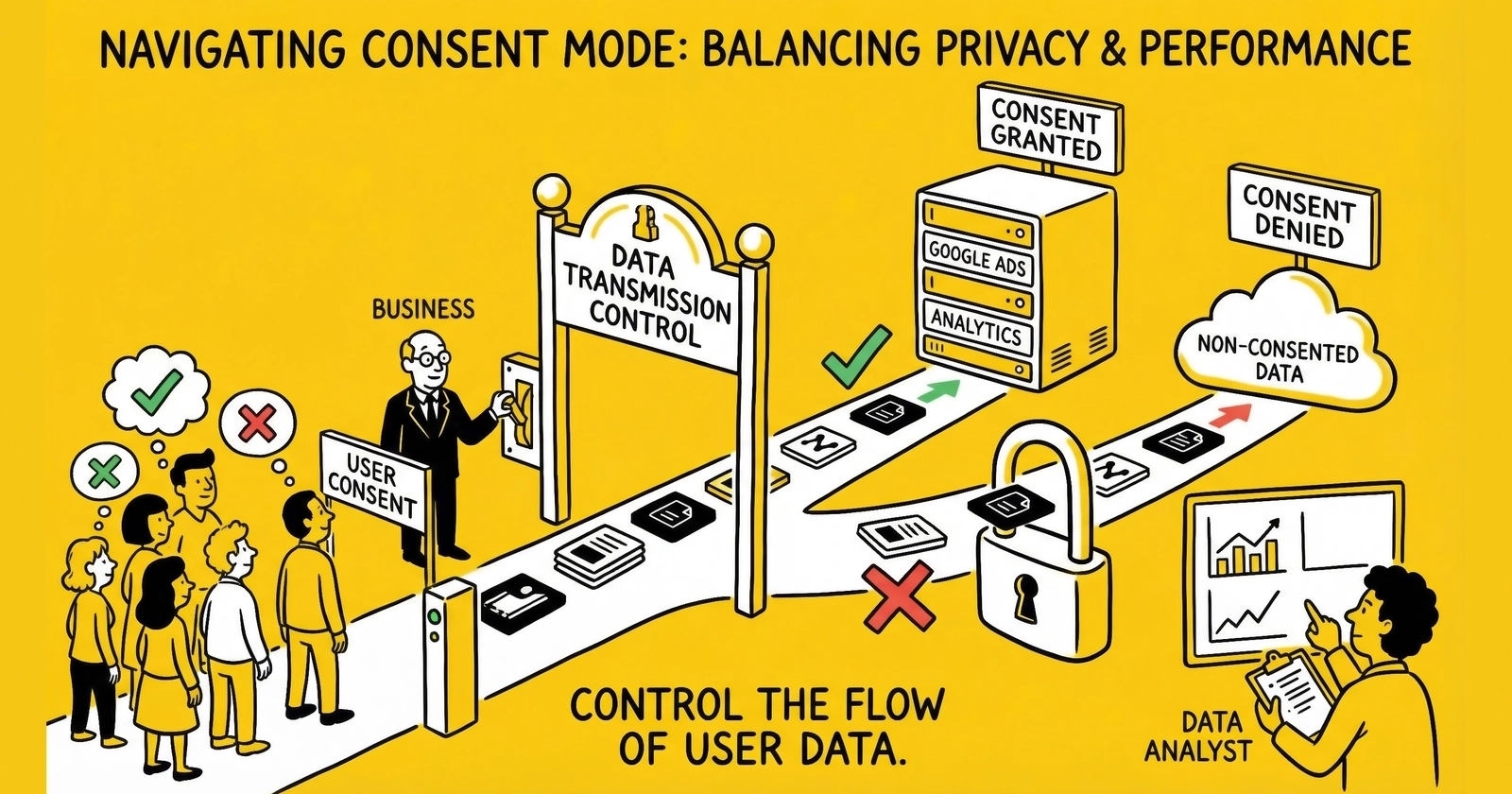
Understanding Google’s new data transmission controls for consent-denied states and how lead generators can maintain measurement while respecting privacy preferences.
Google Ads rolled out Data Transmission Control in January 2026, adding a configuration layer on top of Consent Mode. The feature lets advertisers specify what data is transmitted to Google when a user has denied or limited consent – ranging from full blocking to limited transmission with identifiers redacted.
For lead generators operating in regulated verticals or privacy-conscious markets, this addresses a persistent tension: how to maintain measurement and conversion attribution when significant portions of your traffic operate under consent-denied states.
What Data Transmission Control Does
The Consent Mode Foundation
Google Consent Mode, introduced in 2020, lets websites adjust Google tag behavior based on user consent status. When consent is denied, tags can either:
- Operate normally (ignoring consent status)
- Fire with limited data (no cookies, but basic measurement)
- Not fire at all (full suppression)
Consent Mode v2, required since March 2024 for EEA traffic, distinguishes between ad_storage and ad_personalization consent signals.
The New Layer
Data Transmission Control adds granularity to the “limited data” option. Instead of a binary choice between full operation and full suppression, you can now configure:
| Setting | What Happens | Use Case |
|---|---|---|
| Block all ad data | No ad-related data transmitted until consent granted | Strictest compliance posture |
| Allow limited ad data | Basic conversion signals sent with identifiers redacted | Maintain modeled conversions |
| Standard behavior | Full data transmission based on Consent Mode settings | Markets without strict requirements |
The “limited ad data” option enables Google’s conversion modeling to work even when identifiers are suppressed – giving you directional attribution data without transmitting user-level information.
Why This Matters for Lead Generation
The Measurement Gap Problem
Lead generators live and die by attribution. You need to know which campaigns, keywords, and audiences produce leads that convert to customers. When significant traffic operates under consent-denied states, attribution data develops holes:
- Conversions fire but aren’t attributed to campaigns
- ROAS calculations undercount actual return
- Smart Bidding loses signal quality
- Optimization decisions rely on incomplete data
In markets with high consent denial rates (parts of Europe report 30-50% denial rates on cookie consent prompts), this creates substantial blind spots.
The Compliance Constraint
For lead generators in regulated verticals – insurance, mortgage, solar, legal – consent handling isn’t just about cookies. These verticals require operational approaches documented in lead generation SOPs and operational playbooks. TCPA compliance requires explicit consent for marketing communications. California privacy law gives consumers opt-out rights. GDPR requires lawful basis for processing.
Operating with full data transmission when consent is denied creates compliance risk. Operating with full suppression creates measurement risk. Data Transmission Control offers a middle path.
The Attribution Quality Trade-off
With “limited ad data” enabled, Google receives:
- Conversion events (without user identifiers)
- Contextual signals (page URL, timestamp)
- First-party data you explicitly send (enhanced conversions)
Google does NOT receive:
- Google Click ID (gclid) in identifiable form
- User identifiers for remarketing
- Cross-device matching signals
This enables modeled conversions – Google’s machine learning estimates what portion of unattributed conversions came from which campaigns based on patterns from consented users. Industry reports suggest modeled conversions recover 70-90% of attribution signal in typical implementations.
How to Configure Data Transmission Control
Where to Find It
The setting lives in Google Tag Manager:
- Open Tags → Google Tag
- Select Manage data transmission under Configuration
- Choose your transmission behavior for consent-denied states
For gtag.js implementations, the configuration uses the ads_data_redaction parameter.
Configuration Options
Option 1: Block all ad data until consent
gtag('consent', 'default', {
  'ad_storage': 'denied',
  'ad_user_data': 'denied',
  'ad_personalization': 'denied',
  'analytics_storage': 'denied'
});

gtag('set', 'ads_data_redaction', true);
Use this when: Operating in strict consent regimes where any data transmission without explicit consent creates legal exposure.
Option 2: Allow limited ad data with redaction
gtag('consent', 'default', {
  'ad_storage': 'denied',
  'ad_user_data': 'denied',
  'ad_personalization': 'denied',
  'analytics_storage': 'granted'  // Basic analytics allowed
});

gtag('set', 'ads_data_redaction', true);
gtag('set', 'url_passthrough', true);  // Preserve attribution via URL
Use this when: You need modeled conversions for optimization but must suppress user-level identifiers.
Option 3: Standard Consent Mode behavior
gtag('consent', 'default', {
  'ad_storage': 'denied',
  'ad_user_data': 'denied',
  'ad_personalization': 'denied',
  'analytics_storage': 'granted'
});
// No ads_data_redaction set - standard behavior applies
Use this when: Operating in markets without strict consent requirements where standard Consent Mode provides sufficient privacy controls.
Integration with Consent Management Platforms
If you use a Consent Management Platform (CMP), ensure it updates consent signals when user preferences change:
// When user grants consent via CMP
gtag('consent', 'update', {
  'ad_storage': 'granted',
  'ad_user_data': 'granted',
  'ad_personalization': 'granted'
});
Major CMPs (OneTrust, Cookiebot, Usercentrics) have built-in Consent Mode integrations. Verify your CMP fires the update call when consent status changes.
Lead Generation-Specific Considerations
Form Conversion Tracking
For lead forms, conversion tracking typically fires on thank-you page load or form submission event. Under Data Transmission Control with limited data:
- The conversion event fires
- Attribution uses modeled conversion methodology
- User-level data is redacted before transmission
This maintains your ability to optimize toward form submissions while respecting consent-denied states.
Enhanced Conversions for Leads
Enhanced Conversions let you send hashed first-party data (email, phone) to improve attribution. Under Data Transmission Control:
- If consent is granted: Enhanced conversion data transmits normally
- If consent is denied with limited data: Conversion fires but enhanced data is suppressed
- If consent is denied with full blocking: Nothing transmits
For lead generators, this means enhanced conversions only work for consented traffic. Plan your consent capture to maximize the population where enhanced conversions apply.
Offline Conversion Import
If you import offline conversions (lead → sale attribution), the consent state at click time affects matching:
| Click Consent | Import Ability | Attribution Quality |
|---|---|---|
| Granted | Full match on gclid | High |
| Denied (limited) | Modeled attribution | Medium |
| Denied (blocked) | No attribution | None |
For high-value verticals where offline conversion import drives optimization, consent rates directly impact attribution quality.
Implementation Recommendations
By Vertical
Insurance, Mortgage, Financial Services
These verticals operate under federal and state regulations beyond cookie consent. Recommend:
- Default: Limited ad data with redaction
- First-party data strategy to maintain attribution
- Consent capture on forms aligned with TCPA requirements
Solar, Home Services
High complaint rates on FTC DNC Registry suggest heightened consumer privacy sensitivity. Understanding first-party vs third-party lead dynamics helps structure appropriate consent capture. Recommend:
- Default: Limited ad data with redaction
- Explicit consent flows that can upgrade to full transmission
- Enhanced conversions where consent supports
Legal, Healthcare
Professional conduct rules may impose additional data handling requirements. Recommend:
- Default: Block all ad data until consent
- Legal/compliance review of transmission configuration
- Document consent basis for any data transmission
By Geography
European Economic Area
GDPR requires lawful basis for processing. Cookie consent denial is common.
- Default: Block all ad data until consent OR limited with explicit legal basis
- CMP integration required
- Document lawful basis for any transmission
California
CCPA/CPRA provides opt-out rights. The California Delete Act creates additional obligations for data brokers.
- Default: Limited ad data with redaction
- Honor Global Privacy Control signals
- Align with broader privacy compliance program
General US (non-California)
Less restrictive regime but evolving.
- Default: Limited ad data (conservative) or standard behavior
- Watch state privacy legislation
- Prepare for federal privacy law if enacted
Measuring Impact
Before/After Comparison
When implementing Data Transmission Control, track:
| Metric | Before | After | Delta |
|---|---|---|---|
| Reported conversions | X | Y | Y-X |
| Modeled conversions | 0 | Z | +Z |
| Total attributed | X | Y+Z | Change |
| Attribution rate | A% | B% | B-A% |
Modeled conversions should partially recover the conversions lost to consent denial. The recovery rate depends on your consent acceptance rate and traffic patterns.
Expected Impact
Industry benchmarks suggest:
- High consent markets (80%+ acceptance): Minimal impact, <5% attribution change
- Medium consent markets (50-80% acceptance): 10-20% conversions shift to modeled
- Low consent markets (<50% acceptance): 20-40% conversions modeled, potential signal degradation
If your consent acceptance rate is below 50%, consider UX improvements to consent prompts. Small improvements in acceptance rate can significantly improve attribution quality. For related attribution challenges, see our guide on lead generation attribution models.
Frequently Asked Questions
Does this affect all Google Ads campaigns?
Data Transmission Control affects all campaigns using Google tags for conversion tracking. Search, Display, YouTube, Performance Max – all are subject to the transmission rules you configure.
What about Google Analytics 4?
GA4 has separate consent settings from Google Ads. You can configure different transmission behavior for analytics vs. advertising data. The analytics_storage consent signal controls GA4; ad_storage and ad_user_data control ads data.
Will modeled conversions work for low-volume accounts?
Modeled conversions require sufficient data for machine learning. Google recommends at least 30 conversions per month for reliable modeling. Low-volume accounts may see less accurate modeled attribution.
How does this interact with server-side tagging?
Server-side tagging adds a layer between your site and Google. Consent signals can be managed server-side, and Data Transmission Control configuration applies regardless of client-side or server-side implementation.
Can I have different settings for different campaigns?
Data Transmission Control is configured at the Google Tag level, not per-campaign. All campaigns using the same property share the same transmission configuration. If you need different behavior, you would need separate properties – which creates other measurement challenges.
Key Takeaways
-
Data Transmission Control adds granularity to Consent Mode. Instead of binary on/off, you can allow limited data transmission with identifiers redacted when consent is denied.
-
“Limited ad data” enables modeled conversions. Google’s machine learning estimates campaign attribution from non-identifiable signals, recovering 70-90% of attribution in typical implementations.
-
Configuration lives in Google Tag Manager. Open Google Tag → Manage data transmission. For gtag.js, use the
ads_data_redactionparameter. -
Regulated verticals should default to limited or blocked. Insurance, mortgage, legal, and healthcare lead generators face compliance constraints beyond cookie consent.
-
Consent rates directly impact attribution quality. Low consent acceptance creates measurement gaps that modeled conversions can only partially recover. Optimize consent UX alongside transmission configuration.
-
Align with your broader privacy program. Data Transmission Control is one piece of privacy compliance. Ensure your consent capture, data handling, and suppression practices are consistent across marketing technology stack.
The Bottom Line
Data Transmission Control addresses a real tension in privacy-conscious lead generation: the need for attribution data versus the requirement to respect consent preferences.
The feature is not a magic solution. Modeled conversions are estimates, not observed data. Low consent rates still degrade optimization signal. Full blocking still creates measurement blind spots.
But for operations that previously faced a binary choice – full tracking or zero attribution – this creates a middle path. You can maintain directional measurement while honoring consent states. You can optimize campaigns without transmitting user-level data for non-consented traffic.
The configuration you choose should reflect your compliance posture, your consent acceptance rates, and your tolerance for modeled versus observed attribution. There is no universal right answer – only the answer that fits your operation.
Sources
- Google Consent Mode documentation: https://support.google.com/google-ads/answer/10000067
- Google Enhanced Conversions: https://support.google.com/google-ads/answer/11062876
- PPC News Feed - Data Transmission Control: https://ppcnewsfeed.com/ppc-news/2026-01/data-transmission-control-rolls-out-in-google-ads/