# Google AI Max September 2026 Auto-Flip – What Hits ACA and Campaign-Level Broad Match Despite the February 2027 DSA Extension
> **Canonical:** https://www.leadgen-economy.com/blog/google-ai-max-september-2026-aca-broad-match-flip/
> **Published:** 2026-06-25
> **Author:** Alex Paddington
> **Source:** LeadGen Economy – https://www.leadgen-economy.com
---
*The extension everyone celebrated only covers Dynamic Search Ads. The auto-flip that actually moves lead-gen budget is still landing in September.*
---
## The Two Deadlines the Trade Press Conflated
When Ginny Marvin, Google's Ads Liaison, posted the June 11, 2026 Developer Blog announcement that Dynamic Search Ads migration to AI Max for Search would slip from September 2026 to February 2027, the response across the PPC trade press read like a collective exhale. Search Engine Land's headline framed it as a delay. Search Engine Journal called it an extension. PPC.land documented the campaign-creation restoration scheduled for June 15. Inside agencies, the September AI Max migration meeting got pushed to October.
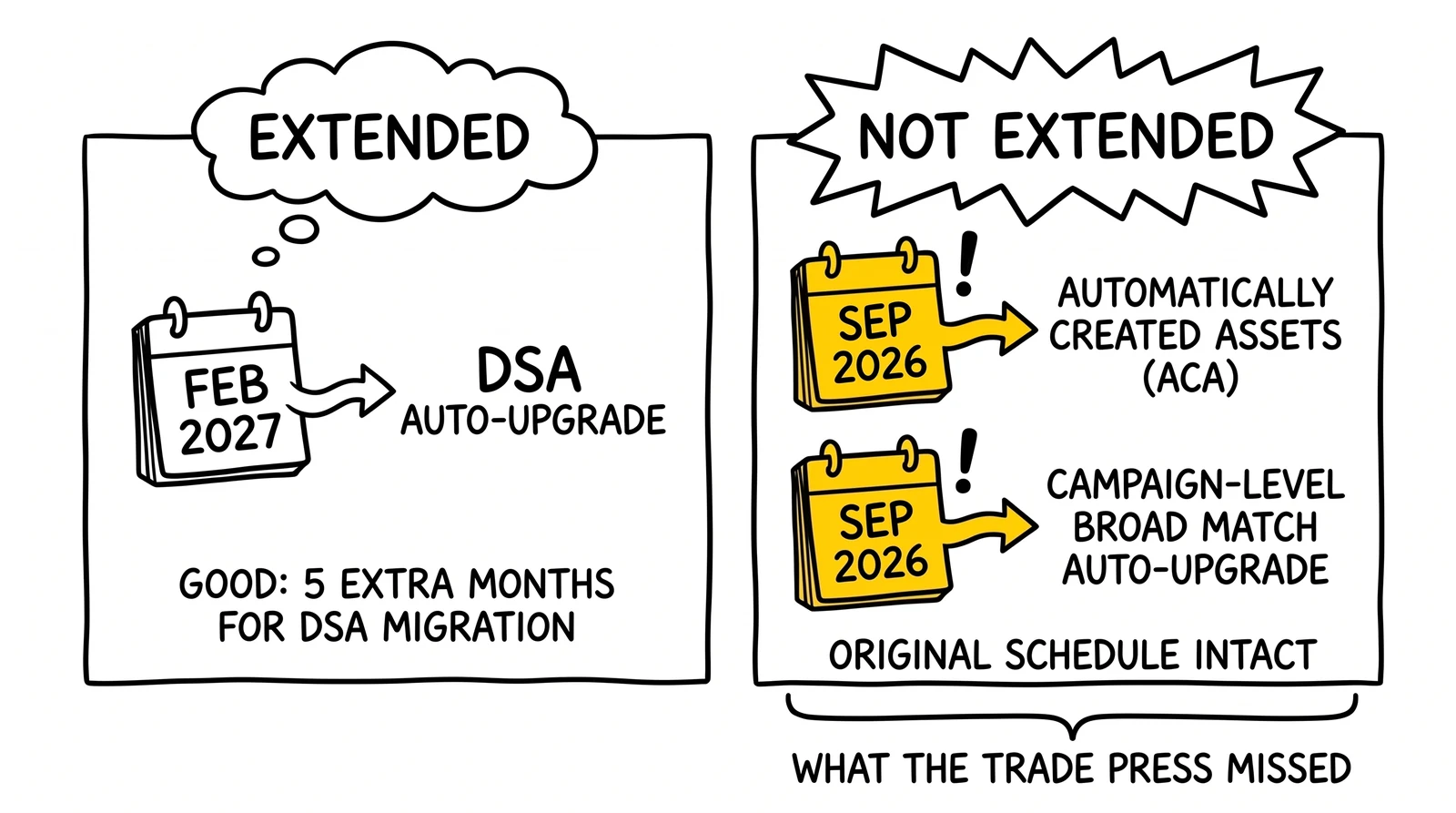
The June 11 extension covered the smaller deadline – September 2026 still flips ACA and campaign-level broad match. Most lead-gen accounts hit it first.
The reading was incomplete. Buried in the same Developer Blog post is a sentence that the trade-press summaries either omitted or relegated to a parenthetical: "Campaigns using Automatically Created Assets (ACA) and campaign-level broad match setting will continue to be auto-upgraded starting in September 2026." The June 11 update did not extend the September flip. It split a single deadline into two operative dates, and the one that arrived later in the calendar – February 2027 – captured the entire trade-press narrative.
For most lead-gen operators, the wrong deadline got the attention. Dynamic Search Ads as a campaign type fell out of fashion in insurance, mortgage, and solar PPC years ago. The dominant configuration in 2026 SMB lead-gen accounts is broad match keywords paired with Smart Bidding – Target CPA or Target ROAS – running against a curated negative-keyword list. Optmyzr's February 2026 study of 30,000 active-spend accounts found broad match has climbed steadily to become the dominant match type by budget share, while exact match has lost nearly 10 percentage points since 2022. The campaign configuration that defines lead-gen PPC in 2026 is exactly the configuration that auto-upgrades on the original schedule.
The September flip is the one to plan against. The February 2027 DSA extension is a footnote for the minority of accounts still running Dynamic Search Ads as a primary campaign type. For everyone else, August is the prep window and September is the forced upgrade.
---
## What Brandon Ervin Announced on April 15
On April 15, 2026, Brandon Ervin, Director of Product Management at Google Ads, announced AI Max for Search had reached general availability after 11 months of open beta. The announcement bundled three concurrent decisions. AI Max moved out of beta with what Google described as improved performance quality across targeting and creative capabilities and more advertiser controls. Dynamic Search Ads, Automatically Created Assets, and the campaign-level broad match setting were placed on a single September 2026 auto-upgrade calendar. Voluntary upgrade tools – the in-product banner that lets advertisers opt in early – began rolling out the week of the announcement.
Ervin framed the shift in terms the trade press immediately picked up: "This evolution is about moving from static tools to a system that truly understands intent. Simply pulling text from a website isn't enough anymore." The line landed because it described the actual mechanic. AI Max consolidates three previously separate features into a single AI-augmented matching layer: search-term matching (broad-match plus keywordless query expansion), text customization (the ACA successor that generates headlines and descriptions from landing-page content and existing creative), and final URL expansion (the routing layer that sends a click to the most relevant page on the advertiser's site regardless of the ad's final URL).
Google's headline benchmark numbers from the April 15 announcement were 14 percent more conversions or conversion value at similar CPA versus matching-only AI Max usage, and 27 percent lift for campaigns with more than 70 percent exact or phrase match conversions in non-retail verticals. Both numbers were sourced from Google Internal Data, Global, Finance, July-December 2024 versus January-June 2025. A subsequent June 11 update revised the headline benchmark for the full feature suite to 7 percent more conversions or conversion value at similar CPA/ROAS – explicitly comparing full-suite AI Max use to search-term matching alone, a narrower baseline than the April 14 percent figure.
Independent measurement told a more cautious story. Smarter Ecommerce analyzed more than 250 Search campaigns running AI Max and reported a median revenue lift of 13 percent paired with a median CPA increase of 16 percent. Only 22 percent of campaigns came close to their original ROAS targets; the remaining 78 percent either significantly over- or under-performed against pre-flip baselines. Roughly 84 percent of advertisers who tested AI Max in the Smarter Ecommerce sample reported neutral or negative results. The 16 percent positive cohort shared common characteristics: Enhanced Conversions enabled, comprehensive negative keyword lists, quality landing pages across the site, adequate monthly conversion volume (100+), and pre-existing success with broad match before enabling AI Max.
The asymmetry between Google's benchmark and Smarter Ecommerce's distribution is the practical lead-gen story. The 14 percent (or 7 percent post-revision) is real as an average. It is also a distribution with significant left-tail risk for accounts that flip without the prerequisite hygiene.
---
## The June 11 Extension – Read the Footnote
Five and a half weeks after Ervin's announcement, Ginny Marvin's June 11 Developer Blog post titled "Dynamic Search Ads (DSA) Automigration Delayed to February 2027 and Campaign Creation Restored" reset half the calendar. The extension cited advertiser feedback requesting more time to prepare for the transition and the desire to avoid disrupting Q4 planning. New DSA campaign creation, which had been phased out, was restored on June 15, 2026. January 2027 became the new cutoff for creating new DSAs, and February 2027 became the forced auto-upgrade date for any remaining active DSA campaigns.
The clarification that did not get headline treatment: ACA and campaign-level broad-match settings still auto-upgrade in September 2026. Marvin's wording on the Developer Blog was unambiguous. The September migration window remains active for those two configuration paths. The Q4 planning concern that justified extending DSAs applies even more sharply to the lead-gen accounts running broad-match Smart Bidding – Q4 is the highest-volume quarter in most verticals, with Medicare AEP, year-end mortgage refi cycles, and Q1 insurance shopping season all loading into the same 90-day stretch. Google chose not to extend the broader cohort.
The reading from inside Google appears to be that ACA and campaign-level broad match are lower-friction conversions than DSA. ACA users already receive AI-generated creative; the September flip extends the AI layer to query matching. Campaign-level broad match users already accept broad-match query expansion; the September flip adds search-term matching and the AI Max architecture wrapper. DSAs, by contrast, are a wholly different campaign type with their own URL targeting, ad generation, and reporting structure – converting them required more configuration work, hence the extension.
The practical effect for operators is that two deadlines now exist and they have different audiences. The February 2027 DSA deadline applies to a shrinking minority of accounts. The September 2026 ACA and broad-match deadline applies to the majority of lead-gen accounts. The trade-press summaries that emphasized the former at the expense of the latter set up a planning trap.
---
## What Actually Changes Inside the Auction
The September flip is not a feature toggle. It is an architecture replacement. Three mechanical changes drive the post-flip performance distribution.
**Search-term matching expands query coverage.** Inside a pre-flip broad-match campaign, the auction layer matched a user's query against the campaign's keyword list using broad-match expansion semantics plus Smart Bidding's intent-modeling. Post-flip, AI Max's search-term matching layer runs above the keyword layer and considers landing-page content, ad creative, and historical conversion patterns to identify queries the keyword list never explicitly contained. Google describes this as keywordless technology. The practical effect is a wider query mix at a similar Target CPA bid. For accounts with a tightly curated keyword list and disciplined negatives, query coverage expands by a meaningful margin. For accounts with sloppy negatives, query coverage explodes.
**Text customization replaces or augments ad creative.** Pre-flip ACA generated headlines and descriptions from landing-page content and existing ads. Post-flip text customization runs the same generative layer through AI Max and ties creative output more directly to the inferred intent of the query. The difference is that the post-flip layer can generate ad copy that does not appear in any input asset – purely AI-synthesized headlines and descriptions that match the predicted intent. For regulated verticals, this is the asset-review surface that the September flip enables by default.
**Final URL expansion is the third feature but stays off at the flip.** Final URL expansion routes a paid click to the most relevant landing page on the advertiser's domain, not necessarily the ad's configured final URL. Google's product copy positions this as engagement-rate optimization. For lead generation, the toggle is the routing decision that determines which landing page a click lands on. The September auto-upgrade does not enable final URL expansion automatically for ACA or campaign-level broad-match upgrades – operators must opt in inside the AI Max environment after the flip. The risk surface opens later, not at the moment of the flip itself.
The Target CPA and Target ROAS bidding strategies survive the flip unchanged at the bid level. Google's June 2026 strategy-label refresh – "Maximize conversions with a Target CPA" became "Target CPA," "Maximize conversion value with a Target ROAS" became "Target ROAS" – did not alter the underlying auction logic. Smart Bidding continues to use real-time auction signals to optimize for conversions or conversion value. What changes is the query inventory the Smart Bidding layer is allocating against, and the creative variants the auction is testing in real time.
The result is a bid-auction surface area expansion. Same bid level. Wider query mix. More creative permutations. The Smarter Ecommerce 250-campaign distribution – median 13 percent revenue lift, median 16 percent CPA increase, only 22 percent landing near pre-flip ROAS – describes the expected shape of post-flip performance under this surface-area change. Accounts with strong pre-flip conversion signals and disciplined negatives capture the upside. Accounts without them pay for AI exploration.
---
## The Lead-Gen Vertical Impact
Three verticals concentrate the September flip exposure most acutely: insurance, mortgage, and solar.
**Insurance lead-gen.** The auto-flip cohort is dense in insurance because auto and home insurance PPC has standardized around broad-match plus Target CPA bidding over the past three years. The vertical is also the most exposed on three secondary axes. Search-term matching expansion can route clicks to query intents the carrier panel does not buy, creating wasted impressions billed at the Smart Bidding target. Text customization can generate headlines that imply coverage terms or premium quotes the carrier has not approved, which triggers NAIC Model Bulletin governance audit-trail requirements. And the conversion-action map matters more in insurance than in any other vertical because ping-post buyer waterfalls grade leads at the call-quality layer rather than the form-fill layer – accounts feeding only form-fill conversions to Smart Bidding miss the qualification signals the AI Max layer needs.
**Mortgage lead-gen.** Mortgage broad-match campaigns face Regulation Z section 1026.24 trigger-term rules. A query expansion that pulls in "30-year fixed rate" or "monthly payment estimate" intent and an AI-generated headline that includes an APR or payment number triggers full disclosure requirements that bind to the specific landing page the click reaches. Post-flip text customization is the exposure vector – the generative layer can produce trigger-term language without the operator pre-approving the headline. Mortgage lead aggregators running broad-match Smart Bidding need to pre-load text guidelines (Google's per-campaign term-exclusion limit is 25 with 40 messaging restrictions) before the September flip and treat the pre-flip text guideline audit as a Reg Z compliance task, not a marketing-ops task. The [Click v. Dahdah aftermath in the mortgage vertical](https://www.leadgen-economy.com/blog/dahdah-rocket-mortgage-click-consent-form-audit/) already raised the cost of unreviewed landing-page routing – the September flip amplifies it.
**Solar lead-gen.** Solar is the vertical where the conversion-action audit matters most. Residential solar lead-gen has been compressed since the December 31, 2025 termination of the 25D credit, with operators relying on TPO lease/PPA framing to maintain volume. Smart Bidding optimization under AI Max requires conversion signals that grade lead quality beyond form fill – call connected, appointment set, contract signed. Solar lead-gen accounts that feed only the form-fill conversion lose the qualification gradient that determines whether a lead actually closes. The September flip widens the query mix; without conversion-action discrimination, the AI Max layer optimizes against the wrong quality signal and CPL inflates while close rates compress.
Across all three verticals, the common thread is that the September flip rewards the pre-flip hygiene that Smarter Ecommerce's 16 percent positive cohort already had: Enhanced Conversions enabled, comprehensive negatives, quality landing pages across the site, 100+ monthly conversions, and prior broad-match success. Operators starting that hygiene work in late August are running it under deadline. Operators starting it in July have the runway to land in the positive cohort.
---
## The Negative-Keyword and Brand-Exclusion Audit
The pre-flip audit decomposes into a three-tier negative keyword strategy plus brand exclusions plus text guidelines. Each layer is independent and each is non-negotiable.
**Account-level negatives.** A baseline of 50 to 100 account-level negatives blocks universally irrelevant terms across every campaign. The canonical exclusions are jobs, careers, free, DIY, adult content, competitor brand names, and vertical-specific resource queries. Lead-gen accounts that skip this layer pay for AI Max's exploration of irrelevant query space – the cost is paid in wasted impressions billed at the Smart Bidding target. Google's brand-safety documentation now treats account-level negatives as foundational hygiene, not optional.
**Campaign-level negatives.** Campaign-level negatives handle intent-specific exclusions. A brand-defense campaign blocks generic product terms. A high-intent Search campaign blocks informational queries. A Shopping campaign blocks service-related queries. Under AI Max, the campaign-level negative list rises in importance because search-term matching can route the campaign into intent territory the operator never explicitly bid on. The pre-flip task is to audit each campaign's current negative list against the campaigns the AI Max layer can pull queries from, then expand the list to cover the new exposure surface.
**Brand exclusions instead of brand keywords as negatives.** Brand exclusions operate at the entity-recognition layer rather than the keyword layer. They automatically catch common misspellings, brand variants, and subsidiary brands that a keyword-only negative misses. Google's positioning is that brand exclusions replace the practice of using negative keywords to block your own brand or competitor brands. For lead-gen accounts running carrier-direct campaigns, the brand-exclusion list is the defense against AI Max competing against the operator's own brand campaign for the same lead.
**Text guidelines.** Text guidelines are the AI Max-specific creative control layer. Per campaign, advertisers can specify up to 25 term exclusions and 40 messaging restrictions that constrain the generative output. Financial services, healthcare, legal, and other regulated advertisers can require disclaimers, prohibit specific claims, enforce certain language standards, or prevent the AI from generating copy that crosses regulatory lines. Google's own positioning is explicit that text guidelines are not a certified compliance tool and that regulated-industry advertisers should verify guideline effectiveness through ongoing asset review. The pre-flip text guideline configuration is the closest the operator has to a generative-output guardrail.
The four-layer setup – account negatives, campaign negatives, brand exclusions, text guidelines – is the minimum-viable AI Max hygiene. Operators running broad-match Smart Bidding into the September flip without this scaffolding are running an A/B test where the B condition is "what does AI Max do with no constraints."
---
## The Conversion-Action Audit
Smart Bidding is signal-driven. The September flip extends the same Smart Bidding strategy to a wider query mix, which means the signal quality differential matters more, not less. Three conversion-action audit tasks define the pre-flip work.
**Inventory the conversion-action map.** Most lead-gen accounts have accumulated conversion actions over the years – form-fill primary, phone call secondary, sometimes microconversions for scroll-depth or time-on-page. The pre-flip task is to map each conversion action to its weight in Smart Bidding optimization. Form-fill weighted at 100 percent and call connected weighted at 50 percent treats a connected call as half the value of a form fill, which is exactly backwards for high-intent lead-gen. The audit task is to reset the weights to reflect actual buyer-side economics – a connected call that books an appointment is typically 5 to 10 times the value of an anonymous form fill.
**Layer Enhanced Conversions.** Enhanced Conversions ties hashed first-party data back to the conversion event, which improves Smart Bidding's match quality and survives third-party cookie deprecation. For accounts feeding lead-quality signals back to Google Ads via offline conversion uploads – buyer-accepted leads, sold leads, retained customers – Enhanced Conversions is the rail. Pre-flip, this is a 3-to-5-day implementation task. Post-flip, it is a 30-to-60-day Smart Bidding re-learning task.
**Feed qualification signals upstream.** The single most impactful lever in lead-gen Smart Bidding is feeding qualification signals upstream as conversions. A lead that calls into the contact center, is qualified by an agent, and is routed to a buyer is a 10x higher-value signal than the same lead's initial form-fill. Operators that send only the form-fill conversion to Google Ads are asking Smart Bidding to optimize for top-of-funnel volume. Operators that send the buyer-accepted lead are asking Smart Bidding to optimize for revenue. The September flip widens the auction surface area; the conversion signal map determines whether the widening compounds revenue or compounds wasted spend.
The conversion-action audit is the work most operators defer because it touches CRM, contact-center, and lead-buyer system integrations that sit outside the PPC team's control. The June 11 extension to February 2027 for DSAs gave the appearance of more time. The September flip gave none for the configurations that matter.
---
## Speed-to-Lead and the Post-Flip Variance Window
Speed-to-lead – the time from form submission to first contact – does not change as a buyer-side SLA. The 60-seconds-or-less industry benchmark still applies. What changes is the upstream signal mix that determines lead arrival rate.
The September flip's wider query expansion produces a larger and more heterogeneous mix of first-touch intents. A pre-flip campaign targeting "auto insurance quote" tightly might have produced 200 to 300 leads/day in a narrow intent band. Post-flip, the same campaign produces 250 to 400 leads/day in a wider intent band – some still quote-stage, some research-stage, some shopping-stage. Lead-handling routing logic that was tuned to a tighter query profile may misroute on intent. A research-stage lead routed into a quote-stage agent script results in a friction-heavy contact that hurts buyer satisfaction.
Operators running ping-post waterfalls should expect more variance in lead quality during the post-flip 30 to 60 days as Smart Bidding re-learns the conversion topology against the new query mix. The Smarter Ecommerce study's median 13 percent revenue lift came at the cost of a 16 percent CPA increase, which translates in lead-gen terms to higher CPL paired with mixed quality. Conversion rates that were stable at 18 to 22 percent in pre-flip campaigns can swing to a 12 to 26 percent band in the 30 to 60 days post-flip before stabilizing.
The operational answer is to instrument lead quality at the routing layer, not just the form-fill layer. Lead arrival rate plus call-connect rate plus buyer-accept rate plus sold rate is the four-stage signal map that needs to feed back to Google Ads as offline conversions during the post-flip re-learning window. Operators that watch only CPL during the variance window draw the wrong conclusions about AI Max performance.
The companion playbook on [Adobe's measurement of AI traffic conversion CPL and EPL recalibration](https://www.leadgen-economy.com/blog/adobe-ai-traffic-conversion-cpl-epl-recalibration/) lays out the broader attribution-decay context that frames the post-flip variance. The September flip is one input into a multi-channel attribution surface that is already volatile.
---
## Final URL Expansion – The Toggle That Links Back to TrustedForm
Final URL expansion does not auto-enable at the September flip. ACA upgrades to AI Max with search-term matching and text customization enabled by default. Campaign-level broad-match upgrades to AI Max with search-term matching enabled by default. Final URL expansion is the third feature and the only one that requires an explicit operator opt-in inside the AI Max environment after the flip.
The toggle matters because it is the routing layer that determines which landing page a click reaches. With final URL expansion off, the click routes to the campaign's configured final URL, the page the operator chose. With final URL expansion on, Google can route the click to the most relevant page on the advertiser's domain – relevance scored by AI Max – regardless of the ad's configured destination.
The TrustedForm and Jornaya tie-in is direct. Both vendors' consent certificates are generated by JavaScript SDKs that fire on the form-host page. When final URL expansion routes a click to a non-canonical landing page where the SDK was never installed, no certificate is generated for that lead. Ping-post buyer waterfalls that price the TrustedForm or Jornaya certificate as the TCPA-defensibility artifact rank certificate-absent leads below certificate-eligible leads. The downstream CPL impact is real and direct.
The operational decision for regulated verticals is to leave final URL expansion off until a URL allowlist exists. Build the allowlist as an explicit list of compliance-reviewed landing pages, each with the TrustedForm or Jornaya SDK installed and certificate-generation tested. Then enable final URL expansion with the allowlist constraint applied. The 7 percent full-feature conversion lift that Google quotes is real, but capturing it without the URL allowlist trades a certificate-defensible lead inventory for a wider but less defensible one.
For pay-per-call operators, the parallel concern is that AI Max's URL routing decisions can land calls on landing pages without the right call-tracking number – a separate failure mode from the certificate question but with the same root cause. The [pay-per-call migration architecture published in May](https://www.leadgen-economy.com/blog/google-call-only-ads-sunset-pay-per-call-migration/) framed this as the call-asset routing problem; the September flip widens the surface.
---
## The August Prep Window – Decision Calendar
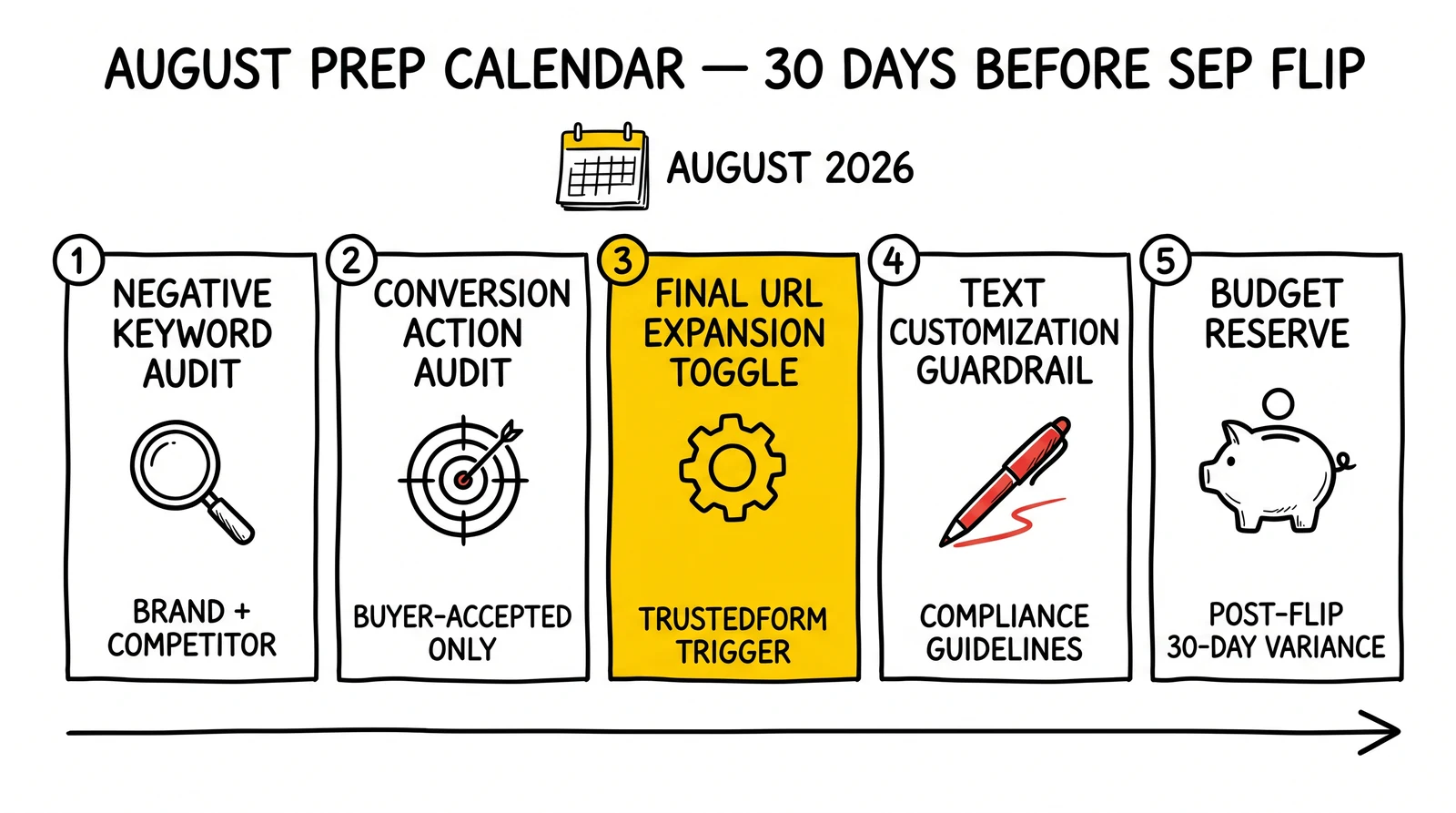
August is the last clean diagnostic month. The prep-window calendar runs as follows.
The final-URL-expansion toggle is the load-bearing setting – it is what connects AI Max page routing to TrustedForm certificate firing, and the only setting the September flip cannot bypass.
**Week of August 3-9.** Inventory the auto-flip cohort. Pull a list of every campaign with the campaign-level broad-match setting enabled and every campaign currently running ACA. Tag each campaign with its current monthly conversion volume, current CPA, current conversion-action map, and current negative keyword list size. The output is a spreadsheet that defines the September exposure surface.
**Week of August 10-16.** Conversion-action audit. Reset conversion-action weights to reflect actual lead-gen economics. Enable Enhanced Conversions if not already on. Implement offline conversion uploads for buyer-accepted, sold-lead, and customer-retained signals. The implementation work here is the bottleneck; CRM and contact-center integrations should already be in flight by week 1.
**Week of August 17-23.** Negative-keyword and brand-exclusion audit. Build account-level negative list to 50-100 items. Expand campaign-level negatives to cover the AI Max search-term matching surface. Configure brand exclusions for the operator's own brand and primary competitor brands. Configure text guidelines per campaign – up to 25 term exclusions and 40 messaging restrictions – with vertical-specific compliance constraints (Reg Z trigger terms for mortgage, NAIC governance language for insurance, FTC and state AG savings-claim language for solar).
**Week of August 24-30.** Voluntary upgrade test. Pick two or three representative campaigns and use the in-product banner to opt in early. Run the upgraded campaigns under live load for 5 to 7 days against the original pre-flip baseline. The voluntary upgrade is the only window to observe AI Max behavior on the operator's actual account before the cohort-wide September flip begins.
**September 1-30.** Cohort flip window. Google has stated all eligible upgrades conclude by end of September. Document a 14-day post-flip review per campaign with hard rollback criteria – CPL ceiling, quality-score floor, conversion-rate floor, buyer-rejection-rate ceiling. The rollback path inside AI Max is to disable individual features (search-term matching, text customization, final URL expansion) rather than revert to the pre-flip configuration, which is not preserved after the auto-upgrade.
**Q4 2026.** Re-baseline. The 30-to-60-day Smart Bidding re-learning window means stable post-flip performance metrics arrive in November at earliest, December more typically. Q4 lead-gen verticals – Medicare AEP through December 7, year-end mortgage refi, Q1 insurance shopping prep – run inside the re-learning window. The operational implication is that Q4 budget should not be allocated against pre-flip CPL benchmarks; build the Q4 plan with a 15-to-20 percent CPL volatility band as a planning assumption.
The full DSA-extension-to-February-2027 calendar is laid out in detail in the [Wave 3 AI Max migration playbook](https://www.leadgen-economy.com/blog/ai-max-dsa-february-2027-extension-lead-gen-migration/) – that piece covers the longer-arc strategic context. This piece focuses on the September flip that arrives first.
---
## Key Takeaways
- The June 11, 2026 extension applies only to Dynamic Search Ads. Automatically Created Assets and the campaign-level broad-match setting still auto-upgrade to AI Max in September 2026. Lead-gen accounts running broad-match Smart Bidding are the dominant cohort exposed to the September flip.
- Optmyzr's 2026 study of 30,000 accounts shows broad match is the dominant match type by budget, with exact match down nearly 10 percentage points since 2022. The configuration that defines lead-gen PPC in 2026 is exactly the configuration that auto-upgrades on the original schedule.
- Google's headline performance benchmarks are 14 percent more conversions at similar CPA versus matching-only AI Max, and 27 percent lift for campaigns with high exact/phrase match conversion share. The June 11 update revised the full-feature suite benchmark to 7 percent. Smarter Ecommerce's independent 250-campaign study found a median 13 percent revenue lift paired with a median 16 percent CPA increase, and only 22 percent of campaigns landed near pre-flip ROAS targets.
- The pre-flip audit decomposes into four layers: account-level negatives (50-100 baseline), campaign-level negatives, brand exclusions, and text guidelines (25 term exclusions, 40 messaging restrictions per campaign). Accounts flipping without this scaffolding pay for AI exploration.
- The conversion-action audit is the work that most accounts defer. Smart Bidding under AI Max's wider query surface is only as good as the conversion signals fed back. Form-fill-only conversion maps underperform; buyer-accepted and sold-lead signal maps capture the upside.
- Final URL expansion stays off at the September flip and requires explicit operator opt-in. The toggle is the routing layer that links AI Max back to TrustedForm and Jornaya certificate generation. Regulated verticals should leave final URL expansion off until a URL allowlist is in place.
- Speed-to-lead remains a buyer-side 60-seconds-or-less SLA. The post-flip 30-to-60-day Smart Bidding re-learning window produces conversion-rate variance – historic 18-22 percent ranges can swing to 12-26 percent before stabilizing.
- August is the last clean diagnostic month. Q4 budget should not be allocated against pre-flip CPL benchmarks; assume a 15-to-20 percent CPL volatility band for planning purposes.
- The trade-press summaries of the June 11 extension created a planning trap by emphasizing the February 2027 DSA deadline at the expense of the September 2026 ACA and broad-match deadline. Operators planning against the wrong deadline lose the August prep window.
---
## Sources
- [Google Ads Developer Blog – Dynamic Search Ads (DSA) Automigration Delayed to February 2027 (June 11, 2026)](https://ads-developers.googleblog.com/2026/06/dynamic-search-ads-dsa-automigration.html)
- [Google Ads Blog – Dynamic Search Ads are Upgrading to AI Max (April 15, 2026)](https://blog.google/products/ads-commerce/dsa-upgrade-to-ai-max-2026/)
- [Google Ads Blog – Steer Performance with New AI Max Features (April 30, 2026)](https://blog.google/products/ads-commerce/ai-max-new-features/)
- [Google Ads Help – How AI Max for Search Campaigns Works](https://support.google.com/google-ads/answer/15910187)
- [Google Ads Help – About Final URL Expansion in Search](https://support.google.com/google-ads/answer/16230205)
- [Google Ads Help – About Negative Keywords](https://support.google.com/google-ads/answer/16668865)
- [Search Engine Land – Google delays Dynamic Search Ads migration to AI Max (June 2026)](https://searchengineland.com/google-delays-dynamic-search-ads-migration-to-ai-max-480049)
- [Search Engine Journal – Google Extends Dynamic Search Ads Migration Deadline](https://www.searchenginejournal.com/google-extends-dynamic-search-ads-migration-deadline/579074/)
- [Search Engine Land – Ginny Marvin clarifies AI Max, AI Search ads and what advertisers should prioritize after GML](https://searchengineland.com/ginny-marvin-clarifies-ai-max-ai-search-ads-and-what-advertisers-should-prioritize-after-gml-479838)
- [PPC.land – Google delays DSA-to-AI Max automigration to February 2027](https://ppc.land/google-delays-dsa-to-ai-max-automigration-to-february-2027/)
- [Optmyzr – Author: Frederick Vallaeys (2026 Match Type Study)](https://www.optmyzr.com/author/frederick-vallaeys/)
- [Search Engine Land – What SMEC's Data Reveals About AI Max Performance](https://www.searchenginejournal.com/what-smecs-data-reveals-about-ai-max-performance/568866/)